|
(11) | EP 0 471 755 B1 |

| (12) | EUROPEAN PATENT SPECIFICATION |
|
|
| (54) |
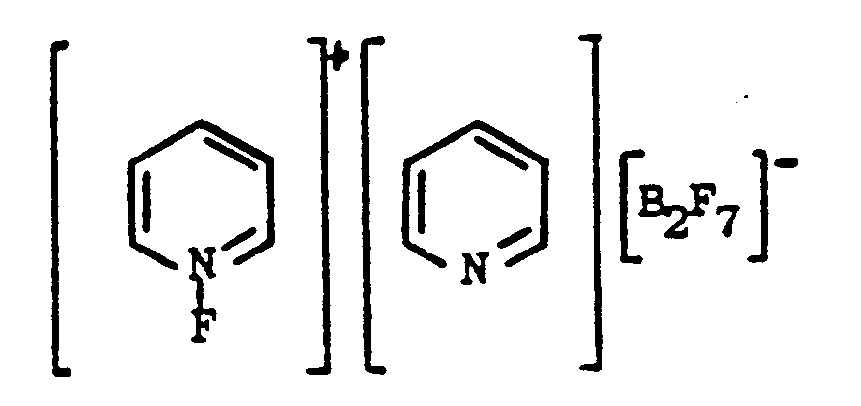
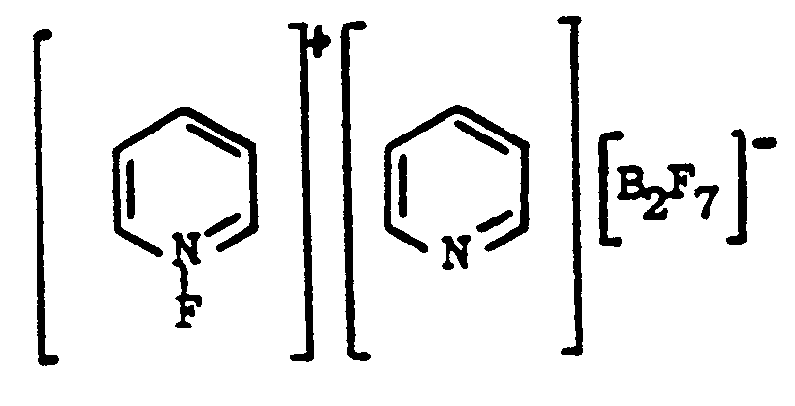
N-FLUOROPYRIDINIUM PYRIDINE HEPTAFLUORODIBORATE N-FLUOROPYRIDINIUM-PYRIDIN-HEPTAFLUORODIBORAT HEPTAFLUORODIBORATE DE N-FLUOROPYRIDINIUM PYRIDINE |
|
|
|||||||||||||||||||||||||||||||
| Note: Within nine months from the publication of the mention of the grant of the European patent, any person may give notice to the European Patent Office of opposition to the European patent granted. Notice of opposition shall be filed in a written reasoned statement. It shall not be deemed to have been filed until the opposition fee has been paid. (Art. 99(1) European Patent Convention). |
BACKGROUND OF THE INVENTION
[0001] This application is a continuation-in-part application of Serial No. 351,115 filed May 12. 1989.
[0003] Many fluorinating reagents are known in the art. One type of fluorinating reagent is known as electrophilic fluorinating reagents. This type of fluorinating reagent is characterized by a structure containing an O-F or N-F bond. Electrophilic fluorinating reagents having an N-F bond include 1-fluoro-2-pyridone as taught by S. T. Purrington et al.. "1-Fluoro-2-pyridone: A Useful Fluorinating Reagent", J. Org. Chem. 48, 761 (1983); N-fluoro-N-alkylsulfonamides as taught by W. E. Barnette. "N-Fluoro-N-alkylsulfonamides: Useful Reagents for the Fluorination of Carbanions", J. Am. Chem. Soc. 106, 452 (1984); N-fluoroquinuclidinium fluoride as taught by R. E. Banks et al., "Electrophilic Fluorination with N-fluoroquinuclidinium Fluoride", J. of Fluorine Chem. 32, 461 (1986); and N-fluoropyridinium salts as taught by T. Umemoto et al., "N-fluoropyridinium Triflate and its Analogs, The First Stable 1:1 Salts of Pyridine Nucleus and Halogen Atom", Tetrahedron Letters 27(28), 3271 (1986).
[0004] N-fluoropyridinium salts have been shown to be stable fluorinating reagents with the ability to fluorinate a variety of organic compounds. For example, T. Umemoto et al., "N-fluoropyridinium Triflate and Its Derivatives: Useful Fluorinating Agents", Tetrahedron Letters 27(37), 4465 (1986) report that these salts are useful in the fluorination of aromatic compounds and the conversion of enol silyl ethers to alpha-fluoroketones. T. Umemoto et al., "Base-Initiated Reactions of N-fluoropyridinium Salts; A Novel Cyclic Carbene Proposed as a Reactive Species", Tetrahedron Letters 28(24), 2705 (1987) report that N-fluoropyridinium salts can also be converted into useful pyridine derivatives such as 2-chloropyridine.
[0005] However. N-fluoropyridinium salts are disadvantageous because the current method for their preparation is hazardous. As taught by the aforementioned first Umemoto et al. article, fluorine is first reacted with pyridine or a substituted pyridine at low temperature to give a pyridine difluoride. In a second step, the pyridine difluoride is converted into an N-fluoropyridinium salt. N-fluoropyridinium tetrafluoroborate and its method of preparation are shown below:
See also European Patent Application Publication 204,535. As those skilled in the art know, pyridine difluorides are inherently unstable and have been known to decompose violently even at temperatures below 0°C. If the foregoing preparation method were used on a large scale, the formation of pyridine difluoride, even if temporary, would be extremely hazardous.
[0006] In response to the foregoing hazard, we attempted to prepare N-fluoropyridinium tetrafluoroborate without the formation of isolatable quantities of pyridine difluoride by reacting fluorine with pyridine-boron trifluoride complex. The resulting product was totally unexpected.
SUMMARY OF THE INVENTION
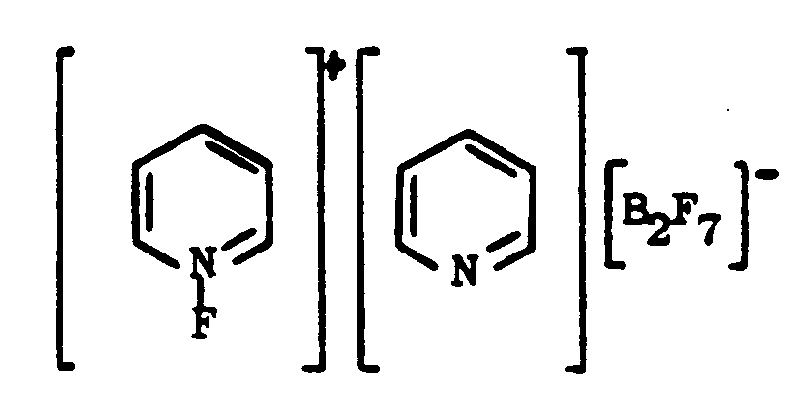
[0007] The resulting product is a novel compound represented as
This novel compound will be referred to as N-fluoropyridinium pyridine heptafluorodiborate. In contrast to the N-fluoropyridinium tetrafluoroborate taught by the aforementioned first Umemoto et al. article, the present compound has an additional pyridine ring therein and a heptafluorodiborate group rather than a tetrafluoroborate group. Also, Umemoto et al. report that N-fluoropyridinium tetrafluoroborate has a melting point of 90-91°C while the present novel compound has a melting point of 196-197°C.
[0008] The present compound is useful as a fluorinating agent and is less expensive than the currently used fluorinating agent, N-fluoropyridinium triflate. Other advantages of the present compound are that the preparation hazards associated with pyridine difluoride intermediates are eliminated and the present compound can be prepared at more convenient temperatures.
[0009] It should be noted that during our attempt to prepare N-fluoropyridinium tetrafluoroborate based salts without the formation of isolatable quantities of pyridine difluoride, we reacted fluorine with 3,5-dichloropyridine-boron trifluoride complex. As expected based on the teachings of the aforementioned Umemoto et al. article, 3,5-dichloro-N-fluoropyridinium tetrafluoroborate formed as shown in Example 45 of the aforementioned European Patent Application: a chlorinated version of the present compound did not form. This further demonstrates the unexpectedness of the present N-fluoropyridinium pyridine heptafluorodiborate.
[0010] Other advantages of the present invention will become apparent from the following description and appended claims.
DETAILED DESCRIPTION OF THE PREFERRED EMBODIMENTS
[0011] The present N-fluoropyridinium pyridine heptafluorodiborate is prepared by reacting fluorine with pyridine-boron trifluoride dissolved in a solvent at a temperature of about -40 to about +35°C. Commercially available pyridine-boron trifluoride may be used to prepare the present compound or pyridine-boron trifluoride complex may be prepared by simply passing BF₃ over pyridine.
[0012] A solvent which will dissolve appreciable amounts of pyridine-boron trifluoride, is inert to fluorine, and is unreactive towards the product is useful herein. An example of a useful solvent is acetonitrile. Preferably, the solvent is commercially available acetonitrile.
[0013] Preferably, the dissolved pyridine-boron trifluoride is at a temperature of about -25 to about +25°C, and more preferably, about -5 to about +25°C.
[0014] Commercially available fluorine is then bubbled into the solution. For safety reasons, it is advantageous to dilute the fluorine with commercially available nitrogen. Based on the amount of nitrogen used, the amount of fluorine used may be about 5 to 35 percent by weight and more specifically, about 10 to 20 percent by weight. Typically, about 1 mole equivalent of fluorine is added to the pyridine-boron trifluoride in acetonitrile. Adding more than 1 mole equivalent of fluorine wastes the fluorine while adding less then 1 mole equivalent of fluorine wastes the pyridine-boron trifluoride.
[0015] As reported in present Example 1, seven grams of pyridine-boron trifluoride were dissolved in 50ml acetonitrile and reacted with fluorine to give a product yield of 66%. We then found that upon scale-up, the use of larger quantities of pyridine-boron trifluoride resulted in poorer yields.
[0016] We then accidently found that product yields are unexpectedly improved by running the present reaction in the presence of water. Because commercially available solvent may have water therein, the solvent may serve as a source of water. For example, one sample of commercially available acetonitrile contained 0.22% water by weight or about 170 microliters of water in 100 cc of acetonitrile. Another sample of commercially available acetonitrile contained 0.005% by weight or about 4 microliters of water in 100 cc of acetonitrile. If the solvent contains insufficient water or does not contain any water, water will then have to be added in order to arrive at the total amount of water required as described below.
[0017] As such, preferably the fluorine is reacted with the pyridine-boron trifluoride dissolved in solvent in the presence of water. Preferably the total amount of water present is about 2 to about 12 microliters per gram of starting pyridine-boron trifluoride. The use of greater than about 20 microliters of water per gram of starting pyridine-boron trifluoride causes the precipitation of pyridine BF₄ salt which does not lead to the desired product and also contaminates the desired product. More preferably, the total amount of water present is about 3 to about 8 microliters per gram of starting pyridine-boron trifluoride, and most preferably, about 4 to about 6 microliters per gram.
[0018] The water may be added to the reaction mixture in several different ways. For example, the water may be added to the pyridine-boron trifluoride dissolved in solvent prior to reaction with the fluorine; this method of water addition is undesirable because precipitation of the pyridine BF₄ salt may occur. As another example, a stream of nitrogen or air may be bubbled through water and then the wet gas may be passed into the reactor to continuously supply a steady but very low supply of water; the flow rate of the wet gas is adjusted to supply the required amount of water based on the starting pyridine-boron trifluoride in the reactor and the reaction rate as dictated by the fluorine mass flow rate. In another method which is preferred, the water is incrementally added to the reaction mixture and the rate of the incremental water addition is determined by the fluorine mass flow rate; such incremental additions may be done continuously or intermittently. Most preferably, the amount of each incremental addition is about 0.3 to about 2.0 microliters of water per gram of starting pyridine-boron trifluoride.
[0019] We have also found that the N-fluoropyridinium pyridine heptafluorodiborate product is less soluble than pyridine-boron trifluoride in acetonitrile. If the ratio of pyridine-boron trifluoride to acetonitrile is too great, the product comes out of solution and interferes with the fluorine flow and thus the reaction. Preferably, the ratio of grams of pyridine-boron trifluoride to cc of acetonitrile does not exceed 0.8.
[0020] The fluorine uptake may be conveniently monitored by passing the gas effluent from the reactor through a bubbler containing a solution of potassium iodide in water. If the fluorine uptake ceases, the fluorine passes through the reactor and immediately reacts with the potassium iodide in the bubbler liberating iodine which turns the almost colorless solution a dark brown.
[0021] The N-fluoropyridinium pyridine heptafluorodiborate is useful as a fluorinating agent. This compound is useful in fluorinating organic compounds including aliphatic compounds such as 1-octyl magnesium bromide and enolate derivatives such as 3-pentanone enol acetate; alicyclic compounds such as 1-morpholino-1-cyclohexene, 1-morpholino-1-cyclopentene, 2-carboethoxy cyclopentanone and cyclohexanone trimethyl silyl enol ether; and aromatic compounds such as benzene and anisole. Fluorinated aliphatic compounds are useful in many applications including pharmaceuticals while fluorinated aromatic compounds are useful in many applications including chemical intermediates for pharmaceutical and agricultural compounds.
[0022] As such, the present invention provides a method of fluorinating organic compounds by using N-fluoropyridinium pyridine heptafluorodiborate as a fluorinating agent. The method of fluorinating an organic compound involves reacting the N-fluoropyridinium pyridine heptafluorodiborate with the organic compound in a solvent. Preferably, the solvent is methylene chloride or acetonitrile.
EXAMPLE 1
[0025] Pyridine-boron trifluoride complex (7 g, 0.0477 mol) was dissolved in 50 mL acetonitrile at ice bath temperature. Fluorine (8 cc/min) diluted with nitrogen (68 cc/min) was bubbled in for 3 hours (0.054 mol fluorine). After the addition was complete, the solution was triturated with carbon tetrachloride and cooled to give 5.2 g of a peach-colored solid. Recrystallization from acetone gave tan crystals, mp 196-7°C. Anal. Calcd. for C₁₀H₁₀B₂F₈N₂: C, 36.20, H, 3.04; N, 8.44; Found: C, 36.75; H, 3.39; N, 8.06. Molecular weight by iodometric titration, Calcd.: 331.6; Found: 323. ¹⁹F NMR: 48.2 ppm downfield from CFCl₃ (1 F) and 150.1 ppm upfield from CFCl₃ (7 F); ¹H NMR (CH₃CN): 9.24 (dd, 2H), 8.5-8.8 (m, 4H), 7.9-8.4 (m, 4H) ppm; ¹¹B NMR: -.12 ppm relative to NH₄BF₄; ¹³C NMR: 148.8, 148.0, 142.7, 137.3, 131.3 and 128.8 ppm.
[0026] Examples 2-9 are directed to the fluorination of various organic compounds by using N-fluoropyridinium pyridine heptafluorodiborate as a fluorinating agent.
EXAMPLE 2
[0027] The reagent (0.25 g) from Example 1 and 2 mL benzene were refluxed in 15 mL methylene chloride overnight. The presence of fluorobenzene was indicated by GC-MS.
EXAMPLE 3
[0028] Anisole (0.1 g) and 0.25 g of the reagent from Example 1 were refluxed in CH₂Cl₂. After 7 hours, 20% of the anisole was converted to a 1:1 mixture of 2-fluoro-and 4-fluoroanisole. After 24 hours reflux, the conversion was 70%.
EXAMPLE 4
[0029] The fluorinating reagent prepared according to Example 1 (9.95 g, 30 mmol) dissolved in 40 mL dry acetonitrile is added slowly to a solution of 1-morpholino-1-cyclohexene (3.35 g, 20 mmol) in 15 mL acetonitrile at a rate to maintain a temperature of less than 35°C. The mixture is then stirred at room temperature for an additional six hours. Aqueous 2 N HCl (25 mL) is added and the mixture refluxed for one hour. The cooled mixture is diluted with 50 mL water and extracted three times with 35 mL methylene chloride. The combined organic layers are dried (MgSO₄) and solvent removed to leave a residue containing 3-fluorocyclohexanone which is purified chromatographically.
EXAMPLES 5-9
[0030] The following organic compounds and 0.25 g of the reagent from Example 1 are refluxed in methylene chloride to prepare fluorinated organic compounds.
Examples 2-9 show that the reagent fluorinates aromatic and aliphatic compounds.
EXAMPLE 10
[0031] This Example provides additional chemical evidence for the existence of an N-fluoropyridium cation in the present compound.
[0032] The fluorinating reagent (0.5 g) from Example 1 was refluxed for 1 hour in 5 mL acetonitrile containing 1 g KF. From the reaction mixture, pyridine, 2-fluoropyridine, and 2-acetamidopyridine were identified by GC-MS. The latter two products are consistent with the behavior of N-fluoropyridinium salts as reported by Umemoto et al. "Preparation of 2-Fluoropyridines via Base - Induced Decomposition of N-Fluoropyridinium Salts", J. Or g. Chem. 54, 1726 (1989).
COMPARATIVE
[0033] This Comparative illustrates the advantage of adding water during the reaction of the fluorine and the pyridine-boron trifluoride in scale-up in improving product yield.
[0034] To a reactor, 80.0g of pyridine-boron trifluoride and 320ml of acetonitrile were charged and purged with N₂. The reactor was placed in an ice-bath and a mixture of 10% F₂ in N₂(V/V) was bubbled into the stirred solution at a rate of 200cc/min. After nearly three hours of addition, the exhaust gases from the reaction turned the potassium iodide trap to a dark color which indicated that the reaction was not absorbing F₂. The reactor contents were cooled and carbon tetrachloride was added; this addition precipitated white crystals(CROP 1). These crystals were collected and vacuum dried at 25°C for several hours(melting point: 192-194°C). ¹H and ¹⁹F-N MR showed the presence of product. To the filtrate from CROP 1 above, more carbon tetrachloride was added which precipitated a second crop(CROP 2) of crystals. These crystals were collected and dried as above to give a solid with a melting point: 194-197°C and again ¹H and ¹⁹F-NMR showed presence of product. The total yield of CROP 1 and CROP 2 was 24.9%.
EXAMPLE 11
[0035] To a reactor, 80.0g pyridine-boron trifluoride complex amd 300 ml of acetonitrile were charged and purged with N₂. The reactor was placed in an ice-bath and a mixture of 10%F₂ in N₂(V/V) was bubbled through the stirred solution at a rate of 200cc/min. After 2.5 hours, the exhaust gases from the reaction turned potassium iodide solution dark which indicated that F₂ was no longer being absorbed. 100 microliters of water were then added and fluorination was resumed with a fresh potassium iodide trap in place. The reaction absorbed F₂ for 1.5 hours at which point, the trap darkened. 50 microliters of water were added to the reaction and fluorination was resumed. In 0.5 hour, F₂ was no longer being absorbed. Two more additions of 50 microliters of water each were made, each time with subsequent F₂ addition and absorption. The reaction liquor was cooled and R-113 added to precipitate near white crystals which were vacuum dried at 25°C for several hours. For CROP 1. the yield was 47.3g or 52.4% with a melting point of 192-194°C. The filtrate was rotovapped to give a second crop of crystals which were filtered and vacuum dried. The yield was 27.0g with a melting point of 150-180°C. ¹H and ¹⁹F-NMR verified the product in both CROPS. CROP 2 showed some impurities.
1. A compound represented as
2. A process for the preparation of a compound represented as
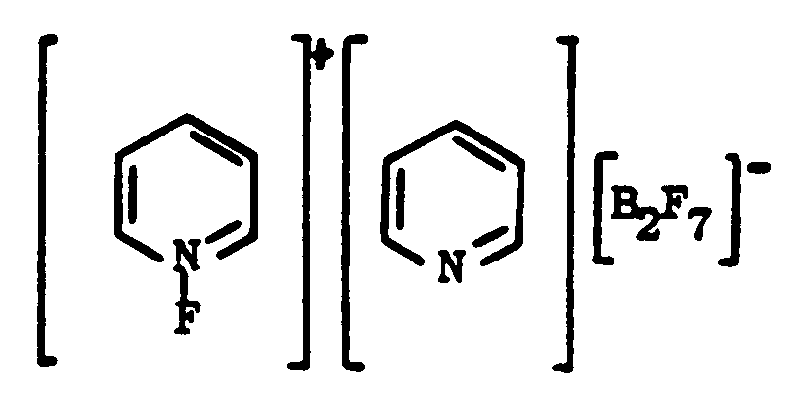
comprising the step of:
reacting fluorine with pyridine-boron trifluoride dissolved in a solvent at a temperature of -40 to +35°C.
comprising the step of:
reacting fluorine with pyridine-boron trifluoride dissolved in a solvent at a temperature of -40 to +35°C.
3. The process of claim 2 wherein said pyridine-boron trifluoride is dissolved in acetonitrile
prior to said reaction with fluorine.
4. The process of claim 2 wherein said reaction is conducted in the presence of water.
5. The process of claim 4 wherein the total amount of said water present is 2 to 12 microliters
per gram of said starting pyridine-boron trifluoride.
6. The process of claim 5 wherein the total amount of said water present is 3 to 8 microliters
per gram of said starting pyridine-boron trifluoride.
7. The process of claim 6 wherein the total amount of said water present is 4 to 6 microliters
per gram of said starting pyridine-boron trifluoride.
8. The process of claim 4 wherein said water is added incrementally to said reaction
mixture.
9. The process of claim 8 wherein the amount of each water addition is 0.3 to 2.0 microliters
of water per gram of said starting pyridine-boron trifluoride.
1. Eine durch
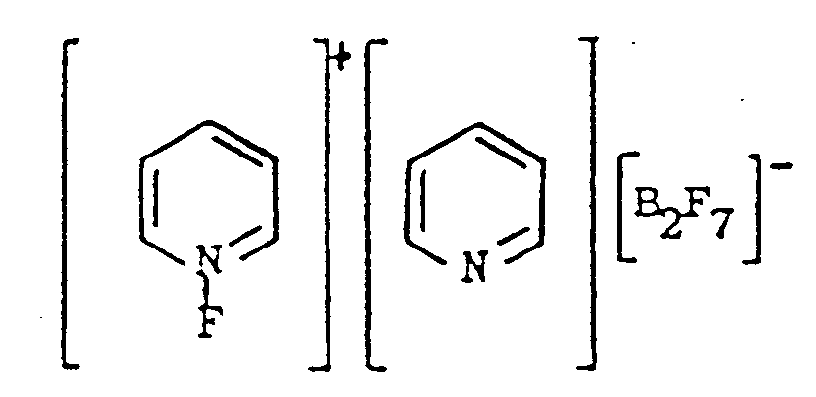
dargestellte Verbindung.
dargestellte Verbindung.
2. Verfahren zur Herstellung einer durch
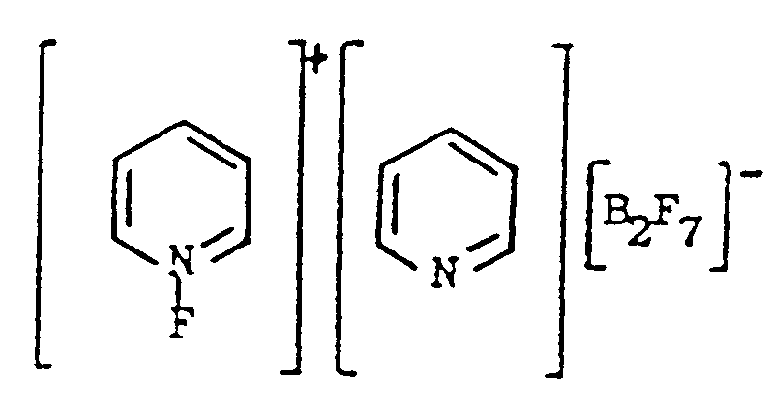
dargestellten Verbindung
mit dem Verfahrensschritt des
Umsetzens von Fluor mit in einem Lösungsmittel gelösten Pyridin-Bor-Trifluorid bei einer Temperatur von -40 bis +35°C.
dargestellten Verbindung
mit dem Verfahrensschritt des
Umsetzens von Fluor mit in einem Lösungsmittel gelösten Pyridin-Bor-Trifluorid bei einer Temperatur von -40 bis +35°C.
3. Verfahren nach Anspruch 2, bei dem das Pyridin-Bor-Trifluorid vor der Reaktion mit
Fluor in Acetonitril aufgelöst wird.
4. Verfahren nach Anspruch 2, bei dem die Reaktion in Gegenwart von Wasser durchgeführt
wird.
5. Verfahren nach Anspruch 4, bei dem die Gesamtmenge an vorhandenem Wasser 2 bis 12
Mikroliter pro Gramm des Ausgangs-Pyridin-Bor-Trifluorid beträgt.
6. Verfahren nach Anspruch 5, bei dem die Gesamtmenge an vorhandenem Wasser 3 bis 8 Mikroliter
pro Gramm des Ausgangs-Pyridin-Bor-Trifluorids beträgt.
7. Verfahren nach Anspruch 6, bei dem die Gesamtmenge an vorhandenem Wasser 4 bis 6 Mikroliter
pro Gramm des Ausgangs-Pyridin-Bor-Trifluorids beträgt.
8. Verfahren nach Anspruch 4, bei dem das Wasser schrittweise dem Reaktionsgemisch zugefügt
wird.
9. Verfahren nach Anspruch 8, bei dem die Menge jeder Wasserzugabe 0,3 bis 2,0 Mikroliter
Wasser pro Gramm des Ausgangs-Pyridin-Bor-Trifluorids beträgt.
1. Composé représenté par
2. Procédé pour la préparation d'un composé représenté par :
comprenant l'étape consistant à :
faire réagir du fluor avec du trifluorure de bore-pyridine dissous dans un solvant à une température de -40 à +35°C.
comprenant l'étape consistant à :
faire réagir du fluor avec du trifluorure de bore-pyridine dissous dans un solvant à une température de -40 à +35°C.
3. Procédé selon la revendication 2, dans lequel ledit trifluorure de bore-pyridine est
dissous dans l'acétonitrile avant ladite réaction avec du fluor.
4. Procédé selon la revendication 2, dans lequel ladite réaction est effectuée en présence
d'eau.
5. Procédé selon la revendication 4, dans lequel la quantité totale de ladite eau présente
est 2 à 12 microlitres par gramme dudit trifluorure de bore-pyridine de départ.
6. Procédé selon la revendication 5, dans lequel la quantité totale de ladite eau présente
est 3 à 8 microlitres par gramme dudit trifluorure de bore-pyridine de départ.
7. Procédé selon la revendication 6, dans lequel ladite quantité totale de ladite eau
présente est 4 à 6 microlitres par gramme dudit trifluorure de bore-pyridine de départ.
8. Procédé selon la revendication 4, dans lequel ladite eau est ajoutée par incréments
audit mélange réactionnel.
9. Procédé selon la revendication 8, dans lequel la quantité de chaque addition d'eau
est 0,3 à 2,0 microlitres d'eau par gramme dudit trifluorure de borepyridine de départ.