|
(11) | EP 0 479 541 B1 |

| (12) | EUROPEAN PATENT SPECIFICATION |
|
|
| (54) |
Iridium-optically active phosphine complex and catalytic production of optically active alcohols therewith Optisch aktiver Iridiumphosphinkomplex und dessen Verwendung zur katalytischen Herstellung von optisch aktiven Alkoholen Complex iridium-phosphine optiquement actif et son utilisation dans la production catalytique d'alcools optiquement actifs |
|
|
|||||||||||||||||||||||||||||||
| Note: Within nine months from the publication of the mention of the grant of the European patent, any person may give notice to the European Patent Office of opposition to the European patent granted. Notice of opposition shall be filed in a written reasoned statement. It shall not be deemed to have been filed until the opposition fee has been paid. (Art. 99(1) European Patent Convention). |
[0001] The present invention relates to a novel iridium-phosphine complex useful as a catalyst for various organic syntheses, particularly enantioselective hydrogenation reactions, and to a process for producing optically active alcohols using the complex.
[0002] A number of organic synthesis reactions using a transition metal complex as a catalyst have hitherto been developed and made use of for various purposes. In particular, many reports have been made on enantioselective catalysts useful for enantioselective synthesis reactions, such as enantioselective hydrogenation and enantioselective isomerization. Among them, metal complexes in which an optically active tertiary phosphine compound is coordinated to metallic rhodium or ruthenium are well known as catalysts for enantioselective hydrogenation.
[0003] For example, a rhodium-phosphine complex using 2,2′-bis(diphenylphosphino)-1,1′-binaphthyl (hereinafter abbreviated as BINAP) as a ligand is disclosed in JP-A-55-61937 (the term "JP-A" as used herein means an "unexamined published Japanese patent application").
[0004] Known ruthenium complexes include those having BINAP or a derivative thereof as a ligand, such as Ru₂Cl₄(BINAP)₂ (NEt₃) (wherein Et represents an ethyl group) as disclosed in Ikariya, et al., J. Chem. Soc., Chem. Commun., p. 922 (1985), Ru(O₂CR)₂-(BINAP) (wherein R represents a lower alkyl group, a lower alkyl-substituted phenyl group, etc.) as disclosed in JP-A-62-265293, and [RuHℓ(R-BINAP)m]Xn (wherein R represents a hydrogen atom or a methyl group; X represents CℓO₄, BF₄, or PF₆; when ℓ is 0, m represents 1, and n represents 2; and when ℓ is 1, m represents 2, and n represents 1) as disclosed in JP-A-63-41487.
[0005] For further information on enantioselective synthesis reactions using transition metal catalysts, Sheri. L. Blystone, Chemical Reviews, pp. 1663-1679 (1989) can be referred to.
[0006] However, few cases are known in which an iridium-optically active phosphine complex is actually used as a catalyst for enantioselective syntheses, except conversion of an imine to an optically active amine as reported, e.g., in JP-A-63-57558 and JP-A-64-47723.
[0007] Rhodium- or ruthenium-optically active phosphine complexes are known to exhibit high catalytic activity on a relatively wide range of substrates to give a high enantioselectivity (i.e., optical purity of a product) in enantioselective syntheses, especially enantioselective hydrogenation. However, both the catalytic activity and enantioselectivity achieved by these complexes are sometimes unsatisfactory depending on the reaction substrate. Accordingly, there has been a need for a novel catalyst for enantioselective syntheses.
[0008] In order to meet the above-described need, the inventors have conducted extensive studies and, as a result, have found a novel iridium-optically active phosphine complex which exhibits excellent catalytic activity and gives high enantioselective yields in enantioselective syntheses, particularly enantioselective hydrogenation.
[0009] The present invention relates to an iridium-optically active phosphine complex represented by formula (I):
[H₂Ir(L¹)(L²)]Y (I)
wherein L¹ represents an optically active phosphine compound represented by formula (II):
wherein Ar represents a phenyl group or a p- and/or m-C₁₋₄ alkyl-substituted phenyl group, or formula (III):
L² represents a tertiary phosphine compound represented by formula (IV):
wherein Z represents a C₁₋₄ alkoxy group or a di-C₁₋₄ alkylamino group; and A represents an integer of from 1 to 3; and Y represents BF₄, PF₆, CℓO₄ or BPh₄, wherein Ph represents a phenyl group.
[0010] The present invention also relates to a process for producing an optically active 3-hydroxytetrahydrothiophene comprising enantioselectivly hydrogenating 3-oxotetrahydrothiophene in the presence of the iridium-optically active phosphine complex represented by formula (I).
[0011] The present invention further relates to a process for producing an optically active allyl alcohol derivative represented by formula (VI):
[wherein R¹ and R² each represent an aromatic hydrocarbon group or an aliphatic hydrocarbon group],
comprising enantioselective hydrogenation of an α,β-unsaturated ketone represented by formula (V):
wherein R¹ and R² are as defined above,
in the presence of the iridium-optically active phosphine complex represented by formula (I).
[0012] In formula (I), the optically active phosphine compound represented by L¹ includes 2,2′-bis(diphenylphosphino)-1,1′-binaphthyl, 2,2′-bis(di-p-tolylphosphino)-1,1′-binaphthyl (hereinafter abbreviated as Tol-BINAP), 2,2′-bis(di-m-tolylphosphino)-1,1′-binaphthyl, 2,2′-bis(di-3,5-dimethylphenylphosphino)-1,1′-binaphthyl, and 2,2′-bis(di-p-t-butylphenylphosphino)-1,1′-binaphthyl. The tertiary phosphine compound represented by L² includes bis(o-dimethylaminophenyl)phenylphosphine, tris(o-dimethylaminophenyl)phosphine, o-dimethylaminophenyldiphenylphosphine, bis(o-methoxyphenyl)phenylphosphine, o-methoxyphenyldiphenylphosphine, tris(o-methoxyphenyl)phosphine, bis(o-ethoxyphenyl)phenylphosphine, o-ethoxyphenyldiphenylphosphine, bis(o-diethylaminophenyl)phenylphosphine, and o-diethylaminophenyldiphenylphosphine.
[0013] The iridium-optically active phosphine complex of formula (I) can be prepared, for example, according to the following reaction scheme.
wherein COD represents 1,5-cyclooctadiene; and L¹, L², and Y are as defined above.
[0014] That is, a complex of formula (VII) is reacted with an optically active phosphine compound L¹ to obtain a complex of formula (VIII), which is then reacted with a tertiary phosphine compound L² and hydrogen to obtain the iridium-optically active phosphine complex (I) of the present invention.
[0015] The starting complex (VII) can be prepared according to the process disclosed in M. Green, et al., J. Chem. Soc., (A) 2334 (1971).
[0016] Of the starting optically active phosphine compounds L¹, the optically active compound of formula (III), i.e., 2,2′-bis(diphenylphosphinyl)-5,5′,6,6′ ,7,7′ ,8,8′-octahydro-1,1′-binaphthyl (hereinafter abbreviated as OcH-BINAP) can be synthesized, for example, as follows. 2,2′-Dibromo-1,1′-binaphthyl synthesized by the process disclosed in H. Takaya, et al., J. Org. Chem., Vol. 51, p. 629 (1986) is hydrogenated in the presence of a ruthenium-on-carbon catalyst to obtain 2,2′-dibromo-5,5′,6,6′,7,7′,8,8′-octahydro-1,1′-binaphthyl (2,2′-dibromo-1,1′-bitetrahydronaphthalene), which is then reacted with metallic magnesium to form a Grignard reagent. The resulting Grignard reagent is condensed with diphenylphosphinyl chloride to synthesize racemic OcH-BINAP. The racemate is optically resolved by recrystallization from a mixed solvent of chloroform and ethyl acetate in the presence of optically active dibenzoyltartaric acid as a resolving agent, and the precipitated crystal collected by filtration is treated with 1N sodium hydroxide to obtain a phosphine oxide. The optical purity of the phosphine oxide is determined by high performance liquid chromatography using an optically active column, and the above recrystallization operation is repeated until the product becomes optically pure. The thus obtained optically active phosphine oxide is then reduced by using trichlorosilane to obtain optically active OcH-BINAP.
[0017] The reaction between the complex (VII) and the optically active phosphine compound L¹ can usually be carried out by stirring in a solvent, e.g., tetrahydrofuran and methylene chloride, at room temperature for 20 minutes to 1 hour. The reaction between the complex (VIII) and the tertiary phosphine compound L² can usually be carried out by stirring in a solvent, e.g., tetrahydrofuran and methylene chloride, in a hydrogen gas atmosphere at room temperature for 5 to 30 hours.
[0018] The thus produced iridium-optically active phosphine complex (I) can be used as a catalyst for enantioselective syntheses either in the form of the reaction mixture as produced or after being isolated therefrom.
[0019] Examples of enantioselective hydrogenation reactions to which the complex of the present invention is applicable are described below.
[0020] Enantioselective hydrogenation of 3-oxotetrahydrothiophene in the presence of the complex (I) gives optically active 3-hydroxytetrahydrothiophene. In carrying out the reaction, the substrate, 3-oxotetrahydrothiophene, is dissolved in an appropriate solvent, e.g., methanol, tetrahydrofuran, methylene chloride, benzene or a mixture thereof, the complex (I) is added to the substrate solution in an amount of from 1/1000 to 1/10 mole per mole of the substrate, and the reaction system is maintained at a temperature of from 10 to 50°C, and preferably around 30°C, under a hydrogen pressure of from 196 kPa to 9800 kPa (2 to 100 kg/cm²), and preferably from 2940 kPa to 4900 kPa (30 to 50 kg/cm²).
[0021] Enantioselective hydrogenation of an α,β-unsaturated ketone of formula (V) in the presence of the complex (I) yields an optically active allyl alcohol derivative of formula (VI) as illustrated by the following reaction scheme:
wherein R¹ and R² are as defined above.
[0022] Similarly to the above-mentioned enantioselective hydrogenation of 3-oxotetrahydrothiophene, this reaction is carried out in an appropriate solvent as enumerated above in the presence of from 1/1000 to 1/10 mole of the complex (I) per mole of the substrate under a hydrogen pressure of from 196 kPa to 9800 kPa (2 to 100 kg/cm²) at a temperature of from 5 to 50°C, and preferably from 20 to 30°C.
[0023] According to the present invention, there is provided an iridium-optically active phosphine complex which exhibits high catalytic activity, achieves high optical purity, and is useful as a catalyst for various enantioselective synthesis reactions, particularly enantioselective hydrogenation reactions. By use of the complex of the present invention, optically active 3-hydroxytetrahydrothiophene and an optically active allyl alcohol derivative can be produced from 3-oxotetrahydrothiophene and an α,β-unsaturated ketone, respectively, in high purity and high yield.
[0024] The present invention is now illustrated in greater detail with reference to Reference Examples and Examples.
[0025] Measuring instruments used in the Reference Examples and Examples are as follows.
¹H-NMR and ³¹P-NMR:
Model AM-400 (400 MHz) (manufactured by Bruker, Inc.)
Internal Standard: ¹H-NMR ... tetramethylsilane
External Standard: ³¹P-NMR ... 85% phosphoric acid
Optical Rotation:
Model DIP-4 (manufactured by JASCO Inc.)
Gas chromatography (measurement of chemical purity):
Chromatograph: Shimadzu GC-9A (manufactured by Shimadzu corporation)
Column: Silica Capillary OV-101 (25 m) (manufactured by Gasukuro Kogyo K.K.)
REFERENCE EXAMPLE 1
Synthesis of [Ir(COD)((+)-BINAP)]BF₄
[0026] In a flask with side-arm whose atmosphere had been displaced with nitrogen was charged 0.9 g (1.9 mmole) of [Ir(COD)(CH₃CN)₂]BF₄ in a nitrogen atmosphere, and 200 mℓ of tetrahydrofuran was added thereto. Then, 20 mℓ of a tetrahydrofuran solution of 1.25 g (2 mmole) of (+)-BINAP was added thereto, followed by stirring at room temperature for 30 minutes. The resulting solution was concentrated to a volume of 15 mℓ, and the precipitated crystal was collected by filtration and dried at room temperature under reduced pressure (1 mmHg) for 6 hours to recover 1.9 g (percent yield: 95%) of the titled compound.
- ³¹P-NMR (CD₂Cℓ₂) δ ppm:
- 15.73 (s)
- ¹H-NMR (CDCℓ₃) δ ppm:
- 1.90 (m, 2H), 2.18 (m, 4H), 2.36 (m, 2H), 4.24 (m, 2H), 4.48 (m, 2H), 6.47 (m, 2H), 6.71 (m, 4H), 6.81 (m, 2H), 7.00 (dt, 2H), 7.35 (m, 3H), 7.37 (m, 3H), 7.50-7.60 (m, 10H), 7.66 (d, 2H), 7.76 (d, 2H), 7.89 (t, 2H)
REFERENCE EXAMPLE 2
Synthesis of [Ir(COD)((-)-OcH-BINAP)]BF₄
[0027] In a 500 mℓ flask with side-arm whose atmosphere had been displaced with nitrogen was charged 0.64 g (1.36 mmole) of [Ir(COD)(CH₃CN)₂]BF₄ in a nitrogen atmosphere, and 15 mℓ of tetrahydrofuran was added thereto. Then, 10 mℓ of a tetrahydrofuran solution of 0.86 g (1.36 mmole) of (-)-OcH-BINAP was added thereto, followed by stirring at room temperature for 30 minutes. Any insoluble matter was removed by filtration, and the filtrate was poured into 300 mℓ of diethyl ether, followed by allowing to stand at room temperature for 60 hours. The precipitated crystal was collected by filtration and dried at room temperature under reduced pressure (1 mmHg) to recover 1.3 g (percent yield: 93.3%) of the titled compound.
- ³¹P-NMR (CDCℓ₃) δ ppm:
- 14.9 (s)
- ¹H-NMR (CDCℓ₃) δ ppm:
- 3.95 (m, 2H), 4.26 (m, 2H), 6.94 (d, 2H), 7.32 (q, 4H), 7.40 (d, 2H), 7.54 (m, 16H)
EXAMPLE 1
[0029] In a 50 mℓ flask with side-arm were charged 252.2 mg (0.25 mmole) of [Ir(COD)((+)-BINAP)]BF₄ synthesized in Reference Example 1 and 80.06 mg (0.263 mmole) of
and 5 mℓ of tetrahydrofuran was added thereto. The reaction mixture was stirred in a hydrogen atmosphere at room temperature for 18 hours, followed by concentration to dryness to obtain 302 mg of the titled compound.
- ¹H-NMR (CD₃CN) δ ppm:
- -11.51 to -11.49 (m, 1H), -9.04 to -8.71 (m, 1H), 1.45 to 2.54 (6H, N-Me), 5.60 to 8.50 (46H, aromatic ring)
| Elemental Analysis for C₆₄H₅₄BF₄NP₃Ir: | |||
| Calcd. (%): | C 63.58; | H 4.50; | N 1.16 |
| Found (%): | C 63.61; | H 4.39; | N 1.42 |
EXAMPLE 2
[0031] The titled complex was prepared in the same manner as in Example 1, except for replacing (+)-BINAP with (-)-OcH-BINAP.
- ¹H-NMR (CD₃CN) δ ppm:
- -11.73 to -11.35 (m, 1H), -9.38 to -9.06 (m, 1H), 2.04 to 2.50 (6H, N-Me), 1.60 to 2.80 (16H, methylene group), 6.00 to 8.40 (38H, aromatic ring)
| Elemental Analysis for C₆₄H₆₆BF₄NP₃Ir: | |||
| Calcd. (%): | C 62.95; | H 5.45; | N 1.15 |
| Found (%): | C 62.73; | H 5.14; | N 1.08 |
EXAMPLES 3 TO 8
[0032] The following complexes were prepared in the same manner as in Example 2, except for replacing (-)-OcH-BINAP with (+)-BINAP, (-)-Tol-BINAP or (-)-2,2′-bis{di(3,5-dimethylphenyl)phosphino}-1,1′-binaphthyl (hereinafter abbreviated as (-)-3,5-D,M-BINAP) and replacing
with
Example 3:
[0034]
| Elemental Analysis for C₆₈H₆₄BF₄N₃P₃Ir: | |||
| Calcd. (%): | C 63.06; | H 4.98; | N 3.24 |
| Found (%): | C 63.41; | H 4.69; | N 3.57 |
Example 4:
[0036]
| Elemental Analysis for C₆₄H₅₃BO₂F₄P₃Ir: | ||
| Calcd. (%): | C 62.80; | H 4.20 |
| Found (%): | C 62.71; | H 4.44 |
Example 5:
[0038]
| Elemental Analysis for C₇₀H₆₇BF₄N₂P₃Ir: | |||
| Calcd. (%): | C 64.27; | H 5.16; | N 2.14 |
| Found (%): | C 63.93; | H 4.83; | N 2.45 |
Example 6:
[0040]
| Elemental Analysis for C₇₄H₇₅BF₄N₂P₃Ir: | |||
| Calcd. (%): | C 65.14; | H 5.54; | N 2.05 |
| Found (%): | C 65.01; | H 5.35; | N 2.41 |
Example 7:
[0042]
| Elemental Analysis for C₆₅H₅₅BF₄O₃P₃Ir: | ||
| Calcd. (%): | C 62.15; | H 4.41 |
| Found (%): | C 62.41; | H 4.62 |
Example 8:
[0044]
| Elemental Analysis for C₆₆H₅₉N₂P₃BF₄Ir: | |||
| Calcd. (%): | C 63.31; | H 4.75; | N 2.24 |
| Found (%): | C 63.53; | H 4.46; | H 2.19 |
EXAMPLE 9
Enantioselective Hydrogenation of 3-Oxotetrahydrothiophene
[0045] In a 500 mℓ stainless steel autoclave were charged 214.5 g (2.103 mole) of 3-oxotetrahydrothiophene and 13 g (10.5 mmole) of
synthesized in Example 8 in a nitrogen atmosphere, and 200 mℓ of tetrahydrofuran and 43 mℓ of methanol were added thereto, followed by stirring at 30°C for 45 hours under a hydrogen pressure of 4900 kPa (50 kg/cm²). The reaction mixture was concentrated, and the residue was subjected to silica gel column chromatography (eluent: hexane/benzene/ethyl acetate=70/25/10 by volume) to separate the hydrogenation product from the unreacted matter. There were recovered 146 g of the unreacted matter and 63 g of 3-hydroxytetrahydrothiophene (conversion: 31.8%; theoretical percent yield: 93.8%).
[α]
: +9.2° (c=2.7, CHCℓ₃)
Optical purity: 63.2 %ee
EXAMPLE 10
[0046] In a 100 mℓ stainless steel autoclave were charged 3 mℓ (35.1 mmole) of 3-oxotetrahydrothiophene and 0.121 g (0.176 mmole) of
synthesized in Example 1 in a nitrogen atmosphere, and 3 mℓ of tetrahydrofuran and 1 mℓ of methanol were added thereto. The mixture was stirred at 30°C under a hydrogen pressure of 4900 kPa (50 kg/cm²) for 45 hours, and the reaction mixture was worked up in the same manner as in Example 9 to obtain 0.84 g of 3-hydroxytetrahydrothiophene ( conversion: 30.1%; theoretical percent yield: 93.5%).
[α]
: +9.6° (c=2.65, CHCℓ₃)
Optical purity: 65.7 %ee
EXAMPLE 11
[0047] In the same manner as in Example 9, except for using
synthesized in Example 7 as a catalyst, 3-hydroxytetrahydrothiophene having an optical purity of 61.1 %ee was obtained at a conversion of 17.1% and a theoretical percent yield of 93%.
EXAMPLE 12
[0048] In a 200 mℓ stainless steel autoclave were charged 5 g (34.2 mmole) of benzalacetone and 0.213 g (0.171 mmole) of
synthesized in Example 4, and 3 mℓ of tetrahydrofuran and 2 mℓ of methanol were added thereto, followed by allowing the mixture to react at 30°C under a hydrogen pressure of 4900 kPa (50 kg/cm²) for 45 hours. The solvent was removed by distillation under reduced pressure (10 mmHg), and the reaction product was analyzed by GLC (PEG HT, 25 m, produced by Gasukuro Kogyo K.K.) to find the conversion to be 34.5%. The product was separated into the unreacted ketone and the hydrogenation product by silica gel column chromatography (eluent: hexane/ethyl acetate=4/1 by volume) to obtain 1.73 g of 4-phenyl-3-buten-2-ol having a purity of 89%. [α]
: +18.1° (c=5, CS₂).
[0049] The resulting allyl alcohol was found to have an optical purity of 76.5 %ee as measured by using CHIRALCEL OD (eluent: hexane/isopropanol=9/1 by volume) at a flow rate of 0.5 mℓ/min and at a UV detection wavelength of 254 nm.
EXAMPLE 13
[0050] In a 100 mℓ stainless steel autoclave were charged 5 g (34.2 mmole) of benzalacetone and 0.204 g (0.171 mmole) of
synthesized in Example 1, and the mixture was allowed to react in the same manner as in Example 12 to obtain 1.34 g of 4-phenyl-3-buten-2-ol having a purity of 70% and an optical purity of 70.3 %ee at a conversion of 26.7%.
EXAMPLE 14
1. An iridium-optically active phosphine complex represented by formula (I):
[H₂Ir(L¹)(L²)]Y (I)
wherein L¹ represents an optically active phosphine compound represented by formula (II):
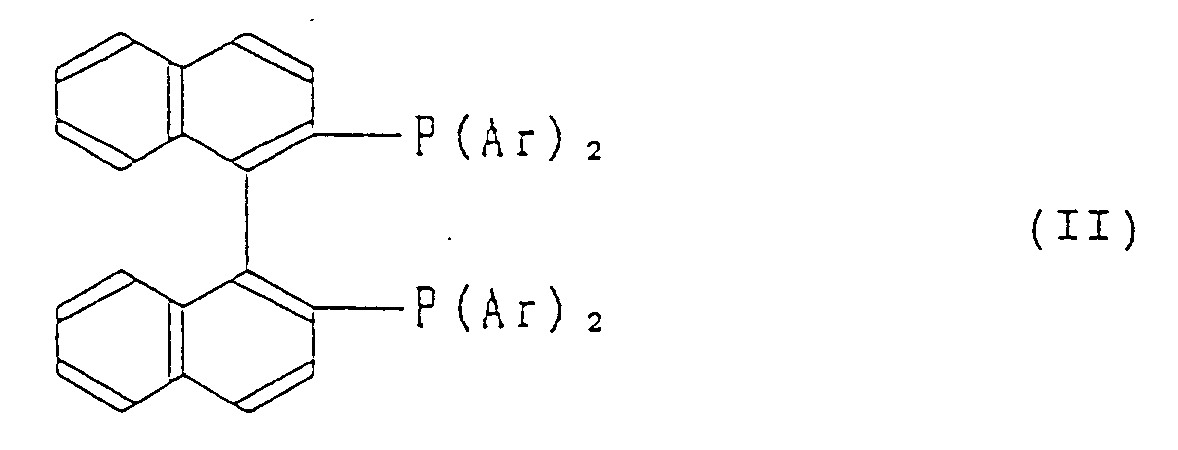
wherein Ar represents a phenyl group or a p- and/or m-C₁₋₄ alkyl-substituted phenyl group, or formula (III):

L² represents a tertiary phosphine compound represented by formula (IV):

wherein Z represents a C₁₋₄ alkoxy group or a di-C₁₋₄ alkylamino group and A represents an integer of from 1 to 3; and Y represents BF₄, PF₆, CℓO₄ or BPh₄, wherein Ph represents a phenyl group.
[H₂Ir(L¹)(L²)]Y (I)
wherein L¹ represents an optically active phosphine compound represented by formula (II):
wherein Ar represents a phenyl group or a p- and/or m-C₁₋₄ alkyl-substituted phenyl group, or formula (III):
L² represents a tertiary phosphine compound represented by formula (IV):
wherein Z represents a C₁₋₄ alkoxy group or a di-C₁₋₄ alkylamino group and A represents an integer of from 1 to 3; and Y represents BF₄, PF₆, CℓO₄ or BPh₄, wherein Ph represents a phenyl group.
2. A process for producing an optically active 3-hydroxytetrahydrothiophene comprising
enantioselective hydrogenation of 3-oxotetrahydrothiophene in the presence of an iridium-optically
active phosphine complex represented by formula (I):
[H₂Ir(L¹)(L²)]Y (I)
as defined in Claim 1.
[H₂Ir(L¹)(L²)]Y (I)
as defined in Claim 1.
3. A process for producing an optically active allyl alcohol derivative represented by
formula (VI):

wherein R¹ and R² each represent an aromatic hydrocarbon group or an aliphatic hydrocarbon group,
comprising enantioselective hydrogenation of an α,β-unsaturated ketone represented by formula (V):

wherein R¹ and R² are as defined above,
in the presence of an iridium-optically active phosphine complex represented by formula (I):
[H₂Ir(L¹)(L²)]Y (I)
as defined in Claim 1.
wherein R¹ and R² each represent an aromatic hydrocarbon group or an aliphatic hydrocarbon group,
comprising enantioselective hydrogenation of an α,β-unsaturated ketone represented by formula (V):
wherein R¹ and R² are as defined above,
in the presence of an iridium-optically active phosphine complex represented by formula (I):
[H₂Ir(L¹)(L²)]Y (I)
as defined in Claim 1.
1. Iridium-optisch aktives Phosphin-Komplex, der durch Formel (I) dargestellt ist:
[H₂Ir(L¹)(L²)]Y (I)
worin L¹ eine optisch aktive Phosphinverbindung darstellt, die durch Formel (II):

worin Ar eine Phenylgruppe oder eine p- und/oder m-C₁-C₄-Alkyl-substituierte Phenylgruppe darstellt,
oder durch Formel (III) dargestellt ist:

L² eine tertiäre Phosphinverbindung darstellt, die durch Formel (IV) dargestellt ist:

worin Z eine C₁-C₄-Alkoxygruppe oder eine Di-C₁-C₄-alkylaminogruppe darstellt und A eine ganze Zahl von 1 bis 3 darstellt; und Y BF₄, PF₆, ClO₄ oder BPh₄ darstellt, worin Ph eine Phenylgruppe darstellt.
[H₂Ir(L¹)(L²)]Y (I)
worin L¹ eine optisch aktive Phosphinverbindung darstellt, die durch Formel (II):
worin Ar eine Phenylgruppe oder eine p- und/oder m-C₁-C₄-Alkyl-substituierte Phenylgruppe darstellt,
oder durch Formel (III) dargestellt ist:
L² eine tertiäre Phosphinverbindung darstellt, die durch Formel (IV) dargestellt ist:
worin Z eine C₁-C₄-Alkoxygruppe oder eine Di-C₁-C₄-alkylaminogruppe darstellt und A eine ganze Zahl von 1 bis 3 darstellt; und Y BF₄, PF₆, ClO₄ oder BPh₄ darstellt, worin Ph eine Phenylgruppe darstellt.
2. Verfahren zum Herstellen eines optisch aktiven 3-Hydroxytetrahydrothiophens, umfassend
die enantioselektive Hydrierung von 3-Oxotetrahydrothiophen in Gegenwart eines Iridium-optisch
aktives Phosphin-Komplexes, der durch Formel (I), wie sie in Anspruch 1 definiert
ist, dargestellt ist:
[H₂Ir(L¹)(L²)]Y (I)
[H₂Ir(L¹)(L²)]Y (I)
3. Verfahren zum Herstellen eines optisch aktiven Allylalkoholderivats, das durch die
Formel (VI) dargestellt ist:

worin R¹ und R² jeweils eine aromatische Kohlenwasserstoffgruppe oder eine aliphatische Kohlenwasserstoffgruppe darstellen,
umfassend die enantioselektive Hydrierung eines α,β-ungesättigten Ketons, das durch Formel (V) dargestellt ist:

worin R¹ und R² wie oben definiert sind,
in Gegenwart eines Iridium-optisch aktives Phosphin-Komplexes, der durch Formel (I), wie sie in Anspruch 1 definiert ist, dargestellt ist:
[H₂Ir(L¹)(L²)]Y (I)
worin R¹ und R² jeweils eine aromatische Kohlenwasserstoffgruppe oder eine aliphatische Kohlenwasserstoffgruppe darstellen,
umfassend die enantioselektive Hydrierung eines α,β-ungesättigten Ketons, das durch Formel (V) dargestellt ist:
worin R¹ und R² wie oben definiert sind,
in Gegenwart eines Iridium-optisch aktives Phosphin-Komplexes, der durch Formel (I), wie sie in Anspruch 1 definiert ist, dargestellt ist:
[H₂Ir(L¹)(L²)]Y (I)
1. Complexe iridium-phosphine optiquement active représenté par la formule (I) :
[H₂Ir(L¹)(L²)]Y (I)
dans laquelle
L¹ représente une phosphine optiquement active représentée par la formule (II) :

où Ar représente un groupe phényle ou un groupe phényle p- et/ou m-substitué par un groupe alkyle en C₁-C₄,
ou par la formule (III) :

L² représente une phosphine tertiaire représentée par la formule (IV) :

où Z représente un groupe alcoxy en C₁-C₄ ou un groupe di-[(alkyle en C₁-C₄)amino] ; et A représente un entier de 1 à 3 ; et
Y représente BF₄, PF₆, ClO₄, ou BPh₄, Ph représentant un groupe phényle.
[H₂Ir(L¹)(L²)]Y (I)
dans laquelle
L¹ représente une phosphine optiquement active représentée par la formule (II) :
où Ar représente un groupe phényle ou un groupe phényle p- et/ou m-substitué par un groupe alkyle en C₁-C₄,
ou par la formule (III) :
L² représente une phosphine tertiaire représentée par la formule (IV) :
où Z représente un groupe alcoxy en C₁-C₄ ou un groupe di-[(alkyle en C₁-C₄)amino] ; et A représente un entier de 1 à 3 ; et
Y représente BF₄, PF₆, ClO₄, ou BPh₄, Ph représentant un groupe phényle.
2. Procédé de production d'un 3-hydroxytétrahydrothiophène optiquement actif comprenant
l'hydrogénation énantiosélective d'un 3-oxotétrahydrothiophène en présence d'un complexe
iridium-phosphine optiquement active représenté par la formule (I) :
[H₂Ir(L¹)(L²)]Y (I)
telle que définie dans la revendication 1.
[H₂Ir(L¹)(L²)]Y (I)
telle que définie dans la revendication 1.
3. Procédé de production d'un dérivé d'alcool allylique optiquement actif représenté
par la formule (VI) :

dans laquelle R¹ et R² représentent chacun un groupe hydrocarboné aromatique ou un groupe hydrocarboné aliphatique,
comprenant l'hydrogénation énantiosélective d'une cétone α,β-insaturée représentée par la formule (V) :

dans laquelle R¹ et R² sont tels que définis ci-dessus, en présence d'un complexe iridium-phosphine optiquement active représenté par la formule (I) :
[H₂Ir(L¹)(L²)]Y (I)
telle que définie dans la revendication 1.
dans laquelle R¹ et R² représentent chacun un groupe hydrocarboné aromatique ou un groupe hydrocarboné aliphatique,
comprenant l'hydrogénation énantiosélective d'une cétone α,β-insaturée représentée par la formule (V) :
dans laquelle R¹ et R² sont tels que définis ci-dessus, en présence d'un complexe iridium-phosphine optiquement active représenté par la formule (I) :
[H₂Ir(L¹)(L²)]Y (I)
telle que définie dans la revendication 1.