|
(11) | EP 0 488 477 A1 |

| (12) | EUROPEAN PATENT APPLICATION |
|
|
|
|
|||||||||||||||||||||||
| (54) | Process for removing hydrogen sulphide from a sour gas |
| (57) A process for the removal of hydrogen sulphide from a sour gaseous stream comprising
feeding the sour gaseous stream to a reaction zone (4) containing an aqueous reactant
solution; passing the gaseous stream and aqueous reactant solution concurrently upward
through the reaction zone (4), the momentum of the gaseous stream being sufficient
to provide and providing the principal motive force for the upward movement of the
aqueous reactant solution, under conditions and for a time sufficient to remove hydrogen
sulphide from the gaseous stream, and producing a purified gas, sulphur, and partially
spent solution admixture; and passing the purified gas, sulphur, and partially spent
solution admixture to a gas-liquid separation vessel (3) comprising an open separation
zone (6) and a reservoir (8) in liquid flow communication with the entrance of the
reaction zone (4). |
[0001] The presence of significant quantities of H₂S in various "sour" industrial gaseous streams poses a persistent problem. Although various procedures have been developed to remove and recover this contaminant, most such processes are deficient, for a variety of reasons.
[0002] While sour gaseous streams that contain relatively low concentrations of H₂S may be treated successfully in a variety of ways if deep removal, e.g., greater than 95 percent removal of H₂S, is not required, removal of this level, or greater, demands efficiencies of operation if excessive costs of operations and materials are not to be incurred.
[0003] One scheme for carrying out the gas treatment utilizes a two-stage contacting procedure in which a venturi-shaped contacting zone is utilized as an initial or primary contacting stage to remove the bulk of the H₂S, and a follow-up or "clean-up" stage, such as a packed column or sparged tower, is provided for removing the remainder of the H₂S in the gaseous stream. This configuration has a number of drawbacks, such as susceptibility to plugging, high gas pressure drop, and high cost. U.S.A. patent No. 4 238 462 describes a process for reacting a circulating reaction solution with different gases in a single reaction vessel, the movement of the solution being accomplished by contrived density differential in the different reaction zones of the vessel. While this process has the advantage of "free" liquid circulation, it appears limited to treatment of gases where the regenerating oxygen does not pose a hazard, and thus appears unsuited, e.g., to treatment of hydrocarbons such as methane or ethane.
[0004] Accordingly, a process which provided an efficient and economic contacting technique to insure good absorption and reaction rates of the H₂S into and with the contacting solution, while avoiding or minimizing the deficiencies mentioned, might have great utility. The invention is directed to such a process.
[0005] To this end the process for the removal of hydrogen sulphide from a sour gaseous stream according to the invention comprises
feeding the sour gaseous stream to a vertically disposed confined or walled reaction zone containing an aqueous reactant solution, at a temperature below the melting point of sulphur;
passing the gaseous stream and aqueous reactant solution concurrently upward through the reaction zone, the momentum of the gaseous stream being sufficient to provide and providing the principal motive force for the upward movement of the aqueous reactant solution, under conditions and for a time sufficient to remove hydrogen sulphide from the gaseous stream, and producing a purified gas, sulphur, and partially spent solution admixture;
passing the purified gas, sulphur, and partially spent solution admixture to a gas-liquid separation vessel comprising an open separation zone and a reservoir in liquid flow communication with the entrance of the reaction zone;
separating the purified gas, sulphur, and partially spent solution admixture in the separation zone into a purified gas stream and partially spent solution containing sulphur; and
collecting and combining partially spent solution containing sulphur with and forming a part of the aqueous reactant solution in the reservoir;
removing aqueous reactant solution from the reservoir, and regenerating at least a portion thereof to produce a regenerated reactant solution, and returning regenerated reactant solution to the reservoir and combining the regenerated reactant solution with the aqueous reactant solution;
periodically or continuously recovering sulphur from aqueous reactant solution or regenerated reactant solution;
concurrently maintaining the aqueous reactant solution liquid level in the reservoir at a level sufficient to provide aqueous reactant solution by gravity to the entrance of the reaction zone.
[0006] As will be apparent to those skilled in the art from the further disclosure herein, the invention relies on the motive force of the gas feed to transport the solution during the contact phase of the process, concurrently utilizing the static head of the aqueous reactant solution in the reservoir to provide the solution in the reservoir to the reaction zone entrance. The invention is very suitable for treating gas at elevated pressure for example above 10 atmospheres.
[0007] As used herein, the term "aqueous reactant solution" refers broadly to an aqueous solution containing a suitable regenerable ionic or chelated oxidizing agent for hydrogen sulphide, and, more particularly, to such solution present in the gas-liquid separation vessel reservoir, such solution including (during operation of the process) a mixture of collected partially spent solution, regenerated reactant solution, and sulphur. The aqueous reactant solution may also be modified by addition of make-up composition and bleed to remove the water formed by the reaction. The oxidizing agent, in converting the hydrogen sulphide to sulphur, is itself converted to a reduced state which must be oxidized for reuse. As those skilled in the art will recognize, the aqueous reactant solution of the invention will contain both the oxidized form and the reduced form of the agent, as discussed more fully hereinafter.
[0008] Suitable oxidation agents are polyvalent metals, supplied in solution as polyvalent ions or as chelated ions, or as mixtures thereof. Any polyvalent metal may be used, but iron, copper, and manganese are very suitable, particularly iron. As indicated, the polyvalent metal should be capable of oxidizing hydrogen sulphide, while being reduced itself from a higher to a lower valence state, and should then be oxidizable to the higher valence state in a typical redox reaction. Other polyvalent metals which may be used include lead, mercury, palladium, platinum, tungsten, nickel, chromium, cobalt, vanadium, titanium, tantalum, zirconium, molybdenum, and tin.
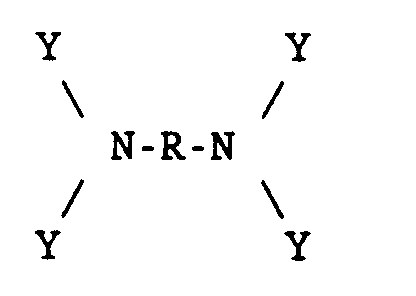
[0009] Suitable reactant materials are coordination complexes in which polyvalent metals form chelates with an acid having the formula
wherein
- from two to four of the groups Y are selected from acetic and propionic acid groups;
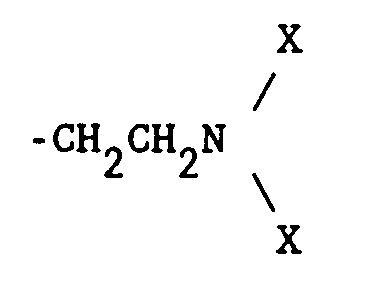
- from zero to two of the groups Y are selected from 2-hydroxyethyl, 2-hydroxypropyl, and
wherein X is selected from acetic and propionic acid groups; and R is ethylene, propylene or isopropylene or alternatively cyclohexane or benzene where the two hydrogen atoms replaced by nitrogen are in the 1,2 position, or with nitrilotriacetic acid, and mixtures thereof.
[0010] The metal chelates are supplied in solution as solubilized species, such as the ammonium or alkali metal salts (or mixtures thereof) of the metal chelates. As used herein, the term "solubilized" refers to the dissolved metal chelate or chelates, whether as a salt or salts of the aforementioned cation or cations, or in some other form, in which the metal chelate or chelates exist in solution. Where solubility of the chelate is difficult, and higher concentrations of chelates are desired, the ammonium salt may be utilized, as described in U.S.A. patent No. 4 859 446. However, the invention may also be employed with more dilute solutions of the chelates, wherein the steps taken to prevent chelate precipitation are not critical. Exemplary chelating agents for the metals, particularly for iron, include aminoacetic acids derived from ethylenediamine, diethylenetriamine, 1,2-propylenediamine, and 1,3-propylenediamine, such as EDTA (ethylenediamine tetraacetic acid), HEEDTA (N-2-hydroxyethyl ethylenediamine triacetic acid), DETPA (diethylenetriamine pentaacetic acid); amino acetic acid derivatives of cyclic, 1,2-diamines, such as 1,2-diamino cyclohexane-N,N-tetraacetic acid, and 1,2-phenylenediamine-N,N-tetraacetic acid, and the amides of polyamino acetic acids disclosed in U.S.A. patent No. 3 580 950. The ferric chelates of nitrilotriacetic acid and N-(2-hydroxyethyl) ethylenediamine triacetic acid are very suitable.
[0011] It is a preferred aspect of the invention that, by suitable flow rates and design of the reaction zone, the flow of the gas-solution mixture through the reaction zone will reach or approximate plug flow. The reaction zone may also incorporate structure for providing improved mixing. Suitable structures for providing the improved mixing include, but are not limited to, chevron-type mixers, such as Koch static mixers or Glitsch Gempak (trade name) mixers.
[0012] The velocity of the gas treated may vary widely. Suitable gas velocities may range from about 0.15 m/s (meter per second) to about 16 m/s, and very suitably in the range of from about 0.3 m/s to about 10 m/s.
[0013] As noted, the aqueous reactant solution to gas ratio must be sufficient to provide effective removal of H₂S while inhibiting or preventing sulphur deposition in the reaction zones. Preferably, the solution to gas ratio will range from 0.2:100 to 30:100, most preferably from 0.5:100 to 5:100, all by volume. Such ratios will also generally be sufficient to provide good wetting of any channel surfaces so that sulphur deposition is inhibited or prevented.
[0014] The metals and the metal chelates employed are regenerable species in which the regeneration is preferably accomplished by the utilization of oxygen, preferably as air. As used herein, the term "oxygen" is not limited to "pure" oxygen, but includes air, air enriched with oxygen, or other oxygen-containing gases. The oxygen will accomplish two functions, the oxidation of the polyvalent metal ion of the reactant to its higher valence state, and the stripping of any residual dissolved gas (if originally present) from the aqueous admixture. The oxygen (in whatever form supplied) is supplied in a stoichiometric equivalent or excess with respect to the amount of solubilized chelate to be oxidized to the higher valence state. Preferably, the oxygen is supplied in an amount of from about 20 percent to about 500 percent excess. Electrochemical regeneration may also be employed.
[0015] The particular type of sour gaseous stream treated is not critical, the only practical limitation is the reactivity of the stream itself with the solutions employed, as will be evident to those skilled in the art. Streams particularly suited to removal of H₂S by the practice of the invention are, as indicated, naturally-occurring gases, recycled CO₂ used in enhanced oil recovery, synthesis gases, process gases, and fuel gases produced by gasification procedures, e.g., gases produced by the gasification of coal, petroleum, shale, tar sands, etc. Particularly preferred are coal gasification streams, natural gas streams, produced and recycled CO₂ streams, and refinery feedstocks composed of gaseous hydrocarbon streams, especially those streams of this type having a low ratio of H₂S to CO₂, and other gaseous hydrocarbon streams. The term "hydrocarbon stream(s)", as employed herein, is intended to include streams containing significant quantities of hydrocarbon (both paraffinic and aromatic), it being recognized that such streams contain significant "impurities" not technically defined as a hydrocarbon. Again, streams containing principally a single hydrocarbon, e.g., ethane, are eminently suited to the practice of the invention. Streams derived from the gasification and/or partial oxidation of gaseous or liquid hydrocarbon may be treated by the invention. The H₂S content of the type of streams contemplated will vary extensively, but, in general, will range from about 0.005 percent to about 10 percent by volume. CO₂ may or may not be present, but if present, may range in content from about 0.1 percent to about 99.0 percent (or more) by volume. In this context, the invention may be used to remove H₂S from various CO₂ streams, e.g., supercritical CO₂ streams. Obviously, the amounts of H₂S and CO₂ present are not generally a limiting factor in the practice of the invention. The stream treated may also have been treated initially for H₂S removal, by this or some other technique.
[0016] The temperatures employed in the reaction zone are not generally critical, except that the reaction is carried out below the melting point of sulphur. In many commercial applications, such as removal of H₂S from natural gas to meet pipeline specifications, absorption at ambient temperatures is desired. In general, temperatures of from 10°C to 80°C are suitable, and temperatures of from 20°C to 60°C are very suitable. Total contact times may be varied widely, but will preferably range from about 0.5 s (second) to about 10 s, with total contact times of about 1 s to about 5 s being very suitable.
[0017] Similarly, in the regeneration zone or zones, temperatures may be varied widely. Preferably, the regeneration zone should be maintained at somewhat lower temperatures compared to the contacting or reaction zone. In general, temperatures of from about 10°C to 80°C, preferably 20°C to 50°C, may be employed.
[0018] Pressure conditions in the contacting zone may vary widely, depending on the pressure of the gas to be treated. For example, pressures in the contacting zone may vary from one atmosphere up to one hundred fifty or even two hundred atmospheres. Pressures of from ten atmosphere to about one hundred atmospheres are very suitable. In the regeneration zone, pressures may be varied considerably, and will preferably range from about one atmosphere to about three or four atmospheres. Residence times for given volumes of admixture and oxygen will also vary, but preferably will range from about 1 minute to about 60 minutes, most preferably from about 1 minute to about 40 minutes. Other conditions of operation for this type of reaction process are further described in U.S.A. patent No. 3 068 065 and in the aforementioned patent. Preferably, pH in the regeneration zone will range from about 6.5 to about 8.5, and the molar ratio of the free acid, in the case of chelated metals, to total solubilized metal is from about 1.0 to 1.5. The process is preferably conducted continuously.
[0019] As indicated, the H₂S, when contacted, is rapidly converted in the process of the invention by the oxidizing agent to solid elemental sulphur. The amount of solubilized oxidizing agent supplied or employed in solution is an amount sufficient to reduce the H₂S concentration or content of the stream to the desired level. If total or substantially total removal is desired, the total amount supplied will generally be on the order of at least about two mols per mol of H₂S. Ratios of from about 2 mols to about 15 mols of solubilized oxidant per mol of H₂S may be used, with ratios of from about 2 mols per mol to about 5 mols of solubilized oxidant per mol of H₂S being very suitable. It has been found advantageous, in at least one instance, to maintain some quantity of the reduced form of the metal in the aqueous reactant solution. For example, in the case of iron, the molar ratio of the ferric chelate of the acid or acids to the ferrous chelate of the acid or acids present in the contacting solution will normally be less than about 6, and will preferably range from about 0.2 to about 6, most preferably about 0.5 to about 6. The oxidant solution will generally be supplied as an aqueous solution having a concentration of from about 0.1 M (mol per litre) to about 3 M; a concentration of from about 0.5 to about 1.5 M is suitable. The total metal concentration will range from about 0.01 percent, suitably about 0.5 percent, to about 7 percent by mass, based on the mass of the solution and the metal. As indicated, the solubilized some chelates of the acid or acids may be formed in aqueous solution by the reaction of elemental metal or of an appropriate salt, oxide, or hydroxide of the metal and the specified acid, in the presence of alkali metal or ammonium ions, or with the ammonium or alkali metal salt.
[0020] The invention will now be described by way of example in more detail with reference to the accompanying drawings, wherein
Figure 1 illustrates an embodiment of the invention wherein the reaction zone is internal to the system, sulphur removal is accomplished in a separate step before regeneration, and regenerated solution is returned to the contacting zone for use as the contacting solution; and
Figure 2 illustrates an embodiment wherein the reaction zone is external to the system. All values are calculated or merely exemplary, and all flows, unless stated otherwise, are continuous.
[0021] As shown, sour gas, e.g., a natural gas stream containing about 0.5 percent H₂S, in line 1 flows into generally cylindrical open column 2 positioned in vessel 3 wherein it is intimately contacted in reaction zone 4 thereof with aqueous reactant solution which comprises aqueous 0.35 M solution of ammonium ferric nitrilotriacetate chelate, which mixture also contains 0.15 M of ammonium ferrous nitrilotriacetate chelate and about 0.25 M of ammonium thiosulphate, pH of the solution being adjusted to 7.5 to 8 by the addition of ammonium hydroxide. The solution is produced by utilization of the reducing effect of the H₂S in the gaseous stream. That is, the initial solution employed in the contacting reaction zone 4 illustrated is a 0.35 M aqueous solution of ferric nitrilotriacetate also containing about 1.0 M ammonium ion. After startup, and reaction with H₂S in the gaseous stream, regeneration, described hereinafter, is controlled, so that regeneration of the ammonium ferric nitrilotriacetic acid complex is not complete.
[0022] In reaction zone 4, the gas stream containing H₂S and the aqueous reactant mixture are intimately mixed to form a gas-reactant liquid mixture, sulphur almost immediately forming, and the gas-reactant liquid mixture is passed upward in cocurrent flow. Although a spray nozzle is illustrated, other suitable devices or techniques which provide intimate mixing or contacting of the gas and aqueous reactant mixture may be employed. In any event, contacting section 4 also comprises a plurality of chevron type flow directing elements 5 which provides a plurality of discrete channels for the passage and direction of the gas-reactant liquid mixture at a 30° angle to the direction of flow to the side of the cylindrical column. In this illustration, the element used is a Koch SMV (trade name) mixing element. To insure that the surfaces of the channels are resistant to sulphur deposition, the mixing element (and all those described hereinafter for reaction zone 4) and the walls of reaction zone 4 are electropolished before use. At least substantial plug flow overall through reaction zone 4 is obtained. The superficial velocity of the gas is 7 m/s, and the liquid to gas volumetric flow ratio is 2:100. The width of the channels of each element is about 2.5 cm (centimeter), and the diameter of the column is about 30 cm. The length of each element in the direction of flow is about 30 cm. As indicated, other types of elements may be employed. At the outlet of the column 2, gas-reactant liquid mixture enters an open section or separation zone 6 of a gas-liquid separation vessel 3 where the natural gas is separated from the liquid and sulphur. Purified natural gas is removed overhead via line 7, and "spent" reactant liquid and sulphur are collected in reservoir 8 of the vessel 3. As shown, reservoir 8 surrounds column 2 and communicates with the inlet of column 2 whereby liquid (aqueous reactant solution) is supplied to the column 2. The liquid need not fully surround column 2, but the height of the liquid with respect to column 2 must be sufficient to supply liquid to the inlet (and reaction zone 4) by head pressure.
[0023] As those skilled in the art will recognize, solution concentrations, sulphur content, and ferric-ferrous ligand concentrations and ratios must be regulated to achieve appropriate H₂S removal,as described, supra. To maintain appropriate ferric concentrations and provide sulphur removal, a stream 9 is sent for regeneration and sulphur removal.
[0024] More particularly, the aqueous admixture in line 9 is sent to a depressurization and degassing unit (not shown), which also serves as a sulphur concentration or thickening zone, and then to sulphur recovery zone 10. Sulphur recovery may be accomplished in any suitable fashion, such as by filtration. For example, sulphur may also be recovered by that method described in U.S.A. patent No. 4 664 902. As those skilled in the art will recognize, sulphur may be removed after regeneration, if desired. In any event, solution recovered during sulphur recovery may be returned to any suitable point in the process, if proper adjustment is made. Preferably, however, the solution recovered is sent to the regeneration zone, as shown, via line 11.
[0025] In regeneration zone or column 12, which may be a sparged tower, the admixture is contacted concurrently with excess air in line 13 to convert ferrous chelate of nitrilotriacetic acid to ferric chelate of nitrilotriacetic acid. Air velocity in the regenerator is in the range of from 0.03 to 0.1 m/s, the temperature of the liquid is about 45°C, and overall pressure is about 2 atmospheres. Spent air is removed via line 14, and regenerated admixture, having a ratio of ferric chelate of nitrilotriacetic acid to ferrous chelate of nitrilotriacetic acid of about 2.5, is returned via line 15 to reservoir 8 which provides reactant solution by static pressure to column 2.
[0027] In Figure 2, the natural gas feed in line 1 is supplied to an external column 51 which contains the reaction zone having elements 55. Column 51 connects to vessel 3 as shown. The gas reactant solution mixture flows into open space 56, with the purified gas being removed via line 57. Operation is otherwise similar to that of the system of Figure 1, liquid from the reservoir being supplied by hydrostatic pressure to the inlet of column 51.
[0028] As will be understood by those skilled in the art, the solutions or mixtures employed may contain other materials or additives for given purposes. For example, U.S.A. patent No. 3 933 993 discloses the use of buffering agents, such as phosphate and carbonate buffers. Similarly, U.S.A. patent No. 4 009 251 describes various additives, such as sodium oxalate, sodium formate, sodium thiosulphate, and sodium acetate, which are beneficial, and other additives, such as additives to improve sulphur separation, or antifoaming and/or wetting agents, may be employed. Finally, it is not necessary that sulphur be removed from the stream sent for regeneration; the sulphur may be allowed to collect in the bottom of the gas-liquid separation vessel, from which it may be removed periodically, or a separate bleed may be provided.
1. A process for the removal of hydrogen sulphide from a sour gaseous stream comprising
feeding the sour gaseous stream to a vertically disposed walled reaction zone containing an aqueous reactant solution, at a temperature below the melting point of sulphur;
passing the gaseous stream and aqueous reactant solution concurrently upward through the reaction zone, the momentum of the gaseous stream being sufficient to provide and providing the principal motive force for the upward movement of the aqueous reactant solution, under conditions and for a time sufficient to remove hydrogen sulphide from the gaseous stream, and producing a purified gas, sulphur, and partially spent solution admixture;
passing the purified gas, sulphur, and partially spent solution admixture to a gas-liquid separation vessel comprising an open separation zone and a reservoir in liquid flow communication with the entrance of the reaction zone;
separating the purified gas, sulphur, and partially spent solution admixture in the separation zone into a purified gas stream and partially spent solution containing sulphur; and
collecting and combining partially spent solution containing sulphur with and forming a part of the aqueous reactant solution in the reservoir;
removing aqueous reactant solution from the reservoir, and regenerating at least a portion thereof to produce a regenerated reactant solution, and returning regenerated reactant solution to the reservoir and combining the regenerated reactant solution with the aqueous reactant solution;
periodically or continuously recovering sulphur from aqueous reactant solution or regenerated reactant solution;
concurrently maintaining the aqueous reactant solution liquid level in the reservoir at a level sufficient to provide aqueous reactant solution by gravity to the entrance of the reaction zone.
feeding the sour gaseous stream to a vertically disposed walled reaction zone containing an aqueous reactant solution, at a temperature below the melting point of sulphur;
passing the gaseous stream and aqueous reactant solution concurrently upward through the reaction zone, the momentum of the gaseous stream being sufficient to provide and providing the principal motive force for the upward movement of the aqueous reactant solution, under conditions and for a time sufficient to remove hydrogen sulphide from the gaseous stream, and producing a purified gas, sulphur, and partially spent solution admixture;
passing the purified gas, sulphur, and partially spent solution admixture to a gas-liquid separation vessel comprising an open separation zone and a reservoir in liquid flow communication with the entrance of the reaction zone;
separating the purified gas, sulphur, and partially spent solution admixture in the separation zone into a purified gas stream and partially spent solution containing sulphur; and
collecting and combining partially spent solution containing sulphur with and forming a part of the aqueous reactant solution in the reservoir;
removing aqueous reactant solution from the reservoir, and regenerating at least a portion thereof to produce a regenerated reactant solution, and returning regenerated reactant solution to the reservoir and combining the regenerated reactant solution with the aqueous reactant solution;
periodically or continuously recovering sulphur from aqueous reactant solution or regenerated reactant solution;
concurrently maintaining the aqueous reactant solution liquid level in the reservoir at a level sufficient to provide aqueous reactant solution by gravity to the entrance of the reaction zone.
2. The process of claim 1 wherein the oxidizing agent employed in the aqueous reactant
solution is a polyvalent metal supplied in ionic form or as a chelate.
3. The process of claim 2 wherein the polyvalent metal is iron and is supplied as a chelate.
4. The process of claim 3 wherein the chelate is that of an acid having the formula
wherein
wherein X is selected from acetic and propionic acid groups; and R is ethylene, propylene or isopropylene or alternatively cyclohexane or benzene where the two hydrogen atoms replaced by nitrogen are in the 1,2 position, or is that of nitrilotriacetic acid, and mixtures thereof.
wherein
- from two to four of the groups Y are selected from acetic and propionic acid groups;
- from zero to two of the groups Y are selected from 2-hydroxyethyl, 2-hydroxypropyl, and
wherein X is selected from acetic and propionic acid groups; and R is ethylene, propylene or isopropylene or alternatively cyclohexane or benzene where the two hydrogen atoms replaced by nitrogen are in the 1,2 position, or is that of nitrilotriacetic acid, and mixtures thereof.
5. The process of claim 1 wherein the inlet for liquid to the walled reaction zone is
positioned in the reservoir and is surrounded by the liquid.
6. The process of claim 1 wherein the inlet for liquid to the walled reaction zone is
external to the reservoir.