|
(11) | EP 0 488 749 B1 |

| (12) | EUROPEAN PATENT SPECIFICATION |
|
|
| (54) |
Water-soluble thiourea dioxide derivatives and process for preparing same Wasserlösliche Thioharnstoffdioxidderivate und Verfahren zu ihrer Herstellung Dérivés du dioxyde de thiourée hydrosoluble et procédé pour leur préparation |
|
|
|||||||||||||||||||||||||||||||
| Note: Within nine months from the publication of the mention of the grant of the European patent, any person may give notice to the European Patent Office of opposition to the European patent granted. Notice of opposition shall be filed in a written reasoned statement. It shall not be deemed to have been filed until the opposition fee has been paid. (Art. 99(1) European Patent Convention). |
[0001] The present invention relates to novel water-soluble thiourea dioxide derivatives and a process for preparing same.
[0002] Thiourea dioxide is in wide use as a reducing agent in the dying industry and the photographic industry because it exhibits a strong reducing ability in a basic aqueous solution.
[0003] In the polymer industry and the field of organic chemistry, moreover, studies have been made about using thiourea dioxide as a stabilizer for various compounds (see U.S. Patent Nos. 2,472,868 and 3,070,569), as a curing agent for amino resins (see German Patent No. 1,215,363 and French Patent No. 1,445,045), or as a polymerization initiator in the polymerization of vinyl monomers using thiourea dioxide together with iron-hydrogen peroxide (see Am. Dyest. Dep. 75, 26-34 (1986). The use of thiourea dioxide as such agents has increased gradually.
[0004] In the field of polymer industry and that of organic chemical industry, however, the application range thereof is limited because thiourea dioxide is insoluble in almost all organic solvents, and its industrial use in these fields is actually very limited. Although thiourea dioxide dissolves in water, the solubility thereof is 30 g/ℓ or so, which is not always sufficient, depending on the field in which it is used.
[0005] Several derivatives of thiourea dioxide have also been proposed with a view to improving the solubility and other properties and expanding the application field. For example, in J. Chem. Soc. Perkin II. 4.1500 (1972) and Synth. Commun. 4.389 (1974) there is proposed a method wherein thiourea derivatives such as N,N'-diphenylthiourea, N,N'-dibenzylthiourea and N,N'-dicyclohexylthiourea are oxidized with hydrogen peroxide to prepare corresponding thiourea dioxide derivatives. However, this method is of little industrial utility because it is difficult to obtain such starting thioureas industrially. Other amine-substituted thiourea derivatives obtained by reacting thiourea dioxide with aliphatic or aromatic amines are disclosed in GB-A-2225007.
[0006] It is the object of the present invention to provide novel thiourea dioxide derivatives superior in water-solubility as compared with thiourea dioxide, which have a sufficient reducing ability and which are capable of being manufactured easily from materials which are easily available industrially.
Summary of the Invention
[0007] The novel thiourea dioxide derivatives of the present invention are represented by the following general formula:
wherein M is K⁺, Na⁺, or 1/2Ca⁺, and n is an integer of 1 to 7.
[0008] The thiourea dioxide derivatives of the above general formula (I) can each be prepared efficiently by adding thiourea dioxide to an aqueous solution comprising an amino acid represented by the following formula and a sodium, potassium or calcium salt of acetic acid and allowing reaction to take place under temperature and time conditions sufficient for the formation of the derivative:
wherein n is an integer of 1 to 7.
Detailed Description of the Invention
[0009] The above manufacturing process is represented as follows in terms of a reaction formula in the case of using glycine as the amino acid and sodium acetate as the acetic acid salt:
[0010] The amino acid used in the above manufacturing process may essentially be any amino acid provided it is represented by the general formula (II). But unbranched straight-chain amino acids are preferred. Examples are glycine, β-alanin, 4-amino-n-butyric acid, 5-amino-valeric acid, 6-amino-n-caproic acid, and 8-amino-n-caprylic acid. As the acetic acid salt there is used sodium salt, potassium salt or calcium salt of acetic acid.
[0011] The amounts of thiourea dioxide, amino acid and acetic acid salt to be used are determined on the basis of a conventional stoichiometric reaction and in accordance with the foregoing reaction formula. Thus, the thiourea dioxide, amino acid and acetic acid salt are used each in a substantially stoichiometric amount.
[0013] It is preferable that the reaction be carried out in an aqueous system after purging the interior of the system with an inert gas such as nitrogen gas. But the reaction may be performed even in the air.
[0014] The thiourea dioxide derivatives of the general formula (I) thus obtained have an excellent reducing ability and exhibit an extremely superior water solubility. For example, the water solubility of the sodium-substituted derivative of glycine shown by the foregoing reaction formula is 300 g/ℓ and that of a potassium-substituted derivative thereof is 500 g/ℓ.
[0015] The following examples are given to further illustrate the present invention, but it is to be understood that the invention is not limited thereto.
Example-1
Glycine sodium salt-substituted derivative
[0016] 41.3 g (0.55 mol) of glycine and 74.8 g (0.55 mol) of sodium acetate were dissolved in 150 ml of water in a nitrogen gas atmosphere, into which was added 54.0 g (0.5 mol) of thiourea dioxide little by little. The mixture was stirred at room temperature for 4 hours.
[0017] After completion of the reaction, water was distilled off until the total amount was reduced to half. Then, 30 ml of methanol were added to precipitate crystals, followed by washing with cold methanol to yield 82.4 g (80% yield) of white crystals having a maximum absorption at 267 nm, decomp. 141-145°C.
[0018] IR spectrum is as shown in Fig. 1. The crystals were dissolved in water at a rate of 310 g/ℓ.
Example-2
β-Alanine sodium salt-substituted derivative
[0019] 49.0 g (0.55 mol) of β-alanine, 74.8 g (0.55 mol) of sodium acetate, 54.1 g (0.5 mol) of thiourea dioxide and 150 ml of water were stirred at room temperature for 6 hours as in Example 1.
[0020] There were obtained 79.2 g (75% yield) of white crystals having a maximum absorption at 267 nm, decomp. 198-205°C. IR spectrum is as shown in Fig. 2. The crystals were dissolved in water at a rate of 350 g/ℓ.
Example-3
4-Amino-n-butyric acid sodium salt-substituted derivative
[0021] 56.7 g (0.55 mol) of 4-amino-n-butyric acid, 74.8 g (0.55 mol) of sodium acetate, 54.1 g (0.5 mol) of thiourea dioxide and 100 ml of water were stirred at room temperature for 6 hours as in Example 1.
[0022] There were obtained 89.7 g (83% yield) of white crystals having a maximum absorption at 266 nm, decomp. 172-175°C. IR spectrum is as shown in Fig. 3. The crystals were dissolved in water at a rate of 350 g/ℓ.
Example-4
6-Amino-n-caproic acid sodium salt-substituted derivative
[0023] 72.1 g (0.55 mol) of 6-amino-n-caproic acid, 74.8 g (0.55 mol) of sodium acetate, 54.1 g (0.5 mol) of thiourea dioxide and 100 ml of water were stirred at room temperature for 8 hours as in Example 1.
[0024] There were obtained 64.7 g (53% yield) of white crystals having a maximum absorption at 272 nm, decomp. 170-172°C. IR spectrum is as shown in Fig. 4. The crystals were dissolved in water at a rate of 380 g/ℓ.
Example-5
Glycine pottasium salt-substituted derivative
[0025] 41.3 g (0.55 mol) of glycine, 54.0 g (0.55 mol) of potassium acetate, 54.1 g (0.5 mol) of thiourea dioxide and 100 ml of water were stirred at room temperature for 6 hours as in Example 1.
[0026] There were obtained 76.6 g (75% yield) of white crystals having a maximum absorption at 262 nm, decomp. 135-138°C. IR spectrum is as shown in Fig. 5. The crystals were dissolved in water at a rate of 490 g/ℓ.
Example-6
Glycine-calcium salt-substituted derivative
[0027] 41.3 g (0.55 mol) of glycine, 48.4 g (0.28 mol) of calcium acetate, 54.1 g (0.5 mol) of thiourea dioxide and 150 ml of water were stirred at room temperature for 3 hours as in Example 1.
[0028] There were obtained 94.5 g (89% yield) of white crystals having a maximum absorption at 268 nm, decomp. 173-175°C. IR spectrum is as shown in Fig. 6.
Brief Description of the Drawings
Claims for the following Contracting State(s): DE, FR, GB
1. A water-soluble thiourea dioxide derivative represented by the general formula
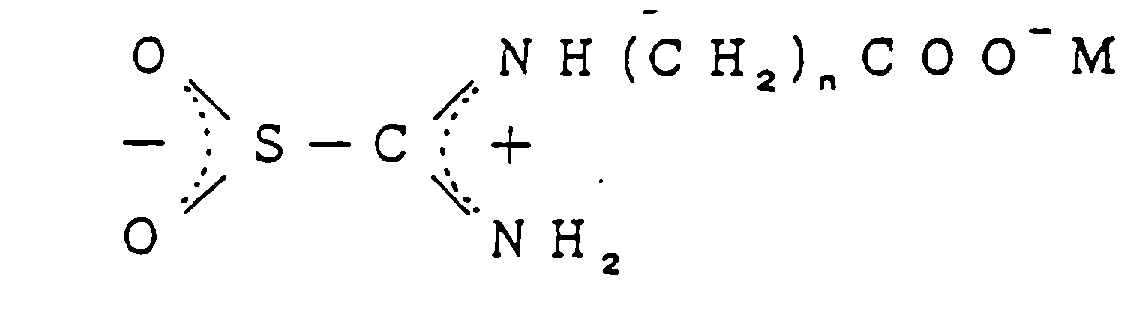
wherein M is K⁺, Na⁺, or 1/2Ca⁺, and n is an integer of 1 to 7.
wherein M is K⁺, Na⁺, or 1/2Ca⁺, and n is an integer of 1 to 7.
2. A process for preparing a water-soluble thiourea dioxide derivative represented by
the general formula
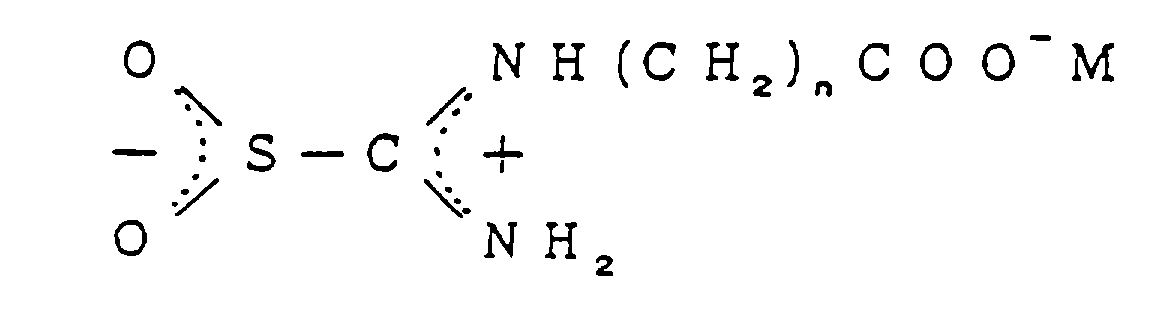
wherein M is K⁺, Na⁺, or 1/2Ca⁺, and n is an integer of 1 to 7, which comprises adding thiourea dioxide to an aqueous solution comprising an amino acid represented by the following general formula and a sodium, potassium or calcium salt of acetic acid:
NH₂(CH₂)nCOOH
wherein n is an integer of 1 to 7 and allowing reaction to take place under temperature and time conditions sufficient to produce the thiourea derivative.
wherein M is K⁺, Na⁺, or 1/2Ca⁺, and n is an integer of 1 to 7, which comprises adding thiourea dioxide to an aqueous solution comprising an amino acid represented by the following general formula and a sodium, potassium or calcium salt of acetic acid:
NH₂(CH₂)nCOOH
wherein n is an integer of 1 to 7 and allowing reaction to take place under temperature and time conditions sufficient to produce the thiourea derivative.
3. A process as set forth in claim 2, wherein the amino acid is glycine, β-alanine, 4-amino-n-butyric
acid, 5-amino-valeric acid, 6-amino-n-caproic acid, or 8-amino-n-caprylic acid.
4. A process as set forth in claim 2 or claim 3, wherein the reaction is performed at
a temperature of 10° to 80°C.
5. A process as set forth in any one of claims 2 to 4, wherein the thiourea dioxide,
amino acid and acetic acid salt are used each in a substantially stoichiometric amount.
Claims for the following Contracting State(s): ES
1. A process for preparing a water-soluble thiourea dioxide derivative represented by
the general formula

wherein M is K⁺, Na⁺, or 1/2Ca⁺, and n is an integer of 1 to 7, which comprises adding thiourea dioxide to an aqueous solution comprising an amino acid represented by the following general formula and a sodium, potassium or calcium salt of acetic acid:
NH₂(CH₂)nCOOH
wherein n is an integer of 1 to 7 and allowing reaction to take place under temperature and time conditions sufficient to product the thiourea derivative.
wherein M is K⁺, Na⁺, or 1/2Ca⁺, and n is an integer of 1 to 7, which comprises adding thiourea dioxide to an aqueous solution comprising an amino acid represented by the following general formula and a sodium, potassium or calcium salt of acetic acid:
NH₂(CH₂)nCOOH
wherein n is an integer of 1 to 7 and allowing reaction to take place under temperature and time conditions sufficient to product the thiourea derivative.
2. A process as set forth in claim 1, wherein the amino acid is glycine, β-alanine, 4-amino-n-butyric
acid, 5-amino-valeric acid, 6-amino-n-caproic acid, or 8-amino-n-caprylic acid.
3. A process as set forth in claim 1 or claim 2, wherein the reaction is performed at
a temperature of 10° to 80°C.
4. A process as set forth in any one of claims 1 to 3 wherein the thiourea dioxide, amino
acid and acetic acid salt are used each in a substantially stoichiometric amount.
Patentansprüche für folgende(n) Vertragsstaat(en): DE, FR, GB
1. Wasserlösliches Thioharnstoffdioxidderivat der allgemeinen Formel
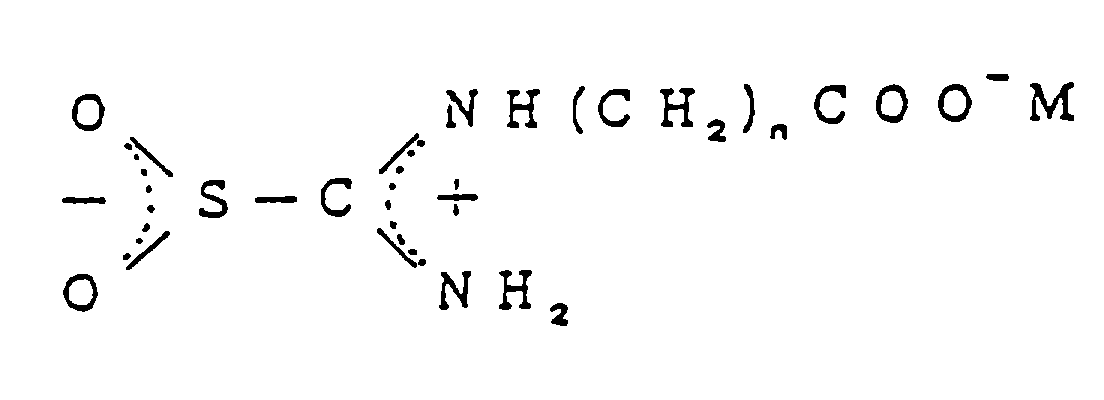
in der
M K⁺, Na⁺ oder 0,5 Ca⁺ und n eine ganze Zahl von 1 bis 7 bedeutet.
in der
M K⁺, Na⁺ oder 0,5 Ca⁺ und n eine ganze Zahl von 1 bis 7 bedeutet.
2. Verfahren zur Herstellung eines wasserlöslichen Thioharnstoffdioxidderivats der allgemeinen
Formel
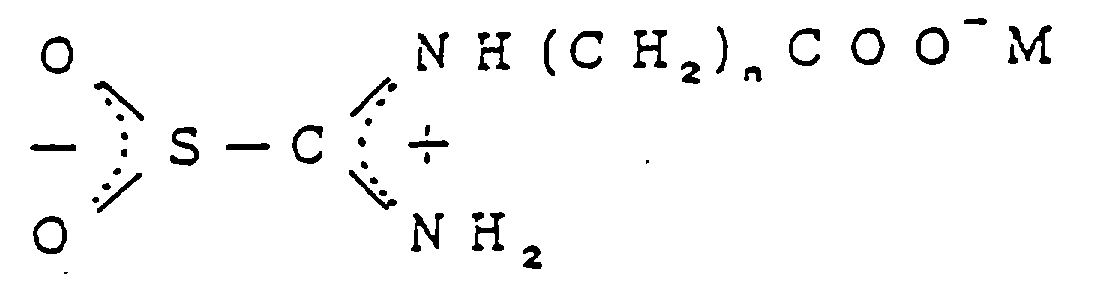
in der
M K⁺, Na⁺ oder 0,5 Ca⁺ und n eine ganze Zahl von 1 bis 7 bedeutet,
bei dem man Thioharnstoffdioxid zu einer wäßrigen Lösung zugibt, die eine der folgenden allgemeinen Formel entsprechende Aminosäure sowie ein Kalium-, Natrium- oder Calciumacetat enthält:
NH₂(CH₂)nCOOH
in der n eine ganze Zahl von 1 bis 7 ist, und man
die Reaktion unter zum Erzeugen des Thioharnstoffderivats ausreichenden Temperatur- und Zeitbedingungen ablaufen läßt.
in der
M K⁺, Na⁺ oder 0,5 Ca⁺ und n eine ganze Zahl von 1 bis 7 bedeutet,
bei dem man Thioharnstoffdioxid zu einer wäßrigen Lösung zugibt, die eine der folgenden allgemeinen Formel entsprechende Aminosäure sowie ein Kalium-, Natrium- oder Calciumacetat enthält:
NH₂(CH₂)nCOOH
in der n eine ganze Zahl von 1 bis 7 ist, und man
die Reaktion unter zum Erzeugen des Thioharnstoffderivats ausreichenden Temperatur- und Zeitbedingungen ablaufen läßt.
3. Verfahren gemäß Anspruch 2, bei dem die Aminosäure Glycin, β-Alanin, 4-Amino-n-buttersäure,
5-Aminovaleriansäure, 6-Amino-n-capronsäure oder 8-Amino-n-caprylsäure darstellt.
4. Verfahren gemäß Anspruch 2 oder 3, bei dem die Umsetzung bei einer Temperatur von
10 bis 80 °C erfolgt.
5. Verfahren gemäß einem der Ansprüche 2 bis 4, bei dem das Thioharnstoffdioxid, die
Aminosäure und das Acetat jeweils in im wesentlichen stöchiometrischen Mengen eingesetzt
werden.
Patentansprüche für folgende(n) Vertragsstaat(en): ES
1. Verfahren zur Herstellung eines wasserlöslichen Thioharnstoffdioxidderivats der allgemeinen
Formel
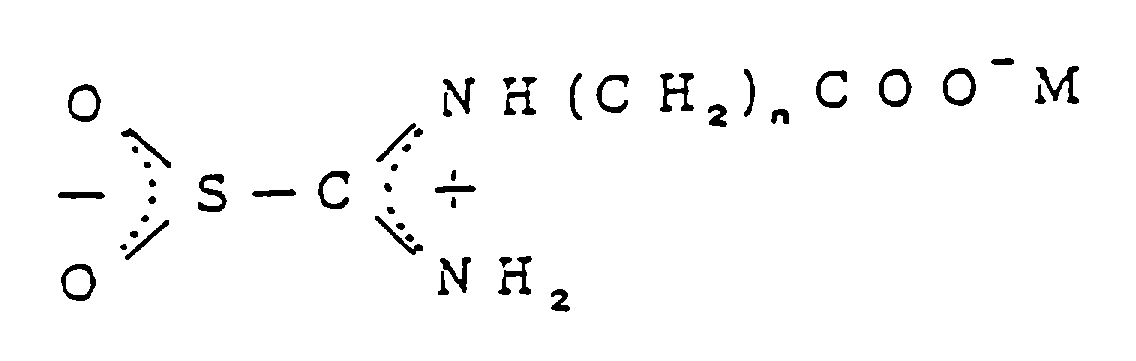
in der
M K⁺, Na⁺ oder 0,5 Ca⁺ und n eine ganze Zahl von 1 bis 7 bedeutet,
bei dem man Thioharnstoffdioxid zu einer wäßrigen Lösung zugibt, die eine der folgenden allgemeinen Formel entsprechende Aminosäure sowie ein Kalium-, Natrium- oder Calciumacetat enthält:
NH₂(CH₂)nCOOH
in der n eine ganze Zahl von 1 bis 7 ist, und man
die Reaktion unter zum Erzeugen des Thioharnstoffderivats ausreichenden Temperatur- und Zeitbedingungen ablaufen läßt.
in der
M K⁺, Na⁺ oder 0,5 Ca⁺ und n eine ganze Zahl von 1 bis 7 bedeutet,
bei dem man Thioharnstoffdioxid zu einer wäßrigen Lösung zugibt, die eine der folgenden allgemeinen Formel entsprechende Aminosäure sowie ein Kalium-, Natrium- oder Calciumacetat enthält:
NH₂(CH₂)nCOOH
in der n eine ganze Zahl von 1 bis 7 ist, und man
die Reaktion unter zum Erzeugen des Thioharnstoffderivats ausreichenden Temperatur- und Zeitbedingungen ablaufen läßt.
2. Verfahren gemäß Anspruch 1, bei dem die Aminosäure Glycin, β-Alanin, 4-Amino-n-buttersäure,
5-Aminovaleriansäure, 6-Amino-n-capronsäure oder 8-Amino-n-caprylsäure darstellt.
3. Verfahren gemäß Anspruch 1 oder 2, bei dem die Umsetzung bei einer Temperatur von
10 bis 80 °C erfolgt.
4. Verfahren gemäß einem der Ansprüche 1 bis 3, bei dem das Thioharnstoffdioxid, die
Aminosäure und das Acetat jeweils in im wesentlichen stöchiometrischen Mengen eingesetzt
werden.
Revendications pour l'(les) Etat(s) contractant(s) suivant(s): DE, FR, GB
1. Dérivé du dioxyde de thiourée soluble dans l'eau représenté par la formule générale
:
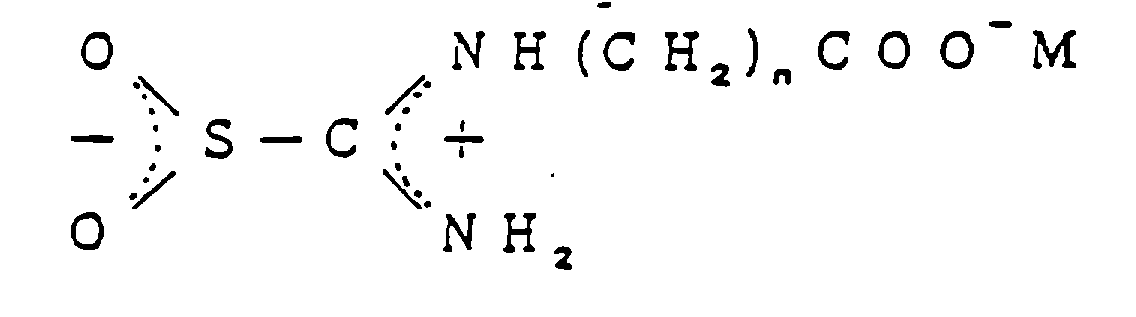
dans laquelle M est K⁺, Na⁺ ou 1/2 Ca⁺, et n est un entier de 1 à 7.
dans laquelle M est K⁺, Na⁺ ou 1/2 Ca⁺, et n est un entier de 1 à 7.
2. Procédé pour la préparation d'un dérivé du dioxyde de thiourée soluble dans l'eau
représenté par la formule générale :
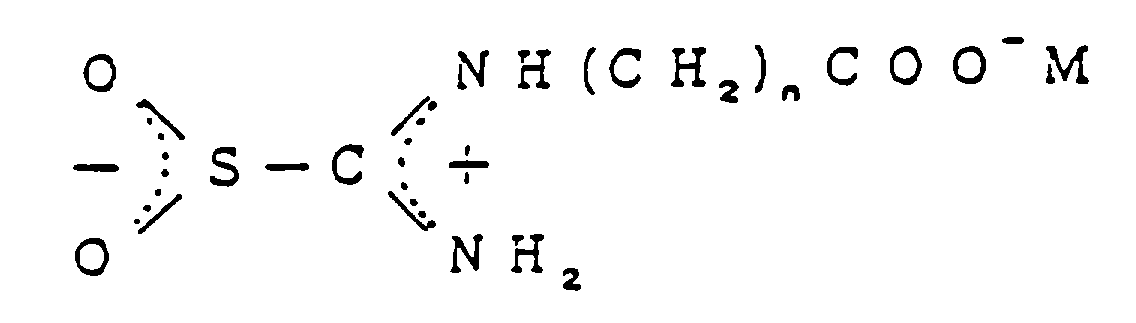
dans laquelle M est K⁺, Na⁺ ou 1/2 Ca⁺, et n est un entier de 1 à 7,
qui comprend l'addition de dioxyde de thiourée à une solution aqueuse comprenant un acide aminé représenté par la formule générale suivante et un sel de sodium, de potassium ou de calcium d'acide acétique :
NH₂(CH₂)nCOOH
dans laquelle n est un entier de 1 à 7 et la réalisation de la réaction dans des conditions de température et de durée suffisantes pour produire le dérivé de thiourée.
dans laquelle M est K⁺, Na⁺ ou 1/2 Ca⁺, et n est un entier de 1 à 7,
qui comprend l'addition de dioxyde de thiourée à une solution aqueuse comprenant un acide aminé représenté par la formule générale suivante et un sel de sodium, de potassium ou de calcium d'acide acétique :
NH₂(CH₂)nCOOH
dans laquelle n est un entier de 1 à 7 et la réalisation de la réaction dans des conditions de température et de durée suffisantes pour produire le dérivé de thiourée.
3. Procédé suivant la revendication 2, dans lequel l'acide aminé est la glycine, la β-alanine,
l'acide 4-amino-n-butyrique, l'acide 5-amino-valérique, l'acide 6-amino-n-caproïque
ou l'acide 8-amino-n-caprylique.
4. Procédé suivant les revendications 2 ou 3, dans lequel la réaction est conduite à
une température de 10°C à 80°C.
5. Procédé suivant l'une quelconque des revendications 2 à 4, dans lequel le dioxyde
de thiourée, l'acide aminé et le sel d'acide acétique sont utilisés chacun en une
quantité pratiquement stoechiométrique.
Revendications pour l'(les) Etat(s) contractant(s) suivant(s): ES
1. Procédé pour la préparation d'un dérivé du dioxyde de thiourée soluble dans l'eau
représenté par la formule générale :
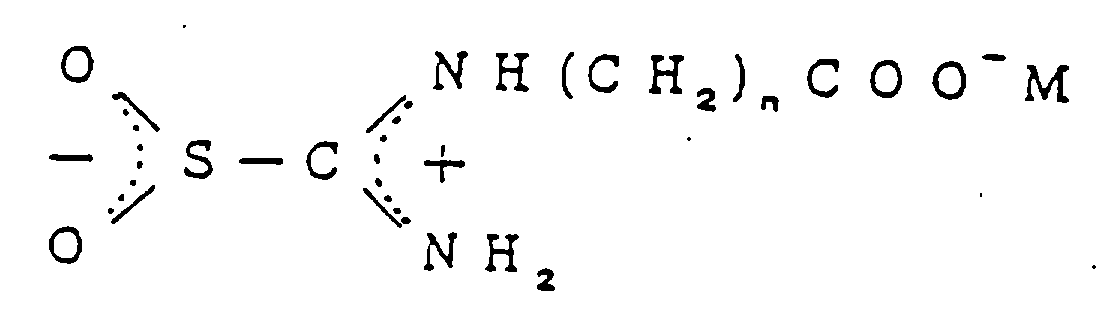
dans laquelle M est K⁺, Na⁺ ou 1/2 Ca⁺, et n est un entier de 1 à 7,
qui comprend l'addition de dioxyde de thiourée à une solution aqueuse comprenant un acide aminé représenté par la formule générale suivante et un sel de sodium, de potassium ou de calcium d'acide acétique :
NH₂(CH₂)nCOOH
dans laquelle n est un entier de 1 à 7, et la réalisation de la réaction dans des conditions de température et de durée suffisantes pour produire le dérivé de thiourée.
dans laquelle M est K⁺, Na⁺ ou 1/2 Ca⁺, et n est un entier de 1 à 7,
qui comprend l'addition de dioxyde de thiourée à une solution aqueuse comprenant un acide aminé représenté par la formule générale suivante et un sel de sodium, de potassium ou de calcium d'acide acétique :
NH₂(CH₂)nCOOH
dans laquelle n est un entier de 1 à 7, et la réalisation de la réaction dans des conditions de température et de durée suffisantes pour produire le dérivé de thiourée.
2. Procédé suivant la revendication 1, dans lequel l'acide aminé est la glycine, la β-alanine,
l'acide 4-amino-n-butyrique, l'acide 5-amino-valérique, l'acide 6-amino-n-caproïque
ou l'acide 8-amino-n-caprylique.
3. Procédé suivant les revendications 1 ou 2, dans lequel la réaction est conduite à
une température de 10°C à 80°C.
4. Procédé suivant l'une quelconque des revendications 1 à 3, dans lequel le dioxyde
de thiourée, l'acide aminé et le sel d'acide acétique sont utilisés chacun en une
quantité pratiquement stoechiométrique.