|
(11) | EP 0 489 951 B1 |

| (12) | EUROPEAN PATENT SPECIFICATION |
|
|
| (54) |
High strength fibers or films of aromatic copolyamides with pendant carboxyl groups Fasern oder Folien von hoher Festigkeit aus aromatischen Copolyamiden mit freien Carboxylgruppen Fibres ou feuilles à haute résistance de copolyamides aromatiques avec des groupes carboxyliques libres |
|
|
||||||||||||||||||||||||||||
| Note: Within nine months from the publication of the mention of the grant of the European patent, any person may give notice to the European Patent Office of opposition to the European patent granted. Notice of opposition shall be filed in a written reasoned statement. It shall not be deemed to have been filed until the opposition fee has been paid. (Art. 99(1) European Patent Convention). |
BACKGROUND OF THE INVENTION
[0001] This invention relates to high strength fibers of p-aramids having pendant carboxyl groups. The presence of these pendant groups imparts properties to the polymer and fibers or films thereof such as would enhance their reactivity, improve adhesion to matrix materials in reinforced composite structures or provide other characteristics.
[0002] The commercial importance of fiber reinforced composites has long been recognized. While the adhesion between certain reinforcing fibers and matrix polymer is excellent, others require the use of so-called "coupling agents" in order to improve the level of strength achieved through reinforcement. In some instances the use of coupling agents has not been satisfactory. Poly(p-phenylene terephthalamide) fiber finds extensive use as a reinforcement in composite structures. In accordance with this invention, the introduction of certain monomeric units in specified proportions in the polymer chain may reduce or eliminate the need for coupling agents in particular applications.
SUMMARY OF THE INVENTION
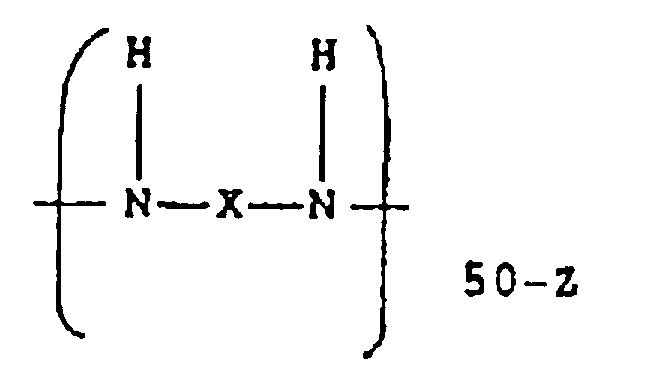
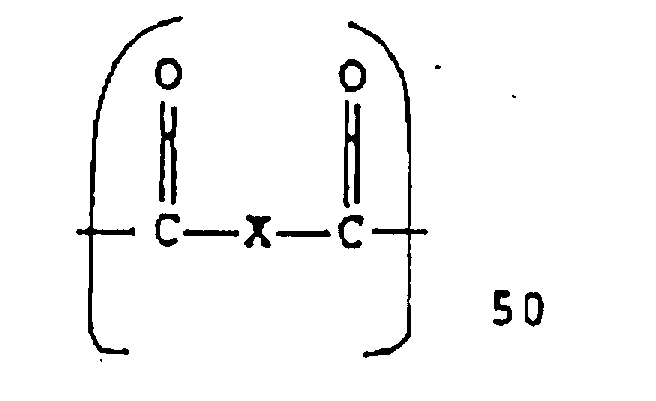
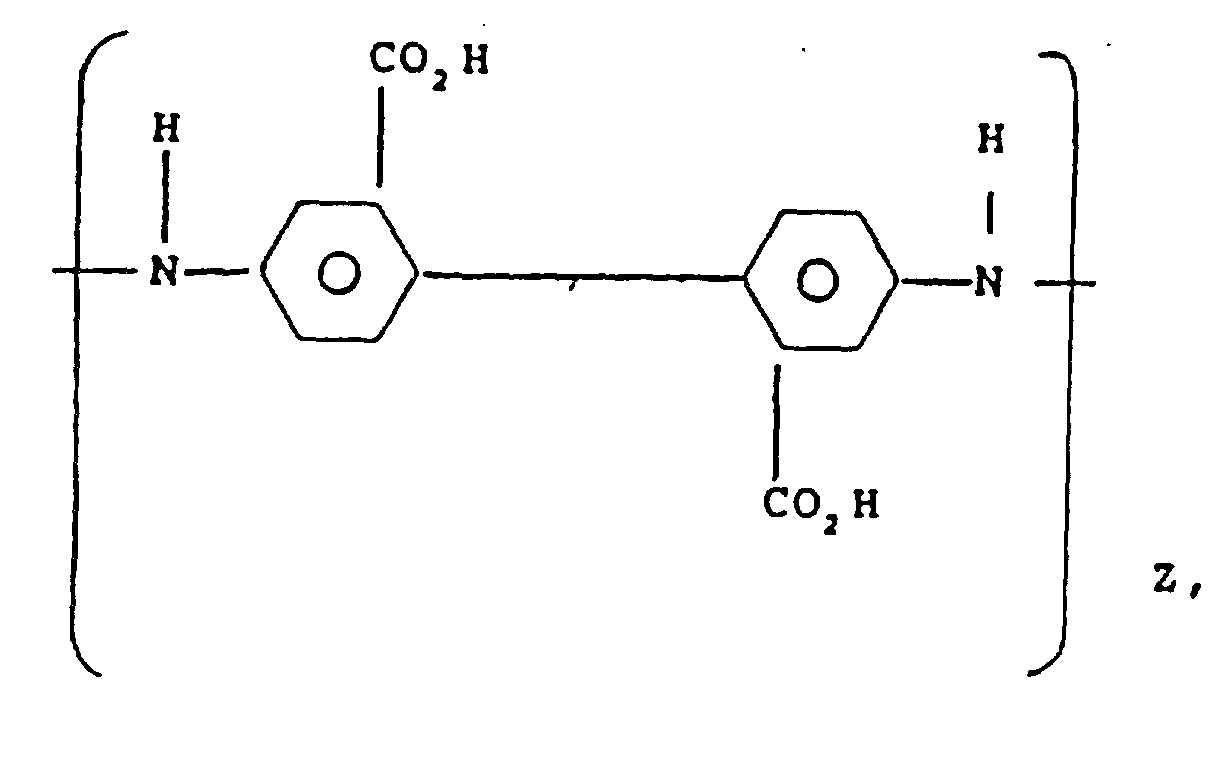
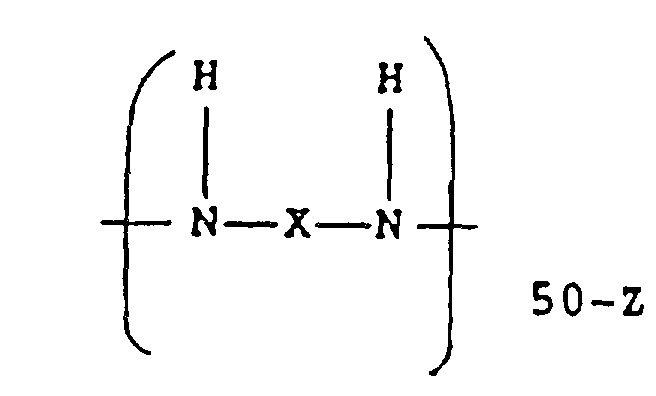
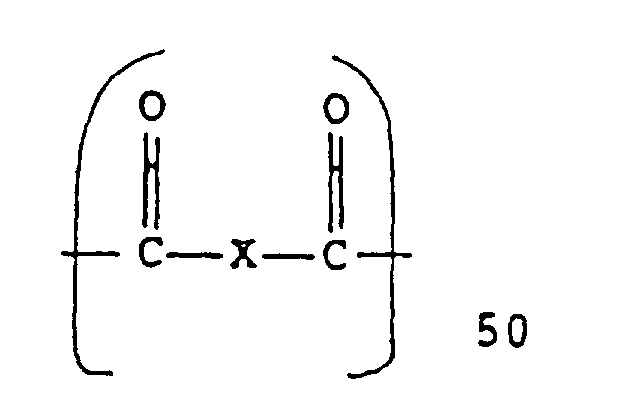
[0003] This invention provides a novel polymer of fiber-forming molecular weight consisting essentially of the following repeat units in the indicated molar proportions:
and
where X is 1,4-phenylene and where Z is from about 2 to 15 mole % and fibers and films thereof. Also included is a process for preparing the fibers.
DETAILED DESCRIPTION OF THE INVENTION
[0004] The present invention has for its purpose, the incorporation of small amounts of carboxyl groups along an aromatic polyamide chain in a way that they do not interfere with the amide linkages. Carboxyl groups are known to enhance adhesion to rubber, epoxides, etc. It has now been found that fibers formed from certain aromatic polyamides bearing limited numbers of carboxyl groups on the chain suffer no significant reduction in tensile properties. The carboxyl groups may be incorporated by polymerizing a mixture of paraphenylene diamine and 4,4'-diaminodiphenic acid with terephthaloyl chloride. As shown in concurrently filed, copending coassigned U.S. Application Serial No. (QP-4365) the diphenic acid should be employed as the dihydrochloride.
[0005] The novel copolymers of the invention are of fiber-forming molecular weight, having an inherent viscosity of at least 3.5 measured as described below, and consist essentially of the following repeating units:
and
where X is 1,4-phenylene and Z is from 2 to 15 mole %, preferably from 2 to 10 mole %. The copolymer may be made into a spin dope by dissolution in concentrated sulfuric acid. The spin dope should preferably contain at least 15% by wt. of the copolymer. The dope may be spun through an inert fluid layer, preferably air, into a coagulating bath such as water. Preparation of spin dopes and spinning procedures are similar to those employed in Blades U.S. Patent No. 3,767,756 with poly (p-phenylene terephthalamide).
Test Procedures
[0006] Inherent viscosity, I.V., is defined by the following equation:
where RV is the relative viscosity and C is the concentration in grams of polymer per deciliter of solvent, typically 0.5g in 100 ml. (Thus, the units for inherent viscosity are dl/g.) The relative viscosity is determined by dividing the flow time of the dilute solution in a capillary viscometer by the flow time for the pure solvent. The flow times are determined at 30°C. The solvent employed is 100% H₂SO₄.
[0007] Tensile measurements were made on single filaments following the test procedure found in ASTM D 2101-82. The filaments were conditioned at 21°C (70°F) and 65 percent relative humidity and tested on a conventional tensile tester using flat clamps with rubber facing and a 2.5 cm (1") gauge length at a 10%/min strain rate (for low elongation, 0-8%). T is tenacity at break in gpd, M is the initial modulus in gpd and E is the break elongation in %.
[0008] The following examples are illustrative of the present invention and are not to be construed as limiting.
Example 1
[0009] In a flame-dried resin kettle, fitted with cage-type stirrer, thermometer, dry nitrogen purge, and external cooling bath a slurry of 4,4'-diaminodiphenic acid dihydrochloride (3.54 g; 0.0103 mole) with a solution of p-phenylene diamine (21.03 g; 0.195 mole) in anhydrous N-methyl pyrrolidone (407 ml; 420 g)/anhydrous CaCl₂ (31.57 g; 0.287 mole) was treated, at room temperature, with anhydrous diethylaniline (3.054 g; 0.0205 mole). To the resulting solution, at 10°C, was added quantitatively, terephthaloyl chloride (41.62 g; 0.205 mole). The initially clear solution in a very sort time gave way to a broken-up gel or crumb. After standing 2 hr at room temperature, this was treated with excess cold water in a blender to precipitate polymer, which was filtered, washed with cold water, then treated in boiling water with stirring for 15 min to remove residual solvent, refiltered and dried at 100°C/15 hr. I.V. in 100% H₂SO₄ was 4.08. Thermogravimetric analysis indicated retention of a few percent residual solvent to about 180°C.
[0010] A 20% (w/w) solution of the polymer at 68°C was extruded through a single hole spinneret, with hole diameter 0.13 mm (0.005 in) and length 0.38 mm (0.015 in), via a 6.35mm (0.25 in) air gap, into a water coagulating bath at 0°C. Fiber was wound up at 256 m/min and spin-stretch factor (S.S.F.) of 9.0X. The well washed, air-dried fiber had T/E/Mi/dpf = 17.3 gpd/4.2%/634 gpd/1.5 den. Wide angle X-ray diffraction showed these as-spun fibers to be essentially amorphous. By passing the never-dried fibers through a tube at 200°C in a nitrogen atmosphere, during 15 sec. under tension, T/E/Mi changed to 20.3/2/8/840. By passage over a hot plate, under tension, at 500°C, T/E/Mi was 18.6/3.2/700 (best break, 21.2/3.9/680).
Example 2
[0011] A copolymer with an inherent viscosity of 4.68 was prepared in the same way as in Example 1 but with the 4,4'-diaminodiphenic acid dihydrochloride concentration increased to 6 mole %. Fiber was spun similarly from sulfuric acid solution at 60°C, with a wind-up speed of 221 m/min and spin-stretch of 8.1X. The air-dried as-spun fiber had T/E/Mi/dpf = 15.1/4.3/578/1.8. The fiber was amorphous. Never-dried fiber, heat treated under tension at 200°C/15 sec. had T/E/Mi = 20.0/2.5/790. Air-dried fiber, heat treated under tension at 450°C, had T/E/Mi - 18.1/4.0/647 (best break, 20.6/4.5/667). Fibers remained amorphous. Heat treatment tended to smooth out the distinct knee in the stress-strain curve of the as-spun fiber.
Example 3
[0012] A copolymer with an inherent viscosity of 4.53 was prepared in the same way as in Example 1 but with the 4,4'-diaminodiphenic acid dihydrochloride concentration increased to 12.5 mole %. Fiber was spun from a dope at 79°C at a wind-up speed of 86 m/min and S.S.F. = 2.9X. Air-dried fiber had T/E/Mi/dpf = 10.3/5.1/404/11.2; fibers were amorphous. Never-dried fiber, heated under tension at 200°C for 15 sec. had a T/E/M = 11.0/2.2/600. Air-dried fibers, passed over a hot plate at 400-500°C under tension, showed no changed in stress-strain behavior or properties, and no development of crystallinity or improvement in orientation. The stress-strain curve showed a distinct knee or yield point, beyond which modulus dropped by more than 50%.
1. Aromatic polyamide of fiber-forming molecular weight consisting essentially of the
following repeat units in the indicated molar proportions:
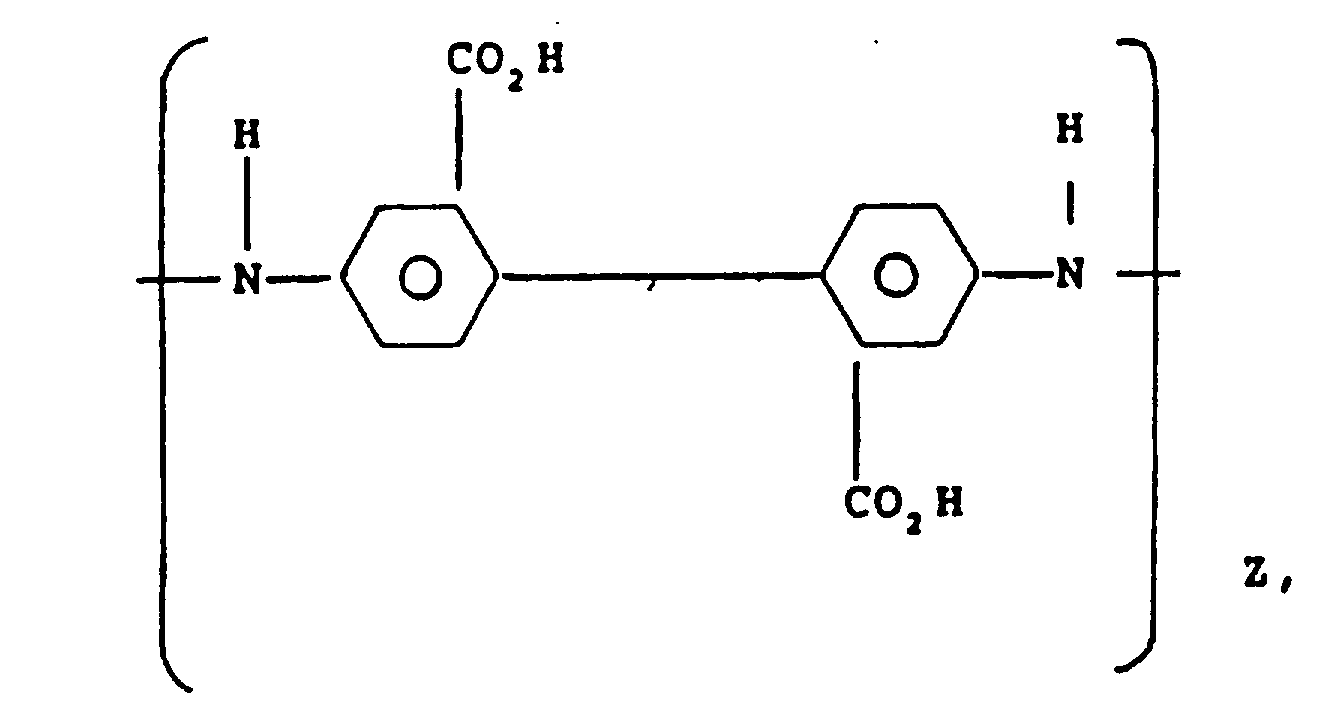
and
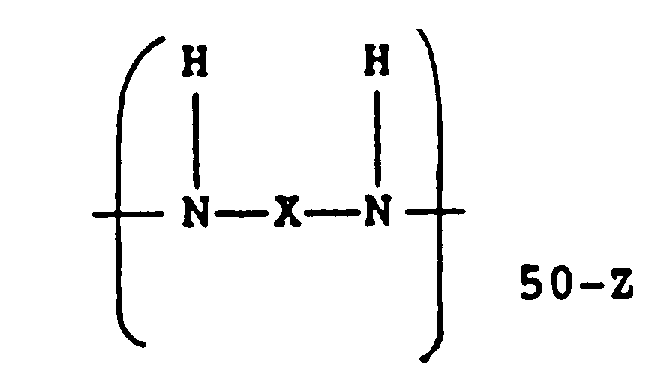
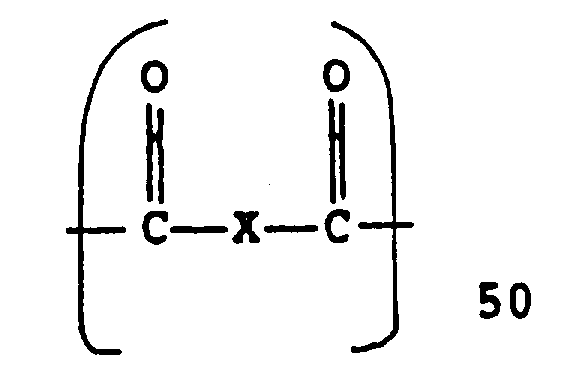
where X is 1,4-phenylene and where Z is from about 2 to 15 mole percent.
and
where X is 1,4-phenylene and where Z is from about 2 to 15 mole percent.
2. A polymer according to claim 1 where Z is from about 2 to 10 mole percent.
3. A process for preparing high strength fibers comprising preparing a spin dope of the
polymer of claim 1 and concentrated sulfuric acid at a concentration of at least 15%
by wt. and spinning it through an inert fluid layer into a coagulating bath and withdrawing
the coagulated fiber from the bath.
4. A high strength fiber formed by the process of claim 3.
1. Aromatisches Polyamid eines faserbildenden Molekulargewichts, bestehend im wesentlichen
aus den folgenden Wiederholungseinheiten in den angegebenen molaren Anteilen:
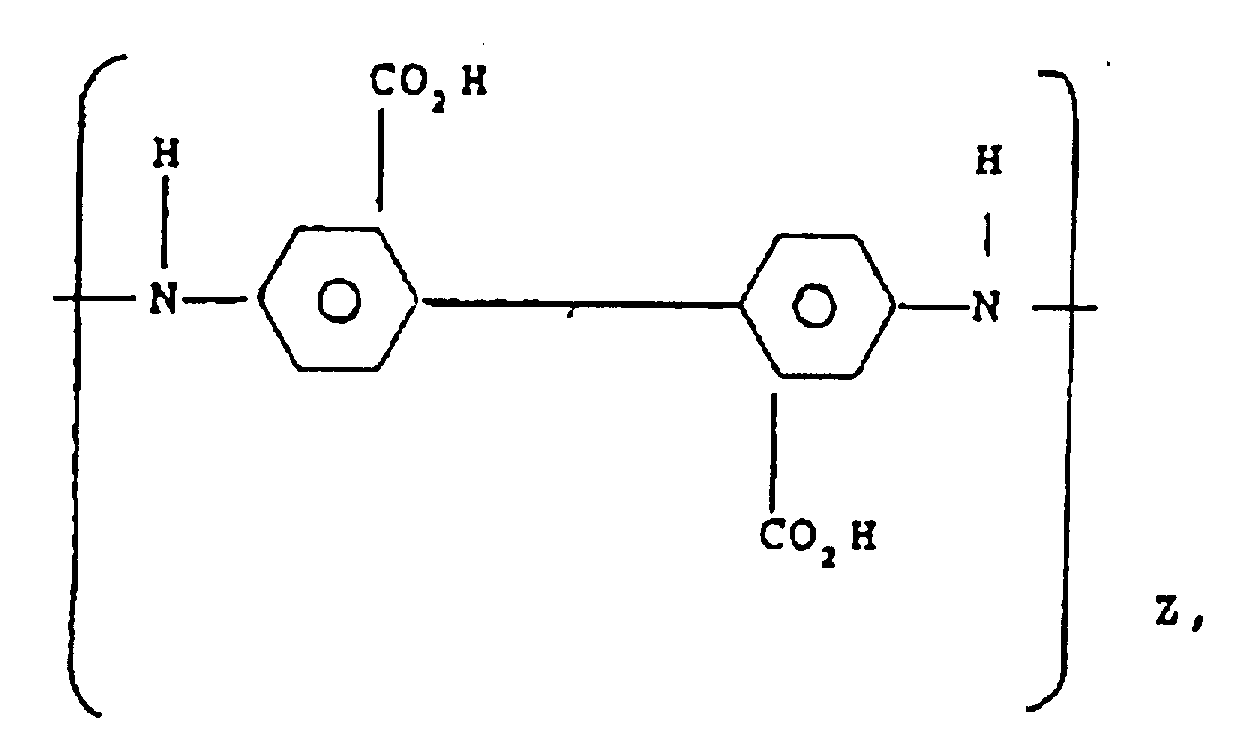
und
worin X für 1,4-Phenylen steht und worin Z etwa 2 bis 15 Mol-% beträgt.
und
worin X für 1,4-Phenylen steht und worin Z etwa 2 bis 15 Mol-% beträgt.
2. Polymer nach Anspruch 1, worin Z etwa 2 bis 10 Mol-% beträgt.
3. Verfahren zur Herstellung von hochfesten Fasern, umfassend die Herstellung einer Spinnlösung
des Polymeren nach Anspruch 1 und von konzentrierter Schwefelsäure bei einer Konzentration
von wenigstens 15 Gew.-% und ihr Verspinnen durch eine inerte Fluidschicht in einem
Koagulationsbad und Abziehen der koagulierten Faser aus dem Bad.
4. Hochfeste Faser, gebildet durch das Verfahren nach Anspruch 1.
1. Polyamide aromatique ayant un poids moléculaire permettant la formation de fibres
consistant essentiellement par les motifs répétitifs suivants selon les proportions
molaires indiquées:
et
où X est un groupe 1,4-phénylène et Z est d'environ 2 à 15% en moles.
et
où X est un groupe 1,4-phénylène et Z est d'environ 2 à 15% en moles.
2. Polymère selon la revendication 1, dans lequel Z est d'environ 2 à 10% en moles.
3. Procédé de préparation de fibres à haute résistance comprenant la préparation d'une
masse de filage du polymère selon la revendication 1 à une concentration d'au moins
15% en poids et d'acide sulfurique, le filage à travers une couche de fluide inerte
dans un bain de coagulation et l'extraction de la fibre coagulée hors du bain.
4. Fibre à haute résistance obtenue par le procédé selon la revendication 3.