|
(11) | EP 0 490 297 A1 |

| (12) | EUROPEAN PATENT APPLICATION |
|
|
|
|
|||||||||||||||||||||||||||
| (54) | Photographic materials with enhanced latent image stability |
| (57) Latent image stability is enhanced in photographic recording materials using N-alkynyl
benzothiazolium or benzoselenazolium salts. |
[0001] The present invention relates to photographic recording materials and more particularly to photographic recording materials having enhanced latent image keeping stability.
[0002] A visible image is formed in silver halide photographic materials by exposure of the material to actinic radiation to form a record of the exposure. This record, which is invisible to the unaided eye, yields a visible image by photographic processing of the exposed material.
[0003] It is generally believed that the latent image comprises minute specks of metallic silver. These specks form in or on individual silver halide grains by interaction between silver ions and photoelectrons generated by absorption of actinic radiation by the silver halide grains.
[0004] Processing of most common silver halide photographic materials includes a development step in which the material is contacted with an aqueous alkaline solution of a developing agent. The developing agent, which is a reducing agent, selectively reduces to metallic silver those silver halide grains containing a latent image.
[0005] It is recognized in the photographic art that a latent image is not permanent and that, with passage of time, silver halide grains which would be developable immediately after exposure become nondevelopable. This phenomenon is termed latent image fading and manifests itself as a loss in image density in the developed image and a consequent loss in speed in the silver halide photographic material.
[0006] If silver halide materials were developed immediately following imagewise exposure, latent image fading would not be a problem. However, with many silver halide materials, delays between exposure and processing frequently occur. For example, with amateur film materials in which multiple images are formed on a single roll of film there is often a delay of months between the time the first image is exposed and the time the exposed material is processed. With such materials latent image fading can present a significant problem and compounds are added to photographic materials to prevent or reduce this undesirable effect. These compounds are referred to as latent image stabilizers and prevention or reduction of latent image fading is referred to as latent image stabilization.
[0007] Various attempts have been made to solve this problem. One attempt is mentioned in U. S. Patent 3,954,478 where N-2-propenyl-benzothiazolium and N-2-propenyl-naphthothiazolium salts are described as being useful for this purpose.
[0008] Other proposed solutions to latent image instability are described in U. S. Patent 4,374,196 where acyclic compounds, obtained by basic hydrolysis of N-alkenylthiazolium salts, are shown to reduce latent image instability. In U.S. Patent 4,423,140 certain aromatic mercaptide compounds are described as being useful in reducing latent image instability. In U.S. Patent 4,948,721 N-alkenylbenzothiazolium esters are described as effective in mitigating against latent image loss. U.S. Patent 4,780,400 discloses 2-unsubstituted N-alkenylthiazolium salts as latent image stabilizers. Other latent image stabilizing compounds such as alkynylaminoheterocyclic compounds have also been disclosed in U.S. Patents 4,378,426 and 4,451,557.
[0009] Notwithstanding these earlier attempts to reduce or to eliminate latent image instability, the need still exists in the photographic art for more effective stabilizers for latent images in exposed silver halide recording materials.
[0010] The present invention satisfies this need by providing a photographic recording material comprising a support and a photographic silver halide emulsion which has associated therewith a benzothiazolium or benzoselenazolium salt having the structural formula:
wherein:
X is sulfur or selenium;
R¹ is hydrogen, halogen, alkyl containing 1 to 5 carbon atoms, such as methyl, ethyl, propyl n-butyl, t-butyl or pentyl; or alkoxy containing 1 to 5 carbon atoms, such as methoxy, ethoxy, propoxy, n-butoxy, t-butoxy and
R² and R³ individually are hydrogen or alkyl containing 1 to 5 carbon atoms, such as methyl, ethyl, propyl, n-butyl, t-butyl or pentyl;
Y is a counterbalancing ion;
z is 1 or 2;
m is 0 to 4;
n is 1 to 4; and
R⁴ is unsubstituted or substituted alkyl or aryl.
[0011] When R¹ is alkyl or alkoxy, the length of the carbon chain is from 1 to 5 carbon atoms, preferably from 1 to about 3 carbon atoms. The alkyl or alkoxy group can be straight or branched chain. When R¹ is halogen it is preferably chloro.
[0012] The counterbalancing ion Y can be any anion compatible with the photographic material in which it is coated. Useful ions include inorganic anions such as halides, halophosphates, trifluoromethanesulfonates and the like.
[0013] While n can be an integer as high as 4, the preferred value is from 1 to 3. The carbon chain can be straight or branched chain.
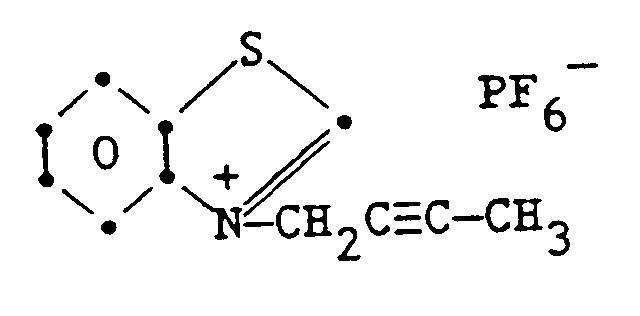
[0014] Specific compounds falling within this invention which can provide improved latent image stability in an exposed photographic silver halide emulsion include the following:
[0015] The alkynyl benzothiazolium and benzoselenazolium compounds as described can be prepared by methods known in the organic compound synthesis art. A typical method of preparation is as follows:
General Method of Synthesis
[0016] The benzothiazolium and benzoselenazolium compounds of this invention can be prepared by the route shown below. Commercially available or synthesized alcohols (I)
- R⁵
- = alkynyl group
- X¹
- = S, Se
- Tf
- = CF₃SO₂
- R⁶
- = H, halogen, alkyl, alkoxy group
Synthesis Example A (Inventive Compound 1):
[0018] Pyridine (0.79g, 0.01 mole) and dichloromethane (20 mL) were mixed in a flask equipped with a magnetic stirrer, dropping funnel, nitrogen inlet, and reflux condenser. The flask was chilled to 0° in an ice-salt bath and a nitrogen atmosphere was maintained inside. Triflic anhydride (A2) (2.82g, 0.01 mole) in dichloromethane (20 mL) was added dropwise; a white precipitate formed. The resulting mixture was stirred for 10 minutes at 0°. A solution of 2-butyn-1-ol (Al) (0.70g, 0.01 mole) in dichloromethane (20 mL) was added dropwise over 25 minutes. After the addition was complete the mixture was stirred for 30 minutes at 0°. The mixture was filtered while still cold through a pad of anhydrous sodium sulfate. The filtrate containing (A3) was added immediately to a solution of benzothiazole (A4) (1.10g, 0.008 mole) in dichloromethane (40 mL). The resulting solution was stirred at room temperature under a nitrogen atmosphere for 21 hours. The solvent was removed on a rotary evaporator to give (A5) as a tan solid. The solid was dissolved in ≃60 mL warm water. The aqueous mixture was shaken with ether. The aqueous layer was separated and potassium hexafluorophosphate (1.5g) was added with stirring. A white precipitate formed. The aqueous mixture was stirred for 30 minutes at room temperature and then was filtered. The collected solid was washed first with water and then with ether. The product (A6) was dried in a vacuum oven overnight at ≃45°. Yield 2.10g (79%) of white powder, m.p. 163-166°. A nmr spectrum was consistent with structure (A6).
| Anal. Calcd. for C₁₁H₁₀F₆NPS: | C, 39.7; | H, 3.0; | N, 4.2; | S, 9.6 |
| Found: | C, 39.9; | H, 3.0; | N, 4.2; | S, 9.4 |
[0019] The benzothiazolium and benzoselenazolium salts described herein can be added to a silver halide emulsion at any point subsequent to precipitation of the silver halide grains. Preferably, the salts are added to an emulsion after chemical and spectral sensitization, but prior to coating. However, the salts can be present during these sensitization procedures.
[0020] The optimum amount of benzothiazolium or benzoselenazolium salt added to an emulsion will depend upon various factors such as the particular salt employed, the particular silver halide emulsion used or the nature of other components of the emulsion. Useful amounts are within the range of from about 0.002 to about 10 millimoles of salt per mole of silver. Preferably, the salt is incorporated in the emulsion in an amount of from about 0.02 to about 0.5 millimole per mole of silver.
[0021] The silver halide emulsions as described can be any of the silver halide emulsions known in the art which are desirably protected against latent image instability or fading. The silver halide emulsions can be comprised of silver bromide, silver chloride, silver chlorobromide, silver chloroiodide, silver bromoiodide, silver chlorobromoiodide or mixtures thereof. The emulsions can include coarse, medium or fine grains and can be monodisperse or polydisperse.
[0022] The silver halide emulsions are preferably surface latent image-forming emulsions. They can be chemically sensitized as illustrated by T. H. James, The Theory of the Photographic Process, 4th Ed., MacMillan, 1977, pp. 67-76, or with sulfur, selenium, tellurium, gold, platinum, palladium, iridium, osmium, rhenium or phosphorus sensitizers, or combinations of these sensitizers, as illustrated by Research Disclosure, Vol. 134, June 1975, Item 13452, or in U. S. Patent Nos. 1,623,499; 1,673,522; 2,399,083; 2,642,361; 3,297,447; 3,297,446; 1,315,755; 3,772,031; 3,761,267; 3,857,711; 3,565,633; 3,901,714 and 3,904,415 and U. K. Patent No. 1,396,696.
[0023] Chemical sensitization can optionally be conducted in the presence of thiocyanate derivatives, as described in U. S. Patent Nos. 2,222,264 and 2,642,361; thioether compounds, as disclosed in U. S. Patent Nos. 2,521,926; 3,021,215 and 4,054,457; or azaindenes, azapyridazines and azapyrimidines, as described in U. S. Patent Nos. 3,411,914; 3,554,757; 3,565,631 and 3,901,714. Additionally or alternatively, the emulsions can be reduction sensitized e.g., with hydrogen, as illustrated by U. S. Patent Nos. 3,891,446 and 3,984,249 by low pAg (e.g., less than 5), high pH (e.g., greater than 8) treatment or through the use of reducing agents, such as stannous chloride, thiourea diazide, polyamines and amineboranes, as illustrated by Research Disclosure, Vol. 136, August 1975, Item 13654, or U. S. Patent Nos. 2,518,696; 2,739,060; 2,743,182; 2,743,183; 2,983,609; 3,026,203 and 3,361,564 (Research Disclosure is published by Kenneth Mason Publications, Ltd., Dudley Annex, 12a North Street, Enisworth, Hampshire, P0107DQ England.)
[0024] The silver halide emulsions can be spectrally sensitized with dyes from a variety of classes, including the polymethine dye class, which includes the cyanines, merocyanines, complex cyanines and merocyanines (i.e., tri-, tetra-, and poly-nuclear cyanines and merocyanines), oxonols, hemioxonols, styryls, merostyryls and streptocyanines. Particularly useful dyes are benzoxazole, benzimidazole and benzothiazole carbocyanine dyes.
[0025] The photographic silver halide emulsions can contain various colloids alone or in combination as vehicles. Suitable hydrophilic materials as well as hardeners therefore, are described in Research Disclosure, December 1989, Item 308119, Sections IX and X.
[0026] The photographic silver halide emulsions and elements employing the stabilizing agents of this invention can contain other addenda conventional in the photographic art. Useful addenda are described, for example, in Research Disclosure, December 1989, Item 308119 and include antifoggants, couplers (such as dye forming couplers, masking couplers, DIR and DIAR couplers), anti-stain agents, image dye stabilizers, absorbing materials such as filter dyes and UV absorbers, light scattering materials, coating aids, plasticizers and lubricants.
[0027] The photographic recording materials described herein can be black-and-white or monochrome materials or they can be multilayer and/or multicolor elements comprising a support bearing one or more layers of a silver halide emulsion. These materials can be designed for processing in conventional developer solutions. Multicolor elements can contain dye image forming units sensitive to each of the three primary regions of the spectrum. Each unit can be comprised of a single emulsion layer or of multiple emulsion layers sensitive to a given region of the spectrum. The layers of the element, including the layers of the image-forming units, can be arranged in various orders as known in the art. In an alternative format, the emulsion or emulsions can be disposed as one or more segmented layers.
[0028] A preferred color photographic recording material according to this invention comprises a support bearing at least one blue-sensitive silver halide emulsion layer having associated therewith a yellow dye-forming coupler, at least one green-sensitive silver halide emulsion layer having associated therewith a magenta dye-forming coupler and at least one red-sensitive silver halide emulsion layer having associated therewith a cyan dye-forming coupler, at least one of the silver halide emulsion layers containing a latent image stabilizing compound of this invention. In accordance with a particularly preferred aspect of the present invention, the stabilizing compound is contained in a yellow dye-forming blue-sensitive silver halide emulsion.
[0029] The photographic recording materials of the present invention can contain additional layers conventional in photographic elements, such as overcoat layers, spacer layers, filter layers, antihalation layers, scavenger layers and the like. The support can be any suitable support used with photographic elements. Typical supports include polymeric films, paper (including polymer-coated paper), glass and the like. Details regarding supports and other layers of the photographic elements of this invention are contained in Research Disclosure, December 1989, Item 308119, referred to above.
[0030] As used herein, the term "associated therewith" signifies that the stabilizing compound is in a silver halide emulsion layer or in an adjacent layer so that the materials contained therein are accessible to one another.
Example 1 - Color Photographic Evaluation
[0032] Benzothiazolium salts as latent image keeping agents were evaluated in a color negative test. The Emulsion I used was a 1.6 micrometer equivalent circular diameter, .12 micrometer thick tabular silver bromoiodide emulsion containing 6 mol % iodide. The emulsion was sulfur and gold sensitized with a yellow optical sensitizing dye. This emulsion was coated in a two layer monochrome with a protective overcoat over the image layer. The image layer contained the emulsion, a yellow dye forming coupler, and the latent image keeping agents coated both at .02 and .10 mmole/mole Ag. The melt pH was 5.9 and the melt pAg was 7.9. The latent image keeping coatings were exposed for 1/100 second and were incubated at 25°C, 50% RH for four weeks.
[0033] A similar color negative test was carried out with a similar silver bromoiodide emulsion (Emulsion II) containing 3 mol % iodide.
[0034] The check coatings were stored at -18°C and then were exposed. Both coatings were processed in a C-41 process with a commercial bleach (C-41 is a tradename and available from Eastman Kodak Company, U.S.A.). The processed coatings were read with status M densitometry. Results are reported in Table 1.
1. A photographic recording material comprising a support and a photographic silver halide
emulsion which has associated therewith a benzothiazolium or benzoselenazolium salt
having the structural formula:
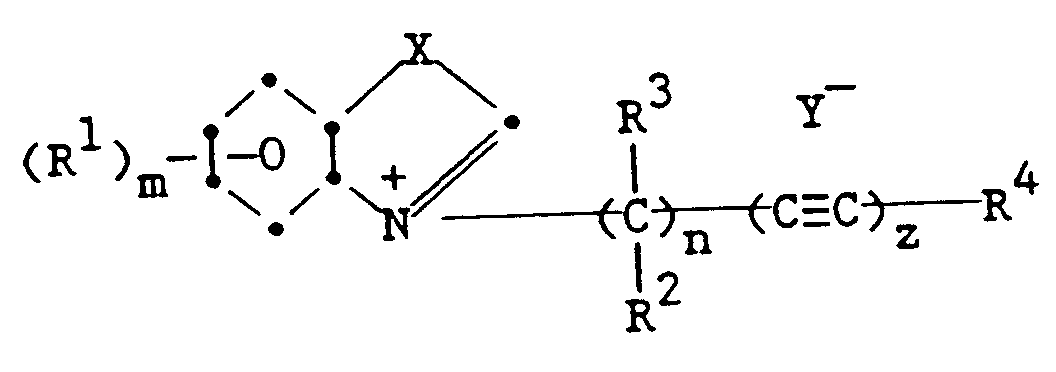
wherein:
X is sulfur or selenium;
R¹ is hydrogen, halogen, alkyl containing 1 to 5 carbon atoms or alkoxy containing 1 to 5 carbon atoms;
R² and R³ individually are hydrogen or alkyl containing 1 to 5 carbon atoms;
Y is a counterbalancing ion;
z is 1 or 2;
m is 0 to 4;
n is 1 to 4; and,
R⁴ is unsubstituted or substituted alkyl or aryl;
wherein:
X is sulfur or selenium;
R¹ is hydrogen, halogen, alkyl containing 1 to 5 carbon atoms or alkoxy containing 1 to 5 carbon atoms;
R² and R³ individually are hydrogen or alkyl containing 1 to 5 carbon atoms;
Y is a counterbalancing ion;
z is 1 or 2;
m is 0 to 4;
n is 1 to 4; and,
R⁴ is unsubstituted or substituted alkyl or aryl;
2. The recording material as claimed in any of claim 1 wherein R¹ is hydrogen.
3. The recording material as claimed in any of claims 1 - 2 wherein R¹ is chlorine.
4. The recording material as claimed in any of claims 1 - 3 wherein R¹ is alkyl or alkoxy
having from 1 to 5 carbon atoms.
5. The recording material as claimed in any of claims 1 - 4 wherein R⁴ is alkyl containing
1 to 3 carbon atoms; R¹, R² and R³ are hydrogen; n is 1 and z is 1.
6. The recording material as claimed in any of claims 1 - 5 wherein the salt is present
in an amount of from 0.002 to about 10 millimoles thereof per mole of silver.
7. The recording material as claimed in any of claims 1 - 6 wherein the salt is present
in an amount of from 0.02 to about 0.5 millimole thereof per mole of silver.
8. The recording material as claimed in any of claims 1 - 7 which is a color photographic
recording material.
9. The recording material as claimed in any of claims 1 - 8 wherein the salt has the
structural formula:
10. The recording material as claimed in any of claims 1 - 9 wherein the photographic
silver halide emulsion is a tabular grain photographic silver halide emulsion.