|
(11) | EP 0 490 567 A1 |

| (12) | EUROPEAN PATENT APPLICATION |
|
|
|
|
|||||||||||||||||||||||||||
| (54) | The use of halogen-containing organic stabilizers for 3-isothiazolones |
| (57) A method of stabilizing 3-isothiazolones against chemical degradation in antagonistic
environments by the use of certain activated halogen compounds is disclosed. Compositions
including 3-isothiazolones and alkyl halohydantoins, halo-substituted triazinetriones,
N-halosuccinimides, p-toluenesulfonyl halides, haloacetic acids and alkyl sulfamoyl
halides are found to be particularly stable in metal working fluids and latex paints. |
[0001] This invention concerns the stabilization of 3-isothiazolone compounds by the incorporation with those compounds of certain halogen-containing organic compounds.
[0002] Isothiazolones have generated high commercial interest as microbicides to prevent spoilage of certain aqueous and non-aqueous products caused by microorganisms. Isothiazolones are highly effective microbicides (as used herein, "microbicides" includes bactericides, fungicides and algicides and microbicidal activity is intended to include both the elimination of and the inhibition or prevention of growth of microbial organisms such as bacteria, fungi and algae); by suitable choice of functional groups, they are useful in a broad range of applications. However, it has been long recognized that either in storage prior to addition to the substrate to be treated or after addition, their efficacy may be decreased because they are not stable under practical conditions of long-term storage. Means have thus been sought for some time to improve the stability of isothiazolones.
[0003] U.S.-A-3,870,795 and 4,067,878 teach the stabilization of isothiazolones against chemical decomposition by addition of a metal nitrite or metal nitrate, but teach that other common metal salts, including carbonates, sulfates, chlorates, perchlorates, and chlorides are ineffective in stabilizing solutions of isothiazolones, such solutions usually being in water or in an hydroxylic solvent.
[0004] U.S.-A-4,150,026 and 4,241,214 teach that metal salt complexes of isothiazolones are useful because they have enhanced thermal stability, while retaining biological activity.
[0005] It is known to use certain organic stabilizers for isothiazolones, generally for use situations where metal salts may create problems, such as corrosion, coagulation of latices, insolubility in non-aqueous media, interaction with the substrate to be stabilized, and the like. Formaldehyde or formaldehyde-releasing chemicals are known as stabilizers, (see U.S.-A-4,165,318 and 4,129,448), as are certain organic chemicals such as orthoesters (U. S.-A-4,906,274) and epoxides (U. S. Appln. Ser. 194,234).
[0006] Both formaldehyde or formaldehyde-releasers and salt stabilization have some drawbacks. In certain applications, however, it is desirable to avoid addition of certain organic stabilizers by virtue of their volatility, decomposition under high heat, higher cost, difficulty in handling, potential toxicity, and the like.
[0007] In actual use, copper salts, such as copper sulfate, have proved efficacious in the stabilization of isothiazolones. However, copper salts may be undesirable in effluent streams in such operations as in the manufacture of stabilized isothiazolones or in their blending into a product or the use of that product. Copper salts, especially the chlorides, may contribute to possible corrosion, or in the presence of polymers in aqueous dispersion may lead to coagulation of the dispersion.
[0008] Research Disclosure, 160, p. 28, #16047 (August 1977), describes antimicrobial synergy between certain activated halogen compounds and certain 3-isothiazolones, but does not disclose the use of the halogen compounds as stabilizers for 3-isothiazolones against chemical decomposition.
[0009] It is an object of the invention to provide a stabilization system for isothiazolones which overcomes some or all of the disadvantages of prior art systems, and which requires only low levels of stabilizer to be used.
[0010] It has been surprisingly found that isothiazolones may be stabilized against decomposition by the addition of certain halogen-containing organic compounds known as "activated" halogen compounds, to the composition containing the isothiazolone. Accordingly the invention provides in one aspect a method of stabilizing a 3-isothiazolone against chemical degradation, comprising incorporating therewith an effective amount of an activated halogen compound.
[0011] Typical isothiazolones have the formula
wherein
Y is an unsubstituted or substituted (C₁ - C₁₈)alkyl, an unsubstituted or substituted (C₃ - C₁₂)cycloalkyl, an unsubstituted or halogen-substituted (C₂-C₈)alkenyl or alkynyl, an unsubstituted or substituted (C₇-C₁₀)aralkyl, or an unsubstituted or substituted aryl; and
R and R¹ is each independently H, halogen or (C₁-C₄)alkyl.
[0012] In another aspect, the invention comprises the use of an activated halogen compound as a stabilizer for 3-isothiazolones. The invention also encompasses compositions comprising isothiazolones and a stabilizing amount of activated halogen compound.
[0013] In a further aspect, the invention comprises a method for inhibiting or preventing the growth of bacteria, fungi, yeast, or algae in a locus subject or susceptible to contamination thereby, which comprises incorporating onto or into the locus, in an amount effective to adversely affect said growth, the aforementioned composition of isothiazolone and activated halogen compound.
The isothiazolones which are stabilized include those disclosed in U.S.-A-3,523,121 and 3,761,488 and are represented by the formula
as defined above. In particular Y may be a (C₁-C₁₈)alkyl or (C₃-C₁₂)cycloalkyl each optionally substituted with one or more of hydroxy, halo, cyano, alkylamino, dialkylamino, arylamino, carboxy, carbalkoxy, alkoxy, aryloxy, alkylthio, arylthio, haloalkoxy, cycloalkylamino, carbamoxy, or isothiazolonyl; and unsubstituted or halo-substituted (C₂-C₈)alkenyl or alkynyl; a (C₇-C₁₀)aralkyl optionally substituted with one or more of halogen, (C₁-C₄)alkyl or (C₁-C₄)alkoxy; and an aryl optionally substituted with one or more of halogen, nitro, (C₁-C₄)alkyl, (C₁-C₄)alkyl-acylamino, carb(C₁-C₄)alkoxy or sulfamyl.
[0014] Preferred substituents for Y are substituted or unsubstituted (C₁-C₁₈)alkyl or (C₃-C₁₂)cycloalkyl; R is preferred to be H, methyl or Cl; and R¹ is preferred to be H or Cl. Representative of such preferred Y substituents are methyl, ethyl, propyl, isopropyl, butyl, hexyl, octyl, cyclohexyl, benzyl, 3,4-dichlorobenzyl, 4-methoxybenzyl, 4-chlorobenzyl, 3,4-dichlorophenyl, 4-methoxyphenyl, hydroxymethyl, chloromethyl, chloropropyl, hydrogen, and the like.
[0015] Particularly preferred isothiazolones are 5-chloro-2-methyl-3-isothiazolone, 2-methyl-3-isothiazolone, 2-n-octyl-3-isothiazolone, 4,5-dichloro-2-cyclohexyl-3-isothiazolone and 4,5-dichloro-2-octyl-3-isothiazolone.
[0016] Most preferred is 5-chloro-2-methyl-3-isothiazolone, either as a sole compound or in admixture with 2-methyl-3-isothiazolone. When in admixture, the preferred ratio of monochlorinated/unchlorinated isothiazolone is from about 70:30 to about 85:15, and an especially preferred ratio is from about 70:30 to about 80:20. A second especially preferred isothiazolone is 2-methyl-3-isothiazolone in combination with low levels of 5-chloro-2-methyl-3-isothiazolone, a preferred ratio being from about 98:2 to about 96:4, and an especially preferred ratio being about 97:3.
[0017] Preferred activated halogen-containing organic compounds are alkyl halohydantoins, halo-substituted triazinetriones, N-halosuccinimides, p-toluenesulfonyl halides, and alkyl sulfamoyl halides. Particularly preferred specific compounds include dichlorodimethylhydantoin, bromochlorodimethylhydantoin and N-bromosuccinimide.
[0018] Some halogen-containing organic compounds are known to have microbicidal activity, although their efficacy as stabilizers of isothiazolones has not previously been appreciated. Such compounds will be particularly desirable to use as stabilizers; examples are 1,3-dichloro-5,5-dimethylhydantoin and 3-bromo-1-chloro-5,5-dimethylhydantoin.
[0019] Among the activated halogen compounds which are useful for the stabilization of 3-isothiazolones in antagonistic environments are: N-halosuccinimides (N-bromosuccinimide, N-iodosuccinimide), haloalkylhydantoins (1,3-dibromo-5,5-dimethylhydantoin, 1,3-dichloro-5,5-dimethylhydantoin, 3-bromo-1-chloro-5,5-dimethyohydantoin), b-bromostyrene, a-chlorocinnamaldehyde, dimethyl sulfamoyl chloride, 2,2-dibromo-3-nitrilopropionamide, bromo-b-nitrostyrene, bis-(trichloromethyl)sulfone, p-tolyldiiodomethyl sulfone, 2-bromo-2-nitropropanediol, 5-bromo-2-nitro-1,3-dioxane, 1,2-dibromo-2,4-dicyanobutone, haloacetic acids (chloroacetic acid, bromoacetic acid, iodoacetic acid, trichloroacetic acid), p-toluenesulfonyl chloride, p-toluenesulfonyl chloramine sodium salt (Chloramine T), bromomaleic anhydride, trichloroisocyanuric acid (1,3,5-trichlorotriazinetrione), polyvinylpyrrolidone (povidone) I₂ complex, morpholine I₂ complex, 5-chlorobenzotriazole and ethyl dichlorophosphate.
[0020] The composition may contain from about 0.01 to about 99.9999 parts of the one or more isothiazolones, and from about 0.0001 to about 99.9 parts of the halogen-containing organic compound.
[0021] Generally, compositions formed in accordance with the invention will be in the form of a solution. Typical formulation ranges are illustrated in the following Table (all percentages are parts by weight) for both a concentrated solution of the isothiazolone and a dilute solution. For certain uses, such as shipping of large quantities, more concentrated solutions may also be utilized.
[0022] Solvents may be used to dissolve the isothiazolones and may be any organic solvent which dissolves the isothiazolones, is compatible with the proposed end use, does not destabilize the isothiazolone, and does not react with the halogen-containing organic compound to eliminate its stabilizing action.
[0023] Hydroxylic solvents, for example, polyols, such as glycols, alcohols and the like, may be used. Under conditions of high dilution and high ratios of stabilizer to isothiazolone, glycols may be successfully used. In certain formulations, hydrocarbons, either aliphatic or aromatic, are useful solvents.
[0024] Preferred solvents are capped polyols, wherein the free hydroxyl group is replaced with an ether or ester function. Especially preferred are 2,5,8,11-tetraoxadodecane, commonly known as triethylene glycol dimethyl ether, and 3,6-dioxadecanol-1 acetate, commonly known as diethylene glycol butyl ether acetate.
[0025] Water is a solvent for certain of the preferred isothiazolones and the halogen-containing organic compound may be employed in aqueous formulations.
[0026] The amounts of halogen-containing organic compound employed will vary depending on use conditions and concentrations of the isothiazolone in the mixture: effective amounts of halogen-containing organic compounds based on isothiazolone may be ratios in the range of from about 1:100 to about 1000:1 stabilizer to isothiazolone. In concentrated solutions, ratios are generally from about 1:50 to about 50:1. Obviously higher amounts may be used, but at additional cost. At high levels of dilution of the isothiazolone (such as from 1 to 10,000 ppm isothiazolone in the solvent), the ratio of stabilizer to isothiazolone can range from about 1:10 to about 20:1. The preferred range is from 1:1 to 20:1.
[0027] The stabilization advantages of the halogen-containing organic compounds of the present invention are noted even when the isothiazolone contains other salt stabilizers, such as those recorded in U.S.-A- 3,870,795, 4,067,878, 4,150,026 and 4,241,214.
[0028] Uses of these new organically stabilized microbicides are typically at any locus subject to contamination by bacteria, fungi, yeast or algae. Typically loci are in aqueous systems such as water cooling, laundry rinse water, oil systems such as cutting oils, oil fields and the like where microorganisms need to be killed or where their growth needs to be controlled. However, these stabilized microbicides may also be used in all applications for which known microbicidal compositions are useful; preferred utilities of the compositions are to protect wood, paint, adhesive, glue, paper, textile, leather, plastics, cardboard, lubricants, cosmetics, food, caulking, feed and industrial cooling water from microorganisms.
[0030] Because isothiazolones are so active as microbicides and only low levels of halogen-containing organic compounds are required to achieve stabilization, the amount of halogen-containing organic compound in systems being treated will be very small, and therefore it is not likely to interfere with other components in systems requiring protection or with systems to which the protected systems will be applied. Potential areas of general application include metal-working fluids, cooling water, and air washers.
[0031] One significant area of application for the compositions of the invention is as microbicides in metal working fluids. Metal working fluids are proprietary combinations of chemicals, which may contain, inter alia, ingredients such as alkanolamines, petroleum sulfonate surfactants, oils (naphthenic, paraffinic, etc.), chlorinated paraffins and fatty esters, sulfurized fatty compounds, phosphate esters, fatty acids and their amine salts, glycols, polyglycols, boric acid esters and amides. They are utilized in the milling, machining, drilling, and other processing technologies for fabricating metal for the purposes of lubricating, cooling, preventing surface corrosion, and the like. They are sold in the form of active metal working fluids (MWF) concentrate, and are diluted in use to 1-10% active ingredients in water.
[0032] Because metal working fluids are recycled and stored, the growth of microorganisms is favored. Isothiazelones have been found effective in preventing the growth of such organisms. Certain of the components in the metal working fluids will tend to destroy the isothiazolone and so remove its microbicidal protective activity, so that stabilizers for the isothiazolone against such degradation are desirable.
[0033] It is known in the art that the performance of microbicides may be enhanced by combination with one or more other microbicides. Thus, other known microbicides may be combined advantageously with the composition of this invention.
[0034] The following examples are intended to illustrate the present invention and not to limit it except as it is limited by the claims. All percentages are by weight unless otherwise specified, and all reagents are of good commercial quality unless otherwise specified. Methods for quantitative determination of the isothiazolones in the following examples in metal-working fluids are described in detail in "Kathon® 886 MW Microbicide and Kathon® 893 MW Fungicide: Analysis in Metalworking Fluids by High-Performance Liquid Chromatography", 1988, Rohm and Haas Company.
EXAMPLE 1
[0035] These examples demonstrate the stabilizing effect of halogen-containing organic compounds for isothiazolones added to metal working fluids (MWF). MWF concentrate A was a "semi-synthetic" type having about 10 to 15 percent naphthenic/paraffinic oil, about 50 percent water, emulsifying agents, pH adjusting amines, anticorrosive agents, and EP (extreme pressure) agents.
[0036] Into a glass vial in the following order were placed: a) 5 parts by weight of the MWF concentrate solution, b) 5 parts of the stabilizer in solution or dispersion, c) 5 parts water, d) 5 parts of an aqueous solution containing 80 ppm active ingredient (AI), prepared by dilution of a 14.4% aqueous solution of an approximately 75 / 25 mixture of 5-chloro-2-methyl-3-isothiazolone and 2-methyl-3-isothiazolone, the former being considered the active ingredient for these purposes; also present was 9.2 weight percent magnesium chloride and 15.7% magnesium nitrate. Thus the final mixture contained 3-5% of the MWF concentrate, 20 ppm active ingredient of the isothiazolone, and 0 (control) to 1,000 ppm of the stabilizer.
[0037] The vials were then capped, stored at ambient room temperature in a closed cabinet for a designated time, filtered through a 0.45 micron filter into another vial and analyzed the same day. The relative concentration of the active ingredient was determined by reverse phase high pressure liquid chromatography, utilizing a Varian model 5500 chromatograph and an ultraviolet detector. Tables 1, 2 and 3 summarize the results for a variety of stabilizers representing different aging conditions.
EXAMPLE 2
[0038] This example illustrates the ability of halogen-containing organic compounds to stabilize isothiazolones in the presence of typical formulations used for water treatment in cooling towers.
[0039] A synthetic cooling tower water was prepared by adding 466.4 mg sodium carbonate into a liter of deionized water. The pH was adjusted to 9.0 using concentrated hydrochloric acid. Into the solution was added 10.7 ml scale/ corrosion inhibitor stock solution (Acrysol® QR 1086, Bahibit™ AM, and CobratecR TT-50-S), then 160 mg CaCl₂ · 2H₂O and 122 mg MgCl₂ · 6H₂O. The final solution was adjusted to pH 9.0 with hydrochloric acid.
[0040] The synthetic water contained 170 ppm hardness as CaCO₃, 440 ppm alkalinity as CaCO₃, 5 ppm Acrysol® QR 1086, 5 ppm Bahibit™ AM (Phosphonate), and 2 ppm Cobratec® TT-50-S (Tolyltriazole). The hardness was 160 ppm CaCl₂ · 2H₂O and 122 ppm MgCl₂ · 6H₂O.
[0041] Isothiazolone was added at 5 ppm AI and incubated for 10 days at room temperature. AI analysis was done as described in Example 1. Results are given in Table 4.
EXAMPLE 3
[0042] This example illustrates the ability of halogen-containing organic compounds to be used in stabiliation of isothiazolones used as mildewcides in paint formulations. The water-based paint formulation was prepared from standard ingredients, utilizing a commercial acrylic-based latex with conventional pigments, dispersants, and the like. The composition is described in Table 5.
[0043] To two sealable containers were charged with 100 parts of the paint formulation. To one was charged twice the desired final stabiliaer concentration, and to the other, twice the desired isothiazolone concentration. Both portions were homogenized for 15 minutes each, then blended and re-mixed. The sealed containers were stored at 60°C. Samples were removed at 0, 5 and 10 days.
[0044] To 1 part of the sample was added 9 parts propylene glycol, the diluted sample shaken for one hour, centrifuged at 70,000 rpm for 30 minutes, the supernatant diluted with two volumes of methanol, and that solution filtered through a 0.45 micron filter. The filtered sample was injected directly into the HPLC described in Example 1. Appropriate analytical calibrations were made for the various isothiazolones studied.
[0045] The 4,5-dichloro-2-octyl-3-isothiazolone was added as a 34% solution in xylene. No other salt was present with the 4,5-dichloro-2-octyl-3-isothiazolone when added to form the test mixture. The following formulation is a typical paint blend for testing of stabilization against microbial activity. Texanol® is trimethyl- 1,3-pentanediol monisobutyrate supplied by Eastman Chemical. "Latex" is a latex of a copolymer of butyl acrylate and methyl methacrylate.
In Table 6 are presented results for 10 days ageing at 60°C.
1. Method of stabilizing a 3-isothiazolone against chemical degradation, comprising incorporating
therewith an effective amount of an activated halogen compound.
2. Method according to claim 1 wherein said activated halogen compound is an alkyl halohydantoin,
haloacetic acid, halo-substituted triazinetrione, N-halosuccinimide, p-toluenesulfonyl
halide, alkyl sulfamoyl halide, a-chlorocinnoamaldehyde, p-toluenesulfonyl chloramine
sodium salt (chloramine T), bromomaleic anhydride, polyvinylpyrrolidone I₂ complex,
morpholine I₂ complex, 5-chlorobenzotriazole, or ethyl dichlorophosphate.
3. Method according to claim 1 or 2, wherein said activated halogen compound is N-bromosuccinimide,
N-iodosuccinimide, 1,3-dibromo-5,5-dimethylhydantoin, b-bromostyrene, dimethyl sulfamoyl
chloride, 2,2-dibromo-3-nitrilopropionamide, bromo-b-nitrostyrene, bis-(trichloromethyl)sulfone, p-tolyldiiodomethyl sulfone, 2-bromo-2-nitropropanediol,
5-bromo-2-nitro-1,3-dioxane, 1,2-dibromo-2,4-dicyanobutone, chloroacetic acid, bromoacetic
acid, iodoacetic acid, trichloroacetic acid, p-toluenesulfonyl chloride, or trichloroisocyanuric
acid (1,3,5-trichlorotriazinetrione), preferably 1,3-dichloro-5,5-dimethylhydantoin
or 3-bromo-1-chloro-5,5-dimethylhydantoin.
4. Method according to any preceding claim wherein said activated halogen compound is
combined in a weight ratio to 3-isothiazolone of from 1:10 to 100:1, preferably from
1:1 to 20:1.
5. Method according to any preceding claim wherein said 3-isothiazolone is of the formula
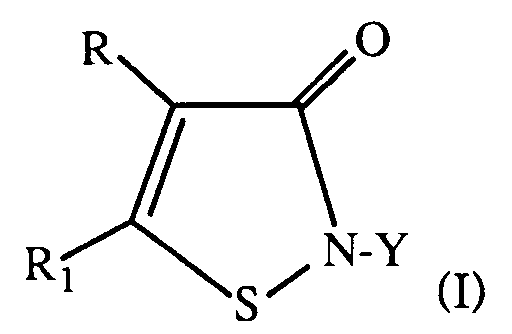
wherein Y is (C₁-C₈)alkyl or (C₃-C₁₂)cycloalkyl each optionally substituted with one or more of hydroxy, halo, cyano, alkylamino, dialkylamino, arylamino, carboxy, carbalkoxy, alkoxy, aryloxy, alkylthio, arylthio, haloalkoxy, cycloalkylamino, carbamoxy, or isothiazolonyl; an unsubstituted or halo-substituted (C₂-C₈)alkenyl or alkynyl; a (C₇-C₁₀)aralkyl optionally substituted with one or more of halogen, (C₁-C₄)alkyl or (C₁-C₄)alkoxy; or aryl optionally substituted with one or more of halogen, nitro, (C₁-C₄)alkyl-acylamino, carb(C₁-C₄)alkoxy or sulfamyl; and R and R₁ are each independently H, halogen or (C₁-C₄)alkyl.
wherein Y is (C₁-C₈)alkyl or (C₃-C₁₂)cycloalkyl each optionally substituted with one or more of hydroxy, halo, cyano, alkylamino, dialkylamino, arylamino, carboxy, carbalkoxy, alkoxy, aryloxy, alkylthio, arylthio, haloalkoxy, cycloalkylamino, carbamoxy, or isothiazolonyl; an unsubstituted or halo-substituted (C₂-C₈)alkenyl or alkynyl; a (C₇-C₁₀)aralkyl optionally substituted with one or more of halogen, (C₁-C₄)alkyl or (C₁-C₄)alkoxy; or aryl optionally substituted with one or more of halogen, nitro, (C₁-C₄)alkyl-acylamino, carb(C₁-C₄)alkoxy or sulfamyl; and R and R₁ are each independently H, halogen or (C₁-C₄)alkyl.
6. Method of preventing or inhibiting the growth of bacteria, fungi or algae in a locus
susceptible or subject thereto, comprising incorporating into or onto said locus,
in an amount effective to adversely affect said growth, a composition comprising a
3-isothiazolone and an activated halogen compound as defined in any of claims 1 to
4.
7. Method according to claim 6, wherein said locus is a metal working fluid, latex paint,
bulk latex, cosmetic or surfactant.
8. Use of an activated halogen compound as defined in any of claims 1 to 4 as a stabilizer
for 3-isothiazolones.
9. Composition comprising a 3-isothiazolone, an activated halogen compound as deined
in any of claims 1 to 4 in an amount sufficient to stabilize said isothiazolone against
chemical degradation, and optionally a solvent, preferably a polyol solvent.