|
(11) | EP 0 492 171 A1 |

| (12) | EUROPEAN PATENT APPLICATION |
|
|
|
|
|||||||||||||||||||||||||||
| (54) | 2-Aryl-5-trifluoromethyl)-2-pyrroline compounds and process for the manufacture of insecticidal, 2-aryl-1-(alkoxymethyl)-4-halo-5-(trofluoromethyl) pyrroles |
| (57) There are provided important pyrroline and glycine intermediates, methods for the
preparation of said intermediates and the use thereof in the manufacture of arylpyrrole
insecticidal agents. |
[0001] It is an object of this invention to present more useful intermediates for the process of manufacture of a variety of insecticidal, acaricidal and nematocidal arylpyrrole compounds and a method for the preparation of said intermediates.
[0002] It is also an object of this invention to provide a process for the manufacture of 4-halo-2-aryl-1-(alkoxymethyl)-5-(trifluoromethyl)pyrrole compounds which are useful for controlling insect, acarid and nematode pests and for protecting harvested and growing crops from said pests.
[0003] It is another object of this invention to provide intermediate 4-halo-2-aryl-1-(halomethyl)-5-(trifluoromethyl)pyrrole compounds.
[0004] It is a further object of this invention to provide an insecticidal, acaricidal and nematocidal agent 4-chloro-1-(ethoxymethyl)-2-(p-chlorophenyl)-5-(trifluoromethyl)pyrrole-3-carbonitrile and a method for its use to protect harvested and growing crops.
[0005] The present invention relates to compounds of formula I
wherein
A is hydrogen or C₁-C₄ alkyl;
W is CN, NO₂ or CO₂R₆;
L is hydrogen or halogen and
M and R are each independently hydrogen, C₁-C₄ alkyl, C₁-C₄ alkoxy, C₁-C₄ alkylthio, C₁-C₄ alkylsulfinyl, C₁-C₄ alkylsulfonyl, cyano, nitro, halogen, CF₃, R₁CF₂Z, R₂CO or NR₃R₄ and when M and R are on adjacent positions they may be taken together with the carbon atoms to which they are attached to form a ring in which MR represents the structure
-OCH₂O-, -OCF₂O- or -CH=CH-CH=CH-;
Z is S(O)n or O;
R₁ is hydrogen, F, CHF₂, CHFCl or CF₃;
R₂ is C₁-C₄ alkyl, C₁-C₄ alkoxy or NR₃R₄;
R₃ is hydrogen or C₁-C₄ alkyl;
R₄ is hydrogen, C₁-C₄ alkyl or R₅CO;
R₅ is hydrogen or C₁-C₄ alkyl and
R₆ is C₁-C₆ alkyl, C₃-C₆ cycloalkyl or phenyl;
n is an integer of 0, 1 or 2.
[0006] The present invention also relates to compounds of formula II
wherein A, L, M and R are as described above for formula I with the proviso that when A is hydrogen, then at least one of L, M and R must be other than hydrogen.
[0007] This invention also relates to a method for the preparation of the above compounds and their use in the manufacture of arylpyrrole insecticidal agents.
[0008] In addition, this invention is directed to a process for the manufacture of insecticidal arylpyrrole compounds of formula IV
wherein R₁ is C₁-C₆ alkyl;
W is CN, NO₂ or CO₂R₂;
X is Br, Cl or I;
L is hydrogen or halogen;
M and R are each independently hydrogen, C₁-C₄ alkyl, C₁-C₄ alkoxy, C₁-C₄ alkylthio, C₁-C₄ alkylsulfinyl, C₁-C₄ alkylsulfonyl, CN, NO₂, Cl, Br, F, I, CF₃, R₃CF₂Z, R₄CO or NR₅R₆ and when M and R are on adjacent positions they may be taken together with the carbon atoms to which they are attached to form a ring in which MR represents the structure
-OCH₂O-, -OCF₂O- or -CH=CH-CH=CH-;
R₂ is C₁-C₆ alkyl, C₃-C₆ cycloalkyl or phenyl;
R₃ is hydrogen, F, CHF₂, CHFCl or CF₃;
R₄ is C₁-C₄ alkyl, C₁-C₄ alkoxy or NR₅R₆;
R₅ is hydrogen or C₁-C₄ alkyl;
R₆ is hydrogen, C₁-C₄ alkyl or R₇CO;
R₇ is hydrogen or C₁-C₄ alkyl;
Z is S(O)n or O and
n is an integer of 0, 1 or 2 which comprises reacting a compound of formula V
wherein W, L, M and R are as described hereinabove with at least 1 molar equivalent of a halogen, X₂, wherein X₂ is Br, Cl or I, preferably at an elevated temperature in the presence of a solvent to obtain a 2-aryl-1-methylpyrrole intermediate, reacting said 1-methylpyrrole intermediate with at least one additional molar equivalent of said halogen to form a 2-aryl-4-halo-1-methylpyrrole intermediate, reacting said 4-halo-1-methylpyrrole intermediate further with at least one molar equivalent of said halogen in the presence of a radical initiator to form a 2-aryl-4-halo-1-(halomethyl)pyrrole intermediate and reacting said 4-halo-1-(halomethyl)pyrrole intermediate with at least one molar equivalent of an alkali metal C₁-C₆alkoxide to give the compound of formula IV.
[0009] Compounds of formula I may be prepared by reacting compounds of formula II with about 1.0 molar equivalent of an activated olefin of formula III
H₂C=CHW (III)
wherein W is CN, NO₂ or CO₂R₆ and R₆ is C₁-C₆ alkyl, C₃-C₆ cycloalkyl or phenyl in the presence of an acid anhydride and a solvent, optionally in the presence of an organic base. The method of preparation is illustrated in Flow Diagram I.
[0010] Solvents that may be used in the method of invention include aprotic organic solvents for example nitriles such as acetonitrile; esters such as ethyl acetate, methyl propionate and the like; ethers such as diethyl ether, tetrahydrofuran, dioxane, ethylene glycol dimethyl ether and the like; halogenated hydrocarbons such as methylene chloride, 1,2-dichloroethane, chloroform, 1,1,1-trichloroethane, carbon tetrachloride and the like; carboxylic acid amides such as N,N-dimethylformamide, N-methylpyrrolidinone and the like; sulfoxides such as dimethyl sulfoxide; sulfones such as tetramethylene sulfone; aromatic hydrocarbons such as benzene, toluene, xylene and the like; halogenated aromatic hydrocarbons such as chlorobenzene, o-dichlorobenzene and the like. One of the preferred organic solvents is acetonitrile. Acid anhydrides suitable for use in the method of invention are lower-alkyl anhydrides such as acetic anhydride. Among the organic bases that may be used in the inventive method are pyridine, morpholine, tri(C₁-C₄)alkylamine, hexamethylenetetramine, dimethylamino pyridine and the like. A preferred organic base is a tri(C₁-C₄)alkylamine such as triethylamine.
[0011] Compounds of formula II may be prepared from the appropriate arylaldehyde and suitable amine precursor via a Strecker synthesis to form the amino acid intermediate of formula III which may be trifluoroacetylated to obtain the desired formula II compound as shown in Flow Diagram II.
[0012] Compounds of formula II wherein A is hydrogen may also be prepared via trifluoroacetylation of the appropriate arylglycine precursor. Alkylation of the thus-obtained compound using an alkylating agent such as a lower alkylhalide gives compounds of formula II wherein A is C₁-C₄ alkyl. Using methyl iodide as the alkylating agent, the reaction sequence is illustrated in flow diagram III.
[0013] The compounds of the invention are intermediates in the manufacture of a variety of arylpyrroles useful as insecticidal, nematocidal and acaricidal agents. Among the arylpyrrole insecticidal agents that may be prepared from the compounds of the invention are 4-halo-2-(p-chlorophenyl)-1-(substituted)-5-(trifluoromethyl)pyrrole-3-carbonitrile compounds. In one example of the method of the invention, the formula I pyrroline compound wherein A is methyl, W is CN, L and R are hydrogen and M is Cl may be reacted with a halogen in the presence of an aprotic solvent at an elevated temperature to give insecticidal arylpyrrole agents of formulas IV and V wherein X is chlorine, bromine or iodine. Further reaction with additional halogen in the presence of a radical initiator such as benzoyl peroxide, 2,2'-azobisisobutyronitrile, photochemical irradiation and the like yields the corresponding 1-(halomethyl)pyrrole intermediate of formula VI which can be reacted with an alkali metal alkoxide such as sodium ethoxide, potassium methoxide or the like to give an arylpyrrole insecticidal agent of formula VII. The reactions are shown in Flow Diagram IV.
[0014] By varying the substituents A, W, L, M and R, the halogen reactant and the reaction conditions, a wide variety of arylpyrrole insecticidal, nematocidal and acaricidal agents may be manufactured from the compounds of formula I.
[0015] The compounds of formula V are particularly effective for controlling insect, acarid and nematode pests and for protecting agronomic crops, both growing and harvested, against the ravages of these pests. Methods of preparation for the compounds generally include halogenation of 2-aryl-5-(trifluoromethyl)pyrrole-3-carbonitrile with a halogenating agent such as a hypohalite, a halogen or a sulfurylhalide to form the corresponding 4-halopyrrole intermediate and alkylating said intermediate with an appropriate chloromethyl(C₁-C₆ alkyl)ether.
[0016] It has now been found that compounds of formula I, particularly wherein X is chlorine, may be readily and efficiently manufactured from pyrroline compounds of formula II by the incremental addition of the appropriate halogen in the presence of a solvent preferably at an elevated temperature to form a 4-halo-1-methylpyrrole intermediate of formula III, the in situ reaction of formula III intermediate with additional halogen in the presence of a radical initiator to form a 4-halo-1-(halomethyl)pyrrole intermediate of formula IV and the reaction of formula IV intermediate with an alkali metal C₁-C₆alkoxide. Surprisingly, the desired compounds of formula I are obtained in good yields and have a high degree of purity. The process of the present invention is shown in flow diagram I.
[0017] Advantageously, it has been found that the incremental addition of halogen improves the reaction yield and product purity. The process of the invention also improves the environmental and human safety of the manufacture of compounds of formula I by avoiding the use of certain undesirable reactants such as chloromethylethylether. Further, the process of the invention includes the productive manufacture of 2-(p-chlorophenyl)-4-chloro-1-ethoxymethyl-5-(trifluoromethyl)pyrrole-3-carbonitrile, an effective insecticidal, acaricidal and nematocidal agent.
[0018] Solvents suitable for use in the process of the present invention include aprotic solvents, for example halogenated aromatic hydrocarbons such as chlorobenzene, o-dichlorobenzene and the like and halogenated hydrocarbons such as methylene chloride, carbon tetrachloride, chloroform, 1,2-dichloroethane and the like. Preferred solvents include halogenated aromatic hydrocarbons such as chlorobenzene and halogenated hydrocarbons such as carbon tetrachloride. Radical initiators suitable for use are light, peroxides such as dibenzoyl peroxide, di-t-butylperoxide, and the like; azo compounds such as azobisisobutyronitrile and the like. Among the preferred radical initiators are benzoyl peroxide and light. Alkali metal alkoxides suitable for use in the inventive method are sodium ethoxide, potassium methoxide and the like.
[0019] In the process of the invention the reaction rate is increased with increased temperature so that elevated temperatures in the range of about 55o to 210oC, preferably about 70o to 120oC, allow the oxidation, ring halogenation and side chain halogenation to proceed at an efficient and effective rate without causing undue adverse side reactions.
[0020] It is now apparent that the process of the invention includes the operative manufacture of an insecticidal, acaricidal and nematocidal agent, 2-(p-chlorophenyl)-4-chloro-1-(ethoxymethyl)-5-(trifluoromethyl)pyrrole-3-carbonitrile. The pyrrole-3-carbonitrile is effective for controlling acarina, lepodoptera, colioptera, hemiptera and the like. Among the agronomic pests that may be effectively controlled are potato beetle, cabbage looper, diamond back moth, tobacco budworm, corn earworm, beet armyworm, tobacco bollworm and the like. Crops which may be protected by the compound of the invention are lettuce, broccoli, corn, cabbage, cauliflower, tomato, cotton and so forth.
[0021] In practice, generally about 10 ppm to 10,000 ppm, preferably about 100 to 5,000 ppm of 2-(p-chlorophenyl)-4-chloro-1-(ethoxymethyl)-5-(trifluoromethyl)pyrrole-3-carbonitrile dispersed in water or other suitable liquid carrier, is effective when applied to the crops or the soil in which the crops are growing to protect the crops from attack by insects, acarina and nematodes. The compound is also effective for protecting horticultural plants such as turf grass from attack by pests such as grubs, chinch bugs and the like.
[0022] While the 4-chloro-1-(ethoxymethyl)pyrrole compound of the invention is effective for controlling insects, acarina and nematodes when employed alone, it may also be used in combination with other pesticidal compounds including other nematocides and acaricides. For example, the compound of this invention may be employed effectively in combination with other arylpyrroles, phosphates, carbamates, pyrethroids, formamidines, chlorinated hydrocarbons, halobenzoylureas and the like.
[0023] In order to facilitate a further understanding of the invention, the following examples are presented to illustrate more specific details thereof. The invention is not to be limited thereby except as defined in the claims. The term NMR designates nuclear magnetic resonance and the term HPLC designates high pressure liquid chromatography. Unless otherwise noted, all parts are parts by weight.
EXAMPLE 1
[0025] A mixture of p-chlorobenzaldehyde (153 g, 1.0 mol) in tetrahydrofuran is treated with a solution of methylamine hydrochloride (88 g, 1.3 mol) in water followed by an aqueous solution of sodium cyanide (53 g, 1.0 mol), stirred at room temperature for 16 hours and extracted with toluene. The organic extract is treated with 10 cc of pyridine followed by 50 cc of acetic anhydride (exotherm), stirred at ambient temperatures for 1/2 hour and concentrated in vacuo to give an oil residue. The residue is added to a 1:1 mixture of water and concentrated hydrochloric acid, heated at reflux temperature for 2 hours, cooled, diluted with water and neutralized to about pH 2 with 50% NaOH solution. The resultant solid precipitate is filtered and air-dried to give the title product as a white solid, 180 g (89.5% yield), mp 208-213oC.
EXAMPLE 2
[0027] A mixture of 2-(p-chlorophenyl)sarcosine (27 g, 0.135 mol) in dry toluene is treated with 20 cc of trifluoroacetic anhydride, stirred for 1 hour and concentrated in vacuo to give a solid residue. The residue is re-evaporated several times with toluene to give the title product as a red solid, 38.7 g (97% yield), mp 117-118oC, identified by NMR spectroscopy.
EXAMPLE 3
Preparation of 2-phenyl-N-(trifluoroacetyl)glycine
[0029] A mixture of DL-phenylglycine (15.1 g, 0.10 mol) in methanol is treated with triethylamine (10.1 g, 0.10 mol) and ethyl trifluoroacetate (17.8 g, 0.125 mol), stirred at room temperature for 72 hours, diluted with methanol and treated with Dowex 50x8 acidic resin. The reaction mixture is stirred for 10 minutes and filtered. The filtrate is concentrated in vacuo to give a pale yellow solid which is recrystallized from 1,2-dichloroethane to give the title product as white needles, 10.5 g (42% yield), mp 155-157oC.
EXAMPLE 4
[0031] A mixture of 2-(p-chlorophenyl)glycine (37.1 g, 0.2 mol) in methanol is treated with triethylamine (20.2 g, 0.2 mol), stirred for 10 minutes, treated dropwise with ethyl trifluoroacetate (35.5 g, 0.25 mol), stirred for 4 days, diluted with methanol and treated with Dowex 50x8-100 ion exchange resin. The reaction mixture is stirred for 10 minutes and filtered. The filter cake is washed with methanol. The filtrates are combined and concentrated in vacuo to afford a yellow solid which is recrystallized from 1,2-dichloroethane to give the title compound as white crystals, 26.4 g (46.8% yield), mp 170-172oC.
[0034] A mixture of 2-phenyl-N-(trifluoroacetyl)glycine (2.5 g, 0.01 mol) and iodomethane (11.35 g, 0.08 mol) in tetrahydrofuran is treated portionwise with a 60% dispersion of sodium hydride in mineral oil (1.2 g, 0.03 mol NaH), stirred at ambient temperatures for 1 hour, heated at reflux temperature for 17 hours, cooled to room temperature, diluted with ethyl acetate followed by 1 mL of water and concentrated in vacuo to a wet yellow solid residue. The residue is dispersed in a mixture of ether and water. The ether layer is washed with a sodium bicarbonate solution. The aqueous phases are combined, acidified with 10% HCl and extracted with ethyl acetate. The ethyl acetate extract is washed sequentially with water, sodium thiosulfate and saturated sodium chloride solution, dried over MgSO₄ and concentrated in vacuo to give a pale yellow solid which is recrystallized from methylcyclohexane to give the title compound as white crystals, 0.5 g, (19.1% yield), mp 124-126oC.
[0036]
A solution of 2-(p-chlorophenyl)-N-(trifluoromethyl)sarcosine (7.4 g, 0.02 mol) in acetonitrile is treated with acetic anhydride (5.1 g, 0.05 mol), acrylonitrile (1.6 g, 0.03 mol) and 10 drops of triethylamine, heated at reflux temperature for 5 1/2 hours, cooled and concentrated in vacuo to a red oil residue. The residue is filtered through silica-gel using 9:1 hexanes/ethyl acetate followed by mixtures of methylene chloride and ethyl acetate. The combined filtrates are concentrated in vacuo to give the title product as a red solid, 6.1 g (85% yield), identified by NMR and mass spectral analyses. A portion of the solid is recrystallized from methylene chloride to give light yellow needles, mp 158-160oC.
EXAMPLE 7
[0038] Using essentially the same procedure described in Example 6 and substituting 2-(p-chlorophenyl)-N-(trifluoroacetyl)glycine as starting material affords the title product as a light yellow solid, mp 158-160oC.
EXAMPLE 8
[0040] To a solution of 2-(p-chlorophenyl)-1-methyl-5-(trifluoromethyl)-2-pyrroline-3-carbonitrile (2.85 g, 0.01 mol) in o-dichlorobenzene is added chlorine (0.8 g, 0.011 mol); the resulting solution is stirred at room temperature for 1 hour, heated slowly to 90oC over a 2 hour period, cooled to 50oC, treated with additional chlorine (0.8 g, 0.11 mol), heated at 110oC for 24 hours, cooled to room temperature, treated with additional chlorine and concomitant additions of small portions of benzoyl peroxide and heated at 110oC for a 4 hour period or until reaction is complete by chromatographic analysis. The resultant solution is cooled, washed with sodium metabisulfite solution and concentrated in vacuo to give a residue which is crystallized by the addition of heptane to afford the title product as a white solid, mp 107-108oC.
EXAMPLE 9
[0042]
A solution of 4-chloro-1-(chloromethyl)-2-(p-chlorophenyl)-5-(trifluoromethyl)pyrrole-3-carbonitrile (2.6 g, 0.0074 mol) in tetrahydrofuran is treated with sodium ethoxide as a 21% wt/wt solution in denatured ethanol (3.6 mL, 0.0096 mol), stirred at room temperature for 1 hour, treated with an additional 2-3 drops of the sodium ethoxide solution, heated at reflux temperature for 1 hour, cooled and poured into water. The resultant precipitate is filtered, dried and recrystallized from isopropanol to afford the title product as a white solid, 1.6 g (60% yield), mp 104.0-104.5oC.
EXAMPLE 10
[0044] A mixture of 2-(p-chlorophenyl)-1-methyl-5-(trifluoromethyl)-2-pyrroline-3-carbonitrile (2.87 g, 0.01 mol) in chlorobenzene is treated with a solution of bromine (1.76 g, 0.011 mol) in chlorobenzene and heated at 100oC for 4-5 hours (until the reaction is complete by HPLC analysis). The reaction mixture is cooled to room temperature, diluted with water and extracted with ethyl acetate. The organic extracts are combined, washed sequentially with water, sodium metabisulfite and water, dried over MgSO₄ and concentrated in vacuo to give a pale yellow solid residue. The solid is recrystallized from heptane/ethyl acetate to give the title product as pale yellow crystals, 2.4 g, (84.2% yield), mp 129.5-130oC.
EXAMPLE 11
[0046] A mixture of 2-(p-chlorophenyl)-1-methyl-5-(trifluoromethyl)-2-pyrroline-3-carbonitrile (2.87 g, 0.01 mol) in carbon tetrachloride and bromine (3.2 g, 0.015 mol) is heated at reflux temperature for 2 hours, cooled to room temperature, treated with additional bromine (3.2 g, 0.015 mol), heated at reflux temperature for 6-7 hours (until reaction is complete by HPLC analysis), cooled to room temperature, washed with aqueous sodium metabisulfite and concentrated in vacuo to give a residue. The residue is recrystallized from heptane to give the title product as white crystals, mp 131-131.5oC.
EXAMPLE 12
[0048]
To a solution of 2-(p-chlorophenyl)-1-methyl-5-(trifluoromethyl)-2-pyrroline-3-carbonitrile (2.85 g, 0.01 mol) in chlorobenzene is added chlorine (0.8 g, 0.011 mol), stirred at room temperature for 1 hour, heated at 90oC for 2 hours, cooled to room temperature, treated with additional chlorine (1.1 g, 0.015 mol), heated at 110oC for 24 hours, cooled to room temperature, treated further with additional chlorine (1.4 g, 0.02 mol) and a catalytic amount of benzoyl peroxide and heated at 110oC until reaction is complete by HPLC analysis. The mixture is cooled to room temperature, washed with aqueous sodium metabisulfite, dried (MgSO₄) and concentrated in vacuo to give a residue. The residue is recrystallized from heptane to give the title product as a white crystalline solid, mp 107-108oC.
EXAMPLE 13
[0050] A stirred solution of 2-(p-chlorophenyl)-1-methyl-5-(trifluoromethyl)-2-pyrroline-3-carbonitrile (2.85 g, 0.01 mol) in carbon tetrachloride is treated with 1.1 molar equivalents of bromine at room temperature, heated at 70oC for 2 hours, cooled to room temperature, treated with an additional 1.5 molar equivalents of bromine, heated at reflux temperature for 6-12 hours, cooled to room temperature, treated with a further 1.5 equivalents of bromine, irradiated for 2-4 days at 70oC or until reaction is complete by HPLC analysis, cooled to room temperature and washed with aqueous sodium meta bisulfite. The organic phase is concentrated in vacuo to give a residue which is recrystallized from heptane to give the title product as white crystals, mp 131.0-131.5oC.
EXAMPLE 14
[0052] A solution of 4-chloro-1-(chloromethyl)-2-(p-chlorophenyl)-5-(trifluoromethyl)pyrrole-3-carbonitrile (2.6 g, 0.0074 mol) in tetrahydrofuran is treated with sodium ethoxide as a 21% wt/wt solution in denatured ethanol (3.6 mL, 0.0096 mol), stirred at room temperature for 1 hour, treated with an additional 2-3 drops of the sodium ethoxide solution, heated at reflux temperature for 1 hour, cooled and poured in water. The resultant precipitate is filtered, dried and recrystallized from isopropanol to afford the title product as a white solid, 1.6 g (60% yield), mp 104.0-104.5oC.
EXAMPLE 15
[0054]
A mixture of 4-bromo-1-(bromomethyl)-2-(p-chlorophenyl)-5-(trifluoromethyl)pyrrole-3-carbonitrile (4.42 g, 0.01 mol) in absolute ethanol is treated with a 21% wt/wt ethanolic solution of sodium ethoxide (0.715 g, 0.011 mol), heated to 80oC for 15-20 minutes, cooled to room temperature and diluted with water and ether. The organic phase is dried (MgSO₄) and concentrated in vacuo to give a solid residue which is recrystallized from heptane to give the title product as a white solid, 3.45 g (85% yield), mp 91-92oC.
EXAMPLE 16
Insecticide and Acaricide Evaluation
[0055] All tests are performed using technical material. All concentrations reported herein are in terms of active ingredient. All tests are kept at 27oC.
Spodoptera eridania, 3rd instar larvae, southern armyworm
[0057] A Sieva lima bean leaf expanded to 7-8 cm in length is dipped in the test suspension with agitation for 3 seconds and placed in a hood to dry. The leaf is then placed in a 100x10 mm petri dish containing a damp filter paper on the bottom and ten 3rd instar caterpillars. The dish is maintained for 5 days before observations are made of mortality, reduced feeding, or any interference with normal moulting.
Spodoptera eridania, 7 day residual
[0058] The plants treated in the above test are maintained under high intensity lamps in the greenhouse for 7 days. These lamps duplicate the effects of a bright sunny day in June in New Jersey and are kept on for 14 hour day length. After 7 days, the foliage is sampled and evaluated as described above.
Tetranychus urticae(P-resistant strain),2-spotted spider mite
[0059] Sieva lima bean plants with primary leaves expanded to 7-8 cm are selected, cut back to one plant per pot and infested with mites to obtain about 100 mites per leaf. The mite-infested plants are dipped in the test formulation for 3 seconds with agitation and set in the hood to dry. Plants are kept for 2 days before estimates of adult kill are made using the first leaf. The second leaf is kept on the plant for another 5 days before observations are made of the kill of eggs and/or newly emerged nymphs.
Diabrotic umdecimpunctata howardi, 3rd instar southern corn rootworm
[0060] One cc of fine talc is placed in a 30 mL wide-mouth screw-top glass jar. One mL of the appropriate acetone suspension is pipetted onto the talc so as to provide 1.25 and 0.25 mg of active ingredient per jar. The jars are set under a gentle air flow until the acetone is evaporated. The dried talc is loosened, 1 cc of millet seed is added to serve as food for the insects and 25 mL of moist soil is added to each jar. The jar is capped and the contents thoroughly mixed on a Vortex Mixer. Following this, ten 3rd instar rootworms are added to each jar and the jars are loosely capped to allow air exchange for the larvae. The treatments are held for 6 days before mortality counts are made. Missing larvae are presumed dead, since they decompose rapidly and can not be found. The concentrations used in this test correspond approximately to 50 and 10 kg/ha, respectively.
Aphis fabae, mixed instar, bean aphid
[0061] Pots containing single nasturtium plants (Tropaeolum sp) about 5 cm tall are infested with about 100-200 aphids one day before the test. Each pot is sprayed with the test formulation for 2 revolutions of a 4 rpm turntable in a hood, using a #154 DeVilbiss atomizer. The spray tip is held about 15 cm from the plant and the spray directed so as to give complete coverage of the plants and the aphids. The sprayed pots are set on their sides on white enamel trays and held for 2 days, following which mortality estimates are made.
Empoasca abrupta, adults, western potato leafhopper
[0062] A Sieva lima bean leaf about 5 cm long is dipped in the test formulation for 3 seconds with agitation and placed in a hood to dry. The leaf is placed in a 100x10 mm petri dish containing a moist filter paper on the bottom. About 10 adjult leaf-hoppers are added to each dish and the treatments are kept for 3 days before mortality counts are made.
Heliothis virescens, 3rd instar tobacco budworm
[0063] Cotton cotyledons are dipped in the test formulation and allowed to dry in a hood. When dry, each is cut into quarters and ten sections placed individually in 30 mL plastic medicine cups containing a 5-7 mm long piece of damp dental wick. One third-instar caterpillar is added to each cup and a cardboard lid placed on the cup. Treatments are maintained for 3 days before mortality counts and estimates of reduction in feeding damage are made.
Heliothis virescens, egg, tobacco budworm
[0064] A young cotton leaf about 6-7 cm long is dipped in the test suspension with agitation for 3 seconds. Eggs are collected on cheesecloth which is cut into 10-20 mm squares containg about 50-100 eggs (6-30 hours old). A square of cheesecloth with eggs is also dipped in the test suspension and placed on the treated leaf. The combination is dried and placed in a cup (240 mL, 6 cm tall, top diameter 9.5 cm, bottom diameter 8 cm), into which a 5 cm length of damp dental wick has been placed. A clear plastic lid is placed on the cup and the treatments are held for 3 days before mortality counts are made.
Blattella germanica, bait test, adult male German cockroach
[0065] A 0.1% bait is prepared by pipetting a 1 mL of a 1000 ppm solution of the test compound in acetone onto 1 gram of cornmeal in a 30 mL wide-moputh bottle. The bait is dried by passing a gentle stream of air into the bottle. The bait is placed in a 1 pint wide-mouth Mason jar and ten adult male cockroaches are added. A screen lid is placed on the jar and a small piece of cotton soaked in 10% honey is put on the top of the screen lid. Mortality counts are made after 3 days.
Blattela germanica, residue test, adult male German cockroach
[0066] One mL of a 1000 ppm acetone solution of the test material is pipetted slowly over the bottom of a 150 x 15 mm petri dish so as to give as uniform coverage as possible. After the deposit has dried, 10 adult male cockroaches are placed in each dish and the lid is added. Mortality counts are made after 3 days.
| Rating Scale | |
| 0 = no effect | 5 = 56 - 65% kill |
| 1 = 10 - 25% kill | 6 = 66 - 75% kill |
| 2 = 26 - 35% kill | 7 = 76 - 85% kill |
| 3 = 36 - 45% kill | 8 = 86 - 99% kill |
| 4 = 46 - 55% kill | 9 = 100% kill |
| R - reduced feeding | |
1. A compound characterized by the structure
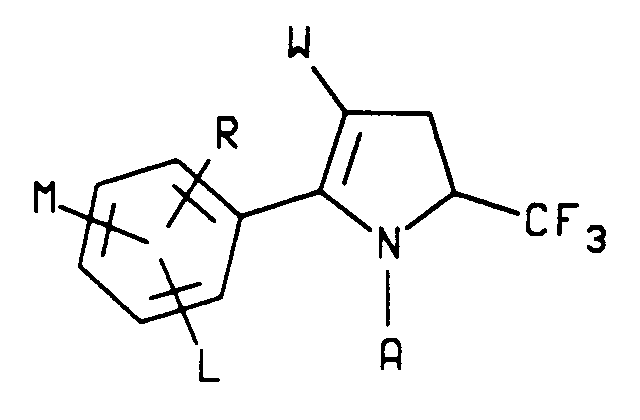
wherein
A is hydrogen or C₁-C₄ alkyl;
W is CN, NO₂ or CO₂R₆;
L is hydrogen or halogen and
M and R are each independently hydrogen, C₁-C₄ alkyl, C₁-C₄ alkoxy, C₁-C₄ alkylthio, C₁-C₄ alkylsulfinyl, C₁-C₄ alkylsulfonyl, CN, NO₂, halogen, CF₃, R₁CF₂Z, R₂CO or NR₃R₄ and when M and R are on adjacent positions they may be taken together with the carbon atoms to which they are attached to form a ring in which MR represents the structure
-OCH₂O-, -OCF₂O- or -CH=CH-CH=CH-;
Z is S(O)n or O;
R₁ is hydrogen, F, CHF₂, CHFCl or CF₃;
R₂ is C₁-C₄ alkyl, C₁-C₄ alkoxy or NR₃R₄;
R₃ is hydrogen or C₁-C₄ alkyl;
R₄ is hydrogen, C₁-C₄ alkyl or R₅CO;
R₅ is hydrogen or C₁-C₄ alkyl and
R₆ is C₁-C₆ alkyl, C₃-C₆ cycloalkyl or phenyl; n is an integer of 0, 1 or 2.
wherein
A is hydrogen or C₁-C₄ alkyl;
W is CN, NO₂ or CO₂R₆;
L is hydrogen or halogen and
M and R are each independently hydrogen, C₁-C₄ alkyl, C₁-C₄ alkoxy, C₁-C₄ alkylthio, C₁-C₄ alkylsulfinyl, C₁-C₄ alkylsulfonyl, CN, NO₂, halogen, CF₃, R₁CF₂Z, R₂CO or NR₃R₄ and when M and R are on adjacent positions they may be taken together with the carbon atoms to which they are attached to form a ring in which MR represents the structure
-OCH₂O-, -OCF₂O- or -CH=CH-CH=CH-;
Z is S(O)n or O;
R₁ is hydrogen, F, CHF₂, CHFCl or CF₃;
R₂ is C₁-C₄ alkyl, C₁-C₄ alkoxy or NR₃R₄;
R₃ is hydrogen or C₁-C₄ alkyl;
R₄ is hydrogen, C₁-C₄ alkyl or R₅CO;
R₅ is hydrogen or C₁-C₄ alkyl and
R₆ is C₁-C₆ alkyl, C₃-C₆ cycloalkyl or phenyl; n is an integer of 0, 1 or 2.
2. The compound according to claim 1, selected from the group consisitng of 2-(p-chlorophenyl)-1-methyl-5-trifluoromethyl)-2-pyrroline-3-carb nitrile and 2-(p-chlorophenyl)-5-(trifluoromethyl)-2-pyrroline-3-carbonitrile.
3. A compound characterized by the structure
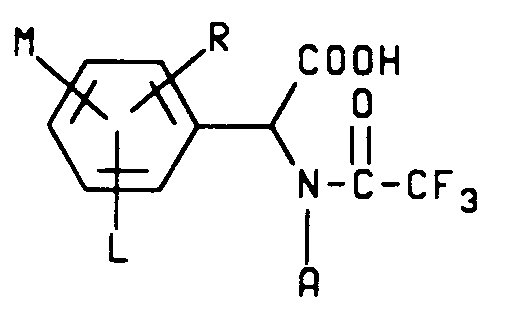
wherein
A is hydrogen or C₁-C₄ alkyl;
L is hydrogen or halogen and
M and R are each independently hydrogen, C₁-C₃ alkyl, C₁-C₃ alkoxy, C₁-C₃ alkylthio, C₁-C₃ alkylsulfinyl, C₁-C₃ alkylsulfonyl, CN, NO₂, halogen, CF₃, R₁CF₂Z, R₂CO or NR₃R₄ and when M and R are on adjacent positions they may be taken together with the carbon atoms to which they are attached to form a ring in which MR represents the structure
-OCH₂O-, -OCF₂O- or -CH=CH-CH=CH-
with the proviso that when A is hydrogen, then at least one of L, M and R must be other than hydrogen;
Z is S(O)n or O;
R₁ is hydrogen, F, CHF₂, CHFCl or CF₃;
R₂ is C₁-C₄ alkyl, C₁-C₄ alkoxy or NR₃R₄;
R₃ is hydrogen or C₁-C₄ alkyl;
R₄ is hydrogen, C₁-C₄ alkyl or R₅CO;
R₅ is hydrogen or C₁-C₄ alkyl and
n is an integer of 0, 1 or 2.
wherein
A is hydrogen or C₁-C₄ alkyl;
L is hydrogen or halogen and
M and R are each independently hydrogen, C₁-C₃ alkyl, C₁-C₃ alkoxy, C₁-C₃ alkylthio, C₁-C₃ alkylsulfinyl, C₁-C₃ alkylsulfonyl, CN, NO₂, halogen, CF₃, R₁CF₂Z, R₂CO or NR₃R₄ and when M and R are on adjacent positions they may be taken together with the carbon atoms to which they are attached to form a ring in which MR represents the structure
-OCH₂O-, -OCF₂O- or -CH=CH-CH=CH-
with the proviso that when A is hydrogen, then at least one of L, M and R must be other than hydrogen;
Z is S(O)n or O;
R₁ is hydrogen, F, CHF₂, CHFCl or CF₃;
R₂ is C₁-C₄ alkyl, C₁-C₄ alkoxy or NR₃R₄;
R₃ is hydrogen or C₁-C₄ alkyl;
R₄ is hydrogen, C₁-C₄ alkyl or R₅CO;
R₅ is hydrogen or C₁-C₄ alkyl and
n is an integer of 0, 1 or 2.
4. The compound according to claim 3, selected from the group consisting of 2-(p-chlorophenyl)-N-(trifluoroacetyl)sarcosine and 2-(p-chlorophenyl)-N-(trifluoroacetyl)glycine.
5. A process for the preparation of a compound characterized by structure I
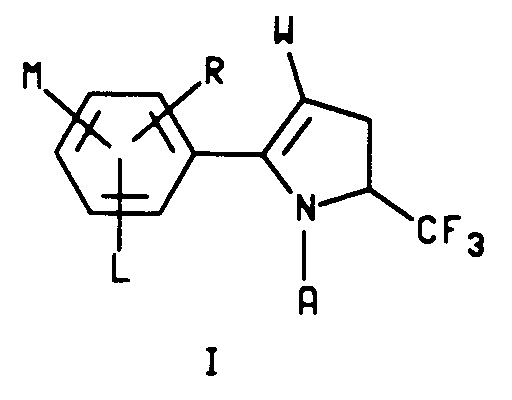
wherein
A is hydrogen or C₁-C₄ alkyl;
L is hydrogen or halogen and
M and R are each independently hydrogen, C₁-C₃ alkyl, C₁-C₄ alkoxy, C₁-C₄ alkylthio, C₁-C₄ alkylsulfinyl, C₁-C₄ alkylsulfonyl, CN, NO₂, halogen, CF₃, R₁CF₂Z, R₂CO or NR₃R₄ and when M and R are on adjacent positions they may be taken together with the carbon atoms to which they are attached to form a ring in which MR represents the structure
-OCH₂O-, -OCF₂O- or -CH=CH-CH=CH-;
Z is S(O)n or O;
R₁ is hydrogen, F, CHF₂, CHFCl or CF₃;
R₂ is C₁-C₄ alkyl, C₁-C₄ alkoxy or NR₃R₄;
R₃ is hydrogen or C₁-C₄ alkyl;
R₄ is hydrogen, C₁-C₄ alkyl or R₅CO;
R₅ is hydrogen or C₁-C₄ alkyl and
R₆ is C₁-C₆ alkyl, C₃-C₆ cycloalkyl or phenyl;
n is an integer of 0, 1 or 2
which comprises reacting a compound having structure II
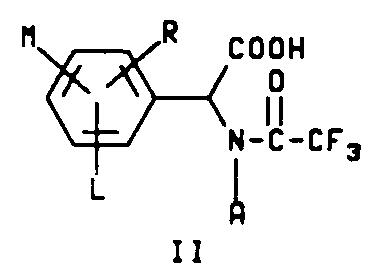
wherein A, L, M and R are as defined above with about 1.0 molar equivalent of an olefin having the structure
H₂C=CHW,
wherein W is as defined above and optionally a catalytic amount of an organic base in the presence of an acid anhydride and a solvent.
wherein
A is hydrogen or C₁-C₄ alkyl;
L is hydrogen or halogen and
M and R are each independently hydrogen, C₁-C₃ alkyl, C₁-C₄ alkoxy, C₁-C₄ alkylthio, C₁-C₄ alkylsulfinyl, C₁-C₄ alkylsulfonyl, CN, NO₂, halogen, CF₃, R₁CF₂Z, R₂CO or NR₃R₄ and when M and R are on adjacent positions they may be taken together with the carbon atoms to which they are attached to form a ring in which MR represents the structure
-OCH₂O-, -OCF₂O- or -CH=CH-CH=CH-;
Z is S(O)n or O;
R₁ is hydrogen, F, CHF₂, CHFCl or CF₃;
R₂ is C₁-C₄ alkyl, C₁-C₄ alkoxy or NR₃R₄;
R₃ is hydrogen or C₁-C₄ alkyl;
R₄ is hydrogen, C₁-C₄ alkyl or R₅CO;
R₅ is hydrogen or C₁-C₄ alkyl and
R₆ is C₁-C₆ alkyl, C₃-C₆ cycloalkyl or phenyl;
n is an integer of 0, 1 or 2
which comprises reacting a compound having structure II
wherein A, L, M and R are as defined above with about 1.0 molar equivalent of an olefin having the structure
H₂C=CHW,
wherein W is as defined above and optionally a catalytic amount of an organic base in the presence of an acid anhydride and a solvent.
6. A process for the preparation of a compound characterized by structure II
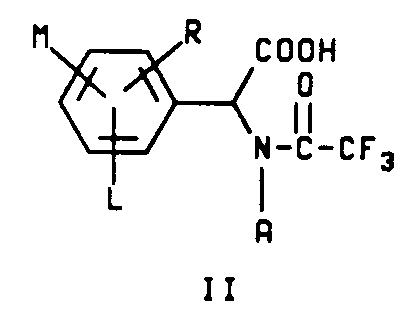
wherein
A is hydrogen or C₁-C₄ alkyl;
L is hydrogen or halogen and
M and R are each independently hydrogen, C₁-C₃ alkyl, C₁-C₃ alkoxy, C₁-C₃ alkylthio, C₁-C₃ alkylsulfinyl, C₁-C₃ alkylsulfonyl, CN, NO₂, halogen, CF₃, R₁CF₂Z, R₂CO or NR₃R₄ and when M and R are on adjacent positions they may be taken together with the carbon atoms to which they are attached to form a ring in which MR represents the structure
-OCH₂O-, -OCF₂O- or -CH=CH-CH=CH-
with the proviso that when A is hydrogen, then at least one of L, M and R must be other than hydrogen;
Z is S(O)n or O;
R₁ is hydrogen, F, CHF₂, CHFCl or CF₃;
R₂ is C₁-C₄ alkyl, C₁-C₄ alkoxy or NR₃R₄;
R₃ is hydrogen or C₁-C₄ alkyl;
R₄ is hydrogen, C₁-C₄ alkyl or R₅CO;
R₅ is hydrogen or C₁-C₄ alkyl and
n is an integer of 0, 1 or 2.
which is characterized by reacting an aldehyde having the structure
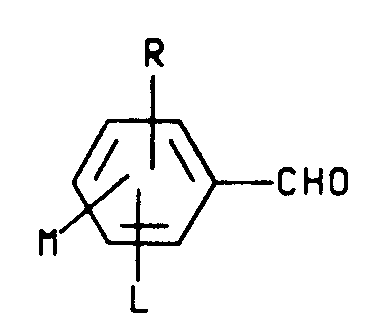
wherein L, M and R are as defined above with at least one molar equivalent of an amine hydrochloride having the structure
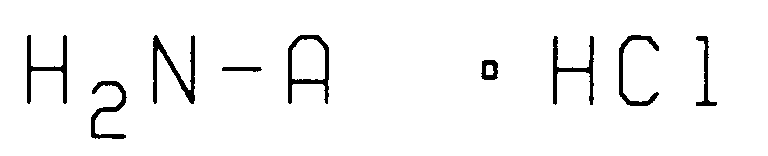
wherein A is as described above in the presence of a solvent to form an intermediate, reacting said intermediate solution with an aqueous solution containing at least one molar equivalent of an alkali metal cyanide to form an amino nitrile intermediate, extracting said amino nitrile intermediate from the reaction mixture with a suitable solvent, reacting the amino nitrile intermediate with an acid anhydride in the presence of an organic base to form an amido nitrile intermediate, reacting said amido nitrile with a mineral acid in the presence of water, optionally at an elevated temperature, to give an amino acid intermediate and reacting said intermediate with trifluoroacetic anhydride to give the desired compound having structure II.
wherein
A is hydrogen or C₁-C₄ alkyl;
L is hydrogen or halogen and
M and R are each independently hydrogen, C₁-C₃ alkyl, C₁-C₃ alkoxy, C₁-C₃ alkylthio, C₁-C₃ alkylsulfinyl, C₁-C₃ alkylsulfonyl, CN, NO₂, halogen, CF₃, R₁CF₂Z, R₂CO or NR₃R₄ and when M and R are on adjacent positions they may be taken together with the carbon atoms to which they are attached to form a ring in which MR represents the structure
-OCH₂O-, -OCF₂O- or -CH=CH-CH=CH-
with the proviso that when A is hydrogen, then at least one of L, M and R must be other than hydrogen;
Z is S(O)n or O;
R₁ is hydrogen, F, CHF₂, CHFCl or CF₃;
R₂ is C₁-C₄ alkyl, C₁-C₄ alkoxy or NR₃R₄;
R₃ is hydrogen or C₁-C₄ alkyl;
R₄ is hydrogen, C₁-C₄ alkyl or R₅CO;
R₅ is hydrogen or C₁-C₄ alkyl and
n is an integer of 0, 1 or 2.
which is characterized by reacting an aldehyde having the structure
wherein L, M and R are as defined above with at least one molar equivalent of an amine hydrochloride having the structure
wherein A is as described above in the presence of a solvent to form an intermediate, reacting said intermediate solution with an aqueous solution containing at least one molar equivalent of an alkali metal cyanide to form an amino nitrile intermediate, extracting said amino nitrile intermediate from the reaction mixture with a suitable solvent, reacting the amino nitrile intermediate with an acid anhydride in the presence of an organic base to form an amido nitrile intermediate, reacting said amido nitrile with a mineral acid in the presence of water, optionally at an elevated temperature, to give an amino acid intermediate and reacting said intermediate with trifluoroacetic anhydride to give the desired compound having structure II.
7. A process for the manufacture of a compound characterized by formula IV
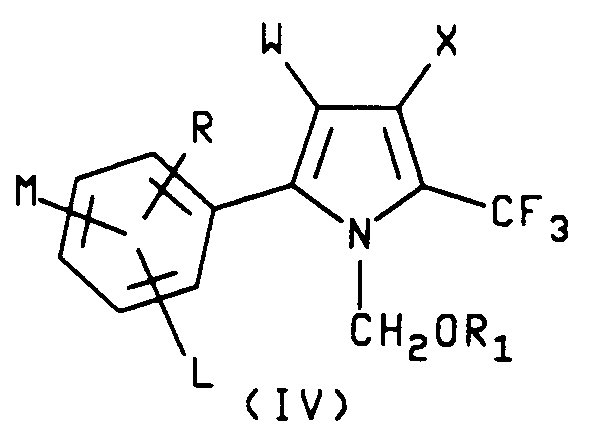
wherein R₁ is C₁₋C₆ alkyl;
W is CN, NO or CO₂R₂;
X is Br, Cl or I
L is hydrogen or halogen;
M and R are each independently hydrogen, C₁-C₄ alkyl, C₁-C₄ alkoxy, C₁-C₄ alkylthio, C₁-C₄ alkylsulfinyl, C₁-C₄ alkylsulfonyl, CN, NO₂, Cl, Br, F, I, CF₃, R₃CF₂Z, R₄CO or NR₅R₆ and when M and R are on adjacent positions they may be taken together with the carbon atoms to which they are attached to form a ring in which MR represents the structure
-OCH₂O-, -OCF₂O- or -CH=CH-CH=CH-;
R₂ is C₁-C₆ alkyl, C₃-C₆ cycloalkyl or phenyl;
R₃ is hydrogen, F, CHF₂, CHFCl or CF₃;
R₄ is C₁-C₄ alkyl, C₁-C₄ alkoxy or NR₅R₆;
R₅ is hydrogen or C₁-C₄ alkyl;
R₆ is hydrogen, C₁-C₄ alkyl or R₇CO;
R₇ is hydrogen or C₁-C₄ alkyl;
Z is S(O)n or O and
n is an integer of 0, 1 or 2 which comprises reacting a compound of formula V
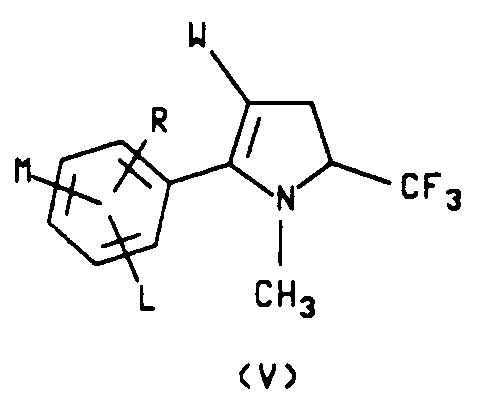
wherein W, L, M and R are as described hereinabove with at least 1 equivalent of a halogen, X₂, wherein X₂ is Br, Cl or I, in the presence of a solvent to obtain a 2-aryl-1-methylpyrrole intermediate, reacting said 1-methylpyrrole intermediate with at least one additional molar equivalent of said halogen to form a 2-aryl-4-halo-1-methylpyrrole intermediate, reacting said 4-halo-1-methylpyrrole intermediate further with at least one molar equivalent of said halogen in the presence of a radical initiator to form a 2-aryl-4-halo-1-(halomethyl)pyrrole intermediate and reacting said 4-halo-1-(halomethyl)pyrrole intermediate with at least one molar equivalent of an alkali metal C₁-C₆-alkoxide to give the compound of formula I.
wherein R₁ is C₁₋C₆ alkyl;
W is CN, NO or CO₂R₂;
X is Br, Cl or I
L is hydrogen or halogen;
M and R are each independently hydrogen, C₁-C₄ alkyl, C₁-C₄ alkoxy, C₁-C₄ alkylthio, C₁-C₄ alkylsulfinyl, C₁-C₄ alkylsulfonyl, CN, NO₂, Cl, Br, F, I, CF₃, R₃CF₂Z, R₄CO or NR₅R₆ and when M and R are on adjacent positions they may be taken together with the carbon atoms to which they are attached to form a ring in which MR represents the structure
-OCH₂O-, -OCF₂O- or -CH=CH-CH=CH-;
R₂ is C₁-C₆ alkyl, C₃-C₆ cycloalkyl or phenyl;
R₃ is hydrogen, F, CHF₂, CHFCl or CF₃;
R₄ is C₁-C₄ alkyl, C₁-C₄ alkoxy or NR₅R₆;
R₅ is hydrogen or C₁-C₄ alkyl;
R₆ is hydrogen, C₁-C₄ alkyl or R₇CO;
R₇ is hydrogen or C₁-C₄ alkyl;
Z is S(O)n or O and
n is an integer of 0, 1 or 2 which comprises reacting a compound of formula V
wherein W, L, M and R are as described hereinabove with at least 1 equivalent of a halogen, X₂, wherein X₂ is Br, Cl or I, in the presence of a solvent to obtain a 2-aryl-1-methylpyrrole intermediate, reacting said 1-methylpyrrole intermediate with at least one additional molar equivalent of said halogen to form a 2-aryl-4-halo-1-methylpyrrole intermediate, reacting said 4-halo-1-methylpyrrole intermediate further with at least one molar equivalent of said halogen in the presence of a radical initiator to form a 2-aryl-4-halo-1-(halomethyl)pyrrole intermediate and reacting said 4-halo-1-(halomethyl)pyrrole intermediate with at least one molar equivalent of an alkali metal C₁-C₆-alkoxide to give the compound of formula I.
8. A product manufactured in accordance with the process of claim 9 which is characterized
by the structure
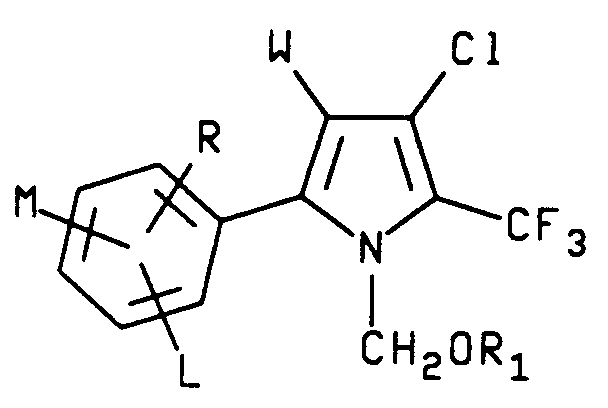
wherein R₁ is C₁-C₆ alkyl;
W is CN, NO₂ or CO₂R₂;
L is hydrogen or halogen;
M and R are each independently hydrogen, C₁-C₄ alkyl, C₁-C₄ alkoxy, C₁-C₄ alkylthio, C₁-C₄ alkylsulfinyl, C₁-C₄ alkylsulfonyl, CN, NO₂, Cl, Br, F, I, CF₃, R₃CF₂Z, R₄CO or NR₅R₆ and when M and R are on adjacent positions they may be taken together with the carbon atoms to which they are attached to form a ring in which MR represents the structure
-OCH₂O-, -OCF₂O- or -CH=CH-CH=CH-;
R₂ is C₁-C₆ alkyl, C₃-C₆ cycloalxyl or phenyl;
R₃ is hydrogen, F, CHF₂, CHFCl or CF₃;
R₄ is C₁-C₄ alkyl, C₁-C₄ alkoxy or NR₅R₆;
R₅ is hydrogen or C₁-C₄ alkyl;
R₆ is hydrogen, C₁-C₄ alkyl or R₇CO;
R₇ is hydrogen or C₁-C₄ alkyl;
Z is S(O)n or O and
n is an integer of 0, 1 or 2.
wherein R₁ is C₁-C₆ alkyl;
W is CN, NO₂ or CO₂R₂;
L is hydrogen or halogen;
M and R are each independently hydrogen, C₁-C₄ alkyl, C₁-C₄ alkoxy, C₁-C₄ alkylthio, C₁-C₄ alkylsulfinyl, C₁-C₄ alkylsulfonyl, CN, NO₂, Cl, Br, F, I, CF₃, R₃CF₂Z, R₄CO or NR₅R₆ and when M and R are on adjacent positions they may be taken together with the carbon atoms to which they are attached to form a ring in which MR represents the structure
-OCH₂O-, -OCF₂O- or -CH=CH-CH=CH-;
R₂ is C₁-C₆ alkyl, C₃-C₆ cycloalxyl or phenyl;
R₃ is hydrogen, F, CHF₂, CHFCl or CF₃;
R₄ is C₁-C₄ alkyl, C₁-C₄ alkoxy or NR₅R₆;
R₅ is hydrogen or C₁-C₄ alkyl;
R₆ is hydrogen, C₁-C₄ alkyl or R₇CO;
R₇ is hydrogen or C₁-C₄ alkyl;
Z is S(O)n or O and
n is an integer of 0, 1 or 2.
9. A compound selected from the group consisting of 4-chloro-1-(chloromethyl)-2-(p-chlorophenyl) -5-(trifluoromethyl)pyrrole-3-carbonitrile, 4-bromo-1-(bromomethyl)-2-(p-chlorophenyl)-5-(trifluoromethyl)pyrrole-3-carbonitrile and 4-chloro-1-(ethoxymethyl)-2-(p-chlorophenyl)-5-(trifluoromethyl)pyrrole-3-carbonitrile.
10. A method for protecting growing plants from attack by insects, nematodes and acarina
which is characterized by applying to the foliage of said plants or to the soil or
water in which said plants are growing, an insecticidally, nematocidally or acaricidally
effective amount of 4-chloro-1-(ethoxymethyl)-2-(p-chlorophenyl)-5-(trifluoromethyl)pyrrole-3-carbonitrile.
11. A method for controlling insects, nematodes and acarina which is characterized by
contacting said insects, nematodes and acarince, their breeding grounds, food supply
or habitat with an insecticidally, nematocidally or acaricidally effective amount
of 4-chloro-1-(ethoxymethyl)-2-(p-chlorophenyl)-5-(trifluoromethyl)pyrrole-3-carbonitrile.
12. A composition for protecting growing plants from attack by insects, nematodes and
acarina characterized by an agronomically acceptable carrier containing an insecticidally,
nematocidally, or acaricidally effective amount of a pyrrole carbonitrile compound.
13. A composition for controlling insects, nematodes and acarina characterized by an agronomically
acceptable carrier containing an insecticidally, nematocidally or acaricidally effective
amount of a pyrrole carbonitrile compound.