|
(11) | EP 0 492 416 B1 |

| (12) | EUROPEAN PATENT SPECIFICATION |
|
|
| (54) |
Fuser member Schmelzfixierelement Dispositif de fusion |
|
|
|||||||||||||||||||||||||||||||
| Note: Within nine months from the publication of the mention of the grant of the European patent, any person may give notice to the European Patent Office of opposition to the European patent granted. Notice of opposition shall be filed in a written reasoned statement. It shall not be deemed to have been filed until the opposition fee has been paid. (Art. 99(1) European Patent Convention). |
CROSS REFERENCE TO RELATED APPLICATIONS
[0001] Attention is directed to the following copending applications assigned to the assignee of the present application. U.S. Application Serial No.07/405,392 with an effective filing date of September 11, 1989, entitled Fuser Member in the name of Clifford O. Eddy et al. U.S. Application Serial No. 07/516,950, filed April 30, 1990, entitled Fusing Assembly With Release Agent Donor Member in the name of Robert M. Ferguson et al. Attention is also directed to commonly assigned U.S. Application Serial No. (not yet assigned, (D/90505) filed concurrently herewith, entitled Novel Material Package For Fabrication of Fusing Components in the name of Santokh S. Badesha et al (EP-A-0 492 402).
BACKGROUND OF THE INVENTION
[0002] The present invention relates to a fuser member, a method of fusing toner images in electrostatographic reproducing apparatus and a method for fabricating the fuser member. In particular, it relates to a fuser member which may preferably take the form of a fuser roll, pressure roll or release agent donor roll.
[0003] In a typical electrostatographic reproducing apparatus, a light image of an original to be copied is recorded in the form of an electrostatic latent image upon a photosensitive member and the latent image is subsequently rendered visible by the application of electroscopic thermoplastic resin particles which are commonly referred to as toner. The visible toner image is then in a loose powdered form and can be easily disturbed or destroyed. The toner image is usually fixed or fused upon a support which may be the photosensitive member itself or other support sheet such as plain paper.
[0004] The use of thermal energy for fixing toner images onto a support member is well known. In order to fuse electroscopic toner material onto a support surface permanently by heat, it is necessary to elevate the temperature of the toner material to a point at which the constituents of the toner material coalesce and become tacky. This heating causes the toner to flow to some extent into the fibers or pores of the support member. Thereafter, as the toner material cools, solidification of the toner material causes the toner material to be firmly bonded to the support.
[0005] Typically, the thermoplastic resin particles are fused to the substrate by heating to a temperature of between about 90°C to about 160°C or higher depending upon the softening range of the particular resin used in the toner. It is undesirable, however, to raise the temperature of the substrate substantially higher than about 200°C because of the tendency of the substrate to discolor at such at elevated temperatures particularly when the substrate is paper.
[0006] Several approaches to thermal fusing of electroscopic toner images have been described in the prior art. These methods include providing the application of heat and pressure substantially concurrently by various means: a roll pair maintained in pressure contact; a belt member in pressure contact with a roll; and the like. Heat may be applied by heating one or both of the rolls, plate members or belt members. The fusing of the toner particles takes place when the proper combination of heat, pressure and contact time are provided. The balancing of these parameters to bring about the fusing of the toner particles is well known in the art, and they can be adjusted to suit particular machines or process conditions.
[0007] During operation of a fusing system in which heat is applied to cause thermal fusing of the toner particles onto a support, both the toner image and the support are passed through a nip formed between the roll pair, or plate or belt members. The concurrent transfer of heat and the application of pressure in the nip effects the fusing of the toner image onto the support. It is important in the fusing process that no offset of the toner particles from the support to the fuser member takes place during normal operations. Toner particles offset onto the fuser member may subsequently transfer to other parts of the machine or onto the support in subsequent copying cycles, thus increasing the background or interfering with the material being copied there. The so called "hot offset" occurs when the temperature of the toner is raised to a point where the toner particles liquefy and a splitting of the molten toner takes place during the fusing operation with a portion remaining on the fuser member. The hot offset temperature or degradation of the hot offset temperature is a measure of the release property of the fuser roll, and accordingly it is desired to provide a fusing surface which has a low surface energy to provide the necessary release. To insure and maintain good release properties of the fuser roll, it has become customary to apply release agents to the fuser members to insure that the toner is completely released from the fuser roll during the fusing operation. Typically, these materials are applied as thin films of, for example, silicone oils to prevent toner offset.
[0008] Particularly preferred fusing systems take the form of a heated cylindrical fuser roll having a fusing surface which is backed by a cylindrical pressure roll forming a fusing nip there between. A release agent donor roll is also provided to deliver release agent to the fuser roll. While the physical and performance characteristics of each of these rolls, and particularly of their functional surfaces are not precisely the same depending on the various characteristics of the fusing system desired, the same classes of materials are typically used for one or more of the rolls in a fusing system in a electrostatographic printing system.
[0009] One of the earliest and most successful fusing systems involved the use of silicone elastomer fusing surfaces, such as a roll with a silicone oil release agent which could be delivered to the fuser roll by a silicone elastomer donor roll. The silicone elastomers and silicone oil release agents used in such systems are described in numerous patents and fairly collectively illustrated in U.S. Patent 4,777,087 to Heeks et al. While highly successful in providing a fusing surface with a very low surface energy to provide excellent release properties to ensure that the toner is completely released from the fuser roll during the fusing operation, these systems suffer from a significant deterioration in physical properties over time in a fusing environment. In particular, the silicone oil release agent tends to penetrate the surface of the silicone elastomer fuser members resulting in swelling of the body of the elastomer causing major mechanical failure including debonding of the elastomer from the substrate, softening and reduced toughness of the elastomer causing it to chunk out and crumble, contaminating the machine and providing non-uniform delivery of release agent. Furthermore, as described in U.S. Patent 4,777,087, additional deterioration of physical properties of silicone elastomers results from the oxidative crosslinking, particularly of a fuser roll at elevated temperatures.
[0010] A more recent development in fusing systems involves the use of fluoroelastomers as fuser members which have a surface with a metal containing filler, which interact with polymeric release agents having functional groups, which interact with the metal containing filler in the fluoroelastomer surface. Such fusing systems, fusing members and release agents, are described in U.S. Patent 4,264,181 to Lentz et al., U.S. Patent 4,257,699 to Lentz and U.S. Patent 4,272,179 to Seanor, all commonly assigned to the assignee of the present invention as well as the two above referenced previously filed copending applications. Typically, the fluoroelastomers are (1) copolymers of vinylidenefluoride and hexafluoropropylene, and (2) terpolymers of vinylidene fluoride, hexafluoropropylene and tetrafluoroethylene. Commercially available materials include: Viton E430, Viton GF and other Viton designations as Trademarks of E.I. Dupont deNemours, Inc. as well as the Fluorel materials of 3M Company. The preferred curing system for these materials is a nucleophilic system with a bisphenol crosslinking agent to generate a covalently crosslinked network polymer formed by the application of heat following basic dehydrofluorination of the copolymer. Exemplary of such fuser member is an aluminum base member with a poly(vinylidenefluoride-hexafluoropropylene) copolymer cured with a bisphenol curing agent having lead oxide filler dispersed therein and utilizing a mercapto functional polyorganosiloxane oil as a release agent. In those fusing processes, the polymeric release agents have functional groups (also designated as chemically reactive functional groups) which interact with the metal containing filler dispersed in the elastomer or resinous material of the fuser member surface to form a thermally stable film which releases thermoplastic resin toner and which prevents the thermoplastic resin toner from contacting the elastomer material itself. The metal oxide, metal salt, metal alloy or other suitable metal compound filler dispersed in the elastomer or resin upon the fuser member surface interacts with the functional groups of the polymeric release agent. Preferably, the metal containing filler materials do not cause degradation of or have any adverse effect upon the polymeric release agent having functional groups. Because of this reaction between the elastomer having a metal containing filler and the polymeric release agent having functional groups, excellent release and the production of high quality copies are obtained even at high rates of speed of electrostatographic reproducing machines.
[0011] While the mechanism involved is not completely understood, it has been observed that when certain polymeric fluids having functional groups are applied to the surface of a fusing member having an elastomer surface with a metal oxide, metal salt, metal, metal alloy or other suitable metal compounds dispersed therein there is an interaction (a chemical reaction, coordination complex, hydrogen bonding or other mechanism) between the metal of the filler in the elastomer and the polymeric fluid having functional groups so that the polymeric release agent having functional groups in the form of a liquid or fluid provides an excellent surface for release which having an excellent propensity to remain upon the surface of the fuser member. Regardless of the mechanism, there appears to be the formation of a film upon the elastomer surface which differs from the composition of the elastomer and the composition of the polymeric release agent having functional groups. This film, however, has a greater affinity for the elastomer containing a metal compound than the toner and thereby provides an excellent release coating upon the elastomer surface. The release coating has a cohesive force which is less than the adhesive forces between heated toner and the substrate to which it is applied and the cohesive forces of the toner. The interaction between the functional group of the polymeric release agent and the metal of the elastomer containing metal leads to an overall diminution of the critical or high surface energy of the metal in the metal containing filler.
[0012] The preferred elastomers are the fluoroelastomers and the most preferred fluoroelastomers are the vinylidenefluoride based fluoroelastomers which contain hexafluoropropylene and tetrafluoroethylene as comonomers. Two of the most preferred fluoroelastomers are (1) a class of copolymers of vinylidenefluoride and hexafluoropropylene known commercially as Viton A and (2) a class of terpolymers of vinylidenefluoride, hexafluoropropylene and tetrafluoroethylene known commercially as Viton B. Viton A and Viton B and other Viton designations are trademarks of E. I. DuPont deNemours and Company. Other commercially available materials include Fluorel of 3M Company, Viton GH, Viton E60C, Viton B 910, and Viton E 430. The preferred curing system is a nucleophilic system with a bisphenol crosslinking agent to generate a covalently cross-linked network polymer formed by the application of heat following basic dehydrofluorination of the copolymer. The nucleophilic curing system also includes an organophosphonium salt accelerator. Some of the commercially available fluoroelastomer polymers which can be cured with the nucleophilic system are Viton E 60C, Viton B 910, Viton E 430, Viton A, Viton B, Viton GF.
[0013] The use of polymeric release agents having functional groups which interact with a fuser member to form a thermally stable, renewable self-cleaning layer having superior release properties for electroscopic thermoplastic resin toners is described in U.S. Patents 4,029,827 to Imperial et al., 4,101,686 to Strella et al. and 4,185,140 also to Strella et al., all commonly assigned to the assignee of the present invention. In particular, U.S. Patent 4,029,827 is directed to the use of polyorganosiloxanes having mercapto functionality as release agents. U.S. Patents 4,101,686 and 4,185,140 are directed to polymeric release agents having functional groups such as carboxy, hydroxy, epoxy, amino, isocyanate, thioether, and mercapto groups as release fluids.
[0014] While the mechanism involved in these fusing systems is not completely understood, it has been observed that when certain polymeric fluids having functional groups are applied to the surface of a fusing member having an elastomer surface with a metal oxide, metal salt, metal, metal alloy or other suitable metal compounds dispersed therein, there is an interaction (a chemical reaction, coordination complex, hydrogen bonding or other mechanism) between the metal ion of the filler in the elastomer and the polymeric fluid having functional groups so that the polymeric release agent having functional groups in the form of a liquid or fluid provides an excellent surface for release which having an excellent propensity to remain upon the surface of the fuser member. Regardless of the mechanism there appears to be the formation of a film upon the elastomer surface which differs from the composition of the elastomer and the composition of the polymeric release agent having functional groups. This film, however, has a greater affinity for the elastomer containing a metal compound than the toner and thereby provides an excellent release coating upon the elastomer surface. The release coating has a cohesive force which is less than the adhesive forces between heated toner and the substrate to which it is applied and the cohesive forces of the toner. The interaction between the functional group of the polymeric release agent and the metal ion in the elastomer containing metal leads to an overall diminution of the critical or high surface energy of the metal in the metal containing filler.
[0015] While these fluoroelastomers have excellent mechanical and physical properties in that they typically have a long wearing life maintaining toughness and strength over time in a fusing environment, they can only be used with very expensive functional release agents and have to contain expensive interactive metal containing fillers. Typically, for example, the functional release agents are of the order of four times as expensive as their nonfunctional conventional silicone oil release agents.
PRIOR ART
[0017] "Improving Release Performance of Viton Fuser Rolls", by Henry et al., Xerox Disclosure Journal, Volume 9, #1, January/February 1984, discloses a fuser member made of a copolymer of vinylidenefluoride and hexafluoropropylene which has a tendency to react with the toner charge control agent producing increased crosslinking and thereby hardening as the double bonds of the fluoroelastomer become saturated to prevent further crosslinking by the addition of a silanic hydrogen compound, such as polymethylhydrosiloxane to covalently bond the siloxane to the surface of this fluoroelastomer and thereby prevent further hardening, and in addition provide good release characteristics.
[0018] "Viton/RTV Silicone Fuser Release Overcoating", Ferguson et al., Xerox Disclosure Journal, Volume 11, #5, September/October 1986, describes a fusing member wherein a fluoroelastomer such as a copolymer of vinylidenefluoride and hexafluoropropylene and an RTV Silicone Rubber are co-dissolved, co-sprayed and co-cured on an aluminum substrate to provide a uniform dispersion of silicone within the fluoroelastomer matrix. Such a fuser surface is described as having the mechanical strength of the fluoroelastomer and the release properties of the silicone and may be used with traditional dimethyl silicone release fluids
U.S. Patent 4,853,737, to Heartly et al. describes a fuser roll comprising a cured fluoroelastomer containing pendant diorganosiloxane segments that are covalently bonded to the backbone of the fluoroelastomer. The siloxane is appended to the fluoroelastomer by adding to the composition to be cured a polydiorganosiloxane oligomer having functional groups such as phenoxy or amino groups to form the covalent bond. The fuser member preferably has a metal oxide containing filler to react with functional release agent.
SUMMARY OF THE INVENTION
[0019] In accordance with a principle aspect of the present invention a long life fuser member together with a method of making the fuser member and a fusing system in which it may be used is provided which does not require the use of functional release agents or the presence of metal containing fillers in the fuser member to interact with the functional release agent. Further, a thin surface layer of a polyorganosiloxane release layer is provided on a cured fluoroelastomer which does not affect the physical properties of the fluoroelastomer.
[0020] In a specific aspect of the present invention a fuser member is provided comprising a supporting substrate having an outer layer of a previously cured fluoroelastomer and having a thin surface layer of a polyorganosiloxane having been grafted to the surface of the cured fluoroelastomer in the presence of a dehydrofluorinating agent for the fluoroelastomer and a polyorganosiloxane having reactive functionality and the formula:
where R is an alkyl, alkenyl or aryl group having less than 19 carbon atoms or an aryl group substituted with an alkyl or alkenyl group having less than 19 carbon atoms, the functional group A is hydrogen, hydroxy, alkoxy, amino, epoxy, vinyl, acrylic or mercapto, and n is 2 to 350.
[0021] In a further aspect of the present invention, the fluoroelastomer is selected from the group consisting of poly(vinylidenefluoride-hexafluoropropylene) and poly(vinylidenefluoride-hexafluoropropylene-tetrafluoroethylene).
[0022] In a further aspect of the present invention, the thin surface layer is from about 5 to about 100 nanometers thick and is covalently bonded to the cured fluoroelastomer.
[0023] In a further aspect of the present invention, the dehydrofluorination agent is selected from the group consisting of inorganic bases and peroxides such as the alkali and alkaline earth metal bases, hydrogen peroxide and benzoyl peroxide.
[0024] In a further aspect of the present invention, the fuser member has a cylindrical sleeve as a supporting substrate and is used as a pressure roll, fuser roll, or release agent donor member.
[0025] In a further aspect of the present invention, the fuser member is made by providing a supporting substrate having an outer layer of a cured fluoroelastomer and contacting the cured fluoroelastomer with a solution of a dehydrofluorinating agent containing a polyorganosiloxane having reactive functionality of the formula:
where R is an alkyl, alkenyl or aryl group having less than 19 carbon atoms or an aryl group substituted with an alkyl or alkenyl group having less than 19 carbon atoms, the functional group A is hydrogen, hydroxy, alkoxy, amino, epoxy, vinyl, acrylic or mercapto, and n is 2 to 350.
BRIEF DESCRIPTION OF THE DRAWING
[0026] Figure 1 is a sectional view of a fuser system which may use the fuser member of the present invention.
DETAILED DESCRIPTION OF THE PRESENT INVENTION
[0027] A typical fuser member of the present invention is described in conjunction with a fuser assembly as shown in Figure 1 where the numeral 1 designates a fuser roll comprising elastomer surface 2 upon suitable base member 4 which is a hollow cylinder or core fabricated from any suitable metal such as aluminum, anodized aluminum, steel, nickel, copper, and the like, having a suitable heating element 6 disposed in the hollow portion thereof which is coextensive with the cylinder. Backup or pressure roll 8 cooperates with fuser roll 1 to form a nip or contact arc 10 through which a copy paper or other substrate 12 passes such that toner images 14 thereon contact elastomer surface 2 of fuser roll 1. As shown in Figure 1, the backup roll 8 has a rigid steel core 16 with an elastomer surface or layer 18 thereon. Sump 20 contains polymeric release agent 22 which may be a solid or liquid at room temperature, but it is a fluid at operating temperatures.
[0028] In the embodiment shown in Figure 1 for applying the polymeric release agent 22 to elastomer surface 2, two release agent delivery rolls 17 and 19 rotatably mounted in the direction indicated are provided to transport release agent 22 from the sump 20 to the elastomer surface. As illustrated in Figure 1, roll 17 is partly immersed in the sump 20 and transports on its surface release agent from the sump to the delivery roll 19. By using a metering blade 24 a layer of polymeric release fluid can be applied initially to delivery roll 19 and subsequently to elastomer 2 in controlled thickness ranging from submicrometer thickness to thickness of several micrometers of release fluid. Thus, by metering device 24, about 0.1 to 2 micrometers or greater thicknesses of release fluid can be applied to the surface of elastomer 2.
[0029] As used herein, the term fuser member may be a roll, belt, flat surface or other suitable shape used in the fixing of thermoplastic toner images to a suitable substrate. It may take the form of a fuser member, a pressure member or a release agent donor member, preferably in the form of a cylindrical roll. Typically, the fuser member is made of a hollow cylindrical metal core, such as copper, aluminum, steel and the like, and has an outer layer of the selected cured fluoroelastomer. Alternatively, there may be one or more intermediate layers between the substrate and the outer layer of the cured elastomer if desired.
[0030] The term surface graft is intended to define a thin layer of the polyorganosiloxane which is covalently bonded to the cured outer surface of the fluoroelastomer of the fusing member.
[0031] The term covalently bonded is intended to define the chemical bonding between the carbon atom of the fluoroelastomer and the functionality atom of the polyorganosiloxane. These bonds could be C-C, C-O, C-N, C-Si etc., depending upon the functionality.
[0032] The fluoroelastomer useful in the practice of the present invention are those described in detail in the above referenced U.S. Patent 4,257,699 to Lentz, as well as those described in commonly assigned copending application Serial No. 07/405,392 and 07/516,950. As described therein these fluoroelastomers, particularly from the class of copolymers and terpolymers of vinylidenefluoride hexafluoropropylene and tetrafluoroethylene, are known commercially under various designations as Viton A, Viton E, Viton E60C, Viton E430, Viton 910, Viton GH and Viton GF. The Viton designation is a Trademark of E.I. Dupont deNemours, Inc. Other commercially available materials include Fluorel 2170, Fluorel 2174, Fluorel 2176, Fluorel 2177 and Fluorel LVS 76, Fluorel being a Trademark of 3M Company. Additional commercially available materials include Aflas, a poly(propylene-tetrafluoroethylene), Fluorel II (Lll900), a poly(propylenetetrafluoroethylene-vinylidenefluoride) both also available from 3M Company as well as the Tecnoflons identified as FOR-60KlR, FOR-LHF, NM, FOR-THF, FOR-TFS, TH, TN505 available from Montedison Specialty Chemical Co. Typically, these fluoroelastomers are cured with a nucleophilic addition curing system, such as a bisphenol crosslinking agent with an organophosphonium salt accelerator as described in further detail in the above referenced Lentz Patent, and in Serial No. 07/405,392.
[0033] The coating of the fuser member substrate with the fluoroelastomer is most conveniently carried out by spraying, dipping, or the like, a solution or homogeneous dispersion of the elastomer. While molding, extruding and wrapping techniques or alternative means which may be used, we prefer to spray successful applications of a solvent solution of the polymer onto the surface to be coated. Typical solvents that may be used for this purpose include: methyl ethyl ketone, methyl isobutyl ketone and the like.
[0034] Other adjuvents and fillers may be incorporated in the elastomer in accordance with the present invention as long as they do not affect the integrity of the fluoroelastomer. Such fillers normally encountered in the compounding of elastomers include coloring agents, reinforcing fillers, crosslinking agents, processing aids, accelerators and polymerization initiators. Following coating of the fluoroelastomer on the substrate, it is subjected to a step curing process at about 38°C for 2 hours followed by 4 hours at 77°C and 2 hours at 177°C.
[0035] The thin surface layer of the polyorganosiloxane, which is grafted on to the cured fluoroelastomer is derived from a polyorganosiloxane, having reactive functionality of the formula:
where R is an alkyl, alkenyl or aryl group having less than 19 carbon atoms or an aryl group substituted with an alkyl or alkenyl group having less than 19 carbon atoms, the functional group A is hydrogen, hydroxy, alkoxy, amino, epoxy, vinyl, acrylic or mercapto, and n is 2 to 350. In the above formula, typical R groups include methyl, ethyl, propyl, octyl, vinyl, allylic crotnyl, phenyl, naphthyl and phenanthryl and typical substituted aryl groups are substituted in the ortho, meta and para portions with lower alkyl groups having less than 15 carbon atoms. Furthermore, in a preferred embodiment n is between 60 and 80 to provide a sufficient number of reactive groups to graft onto the fluoroelastomer.
[0036] For the grafting to be successful it must take place in the presence of a dehydrofluorination agent, which is typically selected from the group of peroxides, inorganic bases such as the alkali and alkaline earth metal bases, such as sodium, potassium, calcium and magnesium hydroxides. In addition, hydrides such as sodium borohydride and lithium aluminum hydride as well as primary, secondary and tertiary aliphatic and aromatic amines where the aliphatic and aromatic groups have from 2 to 15 carbon atoms are effective dehydrofluorination agents. This group includes aliphatic and aromatic diamines and triamines having from 2 to 15 carbon atoms, where the aromatic groups may be benzene, toluene, naphthalene or anthraceine. It is generally preferred for the aromatic diamines and tramines that the aromatic group be substituted in the ortho meta and para positions. Typical substituents include lower alkyl amino groups such as ethyl amino, propyl amino and butyl amino with propyl amino being preferred. However, the peroxides such as hydrogen peroxide and benzoyl peroxides together with the inorganic bases mentioned above are the preferred dehydrofluorination agents. Typically, grafting is achieved by dissolving the selected dehydrofluorinating agent in a polar solvent, such as a ketone or ether, including methyl ethyl ketone, methyl isobutyl ketone, cyclohexanone and tetrahydrofuran in an amount of 1-10% by weight of the dehydrofluorinating agent, of the selected functionality polyorganosiloxane. When the supporting substrate with the outer layer of the cured fluoroelastomer is added to the solution of dehydrofluorinating agent and siloxane, the dehydrofluorinating agent acts to dehydrofluorinate the fluoroelastomer creating unsaturation on its surface enabling a subsequent addition reaction with the siloxane functionality to provide the surface graft of the siloxane onto the fluoroelastomer.
[0037] The dehydrofluorinating agent generates double bonds on the surface of the fluoroelastomer by the dehydrofluorination reaction. To enable this, the supporting substrate having the outer layer of the cured fluoroelastomer is immersed in the solution of the dehydrofluorinating agent and polyorganosiloxane for about 5-20 minutes at 45-65° C, after which it is removed, washed with the same solvent to remove unreacted reactants and air dried at 100-150° C for 20-45 minutes to remove the solvent. This provides a very thin surface layer of the covalently bonded polyorganosiloxane to the already cured fluoroelastomer. Typically, the layer of the polyorganosiloxane is from 5 to about 100 nanometers thick, which is sufficient to provide the superior release properties of the polyorganosiloxane without effecting the physical properties of the underlying fluoroelastomer. While not wishing to be bound to any theory it is believed that the dehydrofluorinating agent creates carbon-carbon double bonds on the surface of the fluoroelastomer by removal of the hydrofluoric acid and the polyorganosiloxane is then covalently bonded through its functionality by an addition reaction. This provides a fuser member having a polyorganosiloxane chemically attached to its outer layer providing an excellent releasing surface where the surface graft is a part of the outer surface chemically bonded thereto rather than physically mixed. Further, since the surface graft is very thin the fuser member has the advantage of the high physical stability of the cured fluoroelastomer outer layer. In addition, the polyorganosiloxane surface graft provides a compatible surface for the release agent thereby affecting better release and because of its lower surface energy provides a non-contaminating surface from toner particles. Finally, with the polyorganosiloxane surface graft release agent anchoring sites of metal containing filler, typically metal oxide, are not required and the fusing system does not require the use of functional release agent to interact with the metal containing filler.
[0038] The following example further defines and describes a fuser member prepared according to the present invention and illustrates a preferred embodiment of the present invention. Unless otherwise indicated, all parts and percentages are by weight.
EXAMPLE
[0039] A pressure roll is made from a standard steel core about 1 1/2 in. in diameter which is primed with an epoxy adhesive, Thixon 300/301. The following formulation was mixed in the listed order and compression molded on the core to the specified dimensions.
| Viton E 45 (DuPont) | 100 g |
| Carbon Black N991 (Vanderbilt) | 10 |
| Ca (OH)2 | 4 g |
| MAG D (C P Hall) | 2 g |
| C-20 (DuPont) | 1.4 g |
| C-30 (DuPont) | 2.8 g |
[0040] The molded roll is subjected to cure and post cure conditions of 2 hours at 200° F, two hours at 300° F, two hours at 350° F, two hours at 400° F, sixteen hours at 450°F. The Viton fluoroelastomer coating is ground to a 3 inch diameter specification and cleaned of mold release. A solution of 250 grams of 100 centistoke vinyl terminated polydimethysiloxane (PS 441 available from Huls America Inc. ) and 100 grams of hydrogen peroxide(50% concentration) was prepared in a litre solvent mixture of toluene and methyl ethyl ketone in a 9:1 ratio using a two litre Erlenmeyer flask. This solution was then stirred and heated at 40-45 degree centigrade using a magnetic stirrer hot plate for approximately 15 minutes. The solution was then poured into an open stainless steel tray and the pressure roll was then placed in the tray in such a way that only its surface comes in contact with the solution. The surface of the roll was treated by rolling it in a back and forth motion in the tray for 45 minutes. The roll was then taken out of the tray and air dried for 1 hour after which time it was washed thoroughly with n-hexane. The roll was then put in the oven and heated at 80 degrees centigrade for 30 minutes. The temperature of the oven was then raised to 200 degrees centigrade over a period of 1 hour. This temperature was maintained for 20 minutes after which time the roll was taken out and allowed to cool to room temperature.
X-ray Photoelectron Spectrocopy Characterization of the Grafted Surface
1. Preparation of Surface
[0041] The grafted surface was sequentially extracted with solvent, hexane or 90/10 hexane/methyl ethyl ketone mixed solvent, 3 to 4 times. The unreacted or loosely bound siloxane is soluble in these solvents and can be removed from the surface, while the grafted siloxane remains in and on the surface layer.
2. XPS Characterization
[0042] The extracted surfaces were then examined with X-ray photoelectron spectroscopy which provided the chemical composition of the topmost 5 to 10 nanometers of the surface layer. The data indicate that the surface of the sample treated with the grafting solution was composed primarily of siloxane.
Testing of the Surface Grafted Pressure Roll
[0043] The surface grafted pressure roll was tested in a stressed customer simulation environment. The objective of the test was two-fold, the foremost was to verify the release characteristics of the roll surface. The second objective was to understand the level of toner and paper debris contamination on the roll surface over time. The test conditions stressed both conditions by applying high toner mass in a localized area and running 14'' lightweight paper.
[0044] After 250,000 prints, there was no evidence of performance degradation with respect to release and no evidence of surface contamination. The test was deemed significant and the surface considered functionally acceptable for the Xerox 5090F product line. The test was suspended without failure.
[0045] Thus, according to the present invention, a long life fuser member has been provided which is capable of use as a fuser roll, donor roll or pressure roll, in a fusing system which does not require the use of functional release agent or the presence of a metal containing filler in the transport surface of the fuser member to interact with the functional release agent to form a release layer. This enables an economical fusing system combining the advantages of fluoroelastomer fuser member surfaces and nonfunctional conventional silicone release agent. In addition, the layer of the polyorganosiloxane is sufficiently thin that it does not interfere with the physical properties of the supporting fluoroelastomer layer.
[0046] While the above example used a functional release agent it should be noted that the fuser member did not contain any metal containing fillers to serve as anchoring sites for the functional release agent and that acceptable performance was achieved with a roll which was primarily made of a fluoroelastomer. The absence of the metal containing filler enables a more physically stable fuser member and one which is less expensive and easier to maufacture.
[0047] All the patents and applications referred to herein are hereby specifically, and totally incorporated herein by reference in their entirety in the instant specification.
[0048] While the invention has been described in detail with reference to specific and preferred embodiments, it will be appreciated that various modifications and variations will be apparent to the artisan. All such modifications and embodiments as may readily occur to one skilled in the art are intended to be within the scope of the appended claims.
1. A fuser member comprising a supporting substrate having an outer layer of a cured
fluoroelastomer and having a thin surface layer of a polyorganosiloxane having been
grafted to the surface of said cured fluoroelastomer in the presence of a dehydrofluorinating
agent for the fluoroelastomer and from a polyorganosiloxane having reactive functionality
and the formula:
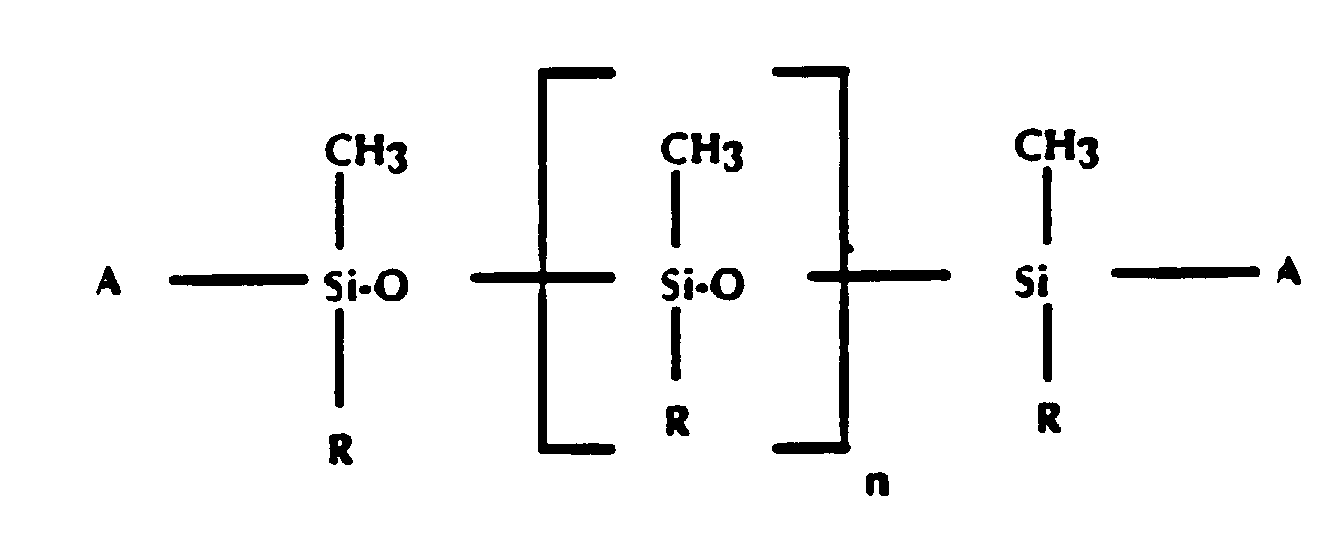
where R is an alkyl, alkenyl or aryl group having less than 19 carbon atoms or an aryl group substituted with an alkyl or alkenyl group having less than 19 carbon atoms, the functional group A is hydrogen, hydroxy, alkoxy, amino, epoxy, vinyl, acrylic or mercapto, and n is 2 to 350.
where R is an alkyl, alkenyl or aryl group having less than 19 carbon atoms or an aryl group substituted with an alkyl or alkenyl group having less than 19 carbon atoms, the functional group A is hydrogen, hydroxy, alkoxy, amino, epoxy, vinyl, acrylic or mercapto, and n is 2 to 350.
2. The fuser member of claim 1 wherein said fluoroelastomer is selected from the group
consisting of poly(vinylidene fluoride-hexafluoropropylene) and poly (vinylidene fluoride-hexafluoropropylene-tetrafluoroethylene).
3. The fuser member of claim 1 wherein said thin surface layer is from about 5 to about
100 nanometers thick.
4. The fuser member of claim 1 wherein said dehydrofluorination agent is selected from
the group consisting of inorganic bases and peroxides.
5. The fuser member of claim 4 wherein said agent is selected from the group consisting
of alkali and alkaline earth metal bases, hydrogen peroxide and benzoyl peroxide.
6. The fuser member of claim 1 wherein said supporting substrate is a cylindrical sleeve.
7. The fuser member of claim 1 wherein said polyorganosiloxane is covalently bonded to
said cured fluoroelastomer and is sufficiently thin as to have substantially no affect
on the physical properties of the cured fluoroelastomer.
8. The fuser member of claim 6 wherein said member is a pressure roll, fuser roll or
release agent donor roll.
9. The fuser member of claim 1 wherein n is from 60 to 80.
10. The method of fusing a thermoplastic resin toner image to a substrate comprising forming
a film of a polymeric release agent on the surface of a heated fuser member as defined
in claims 1 to 9.
11. The method of making a fuser member comprising providing a supporting substrate having
an outer layer of a cured fluoroelastomer, preparing a solvent solution of a dehydrofluorinating
agent containing a polyorganosiloxane having reactive functionality and the formula:
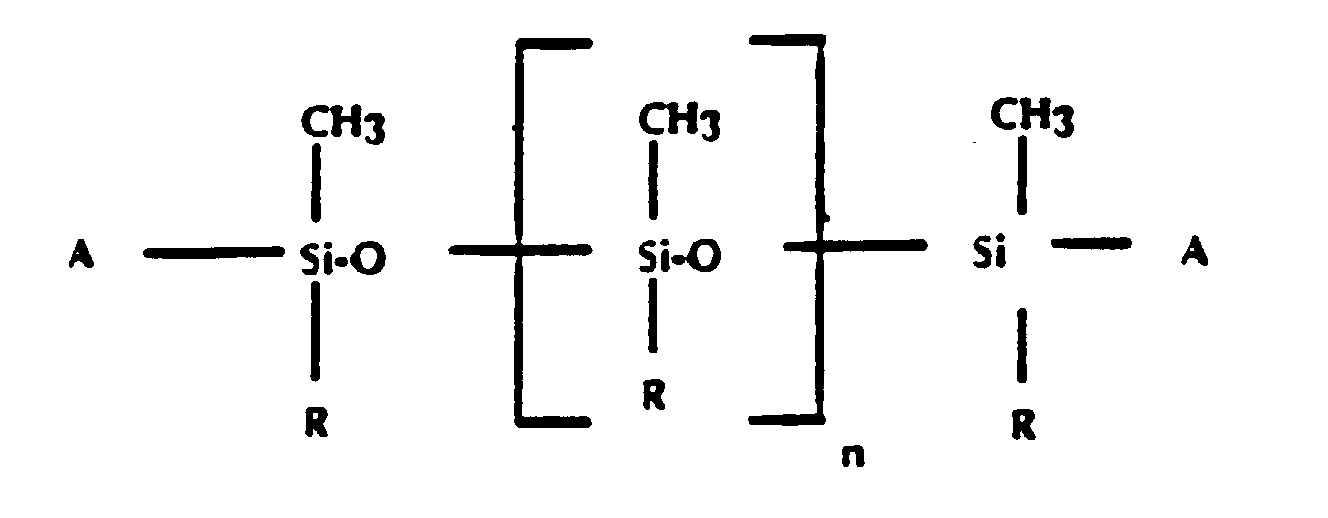
where R is an alkyl, alkenyl or aryl group having less than 19 carbon atoms or an aryl group substituted with an alkyl or alkenyl group having less than 19 carbon atoms, the functional group A is hydrogen, hydroxy, alkoxy, amino, epoxy, vinyl, acrylic or mercapto, and n is 2 to 350, contacting said cured fluoroelastomer with said solution under conditions to form a thin surface layer of the polyorganosiloxane grafted to said fluoroelastomer.
where R is an alkyl, alkenyl or aryl group having less than 19 carbon atoms or an aryl group substituted with an alkyl or alkenyl group having less than 19 carbon atoms, the functional group A is hydrogen, hydroxy, alkoxy, amino, epoxy, vinyl, acrylic or mercapto, and n is 2 to 350, contacting said cured fluoroelastomer with said solution under conditions to form a thin surface layer of the polyorganosiloxane grafted to said fluoroelastomer.
12. The method of claim 11 wherein the treated cured fluoroelastomer is subsequently removed
from the solution; washed with solvent to remove unreacted material and dried to remove
solvent.
13. The method of claim 11 wherein said fluoroelastomer is selected from the group consisting
of poly(vinylidene fluoride-hexafluoropropylene) and poly(vinylidene fluoride-hexafluoropropylene-tetrafluoroethylene).
14. The method of claim 11 wherein said thin surface layer is from about 5 to about 100
nanometers thick.
15. The method of claim 11 wherein said dehydrofluorination agent is selected from the
group consisting of inorganic bases and peroxides.
16. The method of claim 15 wherein said agent is selected from the group consisting of
alkali and alkaline earth metal bases, hydrogen peroxide and benzoyl peroxide.
17. The method of claim 11 wherein said supporting substrate is a cylindrical sleeve.
18. The method of claim 11 wherein said polyorganosiloxane is covalently bonded to said
cured fluoroelastomer and is sufficiently thin as to have substantially no affect
on the physical properties of the cured fluoroelastomer.
19. The method of claim 16, wherein said member is a pressure roll, fuser roll or release
agent donor roll.
20. The method of claim 11 wherein n is from 60 to 80.
1. Schmelzfixierelement umfassend ein Trägersubstrat mit einer äußeren Schicht aus einem
gehärteten Fluorelastomer und mit einer dünnen Oberflächenschicht aus einem Polyorganosiloxan,
welche auf die Oberfläche des gehärteten Fluorelastomers in Anwesenheit eines Dehydrofluorierungsmittel
für das Fluorelastomer und aus einem Polyorganosiloxan mit einer Funktionalität zur
Reaktion und der Formel
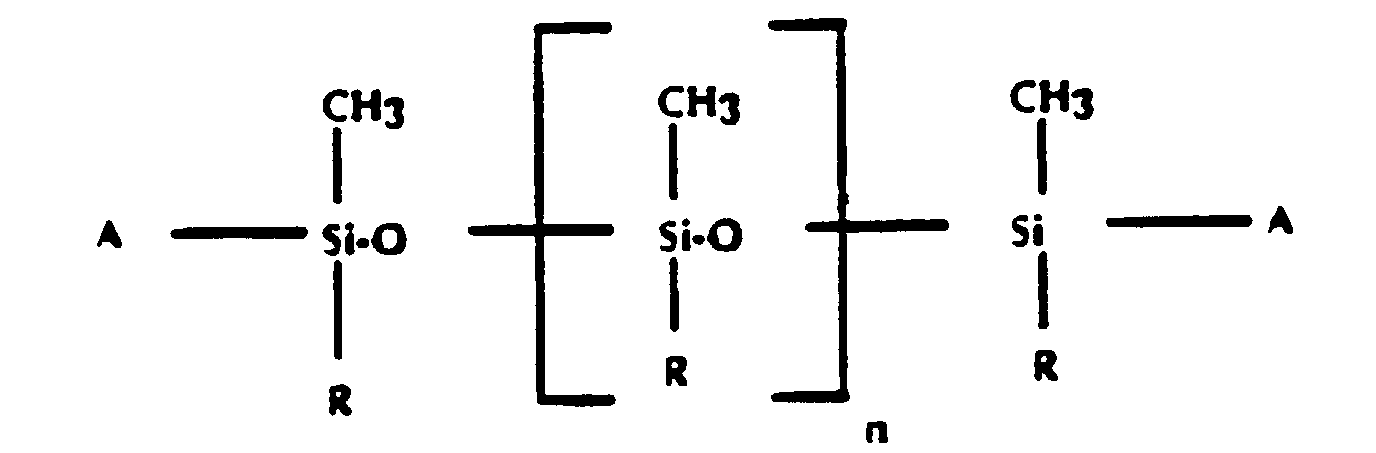
worin R eine Alkyl-, Alkenyl- oder Arylgruppe mit weniger als 19 Kohlenstoffatomen oder eine Arylgruppe ist, die mit einer Alkyl- oder Alkenylgruppe mit weniger als 19 Kohlenstoffatomen substituiert ist, die funktionelle Gruppe A Wasserstoff, Hydroxy, Alkoxy, Amino, Epoxy, Vinyl, Acryl oder Mercapto ist und n 2 bis 350 ist, aufgepfropft wurde.
worin R eine Alkyl-, Alkenyl- oder Arylgruppe mit weniger als 19 Kohlenstoffatomen oder eine Arylgruppe ist, die mit einer Alkyl- oder Alkenylgruppe mit weniger als 19 Kohlenstoffatomen substituiert ist, die funktionelle Gruppe A Wasserstoff, Hydroxy, Alkoxy, Amino, Epoxy, Vinyl, Acryl oder Mercapto ist und n 2 bis 350 ist, aufgepfropft wurde.
2. Schmelzfixierelement von Anspruch 1, wobei das Fluorelastomer aus der Gruppe ausgewählt
ist, die aus Poly(vinylidenfluorid-hexafluorpropylen) und Poly(vinylidenfluorid-hexafluorpropylen-tetrafluorethylen)
besteht.
3. Schmelzfixierelement von Anspruch 1, wobei die dünne Oberflächenschicht etwa 5 bis
etwa 100 Nanometer dick ist.
4. Schmelzfixierelement von Anspruch 1, wobei das Dehydrofluorierungsmittel aus der Gruppe
ausgewählt ist, die aus anorganischen Basen und Peroxiden besteht.
5. Schmelzfixierelement von Anspruch 4, wobei das Mittel aus der Gruppe ausgewählt ist,
die aus Alkali- und Erdalkalimetallbasen, Wasserstoffperoxid und Benzoylperoxid besteht.
6. Schmelzfixierelement von Anspruch 1, wobei das Trägersubstrat ein zylinderförmigen
Mantel ist.
7. Schmelzfixierelement von Anspruch 1, wobei das Polyorganosiloxan kovalent an das gehärtete
Fluorelastomer gebunden ist und ausreichend dünn ist, um im wesentlichen keinen Einfluß
auf die physikalischen Eigenschaften des gehärteten Fluorelastomers zu haben.
8. Schmelzfixierelement von Anspruch 6, wobei das Element eine Anpreßwalze, Schmelzfixierwalze
oder Walze zur Trennmittelzufuhr ist.
9. Schmelzfixierelement von Anspruch 1, wobei n 60 bis 80 ist.
10. Verfahren zum Schmelzfixierens eines Tonerbildes aus thermoplastischem Harz auf einem
Substrat, welches das Bilden eines Films aus einem polymeren Trennmittel auf der Oberfläche
eines in Anspruch 1 bis 9 definierten erhitzten Schmelzfixierelements umfaßt.
11. Verfahren zum Herstellen eines Schmelzfixierelements, welches das Bereitstellen eines
Trägersubstrats mit einer äußeren Schicht aus einem gehärteten Fluorelastomer, das
Herstellen einer Lösung eines Dehydrofluorierungsmittels in einem Lösungsmittel, welches
ein Polyorganosiloxan mit einer Funktionalität zur Reaktion und der folgenden Formel
enthält:
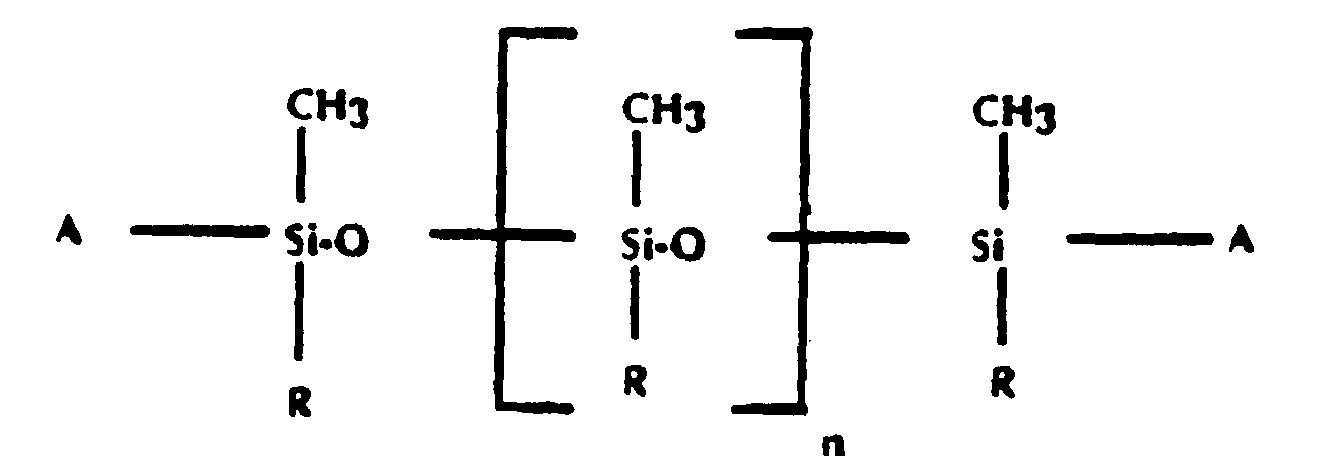
worin R eine Alkyl-, Alkenyl- oder Arylgruppe mit weniger als 19 Kohlenstoffatomen oder eine Arylgruppe ist, die mit einer Alkyl- oder Alkenylgruppe mit weniger als 19 Kohlenstoffatomen substituiert ist, die funktionelle Gruppe A Wasserstoff, Hydroxy, Alkoxy, Amino, Epoxy, Vinyl, Acryl oder Mercapto ist und n 2 bis 350 ist, und das zusammenbringen des gehärteten Fluorelastomers mit der Lösung unter Bedingungen zum Bilden einer dünnen Oberflächenschicht aus dem auf das Fluorelastomer aufgepfropften Polyorganosiloxan umfaßt.
worin R eine Alkyl-, Alkenyl- oder Arylgruppe mit weniger als 19 Kohlenstoffatomen oder eine Arylgruppe ist, die mit einer Alkyl- oder Alkenylgruppe mit weniger als 19 Kohlenstoffatomen substituiert ist, die funktionelle Gruppe A Wasserstoff, Hydroxy, Alkoxy, Amino, Epoxy, Vinyl, Acryl oder Mercapto ist und n 2 bis 350 ist, und das zusammenbringen des gehärteten Fluorelastomers mit der Lösung unter Bedingungen zum Bilden einer dünnen Oberflächenschicht aus dem auf das Fluorelastomer aufgepfropften Polyorganosiloxan umfaßt.
12. Verfahren von Anspruch 11, wobei das behandelte gehärtete Fluorelastomer nachfolgend
aus der Lösung entfernt wird, mit Lösungsmittel zum Entfernen unumgesetzten Materials
gewaschen wird und zum Entfernen von Lösungsmittel getrocknet wird.
13. Verfahren von Anspruch 11, wobei das Fluorelastomer aus der Gruppe ausgewählt ist,
die aus Poly(vinylidenfluorid-hexafluorpropylen) und Poly(vinylidenfluoridhexafluorpropylen-tetrafluorethylen)
besteht.
14. Verfahren von Anspruch 11, wobei die dünne Oberflächenschicht etwa 5 bis etwa 100
Nanometer dick ist.
15. Verfahren von Anspruch 11, wobei das Dehydrofluorierungsmittel aus der Gruppe ausgewählt
ist, die aus anorganischen Basen und Peroxiden besteht.
16. Verfahren von Anspruch 16, wobei das Mittel aus der Gruppe ausgewählt ist, die aus
Alkali- und Erdalkalimetallbasen, Wasserstoffperoxid und Benzoylperoxid besteht.
17. Verfahren von Anspruch 11, wobei das Trägersubstrat ein zylinderförmiger Mantel ist.
18. Verfahren von Anspruch 11, wobei das Polyorganosiloxan kovalent an das gehärtete Fluorelastomer
gebunden ist und ausreichend dünn ist, um im wesentlichen keinen Einfluß auf die physikalischen
Eigenschaften des gehärteten Fluorelastomers zu haben.
19. Verfahren von Anspruch, wobei das Element eine Anpreßwalze, Schmelzfixierwalze oder
Walze zur Trennmittelzufuhr ist.
20. Verfahren von Anspruch 11, wobei n 60 bis 80 ist.
1. Elément de fixation comprenant un substrat de support ayant une couche externe d'un
fluoroélastomère vulcanisé et ayant une couche superficielle fine d'un polyorganosiloxane
qui a été greffé sur la surface de ce fluoroélastomère vulcanisé en présence d'un
agent de défluorhydratation pour le fluoroélastomère, en partant d'un polyorganosiloxane
ayant une fonctionnalité réactive et répondant à la formule :
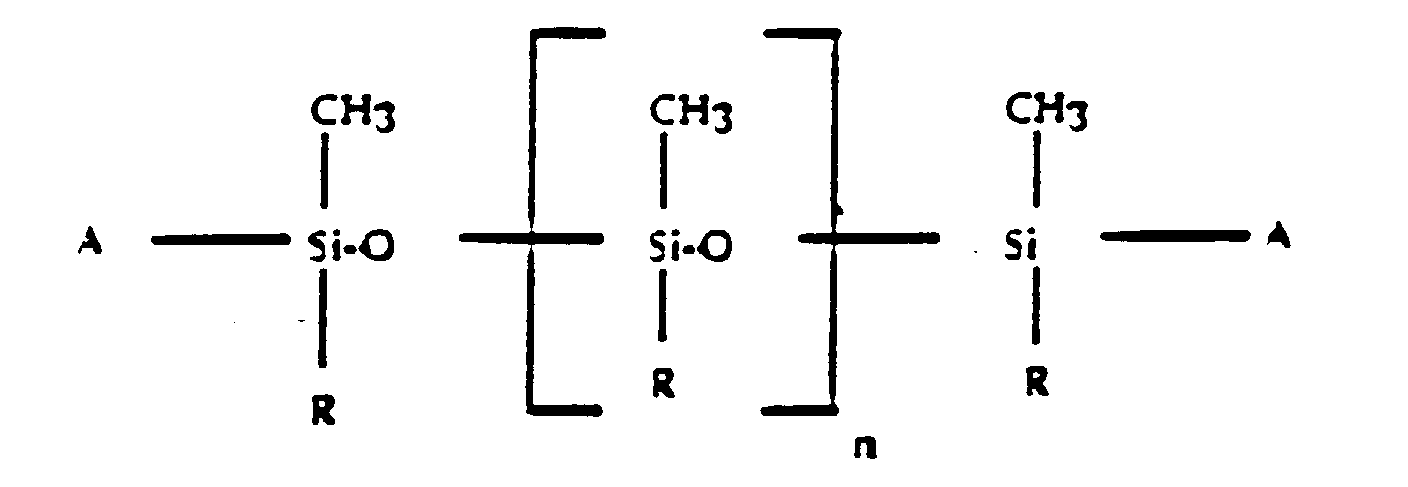
dans laquelle R est un groupe alkyle, alcényle ou aryle ayant moins de 19 atomes de carbone ou un groupe aryle substitué par un groupe alkyle ou alcényle ayant moins de 19 atomes de carbone, le groupe fonctionnel A est un atome d'hydrogène, un groupe hydroxy, alcoxy, amino, époxy, vinyle, acrylique ou mercapto, et n est un nombre de 2 à 350.
dans laquelle R est un groupe alkyle, alcényle ou aryle ayant moins de 19 atomes de carbone ou un groupe aryle substitué par un groupe alkyle ou alcényle ayant moins de 19 atomes de carbone, le groupe fonctionnel A est un atome d'hydrogène, un groupe hydroxy, alcoxy, amino, époxy, vinyle, acrylique ou mercapto, et n est un nombre de 2 à 350.
2. Elément de fixation selon la revendication 1, dans lequel ce fluoroélastomère est
choisi dans le groupe constitué du poly(fluorure de vinylidène-hexafluoropropylène)
et du poly(fluorure de vinylidène-hexafluoropropylène-tétrafluoréthylène).
3. Elément de fixation selon la revendication 1, dans lequel cette couche superficielle
fine a une épaisseur d'environ 5 à environ 100 nanomètres.
4. Elément de fixation selon la revendication 1, dans lequel cet agent de défluorhydratation
est choisi dans le groupe constitué des bases minérales et des peroxydes.
5. Elément de fixation selon la revendication 4, dans lequel cet agent est choisi dans
le groupe constitué des bases de métaux alcalins et alcalino-terreux, du peroxyde
d'hydrogène et du peroxyde de benzoyle.
6. Elément de fixation selon la revendication 1, dans lequel ce substrat de support est
un manchon cylindrique.
7. Elément de fixation selon la revendication 1, dans lequel ce polyorganosiloxane est
lié par covalence à ce fluoroélastomère vulcanisé et est suffisamment fin pour n'avoir
pratiquement aucun effet sur les propriétés physiques du fluoroélastomère vulcanisé.
8. Elément de fixation selon la revendication 6, dans lequel cet élément est un rouleau
de compression, un rouleau de fixation ou un rouleau délivreur d'agent de séparation.
9. Elément de fixation selon la revendication 1, dans lequel n est un nombre de 60 à
80.
10. Procédé de fixation d'une image d'agent de marquage de résine thermoplastique sur
un substrat comprenant le fait de former un film d'un agent de séparation polymère
sur la surface d'un élément de fixation chauffé tel que défini dans les revendications
1 à 9.
11. Procédé pour fabriquer un élément de fixation comprenant le fait de réaliser un substrat
de support ayant une couche externe d'un fluoroélastomère vulcanisé, de préparer une
solution dans un solvant d'agent de défluorhydratation comprenant un polyorganosiloxane
ayant une fonctionnalité réactive et répondant à la formule :
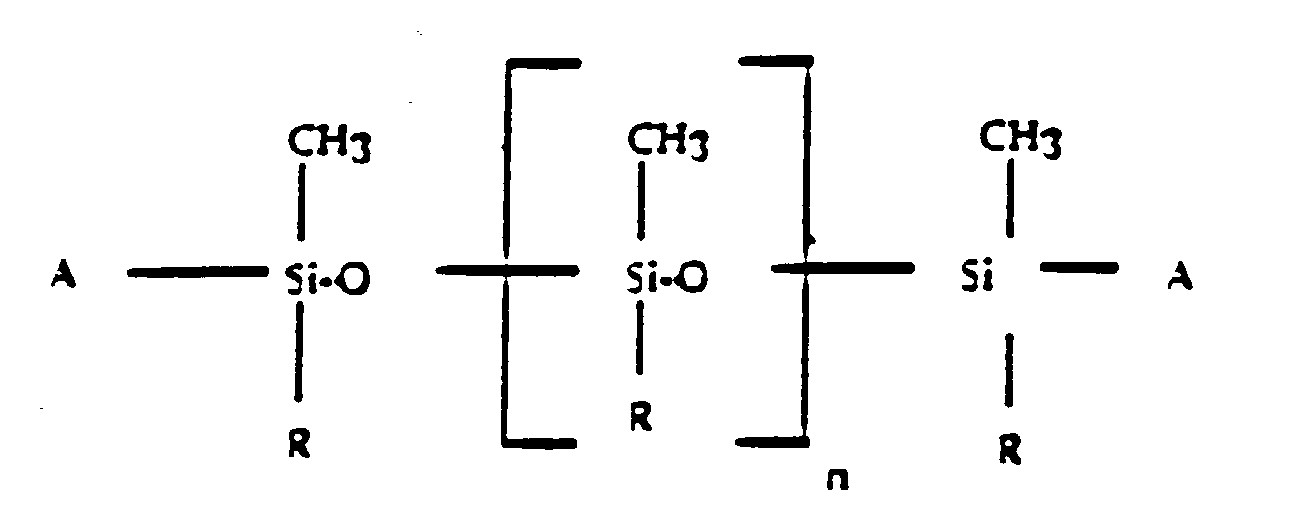
dans laquelle R est un groupe alkyle, alcényle ou aryle ayant moins de 19 atomes de carbone, ou un groupe aryle substitué par un groupe alkyle ou alcényle ayant moins de 19 atomes de carbone, le groupe fonctionnel A est un atome d'hydrogène, un groupe hydroxy, alcoxy, amino, époxy, vinylique, acrylique ou mercapto et n est un nombre de 2 à 350, à mettre en contact ce fluoroélastomère vulcanisé avec cette solution dans des conditions permettant de former une couche superficielle mince du polyorganosiloxane greffé sur ce fluoroélastomère.
dans laquelle R est un groupe alkyle, alcényle ou aryle ayant moins de 19 atomes de carbone, ou un groupe aryle substitué par un groupe alkyle ou alcényle ayant moins de 19 atomes de carbone, le groupe fonctionnel A est un atome d'hydrogène, un groupe hydroxy, alcoxy, amino, époxy, vinylique, acrylique ou mercapto et n est un nombre de 2 à 350, à mettre en contact ce fluoroélastomère vulcanisé avec cette solution dans des conditions permettant de former une couche superficielle mince du polyorganosiloxane greffé sur ce fluoroélastomère.
12. Procédé selon la revendication 11, dans lequel le fluoroélastomère vulcanisé traité
est ensuite éliminé de la solution; lavé avec un solvant pour éliminer la matière
n'ayant pas réagi et séché pour éliminer le solvant.
13. Procédé selon la revendication 11, dans lequel ce fluoroélastomère est choisi dans
le groupe constitué du poly(fluorure de vinylidène-hexafluoropropylène) et du poly(fluorure
de vinylidène-hexafluoropropylène-tétrafluoréthylène).
14. Procédé selon la revendication 11, dans lequel cette couche superficielle fine a une
épaisseur d'environ 5 à environ 100 nanomètres.
15. Procédé selon la revendication 11, dans lequel cet agent de défluorhydratation est
choisi dans le groupe constitué des bases minérales et des peroxydes.
16. Procédé selon la revendication 15, dans lequel cet agent est choisi dans le groupe
constitué des bases de métaux alcalin et alcalino-terreux, du peroxyde d'hydrogène
et du peroxyde de benzoyle.
17. Procédé selon la revendication 11, dans lequel ce substrat de support est un manchon
cylindrique.
18. Procédé selon la revendication 11, dans lequel ce polyorganosiloxane est lié par covalence
à ce fluoroélastomère vulcanisé et est suffisamment mince pour n'avoir pratiquement
aucun effet sur les propriétés physiques du fluoroélastomère vulcanisé.
19. Procédé selon la revendication 16, dans lequel cet élément est un rouleau à pression,
un rouleau de fixation ou un rouleau délivreur d'agent de séparation.
20. Procédé selon la revendication 11, dans lequel n est un nombre de 60 à 80.