|
(11) | EP 0 492 509 B1 |

| (12) | EUROPEAN PATENT SPECIFICATION |
|
|
| (54) |
Vinyl polymer having (meth)acryloyl groups on the side chains and method for preparing same Vinylpolymer mit (Meth)Acryloyl-Gruppen in die Seitenketten und Verfahren zu seiner Herstellung Polymère vinylique contenant des groupes (méth)acryloyl dans la chaîne latérale et méthode de sa préparation |
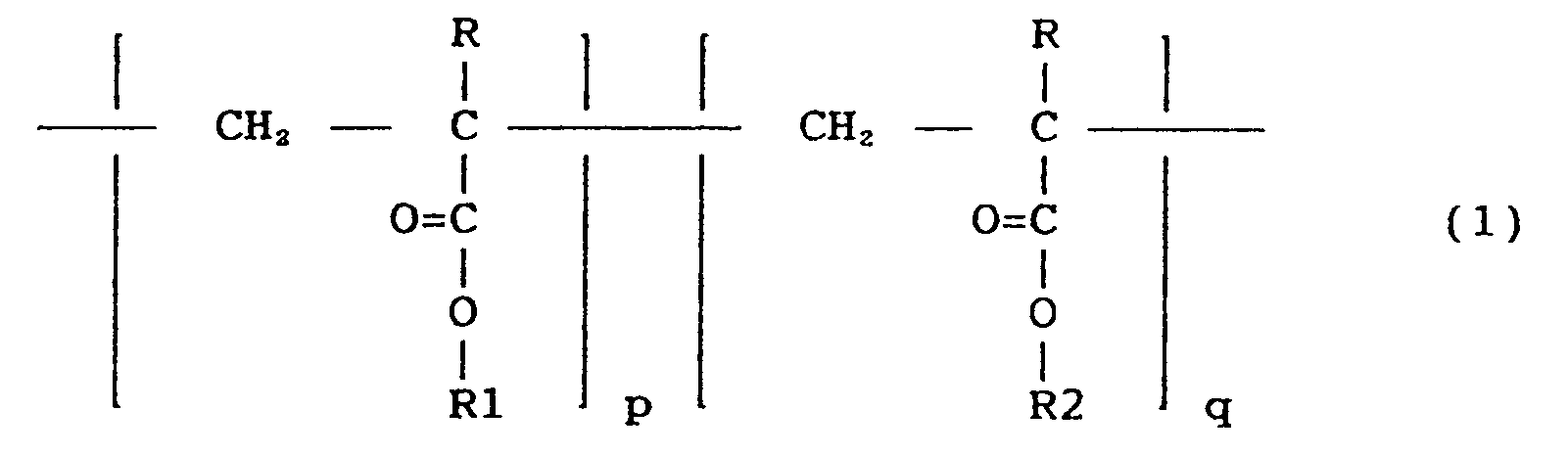
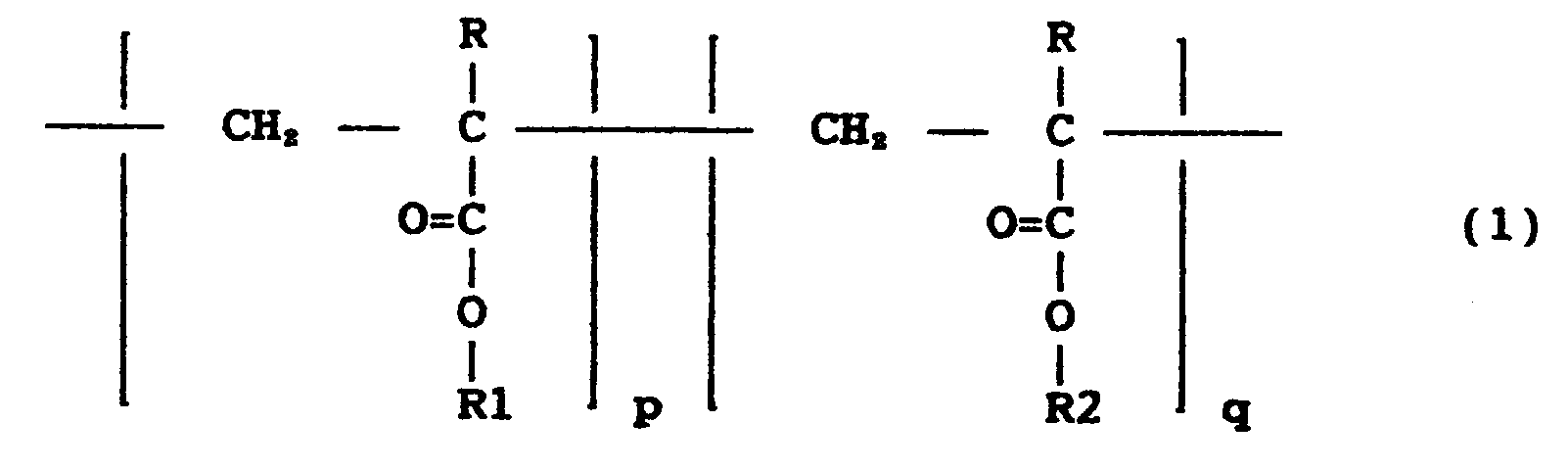
|
|
|||||||||||||||||||||||||||||||
| Note: Within nine months from the publication of the mention of the grant of the European patent, any person may give notice to the European Patent Office of opposition to the European patent granted. Notice of opposition shall be filed in a written reasoned statement. It shall not be deemed to have been filed until the opposition fee has been paid. (Art. 99(1) European Patent Convention). |
[0001] The present invention relates to a vinyl polymer having (meth)acryloyl groups on the side chains which can be used as a material for making a variety of polymeric materials highly multi-functional and highly efficient as well as a method for preparing the same.
[0002] There have been used a variety of polymeric materials in wide variety of fields along with the recent marked progress in polymer industries. In particular, there have been conducted the development of more excellent materials over recent several years in order to satisfy the recent requirements for the improvement in quality, performance and functionality of industrial products.
[0003] Under such circumstances, (meth)acrylic monomers have widely been used in the fields of, for instance, paints, gluing agents, adhesives, inks, fiber-processing agents and synthetic resin plates because of their high reactivity, kinds of new (meth)acrylic monomers have likewise recently been increased year by year in proportion to the industrial importance thereof and the molecular weight of these monomers has also been increased along with the diversity in applications thereof. The Chemical Abstracts, vol. 104, no. 22, abstract no. 187076 (2/6/86) for example describes the polymerization of a (meth)acrylic monomer with a diene monomer, wherein both monomers have long-chain aliphatic moieties, for the preparation of nonaqueous dispersions. For instance, there have been known a series of polymers having a relatively low molecular weight of the order of about 1000 to several tens of thousands and a (meth)acryloyl group at one end thereof (called "macromer" or macromonomer"). They can easily provide a variety of graft polymers if they are copolymerized with vinyl monomers. For this reason, these graft polymers have been investigated and applied to the fields which require any particular combination of physical properties and functions such as a microphase separation structure, amphiphatic properties and interfacial activity, i.e., in the fields of adhesives, gluing agents, compatibilizing agents and medical materials.
[0004] On the other hand, it can he considered that reactive oligomers or polymers having a plurality of (meth)acryloyl groups in the molecular chains per se are used as photohardenable or thermosetting resins or that it is easy for imparting new functions or processability to these oligomers or polymers if they are simultaneously used with other resins and thus they would be anticipated as functional polymeric materials used in a variety of industrial applications.
[0005] The inventors of this invention have worked on the development of reactive oligomers or polymers of a new type having (meth)acryloyl groups in the molecule. As a result, the inventors have found out that reactive vinyl polymers having (meth)acryloyl groups on the side chains can easily be obtained by radical-copolymerizing certain kinds of monofunctional (meth)acrylates with polyfunctional (meth)acrylates under specific conditions in a solvent and thus have completed the present invention.
[0006] The present invention shows that the radical copolymerization of a monofunctional (meth)acrylate with a polyfunctional (meth)acrylate need not lead to gelation. More specifically, according to the present invention, the crosslinking reaction between growing polymer radicals and (meth)acryloyl groups on the side chains of prepolymers can principally be controlled by introducing a group selected from the group consisting of long chain alkyl groups having 6 to 22 carbon atoms, cyclic alkyl groups having 6 to 22 carbon atoms and groups represented by the formula: -(CXH2XO)l-(CyH2yO)m-R3 into the substituent of the side chain on the (meth)acrylate monomer to make use of the steric effect of the introduced group.
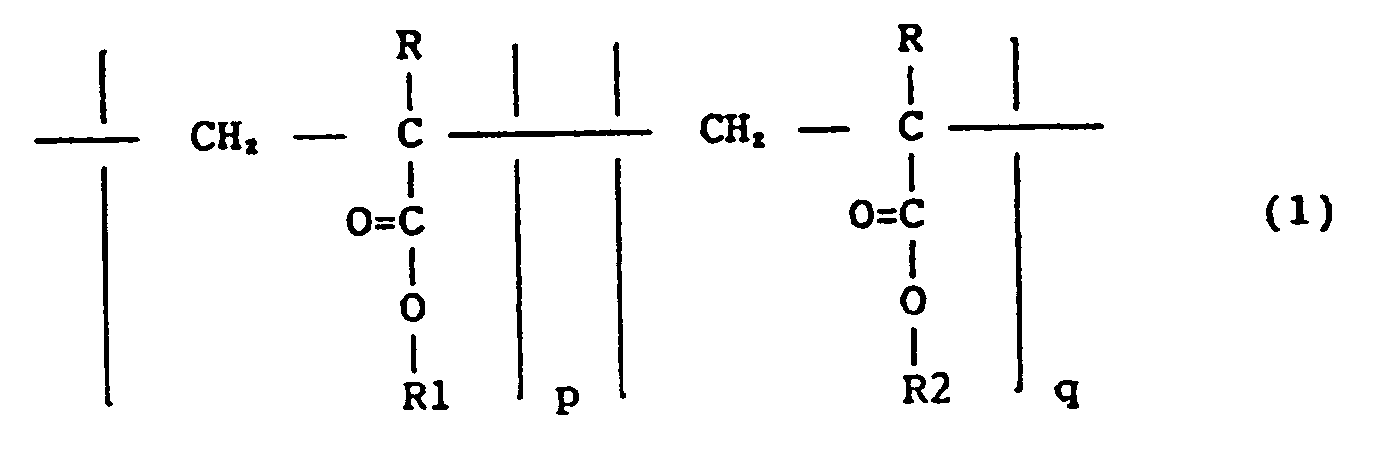
[0007] According to an aspect of the present invention (first aspect of the invention), there is provided a vinyl polymer having (meth)acryloyl groups on the side chains, which comprises repeating units represented by the following general formula (1) wherein the rate of subunit p ranges form 40 to 99.5 mole% and the rate of subunit q ranges from 60 to 0.5 mole% and which has a weight average molecular weight ranging from 2 × 10³ to 10⁷:
In the foregoing general formula (1), R represents a hydrogen atom or a methyl group; R1 represents a long chain alkyl group having 6 to 22 carbon atoms, a cyclic alkyl group having 6 to 22 carbon atoms or a group represented by the formula: -(CXH2XO)l-(CyH2yO)m-R3 (wherein R3 represents a hydrogen atom, an alkyl group or an aryl group); x and y each represents an integer ranging from 1 to 4; l and m each represents 0 or an integer of not less than 1, provided that the sum of l and m is an integer of not less than 2; and R2 represents a (meth)acryloyl group-containing group.
[0008] In the foregoing general formula (1), R2 may be a (meth)acryloyl group-containing group represented by the following general formula (2):
wherein R represents a hydrogen atom or a methyl group; z represents an integer ranging from 2 to 10; and n is an integer ranging from 1 to 4 when z is an integer ranging from 2 to 3, n is 1 or 2 when z is 4 or n is 1 when z is an integer ranging from 5 to 10. The substituent R2 in the general formula (1) may also he a (meth)acryloyl group-containing group represented by the following general formula (3):
wherein R represents a hydrogen atom or a methyl group; R4 represents an ester residue of a polyhydric alcohol having 1 to 12 carbon atoms; and a represents an integer ranging from 1 to 10.
[0009] The vinyl polymer having (meth)acryloyl groups on the side chains represented by the general formula (1) according to the first aspect of the present invention can he prepared by radical-copolymerizing 40 to 99.5 mole% of at least one mono(meth)acrylate monomer represented by the following general formula (5):
(wherein R represents a hydrogen atom or a methyl group;
R1 represents a long chain alkyl group having 6 to 22 carbon atoms, a cyclic alkyl group having 6 to 22 carbon atoms or a group represented by the formula:
-(CXH2XO)l-(CyH2yO)m-R3 (wherein R3 represents a hydrogen atom, an alkyl group or an aryl group); x and y each represents an integer ranging from 1 to 4; and l and m each represents 0 or an integer of not less than 1, provided that the sum of l and m is an integer of not less than 2) which has a single (meth)acryloyl group and a molecular weight of not less than 160 with 60 to 0.5 mole% of at least one (meth)acrylate monomer represented by the following general formula (6):
(wherein R represents a hydrogen atom or a methyl group; and R2 represents a (meth)acryloyl group-containing group) which has a plurality of (meth)acryloyl groups and a molecular weight of not more than 700, in a good solvent for the mono(meth)acrylate monomer, wherein the total concentration of the monomers in the reaction system is limited to a level of not more than 2 mole/l.
[0010] The monomer represented by the general formula (6) is at least one member selected from the group consisting of di(meth)acrylate monomers of the general formula (6) in which the substituent R2 is represented by the general formula (2):
wherein R represents a hydrogen atom or a methyl group; z represents an integer ranging from 2 to 10; and n is an integer ranging from 1 to 4 when z is an integer ranging from 2 to 3, n is 1 or 2 when z is 4 or n is 1 when z is an integer ranging from 5 to 10; and poly(meth)acrylate monomers of the general formula (6) in which the substituent R2 is represented by the following general formula (3);
wherein R represents a hydrogen atom or a methyl group; R4 represents an ester residue of a polyhydric alcohol having 1 to 12 carbon atoms; and a represents an integer ranging form 1 to 10.
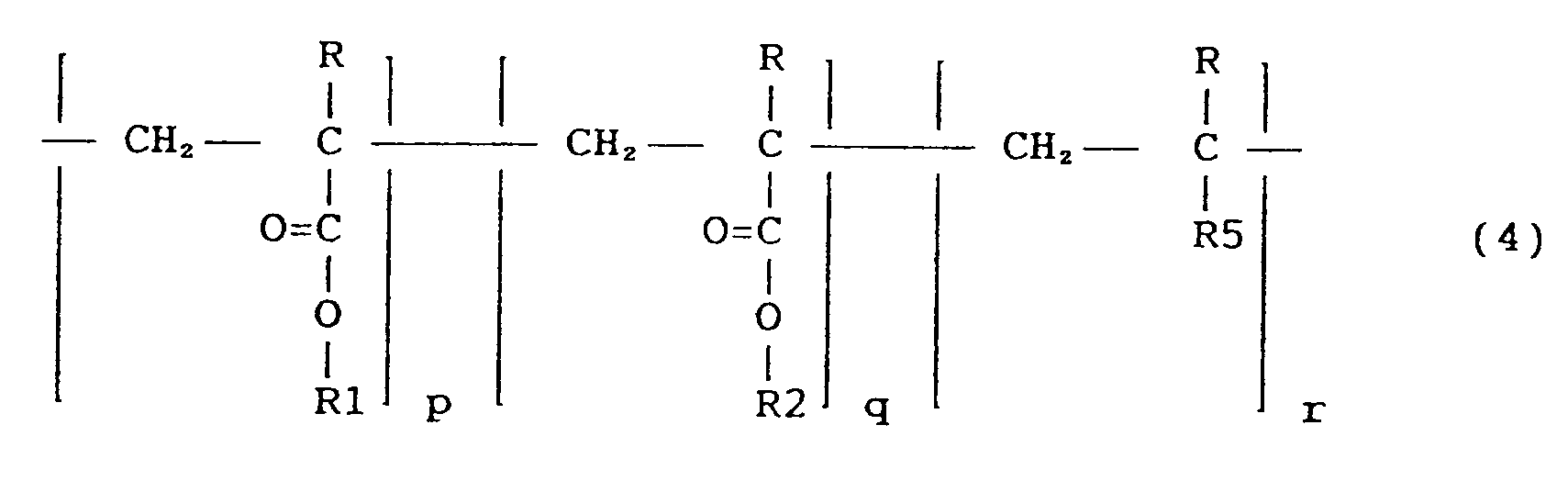
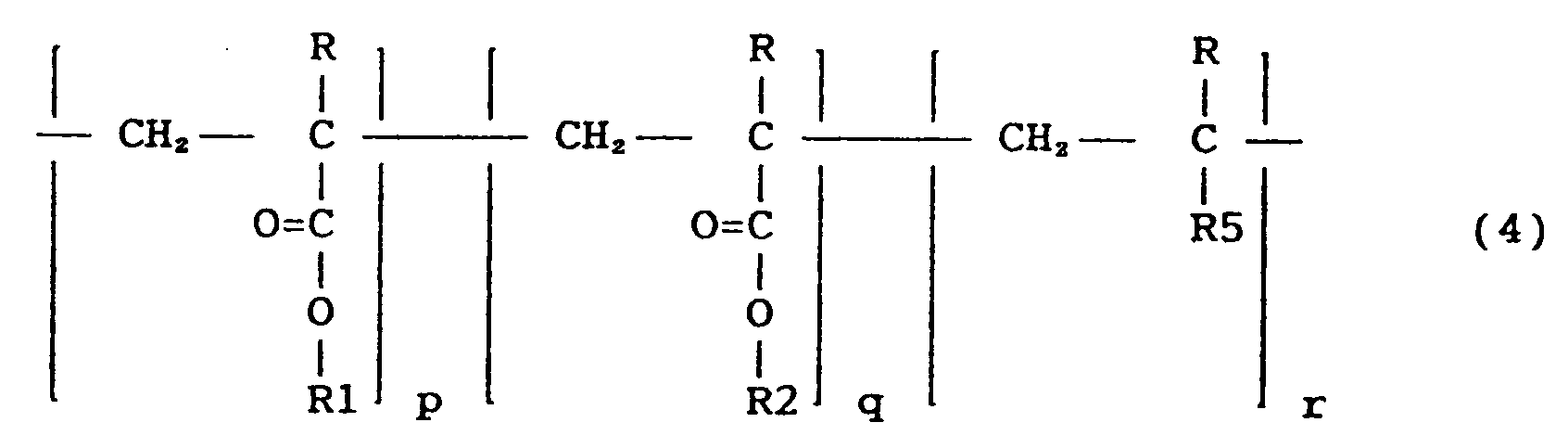
[0011] According to a second aspect of the present invention (second aspect of the invention), there is provided a vinyl polymer carrying (meth)acryloyl groups on the side chains, which comprises repeating units represented by the following general formula (4) wherein p ranges form 40 to 99.5 mole%, q ranges form 60 to 0.5 mole% and r ranges form 0 to 59.5 mole% and which has a weight average molecular weight ranging from 2 × 10³ to 10⁷:
In the foregoing general formula (4), R represents a hydrogen atom or a methyl group; R1 represents a long chain alkyl group having 6 to 22 carbon atoms, a cyclic alkyl group having 6 to 22 carbon atoms or a group represented by the formula: -(CXH2XO)l-(CyH2yO)m-R3 (wherein R3 represents a hydrogen atom, an alkyl group or an aryl group); x and y each represents an integer ranging from 1 to 4; l and m each represents 0 or an integer of not less than 1, provided that the sum of l and m is an integer of not less than 2; R2 represents a (meth)acryloyl group-containing group; and R5 represents a functional group having a molecular weight of less than 133.
[0012] In the foregoing general formula (4), the substituent R2 may be a (meth)acryloyl group-containing group represented by the following general formula (2);
wherein R represents a hydrogen atom or a methyl group; z represents an integer ranging from 2 to 10; and n is an integer ranging from 1 to 4 when z is an integer ranging from 2 to 3, n is 1 or 2 when z is 4 or n is 1 when z is an integer ranging from 5 to 10. The substituent R2 in the general formula (4) may also he a (meth)acryloyl group-containing group represented by the following general formula (3);
wherein R represents a hydrogen atom or a methyl group; R4 represents an ester residue of a polyhydric alcohol having 1 to 12 carbon atoms; and a represents an integer ranging from 1 to 10.
[0013] The vinyl polymer having (meth)acryloyl groups on the side chains represented by the general formula (4) according to the second invention can he prepared by radical-copolymerizing 40 to 99.5 mole% of at least one mono(meth)acrylate monomer represented by the following general formula (5):
(wherein R represents a hydrogen atom or a methyl group; R1 represents a long chain alkyl group having 6 to 22 carbon atoms, a cyclic alkyl group having 6 to 22 carbon atoms or a group represented by the formula:
-(CXH2XO)l-(CyH2yO)m-R3 (wherein R3 represents a hydrogen atom, an alkyl group or an aryl group); x and y each represents an integer ranging from 1 to 4; and l and m each represents 0 or an integer of not less than 1, provided that the sum of l and m is an integer of not less than 2) which has a single (meth)acryloyl group and a molecular weight of not less than 160g; 60 to 0.5 mole% of at least one (meth)acrylate monomer represented by the following general formula (6):
(wherein R represents a hydrogen atom or a methyl group; and R2 represents a (meth)acryloyl group-containing group) which has a plurality of (meth)acryloyl groups and a molecular weight of not more than 700; and 0 to 59.5 mole% of at least one vinyl compound or vinylidene compound represented by the following general formula (7):
(wherein R represents a hydrogen atom or a methyl group; and R5 represents a functional group having a molecular weight of less than 133) which has a molecular weight of not more than 160, in a good solvent for the mono(meth)acrylate monomer, wherein the total concentration of the monomers in the reaction system is limited to a level of not more than 2 mole/l.
[0014] The monomer represented by the general formula (6) is at least one member selected from the group consisting of di(meth)acrylate monomers of the general formula (6) in which the substituent R2 is represented by the general formula (2):
wherein R represents a hydrogen atom or a methyl group; z represents an integer ranging from 2 to 10; and n is an integer ranging from 1 to 4 when z is an integer ranging from 2 to 3, n is 1 or 2 when z is 4 or n is 1 when z is an integer ranging from 5 to 10; and poly(meth)acrylate monomers of the general formula (6) in which the substituent R2 is represented by the following general formula (3):
wherein R represents a hydrogen atom or a methyl group; R4 represents an ester residue of a polyhydric alcohol having 1 to 12 carbon atoms; and a represents an integer ranging from 1 to 10.
[0015] The vinyl polymer according to the present invention comprises (meth)acryloyl groups on the side chains and is useful as photohardenable and thermosetting gluing agents or adhesives as well as a resin for gluing agents and adhesives because of the high reactivity of (meth)acryloyl groups on the side chain. Moreover, the vinyl polymer of the present invention is likewise useful as a functional polymeric material by mixing with other resins. The method for preparing the vinyl polymer carrying (meth)acryloyl groups on the side chains according to the present invention comprises simple reaction operations unlike the conventional methods which comprise complicated multistage reaction processes.
[0016] The first aspect of the invention relates to a vinyl polymer having (meth)acryloyl groups on the side chains whose repeating units are represented by the foregoing general formula (1). The repeating unit represented by the general formula (1) can be formed by polymerizing corresponding monomers, i. e., the monomers represented by the general formulae (5) and (6) respectively:
In the foregoing general formulae (5) and (6), R represents a hydrogen atom or a methyl group; R1 represents a long chain alkyl group having 6 to 22 carbon atoms, a cyclic alkyl group having 6 to 22 carbon atoms or a group represented by the formula: -(CxH2XO)l-(CyH2yO)m-R3 (wherein R3 represents a hydrogen atom, an alkyl group or an aryl group); x and y each represents an integer ranging from 1 to 4; l and m each represents 0 or an integer of not less than 1, provided that the sum of l and m is an integer of not less than 2; and R2 represents a (meth)acryloyl group-containing group.
[0017] In the foregoing general formula (6), the substituant R2 may be a (meth)acryloyl group-containing group represented by the following general formula (2):
wherein R represents a hydrogen atom or a methyl group; z represents an integer ranging from 2 to 10; and n is an integer ranging from 1 to 4 when z is an integer ranging from 2 to 3, n is 1 or 2 when z is 4 or n is 1 when z is an integer ranging from 5 to 10.
[0018] The substituent R2 in the general formula (6) may also he a (meth)acryloyl group-containing group represented by the following general formula (3):
wherein R represents a hydrogen atom or a methyl group; R4 represents an ester residue of a polyhydric alcohol having 1 to 12 carbon atoms; and a represents an integer ranging from 1 to 10.
[0019] Specific examples of the monomers represented by the general formula (5) include hexyl (meth)acrylate, heptyl (meth)acrylate, octyl (meth)acrylate, nonyl (meth)acrylate, decyl (meth)acrylate, undecyl (meth)acrylate, dodecyl (meth)acrylate, tridecyl (meth)acrylate, tetradecyl (meth)acrylate, hexadecyl (meth)acrylate, heptadecyl (meth)acrylate, octadecyl (meth)acrylate, nonadecyl (meth)acrylate, eicosa (meth)acrylate, uneicosa (meth)acrylate, doeicosa (meth)acrylate and isomers thereof such as 2-ethylhexyl (meth)acrylate and isononyl (meth)acrylate for those in which R1 is a long chain alkyl group having 6 to 22 carbon atoms; isobornyl (meth)acrylate, tricyclodecanyl (meth)acrylate and dimethyladamantyl (meth)acrylate for those in which R1 is a cyclic alkyl group having 6 to 22 carbon atoms; and methoxydiethylene glycol (meth)acrylate, ethoxydiethylene glycol (meth)acrylate, isooctyloxydiethylene glycol (meth)acrylate, phenoxydiethylene glycol (meth)acrylate, phenoxytriethylene glycol (meth)acrylate, methoxytriethylene glycol (meth)acrylate, methoxypolyethylene glycol (meth)acrylate, nonylphenyltetraethylene glycol (meth)acrylate, nonylphenyloctadecylethylene glycol (meth)acrylate, methoxydipropylene glycol (meth)acrylate, (meth)acrylate of 11:15 by molar ratio random adduct of ethylene oxide-propylene oxide one end of which is modified with a stearyloxy group and polytetramathylene glycol mono(meth)acrylate as well as isomers thereof for those in which R1 is a group represented by the formula: -(CXH2XO)l-(CyH2yO)m-R3.
[0020] These monomers represented by the general formula (5) may be used alone or in any combination of at least two of them.
[0021] The monomers represented by the general formula (6) include those in which R2 is represented by the general formula (2) and those having R2 represented by the general formula (3). These monomers represented by the general formula (6) sometimes undergo intramolecular cyclization and crosslinking reactions during polymerization, but these reactions does not cause any trouble.
[0022] Specific examples of the monomers represented by the general formula (6) include ethylene glycol di(meth)acrylate, diethylene glycol di(meth)acrylate, triethylene glycol di(meth)acrylate, tetraethylene glycol di(meth)acrylate, propylene glycol di(meth)acrylate, tetrapropylene glycol di(meth)acrylate, 1,4-butanediol di(meth)acrylate, di(tetramathylene glycol) di(meth)acrylate, 1,5-pentanediol di(meth)acrylate, 1,6-hexanediol di(meth)acrylate, 3-methyl-1,5-pentanediol di(meth)acrylate, 1,9-nonanediol di(meth)acrylate, 1,10-decanediol di(meth)acrylate and isomers thereof for those in which R2 is represented by the general formula (2); and trimethylolpropane tri(meth)acrylate, pentaerythritol tri(meth)acrylate, pentaerythritol tetra (meth)acrylate, dipentaerythritol hexa(meth)acrylate, trimethylolheptane tri(meth)acrylate and isomers thereof for those in which R2 is represented by the general formula (3).
[0023] These monomers represented by the general formula (6) may be used alone or in any combination of at least two of them.
[0024] The second aspect of the invention relates to a vinyl polymer having (meth)acryloyl groups on the side chains whose repeating units are represented by the foregoing general formula (4). The repeating unit represented by the general formula (4) can be obtained by copolymerizing the foregoing monomers represented by the general formulae (5), (6) and (7) respectively:
In these formulae, R represents a hydrogen atom or a methyl group; R1 represents a long chain alkyl group having 6 to 22 carbon atoms, a cyclic alkyl group having 6 to 22 carbon atoms or a group represented by the formula: -(CXH2XO)l-(CyH2yO)m-R3 (wherein R3 represents a hydrogen atom, an alkyl group or an aryl group); x and y each represents an integer ranging from 1 to 4; l and m each represents 0 or an integer of not less than 1, provided that the sum of l and m is an integer of not less than 2; R2 represents a (meth)acryloyl group-containing group; and R5 is a functional group having a molecular weight of less than 133.
[0025] In the foregoing general formula (6), R2 may be a (meth)acryloyl group-containing group represented by the following general formula (2):
wherein R represents a hydrogen atom or a methyl group; z represents an integer ranging from 2 to 10; and n is an integer ranging from 1 to 4 when z is an integer ranging from 2 to 3, n is 1 or 2 when z is 4 or n is 1 when z is an integer ranging from 5 to 10.
[0026] The substituent R2 in the general formula (6) may also be a (meth)acryloyl group-containing group represented by the following general formula (3);
wherein R represents a hydrogen atom or a methyl group; R4 represents an ester residue of a polyhydric alcohol having 1 to 12 carbon atoms; and a represents an integer ranging from 1 to 10.
[0027] Specific examples of the monomers represented by the general formula (5) and (6) are the same as those already defined above.
[0028] Examples of the monomers represented by the general formula (7) include styrene, vinyl monomers such as vinyl acetate, (meth)acrylic acid, methyl (meth)acrylate, ethyl (meth)acrylate, propyl (meth)acrylate, butyl (meth)acrylate, pentyl (meth)acrylate, hexyl acrylate, glycidyl (meth)acrylate, isocyanatoethyl (meth)acrylate and isomers thereof. These monomers represented by the general formula (7) may be used alone or in any combination of at least two of them.
[0029] The vinyl polymer having the repeating units represented by the general formula (1) (the first invention) can be prepared by adding 40 to 99.5 mole% of a monomer represented by the general formula (5) and 60 to 0.5 mole% of a monomer represented by the general formula (6) in a reactor and then radical-copolymerizing these monomers in a good solvent for the monomer represented by the general formula (5). In this respect, the total monomer concentration in the reaction system should be limited to not more than 2 mole/l in order to prevent the gelation thereof.
[0030] The vinyl polymer having the repeating units represented by the general formula (4) (the second aspect of the invention) can be prepared by adding 40 to 99.5 mole% of a monomer represented by the general formula (5), 60 to 0.5 mole% of a monomer represented by the general formula (6) and 0 to 59.5 mole% of a monomer represented by the general formula (7) in a reactor and then radical-copolymerizing these monomers in a good solvent for the monomer represented by the general formula (5). In this respect, the total monomer concentration in the reaction system should be limited to not more than 2 mole/l in order to prevent the gelation thereof.
[0031] Examples of solvents used in the copolymerization are those having low polarity such as benzene, toluene, xylene, hexane, cyclohexane and heptane for the monomer whose substituent R1 is a long chain alkyl group having 6 to 22 carbon atoms or a cyclic alkyl group having 6 to 22 carbon atoms; or those having high polarity such as alcohols, for instance, methanol and ethanol, ketones, for instance, acetone and methyl ethyl ketone, esters, for instance, ethyl acetate and butyl acetate, ethers, for instance, dioxane and ethylene glycol derivative solvents, for instance, ethylene glycol mono butyl ether in addition to the foregoing solvents having low polarity for the monomers of the formula (5) whose substituent R1 is a group represented by the general formula: -(CXH2XO)l-(CyH2yO)m-R3.
[0032] In the foregoing copolymerization, commonly known radical polymerization initiators can be used and specific examples thereof include azo compounds such as 2,2'-azobisisobutyronitrile (hereinafter referred to as "AIBN"); and peroxy compounds such as lauroyl peroxide (hereinafter referred to as "LPO") and benzoyl peroxide (hereinafter referred to as "BPO") which may be used alone or in combination.
[0033] The reaction is carried out at a temperature which permits the practice of the radical-copolymerization, for instance, ranging from about 40 to 130°C.
[0034] In addition, a chain transfer agent selected from the group consisting of lauryl mercaptan and mercaptopropionic acid can optionally be used to control the degree of polymerization of the resulting polymers.
[0035] It is desirable to add a heat polymerization inhibitor selected from the group consisting of p-methoxyphenol, hydroquinone and butylhydroxytoluene to the reaction product for the purpose of imparting shelf stability to the resulting reaction product after the completion of the reaction.
[0036] The polymer produced is recovered by distilling off the reaction solvent under reduced pressure or by pouring the reaction solution in a precipitant to thus precipitate and purify the product.
[0037] In the preparation of the vinyl polymer whose repeating units are represented by the general formula (1) (the first aspect of the invention), the monomers represented by the general formulae (5) and (6) are used in amounts ranging from 40 to 99.5 mole% and 60 to 0.5 mole% respectively. This is because, if the amount of the monomer (5) used is less than 40 mole%, the substituent R1 on the side chain of the monomer (5) does not show a sufficient steric effect and the resulting polymer becomes insoluble in the solvent in an early stage, in other words causes premature gelation. On the other hand, if it is more than 99.5 mole% or the amount of the monomer represented by the general formula (6) is less than 0.5 mole% , polymers can easily be produced, but the resulting polymer does not contain a sufficient amount of (meth)acryloyl side chains required for effective crosslinking thereof through the application of, for instance, heat or light rays and, therefore, the industrial value thereof is greatly impaired.
[0038] In the preparation of the vinyl polymer whose repeating units are represented by the general formula (4) (the second aspect of the invention), the monomers represented by the general formulae (5), (6) and (7) are used in amounts ranging from 40 to 99.5 mole%, 60 to 0.5 mole% and 0 to 59.5 mole% respectively. This is because, if the amounts of the monomers represented by the general formulae (5) and (6) are beyond the ranges defined above, the same problems as those described above arise. If the amount of the monomer represented by the general formula (7) exceeds the upper limit, the substituent R1 on the side chain of the monomer (5) does not show a sufficient steric effect and the resulting polymer accordingly causes gelation.
[0039] The weight average molecular weight of the vinyl polymer according to the present invention in general ranges from 2 × 10³ to 10⁷ and preferably 5 × 10³ to 10⁶. This is because if it is less than 2 × 10³, the number of the side chain: (meth)acryloyl group in the polymer is sometimes not more than 1 per polymer on the average since the resulting polymer has a small chain length. In other words, some of the resulting polymers do not contain any side chain: (meth)acryloyl group in the molecule. On the other hand, if it exceeds 10⁷, the melt viscosity of the resulting polymer is substantially increased and correspondingly the processability thereof is greatly impaired or further the compatibility thereof with other resins is lowered.
[0040] In this respect, the weight average molecular weight of the vinyl polymer was determined at 30°C by means of Dynamic Light Scattering Photometer DLS 700 available from Otsuka Electric Co., Ltd. using tetrahydrofuran (THF) as a solvent.
[0041] The present invention will hereunder be explained in more detail with reference to the following non-limitative working Examples.
[0042] In the following Examples, ¹H-NMR spectra were measured at 27 °C by means of an apparatus: GSX-400 available from NEC Corporation using CDCl₃ as a solvent. The content of the side chain: (meth)acryloyl group in the resulting polymer was determined on the basis of the ¹H-NMR spectra of a sample solution containing a known amount of a reference substance.
[0043] Examples 1 to 11 and 18 to 21 relate to vinyl polymers whose repeating unit is represented by the general formula (1), while Examples 12 to 17 and 22 to 24 relate to vinyl polymers whose repeating unit is represented by the general formula (4).
Example 1:
[0044] There were mixed 120.8g (0.475 mole) of lauryl methacrylate (Light Ester L; available from Kyoeisha Chemical Co., Ltd.), 8.3g (0.025 mole) of tetraethylene glycol dimethacrylate (Light Ester 4 EG; available from Kyoeisha Chemical Co., Ltd.) and 3.3g of AIBN and then benzene was added to obtain 1ℓ of a reaction solution. The resulting solution was charged in a 2ℓ volume 4-necked flask equipped with a stirring machine, a cooling tube, a thermometer and a tube for introducing nitrogen gas and radical copolymerization was performed at 50 °C for 10 hours in a nitrogen gas stream. After the completion of the copolymerization, the reaction solution was cooled, the reaction was interrupted by the addition of 200 ppm of p-methoxyphenol and then the solution was poured in methanol as a precipitating agent to thus deposit the resulting polymer. In order to purify or remove a trace amount of the unreacted monomers, the resulting polymer was again dissolved in benzene and then poured in methanol to again precipitate the polymer. The solvent was completely removed under reduced pressure to give 119g of the final product (yield 92%). The polymer was analyzed by 400 MHz ¹H-NMR spectroscopy and it was found out that peaks corresponding to the vinyl methylene proton =CH₂ of the side chain. methacryloyl group were detected at δ = 5.7 ppm and δ = 6.2 ppm in addition to the peak corresponding to lauryl methacrylate units as principal component. The weight average molecular weight of this polymer was found to be 6.5 × 10⁵.
Example 2:
[0045] The same procedures used in Example 1 were repeated except that 88.5g (0.48 mole) of 2-ethylhexyl acrylate (Light Acrylate EH-A; available from Kyoeisha Chemical Co., Ltd.) and 4.0g (0.02 mol) of ethylene glycol dimethacrylate (Light Ester EG; available from Kyoeisha Chemical Co., Ltd.) were substituted for the lauryl methacrylate and tetraethylene glycol dimethacrylate used in Example 1 respectively to give a purified polymer (84g; yield 91%). The polymer thus obtained was analyzed by ¹H-NMR spectroscopy and it was found out that peaks corresponding to the vinyl methylene proton =CH₂ of the side chain: methacryloyl group were detected at δ = 5.7 ppm and δ = 6.2 ppm. The weight average molecular weight of this polymer was found to be 3.8 × 10⁵.
Example 3:
[0046] The same procedures used in Example 1 were repeated except that 284.2g (0.72 mole) of behenyl methacrylate and 8.5g (0.03 mole) of 1,10-decanediol dimethacrylate were substituted for the lauryl methacrylate and tetraethylene glycol dimethacrylate used in Example 1 respectively to give a purified polymer (269g; yield 92%). The polymer thus obtained was analyzed by ¹H-NMR spectroscopy and it was found out that peaks corresponding to the vinyl methylene proton =CH₂ of the side chain: methacryloyl group were detected at δ = 5.7 ppm and δ = 6.2 ppm. The weight average molecular weight of this polymer was found to be 7.5 × 10⁵.
Example 4:
[0047] The same procedures used in Example 1 were repeated except that 80.9g (0.475 mole) of n-hexyl methacrylate and 5.0g (0.025 mole) of ethylene glycol dimethacrylate (Light Ester EG; available from Kyoeisha Chemical Co., Ltd.) were substituted for the lauryl methacrylate and tetraethylene glycol dimethacrylate used in Example 1 respectively to give a purified polymer (77g; yield 90%). The polymer thus prepared was analyzed by ¹H-NMR spectroscopy and it was found out that peaks corresponding to the vinyl methylene proton =CH₂ of the side chain: methacryloyl group were detected at δ = 5.7 ppm and δ = 6.2 ppm. The weight average molecular weight of this polymer was found to be 5.8 × 10⁵.
Example 5:
[0048] The same procedures used in Example 1 were repeated except that 82.7g (0.475 mole) of methoxydiethylene glycol acrylate and 5.3g (0.025mole) of neopentyl glycol diacrylate were substituted for the lauryl methacrylate and tetraethylene glycol dimethacrylate used in Example 1 respectively, that dioxane was used as a solvent and that n-hexane was used as a solvent for reprecipitation to give a purified polymer (78g; yield 89%). The polymer thus obtained was analyzed by ¹H-NMR spectroscopy and it was found out that peaks corresponding to the vinyl methylene proton =CH₂ of the side chain: acryloyl group were detected at δ = 5.9 ppm and δ = 6.5 ppm and a peak for vinyl methine proton =CH-was detected at δ = 6.2 ppm. The weight average molecular weight of this polymer was found to be 6.2 × 10⁵.
Example 6:
[0049] The same procedures used in Example 1 were repeated except that 350.1g (0.705 mole) of methoxynonaethylene glycol methacrylate and 11.4g (0.045 mole) of 3-methyl-1,5-pentanediol dimethacrylate were substituted for the lauryl methacrylate and tetraethylene glycol dimethacrylate used in Example 1 respectively, that ethanol was used as a solvent and that n-hexane was used as a precipitating agent to give a purified polymer (325g; yield 90%). The polymer thus obtained was analyzed by ¹H-NMR spectroscopy and it was found out that peaks corresponding to the vinyl methylene proton =CH₂ of the side chain: methacryloyl group were detected at δ = 5.7 ppm and δ = 6.2 ppm. The weight average molecular weight of this polymer was found to be 8.6 × 10⁵.
Example 7:
[0050] The same procedures used in Example 1 were repeated except that 306.3g (0.287 mole) of p-nonylphenoxy octadecylethylene glycol acrylate and 18.9g (0.063 mole) of tripropylene glycol diacrylate were substituted for the lauryl methacrylate and tetraethylene glycol dimethacrylate used in Example 1 respectively to give a purified polymer (236g; yield 92%). The polymer thus obtained was analyzed by ¹H-NMR spectroscopy and it was found out that peaks corresponding to the vinyl methylene proton =CH₂ of the side chain: acryloyl group were detected at δ = 5.9 ppm and δ = 6.5 ppm and a peak attributable to vinyl methine proton =CH- was detected at δ = 6.2 ppm. The weight average molecular weight of this polymer was found to be 2.4 × 10⁵.
Example 8:
[0051] The same procedures used in Example 1 were repeated except that 406.6g (0.24 mole) of an ester of methacrylic acid with an alcohol having a molecular weight of about 1600 and obtained by blocking, with a stearyl group, one end of an EO-PO random copolymer which comprised 11 moles of ethylene oxide and 15 moles of propylene oxide, and 23.2g (0.06 mole) of tetrapropylene glycol dimethacrylate were substituted for the lauryl methacrylate and tetraethylene glycol dimethacrylate used in Example 1 respectively, that THF was used as a solvent and that n-hexane was used as a precipitating agent to give a purified polymer (391g; yield 91%). The polymer thus obtained was analyzed by ¹H-NMR spectroscopy and it was found out that peaks corresponding to the vinyl methylene proton =CH₂ of the side chain: methacryloyl group were detected at δ = 5.7 ppm and δ = 6.2 ppm. The weight average molecular weight of this polymer was found to be 4.8 × 10⁵.
Example 9:
[0052] The same procedures used in Example 1 were repeated except that 3.0g (0.015 mole) of ethylene glycol dimethacrylate and 2.9g (0.01 mole) of triethylene glycol dimethacrylate (Light Ester 3 EG; available from Kyoeisha Chemical Co., Ltd.) were substituted for the tetraethylene glycol dimethacrylate used in Example 1 to give a purified polymer (127g; yield 91%). The polymer thus obtained was analyzed by ¹H-NMR spectroscopy and it was found out that peaks corresponding to the vinyl methylene proton =CH₂ of the side chain: methacryloyl group were detected at δ = 5.9 ppm and δ = 6.2 ppm. The weight average molecular weight of this polymer was found to be 9.2 × 10⁵.
Example 10:
[0053] The same procedures used in Example 1 were repeated except that 46.4g (0.252 mole) of isooctyl acrylate (Light Acrylate I0-A; available from Kyoeisha Chemical Co., Ltd.) and 136.3g (0.42 mole) of stearyl acrylate (Light Acrylate S-A; available from Kyoeisha Chemical Co., Ltd.) were substituted for the lauryl methacrylate used in Example 1 and 6.3g (0.028 mole) of 1,6-hexanediol diacrylate (Light Acrylate 1,6 HX-A; available from Kyoeisha Chemical Co., Ltd.) was substituted for the tetraethylene glycol dimethacrylate used in Example 1 to give a purified polymer (166g; yield 88%). The polymer thus obtained was analyzed by ¹H-NMR spectroscopy and it was found out that peaks corresponding to the vinyl methylene proton =CH₂ of the side chain: acryloyl group were detected at δ = 5.9 ppm and δ = 6.5 ppm and a peak for vinyl methine proton =CH- was detected at δ = 6.2 ppm. The weight average molecular weight of this polymer was found to be 7.1 × 10⁵.
Example 11:
[0054] The same procedures used in Example 1 were repeated except that 105.5g (0.475 mole) of isobornyl methacrylate (Light Ester IB-X; available from Kyoeisha Chemical Co., Ltd.) was substituted for the lauryl methacrylate used in Example 1 and 7.4g (0.025 mole) of trimethylolpropane triacrylate (Light Acrylate TMP-A; available from Kyoeisha Chemical Co., Ltd.) was substituted for the tetraethylene glycol dimethacrylate used in Example 1 and that the reaction temperature was changed to 60 °C to give a purified polymer (99g; yield 88%). The polymer thus prepared was analyzed by ¹H-NMR spectroscopy and it was found out that peaks corresponding to the vinyl methylene proton =CH₂ of the side chain: acryloyl group were detected at δ = 5.9 ppm and δ = 6.5 ppm and a peak for vinyl methine proton =CH- was detected at δ = 6.2 ppm. The weight average molecular weight of this polymer was found to be 4.2 × 10⁵.
Example 12:
[0055] The same procedures used in Example 1 were repeated except that 50.9g (0.2 mole) of lauryl methacrylate and 4.95g (0.025 mole) of ethylene glycol dimethacrylate instead of the tetraethylene glycol dimethacrylate used in Example 1 as well as 28.6g (0.275 mole) of styrene were used and that the reaction temperature was changed to 60 °C to give a purified polymer (80.2g; yield 89%). The polymer thus obtained was analyzed by ¹H-NMR spectroscopy and it was found out that peaks corresponding to the vinyl methylene proton =CH₂ of the side chain: methacryloyl group were detected at δ = 5.7 ppm and δ = 6.2 ppm. The weight average molecular weight of this polymer was found to be 4.5 × 10⁵.
Example 13:
[0056] The same procedures used in Example 1 were repeated except that 101.8g (0.4 mole) of lauryl methacrylate and 14.8g (0.05 mole) of trimethylolpropane triacrylate instead of the tetraethylene glycol dimethacrylate used in Example 1 as well as 62.0g (0.595 mole) of styrene were used, that 6.6g of AIBN was used, that toluene was used as a solvent and that the reaction temperature was changed to 60 °C to give a purified polymer (163.0g; yield 88%). The polymer thus obtained was analyzed by ¹H-NMR spectroscopy and it was found out that peaks corresponding to the vinyl methylene proton =CH₂ of the side chain: acryloyl group were detected at δ = 5.9 ppm and δ = 6.5 ppm and a peak for vinyl methine proton =CH- was detected at δ = 6.2 ppm. The weight average molecular weight of this polymer was found to be 5.0 × 10⁵.
Example 14:
[0057] The same procedures used in Example 1 were repeated except that 57.2g (0.225mole) of lauryl methacrylate and 7.4g (0.025 mole) of trimethylolpropane triacrylate instead of the tetraethylene glycol dimethacrylate used in Example 1 as well as 15.7g (0.15 mole) of styrene and 10.0g (0.1 mole) of methyl methacrylate were used and that the reaction temperature was changed to 60 °C to give a purified polymer (83.8g: yield 89.5%). The polymer thus obtained was analyzed by ¹H-NMR spectroscopy and it was found out that peaks corresponding to the vinyl methylene proton =CH₂ of the side chain: acryloyl group were detected at δ = 5.9 ppm and δ = 6.5 ppm and a peak for vinyl methine proton =CH-was detected at δ = 6.2 ppm. The weight average molecular weight of this polymer was found to be 4.2 × 10⁵.
Example 15:
[0058] The same procedures used in Example 1 were repeated except that 101.8g (0.45 mole) of decyl methacrylate instead of the lauryl methacrylate used in Example 1 and 8.9g (0.03 mole) of pentaerythritol triacrylate instead of the tetraethylene glycol dimethacrylate used in Example 1 as well as 67.7g (0.52 mole) of 2-hydroxyethyl methacrylate were used, that 6.6g of AIBN was used, that toluene was used as a solvent and that the reaction temperature was changed to 60 °C to give a purified polymer (167.4g; yield 90.5%). The polymer thus obtained was analyzed by ¹H-NMR spectroscopy and it was found out that peaks corresponding to the vinyl methylene proton =CH₂ of the side chain: acryloyl group were detected at δ = 5.9 ppm and δ = 6.5 ppm and a peak for vinyl methine proton =CH-was detected at δ = 6.2 ppm. The weight average molecular weight of this polymer was found to be 2.9 × 10⁵.
Example 16:
[0059] The same procedures used in Example 1 were repeated except that 89.0g (0.35 mole) of lauryl methacrylate and 8.9g (0.03 mole) of pentaerythritol triacrylate instead of the tetraethylene glycol dimethacrylate used in Example 1 as well as 14.2g (0.1 mole) of glycidyl methacrylate and 3.6g (0.035 mole) of styrene were used, 4.0g of LPO was substituted for AIBN, toluene was used as a solvent and the reaction temperature was changed to 60°C to give a purified polymer (109.2g; yield 91.2%). The polymer thus obtained was analyzed by ¹H-NMR spectroscopy and it was found out that peaks corresponding to the vinyl methylene proton =CH₂ of the side chain; acryloyl group were detected at δ = 5.9 ppm and δ = 6.5 ppm and a peak for vinyl methine proton =CH- was detected at δ = 6.2 ppm. In addition, peaks attributable to epoxy groups were observed upon the infrared (IR) absorption spectroscopic measurement of the polymer. The weight average molecular weight of this polymer was found to be 5.5 × 10⁵.
Example 17:
[0060] The same procedures used in Example 1 were repeated except that 165.4g (0.65 mole) of lauryl methacrylate and 14.8g (0.05 mole) of trimethylolpropane triacrylate instead of the tetraethylene glycol dimethacrylate used in Example 1 as well as 31.0g (0.20 mole) of isocyanatoethyl methacrylate and 10.4g (0.10 mole) of styrene were used, 4.0g of LPO was substituted for AIBN, anhydrous toluene was used as a solvent and the reaction temperature was changed to 60°C to give a purified polymer (199.9g; yield 90.2%). The polymer thus obtained was analyzed by ¹H-NMR spectroscopy and it was found out that peaks corresponding to the vinyl methylene proton =CH₂ of the side chain: acryloyl group were detected at δ = 5.9 ppm and δ = 6.5 ppm and a peak for vinyl methine proton =CH- was detected at δ = 6.2 ppm. In addition, peaks attributable to NCO moieties were observed upon the infrared (IR) absorption spectroscopic measurement of the polymer. The weight average molecular weight of this polymer was found to be 3.2 × 10⁵.
Example 18:
[0061] The same procedures used in Example 1 were repeated except that 90.3g (0.49 mole) of 2-ethylhexyl acrylate (Light Acrylate EH-A; available from Kyoeisha Chemical Co., Ltd.) was substituted for the lauryl methacrylate used in Example 1 and that 3.4g (0.01 mole) of trimethylolpropane trimethacrylate (Light Ester TMP; available from Kyoeisha Chemical Co., Ltd.) and 4.7g (0.065 mole) of acrylic acid were substituted for the tetraethylene glycol dimethacrylate used in Example 1 to give a purified polymer (88g; yield 89%). The polymer thus obtained was analyzed by ¹H-NMR spectroscopy and it was found out that peaks corresponding to the vinyl methylene proton =CH₂ of the side chain: methacryloyl group were detected at δ = 5.7 ppm and δ = 6.2 ppm. The weight average molecular weight of this polymer was found to be 2.5 × 10⁵.
Example 19:
[0062] The same procedures used in Example 1 were repeated except that 46.4g (0.252 mole) of isooctyl acrylate (Light Acrylate IO-A; available from Kyoeisha Chemical Co., Ltd.) and 136.2g (0.42 mole) of stearyl acrylate (Light Acrylate S-A; available from Kyoeisha Chemical Co., Ltd.) were substituted for the lauryl methacrylate used in Example 1 and that 6.3g (0.028 mole) of 1,6-hexanediol diacrylate (Light Acrylate 1.6 HX-A; available from Kyoeisha Chemical Co., Ltd.) was substituted for the tetraethylene glycol dimethacrylate used in Example 1 to give a purified polymer (166g; yield 88%). The polymer thus prepared was analyzed by ¹H-NMR spectroscopy and it was found out that peaks corresponding to the vinyl methylene proton =CH₂ of the side chain: acryloyl group were detected at δ = 5.9 ppm and δ = 6.5 ppm and a peak for vinyl methine proton =CH-was detected at δ = 6.2 ppm. The weight average molecular weight of this polymer was found to be 7.1 × 10⁵.
Example 20:
[0063] The same procedures used in Example 1 were repeated except that 89.0g (0.35 mole) of lauryl methacrylate and 7.4g (0.025 mole) of trimethylolpropane triacrylate (Light Acrylate TMP-A; available from Kyoeisha Chemical Co., Ltd.) instead of the tetraethylene glycol dimethacrylate used in Example 1 as well as 27.8g (0.125 mole) of isobornyl methacrylate (Light Ester IB-X; available from Kyoeisha Chemical Co., Ltd.) were used to give a purified polymer (116g; yield 91%). The polymer thus prepared was analyzed by ¹H-NMR spectroscopy and it was found out that peaks corresponding to the vinyl methylene proton =CH₂ of the side chain: acryloyl group were detected at δ = 5.9 ppm and δ = 6.5 ppm and a peak for vinyl methine proton =CH-was detected at δ = 6.2 ppm. The weight average molecular weight of this polymer was found to be 9.8 × 10⁴.
Example 21:
[0064] The same procedures used in Example 1 were repeated except that 105.5g (0.475 mole) of isobornyl methacrylate (Light Ester IB-X; available from Kyoeisha Chemical Co., Ltd.) was substituted for the lauryl methacrylate used in Example 1, 7.4g (0.025 mole) of trimethylolpropane triacrylate (Light Acrylate TMP-A; available from Kyoeisha Chemical Co., Ltd.) was substituted for the tetraethylene glycol dimethacrylate used in Example 1 and the reaction temperature was changed to 60 °C to give a purified polymer (99g; yield 88%). The polymer thus obtained was analyzed by ¹H-NMR spectroscopy and it was found out that peaks corresponding to the vinyl methylene proton =CH₂ of the side chain: acryloyl group were detected at δ = 5.9 ppm and δ = 6.5 ppm and a peak for vinyl methine proton =CH-was detected at δ = 6.2 ppm. The weight average molecular weight of this polymer was found to be 4.2 × 10⁵.
Example 22:
[0065] The same procedures used in Example 1 were repeated except that 50.9g (0.2 mole) of lauryl methacrylate and 7.4g (0.025 mole) of ethylene glycol dimethacrylate instead of the tetraethylene glycol dimethacrylate used in Example 1 as well as 28.6g (0.275 mole) of styrene were used and the reaction temperature was changed to 60°C to give a purified polymer (80.2g; yield 89%). The polymer thus obtained was analyzed by ¹H-NMR spectroscopy and it was found out that peaks corresponding to the vinyl methylene proton =CH₂ of the side chain: methacryloyl group were detected at δ = 5.7 ppm and. δ = 6.2 ppm. The weight average molecular weight of this polymer was found to be 4.5 × 10⁵.
Example 23:
[0066] The same procedures used in Example 1 were repeated except that 101.8g (0.4 mole) of lauryl methacrylate and 14.8g (0.05 mole) of trimethylolpropane triacrylate instead of the tetraethylene glycol dimethacrylate used in Example 1 as well as 62.0g (0.595 mole) of styrene were used, 6.6g of AIBN was used, toluene was used as a solvent and the reaction temperature was changed to 60°C to give a purified polymer (163.0g; yield 88%). The polymer thus obtained was analyzed by ¹H-NMR spectroscopy and it was found out that peaks corresponding to the vinyl methylene proton =CH₂ of the side chain: acryloyl group were detected at δ = 5.9 ppm and δ = 6.5 ppm and a peak for vinyl methine proton =CH-was detected at δ = 6.2 ppm. The weight average molecular weight of this polymer was found to be 5.0 × 10⁵.
Example 24:
[0067] The same procedures used in Example 1 were repeated except that 165.4g (0.65 mole) of lauryl methacrylate and 14.8g (0.05 mole) of trimethylolpropane triacrylate instead of the tetraethylene glycol dimethacrylate used in Example 1 as well as 31.0g (0.20 mole) isocyanatoethyl methacrylate and 10.4g (0.10 mole) of styrene were used, 4.0g of LPO was substituted for AIBN, toluene was used as a solvent and the reaction temperature was changed to 60°C to give a purified polymer (199.9g; yield 90.2%). The polymer thus obtained was analyzed by ¹H-NMR spectroscopy and it was found out that peaks corresponding to the vinyl methylene proton =CH₂ of the side chain: acryloyl group were detected at δ = 5.9 ppm and δ = 6.5 ppm and a peak for vinyl methine proton =CH- was detected at δ = 6.2 ppm. In addition, peaks attributable to NCO moieties were observed upon the infrared (IR) spectroscopic measurement of the polymer. The weight average molecular weight of this polymer was found to be 3.2 × 10⁵.
Reference Example 1:
[0068] The polymer obtained in Example 20 (100 parts by weight) and Darocure #1173 (available from Merk Company) (3.0 parts by weight) were sufficiently mixed and the resulting mixture was applied onto a PET film which had been subjected to the corona discharge treatment with a bar coater so that the thickness of the resulting coated layer was equal to 10µ. The adhesive strength thereof to the PET film was 3.5kg/25mm. The resulting assembly was irradiated with light rays from a high pressure mercury lamp (80W/cm) at a distance of 10cm to harden the coated layer (conveyor velocity 6m/min, 2 passes) and it was found that the adhesive strength of the adhesive irradiated with UV rays was 0.004kg/25mm. This clearly indicates that the polymer of Example 20 is suitable for use as a paste resin for adhesives peelable through UV irradiation. In this Reference Example, the adhesive strength was determined by cutting out a specimen having a size of 2.5cm × 10cm from the PET film coated with the adhesive, adhering the specimen to a stainless steel plate at room temperature by moving a 2kg roll thereon for two times, allowing to stand for one week and determining the adhesive strength at 25 °C by peeling the adhered film at an angle of 180 ° at a pulling rate of 300mm/min.
Comparative Example:
[0069] The same procedures used in Example 1 were repeated except that 47.8g (0.475 mole) of methyl methacrylate (Light Ester M; available from Kyoeisha Chemical Co., Ltd.) was substituted for the lauryl methacrylate used in Example 1 to perform synthesis, but the viscosity of the reaction system increased during the reaction and the system caused gelation.
1. A vinyl polymer having (meth)acryloyl groups on the side chains, comprising repeating
units represented by the following general formula (1):
wherein R represents a hydrogen atom or a methyl group; R1 represents a long chain alkyl group having 6 to 22 carbon atoms, a cyclic alkyl group having 6 to 22 carbon atoms or a group represented by the following formula:
-(CxH2xO)l-(CyH2yO)m-R3 (wherein R3 represents a hydrogen atom, an alkyl group or an aryl group); x and y each represents an integer ranging from 1 to 4; l and m each represents O or an integer of not less than 1, provided that the sum of l and m is an integer of not less than 2; and R2 represents a (meth)acryloyl group-containing group, the rate of the subunit p ranging from 40 to 99.5 mole%, the rate of the subunit q ranging from 60 to 0.5 mole% and the vinyl polymer having a weight average molecular weight ranging from 2 × 10³ to 10⁷.
wherein R represents a hydrogen atom or a methyl group; R1 represents a long chain alkyl group having 6 to 22 carbon atoms, a cyclic alkyl group having 6 to 22 carbon atoms or a group represented by the following formula:
-(CxH2xO)l-(CyH2yO)m-R3 (wherein R3 represents a hydrogen atom, an alkyl group or an aryl group); x and y each represents an integer ranging from 1 to 4; l and m each represents O or an integer of not less than 1, provided that the sum of l and m is an integer of not less than 2; and R2 represents a (meth)acryloyl group-containing group, the rate of the subunit p ranging from 40 to 99.5 mole%, the rate of the subunit q ranging from 60 to 0.5 mole% and the vinyl polymer having a weight average molecular weight ranging from 2 × 10³ to 10⁷.
2. The vinyl polymer having (meth)acryloyl groups on the side chains according to claim
1 wherein, in the general formula (1), R2 is a (meth)acryloyl group-containing group
represented by the following general formula (2):

wherein R represents a hydrogen atom or a methyl group; z represents an integer ranging from 2 to 10; and n is an integer ranging from 1 to 4 when z is an integer ranging from 2 to 3, n is 1 or 2 when z is 4 or n is 1 when z is an integer ranging from 5 to 10.
wherein R represents a hydrogen atom or a methyl group; z represents an integer ranging from 2 to 10; and n is an integer ranging from 1 to 4 when z is an integer ranging from 2 to 3, n is 1 or 2 when z is 4 or n is 1 when z is an integer ranging from 5 to 10.
3. The vinyl polymer having (meth)acryloyl groups on the side chains according to claim
1 wherein, in the general formula (1), the substituent R2 is a (meth)acryloyl group-containing
group represented by the following general formula (3):

wherein R represents a hydrogen atom or a methyl group; R4 represents an ester residue of a polyhydric alcohol having 1 to 12 carbon atoms; and a represents an integer ranging from 1 to 10.
wherein R represents a hydrogen atom or a methyl group; R4 represents an ester residue of a polyhydric alcohol having 1 to 12 carbon atoms; and a represents an integer ranging from 1 to 10.
4. A vinyl polymer carrying (meth) acryloyl groups on the side chains, comprising repeating
units represented by the following general formula (4):
wherein R represents a hydrogen atom or a methyl group; R1 represents a long chain alkyl group having 6 to 22 carbon atoms, a cyclic alkyl group having 6 to 22 carbon atoms or a group represented by the formula:
-(CxH2xO)l-(CyH2yO)m-R3 (wherein R3 represents a hydrogen atom, an alkyl group or an aryl group); x and y each represents an integer ranging from 1 to 4; l and m each represents O or an integer of not less than 1, provided that the sum of l and m is an integer of not less than 2; R2 represents a (meth)acryloyl group-containing group; and R5 represents a functional group having a molecular weight of less than 133, the rate of the subunit p ranging from 40 to 99.5 mole%, the rate of the subunit q ranging from 60 to 0.5 mole%, the rate of the subunit r ranging from 0 to 59.5 mole% and the vinyl polymer having a weight average molecular weight ranging from 2 × 10³ to 10⁷:
wherein R represents a hydrogen atom or a methyl group; R1 represents a long chain alkyl group having 6 to 22 carbon atoms, a cyclic alkyl group having 6 to 22 carbon atoms or a group represented by the formula:
-(CxH2xO)l-(CyH2yO)m-R3 (wherein R3 represents a hydrogen atom, an alkyl group or an aryl group); x and y each represents an integer ranging from 1 to 4; l and m each represents O or an integer of not less than 1, provided that the sum of l and m is an integer of not less than 2; R2 represents a (meth)acryloyl group-containing group; and R5 represents a functional group having a molecular weight of less than 133, the rate of the subunit p ranging from 40 to 99.5 mole%, the rate of the subunit q ranging from 60 to 0.5 mole%, the rate of the subunit r ranging from 0 to 59.5 mole% and the vinyl polymer having a weight average molecular weight ranging from 2 × 10³ to 10⁷:
5. The vinyl polymer having (meth)acryloyl groups on the side chains according to claim
4 wherein, in the general formula (4), the substituent R2 is a (meth)acryloyl group-containing
group represented by the following general formula (2):

wherein R represents a hydrogen atom or a methyl group: z represents an integer ranging from 2 to 10; and n is an integer ranging from 1 to 4 when z is an integer ranging from 2 to 3, n is 1 or 2 when z is 4 or n is 1 when z is an integer ranging from 5 to 10.
wherein R represents a hydrogen atom or a methyl group: z represents an integer ranging from 2 to 10; and n is an integer ranging from 1 to 4 when z is an integer ranging from 2 to 3, n is 1 or 2 when z is 4 or n is 1 when z is an integer ranging from 5 to 10.
6. The vinyl polymer having (meth)acryloyl groups on the side chains according to claim
4 wherein, in the general formula (4), the substituent R2 is a (meth)acryloyl group-containing
group represented by the following general formula (3):

wherein R represents a hydrogen atom or a methyl group; R4 represents an ester residue of a polyhydric alcohol having 1 to 12 carbon atoms; and a represents an integer ranging from 1 to 10.
wherein R represents a hydrogen atom or a methyl group; R4 represents an ester residue of a polyhydric alcohol having 1 to 12 carbon atoms; and a represents an integer ranging from 1 to 10.
7. A method for preparing a vinyl polymer carrying (meth)acryloyl groups on the side
chains, comprising the step of radical copolymerizing 40 to 99.5 mole% of at least
one mono(meth)acrylate monomer represented by the following general formula (5):

(wherein R represents a hydrogen atom or a methyl group; R1 represents a long chain alkyl group having 6 to 22 carbon atoms, a cyclic alkyl group having 6 to 22 carbon atoms or a group represented by the formula:
-(CxH2xO)l-(CyH2yO)m-R3 (wherein R3 represents a hydrogen atom, an alkyl group or an aryl group); x and y each represents an integer ranging from 1 to 4; l and m each represents O or an integer of not less than 1, provided that the sum of l and m is an integer of not less than 2) which has a single (meth)acryloyl group and a molecular weight of not less than 160 with 60 to 0.5 mole% of at least one (meth)acrylate monomer represented by the following general formula (6):

(wherein R represents a hydrogen atom or a methyl group; and R2 represents a (meth)acryloyl group-containing group) which has a plurality of (meth)acryloyl groups and a molecular weight of not more than 700, in a good solvent for the mono(meth)acrylate monomer, wherein the total concentration of the monomers in the reaction system is limited to a level of not more than 2 mole/l, to thus give a vinyl polymer carrying (meth)acryloyl groups on the side chains represented by the following general formula (1):
(wherein R represents a hydrogen atom or a methyl group; R1 represents a long chain alkyl group having 6 to 22 carbon atoms, a cyclic alkyl group having 6 to 22 carbon atoms or a group represented by the formula:
-(CxH2xO)l-(CyH2yO)m-R3 (wherein R3 represents a hydrogen atom, an alkyl group or an aryl group); x and y each represents an integer ranging from 1 to 4; l and m each represents O or an integer of not less than 1, provided that the sum of l and m is an integer of not less than 2) which has a single (meth)acryloyl group and a molecular weight of not less than 160 with 60 to 0.5 mole% of at least one (meth)acrylate monomer represented by the following general formula (6):
(wherein R represents a hydrogen atom or a methyl group; and R2 represents a (meth)acryloyl group-containing group) which has a plurality of (meth)acryloyl groups and a molecular weight of not more than 700, in a good solvent for the mono(meth)acrylate monomer, wherein the total concentration of the monomers in the reaction system is limited to a level of not more than 2 mole/l, to thus give a vinyl polymer carrying (meth)acryloyl groups on the side chains represented by the following general formula (1):
8. The method for preparing a vinyl polymer carrying (meth)acryloyl groups on the side
chains according to claim 7 wherein the monomer represented by the general formula
(6) is et least one member selected from the group consisting of di(meth)acrylate
monomers of the general formula (6) in which the substituent R2 is represented by
the general formula (2):

wherein R represents a hydrogen atom or a methyl group: z represents an integer ranging from 2 to 10; and n is an integer ranging from 1 to 4 when z is an integer ranging from 2 to 3, n is 1 or 2 when z is 4 or n is 1 when z is an integer ranging from 5 to 10; and poly(meth)acrylate monomers of the general formula (6) in which the substituent R2 is represented by the following general formula (3):

wherein R represents a hydrogen atom or a methyl group; R4 represents an ester residue of a polyhydric alcohol having 1 to 12 carbon atoms; and a represents an integer ranging from 1 to 10.
wherein R represents a hydrogen atom or a methyl group: z represents an integer ranging from 2 to 10; and n is an integer ranging from 1 to 4 when z is an integer ranging from 2 to 3, n is 1 or 2 when z is 4 or n is 1 when z is an integer ranging from 5 to 10; and poly(meth)acrylate monomers of the general formula (6) in which the substituent R2 is represented by the following general formula (3):
wherein R represents a hydrogen atom or a methyl group; R4 represents an ester residue of a polyhydric alcohol having 1 to 12 carbon atoms; and a represents an integer ranging from 1 to 10.
9. The method for preparing a vinyl polymer carrying (meth)acryloyl groups on the side
chains according to claim 7 wherein the monomer represented by the general formula
(5) in which R1 is a long chain alkyl group having 6 to 22 carbon atoms is at least
one member selected from the group consisting of hexyl (meth)acrylate, heptyl (meth)acrylate,
octyl (meth)acrylate, nonyl (meth)acrylate, decyl (meth)acrylate, undecyl (meth)acrylate,
dodecyl (meth)acrylate, tridecyl (meth)acrylate, tetradecyl (meth)acrylate, hexadecyl
(meth)acrylate, heptadecyl (meth)acrylate, octadecyl (meth)acrylate, nonadecyl (meth)acrylate,
eicosa (meth)acrylate, uneicosa (meth)acrylate, doeicosa (meth)acrylate and isomers
thereof such as 2-ethylhexyl (meth)acrylate and isononyl (meth)acrylate.
10. The method for preparing a vinyl polymer carrying (meth)acryloyl groups on the side
chains according to claim 7 wherein the monomer represented by the general formula
(5) in which R1 is a cyclic alkyl group having 6 to 22 carbon atoms is at least one
member selected from the group consisting of isobornyl (meth)acrylate, tricyclodecanyl
(meth)acrylate and dimethyladamantyl (meth)acrylate and isomers.
11. The method for preparing a vinyl polymer carrying (meth)acryloyl groups on the side
chains according to claim 7 wherein the monomer represented by the general formula
(5) in which R1 is a group represented by the formula: -(CxH2xO)l-(CyH2yO)m-R3 is at least one member selected from the group consisting of methoxydiethylene
glycol (meth)acrylate, ethoxydiethylene glycol (meth)acrylate, isooctyloxydiethylene
glycol (meth)acrylate, phenoxydiethylene glycol (meth)acrylate, phenoxytriethylene
glycol (meth)acrylate, methoxytriethylene glycol (meth)acrylate, methoxypolyethylene
glycol (meth)acrylate, nonylphenyltetraethylene glycol (meth)acrylate, nonylphenyloctadecylethylene
glycol (meth)acrylate, methoxydipropylene glycol (meth)acrylate, (meth)acrylate of
11:15 by molar ratio random adduct of ethylene oxide-propylene oxide one end of which
is modified with a stearyloxy group and polytetramethylene glycol mono(meth)acrylate
as well as isomers thereof.
12. The method for preparing a vinyl polymer carrying (meth)acryloyl groups on the side
chains according to claim 7 wherein the solvent is a member selected from the group
consisting of benzene, toluene, xylene, hexane, cyclohexane and heptane for the monomer
whose substituent R1 in the general formula (5) is a long chain alkyl group having
6 to 22 carbon atoms or a cyclic alkyl group having 6 to 22 carbon atoms; or a member
selected from the group consisting of benzene, toluene, xylene, hexane, cyclohexane,
heptane, alcohols such as methanol and ethanol, ketones, for instance, acetone and
methyl ethyl ketone, esters, for instance, ethyl acetate and butyl acetate, ethers,
for instance, dioxane and ethylene glycol derivative solvent, for instance, ethylene
glycol mono butyl ether for the monomer whose substituent R1 in the general formula
(5) is a group represented by the general formula: -(CxH2xO)l-(CyH2yO)m-R3.
13. The method for preparing a vinyl polymer carrying (meth)acryloyl group on the side
chains according to claim 7 wherein the reaction temperature during the radical copolymerization
ranges from about 40 to 130°C , at least one polymerization initiator selected from
the group consisting of azo compounds such as 2,2'-azobisisobutyronitrile and peroxy
compounds such as lauroyl peroxide and benzoyl peroxide is used and a chain transfer
agent selected from the group consisting of lauryl mercaptan and mercaptopropionic
acid is optionally used.
14. The method for preparing a vinyl polymer carrying (meth)acryloyl groups on the side
chains according to claim 7 wherein after the radical copolymerization, a heat polymerization
inhibitor selected from the group consisting of p-methoxyphenol, hydroquinone and
butylhydroxytoluene to the reaction product.
15. The method for preparing a vinyl polymer carrying (meth)acryloyl groups on the side
chains according to claim 8 wherein the monomer represented by the general formula
(6) in which R2 is represented by the general formula (2) is at least one member selected
from the group consisting of ethylene glycol di(meth)acrylate, diethylene glycol di(meth)acrylate,
triethylene glycol di(meth)acrylate, tetraethylene glycol di(meth)acrylate, propylene
glycol di(meth)acrylate, tetrapropylene glycol di(meth)acrylate, 1,4-butanediol di(meth)acrylate,
di(tetramethylene glycol) di(meth)acrylate, 1,5-pentanediol di(meth)acrylate, 1,6-hexanediol
di(meth) acrylate, 3-methyl-1,5-pentanediol di(meth)acrylate, 1,9-nonanediol di(meth)acrylate,
1,10-decanediol di(meth)acrylate and isomers thereof.
16. The method for preparing a vinyl polymer carrying (meth)acryloyl groups on the side
chains according to claim 8 wherein the monomer represented by the general formula
(6) in which R2 is represented by the general formula (3) is at least one member selected
from the group consisting of trimethylolpropane tri(meth)acrylate, pentaerythritol
tri(meth)acrylate, pentaerythritol tetra(meth)acrylate, dipentaerythritol hexa(meth)acrylate,
trimethylolheptane tri(meth)acrylate and isomers thereof.
17. A method for preparing a vinyl polymer carrying (meth)acryloyl groups on the side
chains, comprising the step of radical-copolymerizing 40 to 99.5 mole% of at least
one mono(meth)acrylate monomer represented by the following general formula (5):

(wherein R represents a hydrogen atom or a methyl group; R1 represents a long chain alkyl group having 6 to 22 carbon atoms, a cyclic alkyl group having 6 to 22 carbon atoms or a group represented by the formula:
-(CxH2xO)l -(CyH2yO)m-R3 (wherein R3 represents a hydrogen atom, an alkyl group or an aryl group); x and y each represents an integer ranging from 1 to 4; and l and m each represents O or an integer of not less than 1, provided that the sum of l and m is an integer of not less than 2) which has a single (meth)acryloyl group and a molecular weight of not less than 160; 60 to 0.5 mole% of at least one (meth)acrylate monomer represented by the following general formula (6):

(wherein R represents a hydrogen atom or a methyl group; and R2 represents a (meth)acryloyl group-containing group) which has a plurality of (meth)acryloyl groups and a molecular weight of not more than 700; and 0 to 59.5 mole% of at least one vinyl compound or vinylidene compound represented by the following general formula (7):

(wherein R represents a hydrogen atom or a methyl group; and R5 represents a functional group having a molecular weight of less than 133) which has a molecular weight of not more than 160g, in a good solvent for the mono(meth)acrylate monomer, wherein the total concentration of the monomers in the reaction system is limited to a level of not more than 2 mole/l, to thus give a vinyl polymer having (meth)acryloyl groups on the side chains and represented by the following general formula (4):
(wherein R represents a hydrogen atom or a methyl group; R1 represents a long chain alkyl group having 6 to 22 carbon atoms, a cyclic alkyl group having 6 to 22 carbon atoms or a group represented by the formula:
-(CxH2xO)l -(CyH2yO)m-R3 (wherein R3 represents a hydrogen atom, an alkyl group or an aryl group); x and y each represents an integer ranging from 1 to 4; and l and m each represents O or an integer of not less than 1, provided that the sum of l and m is an integer of not less than 2) which has a single (meth)acryloyl group and a molecular weight of not less than 160; 60 to 0.5 mole% of at least one (meth)acrylate monomer represented by the following general formula (6):
(wherein R represents a hydrogen atom or a methyl group; and R2 represents a (meth)acryloyl group-containing group) which has a plurality of (meth)acryloyl groups and a molecular weight of not more than 700; and 0 to 59.5 mole% of at least one vinyl compound or vinylidene compound represented by the following general formula (7):
(wherein R represents a hydrogen atom or a methyl group; and R5 represents a functional group having a molecular weight of less than 133) which has a molecular weight of not more than 160g, in a good solvent for the mono(meth)acrylate monomer, wherein the total concentration of the monomers in the reaction system is limited to a level of not more than 2 mole/l, to thus give a vinyl polymer having (meth)acryloyl groups on the side chains and represented by the following general formula (4):
18. The method for preparing a vinyl polymer carrying (meth)acryloyl groups on the side
chains according to claim 17 wherein the monomer represented by the general formula
(6) is at least one member selected from the group consisting of di(meth)acrylate
monomers of the general formula (6) in which the substituent R2 is represented by
the general formula (2):

wherein R represents a hydrogen atom or a methyl group; z represents an integer ranging from 2 to 10; and n is an integer ranging from 1 to 4 when z is an integer ranging from 2 to 3, n is 1 or 2 when z is 4 or n is 1 when z is an integer ranging from 5 to 10; and poly(meth)acrylate monomers of the general formula (6) in which the substituent R2 is represented by the following general formula (3):

wherein R represents a hydrogen atom or a methyl group; R4 represents an ester residue of a polyhydric alcohol having 1 to 12 carbon atoms; and a represents an integer ranging from 1 to 10.
wherein R represents a hydrogen atom or a methyl group; z represents an integer ranging from 2 to 10; and n is an integer ranging from 1 to 4 when z is an integer ranging from 2 to 3, n is 1 or 2 when z is 4 or n is 1 when z is an integer ranging from 5 to 10; and poly(meth)acrylate monomers of the general formula (6) in which the substituent R2 is represented by the following general formula (3):
wherein R represents a hydrogen atom or a methyl group; R4 represents an ester residue of a polyhydric alcohol having 1 to 12 carbon atoms; and a represents an integer ranging from 1 to 10.
19. The method for preparing a vinyl polymer carrying (meth)acryloyl groups on the side
chains according to claim 17 wherein the monomer represented by the general formula
(5) in which R1 is a long chain alkyl group having 6 to 22 carbon atoms is at least
one member selected from the group consisting of hexyl methacrylate, heptyl (meth)acrylate,
octyl (meth)acrylate, nonyl (meth)acrylate, decyl (meth)acrylate, undecyl (meth)acrylate,
dodecyl (meth)acrylate, tridecyl (meth)acrylate, tetradecyl (meth)acrylate, hexadecyl
(meth)acrylate, heptadecyl (meth)acrylate, octadecyl (meth)acrylate, nonadecyl (meth)acrylate,
eicosa (meth)acrylate, uneicosa (meth)acrylate, doeicosa (meth)acrylate and isomers
thereof such as 2-ethylhexyl (meth)acrylate and isononyl (meth)acrylate.
20. The method for preparing a vinyl polymer carrying (meth)acryloyl groups on the side
chains according to claim 17 wherein the monomer represented by the general formula
(5) in which R1 is a cyclic alkyl group having 6 to 22 carbon atoms is at least one
member selected from the group consisting of isobornyl (meth)acrylate, tricyclodecanyl
(meth)acrylate and dimethyladamantyl (meth)acrylate and isomers.
21. The method for preparing a vinyl polymer carrying (meth)acryloyl groups on the side
chains according to claim 17 wherein the monomer represented by the general formula
(5) in which R1 is a group represented by the formula: -(CxH2xO)l-(CyH2yO)m-R3 is at least one member selected from the group consisting of methoxydiethylene
glycol (meth)acrylate, ethoxydiethylene glycol (meth)acrylate, isooctyloxydiethylene
glycol (meth)acrylate, phenoxydiethylene glycol (meth)acrylate, phenoxytriethylene
glycol (meth)acrylate, methoxytriethylene glycol (meth)acrylate, methoxypolyethylene
glycol (meth)acrylate, nonylphenyltetraethylene glycol (meth)acrylate, nonylphenyloctadecylethylene
glycol (meth)acrylate, methoxydipropylene glycol (meth)acrylate, (meth)acrylate of
11:15 by molar ratio random adduct of ethylene oxide-propylene oxide one end of which
is modified with a stearyloxy group and polytetramethylene glycol mono(meth)acrylate
as well as isomers thereof.
22. The method for preparing a vinyl polymer carrying (meth)acryloyl groups on the side
chains according to claim 17 wherein the monomer represented by the general formula
(7) is at least one member selected from the group consisting of styrene, vinyl monomers
such as vinyl acetate, (meth)acrylic acid, methyl (meth)acrylate, ethyl (meth)acrylate,
propyl (meth)acrylate, butyl (meth)acrylate, pentyl (meth)acrylate, hexyl acrylate,
glycidyl (meth)acrylate, isocyanatoethyl (meth)acrylate and isomers thereof.
23. The method for preparing a vinyl polymer carrying (meth)acryloyl groups on the side
chains according to claim 17 wherein the solvent is a member selected from the group
consisting of benzene, toluene, xylene, hexane, cyclohexane and heptane for the monomer
whose substituent R1 in the general formula (5) is a long chain alkyl group having
6 to 22 carbon atoms or a cyclic alkyl group having 6 to 22 carbon atoms; or a member
selected from the group consisting of benzene, toluene, xylene, hexane, cyclohexane,
heptane, alcohols such as methanol and ethanol, ketones, for instance, acetone and
methyl ethyl ketone, esters, for instance, ethyl acetate and butyl acetate, ethers,
for instance, dioxane and ethylene glycol derivative solvents, for instance, ethylene
glycol mono butyl ether for the monomer whose substituent R1 in the general formula
(5) is a group represented by the general formula: -(CxH2xO)l-(CyH2yO)m-R3.
24. The method for preparing a vinyl polymer carrying (meth)acryloyl groups on the side
chains according to claim 17 wherein the reaction temperature during the radical copolymerization
ranges from about 40 to 130°C , at least one polymerization initiator selected from
the group consisting of azo compounds such as 2,2'-azobisisobutyronitrile and peroxy
compounds such as lauroyl peroxide and benzoyl peroxide is used and a chain transfer
agent selected from the group consisting of lauryl mercaptan and mercaptopropionic
acid is optionally used.
25. The method for preparing a vinyl polymer carrying (meth)acryloyl groups on the side
chains according to claim 17 wherein after the radical copolymerization, a heat polymerization
inhibitor selected from the group consisting of p-methoxyphenol, hydroquinone or butylhydroxytoluene
to the reaction product.
26. The method for preparing a vinyl polymer carrying (meth)acryloyl groups on the side
chains according to claim 18 wherein the monomer represented by the general formula
(6) in which R2 is represented by the general formula (2) is at least one member selected
from the group consisting of ethylene glycol di(meth)acrylate, diethylene glycol di(meth)acrylate,
triethylene glycol di(meth)acrylate, tetraethylene glycol di(meth)acrylate, propylene
glycol di(meth)acrylate, tetrapropylene glycol di(meth)acrylate, 1,4-butanediol di(meth)acrylate,
di(tetramethylene glycol) di(meth)acrylate, 1,5-pentanediol di(meth)acrylate, 1,6-hexanediol
di(meth)acrylate, 3-methyl-1,5-pentanediol di(meth)acrylate, 1,9-nonanediol di(meth)acrylate,
1,10-decanediol di(meth)acrylate and isomers thereof.
27. The method for preparing a vinyl polymer carrying (meth)acryloyl groups on the side
chains according to claim 18 wherein the monomer represented by the general formula
(6) in which R2 is represented by the general formula (3) is at least one member selected
from the group consisting of trimethylolpropane tri(meth)acrylate, pentaerythritol
tri(meth)acrylate, pentaerythritol tetra(meth)acrylate, dipentaerythritol hexa(meth)acrylate,
trimethylolheptane tri(meth)acrylate and isomers thereof.
1. Vinylpolymer mit (Meth)acryloylgruppen in den Seitenketten, das sich wiederholende
Einheiten umfaßt, die durch die folgende, allgemeine Formel (1) dargestellt sind:
worin R ein Wasserstoffatom oder eine Methylgruppe darstellt, R1 eine langkettige Alkylgruppe mit 6 bis 22 Kohlenstoffatomen, eine cyclische Alkylgruppe mit 6 bis 22 Kohlenstoffatomen oder eine Gruppe darstellt, die durch die Formel: -(CxH2xO)l-(CyH2yO)m-R3 (worin R3 ein Wasserstoffatom, eine Alkylgruppe oder eine Arylgruppe darstellt, x und y jeweils eine ganze Zahl im Bereich von 1 bis 4 darstellen und l und m jeweils 0 oder eine ganze Zahl von nicht weniger als 1 darstellen, vorausgesetzt, daß die Summe von l und m eine ganze Zahl von nicht weniger als 2 ist) dargestellt ist, und R2 eine (Meth)acryloylgruppen enthaltende Gruppe darstellt, der Anteil der Untereinheit p im Bereich von 40 bis 99,5 Mol% tiegt, der Anteil der Untereinheit q im Bereich von 60 bis 0,5 Mol% liegt und das Vinylpolymer ein gewichtsmittleres Molekulargewicht im Bereich von 2 × 10³ bis 10⁷ besitzt.
worin R ein Wasserstoffatom oder eine Methylgruppe darstellt, R1 eine langkettige Alkylgruppe mit 6 bis 22 Kohlenstoffatomen, eine cyclische Alkylgruppe mit 6 bis 22 Kohlenstoffatomen oder eine Gruppe darstellt, die durch die Formel: -(CxH2xO)l-(CyH2yO)m-R3 (worin R3 ein Wasserstoffatom, eine Alkylgruppe oder eine Arylgruppe darstellt, x und y jeweils eine ganze Zahl im Bereich von 1 bis 4 darstellen und l und m jeweils 0 oder eine ganze Zahl von nicht weniger als 1 darstellen, vorausgesetzt, daß die Summe von l und m eine ganze Zahl von nicht weniger als 2 ist) dargestellt ist, und R2 eine (Meth)acryloylgruppen enthaltende Gruppe darstellt, der Anteil der Untereinheit p im Bereich von 40 bis 99,5 Mol% tiegt, der Anteil der Untereinheit q im Bereich von 60 bis 0,5 Mol% liegt und das Vinylpolymer ein gewichtsmittleres Molekulargewicht im Bereich von 2 × 10³ bis 10⁷ besitzt.
2. Vinylpolymer mit (Meth)acryloylgruppen in den Seitenketten nach Anspruch 1, worin
in der allgemeinen Formel (1) R2 eine (Meth)acryloylgruppen enthaltende Gruppe ist,
die durch die folgende, allgemeine Formel (2) dargestellt ist:

worin R ein Wasserstoffatom oder eine Methylgruppe darstellt, z eine ganze Zahl im Bereich von 2 bis 10 darstellt und n eine ganze Zahl im Bereich von 1 bis 4 ist, wenn z eine ganze Zahl im Bereich von 2 bis 3 ist, n 1 oder 2 ist, wenn z 4 ist, oder n 1 ist, wenn z eine ganze Zahl im Bereich von 5 bis 10 ist.
worin R ein Wasserstoffatom oder eine Methylgruppe darstellt, z eine ganze Zahl im Bereich von 2 bis 10 darstellt und n eine ganze Zahl im Bereich von 1 bis 4 ist, wenn z eine ganze Zahl im Bereich von 2 bis 3 ist, n 1 oder 2 ist, wenn z 4 ist, oder n 1 ist, wenn z eine ganze Zahl im Bereich von 5 bis 10 ist.
3. Vinylpolymer mit (Meth)acryloylgruppen in den Seitenketten nach Anspruch 1, worin
in der allgemeinen Formel (1) der Substituent R2 eine (Meth)acryloylgruppen enthaltende
Gruppe ist, die durch die folgende, allgemeine Formel (3) dargestellt ist:

worin R ein Wasserstoffatom oder eine Methylgruppe darstellt, R4 einen Esterrest eines mehrwertigen AIkohols mit 1 bis 12 Kohlenstoffatomen darstellt und a eine ganze Zahl im Bereich von 1 bis 10 darstellt.
worin R ein Wasserstoffatom oder eine Methylgruppe darstellt, R4 einen Esterrest eines mehrwertigen AIkohols mit 1 bis 12 Kohlenstoffatomen darstellt und a eine ganze Zahl im Bereich von 1 bis 10 darstellt.
4. Vinylpolymer, das (Meth)acryloylgruppen in den Seitenketten trägt und das sich wiederholende
Einheiten umfaßt, die durch die folgende, allgemeine Formel (4) dargestellt sind:
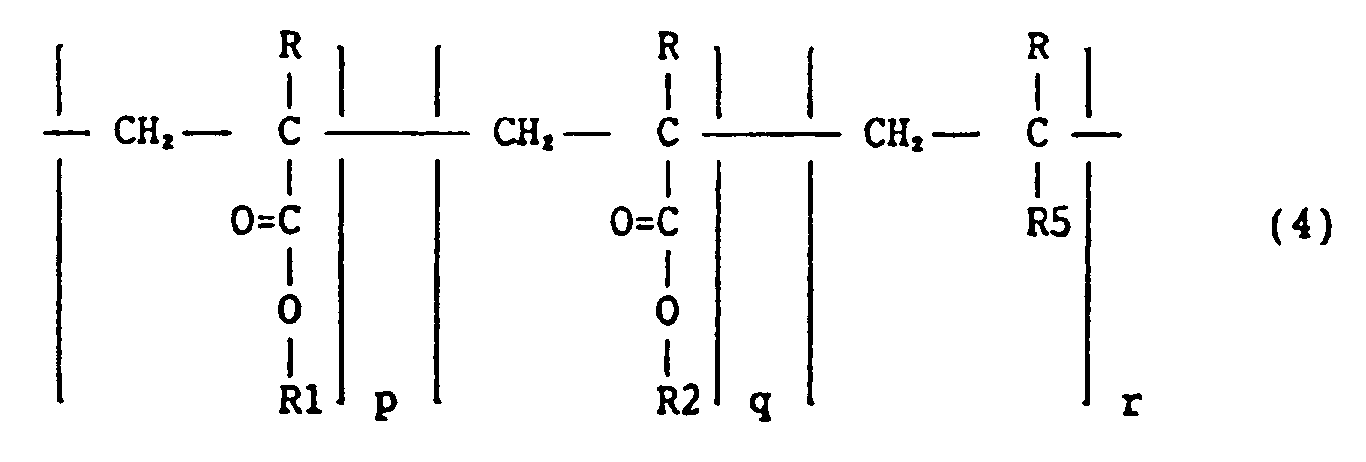
worin R ein Wasserstoffatom oder eine Methylgruppe darstellt, R1 eine langkettige Alkylgruppe mit 6 bis 22 Kohlenstoffatomen, eine cyclische Alkylgruppe mit 6 bis 22 Kohlenstoffatomen oder eine Gruppe darstellt, die durch die Formel: -(CxH2xO)l-(CyH2yO)m-R3 (worin R3 ein Wasserstoffatom, eine Alkylgruppe oder Arylgruppe darstellt, x und y jeweils eine ganze Zahl im Bereich von 1 bis 4 darstellen und l und m jeweils 0 oder eine ganze Zahl von nicht weniger als 1 darstellen, vorausgesetzt, daß die Summe von l und m eine ganze Zahl von nicht weniger als 2 ist) dargestellt ist, R2 eine (Meth)acryloylgruppen enthaltende Gruppe darstellt, und R5 eine funktionelle Gruppe mit einem Molekulargewicht von weniger als 133 darstellt, der Anteil der Untereinheit p im Bereich von 40 bis 99,5 Mol% liegt, der Anteil der Untereinheit q im Bereich von 60 bis 0,5 Mol% liegt, der Anteil der Untereinheit r im Bereich von 0 bis 59,5 Mol% liegt, und das Vinylpolymer ein gewichtsmittleres Molekulargewicht im Bereich von 2 × 10³ bis 10⁷ besitzt.
worin R ein Wasserstoffatom oder eine Methylgruppe darstellt, R1 eine langkettige Alkylgruppe mit 6 bis 22 Kohlenstoffatomen, eine cyclische Alkylgruppe mit 6 bis 22 Kohlenstoffatomen oder eine Gruppe darstellt, die durch die Formel: -(CxH2xO)l-(CyH2yO)m-R3 (worin R3 ein Wasserstoffatom, eine Alkylgruppe oder Arylgruppe darstellt, x und y jeweils eine ganze Zahl im Bereich von 1 bis 4 darstellen und l und m jeweils 0 oder eine ganze Zahl von nicht weniger als 1 darstellen, vorausgesetzt, daß die Summe von l und m eine ganze Zahl von nicht weniger als 2 ist) dargestellt ist, R2 eine (Meth)acryloylgruppen enthaltende Gruppe darstellt, und R5 eine funktionelle Gruppe mit einem Molekulargewicht von weniger als 133 darstellt, der Anteil der Untereinheit p im Bereich von 40 bis 99,5 Mol% liegt, der Anteil der Untereinheit q im Bereich von 60 bis 0,5 Mol% liegt, der Anteil der Untereinheit r im Bereich von 0 bis 59,5 Mol% liegt, und das Vinylpolymer ein gewichtsmittleres Molekulargewicht im Bereich von 2 × 10³ bis 10⁷ besitzt.
5. Vinyipoiymer mit (Meth)acryloylgruppen in den Seitenketten nach Anspruch 4, worin
in der allgemeinen Formel (4) der Substituent R2 eine (Meth)acryloylgruppen enthaltende
Gruppe ist, die durch die folgende, allgemeine Formel (2) dargestellt ist:

worin R ein Wasserstoffatom oder eine Methylgruppe darstellt, z eine ganze Zahl im Bereich von 2 bis 10 darstellt und n eine ganze Zahl im Bereich von 1 bis 4 ist, wenn z eine ganze Zahl im Bereich von 2 bis 3 ist, n 1 oder 2 ist, wenn z 4 ist, oder n 1 ist, wenn z eine ganze Zahl im Bereich von 5 bis 10 ist.
worin R ein Wasserstoffatom oder eine Methylgruppe darstellt, z eine ganze Zahl im Bereich von 2 bis 10 darstellt und n eine ganze Zahl im Bereich von 1 bis 4 ist, wenn z eine ganze Zahl im Bereich von 2 bis 3 ist, n 1 oder 2 ist, wenn z 4 ist, oder n 1 ist, wenn z eine ganze Zahl im Bereich von 5 bis 10 ist.
6. Vinylpolymer mit (Meth)acryloylgruppen in den Seitenketten nach Anspruch 4, worin
in der allgemeinen Formel (4) der Substituent R2 eine (Meth)acryloylgruppen enthaltende
Gruppe ist, die durch die folgende, allgemeine Formel (3) dargestellt ist:

worin R ein Wasserstoffatom oder eine Methylgruppe darstellt, R4 einen Esterrest eines mehrwertigen Alkohols mit 1 bis 12 Kohlenstoffatomen darstellt und a eine ganze Zahl im Bereich von 1 bis 10 darstellt.
worin R ein Wasserstoffatom oder eine Methylgruppe darstellt, R4 einen Esterrest eines mehrwertigen Alkohols mit 1 bis 12 Kohlenstoffatomen darstellt und a eine ganze Zahl im Bereich von 1 bis 10 darstellt.
7. Verfahren zur Herstellung eines Vinylpolymers, das (Meth)acryloylgruppen in den Seitenketten
trägt, das den Schritt eines radikalischen Copolymerisierens von 40 bis 99,5 Mol%
mindestens eines Mono(meth)acrylatmonomers, das durch die folgende, allgemeine Formel
(5) dargestellt ist:

worin R ein Wasserstoffatom oder eine Methylgruppe darstellt, R1 eine langkettige Alkylgruppe mit 6 bis 22 Kohlenstoffatomen, eine cyclische Alkylgruppe mit 6 bis 22 Kohlenstoffatomen oder eine Gruppe darstellt, die durch die Formel: -(CxH2xO)l-(CyH2yO)m-R3 (worin R3 ein Wasserstoffatom, eine Alkylgruppe oder eine Arylgruppe darstellt, x und y jeweils eine ganze Zahl im Bereich von 1 bis 4 darstellen und l und m jeweils 0 oder eine ganze Zahl von nicht weniger als 1 darstellen, vorausgesetzt, daß die Summe von l und m eine ganze Zahl von nicht weniger als 2 ist) dargestellt ist, das eine einzelne (Meth)acryloylgruppe und ein Molekulargewicht von nicht weniger als 160 besitzt, mit 60 bis 0,5 Mol% mindestens eines (Meth)acrylatmonomers, das durch die folgende, allgemeine Formel (6) dargestellt ist:

worin R ein Wasserstoffatom oder eine Methylgruppe darstellt und R2 eine (Meth)acryloylgruppen enthaltende Gruppe darstellt, das eine Vielzahl von (Meth)acryloylgruppen und ein Molekulargewicht von nicht mehr als 700 besitzt, in einem guten Lösungsmittel für das Mono(meth)acrylatmonomer, worin die Gesamtkonzentration der Monomere im Reaktionssystem auf ein Niveau von nicht mehr als 2 Mol/l begrenzt ist, umfaßt, um so ein Vinylpolymer zu ergeben, das (Meth)acryloylgruppen in den Seitenketten trägt und das durch die folgende, allgemeine Formel (1) dargestellt ist:
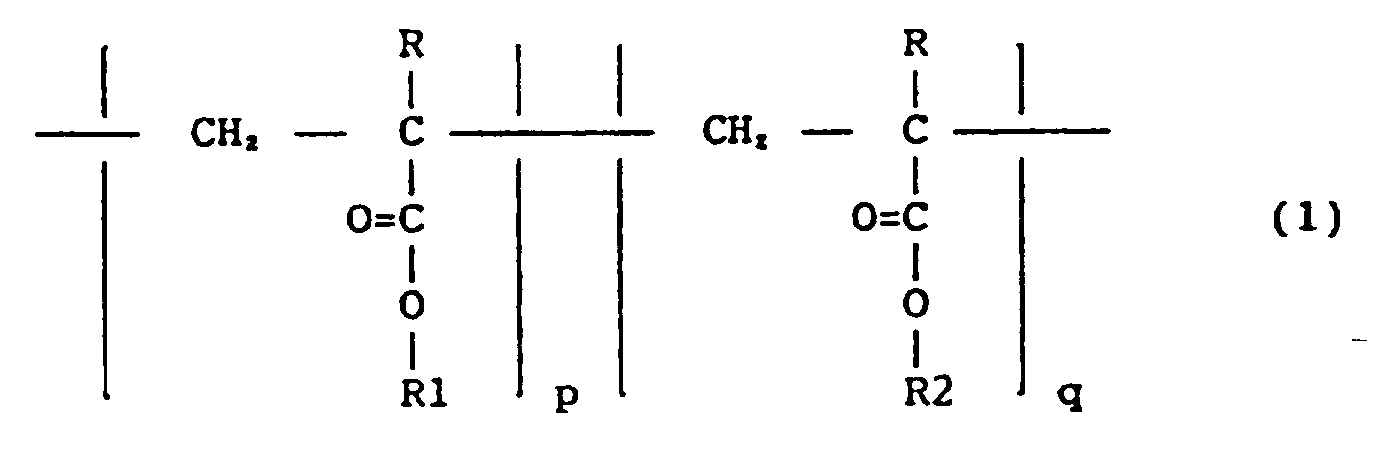
worin R ein Wasserstoffatom oder eine Methylgruppe darstellt, R1 eine langkettige Alkylgruppe mit 6 bis 22 Kohlenstoffatomen, eine cyclische Alkylgruppe mit 6 bis 22 Kohlenstoffatomen oder eine Gruppe darstellt, die durch die Formel: -(CxH2xO)l-(CyH2yO)m-R3 (worin R3 ein Wasserstoffatom, eine Alkylgruppe oder eine Arylgruppe darstellt, x und y jeweils eine ganze Zahl im Bereich von 1 bis 4 darstellen und l und m jeweils 0 oder eine ganze Zahl von nicht weniger als 1 darstellen, vorausgesetzt, daß die Summe von l und m eine ganze Zahl von nicht weniger als 2 ist) dargestellt ist, das eine einzelne (Meth)acryloylgruppe und ein Molekulargewicht von nicht weniger als 160 besitzt, mit 60 bis 0,5 Mol% mindestens eines (Meth)acrylatmonomers, das durch die folgende, allgemeine Formel (6) dargestellt ist:
worin R ein Wasserstoffatom oder eine Methylgruppe darstellt und R2 eine (Meth)acryloylgruppen enthaltende Gruppe darstellt, das eine Vielzahl von (Meth)acryloylgruppen und ein Molekulargewicht von nicht mehr als 700 besitzt, in einem guten Lösungsmittel für das Mono(meth)acrylatmonomer, worin die Gesamtkonzentration der Monomere im Reaktionssystem auf ein Niveau von nicht mehr als 2 Mol/l begrenzt ist, umfaßt, um so ein Vinylpolymer zu ergeben, das (Meth)acryloylgruppen in den Seitenketten trägt und das durch die folgende, allgemeine Formel (1) dargestellt ist:
8. Verfahren zur Herstellung eines Vinylpolymers, das (Meth)acryloylgruppen in den Seitenketten
trägt, nach Anspruch 7, worin das Monomer, das durch die allgemeine Formel (6) dargestellt
ist, mindestens ein Element ist, das aus der Gruppe ausgewählt ist, die aus Di(meth)acrylatmonomeren
der allgemeinen Formel (6), in der der Substituent R2 durch die allgemeine Formel
(2) dargestellt ist:

worin R ein Wasserstoffatom oder eine Methylgruppe darstellt, z eine ganze Zahl im Bereich von 2 bis 10 darstellt und n eine ganze Zahl im Bereich von 1 bis 4 ist, wenn z eine ganze Zahl im Bereich von 2 bis 3 ist, n 1 oder 2 ist, wenn z 4 ist, oder n 1 ist, wenn z eine ganze Zahl im Bereich von 5 bis 10 ist, und Poly(meth)acrylatmonomeren der allgemeinen Formel (6), in der der Substituent R2 durch die folgende, allgemeine Formel (3) dargestellt ist:
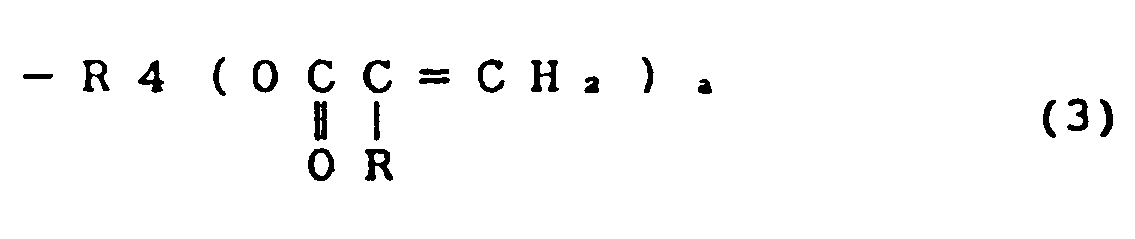
worin R ein Wasserstoffatom oder eine Methylgruppe darstellt, R4 einen Esterrest eines mehrwertigen Alkohols mit 1 bis 12 Kohlenstoffatomen darstellt und a eine ganze Zahl im Bereich von 1 bis 10 darstellt, besteht.
worin R ein Wasserstoffatom oder eine Methylgruppe darstellt, z eine ganze Zahl im Bereich von 2 bis 10 darstellt und n eine ganze Zahl im Bereich von 1 bis 4 ist, wenn z eine ganze Zahl im Bereich von 2 bis 3 ist, n 1 oder 2 ist, wenn z 4 ist, oder n 1 ist, wenn z eine ganze Zahl im Bereich von 5 bis 10 ist, und Poly(meth)acrylatmonomeren der allgemeinen Formel (6), in der der Substituent R2 durch die folgende, allgemeine Formel (3) dargestellt ist:
worin R ein Wasserstoffatom oder eine Methylgruppe darstellt, R4 einen Esterrest eines mehrwertigen Alkohols mit 1 bis 12 Kohlenstoffatomen darstellt und a eine ganze Zahl im Bereich von 1 bis 10 darstellt, besteht.
9. Verfahren zum Herstellen eines Vinylpolvmers, das (Meth)acryloylgruppen in den Seitenketten
trägt, nach Anspruch 7, worin das Monomer, das durch die allgemeine Formel (5) dargestellt
ist, in der R1 eine langkettige Alkylgruppe mit 6 bis 22 Kohlenstoffatomen ist, mindestens
ein Element ist, das aus der Gruppe ausgewählt ist, die aus Hexyl(meth)acrylat, Heptyl(meth)acrylat,
Octyl(meth)acrylat, Nonyl(meth)acrylat, Decyl(meth)acrylat, Undecyl(meth)acrylat,
Dodecyl(meth)acrylat, Tridecyl(meth)acrylat, Tetradecyl(meth)acrylat, Hexadecyl(meth)acrylat,
Heptadecyl(meth)acrylat, Octadecyl(meth)acrylat, Nonadecyl(meth)acrylat, Eicosa(meth)acrylat,
Uneicosa(meth)acrylat, Doeicosa(meth)acrylat und ihren Isomeren, wie zum Beispiel
2-Ethylhexyl(meth)acrylat und Isononyl(meth)acrylat, besteht.
10. Verfahren zur Herstellung eines Vinylpolymers, das (Meth)acryloylgruppen in den Seitenketten
trägt, nach Anspruch 7, worin das Monomer, das durch die allgemeine Formel (5) dargestellt
ist, in der R1 eine cyclische Alkylgruppe mit 6 bis 22 Kohlenstoffatomen ist, mindestens
ein Element ist, das aus der Gruppe ausgewählt ist, die aus Isobornyl(meth)acrylat,
Tricyclcodecanyl(meth)acrylat und Dimethyladamantyl(meth)acrylat und ihren Isomeren
besteht.
11. Verfahren zur Herstellung eines Vinylpolymers, das (Meth)acryloylgruppen in den Seitenketten
trägt, nach Anspruch 7, worin das Monomer, das durch die allgemeine Formel (5) dargestellt
ist, in der R1 eine Gruppe ist, die durch die Formel -(CxH2xO)l-(CyH2yO)m-R3 dargestellt ist, mindestens ein Element ist, das aus der Gruppe ausgewählt ist,
die aus Methoxydiethylenglycol(meth)acrylat, Ethoxydiethylenglycol(meth)acrylat, Isooctyloxydiethylenglycol(meth)acrylat,
Phenoxydiethylenglycol(meth)acrylat, Phenoxytriethylenglycol(meth)acrylat, Methoxytriethylenglycol(meth)acrylat,
Methoxypolyethylenglycol(meth)acrylat, Nonylphenyltetraethylenglycol(meth)acrylat,
Nonylphenyloctadecylethylenglycol(meth)acrylat, Methoxydipropylenglycol(meth)acrylat,
einem (Meth)acrylat eines statistischen Additionsproduktes aus Ethylenoxid und Propylenoxid
in einem molaren Verhältnis von 11:15, dessen eines Ende mit einer Stearyloxygruppe
modifiziert ist, und Polytetramethylenglycolmono(meth)acrylat, sowie deren Isomeren
besteht.
12. Verfahren zur Herstellung eines Vinylpolymers, das (Meth)acryloylgruppen in den Seitenketten
trägt, nach Anspruch 7, worin das Lösungsmittel ein Element ist, das aus der Gruppe
ausgewählt ist, die aus Benzol, Toluol, Xylol, Hexan, Cyclohexan und Heptan besteht,
für das Monomere, dessen Substituent R1 in der allgemeinen Formel (5) eine langkettige
AIkylgruppe mit 6 bis 22 Kohlenstoffatomen oder eine cyclische Alkylgruppe mit 6 bis
22 Kohlenstoffatomen ist, oder ein Element ist, das aus der Gruppe ausgewählt ist,
die aus Benzol, Toluol, Xylol, Hexan, Cyclohexan, Heptan, Alkoholen, wie zum Beispiel
Methanol und Ethanol, Ketonen, wie zum Beispiel Aceton und Methylethylketon, Estern,
zum Beispiel, Ethylacetat und Butylacetat, Ethern, wie zum Beispiel Dioxan, und einem
Lösungsmittel aus einem Ethylenglvcolderivat, wie zum Beispiel Ethylenglycolmonobutylether,
besteht, für das Monomer, dessen Substituent R1 der allgemeinen Formel (5) eine Gruppe
ist, die durch die allgemeine Formel
-(CxH2xO)l-(CyH2yO)m-R3 dargestellt ist.
-(CxH2xO)l-(CyH2yO)m-R3 dargestellt ist.
13. Verfahren zur Herstellung eines Vinylpolymers, das (Meth)acryloylgruppen in den Seitenketten
trägt, nach Anspruch 7, worin die Reaktionstemperatur während der radikalischen Copolymerisation
im Bereich von ungefähr 40 bis 130°C liegt, mindestens ein Polymerisationsinitiator,
der aus der Gruppe ausgewählt ist, die aus Azoverbindungen, wie zum Beispiel 2,2'-Azobisisobutyronitril,
und Peroxidverbindungen, wie zum Beispiel Lauroylperoxid und Benzoylperoxid, besteht,
verwendet wird und ein Kettenübertragungsmittel, das aus der Gruppe ausgewählt ist,
die aus Laurylmercaptan und Mercaptopropionsäure besteht, gegebenenfalls verwendet
wird.
14. Verfahren zur Herstellung eines Vinylpolymers, das (Meth)acryloylgruppen in den Seitenketten
trägt, nach Anspruch 7, worin nach der radikalischen Copolymerisation ein Stabilisator
gegen Polymerisation durch Wärme, der aus der Gruppe ausgewählt ist, die aus p-Methoxyphenol,
Hydrochinon und Butylhydroxytoluol besteht, zum Reaktionsprodukt gegeben wird.
15. Verfahren zur Herstellung eines Vinylpolymers, das (Meth)acryloylgruppen in den Seitenketten
trägt, nach Anspruch 8, worin das Monomer, das durch die allgemeine Formel (6) dargestellt
ist, in der R2 durch die allgemeine Formel (2) dargestellt ist, mindestens ein Element
ist, das aus der Gruppe ausgewählt ist, die aus Ethylenglycoldi(meth)acrylat, Diethylenglycoldi(meth)acrylat,
Triethylenglycoldi(meth)acrylat, Tetraethylenglycoldi(meth)acrylat, Propylenglycoldi(meth)acrylat,
Tetrapropylenglycoldi(meth)acrylat, 1,4-Butandioldi(meth)acrylat, Ditetraethylenglycoldi(meth)acrylat,
1,5-Pentandioldi(meth)acrylat, 1,6-Hexandioldi(meth)acrylat, 3-Methyl-1,5-pentandioldi(meth)acrylat,
1,9-Nonandioldi(meth)acrylat, 1,10-Decandioldi(meth)acrylat und deren Isomeren besteht.
16. Verfahren zur Herstellung eines Vinylpolymers, das (Meth)acryloylgruppen in den Seitenketten
trägt, nach Anspruch 8, worin das Monomer, das durch die allgemeine Formel (6) dargestellt
ist, in der R2 durch die allgemeine Formel (3) dargestellt ist, mindestens ein Element
ist, das aus der Gruppe ausgewählt ist, die aus Trimethylolpropantri(meth)acrylat,
Pentaerythritoltri(meth)acrylat, Pentaerythritoltetra(meth)acrylat, Dipentaerythritolhexa(meth)acrylat,
Trimethylolheptanetri(meth)acrylat und deren Isomeren besteht.
17. Verfahren zur Herstellung eines Vinylpolymers, das (Meth)acryloylgruppen in den Seitenketten
trägt, das den Schritt eines radikalischen Copolymerisierens von 40 bis 99,5 Mol%
von mindestens einem Mono(meth)acrylatmonomer, das durch die folgende, allgemeine
Formel (5) dargestellt ist:

worin R ein Wasserstoffatom oder eine Methylgruppe darstellt, R1 eine langkettige Alkylgruppe mit 6 bis 22 Kohlenstoffatomen, eine cyclische Alkylgruppe mit 6 bis 22 Kohlenstoffatomen oder eine Gruppe darstellt, die durch die Formel -(CxH2xO)l-(CyH2yO)m-R3 (worin R3 ein Wasserstoffatom, eine Alkylgruppe oder eine Arylgruppe darstellt, x und y jeweils eine ganze Zahl im Bereich von 1 bis 4 darstellen und l und m jeweils 0 oder eine ganze Zahl von nicht weniger als 1 darstellen, vorausgesetzt, daß die Summe von l und m eine ganze Zahl von nicht weniger als 2 ist) dargestellt ist, das eine einzelne (Meth)acryloylgruppe und ein Molekulargewicht von nicht weniger als 160 besitzt, 60 bis 0,5 Mol% von mindestens einem (Meth)acrylatmonomer, das durch die folgende, allgemeine Formel (6) dargestellt ist:

worin R ein Wasserstoffatom oder eine Methylgruppe darstellt und R2 eine (Meth)acryloylgruppen enthaltende Gruppe darstellt, das eine Vielzahl von (Meth)acryloylgruppen und ein Molekulargewicht von nicht mehr als 700 besitzt, und 0 bis 59,5 Mol% von mindestens einer Vinylverbindung oder Vinylidenverbindung, die durch die folgende, allgemeine Formel (7) dargestellt ist:

worin R ein Wasserstoffatom oder eine Methylgruppe darstellt und R5 eine funktionelle Gruppe mit einem Molekulargewicht von weniger als 133 darstellt, das ein Molekulargewicht von nicht mehr als 160 besitzt, in einem guten Lösungsmittel für das Mono(meth)acrylatmonomer, worin die Gesamtkonzentration der Monomere im Reaktionssystem auf ein Niveau von nicht-mehr als 2 Mol/l begrenzt ist, um so ein Vinylpolymer zu ergeben, das (Meth)acryloylgruppen in den Seitenketten trägt und das durch die folgende, allgemeine Formel (4) dargestellt ist:
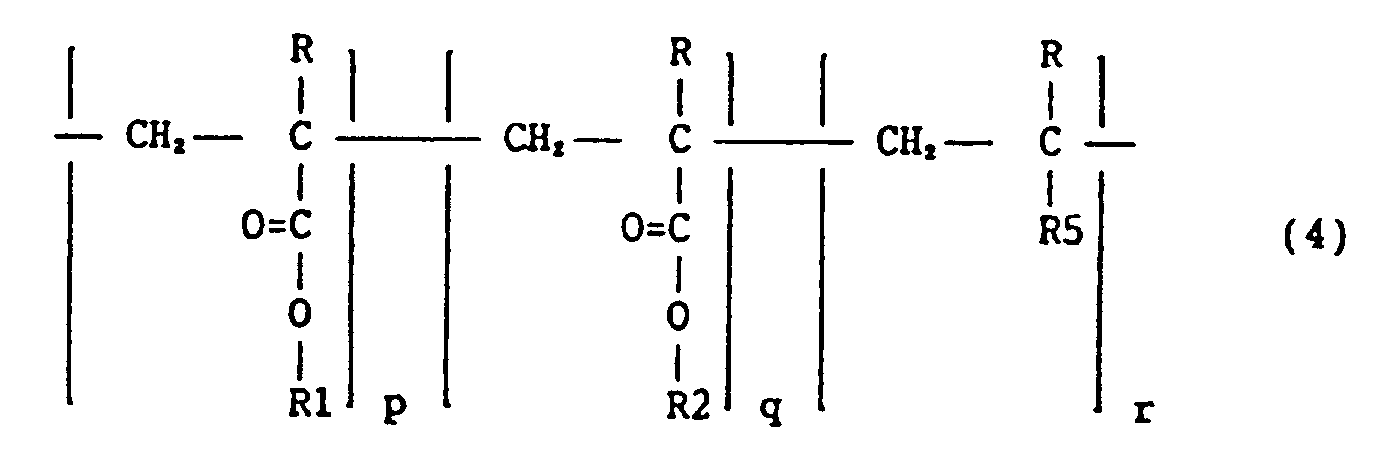
worin R ein Wasserstoffatom oder eine Methylgruppe darstellt, R1 eine langkettige Alkylgruppe mit 6 bis 22 Kohlenstoffatomen, eine cyclische Alkylgruppe mit 6 bis 22 Kohlenstoffatomen oder eine Gruppe darstellt, die durch die Formel -(CxH2xO)l-(CyH2yO)m-R3 (worin R3 ein Wasserstoffatom, eine Alkylgruppe oder eine Arylgruppe darstellt, x und y jeweils eine ganze Zahl im Bereich von 1 bis 4 darstellen und l und m jeweils 0 oder eine ganze Zahl von nicht weniger als 1 darstellen, vorausgesetzt, daß die Summe von l und m eine ganze Zahl von nicht weniger als 2 ist) dargestellt ist, das eine einzelne (Meth)acryloylgruppe und ein Molekulargewicht von nicht weniger als 160 besitzt, 60 bis 0,5 Mol% von mindestens einem (Meth)acrylatmonomer, das durch die folgende, allgemeine Formel (6) dargestellt ist:
worin R ein Wasserstoffatom oder eine Methylgruppe darstellt und R2 eine (Meth)acryloylgruppen enthaltende Gruppe darstellt, das eine Vielzahl von (Meth)acryloylgruppen und ein Molekulargewicht von nicht mehr als 700 besitzt, und 0 bis 59,5 Mol% von mindestens einer Vinylverbindung oder Vinylidenverbindung, die durch die folgende, allgemeine Formel (7) dargestellt ist:
worin R ein Wasserstoffatom oder eine Methylgruppe darstellt und R5 eine funktionelle Gruppe mit einem Molekulargewicht von weniger als 133 darstellt, das ein Molekulargewicht von nicht mehr als 160 besitzt, in einem guten Lösungsmittel für das Mono(meth)acrylatmonomer, worin die Gesamtkonzentration der Monomere im Reaktionssystem auf ein Niveau von nicht-mehr als 2 Mol/l begrenzt ist, um so ein Vinylpolymer zu ergeben, das (Meth)acryloylgruppen in den Seitenketten trägt und das durch die folgende, allgemeine Formel (4) dargestellt ist:
18. Verfahren zur Herstellung eines Vinylpolymers, das (Meth)acryloylgruppen in den Seitenketten
trägt, nach Anspruch 17, worin das Monomer, das durch die allgemeine Formel (6) dargestellt
ist, mindestens ein Element ist, das aus der Gruppe ausgewählt ist, die aus Di(meth)acrylatmonomeren
der allgemeinen Formel (6), in der der Substituent R2 durch die allgemeine Formel
(2) dargestellt ist:

worin R ein Wasserstoffatom oder eine Methylgruppe darstellt, z eine ganze Zahl im Bereich von 2 bis 10 darstellt und n eine ganze Zahl im Bereich von 1 bis 4 ist, wenn z eine ganze Zahl im Bereich von 2 bis 3 ist, n 1 oder 2 ist, wenn z 4 ist, oder n 1 ist, wenn z eine ganze Zahl im Bereich von 5 bis 10 ist, und Poly(meth)acrylatmonomeren der allgemeinen Formel (6), in der der Substituent R2 durch die folgende, allgemeine Formel (3) dargestellt ist:

worin R ein Wasserstoffatom oder eine Methylgruppe darstellt, R4 einen Esterrest eines mehrwertigen Alkohols mit 1 bis 12 Kohlenstoffatomen darstellt und a eine ganze Zahl im Bereich von 1 bis 10 darstellt, besteht.
worin R ein Wasserstoffatom oder eine Methylgruppe darstellt, z eine ganze Zahl im Bereich von 2 bis 10 darstellt und n eine ganze Zahl im Bereich von 1 bis 4 ist, wenn z eine ganze Zahl im Bereich von 2 bis 3 ist, n 1 oder 2 ist, wenn z 4 ist, oder n 1 ist, wenn z eine ganze Zahl im Bereich von 5 bis 10 ist, und Poly(meth)acrylatmonomeren der allgemeinen Formel (6), in der der Substituent R2 durch die folgende, allgemeine Formel (3) dargestellt ist:
worin R ein Wasserstoffatom oder eine Methylgruppe darstellt, R4 einen Esterrest eines mehrwertigen Alkohols mit 1 bis 12 Kohlenstoffatomen darstellt und a eine ganze Zahl im Bereich von 1 bis 10 darstellt, besteht.
19. Verfahren zur Herstellung eines Vinylpolymers, das (Meth)acryloylgruppen in den Seitenketten
trägt, nach Anspruch 17, worin das Monomer, das durch die allgemeine Formel (5) dargestellt
ist, in der R1 eine langkettige Alkylgruppe mit 6 bis 22 Kohlenstoffatomen ist, mindestens
ein Element ist, das aus der Gruppe ausgewählt ist, die aus Hexyl(meth)acrylat, Heptyl(meth)acrylat,
Octyl(meth)acrylat, Nonyl(meth)acrylat, Decyl(meth)acrylat, Undecyl(meth)acrylat,
Dodecyl(meth)acrylat, Tridecyl(meth)acrylat, Tetradecyl(meth)acrylat, Hexadecyl(meth)acrylat,
Heptadecyl(meth)acrylat, Octadecyl(meth)acrylat, Nonadecyl(meth)acrylat, Eicosa(meth)acrylat,
Uneicosa(meth)acrylat, Doeicosa(meth)acrylat und ihren Isomeren, wie zum Beispiel
2-Ethylhexyl(meth)acrylat und Isononyl(meth)acrylat, besteht.
20. Verfahren zur Herstellung eines Vinylpolymers, das (Meth)acryloylgruppen in den Seitenketten
trägt, nach Anspruch 17, worin das Monomer, das durch die allgemeine Formel (5) dargestellt
ist, in der R1 eine cyclische Alkylgruppe mit 6 bis 22 Kohlenstoffatomen ist, mindestens
ein Element ist, das aus der Gruppe ausgewählt ist, die aus Isobornyl(meth)acrylat,
Tricyclcodekanyl(meth)acrylat und Dimethyladamantyl(meth)acrylat und ihren Isomeren
besteht.
21. Verfahren zur Herstellung eines Vinylpolymers, das (Meth)acryloylgruppen in den Seitenketten
trägt, nach Anspruch 17, worin das Monomer, das durch die allgemeine Formel (5) dargestellt
ist, in der R1 eine Gruppe ist, die durch die Formel -(CxH2xO)l-(CyH2yO)m-R3 dargestellt ist, mindestens ein Element ist, das aus der Gruppe ausgewählt ist,
die aus Methoxydiethylenglycol(meth)acrylat, Ethoxydiethylenglycol(meth)acrylat, Isooctyloxydiethylenglycol(meth)acrylat,
Phenoxydiethylenglycol(meth)acrylat, Phenoxytriethylenglycol(meth)acrylat, Methoxytriethylenglycol(meth)acrylat,
Methoxypolyethylenglycol(meth)acrylat, Nonylphenyltetraethylenglycol(meth)acrylat,
Nonylphenyloctadecylethylenglycol(meth)acrylat, Methoxydipropylenglycol(meth)acrylat,
einem (Meth)acrylat eines statistischen Additionsproduktes aus Ethylenoxid und Propylenoxid
in einem molaren Verhältnis von 11:15, dessen eines Ende mit einer Stearyloxygruppe
modifiziert ist, und Polytetramethylenglycolmono(meth)acrylat, sowie deren Isomeren
besteht.
22. Verfahren zur Herstellung eines Vinylpolymers, das (Meth)acryloylgruppen in den Seitenketten
trägt, nach Anspruch 17, worin das Monomer, das durch die allgemeine Formel (7) dargestellt
ist, mindestens ein Element ist, das aus der Gruppe ausgewählt ist, die aus Styrol,
Vinylmonomeren, wie zum Beispiel Vinylacetat, (Meth)acrylsäure, Methyl(meth)acrylat,
Ethyl(meth)acrylat, Propyl(meth)acrylat, Butyl(meth)acrylat, Pentyl(meth)acrylat,
Hexylacrylat, Glycidyl(meth)acrylat, Isocyanatoethyl(meth)acrylat und deren Isomeren
besteht.
23. Verfahren zur Herstellung eines Vinylpolymers, das (Meth)acryloylgruppen in den Seitenketten
trägt, nach Anspruch 17, worin das Lösungsmittel ein Element ist, das aus der Gruppe
ausgewählt ist, die aus Benzol, Toluol, Xylol, Hexan, Cyclohexan und Heptan besteht,
für das Monomere, dessen Substituent R1 in der allgemeinen Formel (5) eine langkettige
Alkylgruppe mit 6 bis 22 Kohlenstoffatomen oder eine cyclische Alkylgruppe mit 6 bis
22 Kohlenstoffatomen ist; oder ein Element ist, das aus der Gruppe ausgewählt ist,
die aus Benzol, Toluol, Xylol, Hexan, Cyclohexan, Heptan, Alkoholen, wie zum Beispiel
Methanol und Ethanol, Ketonen, wie zum Beispiel Aceton und Methylethylketon, Estern,
wie zum Beispiel Ethylacetat und Butylacetat, Ethern, wie zum Beispiel Dioxan, und
einem Lösungsmittel aus einem Ethylenglycolderivat, wie zum Beispiel Ethylenglycolmonobutylether,
besteht, für das Monomer, dessen Substituent R1 der allgemeinen Formel (5) eine Gruppe
ist, die durch die allgemeine Formel
-(CxH2xO)l-(CyH2yO)m-R3 dargestellt ist.
-(CxH2xO)l-(CyH2yO)m-R3 dargestellt ist.
24. Verfahren zur Herstellung eines Vinylpolymers, das (Meth)acryloylgruppen in den Seitenketten
trägt, nach Anspruch 17, worin die Reaktionstemperatur während der radikalischen Copolymerisation
im Bereich von ungefähr 40 bis 130°C liegt, mindestens ein Polymerisationsinitiator,
der aus der Gruppe ausgewählt ist, die aus Azoverbindungen, wie zum Beispiel 2,2'-Azobisisobutyronitril,
und Peroxidverbindungen, wie zum Beispiel Lauroylperoxid und Benzoylperoxid besteht,
verwendet wird und ein Kettenübertragungsmittel, das aus der Gruppe ausgewählt ist,
die aus Laurylmercaptan und Mercaptopropionsäure besteht, gegebenenfalls verwendet
wird.
25. Verfahren zur Herstellung eines Vinylpolymers, das (Meth)acryloylgruppen in den Seitenketten
trägt, nach Anspruch 17, worin nach der radikalischen Copolymerisation ein Stabilisator
gegen Polymerisation durch Wärme, der aus der Gruppe ausgewählt ist, die aus p-Methoxyphenol,
Hydrochinon und Butylhydroxytoluol besteht, zum Reaktionsprodukt gegeben wird.
26. Verfahren zur Herstellung eines Vinylpolymers, das (Meth)acryloylgruppen in den Seitenketten
trägt, nach Anspruch 18, worin das Monomer, das durch die allgemeine Formel (6) dargestellt
ist, in der R2 durch die allgemeine Formel (2) dargestellt ist, mindestens ein Element
ist, das aus der Gruppe ausgewählt ist, die aus Ethylenglycoldi(meth)acrylat, Diethylenglycoldi(meth)acrylat,
Triethylenglycoldi(meth)acrylat, Tetraethylenglycoldi(meth)acrylat, Propylenglycoldi(meth)acrylat,
Tetrapropylenglycoldi(meth)acrylat, 1,4-Butandioldi(meth)acrylat, Ditetraethylenglycoldi(meth)acrylat,
1,5-Pentandioldi(meth)acrylat, 1,6-Hexandioldi(meth)acrylat, 3-Methyl-1,5-pentandioldi(meth)acrylat,
1,9-Nonandioldi(meth)acrylat, 1,10-Decandioldi(meth)acrylat und deren Isomeren besteht.
27. Verfahren zur Herstellung eines Vinylpolymers, das (Meth)acryloylgruppen in den Seitenketten
trägt, nach Anspruch 18, worin das Monomer, das durch die allgemeine Formel (6) dargestellt
ist, in der R2 durch die allgemeine Formel (2) dargestellt ist, mindestens ein Element
ist, das aus der Gruppe ausgewählt ist, die aus Trimethylolpropantri(meth)acrylat,
Pentaerythritoltri(meth)acrylat, Pentaerythritoltetra(meth)acrylat, Dipentaerythritolhexa(meth)acrylat,
Trimethylolheptanetri(meth)acrylat und deren Isomeren besteht.
1. Polymère vinylique possédant des groupes (méth)acryloyle sur les chaînes latérales,
comprenant des motifs récurrents représentés par la formule générale (1) suivante:
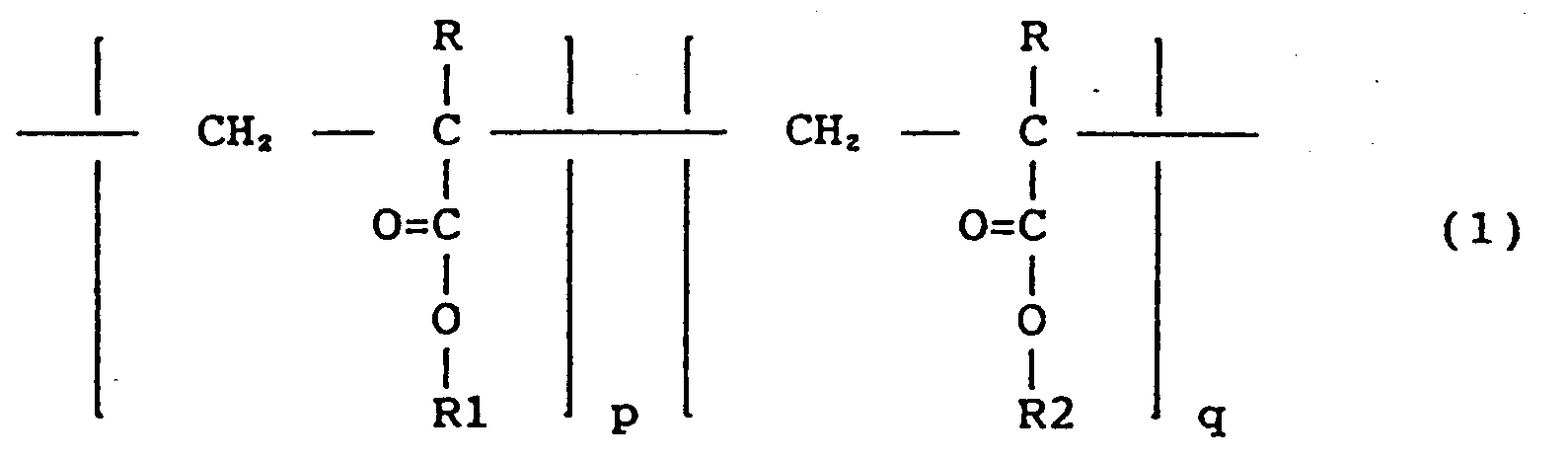
dans laquelle R représente un atome d'hydrogène ou un groupe méthyle; R₁ représente un groupe alkyle à chaîne longue comportant 6 à 22 atomes de carbone, un groupe alkyle cyclique comportant 6 à 22 atomes de carbone ou un groupe représenté par la formule suivante: -(CxH2xO)l-(CyH2yO)m-R₃ (dans laquelle R₃ représente un atome d'hydrogène, un groupe alkyle ou un groupe aryle); x et y représentent chacun un nombre entier s'échelonnant de 1 à 4; l et m représentent chacun 0 ou un nombre entier non inférieur à 1, à condition que la somme l + m soit un nombre entier non inférieur à 2; et R₂ représente un groupe contenant un groupe (méth)acryloyle, la proportion du sous-motif p s'échelonnant de 40 à 99,5% en moles, la proportion du sous-motif q s'échelonnant de 60 à 0,5% en moles, et le polymère vinylique ayant une masse moléculaire moyenne en poids s'échelonnant de 2 x 10³ à 10⁷.
dans laquelle R représente un atome d'hydrogène ou un groupe méthyle; R₁ représente un groupe alkyle à chaîne longue comportant 6 à 22 atomes de carbone, un groupe alkyle cyclique comportant 6 à 22 atomes de carbone ou un groupe représenté par la formule suivante: -(CxH2xO)l-(CyH2yO)m-R₃ (dans laquelle R₃ représente un atome d'hydrogène, un groupe alkyle ou un groupe aryle); x et y représentent chacun un nombre entier s'échelonnant de 1 à 4; l et m représentent chacun 0 ou un nombre entier non inférieur à 1, à condition que la somme l + m soit un nombre entier non inférieur à 2; et R₂ représente un groupe contenant un groupe (méth)acryloyle, la proportion du sous-motif p s'échelonnant de 40 à 99,5% en moles, la proportion du sous-motif q s'échelonnant de 60 à 0,5% en moles, et le polymère vinylique ayant une masse moléculaire moyenne en poids s'échelonnant de 2 x 10³ à 10⁷.
2. Polymère vinylique possédant des groupes (méth)acryloyle sur les chaînes latérales
selon la revendication 1, dans lequel, dans la formule générale (1), R₂ est un groupe
contenant un groupe (méth)acryloyle, représenté par la formule générale (2) suivante:

dans laquelle R représente un atome d'hydrogène ou un groupe méthyle; z représente un nombre entier s'échelonnant de 2 à 10; et n est un nombre entier s'échelonnant de 1 à 4 lorsque z est un nombre entier s'échelonnant de 2 à 3, n est égal à 1 ou 2 lorsque z est égal à 4, ou n est égal à 1 lorsque z est un nombre entier s'échelonnant de 5 à 10.
dans laquelle R représente un atome d'hydrogène ou un groupe méthyle; z représente un nombre entier s'échelonnant de 2 à 10; et n est un nombre entier s'échelonnant de 1 à 4 lorsque z est un nombre entier s'échelonnant de 2 à 3, n est égal à 1 ou 2 lorsque z est égal à 4, ou n est égal à 1 lorsque z est un nombre entier s'échelonnant de 5 à 10.
3. Polymère vinylique possédant des groupes (méth)acryloyle sur les chaînes latérales
selon la revendication 1, dans lequel, dans la formule générale (1), le substituant
R₂ est un groupe contenant un groupe (méth)acryloyle, représenté par la formule générale
(3) suivante:

dans laquelle R représente un atome d'hydrogène ou un groupe méthyle; R₄ représente un résidu ester d'un polyol comportant 1 à 12 atomes de carbone; et a représente un nombre entier s'échelonnant de 1 à 10.
dans laquelle R représente un atome d'hydrogène ou un groupe méthyle; R₄ représente un résidu ester d'un polyol comportant 1 à 12 atomes de carbone; et a représente un nombre entier s'échelonnant de 1 à 10.
4. Polymère vinylique portant des groupes (méth)acryloyle sur les chaînes latérales,
comprenant des motifs récurrents représentés par la formule générale (4) suivante:
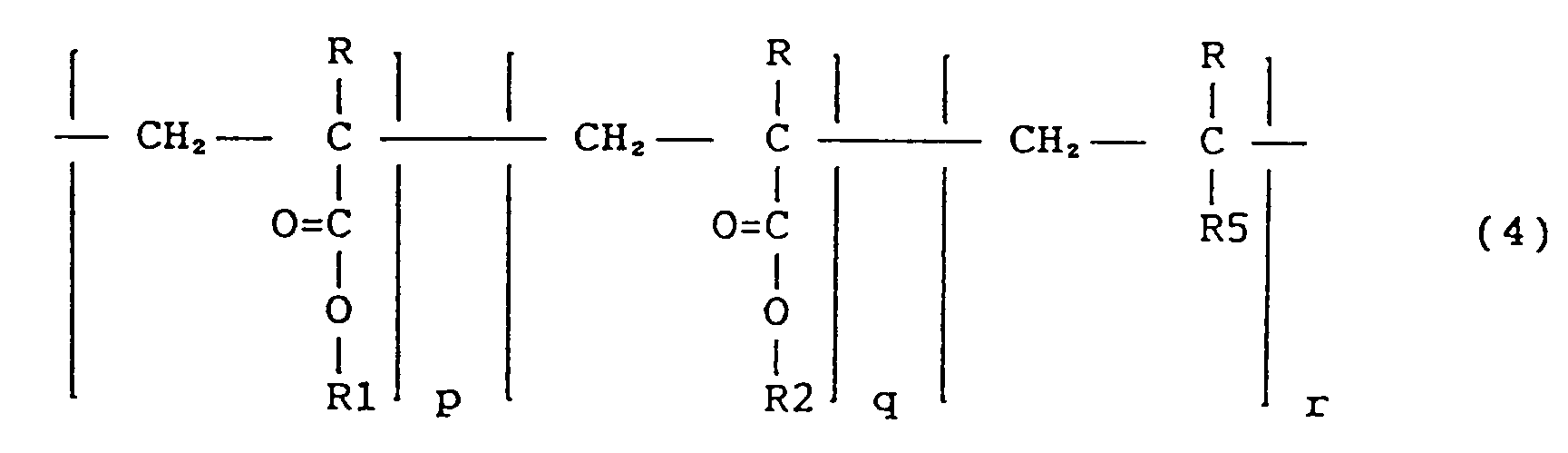
dans laquelle R représente un atome d'hydrogène ou un groupe méthyle; R₁ représente un groupe alkyle à chaîne longue comportant 6 à 22 atomes de carbone, un groupe alkyle cyclique comportant 6 à 22 atomes de carbone ou un groupe représenté par la formule: -(CxH2xO)l-(CyH2yO)m-R₃ (dans laquelle R₃ représente un atome d'hydrogène, un groupe alkyle ou un groupe aryle); x et y représentent chacun un nombre entier s'échelonnant de 1 à 4; l et m représentent chacun 0 ou un nombre entier non inférieur à 1, à condition que la somme l + m soit un nombre entier non inférieur à 2; R₂ représente un groupe contenant un groupe (méth)acryloyle; et R₅ représente un groupe fonctionnel ayant une masse moléculaire inférieure à 133, la proportion du sous-motif p s'échelonnant de 40 à 99,5% en moles, la proportion du sous-motif q s'échelonnant de 60 à 0,5% en moles, la proportion du sous-motif r s'échelonnant de 0 à 59,5% en moles, et le polymère vinylique ayant une masse moléculaire moyenne en poids s'échelonnant de 2 x 10³ à 10⁷.
dans laquelle R représente un atome d'hydrogène ou un groupe méthyle; R₁ représente un groupe alkyle à chaîne longue comportant 6 à 22 atomes de carbone, un groupe alkyle cyclique comportant 6 à 22 atomes de carbone ou un groupe représenté par la formule: -(CxH2xO)l-(CyH2yO)m-R₃ (dans laquelle R₃ représente un atome d'hydrogène, un groupe alkyle ou un groupe aryle); x et y représentent chacun un nombre entier s'échelonnant de 1 à 4; l et m représentent chacun 0 ou un nombre entier non inférieur à 1, à condition que la somme l + m soit un nombre entier non inférieur à 2; R₂ représente un groupe contenant un groupe (méth)acryloyle; et R₅ représente un groupe fonctionnel ayant une masse moléculaire inférieure à 133, la proportion du sous-motif p s'échelonnant de 40 à 99,5% en moles, la proportion du sous-motif q s'échelonnant de 60 à 0,5% en moles, la proportion du sous-motif r s'échelonnant de 0 à 59,5% en moles, et le polymère vinylique ayant une masse moléculaire moyenne en poids s'échelonnant de 2 x 10³ à 10⁷.
5. Polymère vinylique possédant des groupes (méth)acryloyle sur les chaînes latérales
selon la revendication 4, dans lequel, dans la formule générale (4), le substituant
R₂ est un groupe contenant un groupe (méth)acryloyle représenté par la formule générale
(2) suivante:

dans laquelle R représente un atome d'hydrogène ou un groupe méthyle; z représente un nombre entier s'échelonnant de 2 à 10; et n est un nombre entier s'échelonnant de 1 à 4 lorsque z est un nombre entier s'échelonnant de 2 à 3, n est égal à 1 ou 2 lorsque z est égal à 4, ou n est égal à 1 lorsque z est un nombre entier s'échelonnant de 5 à 10.
dans laquelle R représente un atome d'hydrogène ou un groupe méthyle; z représente un nombre entier s'échelonnant de 2 à 10; et n est un nombre entier s'échelonnant de 1 à 4 lorsque z est un nombre entier s'échelonnant de 2 à 3, n est égal à 1 ou 2 lorsque z est égal à 4, ou n est égal à 1 lorsque z est un nombre entier s'échelonnant de 5 à 10.
6. Polymère vinylique possédant des groupes (méth)acryloyle sur les chaînes latérales
selon la revendication 4, dans lequel, dans la formule générale (4), le substituant
R₂ est un groupe contenant un groupe (méth)acryloyle, représenté par la formule générale
(3) suivante:
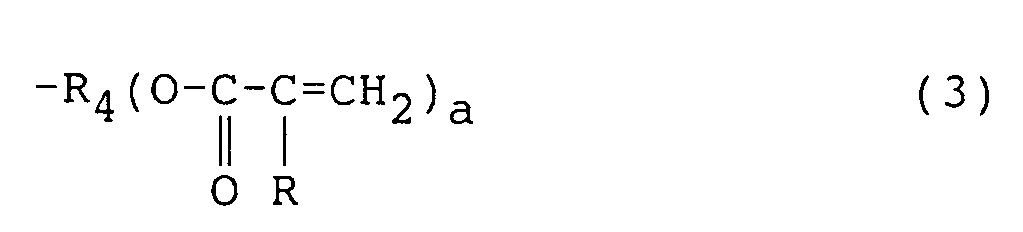
dans laquelle R représente un atome d'hydrogène ou un groupe méthyle; R₄ représente un résidu ester d'un polyol comportant 1 à 12 atomes de carbone; et a représente un nombre entier s'échelonnant de 1 à 10.
dans laquelle R représente un atome d'hydrogène ou un groupe méthyle; R₄ représente un résidu ester d'un polyol comportant 1 à 12 atomes de carbone; et a représente un nombre entier s'échelonnant de 1 à 10.
7. Procédé de préparation d'un polymère vinylique portant des groupes (méth)acryloyle
sur les chaînes latérales, comprenant l'étape de copolymérisation radicalaire de 40
à 99,5% en moles d'au moins un monomère mono(méth)acrylate représenté par la formule
générale (5) suivante:
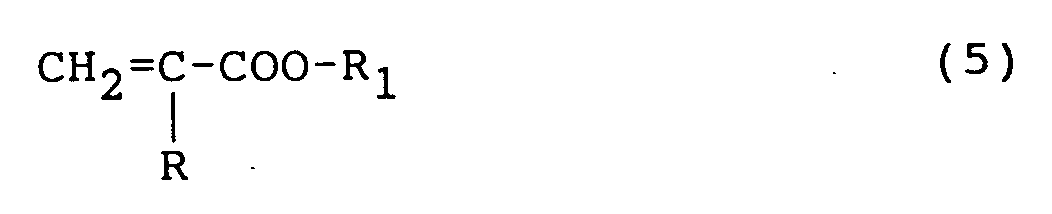
(dans laquelle R représente un atome d'hydrogène ou un groupe méthyle; R₁ représente un groupe alkyle à chaîne longue comportant 6 à 22 atomes de carbone, un groupe alkyle cyclique comportant 6 à 22 atomes de carbone ou un groupe représenté par la formule: -(CxH2xO)l-(CyH2yO)m-R₃ (dans laquelle R₃ représente un atome d'hydrogène, un groupe alkyle ou un groupe aryle); x et y représentent chacun un nombre entier s'échelonnant de 1 à 4; l et m représentent chacun 0 ou un nombre entier non inférieur à 1, à condition que la somme l + m soit un nombre entier non inférieur à 2), qui possède un seul groupe (méth)acryloyle et qui a une masse moléculaire non inférieure à 160, avec 60 à 0,5% en moles d'au moins un monomère (méth)acrylate représenté par la formule générale (6) suivante:
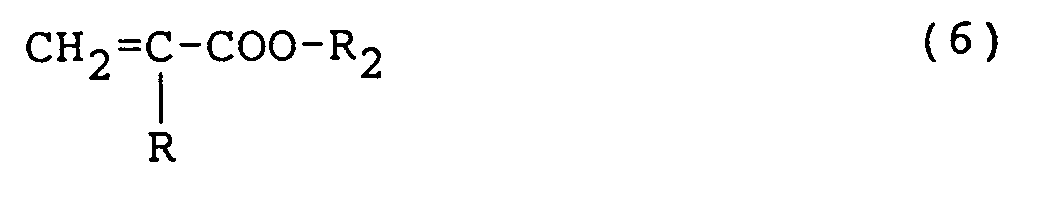
(dans laquelle R représente un atome d'hydrogène ou un groupe méthyle; et R₂ représente un groupe contenant un groupe (méth)acryloyle), qui possède plusieurs groupes (méth)acryloyle et qui a une masse moléculaire non supérieure à 700, dans un bon solvant pour le monomère mono(méth)acrylate, dans lequel la concentration totale des monomères, dans le système réactionnel, est limitée à une valeur de pas plus de 2 moles/l, pour donner ainsi un polymère vinylique portant des groupes (méth)acryloyle sur les chaînes latérales, représenté par la formule générale (1) suivante:
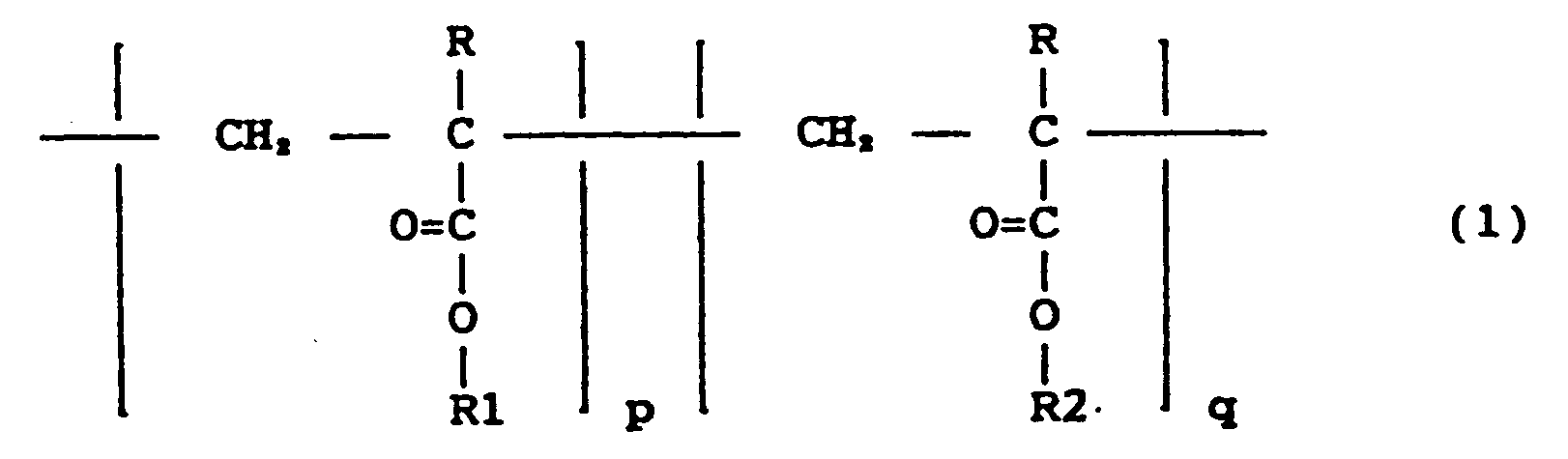
(dans laquelle R représente un atome d'hydrogène ou un groupe méthyle; R₁ représente un groupe alkyle à chaîne longue comportant 6 à 22 atomes de carbone, un groupe alkyle cyclique comportant 6 à 22 atomes de carbone ou un groupe représenté par la formule: -(CxH2xO)l-(CyH2yO)m-R₃ (dans laquelle R₃ représente un atome d'hydrogène, un groupe alkyle ou un groupe aryle); x et y représentent chacun un nombre entier s'échelonnant de 1 à 4; l et m représentent chacun 0 ou un nombre entier non inférieur à 1, à condition que la somme l + m soit un nombre entier non inférieur à 2), qui possède un seul groupe (méth)acryloyle et qui a une masse moléculaire non inférieure à 160, avec 60 à 0,5% en moles d'au moins un monomère (méth)acrylate représenté par la formule générale (6) suivante:
(dans laquelle R représente un atome d'hydrogène ou un groupe méthyle; et R₂ représente un groupe contenant un groupe (méth)acryloyle), qui possède plusieurs groupes (méth)acryloyle et qui a une masse moléculaire non supérieure à 700, dans un bon solvant pour le monomère mono(méth)acrylate, dans lequel la concentration totale des monomères, dans le système réactionnel, est limitée à une valeur de pas plus de 2 moles/l, pour donner ainsi un polymère vinylique portant des groupes (méth)acryloyle sur les chaînes latérales, représenté par la formule générale (1) suivante:
8. Procédé de préparation d'un polymère vinylique portant des groupes (méth)acryloyle
sur les chaînes latérales selon la revendication 7, dans lequel le monomère représenté
par la formule générale (6) est au moins un membre du groupe constitué par les monomères
di(méth)acrylates de formule générale (6), dans laquelle le substituant R₂ est représenté
par la formule générale (2):

dans laquelle R représente un atome d'hydrogène ou un groupe méthyle; z représente un nombre entier s'échelonnant de 2 à 10; et n est un nombre entier s'échelonnant de 1 à 4 lorsque z est un nombre entier s'échelonnant de 2 à 3, n est égal à 1 ou 2 lorsque z est égal à 4, ou n est égal à 1 lorsque z est un nombre entier s'échelonnant de 5 à 10; et les monomères poly(méth)acrylates de formule générale (6), dans laquelle le substituant R₂ est représenté par la formule générale (3) suivante:
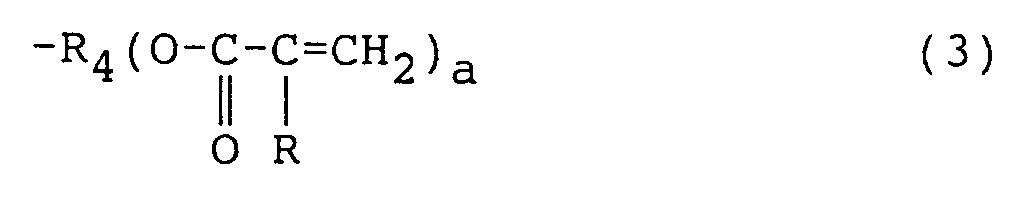
dans laquelle R représente un atome d'hydrogène ou un groupe méthyle; R₄ représente un résidu ester d'un polyol comportant 1 à 12 atomes de carbone; et a représente un nombre entier s'échelonnant de 1 à 10.
dans laquelle R représente un atome d'hydrogène ou un groupe méthyle; z représente un nombre entier s'échelonnant de 2 à 10; et n est un nombre entier s'échelonnant de 1 à 4 lorsque z est un nombre entier s'échelonnant de 2 à 3, n est égal à 1 ou 2 lorsque z est égal à 4, ou n est égal à 1 lorsque z est un nombre entier s'échelonnant de 5 à 10; et les monomères poly(méth)acrylates de formule générale (6), dans laquelle le substituant R₂ est représenté par la formule générale (3) suivante:
dans laquelle R représente un atome d'hydrogène ou un groupe méthyle; R₄ représente un résidu ester d'un polyol comportant 1 à 12 atomes de carbone; et a représente un nombre entier s'échelonnant de 1 à 10.
9. Procédé de préparation d'un polymère vinylique portant des groupes (méth)acryloyle
sur les chaînes latérales selon la revendication 7, dans lequel le monomère représenté
par la formule générale (5), dans laquelle R₁ est un groupe alkyle à chaîne longue
comportant 6 à 22 atomes de carbone, est au moins un membre choisi dans le groupe
constitué par le (méth)acrylate d'hexyle, le (méth)acrylate d'heptyle, le (méth)acrylate
d'octyle, le (méth)acrylate de nonyle, le (méth)acrylate de décyle, le (méth)acrylate
d'undécyle, le (méth)acrylate de dodécyle, le (méth)acrylate de tridécyle, le (méth)acrylate
de tétradécyle, le (méth)acrylate d'hexadécyle, le (meth)acrylate d'heptadécyle, le
(méth)acrylate d'octadécyle, le (méth)acrylate de nonadécyle, le (méth)acrylate d'éicosyle,
le (méth)acrylate d'unéicosyle, le (méth)acrylate de doéicosyle, et leurs isomères,
tels que le (méth)acrylate de 2-éthylhexyle et le (méth)acrylate d'isononyle.
10. Procédé de préparation d'un polymère vinylique portant des groupes (méth)acryloyle
sur les chaînes latérales selon la revendication 7, dans lequel le monomère représenté
par la formule générale (5), dans laquelle R₁ est un groupe alkyle cyclique comportant
6 à 22 atomes de carbone, est au moins un membre choisi dans le groupe constitué par
le (méth)acrylate d'isobornyle, le (méth)acrylate de tricyclodécanyle et le (méth)acrylate
de diméthyladamantyle, et leurs isomères.
11. Procédé de préparation d'un polymère vinylique portant des groupes (méth)acryloyle
sur les chaînes latérales selon la revendication 7, dans lequel le monomère représenté
par la formule générale (5), dans laquelle R₁ est un groupe représenté par la formule:
-(CxH2xO)l-(CyH2yO)m-R₃, est au moins un membre choisi dans le groupe constitué par le (méth)acrylate
de méthoxydiéthylèneglycol, le (méth)acrylate d'éthoxydiéthylèneglycol, le (méth)acrylate
d'isooctyloxydiéthylèneglycol, le (méth)acrylate de phénoxydiéthylèneglycol, le (méth)acrylate
de phénoxytriéthylèneglycol, le (méth)acrylate de méthoxytriéthylèneglycol, le (méth)acrylate
de méthoxypolyéthylèneglycol, le (méth)acrylate de nonylphényltétraéthylèneglycol,
le (méth)acrylate de nonylphényloctaéthylèneglycol, le (méth)acrylate de méthoxydipropylèneglycol,
le (méth)acrylate du composé d'addition statistique, rapport molaire 11:15, d'oxyde
d'éthylène et d'oxyde de propylène, dont une extrémité est modifiée par un groupe
stéaryloxy, et le mono(méth)acrylate de polytétraméthylèneglycol, ainsi que leurs
isomères.
12. Procédé de préparation d'un polymère vinylique portant des groupes (méth)acryloyle
sur les chaînes latérales selon la revendication 7, dans lequel le solvant est un
membre choisi dans le groupe constitué par le benzène, le toluène, le xylène, l'hexane,
le cyclohexane et l'heptane, pour le monomère dont le substituant R₁, dans la formule
générale (5), est un groupe alkyle à chaîne longue comportant 6 à 22 atomes de carbone
ou un groupe alkyle cyclique comportant 6 à 22 atomes de carbone; ou un membre choisi
dans le groupe constitué par le benzène, le toluène, le xylène, l'hexane, le cyclohexane,
l'heptane, les alcools tels que le méthanol et l'éthanol, les cétones, par exemple
l'acétone et la méthyléthylcétone, les esters, par exemple l'acétate d'éthyle et l'acétate
de butyle, les éthers, par exemple le dioxane et un solvant dérivé de l'éthylèneglycol,
par exemple l'éther monobutylique d'éthylèneglycol, pour le monomère dont le substituant
R₁, dans la formule générale (5), est un groupe représenté par la formule générale:
-(CxH2xO)l-(CyH2yO)m-R₃.
13. Procédé de préparation d'un polymère vinylique portant des groupes (méth)acryloyle
sur les chaînes latérales selon la revendication 7, dans lequel la température réactionnelle,
pendant la copolymérisation radicalaire, s'échelonne d'environ 40 à 130°C, on utilise
au moins un initiateur de polymérisation choisi dans le groupe constitué par les composés
azoïques tels que le 2,2'-azobis-isobutyronitrile et les composés peroxy tels que
le peroxyde de lauroyle et le peroxyde de benzoyle, et on utilise éventuellement un
agent de transfert de chaîne choisi dans le groupe constitué par le laurylmercaptan
et l'acide mercaptopropionique.
14. Procédé de préparation d'un polymère vinylique portant des groupes (méth)acryloyle
sur les chaînes latérales selon la revendication 7, dans lequel, après la copolymérisation
radicalaire, on ajoute au produit de la réaction un inhibiteur de polymérisation thermique
choisi dans le groupe constitué par le p-méthoxyphénol, l'hydroquinone et le butylhydroxytoluène.
15. Procédé de préparation d'un polymère vinylique portant des groupes (méth)acryloyle
sur les chaînes latérales selon la revendication 8, dans lequel le monomère représenté
par la formule générale (6), dans laquelle R₂ est représenté par la formule générale
(2), est au moins un membre choisi dans le groupe constitué par le di(méth)acrylate
d'éthylèneglycol, le di(méth)acrylate de diéthyièneglycol, le di(méth)acrylate de
triéthylèneglycol, le di(méth)acrylate de tétraéthylèneglycol, le di(méth)acrylate
de propylèneglycol, le di(méth)acrylate de tétrapropylèneglycol, le di(méth)acrylate
de 1,4-butanediol, le di(méth)acrylate de di(tétraméthylèneglycol), le di(méth)acrylate
de 1,5-pentanediol, le di(méth)acrylate de 1,6-hexanediol, le di(méth)acrylate de
3-méthyl-1,5-pentanediol, le di(méth)acrylate de 1,9-nonanediol, le di(méth)acrylate
de 1,10-décanediol, et leurs isomères.
16. Procédé de préparation d'un polymère vinylique portant des groupes (méth)acryloyle
sur les chaînes latérales selon la revendication 8, dans lequel le monomère représenté
par la formule générale (6), dans laquelle R₂ est représenté par la formule générale
(3), est au moins un membre choisi dans le groupe constitué par le tri(méth)acrylate
de triméthylolpropane, le tri(méth)acrylate de pentaérythritol, le tétra(méth)acrylate
de pentaérythritol, l'hexa(méth)acrylate de dipentaérythritol, le tri(méth)acrylate
de triméthylolheptane, et leurs isomères.
17. Procédé de préparation d'un polymère vinylique portant des groupes (méth)acryloyle
sur les chaînes latérales, comprenant l'étape de copolymérisation radicalaire de 40
à 99,5% en moles d'au moins un monomère mono(méth)acrylate représenté par la formule
générale (5) suivante:
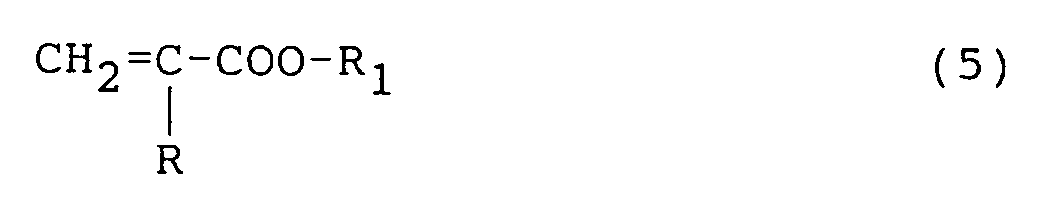
(dans laquelle R représente un atome d'hydrogène ou un groupe méthyle; R₁ représente un groupe alkyle à chaîne longue comportant 6 à 22 atomes de carbone, un groupe alkyle cyclique comportant 6 à 22 atomes de carbone ou un groupe représenté par la formule: -(CxH2xO)l-(CyH2yO)m-R₃ (dans laquelle R₃ représente un atome d'hydrogène, un groupe alkyle ou un groupe aryle); x et y représentent chacun un nombre entier s'échelonnant de 1 à 4; l et m représentent chacun 0 ou un nombre entier non inférieur à 1, à condition que la somme l + m soit un nombre entier non inférieur à 2), qui possède un seul groupe (méth)acryloyle et qui a une masse moléculaire non inférieure à 160; de 60 à 0,5% en moles d'au moins un monomère (méth)acrylate représenté par la formule générale (6) suivante:

(dans laquelle R représente un atome d'hydrogène ou un groupe méthyle; et R₂ représente un groupe contenant un groupe (méth)acryloyle), qui possède plusieurs groupes (méth)acryloyle et qui a une masse moléculaire non supérieure à 700; et de 0 à 59,5% en moles d'au moins un composé vinylique ou composé de vinylidène représenté par la formule générale (7) suivante:

(dans laquelle R représente un atome d'hydrogène ou un groupe méthyle; et R₅ représente un groupe fonctionnel ayant une masse moléculaire inférieure à 133), qui possède une masse moléculaire non supérieure à 160, dans un bon solvant pour le monomère mono(méth)acrylate, dans lequel la concentration totale des monomères, dans le système réactionnel, est limitée à une valeur de pas plus de 2 moles/l, pour donner ainsi un polymère vinylique possédant des groupes (méth)acryloyle sur les chaînes latérales, représentés par la formule générale (4) suivante:
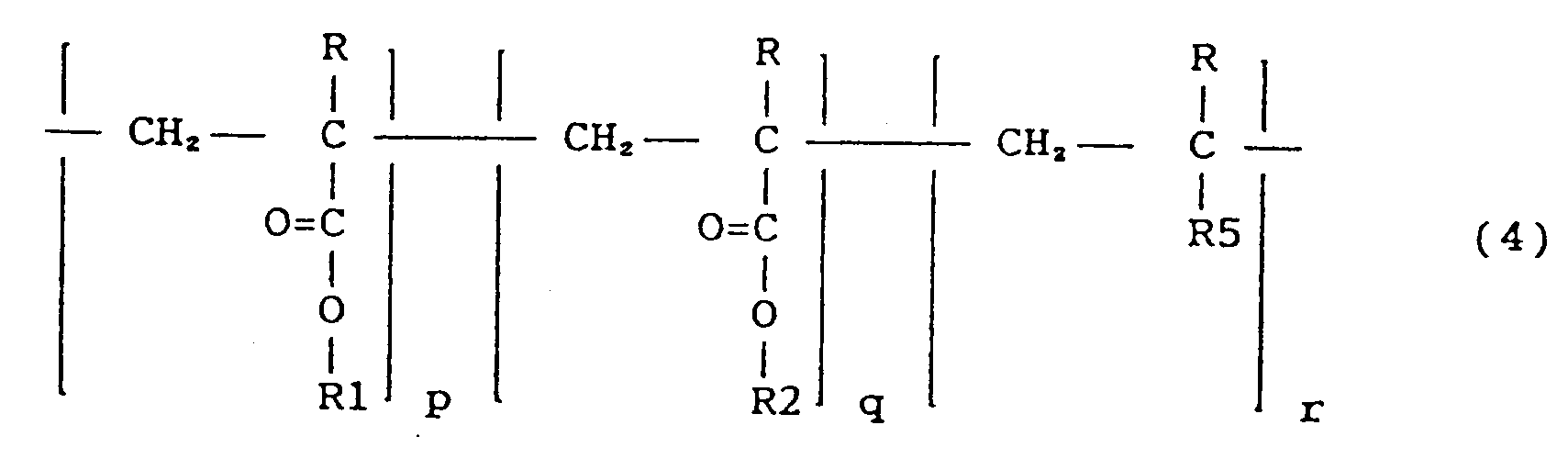
(dans laquelle R représente un atome d'hydrogène ou un groupe méthyle; R₁ représente un groupe alkyle à chaîne longue comportant 6 à 22 atomes de carbone, un groupe alkyle cyclique comportant 6 à 22 atomes de carbone ou un groupe représenté par la formule: -(CxH2xO)l-(CyH2yO)m-R₃ (dans laquelle R₃ représente un atome d'hydrogène, un groupe alkyle ou un groupe aryle); x et y représentent chacun un nombre entier s'échelonnant de 1 à 4; l et m représentent chacun 0 ou un nombre entier non inférieur à 1, à condition que la somme l + m soit un nombre entier non inférieur à 2), qui possède un seul groupe (méth)acryloyle et qui a une masse moléculaire non inférieure à 160; de 60 à 0,5% en moles d'au moins un monomère (méth)acrylate représenté par la formule générale (6) suivante:
(dans laquelle R représente un atome d'hydrogène ou un groupe méthyle; et R₂ représente un groupe contenant un groupe (méth)acryloyle), qui possède plusieurs groupes (méth)acryloyle et qui a une masse moléculaire non supérieure à 700; et de 0 à 59,5% en moles d'au moins un composé vinylique ou composé de vinylidène représenté par la formule générale (7) suivante:
(dans laquelle R représente un atome d'hydrogène ou un groupe méthyle; et R₅ représente un groupe fonctionnel ayant une masse moléculaire inférieure à 133), qui possède une masse moléculaire non supérieure à 160, dans un bon solvant pour le monomère mono(méth)acrylate, dans lequel la concentration totale des monomères, dans le système réactionnel, est limitée à une valeur de pas plus de 2 moles/l, pour donner ainsi un polymère vinylique possédant des groupes (méth)acryloyle sur les chaînes latérales, représentés par la formule générale (4) suivante:
18. Procédé de préparation d'un polymère vinylique portant des groupes (méth)acryloyle
sur les chaînes latérales selon la revendication 17, dans lequel le monomère représenté
par la formule générale (6) est au moins un membre choisi dans le groupe constitué
par les monomères di(méth)acrylates de formule générale (6), dans laquelle le substituant
R₂ est représenté par la formule générale (2):

dans laquelle R représente un atome d'hydrogène ou un groupe méthyle; z représente un nombre entier s'échelonnant de 2 à 10; et n est un nombre entier s'échelonnant de 1 à 4 lorsque z est un nombre entier s'échelonnant de 2 à 3, n est égal à 1 ou 2 lorsque z est égal à 4, ou n est égal à 1 lorsque z est un nombre entier s'échelonnant de 5 à 10; et les monomères poly(méth)acrylates de formule générale (6), dans laquelle le substituant R₂ est représenté par la formule générale (3) suivante:

dans laquelle R représente un atome d'hydrogène ou un groupe méthyle; R₄ représente un résidu ester d'un polyol comportant 1 à 12 atomes de carbone; et a représente un nombre entier s'échelonnant de 1 à 10.
dans laquelle R représente un atome d'hydrogène ou un groupe méthyle; z représente un nombre entier s'échelonnant de 2 à 10; et n est un nombre entier s'échelonnant de 1 à 4 lorsque z est un nombre entier s'échelonnant de 2 à 3, n est égal à 1 ou 2 lorsque z est égal à 4, ou n est égal à 1 lorsque z est un nombre entier s'échelonnant de 5 à 10; et les monomères poly(méth)acrylates de formule générale (6), dans laquelle le substituant R₂ est représenté par la formule générale (3) suivante:
dans laquelle R représente un atome d'hydrogène ou un groupe méthyle; R₄ représente un résidu ester d'un polyol comportant 1 à 12 atomes de carbone; et a représente un nombre entier s'échelonnant de 1 à 10.
19. Procédé de préparation d'un polymère vinylique portant des groupes (méth)acryloyle
sur les chaînes latérales selon la revendication 17, dans lequel le monomère représenté
par la formule générale (5), dans laquelle R₁ est un groupe alkyle à chaîne longue
comportant 6 à 22 atomes de carbone, est au moins un membre choisi dans le groupe
constitué par le méthacrylate d'hexyle, le (méth)acrylate d'heptyle, le (méth)acrylate
d'octyle, le (méth)acrylate de nonyle, le (méth)acrylate de décyle, le (méth)acrylate
d'undécyle, le (méth)acrylate de dodécyle, le (méth)acrylate de tridécyle, le (méth)acrylate
de tétradécyle, le (méth)acrylate d'hexadécyle, le (méth)acrylate d'heptadécyle, le
(méth)acrylate d'octadécyle, le (méth)acrylate de nonadécyle, le (méth)acrylate d'éicosyle,
le (méth)acrylate d'unéicosyle, le (méth)acrylate de doéicosyle, et leurs isomères,
tels que le (méth)acrylate de 2-éthylhexyle et le (méth)acrylate d'isononyle.
20. Procédé de préparation d'un polymère vinylique portant des groupes (méth)acryloyle
sur les chaînes latérales selon la revendication 17, dans lequel le monomère représenté
par la formule générale (5), dans laquelle R₁ est un groupe alkyle cyclique comportant
6 à 22 atomes de carbone, est au moins un membre choisi dans le groupe constitué par
le (méth)acrylate d'isobornyle, le (méth)acrylate de tricyclodécanyle et le (méth)acrylate
de diméthyladamantyle, et leurs isomères.
21. Procédé de préparation d'un polymère vinylique portant des groupes (méth)acryloyle
sur les chaînes latérales selon la revendication 17, dans lequel le monomère représenté
par la formule générale (5), dans laquelle R₁ est un groupe représenté par la formule:
-(CxH2xO)l-(CyH2yO)m-R₃, est au moins un membre choisi dans le groupe constitué par le (méth)acrylate
de méthoxydiéthylèneglycol, le (méth)acrylate d'éthoxydiéthylèneglycol, le (méth)acrylate
d'isooctyloxydiéthylèneglycol, le (méth)acrylate de phénoxydiéthylèneglycol, le (méth)acrylate
de phénoxytriéthylèneglycol, le (méth)acrylate de méthoxytriéthylèneglycol, le (méth)acrylate
de méthoxypolyéthylèneglycol, le (méth)acrylate de nonylphényltétraéthylèneglycol,
le (méth)acrylate de nonylphényloctaéthylèneglycol, le (méth)acrylate de méthoxydipropylèneglycol,
le (méth)acrylate du composé d'addition statistique, rapport molaire 11:15, d'oxyde
d'éthylène et d'oxyde de propylène, dont une extrémité est modifiée par un groupe
stéaryloxy, et le mono(méth)acrylate de polytétraméthylèneglycol, ainsi que leurs
isomères.
22. Procédé de préparation d'un polymère vinylique portant des groupes (méth)acryloyle
sur les chaînes latérales selon la revendication 17, dans lequel le monomère représenté
par la formule générale (7) est au moins un membre choisi dans le groupe constitué
par le styrène, les monomères vinyliques tels que l'acétate de vinyle, l'acide (méth)acrylique,
le (méth)acrylate de méthyle, le (méth)acrylate d'éthyle, le (méth)acrylate de propyle,
le (méth)acrylate de butyle, le (méth)acrylate de pentyle, l'acrylate d'hexyle, le
(méth)acrylate de glycidyle, le (méth)acrylate d'isocyanatoéthyle, et leurs isomères.
23. Procédé de préparation d'un polymère vinylique portant des groupes (méth)acryloyle
sur les chaînes latérales selon la revendication 17, dans lequel le solvant est un
membre choisi dans le groupe constitué par le benzène, le toluène, le xylène, l'hexane,
le cyclohexane et l'heptane, pour le monomère dont le substituant R₁, dans la formule
générale (5), est un groupe alkyle à chaîne longue comportant 6 à 22 atomes de carbone
ou un groupe alkyle cyclique comportant 6 à 22 atomes de carbone; ou un membre choisi
dans le groupe constitué par le benzène, le toluène, le xylène, l'hexane, le cyclohexane,
l'heptane, les alcools tels que le méthanol et l'éthanol, les cétones, par exemple
l'acétone et la méthyléthylcétone, les esters, par exemple l'acétate d'éthyle et l'acétate
de butyle, les éthers, par exemple le dioxane et un solvant dérivé de l'éthylèneglycol,
par exemple l'éther monobutylique d'éthylèneglycol, pour le monomère dont le substituant
R₁, dans la formule générale (5), est un groupe représenté par la formule générale:
-(CxH2xO)l-(CyH2yO)m-R₃.
-(CxH2xO)l-(CyH2yO)m-R₃.
24. Procédé de préparation d'un polymère vinylique portant des groupes (méth)acryloyle
sur les chaînes latérales selon la revendication 17, dans lequel la température réactionnelle,
pendant la copolymérisation radicalaire, s'échelonne d'environ 40 à 130°C, on utilise
au moins un initiateur de polymérisation choisi dans le groupe constitué par les composés
azoïques tels que le 2,2'-azobis-isobutyronitrile et les composés peroxy tels que
le peroxyde de lauroyle et le peroxyde de benzoyle, et on utilise éventuellement un
agent de transfert de chaîne choisi dans le groupe constitué par le laurylmercaptan
et l'acide mercaptopropionique.
25. Procédé de préparation d'un polymère vinylique portant des groupes (méth)acryloyle
sur les chaînes latérales selon la revendication 17, dans lequel, après la copolymerisation
radicalaire, on ajoute au produit de la réaction un inhibiteur de polymérisation thermique
choisi dans le groupe constitué par le p-méthoxyphénol, l'hydroquinone et le butylhydroxytoluène.
26. Procédé de préparation d'un polymère vinylique portant des groupes (méth)acryloyle
sur les chaînes latérales selon la revendication 18, dans lequel le monomère représenté
par la formule générale (6), dans laquelle R₂ est représenté par la formule générale
(2), est au moins un membre choisi dans le groupe constitué par le di(méth)acrylate
d'éthylèneglycol, le di(méth)acrylate de diéthylèneglycol, le di(méth)acrylate de
triéthylèneglycol, le di(méth)acrylate de tétraéthylèneglycol, le di(méth)acrylate
de propylèneglycol, le di(méth)acrylate de tétrapropylèneglycol, le di(méth)acrylate
de 1,4-butanediol, le di(méth)acrylate de di(tétraméthylèneglycol), le di(méth)acrylate
de 1,5-pentane-diol, le di(méth)acrylate de 1,6-hexanediol, le di(méth)acrylate de
3-méthyl-1,5-pentanediol, le di(méth)acrylate de 1,9-nonanediol, le di(méth)acrylate
de 1,10-décanediol, et leurs isomères.
27. Procédé de préparation d'un polymère vinylique portant des groupes (méth)acryloyle
sur les chaînes latérales selon la revendication 18, dans lequel le monomère représenté
par la formule générale (6), dans laquelle R₂ est représenté par la formule générale
(3), est au moins un membre choisi dans le groupe constitué par le tri(méth)acrylate
de triméthylolpropane, le tri(méth)acrylate de pentaérythritol, le tétra(méth)acrylate
de pentaérythritol, l'hexa(méth)acrylate de dipentaérythritol, le tri(méth)acrylate
de triméthylolheptane, et leurs isomères.