|
(11) | EP 0 494 113 A1 |

| (12) | EUROPEAN PATENT APPLICATION |
|
|
|
|
|||||||||||||||||||||||||||
| (54) | Flame resistant, low pilling polyester fiber |
| (57) The invention is a polyester and a method for producing a polyester filament which
has a combination of flame resistance and low pilling properties. The method comprises
forming a polyester polymer from a mixture consisting essentially of terephthalate
acid or dimethyl terephthalate, ethylene glycol, a chain branching agent having a
functionality of at least 3 and a phosphinic acid in the amount between 0.5 and 20
mole percent of the terephthalate acid and monomer. In particular, the invention also
comprises the enhanced fiber formed by the process, as well as the fabrics having
a pilling of about 3 to less than 5 as measured in accordance with ASTM D-3512-82. |
Field of the Invention
[0001] The present invention relates to polyester fibers and their use in textile applications, and in particular relates to an enhanced polyester fiber material having a combination of flame resistance and low pilling.
Background of the Invention
[0002] Polyester has long been recognized as a desirable material for textile applications including garments, upholstery and numerous other uses. The processes for manufacture of polyester are relatively well known and straight forward to those knowledgeable in the art, and fibers made from polyester can be appropriately woven or knitted to form textile fabrics. Polyester fibers can be blended with other fibers such as wool or cotton to produce fabrics which have the enhanced strength, durability and memory aspects of polyester and retaining many of the desired qualities of the natural fiber with which the polyester is blended.
[0003] As with any fiber, the particular polyester fiber from which any given fabric is formed must have properties suitable for end use of the fabric. In many applications such as sleepwear fabrics, draperies, and bedspreads, for example, it is desirable the textile fabric have the property of flame resistance. Flame resistant fabrics are defined as fabrics that will self extinguish when an ignition source is removed. Requirements are set forth in various tests including the NFPA 701-1977.
[0004] One technique for attaining the flame resistance of fabrics of polyester fiber is to modify the polyester with carboxyphosphinic acids. Such modified polyester fibers and their use in fabrics are disclosed in U. S. Patent Nos. 3,941,752; 4,033,936; and RE 30,783. In fact, these patents describe flame resistant linear polyesters made from modified polyesters consisting of dicarboxylic acid components and diol components and phosphorus containing chain members being structurally units of the formula
which constitute about 1 - 20 mole percent of the acid component of the polyester. In this formula R is the saturated open-chained or cyclic alkylene, arylene, or aralkylene having from 1 - 15, preferably from 2 - 10 carbon atoms and R₁ is an alkyl radical having up to 6 carbon atoms or an aryl radical or an arakyl radical as described in U. S. Patent 3,941,752. Such modified polyester fibers are currently available from Hoechst Celanese Corporation.
[0005] Although fabrics containing polyester fibers as described above provide flame resistance, such synthetic fibers have an undesirable propensity upon prolonged use to exhibit small, compact groupings or entangled fibers (i.e., fuzzballs) on the fabric surface. Such fiber groupings commonly are termed "pills" and tend to form and to tenaciously adhere to the surface of the fabric as the fabric encounters surface abrasion during normal use. The aesthetic appearance of fabric accordingly may be adversely influenced by these relatively small groupings of entangled fibers which are retained on the surface of the fabric.
[0006] Heretofore, it has been believed that such pills can be traced to the relatively high strength of the synthetic fibers present in the fabric. For instance, the pills may be more or less permanently attached to the fabric surface by one or more synthetic polymer fibers extending out of the fabric which will resist breakage as the surface abrasion continues. This theory of pill formation is supported by the significant lower level of the retention of undesired fuzzballs on the surface of the fabric consisting solely of cotton fibers following the same surface abrasion conditions. It is believed that the entangled cotton fibers which form at the surface of the fabric readily break away since the cotton fibers are of an inherently lower strength.
[0007] This pilling problem may be observed in fabrics formed in whole or in part from polyethylene terephthalate (PET) fibers. Pills commonly are observed on the fabric formed from blends of cotton and PET staple fibers following use in service and during the cleaning process including laundering or dry cleaning. While the pills may be observed in fabrics having a wide variety of construction, they are more commonly observed on loosely constructed fabrics, particularly knitted fabrics.
[0008] One approach heretofore proposed to reduce the pilling of fabrics is to reduce the tenacity (or strength) of the PET fibers by using a low molecular weight (measured as intrinsic viscosity) PET polymer. Low intrinsic viscosity provides a general indication of reduced polymeric chain length and leads to fibers having a lesser strength. Accordingly, when such entangled fibers become free on the surface of the fabric following abrasion, the fibers tend to cleanly break away and not hold a fuzzball at the surface of the fabric.
[0009] It has been found, however, that when this approach is followed, it is more difficult initially to form and process the PET into a fabric using standard processing conditions because of the reduces tenacity. Such reduced tenacity can lead to a premature fiber breakage and processing disadvantages. These disadvantages have been overcome by gentler textile processing conditions. However, it has also been known that intrinsic viscosity reduction does not resolve the problem of low pilling to the satisfaction desired in the market.
[0010] It is also well known to chain branch polyester polymers in order to reduce pilling in the fabric. Chain branching of polyester fibers can be accomplished by inclusion of chain branching agents such as tetrafunctional chain branching agents, in particular, pentaerythritol and tetraethyl orthosilicate.
[0011] U. S. Patent No. 3,576,773 discloses low pilling PET fibers containing trifunctional or tetrafunctional branching agents. Pentaerythritol is listed as a branching agent and is shown used in Example 5. U. S. Patent No. 3,335,211 discloses low pilling PET fibers made in the presence of a polycondensation catalyst of antimony or titanium and adding an oxysilicon compound prior to melt spinning such as tetraethyl orthosilicate. Although it is recognized that trifunctional and tetrafunctional branching agents may be used to overcome pilling of PET fibers, inclusion of such branching agents in flame resistant polyester fibers at normal processing intrinsic viscosities of polyester has been found not to achieve the desired low pilling.
[0012] There remains a need to develop a processable polyester fiber having flame resistance and low pilling properties while also maintaining the other properties desired in the resulting fabric, especially the aesthetic properties of the fabric resulting from the polyester fiber.
Summary of the Invention
[0013] It is therefore an object of the present invention to provide a polyester fiber and a method for producing the polyester fiber which has a combination of flame resistance and low pilling properties. The polyester fiber comprises the polycondensation product of a dicarboxylic acid or a lower alkyl ester thereof, a diol, a chain branching agent having a functionality of at least 3, and a carboxyphosphinic acid monomer, said monomer being used in an amount from about 0.5 to about 20 mole percent based on a total amount of dicarboxylic acid or lower alkyl ester thereof and monomer, said monomer of the general formula
or a lower alkyl ester or cyclic anhydride of same monomer wherein R is a saturated, open chain or cyclic alkylene, arylene or aralkylene having one to 15 carbon atoms, and R₁ of the formula is alkyl having up to 6 carbon atoms or an arakyl, wherein the polycondensation product has an intrinsic viscosity based on dichloroacetic acid at 25° less than about 0.55 deciliters/gm.
[0014] The foregoing and other objects, advantages and features of the invention, and the manner in which the same are accomplished will become more readily apparent upon consideration of the folowing detailed description of the invention, taken in conjunction with the examples which illustrate exemplary embodiments.
Detailed Description of the Preferred Embodiment
[0015] The invention comprises forming a polyester fiber from the mixture comprising a dicarboxylic acid or a lower dialkyl ester of the acid, generally dimethyl terephtalalate (DMT), a diol such as ethylene glycol, a chain branching agent having a functionality of at least 3 and a flame resistant carboxyphosphinic acid monomer being added in the amount of about 0.5 to about 20 mole percent based on a total amount of the diacarboxylic acid or lower alkyl ester and a monomer. The mixture or polyester polymer of the invention has an intrinsic viscosity based on dichloroacetic acid at 25°C. of less than about 0.55 deciliters/gm.
[0016] Dicarboxylic acids suitable for the present invention include acids having the formula
wherein R is selected from the group consisting of -(CH₂)n- where n is from 2 to 12,
[0017] Suitable dicarboxylic acids include terephthalic acid, isophthalic acid, adipic acid and naphthalic acid.
[0018] It is well known in the art that suitable lower dialkyl esters of the TA may include in addition to DMT, diethyl terephthalate, dipropyl terephthalate, dibutyl terephthalate, dialkyl naphthalates such as 2.6 dimethyl naphthalate, or mixtures of two or more of these. The glycol may comprise in addition to ethylene glycol, diethylene glycol, polyethylene glycol, blends of ethylene glycol and propane and/or butane diol, or mixtures of two or more of these. Although the embodiment is directed to polyethylene terephthalate, a specific type of polyester, this is not to be taken as a limitation, but as one embodiment of the present invention.
[0019] As is known to those familiar with the commercial production of polyester, the polyester polymer can be formed from a starting mixture of terephthalate acid and ethylene glycol or from dimethyl terephthalate and ethylene glycol. The polyester may be manufactured using a batch process or a continuous process. The reacticn proceeds through the well known steps of esterification and condensation to form polyethylene terephthalate, commonly referred to as PET. A number of catalysts or other additives have been found to be useful in promoting either the esterification or condensation reactions, or in adding certain properties to the polyester. For example, manganese is used as a catalyst for esterification, antimony compounds are commonly used to catalyze the ccndensation reaction and inorganic compounds such as titanium dioxide (TiO₂) are commonly added as delustrants or for other similar purposes.
[0020] In the ester interchange route, dimethyl terephthalate (DMT) and ethylene glycol (EG) are typically reacted in the presence of a catalyst (manganese) at atmospheric pressure and at a temperature of from about 180° C to 230° C. In the presence of the catalyst, these components undergo ester interchange to yield two intermediate monomers and methanol. The reaction which is conveniently done with about 1 mole of DMT, and 1.8 to 2.2 moles of EG, is reversible and is carried to completion by removing methanol formed. During the ester interchange, the two intermediate monomers are the substantial majority product (not considering the methanol), along with small amounts of low molecular weight oligomers.
[0021] The monomers are then polymerized by a polycondensation reaction, where the temperature is raised to about 280° C. to about 310° C. and the pressure is reduced to below 1 mm of mercury vacuum and in the presence of a suitable polymerization catalyst (antimony). From this reaction, polyethylene terephthalate and ethylene glycol are formed. Because the reaction is reversible, the glycol is removed as it is evolved, thus forcing the reaction toward the formation of the polyester.
[0022] The polyester at temperatures of 280° to 310° C. is a viscous liquid which is forced through a spinneret to form individual filaments; a process generally referred to in the art as "spinning". The spun filaments are subsequently drawn, heat set, crimped, dried and cut with appropriate lubricating finishes added in a conventional manner. It will be understood by those familiar with textile manufacturing in general and synthetic fiber manufacture, in particular, that the word "spinning" has two connotations in the art, the first meaning being a term used to describe the manufacture of fiber from a polymer melt, and the second being the twisting of the fibers together - natural, synthetic or blended to form spun yarn. Both these terms will be used herein in the conventional sense the polyester polymer of the present invention is produced.
[0023] The polyester polymer of the present invention is produced by previously described production methods for polyester, i.e., esterification followed by polymerization via polycondensation. A batch process is generally employed, and catalyst and/or other typical additives may be employed. It will be understood that the presence or absence of such materials does not affect the essential techniques or results of the present invention, although they may modify or enhance the polyester monomer in the same desirable manner as for polyester itself. It is noted and described hereinafter the process is tailored to the intrinsic viscosity of the polyester polymer. Intrinsic viscosities as used herein require lower spinning temperatures than those temperatures required for polyesters of higher intrinsic viscosity.
[0024] The present invention is directed to polyester fibers that also include flame resistant carboxyphosphinic acid monomer and the chain branching agent. The flame resistant carboxyphosphinic acid monomers and their use in polyester fibers are described in U. S. Patent Nos. 3,941,752, 4,033,936; and RE 30,783 which are incorporated by reference.
[0025] The carboxyphosphinic acid monomers have the general structural formula:
wherein R is a saturated, open-chained or cyclic alkylene, arylene or aralkylene, having from 1 to 15, preferably 2 to 10 carbon atoms, and R₁ is an alkyl radical having up to six carbon atoms, an aryl radical or an aralykyl radical. Preferred phosphorous-containing chain members are the structural units of the above formula with R being C₂H₄ or C₆H₄ and R₁ being CH₃ or C₆H₅ or C₄ H₉.
[0026] When manufacturing the polyesters according to the process of the present invention, the carboxyphosphinic acids may be used as free acids, their acids or their cyclic anhydrides. Since above all the cyclic anhydrides (2,5-dioxo-1,2-oxaphospholanes) are easily obtainable, the use of these compounds is advantageous. However, as described in the U. S. Patent 4,033,936 there are difficulties in using the cyclic anhydrides of the carboxyphosphinic acids. These difficulties were overcome, as disclosed in the '936 patent by previously dissolving the oxaphospholane at elevated temperatures in a diol suitable for the polyester manufacture, and subsequently adding this solution to the polyester manufacturing batch.
[0027] When the cyclic anhydrides are dissolved in a suitable diol, the ring is opened with the addition of 1 mole of diol. The dissolving temperature depends of course on the nature of he oxaphospholane and the diol; generally, it is in a range of from about 50° C. to 150° C. When 2-methyl-2,5-dioxo-1, 2-oxaphospholane is to be dissolved, the most advantageous temperature is amout 105° to 130° C. The weight ratio of diol: oxaphospholane may widely vary. A lower limit is set only by the necessity of providing enough diol for the reaction, that is, at least 1 mole of diol per mole of anhydride, and of ensuring a sufficient viscosity of the solution. An upper limit of the diol amount is set by economic considerations only, since excess glycol has to be distilled off later on.
[0028] The carboxyphosphinic acid semi-esters formed by dissolution of the cyclic anhydrides in the diols, for example 2-carboxyethyl-methylphosphinic acid-ethylene glycol ester, are substances that are viscous liquids at room temperature which do not decompose or to an insignificant extent only at the elevated temperatures usually required for polyester manufacture, so that undesirable discoloration does not occur. The semi-esters are incorporated into the polyester chain molecules in the same manner is the other phosphorus containing modification agents used. The oxaphospholane solution in the corresponding diol is added to the polyester manufacturing batch in the same manner as is described for the carboxyphosphinic acids and their derivatives, namely, in case of reaction in known manner of starting substances usual for the manufacture of high molecular weight, especially fiber and film-forming, linear polyesters, before or during the polycondensation, or just before it is complete. The amount of carboxyphosphinic acid component should be from 0.5 to 20 mole % of the total acid components.
[0029] Methods of preparing the carboxyphosphinic acid monomers and incorporation into polyester polymers are described in U. S. Patent No. 3,941,752 and RE 30,783. The process of making the flame resistant polyesters from phosphorus containing compounds are further described in U. S. Patent No. 4,033,936. In particular, in the described process, cyclic anhydride of the above phosphorus compounds is employed wherein the cyclic anhydride is dissolved at elevated temperatures in a diol solvent suitable for the polyester manufacture to form a carboxyphosphinic acid semiester of said diol solvent in reacting said semiester with the dicarboxylic acid and the diol reactant to form the polyester.
[0030] The chain branching agents employed in the present invention have a funcctionality of at least 3. That is, they contain at least 3 functional groups such as hydroxyl, carboxyl, ester or silicate. Examples of suitable compounds are pentaerythritol; compounds having the formula R (OH)n wherein R is an alkylene group containing from 3 to 6 carbon atoms and n is a integer from 3 to 6, for example, glycerols, 1, 2, 6 hexanetriol and the like; compounds having the formula: R-(CH₂OH)₃ wherein R is an alkyl group containing from 2 to 6 carbon atoms, for example trimethylolethane, trimethylol propane, and the like compounds up to trimethylol hexane; and suitable hydrocarbyloxysilicon compounds having the formula
wherein R is an alkyl radical having from 2 to 10 carbon atoms or may be an aryl radical. These esters are commonly identified as tetramethyl orthosilicate, tetraethyl orthosilicate, tetra(2-hydroxyethyl) orthosilicate, etc. Mixed esters may also be employed.
[0031] It is preferred that chain branching agents having a functionality of 4 be employed because of the smaller amounts required. Examples of such agents are pentaerythritol and tetraethyl orthosilicate. In particular 500 to 1400 ppm of the DMT of pentaerythritol is used and from 0.1 to 1.0 weight percent of DMT of tetraethyl orthosilicate is used.
[0032] In view of the foregoing, an example of the process for making flame resistant low pilling polyester of the present invention will be described in detail.
[0033] A batch process of the present invention starts with esterification performed at atmospheric pressure and at 180 to 220° C. The reactor is loaded with dimethyl terephthalate, ethylene glycol and a catalyst as is conventionally carried out in a customary batch polyester process. After esterification is completed, the carboxyphosphinic acid and chain branching agent such as pentaerythritol are added. Other additives such as delustrants (TiO₂), thermostabilizers, optical brighteners and/or bluing agents, etc., may be added at this initial stage. The polymerization stage is run at 280 - 300° C. at a strong vacuum of 0.3 to 3.0 mm Hg. The target intrinsic viscosity of the polymer is less than 0.55 deciliters/gm in the solvent base dichloracetic acid at 25° C. and preferably from about 0.45 to about 0.54 deciliters/gm.
[0034] The above-described batch process can be run in a manner such that the chain branching agent is loaded with the other raw materials at the beginning of the esterification process. Furthermore, it is contemplated for a batch operation that some of the carboxyphosphinic acid and remaining additives are added at the beginning of the polymerization stage.
[0035] Subsequently, the polymer is heated to 270° C. to 275° C. and spun into fibers according to methods well known in the art involving quenching, finish application and takeup.
[0036] Prior to spinning into fibers, the polymer is tested for intrinsic viscosity in dichloroacetic acid at 25° C. By definition, intrinsic viscosity is the value of the intercept at about zero concentration of the plot in [(relative viscosity)/concentration] versus concentration of polyester polymer in dichloroacetic acid at 25° C. The desired intrinsic viscosity is less than 0.55 deciliters/gm. Subsequent to the spinning operation the fibers are processed through a drawing process at heat setting temperatures to impart desired tensile properties in the filaments. In this regard, heat setting temperatures most preferred are generally greater than 120° C., and preferably from between about 125° and 140° C. These fibers are then cut into staple length. The cut staple fibers are processed into yarns which are subsequently converted into fabrics and then into various products including garments,
draperies, bedspreads, etc.
[0037] The fabrics made according to the process generally have what is called low pilling characteristics. The term "low pilling" or its equivalent means herein that the tested material obtains a value of 3 to 4 as defined as ASTM D-3512-82 entitled "Standard Test Method for Pilling Resistance and Other Related Surface Changes of Textile Fabrics: Random Tumble Pilling Tester Method". The value of 5 indicates no pill formation, whereas the values of less than 5 indicate various levels of pilling.
[0038] The following examples illustrate specific embodiments of the invention, but the invention is not limited to such examples.
Experimental Procedure
[0039] Autoclave batches were prepared in which batches of roughly 70 kilograms of polymer for Example 1 were produced at approximately 2.5 to 1 mole ratio of ethylene glycol (EG) to DMT in a batch process. In each case, the autoclave was first charged with the raw materials including DMT, ethylene glycol, the catalysts, manganese acetate, cobalt and pentaerythritol.
[0040] During charging of the raw materials, the autoclave was subjected to an inert gas (nitrogen at 4 standard cubic feet per hour) to aid is preventing oxidation. Generally, the autoclave was agitated with a stirrer to assure homogenous commingling of the raw materials. At the start of the ester interchange reaction (approximately when the reactor contents reached 155° C.), the flow of nitrogen gas was terminated. The autoclave temperature during ester interchange rose from approximately 155° to about 180 to 230° C. During the ester interchange the methanol was continuously removed to force the reaction toward the production of the monomer.
[0041] At this point of the reaction, the ester interchange reaction was substantially complete and phospholane solution was added and the slurry stirred for about five minutes. Then titanium dioxide was added and the slurry stirred for five minutes. Finally, a solution of PPA was added.
[0042] For Example 1, polycondensation was performed in the same autoclave. The catalyst antimony trioxide was added after ester interchange reaction. Vacuum-let-down was initiated and during this time the flow of nitrogen gas was once again terminated. During vacuum-let-down a vacuum is drawn on the autoclave until a vacuum of about 1.0 mm of mercury or lower is achieved. At the end of the vacuum-let-down, the autoclave was again heated to about 290° C. thereby initiating the polycondensation reaction. The polycondensation reaction proceeded until substantial completion, during which the glycol formed was removed.
[0043] Once the polyester was formed, the polyester was tested for intrinsic viscosity (IV), and tenacity expressed in grams per denier. The IV was tested at 25° C. using a dichloroacetic acid solvent.
Example 1
[0044] Various polyester fibers were made to demonstrate the effect of the present invention on both pilling and flame resistance. Experiment 1 (control) was spun to have an IV of 0.60 deciliters per gram which was higher than that claimed in the present invention. In Experiment 1 also, pentaerythritol and phospholane was added. The pentaerythritol was added at 1,000 ppm of the DMT and the phospholane was added at 1.55%. In Experiment 2, the polymer was made to have an IV of 0.52 deciliters per gram. The polymer was made using 1,000 ppm pentaerythrytol and 1.55% phospholane. Experiment 3 incorporated the tetraethyl orthosilicate, as well as the phospholane at an IV of 0.52 deciliters per gram. The polyester fiber was used and incorporated in polyester fabric in a 5 shaft satin weave which was then measured for pilling and flame resistance. As is evidenced by the control Experiment 1, the fabric made from polyester having a higher IV was outside the scope of the present invention fails the pilling test, whereas fabrics made from IVs according to the present invention met the required pilling test, as well as the required flame resistance.
1. A polyester which comprises the polycondensation product of a dicarboxylic acid or
a lower alkyl ester thereof, a diol, a chain branching agent having a functionality
of at least 3 and a carboxyphosphinic acid monomer, said monomer being used in an
amount of from 0.5 to 20 mol percent based on the total amount of dicarboxylic acid
or lower alkyl ester thereof and monomer, said monomer being of the general formula
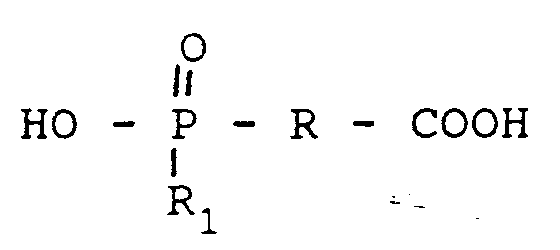
or a lower alkyl ester or cyclic anhydride of said monomer, wherein R is a saturated, open-chain or cyclic alkylene, arylene or aralkyl having one to 15 carbon atoms, and R₁ is an alkyl having up to 6 carbon atoms, aryl or aralkyl, wherein the polycondensation product has an intrinsic viscosity of about 0.55 deciliters/gm or less in the solvent base dichloroacetic acid at 25°C.
or a lower alkyl ester or cyclic anhydride of said monomer, wherein R is a saturated, open-chain or cyclic alkylene, arylene or aralkyl having one to 15 carbon atoms, and R₁ is an alkyl having up to 6 carbon atoms, aryl or aralkyl, wherein the polycondensation product has an intrinsic viscosity of about 0.55 deciliters/gm or less in the solvent base dichloroacetic acid at 25°C.
2. A polyester according to claim 1 wherein R is C₂H₄ or benzyl and R₁ is CH₃, benzyl
or butyl.
3. A polyester according to claim 1 wherein R is C₂H₄ and R₁ is methyl.
4. A polyester according to claim 1, 2 or 3 wherein the units derived from dicarboxylic
acid are essentially terephthalic acid units and the units derived from the diol are
essentially units of a diol of the general formula

wherein n is 2 to 10, or the diol units are derived from 1,4-cyclohexanedimethanol.
wherein n is 2 to 10, or the diol units are derived from 1,4-cyclohexanedimethanol.
5. A polyester according to claim 1, 2 or 3 wherein the units derived from dicarboxylic
acid are essentially terephthalic acid units and the units derived from the diol are
essentially ethylene glycol units.
6. A polyester according to claim 1, 2 or 3 wherein the lower alkyl ester of the dicarboxylic
acid is dimethyl terephthalate, and the diol is ethylene glycol.
7. A polyester according to any of claims 1 to 6 having an intrinsic viscosity in the
solvent base of dichloroacetic acid at 25°C in the range of 0.40 to 0.55 deciliters/gm.
8. A polyester according to any of claims 1 to 7 wherein the chain branching agent has
a functionality of 4.
9. A polyester according to any of claims 1 to 8 wherein the chain branching agent is
pentaerythritol in the amount from about 500 to about 1,400 ppm of the carboxylic
acid or lower alkyl ester thereof.
10. A polyester according to any of claims 1 to 9 wherein the chain branching agent has
the formula R[OSi(OR)₂] OR, wherein R is a radical such as methyl, ethyl, 2-hydroxyethyl,
butyl, phenyl or mixed groups.
11. A polyester according to any of claims 1 to 10 wherein the chain branching agent is
tetraethyl orthosilicate.
12. A polyester according to any of claims 1 to 11 which is the polycondensation product
consisting essentially of a dicarboxylic acid or a lower alkyl ester thereof, a diol,
a chain branching agent and a carboxyphosphinic acid monomer or lower alkyl ester
or cyclic anhydride thereof.
13. A polyester according to any of claims 1 to 12, wherein the carboxyphosphinic acid
monomer, or lower alkyl ester or cyclic anhydride thereof, is present in an amount
of from 0.55 to 20 mol percent relative to the total amount of dicarboxylic acid,
or lower alkyl ester thereof, and monomer, or lower alkyl ester or cyclic anhydride
thereof.
14. A polyester according to any of claims 1 to 13 that is flame-resistant and low-pilling.
15. A garment made containing the flame resistant, low pilling polyester of claim 14.
16. A method of making a polyester which comprises polycondensing a dicarboxylic acid
or a lower alkyl ester thereof with a diol in the presence of a chain branching agent
having a functionality of at least 3 and a carboxyphosphinic acid monomer, said monomer
being used in an amount of from 0.5 to 20 mole percent based on the total amount of
dicarboxylic acid or lower alkyl ester thereof and monomer, said monomer being of
the general formula
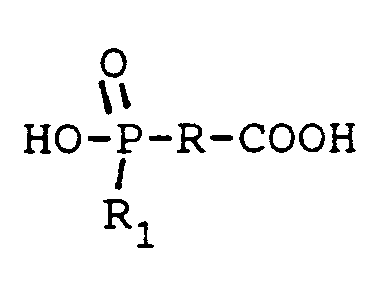
or a lower alkyl ester or cyclic anhydride of said monomer, wherein R is a saturated, open-chain or cyclic alkylene, arylene or aralkylene having one to 15 carbon atoms and R₁ is an alkyl having up to 6 carbon atoms, aryl or aralkyl, wherein the polycondensation product has an intrinsic viscosity of about 0.55 deciliters/gm or less based on dichloroacetic acid at 25°C.
or a lower alkyl ester or cyclic anhydride of said monomer, wherein R is a saturated, open-chain or cyclic alkylene, arylene or aralkylene having one to 15 carbon atoms and R₁ is an alkyl having up to 6 carbon atoms, aryl or aralkyl, wherein the polycondensation product has an intrinsic viscosity of about 0.55 deciliters/gm or less based on dichloroacetic acid at 25°C.
17. A method of making a polyester which comprises polycondensing a dicarboxylic acid
or a lower alkyl ester thereof with a diol reactant in the presence of a chain branching
agent having a functionality of at least 3 and a carboxyphosphinic acid monomer, said
monomer being used in an amount of from 0.5 to 20 mole percent based on the total
amount of dicarboxylic acid or lower alkyl ester thereof and monomer, said monomer
being a cyclic anhydride of an acid of the general formula

wherein R is a saturated, open-chain or cyclic alkylene, arylene or aralkylene having one to 15 carbon atoms and R₁ is an alkyl having up to 6 carbon atoms, aryl or aralkyl, dissolving said cyclic anhydride at elevated temperature in a diol solvent suitable for polyester manufacture to form a carboxyphosphinic acid semi-ester of said diol solvent and reacting said semi-ester with said carboxylic acid and said diol reactant to form said polyester wherein the polycondensation product has an intrinsic viscosity of about 0.55 deciliters/gm or less based on dichloroacetic acid at 25°C.
wherein R is a saturated, open-chain or cyclic alkylene, arylene or aralkylene having one to 15 carbon atoms and R₁ is an alkyl having up to 6 carbon atoms, aryl or aralkyl, dissolving said cyclic anhydride at elevated temperature in a diol solvent suitable for polyester manufacture to form a carboxyphosphinic acid semi-ester of said diol solvent and reacting said semi-ester with said carboxylic acid and said diol reactant to form said polyester wherein the polycondensation product has an intrinsic viscosity of about 0.55 deciliters/gm or less based on dichloroacetic acid at 25°C.
18. A method according to claim 17 wherein a semi-ester formed by dissolving the cyclic
anhydride of 2-carboxyethyl-methylphosphinic acid in ethylene glycol is used.
19. A method according to claim 17 or 18 wherein said diol solvent is the same as said
diol reactant.
20. A method according to any of claims 16 to 19, which produces a polyester according
to any one of claims 2 to 14.