|
(11) | EP 0 496 413 B1 |

| (12) | EUROPEAN PATENT SPECIFICATION |
|
|
| (54) |
Process for preparing perfluorooxyaziridines Verfahren zur Herstellung von Perfluoroxaziridinen Procédé pour la préparation de perfluoro-oxaziridines |
|
|
|||||||||||||||||||||||||||||||
| Note: Within nine months from the publication of the mention of the grant of the European patent, any person may give notice to the European Patent Office of opposition to the European patent granted. Notice of opposition shall be filed in a written reasoned statement. It shall not be deemed to have been filed until the opposition fee has been paid. (Art. 99(1) European Patent Convention). |
[0002] The simplest perfluoro-oxyaziridine is perfluoro-2-aza-propene oxide:
A process for preparing this compound has been described by Falardeau and DesMarteau in J. Am. Chem. Soc., 98, 3529 (1976). It comprises adding trifluoromethyl hydroperoxide CF₃OOH to the corresponding imine CF₃N=CF₂ and subsequently converting the resulting hydroperoxide to oxyaziridine through NaF.
[0003] This process exhibits several drawbacks, which are mainly due to hydroperoxide CF₃OOH used as an oxidant, which is potentially explosive and is preparable only by means of a complex multi step process.
[0004] The same process described by Falardeau and DesMarteau has been utilized by Zheng and DesMarteau (J. Org. Chem., 48, 4844 (1983)) for preparing oxyaziridines of formula:
from the corresponding imines. By means of this process, how-ever, it is not possible to prepare oxyaziridines substituted, on the carbon atom, by perfluoroalkyl groups.
[0005] Another method for preparing perfluoro-oxyaziridines is described in US-A-4,287,128, where a perhaloalkyl imine is reacted with gaseous chlorine in the presence of a carbonate or bicarbonate of an alkali or alkaline-earth metal. The presence of water traces is necessary to catalyze the reaction. This fact represents a drawback as both the starting imines and the obtained oxyaziridines hydrolize easily , in particular when they are non-substituted. By consequence, said method cannot be used for preparing perfluoro-2-azapropene oxide.
[0006] Patent US-A-4,874,875 describes another process for synthesizing perfluoro-oxyaziridines. It consists in reacting a perfluoroimine with H₂O₂, in the presence of a base, in an aprotic polar solvent. Owing to the presence of the water deriving from H₂O₂, neither this process can be utilized for preparing perfluoro-2-azapropene oxide.
[0007] Thus, for preparing said first member of the class of perfluoro-oxyaziridines, only the complicated method disclosed by Falardeau and DesMarteau is utilizable, which is affected with the above-described drawbacks.
[0008] In Journal of Organic Chemistry, vol. 32, No. 5, 1967, page 1628 a method is described for preparing phenyl-N-n-alkyl oxaziridines based on the reaction of an imine with a peracid which, on peroxidation of the imine, would precipitate the parent carboxylic acid from the reaction medium. No mention is made in the article to the applicability of the method to the preparation of other oxaziridine derivatives.
[0009] The Applicant has now surprisingly found that the perfluoro-oxyaziridines can be prepared by reacting the corresponding perfluoro-imines with an aromatic peroxyacid in an aprotic solvent; in particular, the process is utilizable for preparing, with good yields, perfluoro-oxyaziridines non-substituted on the carbon atom, such as perfluoro-2-azapropene oxide.
[0010] Thus, an object of the present invention is a process for preparing perfluoro-oxyaziridines of formula:
wherein:
Rx is F, a perfluoroalkyl group having 1 to 10 carbon atoms or a -NRf2 group in which Rf is a perfluoroalkyl group having 1 to 10 carbon atoms,
Ry is F or a perfluoroalkyl group having 1 to 10 carbon atoms,
Rz is a perfluoroalkyl group having 1 to 10 carbon atoms.
[0011] The process consists in reacting a perfluoro-imine of formula:
where Rx, Ry and Rz are the same as defined hereinbefore, with an aromatic peroxyacid of formula:
where X is H or an electron-attractor substituent, in an aprotic solvent, at a temperature ranging from -50° to +100°C.
[0012] The starting perfluoro-imines are known compounds and are preparable according to the methods described, for example, in "Organic Fluorine Chemistry" by W.A. Sheppard and C.M. Sharts, W.A. Benjamin Inc. (1969) and in Inorg. Chem., 14, 1223 (1975) by K.E. Peterman and J.M. Shreeve. In particular for CF₂=N-CF₃ it is possible to utilize the process described by Barr and Haszeldine in J. Chem. Soc., 1881 (1955).
[0013] The Rx, Ry and Rz groups have preferably from 1 to 8 carbon atoms. The Rf group has preferably from 1 to 3 carbon atoms.
[0014] As regards the aromatic peroxyacids of formula (III), substituent X can be in ortho, meta or para position with respect to the peroxycarboxylic group and it is preferably selected from F, Cl, -NO₂, -COOR and -CONR₂, where R is H or an alkyl group preferably having from 1 to 5 carbon atoms.
[0015] Examples of aromatic peroxyacids utilizable in the process of the present invention are: m-chloroperoxybenzoic acid, p-nitroperoxybenzoic acid, p-methoxycarboxy-peroxybenzoic acid, monoperoxyphthalic acid. Particularly preferred is m-chloroperoxybenzoic acid.
[0016] As already mentioned, the reaction is conducted in an aprotic solvent. It is possible to utilize any solvent of this type compatible with the peroxyacid and with the perfluoro-imine. Utilizable are, for example, nitriles (such as acetonitrile and benzonitrile), ethers (such as diethylether, dioxane, tetrahydrofuran, 2-methoxyethylether), chlorinated hydrocarbons (such as dichloromethane, terachloromethane, chloroform, mono-chloroethane) or mixtures thereof.
[0018] Preferably, the solvent and the peracid are thoroughly anhydrified prior to the reaction in order to avoid the hydrolysis of the starting amine and of the oxyaziridine. This procedure is particularly recommended when oxyaziridines non-substituted on the carbon atom, such as perfluoro-2-azapropene oxide, are to be prepared.
[0019] Conventional techniques are utilizable to this purpose. For example, the solvent can be distilled in the presence of an anhydrifying agent (for example P₂O₅, CaCl₂, MgSO₄, etc.), while the peroxyacid can be kept in contact with any anhydrifying agent which is compatible with the peroxyacid itself. Suitable for this purpose are, for example, the common molecular sieves.
[0021] The peroxyacid/imine molar ratio is generally in the range of from 1:1 to 10:1, preferably from 1:1 to 2:1.
[0022] The reaction time is not a critical parameter and is a function of the selected reaction temperature. Generally, the reaction is concluded in a time ranging from 10 minutes to 24 hours.
[0023] The perfluoro-oxyaziridines preparable by the process of the present invention are utilized for the synthesis of polymers or copolymers characterized by a high chemical inertia and by a high thermal stability, such as the perfluoroaminoether polymers described in patent application EP-338,585.
[0024] The perfluoro-oxyaziridines can be utilized also in the preparation of nitrons. Furthermore, they form complexes with the ions of transition metals, which act as catalysts for the photopolymerization of ethylene monomers.
[0025] The following examples are given for illustrative purposes and are by no way to be considered as a limitation of the scope of the present invention.
[0026] Into a Pyrex ® 50 ml flask there were introduced, inside a dry-box, 2.0 g (7.0 mmols) of m-chloro-peroxybenzoic acid (MCPBA), a commercial product of Aldrich Co., containing 75-80% of MCPBA, the remaining portion being m-chloro-benzoic acid.
[0027] The MCPBA was dissolved in 25 ml of CH₂Cl₂ (commercial product of Aldrich), previously distilled on P₂O₅. The solution was maintained in contact with molecular sieves (Fisher M-564, type 3A, 8-12 mesh) for 50 minutes, at room temperature. The solution was then transferred into another 50 ml flask equipped with a magnetic stirrer.
[0028] The flask was cooled with liquid nitrogen (-196°C) and evacuated. By means of a Pyrex® vacuum line, 0.4 g (3.0 mmols) of perfluoro-2-azapropene CF₂=N-CF₃ were condensed in the flask.
[0029] The flask was introduced into a water-ice bath. The reaction mixture was stirred for 15 minutes at 0°C.
[0030] Through vacuum distillation there were recovered 0.24 g (1.6 mmols) of perfluoro-2-azapropene oxide (yield : 53%).
[0031] The oxyaziridine was identified by comparing the IR and ¹⁹F-NMR spectra with the data of the literature.
[0032] 5.4 g (25.0 mmols) of MCPBA (commercial product as in example 1) were introduced, inside a dry-box, into a 50 ml flask.
[0033] The MCPBA was dissolved in 30 ml of CH₃CN (commercial product manufactured by Aldrich). The solution was maintained in contact with molecular sieves for 40 minutes at room temperature. Then it was transferred into another 50 ml flask equipped with a magnetic stirrer, and it was cooled to +10°C.
[0034] 10.0 g (23.0 mmols) of CF₃(CF₂)₂-CF=N-(CF₂)₃CF₃ were added. The reaction mixture was maintained under stirring at +10° C for 5 minutes, was allowed to heat up to room temperature in 10 minutes and then was diluted with 70 ml of CH₃CN so as to dissolve the precipitate which had formed during the reaction.
[0035] The product so obtained was separated by means of a separatory funnel, anhydrified on CaCl₂ for 1 hour and then distilled. 8.2 g (18.3 mmols) of pure oxyaziridine (yield: 79%), which was characterized through the IR, ¹⁹F-NMR and mass spectra, were recovered.
[0036] 5.0 g (22.0 mmols) of MCPBA, dissolved in 25 ml of CH₃CN, were reacted with 8.0 g (15.0 mmols) of a 1:1 isomeric mixture of the perfluoro-imines of formula:
CF₃(CF₂)₃-CF=N-(CF₂)₄CF₃
and
CF₃CF₂CF (CF₃)-CF=N-(CF₂)₄CF₃.
[0037] Following the same procedure described in example 2, 6.5 g (11.8 mmols) of pure oxyaziridine (yield: 79%) were obtained. The boiling point was 68-70°C/135 mm Hg.
[0038] On the basis of the IR and ¹⁹F-NMR spectra and of the gaschromatographic data, the obtained product resulted to consist of a 1:1 mixture of the two isomers of formula:
[0039] 3.5 g (15.3 mmols) of MCPBA, dissolved in 25 ml of CH₃CN, were reacted with 3.5 g (12.4 mmols) of CF₃-CF=N-CF(CF₃)₂ according to the same procedure illustrated in example 2.
[0042] 4.0 g (17.4 mmols) of MCPBA, dissolved in 25 ml of CH₃CN, were reacted with 6.0 g (9.5 mmols) of : CF₃(CF₂)₄-CF=N-(CF₂)₅CF₃, following the same procedure as is described in example 2.
[0045] 1.0 g (4.4 mmols) of MCPBA was dissolved in 10 ml of CH₃CN and maintained in contact with molecular sieves for 45 minutes, at room temperature. The solution was transferred into a 50 ml flask equipped with a magnetic stirrer. The flask was cooled with liquid nitrogen (-196°C) and then it was evacuated.
[0046] Into the flask there were condensed, by means of a Pyrex® vacuum line, 0.8 g (3.0 mmols) of (CF₃)₂N-CF=N-CF₃. The reaction mixture was heated to room temperature in 10 minutes, then it was stirred for 15 minutes at that temperature. Through vacuum distillation there were obtained 0.5 g (1.82 mmols) of pure oxyaziridine (yield: 61%).
1. A process for preparing perfluoro-oxyaziridines of formula:
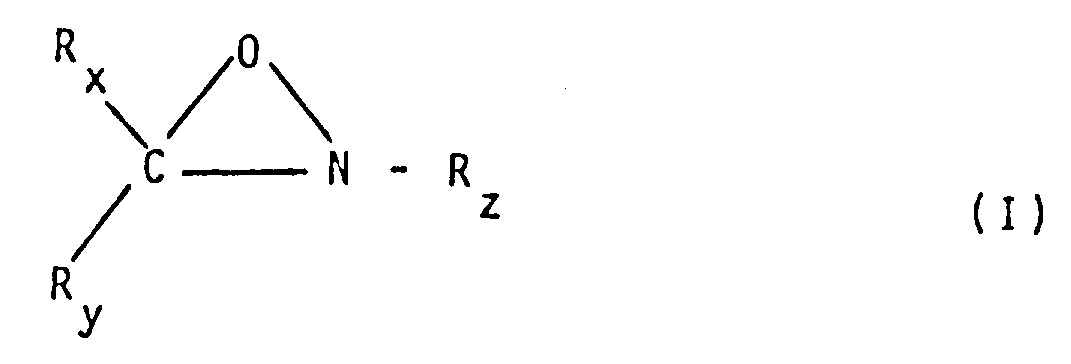
wherein:
Rx is F, a perfluoroalkyl group having 1 to 10 carbon atoms or a -NRf₂ group in which Rf is a perfluoroalkyl group having 1 to 10 carbon atoms,
Ry is F or a perfluoroalkyl group having 1 to 10 carbon atoms,
Rz is a perfluoroalkyl group having 1 to 10 carbon atoms, by reacting a perfluoro-imine of formula:
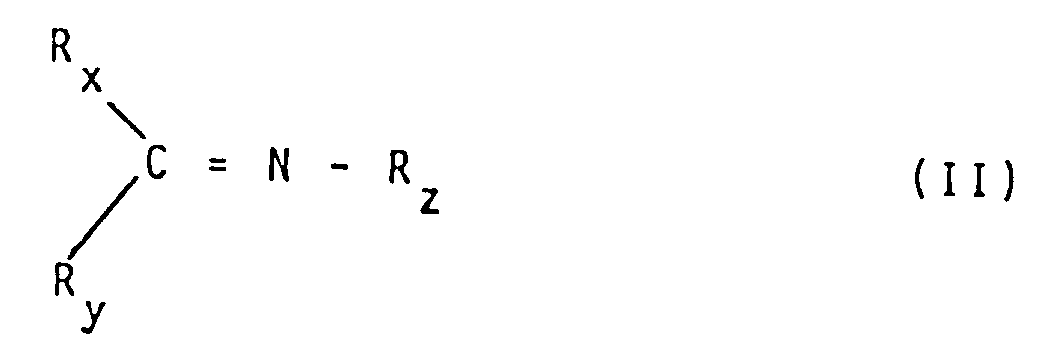
where Rx, Ry and Rz are the same as defined above,
with an oxidant, characterised in that an aromatic peroxyacid of formula:
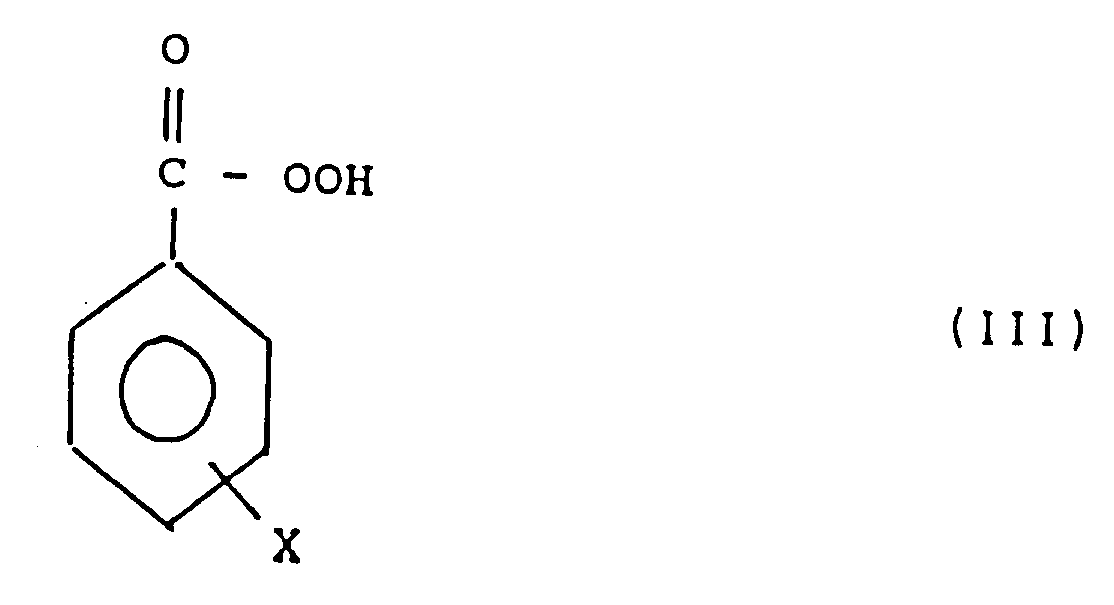
where X is H or an electron attractor substituent, is used as the oxidant in an aprotic solvent and at a temperature ranging from -50° to +100°C.
wherein:
Rx is F, a perfluoroalkyl group having 1 to 10 carbon atoms or a -NRf₂ group in which Rf is a perfluoroalkyl group having 1 to 10 carbon atoms,
Ry is F or a perfluoroalkyl group having 1 to 10 carbon atoms,
Rz is a perfluoroalkyl group having 1 to 10 carbon atoms, by reacting a perfluoro-imine of formula:
where Rx, Ry and Rz are the same as defined above,
with an oxidant, characterised in that an aromatic peroxyacid of formula:
where X is H or an electron attractor substituent, is used as the oxidant in an aprotic solvent and at a temperature ranging from -50° to +100°C.
2. The process of claim 1, wherein X is selected from F, Cl, -NO₂, -COOR and CONR₂, where
R is H or an alkyl group.
3. The process of claim 2, wherein X is Cl and is in meta position with respect to the
peroxycarboxylic group.
4. The process of one or more of the preceding claims, wherein Rx and Ry are F.
5. The process of claim 4, wherein Rz is -CF₃.
6. The process of one or more of the preceding claims, wherein the solvent is selected
from nitriles, ethers and chlorinated hydrocarbons or mixtures thereof.
7. The process of claim 6, wherein the solvent is dichloromethane.
8. The process of claim 6, wherein the solvent is acetonitrile.
1. Verfahren zur Herstellung von Perfluoro-oxyaziridinen der Formel
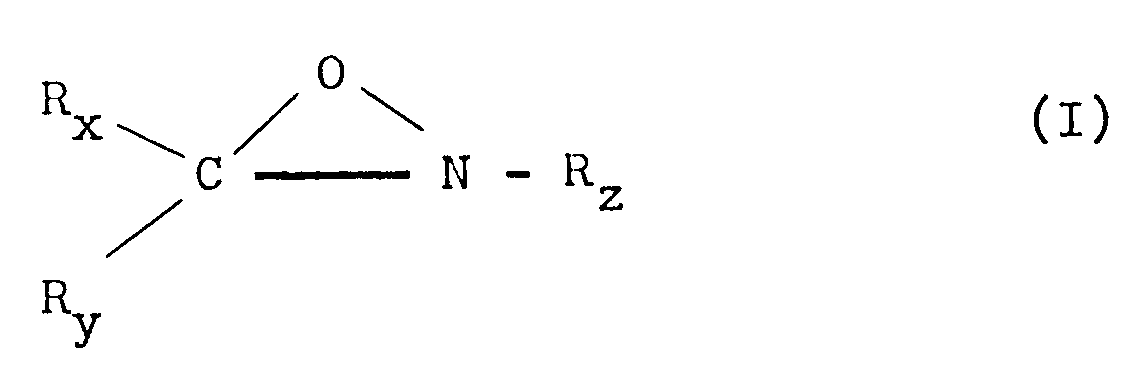
worin
Rx für F, eine Perfluoralkylgruppe mit 1 bis 10 Kohlenstoffatomen oder eine Gruppe -NRf₂ steht, in der Rf eine Perfluoralkylgruppe mit 1 bis 10 Kohlenstoffatomen ist,
Ry für F oder eine Perfluoralkylgruppe mit 1 bis 10 Kohlenstoffatomen steht,
Rz eine Perfluoralkylgruppe mit 1 bis 10 Kohlenstoffatomen bedeutet,
durch Umsetzung eines Perfluor-imins der Formel
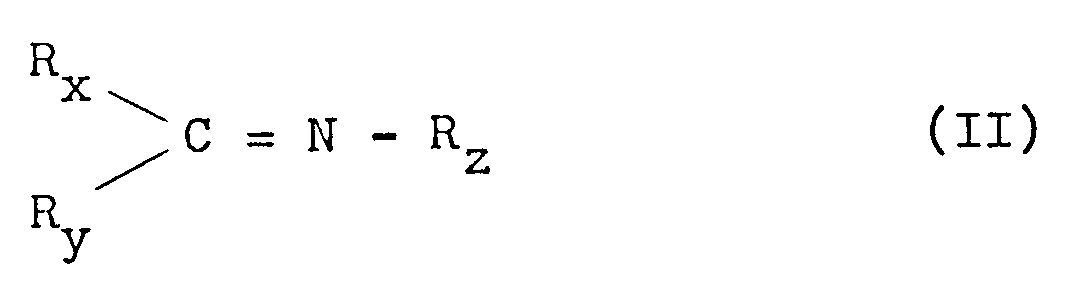
worin Rx, Ry und Rz wie vorstehend definiert sind, mit einem Oxidans, dadurch gekennzeichnet, daß eine aromatische Peroxysäure der Formel
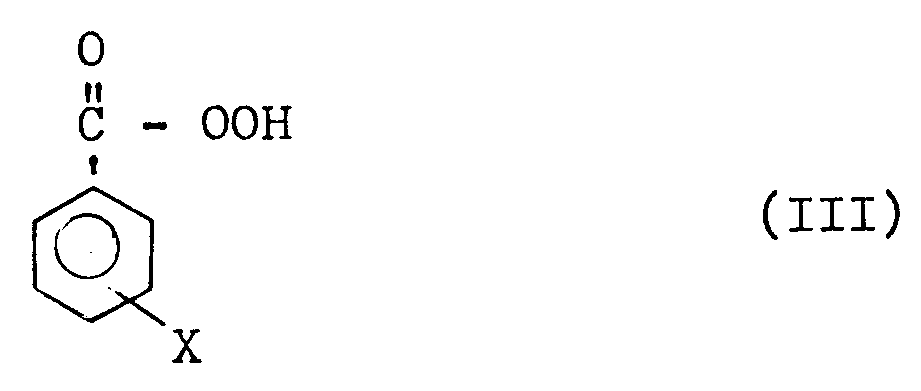
worin X für H oder einen elektronenanziehenden Substituenten steht, als Oxidans in einem aprotischen Lösungsmittel bei einer Temperatur im Bereich von -50 bis +100°C verwendet wird.
worin
Rx für F, eine Perfluoralkylgruppe mit 1 bis 10 Kohlenstoffatomen oder eine Gruppe -NRf₂ steht, in der Rf eine Perfluoralkylgruppe mit 1 bis 10 Kohlenstoffatomen ist,
Ry für F oder eine Perfluoralkylgruppe mit 1 bis 10 Kohlenstoffatomen steht,
Rz eine Perfluoralkylgruppe mit 1 bis 10 Kohlenstoffatomen bedeutet,
durch Umsetzung eines Perfluor-imins der Formel
worin Rx, Ry und Rz wie vorstehend definiert sind, mit einem Oxidans, dadurch gekennzeichnet, daß eine aromatische Peroxysäure der Formel
worin X für H oder einen elektronenanziehenden Substituenten steht, als Oxidans in einem aprotischen Lösungsmittel bei einer Temperatur im Bereich von -50 bis +100°C verwendet wird.
2. Verfahren gemäß Anspruch 1, worin X unter F, Cl, -NO₂, -COOR und CONR₂ ausgewählt
wird, worin R für H oder eine Alkylgruppe steht.
3. Verfahren gemäß Anspruch 2, worin X für Cl steht und in meta-Stellung in bezug auf
die Peroxycarbonsäure-gruppe vorliegt.
4. Verfahren gemäß einem oder mehreren der vorhergehenden Ansprüche, worin Rx und Ry für F stehen.
5. Verfahren gemäß Anspruch 4, worin Rz für -CF₃ steht.
6. Verfahren gemäß einem oder mehreren der vorhergehenden Ansprüche, worin das Lösungsmittel
unter Nitrilen, Ethern und chlorierten Kohlenwasserstoffen oder Mischungen hiervon
ausgewählt wird.
7. Verfahren gemäß Anspruch 6, worin das Lösungsmittel Methylenchlorid ist.
8. Verfahren gemäß Anspruch 6, worin das Lösungsmittel Acetonitril ist.
1. Procédé de préparation de perfluorooxyaziridines représentées par la formule :
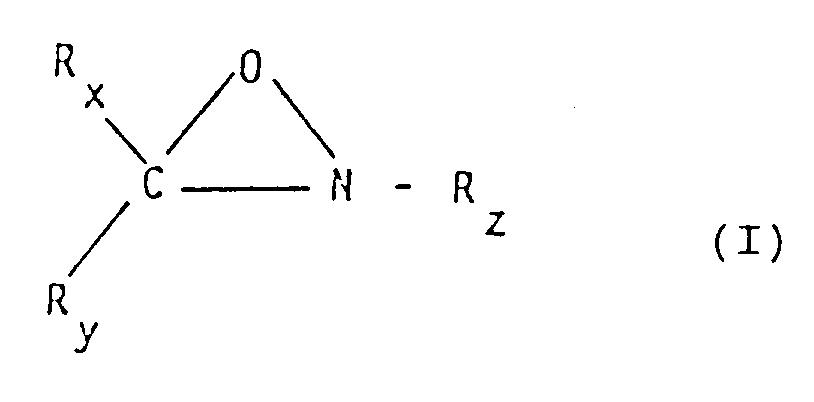
dans laquelle :
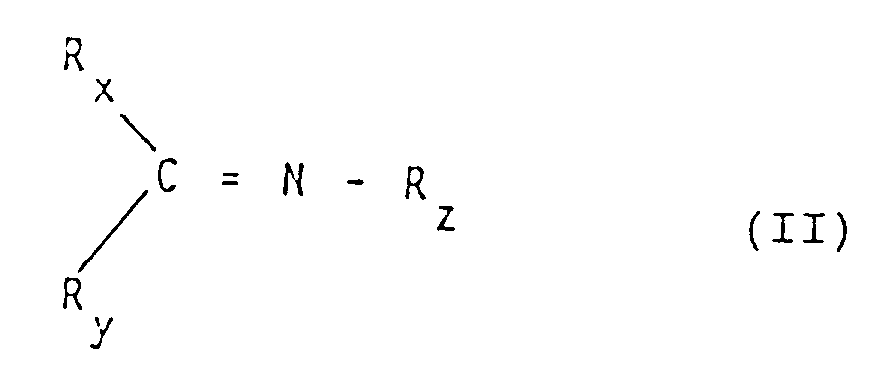
ou Rx, Ry et Rz sont les mêmes que ceux définis ci-dessus, avec un oxydant, caractérisé par le fait qu'un peroxyacide aromatique représenté par la formule :
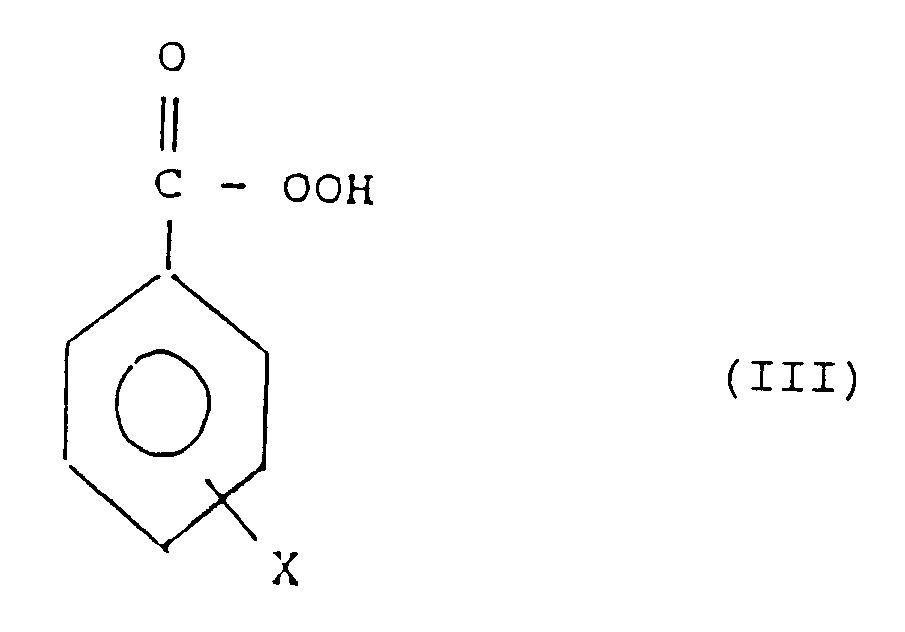
où X représente H ou un substituant attracteur d'électrons, est utilisé en tant qu'oxydant dans un solvant aprotique et à une température se situant à l'intérieur d'une plage allant de -50° à +100°C.
dans laquelle :
- Rx représente F, un groupe perfluoroalkyle ayant de 1 à 10 atomes de carbone ou un groupe -NRf₂ dans lequel Rf est un groupe perfluoroalkyle ayant de 1 à 10 atomes de carbone ;
- Ry représente F ou un groupe perfluoroalkyle ayant de 1 à 10 atomes de carbone ;
- R₂ représente un groupe perfluoroalkyle ayant de 1 à 10 atomes de carbone,
par réaction d'une perfluoro-imine représentée par la formule :ou Rx, Ry et Rz sont les mêmes que ceux définis ci-dessus, avec un oxydant, caractérisé par le fait qu'un peroxyacide aromatique représenté par la formule :
où X représente H ou un substituant attracteur d'électrons, est utilisé en tant qu'oxydant dans un solvant aprotique et à une température se situant à l'intérieur d'une plage allant de -50° à +100°C.
2. Procédé selon la revendication 1, dans lequel X est choisi parmi F, Cl, -NO₂, -COOR
et CONR₂, où R représente H ou un groupe alkyle.
3. Procédé selon la revendication 2, dans lequel X représente Cl et est en position méta
par rapport au groupe peroxycarboxylique.
4. Procédé selon l'une ou plusieurs des revendications précédentes dans lequel Rx et Ry représentent F.
5. Procédé selon la revendication 4, dans lequel Rz représente -CF₃.
6. Procédé selon l'une ou plusieurs des revendications précédentes, dans lequel le solvant
est choisi parmi les nitriles, les éthers et les hydrocarbures chlorés, ou leurs mélanges.
7. Procédé selon la revendication 6, dans lequel le solvant est le dichlorométhane.
8. Procédé selon la revendication 6, dans lequel le solvant est l'acétonitrile.