|
(11) | EP 0 496 414 A1 |

| (12) | EUROPEAN PATENT APPLICATION |
|
|
|
|
|||||||||||||||||||||||||||
| (54) | Process for preparing perfluorooxyaziridines |
| (57) A process for preparing perfluoro-oxyaziridines of formula:
where Rx and Ry, like or different from each other, are F or a C₁-C₁₀ , perfluoroalkyl group, Rz is a C₁-C₁₀-perfluoroalkyl group. The process consists in reacting the corresponding perfluoroimine with a perfluoroalkyl fluoroformyl peroxide RfOOC(O)F, in the presence of an alkali metal fluoride MF, at a temperature ranging from -40° to +50°C. |
[0003] A process for preparing this compound has been described by Falardeau and DesMarteau in J.Am.Chem.Soc., 98, 3529 (1976). It comprises the addition of trifluoromethyl hydroperoxide CF₃OOH to the corresponding imine CF₃N=CF₂ and the subsequent conversion of the resulting hydroperoxide to oxyaziridine through NaF.
[0004] The same two-step process has been utilized by Zheng and DesMarteau (J.Org.Chem., 48, 4844 (1983)) for preparing oxyaziridines of formula:
from the corresponding imines.
[0005] This process exhibits several drawbacks. Apart from the fact that two distinct passages are required, by means of such process it is not possible to prepare oxyaziridines substituted, on the carbon atom, by perfluoroalkyl groups.
[0006] The hydroperoxide CF₃OOH is preparable through a two-step process, as is illustrated by the following reaction scheme:
[0007] Reaction 1) is described by DesMarteau in Inorg.Chem., 9, 2179 (1970),reaction 2) by Bernstein, Hohorst and DesMarteau in J.Am.Chem.Soc., 93, 3882 (1971).
[0008] The Applicant has now surprisingly found that it is possible to prepare perfluoro-oxyaziridines through a single-step process, by reacting the corresponding perfluoroimines with a perfluoroalkyl-fluoroformyl peroxide of general formula RfOOC(O)F, in the presence of an alkali metal fluoride MF.
[0010] Thus, an object of the present invention is a process for preparing perfluoro-oxyaziridines of formula:
wherein:
Rx and Ry, like or different from each other, are F or a perfluoroalkyl group having 1 to 10 carbon atoms, Rz is a perfluoroalkyl group having 1 to 10 carbon atoms. The process consists in reacting a perfluoroimine of formula:
where Rx, Ry and Rz are the same as defined hereinabove, with a perfluoroalkyl-fluoroformyl peroxide RfOOC(O)F, Rf being a perfluoroalkyl group having 1 to 4 carbon atoms, in the presence of an alkali metal fluoride MF, at a temperature ranging from -40° to +50°C.
[0012] The starting perfluoroimines are known compounds and can be prepared according to the methods described, for example, in "Organic Fluorine Chemistry" by W.A. Sheppard and C.M. Sharts, W.A. Benjamin Inc. (1969) and in Inorg.Chem., 14, 1223 (1975) by K.E. Peterman and J.M. Shreeve.
[0013] A compound of formula RfOOC(O)F, preparable according to the method described by DesMarteau in Inorg.Chem., 9, 2179 (1970) is utilized as an oxidant.
[0014] It is to be pointed out that such method corresponds to reaction 1) of the above-illustrated scheme for preparing CF₃OOH. In other words, the oxidant utilized in the present invention is an intermediate for preparing the peroxide utilized in the Falardeau and DesMarteau process.
[0015] As already said, Rf is a perfluoroalkyl group having 1 to 4 carbon atoms, preferably it is -CF₃.
[0017] Before being used, fluoride MF is usually dried by means of conventional techniques, for example by heating in an oven at temperatures higher than 100°C.
[0019] The peroxide/imine molar ratio generally ranges from 1:1 to 2:1, preferably from 1:1 to 1.3:1.
[0020] The fluoride MF/peroxide molar ratio generally ranges from 0.1 : 1 to 50:1, preferably from 5:1 to 10:1.
[0021] The reaction time is not a critical parameter and it is a function of the selected reaction temperature. Generally, the reaction is concluded in a time ranging from 30 minutes to 30 hours.
[0022] The perfluoro-oxyaziridines preparable by the process of the present invention are utilized for the synthesis of polymers or copolymers characterized by a high chemical inertia and a high thermal stability, such as the perfluoroaminoether polymers described in patent application EP-338,585.
[0023] The perfluoro-oxyaziridines can be also utilized in the preparation of nitrons. Furthermore, they form complexes with the ions of the transition metals, which act as catalysts for the photopolymerization of ethylene monomers.
[0024] The following examples are given for illustrative purposes and are by no way to be considered as a limitation of the scope of the present invention.
EXAMPLE 1
[0025] Into a Pyrex® 50 ml flask equipped with connections for a vacuum line and with a magnetic stirrer, there were introduced 2 g (13.2 mmols) of CsF. The fluoride had been previously dried in oven for two hours at 300-400°C. The flask was then evacuated.
[0026] In the flask maintained at -196°C there were condensed, through a Pyrex® vacuum line, 0.67 g (2.0 mmols) of C₃F₇N=CFC₂F₅ and 0.33 g (2.2 mmols) of CF₃OOC(O)F.
[0027] The reaction mixture was heated up to 22°C in 10 minutes and was maintained under stirring at such temperature for 19 hours.
[0028] On conclusion of the reaction there were recovered, through distillation, 0.59 g (1.7 mmols ) of the oxyaziridine of formula:
Yield: 85%.
[0029] The compound was characterized by the IR, ¹⁹F-NMR and mass spectra. The boiling point, determined according to the Sivoloboff method, was 73-75°C.
EXAMPLE 2
[0030] 1.3 g (3.0 mmols) of C₄F₉N=CFC₃F₇ were reacted with 0.52 g (3.5 mmols) of CF₃OOC(O)F in the presence of 2.0 g (13.2 mmols) of CsF, following the procedure described in example 1.
[0031] After a 18-hour stirring at 22°C, there were recovered, through distillation, 1.1 g (2.45 mmols) of the oxyaziridine of formula:
(yield: 82%).
[0032] The compound was characterized through the IR, ¹⁹F-NMR and mass spectra. The boiling point, determined according to the Sivoloboff method, was 118°-120°C.
EXAMPLE 3
[0033] 0.57 g (2.0 mmols) of (CF₃)₂CFN=CFCF₃ were reacted with 0.33 g (2.2 mmols) of CF₃OOC(O)F in the presence of 6.0 g (39.5 mmols) of CsF, following the precedure described in example 1.
[0034] After a 20-hour stirring at 22 °C there was recovered,by means of distillation, a 1:1 mixture of the starting imine and of the oxyaziridine of formula:
[0035] Through preparative gas-liquid chromatography (GLC) (column filling: 20% of Halocarbon K-352 on Chromosorb PAW), 0.18 g (0.6 mmols) of pure oxyaziridine were isolated (yield: 30%).
[0036] The compound was characterized through the IR, ¹⁹F-NMR and mass spectra. The boiling point, determined through the Sivoloboff method, was 45°-46°C.
EXAMPLE 4
[0037] 0.47 g (2.0 mmols) of (CF₃)₂C=NCF₃ were reacted with 0.33 g (2.2 mmols) of CF₃OOC(O)F in the presence of 2.0 g (13.2 mmols) of CsF, following the procedure described in example 1.
[0038] After a 19-hour stirring at 22°C, there were recovered, through distillation, 0.27 g (1.1 mmols) of the oxyaziridine of formula:
COMPARATIVE EXAMPLE
[0040] A Pyrex® 100 ml flask equipped with a magnetic stirrer and connections for the vacuum, was cooled to -196°C and then evacuated. In it there were condensed, through a Pyrex® vacuum line, 0.47 g (2.0 mmols) of (CF₃)₂C=NCF₃ and 0.20 g (2.0 mmols) of CF₃OOH.
[0041] The reactor was heated to 22°C and maintained under stirring at such temperature for 19 hours.
1. A process for preparing perfluoro-oxyaziridines of formula:
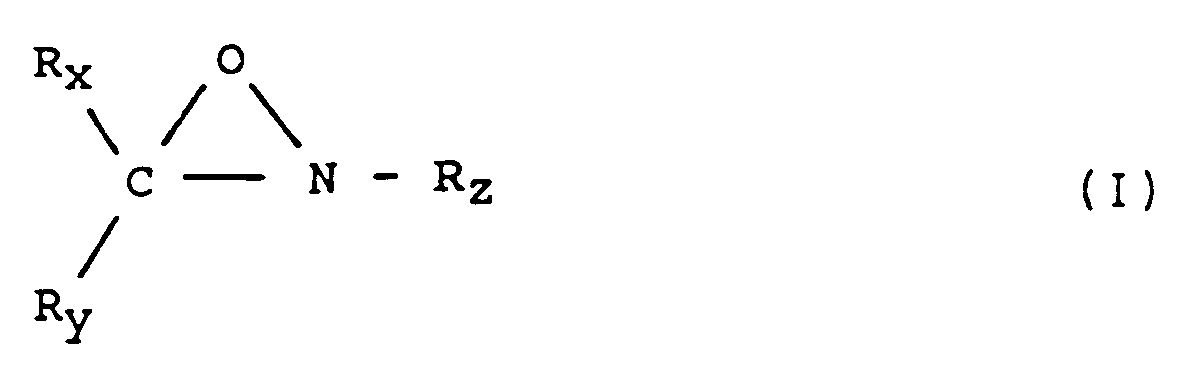
wherein:
Rx and Ry, like or different from each other, are F or a perfluoroalkyl group having 1 to 10 carbon atoms, Rz is a perfluoroalkyl group having 1 to 10 carbon atoms; in which a perfluoro-imine of formula:

where Rx, Ry and Rz are the same as defined hereinbefore, is reacted with a perfluoroalkyl-fluoroformyl peroxide RfOOC(O)F, Rf being a perfluoroalkyl group having 1 to 4 carbon atoms, in the presence of an alkali metal fluoride MF, at a temperature ranging from -40° to +50°C.
wherein:
Rx and Ry, like or different from each other, are F or a perfluoroalkyl group having 1 to 10 carbon atoms, Rz is a perfluoroalkyl group having 1 to 10 carbon atoms; in which a perfluoro-imine of formula:
where Rx, Ry and Rz are the same as defined hereinbefore, is reacted with a perfluoroalkyl-fluoroformyl peroxide RfOOC(O)F, Rf being a perfluoroalkyl group having 1 to 4 carbon atoms, in the presence of an alkali metal fluoride MF, at a temperature ranging from -40° to +50°C.
2. The process of claim 1, wherein the perfluoroalkyl-fluoroformyl peroxide is CF₃OOC(O)F.
3. The process of claim 1 or 2, wherein the MF fluoride is CsF.
4. Perfluoro-oxyaziridines prepared by the process described in one or more of the preceding
claims.