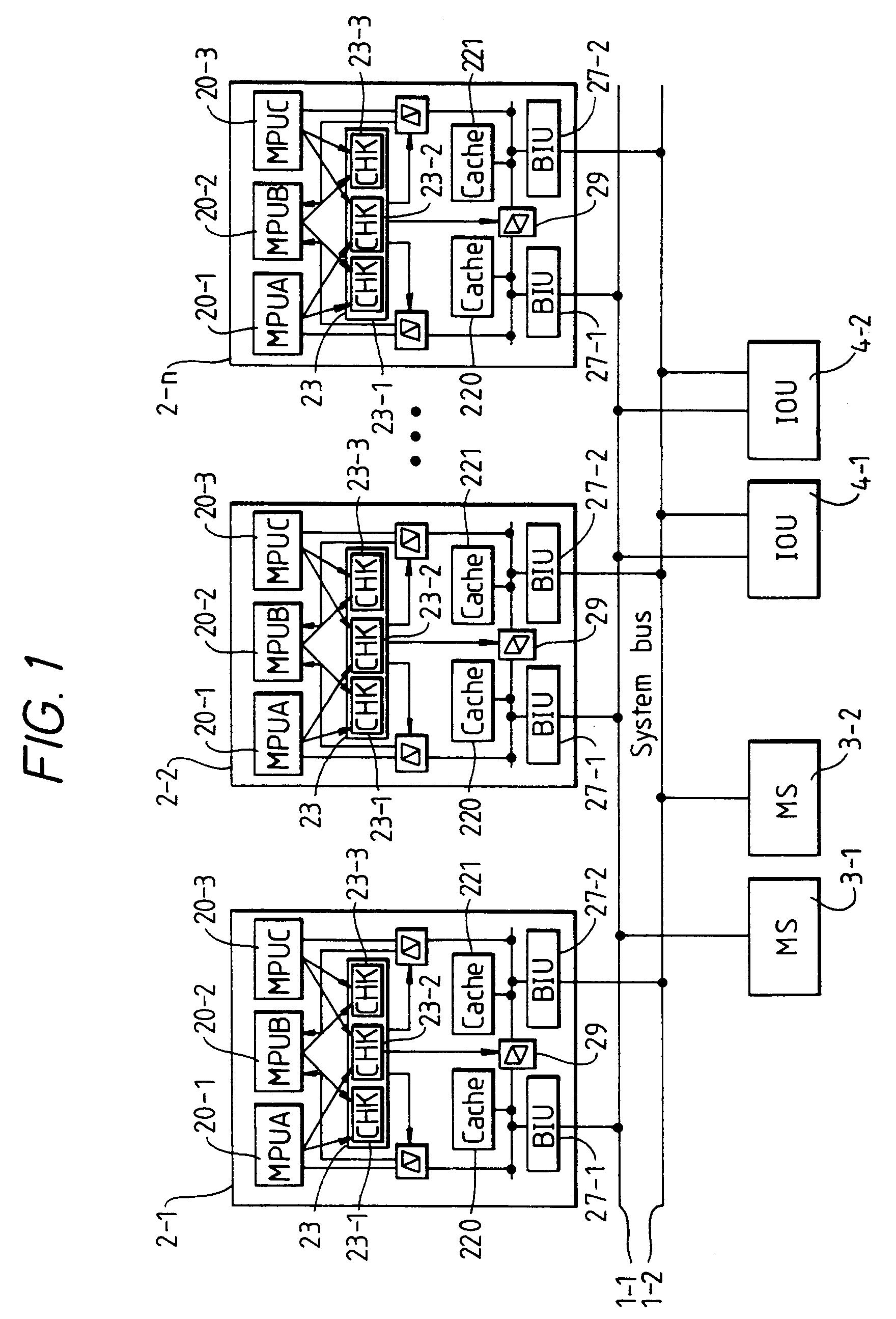
(57) A computer system has a plurality of processing units (2-1,2-2,2-n) connected via
one or more system buses (1-1,1-2). Each processing unit (2-1,2-2,2-n) has three or
more processors (20-1,20-2,20-3) on a common support board (PL) and controlled by
a common clock unit (1000). The three processors (20-1,20-2,20-3) perform the same
operation and a fault in a processor (20-1,20- 2,20-3) is detected by comparison of
the operations of the three processors (20-1,20-2,20-3). If one processor (20-1,20-2,20-3)
fails, the operation can continue in the other two processors (20-1,20-2,20-3) of
the processing unit (2-1,2-2,2-n), at least temporarily, before replacement of the
entire processing unit (2-1,2- 2,2-n). Furthermore, the processing unit (2-1,2-2,2-n)
may have a plurality of clocks (A,B) within the clock unit (1000), with a switching
arrangement so that the processors (20-1,20-2,20-n) normally receive clock pulses
from a main clock (A), but receive pulses from an auxiliary clock (B) if the main
clock (A) fails. Switching between the main and auxiliary clock (A,B) involves comparison
of the pulse duration from the clocks (A,B). Additionally, a plurality of cache memories
(220,221) may be connected in common to the processors (20-1,20-2,20-3), so that failure
of one cache memory (220,221) permits the processing unit (2-1,2-2,2-n) to continue
to operate using the other cache memory (220,221). Coherence of the contents of the
cache memories (220,221) may be achieved by direct comparison, and a comparison method
can also be used to invalidate data in an internal cache memory (2020- 1,2020-2,2020-3)
of a processor (20-1,20-2,20-3) which differs from that in the external cache memory
(220,221). Coherence of protocols may also ensure that data in caches (220,221) of
the different processor units (2-1,2-2,2-n) are always correct.
|
|
