| (19) |
 |
|
(11) |
EP 0 496 728 B1 |
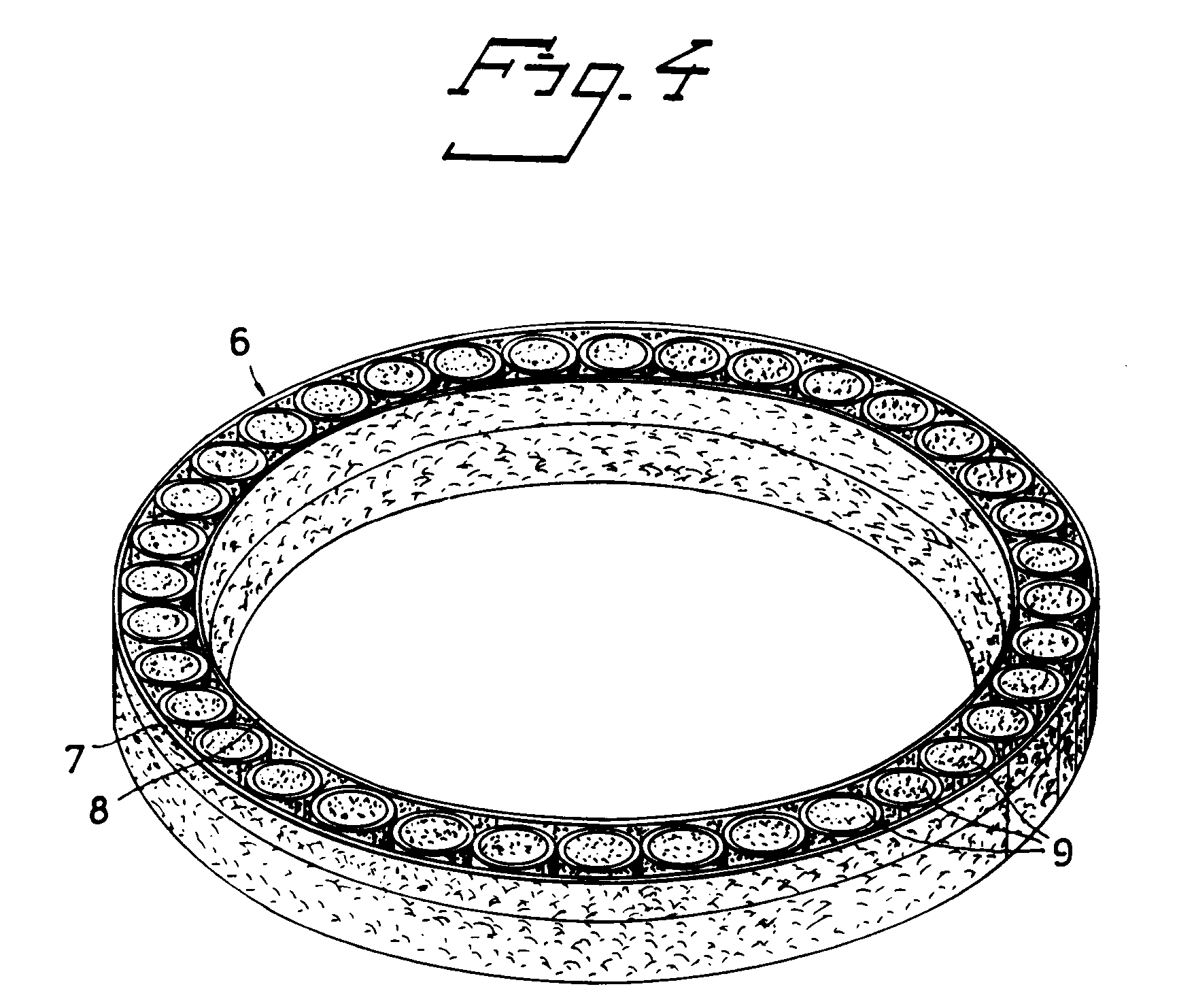
| (12) |
EUROPEAN PATENT SPECIFICATION |
| (45) |
Mention of the grant of the patent: |
|
20.09.1995 Bulletin 1995/38 |
| (22) |
Date of filing: 09.10.1989 |
|
| (51) |
International Patent Classification (IPC)6: G21F 9/24 |
| (86) |
International application number: |
|
PCT/SE8900/551 |
| (87) |
International publication number: |
|
WO 9105/351 (18.04.1991 Gazette 1991/09) |
|
| (54) |
AN ARRANGEMENT FOR THE STORAGE OF ENVIRONMENTALLY HAZARDOUS WASTE
ANORDNUNG ZUR LAGERUNG VON UMWELTSCHAEDLICHEN ABFALLSTOFFEN
AGENCEMENT POUR LE STOCKAGE DE DECHETS DANGEREUX POUR L'ENVIRONNEMENT
|
| (84) |
Designated Contracting States: |
|
DE FR GB IT NL |
| (43) |
Date of publication of application: |
|
05.08.1992 Bulletin 1992/32 |
| (73) |
Proprietor: HYDRO BETONG AB |
|
S-115 42 Stockholm (SE) |
|
| (72) |
Inventor: |
|
- GEORGII, Hans
London SW3 (GB)
|
| (74) |
Representative: Nyberg, Bengt |
|
CARMINGER, UUSITALO & NYBERG
Patentbyra AB
P.O. Box 7274
103 89 Stockholm
103 89 Stockholm (SE) |
|
| |
|
| Note: Within nine months from the publication of the mention of the grant of the European
patent, any person may give notice to the European Patent Office of opposition to
the European patent
granted. Notice of opposition shall be filed in a written reasoned statement. It shall
not be deemed to
have been filed until the opposition fee has been paid. (Art. 99(1) European Patent
Convention).
|
[0001] The present invention relates to an arrangement for the storage of environmentally
hazardous waste, and more particularly, but not exclusively, to an arrangement for
the storage of radioactive or chemical waste.
[0002] No-A-149499 discloses a tank for underwater storage of gaseous or liquid products,
such as natural gas or petroleum. This tank, which may be at least partially made
of concrete, is provided with a plurality of ballast chambers for receiving a heavy
ballast material, is neither intended nor suitable for long-term storage of hazardous
waste, such as radioactive waste.
[0003] The inventive arrangement is based on the offshore storage of waste of the aforesaid
nature, i.e. underwater storage at relatively great depths. The invention provides
several significant advantages over earlier proposed methods of storing such waste
on land, in rock cavities and like storage facilities. For instance, the inventive
offshore storage facility enables any leakages that may occur to be monitored and
remedied much more easily than is the case with known facilities. Furthermore, the
invention enables the use of considerably larger and heavier storage containers, each
of which can thus accommodate a larger quantity of waste and afford greater security
against the permeation of radiation from, e.g., radioactive waste.
[0004] The inventive arrangement is characterized by the characterizing features set forth
in the claims.
[0005] The invention will now be described in greater detail with reference to an exemplifying
embodiment thereof illustrated in the accompanying drawings, in which
Figure 1 illustrates in side view, partly in axial section, an inventive concrete
body which functions as a secondary capsule;
Figure 2 is an end view, partly in radial section, of the concrete body shown in Figure
1;
Figure 3 illustrates schematically, and in axial section, a primary waste-storage
capsule of appropriate conventional construction and intended to be placed in a secondary
capsule of the kind illustrated in Figures 1 and 2; and
Figure 4 illustrates schematically an annular concrete structure which is intended
to rest on the sea bed and which functions as a storage place for a plurality of secondary
capsules according to Figures 1 and 2.
[0006] Figures 1 and 2 illustrate an exemplifying embodiment of the basic element of the
inventive storage arrangement.
[0007] The basic element comprises a secondary capsule 1 which is intended to accommodate.and
to seal a primary capsule 2 of, for instance, the configuration illustrated in Figure
3, said primary capsule containing the environmentally hazardous waste, e.g. radioactive
or chemical waste, to be stored. The primary capsule 2 may be of any appropriate,
known design which will enable waste to be handled and transported from its place
of origin to the secondary capsule 1 without danger to the environment from said waste.
[0008] The secondary capsule 1 consists of a concrete cylinder which, in the case of the
illustrated embodiment has hemi-spherical ends. The illustrated concrete cylinder
has a central storage cavity 3, which in the case of the illustrated embodiment has
the form of a centrally located, axially extending hollow shaft which is open at one
end and into which the primary capsule 2 can be inserted in the manner illustrated
schematically in Figure 1. The open end of the shaft is plugged or likewise sealed
with concrete for example, subsequent to inserting the primary capsule into the shaft.
An advantage is afforded when the open end of the shaft is plugged in a manner which
will enable the plug to be removed readily at a later stage, e.g. by incorporating
fracture weakening or the like in the plug, therewith to to enable the primary capsule
to be removed.
[0009] The secondary capsule 1 is intended to be submerged permanently under water and to
this end is configured with a plurality of internal ballast chambers 4 distributed
circumferentially around the concrete cylinder. These chambers can be filled with
water to varying degrees and the total volume of the chambers is such as to enable
the secondary capsule 1, together with an inserted primary capsule 2, to float in
the water and to be brought to different attitudes therein, e.g. with the longitudinal
axis of the concrete cylinder extending vertically or horizontally. Consequently,
since it is possible to control the effective "weight" of the secondary capsule 1
and also its attitude in the water, the secondary capsule 1 can be made very large
and heavy without making it impossible to handle and move the capsule in water, such
handling and movement of the capsule being a necessary factor. Because of its large
dimensions and heavy weight, the secondary capsule 1 is able to accommodate a large
quantity of waste. The secondary capsule is also mechanically strong and is highly
insensitive to external influences. Furthermore, the secondary capsule will dampen
significantly any radiation which may emanate from radioactive waste enclosed in the
primary capsule for instance. A secondary capsule of the design illustrated by way
of example in Figures 1 and 2 may, for instance, have an axial length of 40 m and
a diameter of 16 m and a displacement of about 10000 tonnes. Naturally, the secondary
capsule may have larger or smaller dimensions than those recited above.
[0010] When the secondary capsule 1 is intended for the storage of heat-emitting waste,
the capsule may, advantageously, be provided with inner cooling channels 5 which extend
axially in the concrete cylinder, with the channel orifices opening in the outer surface
of the cylinder, as in the case of the embodiment illustrated in Figures 1 and 2.
These cooling channels 5 are preferably located as close as possible to the storage
cavity 3 and therewith the primary capsule 2. When the secondary capsule 1 is stored
under water with the capsule axis substantially vertical, autocirculation of the water
in the channels 5 will take place in the direction of the arrows shown, due to heating
of the water present in said channels by the heat emitted from the waste in the primary
capsule 2, therewith cooling the capsule.
[0011] The secondary capsule 1 can be transported in the water, for instance from a harbor
to its ultimate storage location, in several different ways. The most natural method
of transportation is to use tug boats of more or less conventional design. Another
possible method resides in the use of special-duty vessels, possibly submersibles,
which are coupled directly to the secondary capsule 1. A further possible method of
transportation is to equip the secondary capsule 1 with a detachable unit comprising
the pumps and control apparatus required for varying and regulating the volume of
water in the ballast chambers 4 and also with power generating devices, for instance
in the form of water-jet propulsion motors, for movement of the secondary capsule
in water.
[0012] The inventive secondary capsule can be manufactured in a dry dock or some corresponding
facility, although the capsule may, advantageously, be manufactured directly in the
water in accordance with the manufacturing principle described in US Patent Specification
US-A-3,249,664.
[0013] The ultimate storage of the secondary capsules 1 enclosing waste-containing primary
capsules 2 can be effected, advantageously, in an annular concrete construction resting
on the sea bottom and being of the kind illustrated schematically by way of example
in Figure 4. This annular concrete structure comprises a single, coherent rigid unit
and in the case of the illustrated embodiment has an outer cylindrical wall 7 and
an inner cylindrical wall 8. Extending between the outer and inner walls 7,8 is a
large number of cylindrical compartments 9 which are open at least at their upper
ends, preferably at both ends, and which are firmly connected together and to the
outer and inner walls 7,8 of the annulus. The cylindrical compartments 9 are so dimensioned
that each compartment is able to accommodate a secondary capsule 1 of the aforedescribed
kind. Storage of the secondary capsules 1 in the concrete annulus 6 can be likened
to the storage of eggs in an egg carton. The concrete annulus 6 holds the secondary
capsules safely in position and protects the capsules against external influences.
The concrete annulus 6 incorporates in its cylindrical walls 7 and 8 and also in the
walls of the cylindrical storage compartments 9 a large number of ballast chambers
which can be filled with water to varying degrees and which together have a total
volume such as to enable the concrete annulus 6 as a whole to be brought to a boyant
state in the water, by emptying the ballast chambers. Thus, the concrete annulus 6
can be manufactured in a place of manufacture, advantageously by means of the method
described in US-A-3,249,664, and then towed to the intended waste-storage site and
there submerged onto the sea bed, for instance at a location where the depth of water
is some hundred meters.
[0014] Naturally, a concrete construction for the storage of a large number of secondary
capsules 1 on the sea bed need not necessarily have an annular configuration similar
to the aforedescribed annulus illustrated in Figure 4. The concrete construction may
alternatively have a rectangular configuration which incorporates cylindrical storage
compartments for secondary capsules 1 over the whole of its area. In such cases, the
egg-carton-like concrete structure will also include ballast chambers capable of being
filled with water to varying degrees and enabling the whole of the concrete construction
to be brought to a buoyant state. Concrete structures of other configurations are
also possible of course.
[0015] The primary capsules which accommodate the waste-containing secondary capsules can
also be stored on the sea bed within an offshore complex of the kind described in
Swedish Patent Specification SE-A-447 141. In this case, the secondary capsules will
preferably be somewhat smaller than the secondary capsules aforedescribed, for instance
capsules having a displacement of about 2000 tonnes.
[0016] An advantage is afforded when the secondary capsules are trimmed with the aid of
the ballast chambers in a manner such that the capsules will automatically take a
position with the axis extending vertically in the water. This is advantageous from
a cooling aspect, should a capsule unintentionally or accidentally come loose on the
sea bottom.
[0017] The invention affords many significant advantages. The storage of environmentally
hazardous waste, particularly radioactive waste, in deep waters is in itself an advantage.
Another advantage is that very large secondary capsules can be used, thus enabling
a large quantity of waste material to be stored. Such capsules also have significant
mechanical strength and resistance to external influences. Furthermore, the capsules
provide a highly effective screen against radioactive radiation for instance. A waste-storage
arrangement constructed in accordance with the invention can be readily monitored
with respect to possible leakage of waste material or radiation. When a leak is detected,
the secondary capsule responsible for the leak can be readily taken to the surface
for closer inspection and subsequent remedial action. This remedial action may consist
in either replacing the secondary capsule or primary capsule, depending on whether
the leakage is caused by a fault in the secondary capsule or in the primary capsule,
whereafter the serviced secondary capsule with the primary capsule inserted therein
can be returned to the storage location on the sea bed.
1. An arrangement for the storage of environmentally hazardous waste under water, particularly
radioactive or chemical waste, which arrangement includes at least one substantially
cylindrical concrete body (1) provided with a central storage cavity (3) for accommodating
and enclosing waste, and a plurality of ballast chambers (4) which are located in
the vicinity of the cylindrical surface of said body and distributed around the circumference
thereof and which can be filled to varying degrees with water and the total volume
of which is such as to enable the body to be brought to a water-buoyant state by emptying
said ballast chambers, characterized in that the concrete body (1) is provided with
a plurality of inner cooling channels (5) which extend substantially in an axial direction
in spaced relationship around the circumference of said body and the respective ends
of which channels open in the outer surface of the concrete body.
2. An arrangement according to Claim 1, characterized in that the cooling channels (5)
are located between the ballast chambers (4) and the storage cavity (3).
3. An arrangement according to Claim 1 or 2 characterized in that the storage cavity
(3) has the form of a hollow shaft which is open at one end and which extends axially
and centrally in the concrete body (1); said shaft being intended to receive a waste-containing
capsule (2) and thereafter to be sealed at its open end.
4. An arrangement according to any one of Claims 1-3, characterized in that the two ends
of the concrete body (1) are substantially hemispherical in shape.
5. An arrangement according to any one of Claims 1-4, characterized in that the concrete
body (1) is provided with a water-jet propulsion unit for movement of the body in
water.
6. An arrangement according to any one of Claims 1-5, characterized in that the concrete
body (1) is provided with pump means for varying the volume of water in the ballast
chambers (4).
7. An arrangement according to Claim 5 or Claim 6, characterized in that the water-jet
propulsion unit and/or the pump means comprise a unit which can be detachably fitted
to the concrete body (1).
8. An arrangement according to any one of Claims 1-7, characterized in that the arrangement
further comprises a rigid, single-piece coherent concrete structure (6) having a substantially
greater cross-sectional area than height and which is intended to rest on the sea
bed and includes a large number of mutually adjacent cylindrical storage spaces (9)
which are open at least at their upper ends and each of which is formed to receive
a concrete body (1) of the aforesaid kind; and in that the walls of the concrete structure
(6) contain a plurality of ballast chambers which can be filled to varying degrees
with water and which together have a total volume such as to enable the concrete structure
(6) to be brought to a buoyant state in water by emptying the ballast chambers.
9. An arrangement for the storage of environmentally hazardous waste under water, particularly
radioactive or chemical waste, which arrangement includes at least one substantially
cylindrical concrete body (1) provided with a central storage cavity (3) for accommodating
and enclosing waste, and a plurality of ballast chambers (4) which are located in
the vicinity of the cylindrical surface of said body and distributed around the circumference
thereof and which can be filled to varying degrees with water and the total volume
of which is such as to enable the body to be brought to a water-buoyant state by emptying
said ballast chambers, characterized in that the arrangement further comprises a rigid,
single-piece coherent concrete structure (6) having a substantially greater cross-sectional
area than height and which is intended to rest on the sea bed and includes a large
number of mutually adjacent cylindrical storage spaces (9) which are open at least
at their upper ends and each of which is formed to receive a concrete body (1) of
the aforesaid kind; and in that the walls of the concrete structure (6) contain a
plurality of ballast chambers which can be filled to varying degrees with water and
which together have a total volume such as to enable the concrete structure (6) to
be brought to a buoyant state in water by emptying the ballast chambers.
10. An arrangement according to Claim 8 or 9, characterized in that the concrete structure
(6) has an annular configuration.
11. An arrangement according to Claim 8 or 9, characterized in that the concrete structure
has the form of a polygonal slab containing said storage spaces.
1. Anordnung zur Speicherung von umweltschädlichem Abfall unter Wasser, insbesondere
radioaktivem oder chemischem Abfall, mit mindestens einem im wesentlichen zylindrischen
Betonkörper (1), der mit einem zentralen Speicherraum (3) zur Aufnahme und zum Umschließen
des Abfalls versehen ist, und einer Vielzahl von Ballastkammern (4), die in der Nachbarschaft
der zylindrischen Fläche des Körpers angeordnet sind, um den Umfang des Körpers verteilt
sind und auf unterschiedliche Niveaus mit Wasser gefüllt werden können, wobei das
Gesamtvolumen der Ballastkammern derart bemessen ist, daß der Körper durch Entleeren
der Ballastkammern in einen schwimmfähigen Zustand auf dem Wasser gebracht werden
kann, dadurch gekennzeichnet, daß der Betonkörper (1) mit einer Vielzahl von inneren
Kühlkanälen (5) versehen ist, die sich im wesentlichen in einer axialen Richtung im
beabstandeten Zustand um den Umfang des Körpers erstrecken, wobei die entsprechenden
Enden der Kanäle in die Außenfläche des Betonkörpers münden.
2. Anordnung nach Anspruch 1, dadurch gekennzeichnet, daß die Kühlkanäle (5) zwischen
den Ballastkammern (4) und dem Speicherraum (3) angeordnet sind.
3. Anordnung nach Anspruch 1 oder 2, dadurch gekennzeichnet, daß der Speicherraum (3)
die Form eines hohlen Schaftes besitzt, der an einem Ende offen ist und sich axial
und mittig im Betonkörper (1) erstreckt, wobei dieser Schaft eine Abfall enthaltende
Kapsel (2) aufnehmen und danach an seinem offenen Ende abgedichtet werden kann.
4. Anordnung nach einem der Ansprüche 1 bis 3, dadurch gekennzeichnet, daß die beiden
Enden des Betonkörpers (1) im wesentlichen halbkugelförmig ausgebildet sind.
5. Anordnung nach einem der Ansprüche 1 bis 4, dadurch gekennzeichnet, daß der Betonkörper
(1) mit einer Wasserstrahlantriebseinheit zur Bewegung des Körpers im Wasser versehen
ist.
6. Anordnung nach einem der Ansprüche 1 bis 5, dadurch gekennzeichnet, daß der Betonkörper
(1) mit Pumpeinrichtungen zum Verändern des Wasservolumens in den Ballastkammern (4)
versehen ist.
7. Anordnung nach Anspruch 5 oder 6, dadurch gekennzeichnet, daß die Wasserstrahlantriebseinheit
und/oder die Pumpeinrichtungen eine Einheit umfassen, die lösbar am Betonkörper (1)
befestigt werden kann.
8. Anordnung nach einem der Ansprüche 1 bis 7, dadurch gekennzeichnet, daß sie des weiteren
eine starre, einstückige und kohärente Betonkonstruktion (6) aufweist, die einen wesentlich
größeren Querschnittsbereich als ihre Höhe besitzt und dazu dient, auf dem Wasser
zu ruhen, sowie eine große Zahl von benachbarten zylindrischen Speicherräumen (9)
umfaßt, die mindestens an ihren oberen Enden offen und jeweils so ausgebildet sind,
daß sie einen Betonkörper (1) der vorstehend beschriebenen Art aufnehmen, und daß
die Wände der Betonkonstruktion (6) eine Vielzahl von Ballastkammern enthalten, die
auf unterschiedliche Niveaus mit Wasser gefüllt werden können und zusammen ein solches
Gesamtvolumen besitzen, daß die Betonkonstruktion (6) durch Entleeren der Ballastkammern
in einen im Wasser schwimmfähigen Zustand gebracht werden kann.
9. Anordnung zur Speicherung von umweltschädlichem Abfall unter Wasser, insbesondere
radioaktivem oder chemischem Abfall, mit mindestens einem im wesentlichen zylindrischen
Betonkörper (1), der mit einem zentralen Speicherraum (3) zur Aufnahme und zum Umschließen
von Abfall versehen ist, und einer Vielzahl von Ballastkammern (4), die in der Nachbarschaft
der zylindrischen Fläche des Körpers angeordnet sind, um dessen Umfang verteilt sind
und auf unterschiedliche Niveaus mit Wasser gefüllt werden können, wobei das Gesamtvolumen
der Ballastkammern derart bemessen ist, daß der Körper durch Entleeren der Ballastkammern
in einen schwimmfähigen Zustand im Wasser gebracht werden kann, dadurch gekennzeichnet,
daß die Anordnung des weiteren eine starre, einstückige und kohärente Betonkonstruktion
(6) aufweist, die einen wesentlich größeren Querschnittsbereich als ihre Höhe besitzt,
die dazu dient, auf dem Wasser zu ruhen, und die eine große Zahl von benachbarten
zylindrischen Speicherräumen (9) aufweist, die zumindest an ihren oberen Enden offen
und jeweils so ausgebildet sind, daß sie einen Betonkörper (1) der vorstehend beschriebenen
Art aufnehmen, und daß die Wände der Betonkonstruktion (6) eine Vielzahl von Ballastkammern
enthalten, die auf unterschiedliche Niveaus mit Wasser gefüllt werden können und zusammen
ein solches Gesamtvolumen besitzen, daß die Betonkonstruktion (6) durch Entleeren
der Ballastkammern in einen im Wasser schwimmfähigen Zustand gebracht werden kann.
10. Anordnung nach Anspruch 8 oder 9, dadurch gekennzeichnet, daß die Betonkonstruktion
(6) eine ringförmige Gestalt besitzt.
11. Anordnung nach Anspruch 8 oder 9, dadurch gekennzeichnet, daß die Betonkonstruktion
die Form einer polygonalen Platte besitzt, die die Speicherräume enthält.
1. Un dispositif pour le stockage sous eau de déchets dangereux pour l'environnement,
en particulier de déchets radioactifs ou chimiques, ledit dispositif comprenant au
moins une coque de béton pratiquement cylindrique (1) munie d'une cavité de stockage
centrale (3) pour recevoir et enfermer des déchets, et une pluralité de ballasts (4)
qui sont placés au voisinage de la surface cylindrique de la coque et répartis autour
de la circonférence de cette dernière, qui peuvent être remplis d'eau à des degrés
variables et dont le volume total permet d'amener la coque à un état flottant dans
l'eau en vidant les ballasts,
caractérisé en ce que la coque de béton (1) est munie d'une pluralité de canaux de
refroidissement intérieurs (5) dont le sens est pratiquement axial et qui sont espacés
autour de la circonférence de la coque, les extrémités respectives de ces canaux communiquant
avec la surface extérieure de la coque de béton.
2. Un dispositif selon la Revendication 1, caractérisé en ce que les canaux de refroidissement
(5) sont placés entre les ballasts (4) et la cavité de stockage (3).
3. Un dispositif selon la Revendication 1 ou 2, caractérisé en ce que la cavité de stockage
(3) a la forme d'un arbre creux qui est ouvert à une extrémité et qui est situé centralement
dans le sens axial dans la coque de béton (1) ; ledit arbre étant destiné à recevoir
une capsule (2) contenant des déchets, puis à être hermétiquement fermée à son extrémité
ouverte.
4. Un dispositif selon l'une ou l'autre des Revendications 1 à 3, caractérisé en ce que
les deux extrémités de la coque de béton (1) ont une forme pratiquement hémisphérique.
5. Un dispositif selon l'une ou l'autre des Revendications 1 à 4, caractérisé en ce que
la coque de béton (1) est équipée d'une unité de propulsion à hydrolance pour le déplacement
de la coque dans l'eau.
6. Un dispositif selon l'une ou l'autre des Revendications 1 à 5, caractérisé en ce que
la coque de béton (1) est équipée d'un moyen de pompage pour faire varier le volume
d'eau dans les ballasts (4).
7. Un dispositif selon la Revendication 5 ou la Revendication 6, caractérisé en ce que
l'unité de propulsion à hydrolance et/ou le moyen de pompage constituent une unité
qui peut être fixée de façon amovible à la coque de béton (1).
8. Un dispositif selon l'une ou l'autre des Revendications 1 à 7, caractérisé en ce que
le dispositif comprend en outre une structure de béton cohérente d'une seule pièce
(6) dont la section transversale est nettement supérieure à sa hauteur, qui est destinée
à reposer sur le fond de la mer et qui comporte un grand nombre d'espaces de stockage
cylindriques adjacents entre eux (9) qui sont ouverts au moins à leur extrémité supérieure
et dont chacun est formé pour recevoir une coque de béton (1) du type décrit plus
haut ; et en ce que les parois de la structure de béton (6) contiennent une pluralité
de ballasts qui peuvent être remplis d'eau à des degrés variables et dont le volume
total permet d'amener la structure de béton (6) à un état flottant dans l'eau en vidant
les ballasts.
9. Un dispositif pour le stockage sous eau de déchets dangereux pour l'environnement,
en particulier de déchets radioactifs ou chimiques, ledit dispositif comprenant au
moins une coque de béton pratiquement cylindrique (1) munie d'une cavité de stockage
centrale (3) pour recevoir et enfermer des déchets, et une pluralité de ballasts (4)
qui sont placés au voisinage de la surface cylindrique de la coque et répartis autour
de la circonférence de cette dernière, qui peuvent être remplis d'eau à des degrés
variables et dont le volume total permet d'amener la coque à un état flottant dans
l'eau en vidant les ballasts,
caractérisé en ce que le dispositif comprend en outre une structure de béton cohérente
d'une seule pièce (6) dont la section transversale est nettement supérieure à sa hauteur,
qui est destinée à reposer sur le fond de la mer et qui comporte un grand nombre d'espaces
de stockage cylindriques adjacents entre eux (9) qui sont ouverts au moins à leur
extrémité supérieure et dont chacun est formé pour recevoir une coque de béton (1)
du type décrit plus haut ; et en ce que les parois de la structure de béton (6) contiennent
une pluralité de ballasts qui peuvent être remplis d'eau à des degrés variables et
dont le volume total permet d'amener la structure de béton (6) à un état flottant
dans l'eau en vidant les ballasts.
10. Un dispositif selon la Revendication 8 ou 9, caractérisé en ce que la structure de
béton (6) a une configuration annulaire.
11. Un dispositif selon la Revendication 8 ou 9, caractérisé en ce que la structure de
béton a la forme d'une dalle polygonale contenant lesdits espaces de stockage.