|
(11) | EP 0 497 001 B1 |

| (12) | EUROPEAN PATENT SPECIFICATION |
|
|
| (54) |
Oxidized-type glutathione alkyl ester Alkylester von oxidiertem Glutathion Ester alkylique de glutathion de type oxydé |
|
|
|||||||||||||||||||||||||||||||
| Note: Within nine months from the publication of the mention of the grant of the European patent, any person may give notice to the European Patent Office of opposition to the European patent granted. Notice of opposition shall be filed in a written reasoned statement. It shall not be deemed to have been filed until the opposition fee has been paid. (Art. 99(1) European Patent Convention). |
BACKGROUND OF THE INVENTION
[0001] The present invention relates to a novel oxidized-type glutathione derivative, more specifically to an oxidized-type glutathione alkyl ester and a pharmaceutically acceptable salt thereof, a method of preparation thereof as well as a pharmaceutical composition containing one of them as an active constituent for suppression of disorders in the liver.
[0002] It is known that glutathione alkyl esters (reduced-type) are superior to glutathione in transferability into living bodies, for example to the liver and the kidney, and that they undergo hydrolysis to form glutathione after transferred.
[0003] Glutathione monoesters (reduced-type) have been described in Japanese Unexamined Patent Publication No. 15870/1986, whereas no description has been given about an oxidized-type glutathione alkyl ester, a method of preparation thereof or a use thereof.
[0004] JP 62-221 698 describes reduced glutathione derivatives of the formula
wherein R1 to R4 and Y are selected from different meanings, useful in the treatment of hepatic diseases. These compounds are prepared from oxidized glutathione of the general formula
SUMMARY OF THE INVENTION
[0005] The inventors have made a study to find a glutathione derivative which has a satisfactory absorbability to tissues as well as a sufficient stability. As a result, the inventors have found that oxidized-type glutathione alkyl esters with an excellent stability are obtained by oxidation of glutathione monoalkyl esters by a simple method, i.e., oxidation with the air, hydrogen peroxide or iodine and that these compounds have an excellent pharmaceutical activity. And the studies have been further accumulated to finally accomplish the present invention.
DETAILED DISCUSSION
[0006] Therefore, the present invention relates to an oxidized-type glutathione alkyl ester represented by the formula (I) below,
Therein R denotes a C1-10 alkyl group, or a pharmaceutically acceptable salt thereof, a method of preparation thereof and a pharmaceutical composition containing them for suppression of disorders in the liver.
[0007] Any of straight, branched or cyclic C1-10 alkyl groups may be preferably selected as said C1-10 alkyl groups, and an alkyl group composed of their combination may be preferably used likewise.
[0008] Examples of the particularly preferred lower alkyl groups include, methyl, ethyl, n-propyl, isopropyl, cyclopropyl, n-butyl, t-butyl, sec-butyl, n-pentyl, 1-ethylpropyl, isopentyl, benzyl and the like.
[0010] First, in alcohol and under the presence of an acid, glutathione is converted into an acidic salt of a glutathione monoester represented by the formula (II),
This is then neutralized with an alkali, and to the thus obtained neutral aqueous solution, the air is introduced or hydrogen peroxide or iodine in alcohol is added dropwise while stirring so as to oxidize the glutathione monoester. Herein, the acidic salt of the glutathione monoester may be, for example, a hydrochloride, sulfate or p-toluenesulfonate, although the scope of it is not restricted by these. Above reactions may be easily attained by simple procedures, and the reaction mixture solution thus obtained may then be chromatographed for purification or recrystallized to give the aimed compound.
[0011] The compound of the present invention has an activity to suppress the elevation of the levels of GOT, GPT, etc. and efficiently restrains the onset of acute or chronic hepatic disorders. Thus, it may be used for the prophylaxis against and treatment of acute or chronic hepatitis. Moreover, it may also be used advantageously in other disorders in the liver induced by drugs such as acetaminophen. In addition, it is also expected that it may be used for the prevention of the progress and the treatment of cataract.
[0012] The compound of the present invention may be appropriately used through an oral or parenteral route. The pharmaceutical composition may be prepared in the form of, for example, tablets, granules, powder or capsules, a liquid preparation such as an injection or eye-drops, or any other form by a known method according to the type and the site of the disorder.
[0013] For these preparations, ingredients usually incorporated may suitably be used, which include binders, disintegrators, thickeners, dispersing agents, resorption accelerators, flavoring agents, buffering agents, surfactants, solubilizers, preservatives, emulsifiers, isotonizers, stabilizers and pH adjusting agents.
[0014] A suitable dose of the active constituent in general may be, for example, in the range of approximately 1-1000 mg/day for an adult human in the case of injection, and in the range of approximately 10-2000 mg/dosage with several administrations/day for an adult human in the case of oral administration, although it may vary in accordance with the type and severity of the disorder, the age and body weight of the patient, the specific form of the preparation and the like.
[0015] The pharmaceutical composition for suppression of hepatic disorders containing as an active constituent the compound of the present invention may contain one of the compounds of the present invention or two or more of them in proper combination, and may also contain other proper constituents having the same or different pharmaceutical activities insofar as they will not hinder the purpose of the present invention.
Examples
Example 1 γ-L-glutamyl-L-cysteinylglycine isopropyl ester disulfide (oxidized-type glutathione isopropyl ester)
(Method A)
[0017] 10 g of γ-L-glutamyl-L-cysteinylglycine isopropyl ester sulfate (GSH isopropyl ester sulfate) is suspended in 200 ml of water. The suspension is then neutralized by a gradual addition of 3.0 g of calcium carbonate. Thus, GSH isopropyl ester is freed and dissolved, while calcium sulfate precipitates. The mixture is then filtered, and to the filtrate is added dropwise 14 ml of 5 % hydrogen peroxide while cooling. After stirring for 3 hours, the reaction mixture is concentrated in vacuo at a temperature not higher than 40 °C. To the concentrate is added acetonitrile, and the precipitated crystals are collected by filtration to give 6 g of crude crystals.
[0018] The crude crystals are purified by column chromatography (column; YMC ODS 120A S-50, eluant; acetonitrile/water = 1/4), and the solvent is evaporated in vacuo from the obtained fraction. The residue is crystallized by an addition of acetonitrile, and recrystallized from water-acetonitrile to give 2.5 g of colorless amorphous crystals.
[0019] TLC (silica gel): Rf = 0.26 (n-butanol/acetic acid/water = 4/1/1)
| Elemental analysis : For C26H44O12N6S2·2H2O | |||
| Calculated(%): | C; 42.61, | H; 6.60, | N; 11.47 |
| Found (%) : | C; 42.84, | H; 6.50, | N; 11.52 |
(Method B)
[0020] A solution of GSH isopropyl ester is obtained analogously to Method A using 10 g of GSH isopropyl ester sulfate. To this is added dropwise a 2 w/v % iodine solution in methanol at room temperature until the reacting mixture solution turns pale yellow. The mixture is stirred for further 2 hours at 40 °C and then neutralized with calcium carbonate. The precipitated inorganic crystals are removed by filtration, and the filtrate is concentrated in vacuo. To the concentrate is added acetonitrile, and the precipitated crystals are collected by filtration to give 5 g of crude crystals. Then the crystals are purified by column chromatography analogously to Method A to give 1.9 g of the purified product.
(Method C)
[0021] A solution of GSH isopropyl ester obtained analogously to Method A using 10 g of GSH isopropyl ester sulfate is vigorously stirred for 24 hours at room temperature while introducing the air. The mixture is then treated analogously to Method A to give 2.3 g of purified product.
Example 2 γ-L-glutamyl-L-cysteinylglycine ethyl ester disulfide (oxidized-type glutathione ethyl ester)
[0022] Analogously to Method A in Example 1, 10 g of γ-L-glutamyl-L-cysteinylglycine ethyl ester hydrochloride and 3.0 g of calcium carbonate are used, and oxidation is performed with 5 % hydrogen peroxide. Analogous combination of a column (YMC DDS 120A S-50) and an eluant (acetonitrile/water = 7/43) are used for separation. The crystals obtained are recrystallized from water-acetonitrile to give 1.5 g of colorless amorphous crystals.
[0023] TLC (silica gel): Rf = 0.16 (n-butanol/acetic acid/water = 4/1/1)
| Elemental analysis: For C24H40O12N6S2·2H2O | |||
| Calculated (%): | C; 40.90, | H; 6.29, | N; 11.92 |
| Found (%): | C; 40.62, | H; 6.41, | N; 11.61 |
Pharmacological test
[0024] (Method) Male Wistar rats with a body weight of about 180 g were fasted for 24 hours and orally administered, through a cannula for oral administration, 87-349 mg of oxidized-type glutathione isopropyl ester (hereinafter also referred to as "GSSG isopropyl"), which is one of the compounds of the present invention, 102 mg of reduced-type glutathione isopropyl ester 1/2 H2SO4·1/2 H2O (87 mg as reduced-type glutathione isopropyl ester (hereinafter also referred to as "GSH isopropyl")) or 5 % gum arabic solution as a control, respectively. 1 hour later, 400 mg/kg of acetaminophen, a compound which may induce disorders in the liver, was intra-peritoneally administered. 24 hours later, the rats were anesthetized with pentobarbital and the blood was collected from the abdominal aorta, and s-GOT and s-GPT were measured to compare the hepatic disorder suppressing effect of GSSG isopropyl with that of GSH isopropyl. (Results) As a result, it was demonstrated that the elevation of s-GOT and s-GPT is significantly suppressed dose-dependently by the administration of 87-349 mg/kg of GSSG isopropyl as shown in Table 1. It was also demonstrated that the administration of 102 mg/kg of GSH isopropyl sulfate significantly suppresses the elevation of s-GOT and s-GPT, and that the administration of 87 mg/kg of GSSG isopropyl exhibits a hepatic disorder suppressing effect which is almost equivalent to that exhibited by the administration of 102 mg/kg of GSH isopropyl sulfate.
Table 1 Suppressive effect of GSSG isopropyl and GSH isopropyl on acetaminophen-induced liver disorder in the rat.
| Test compound | Dose (mg/kg) | s-GOT (IU/l) | s-GPT (IU/l) |
| 5% gum arabic | - | 8632±2397 | 4505±1283 |
| GSSG isopropyl | 87[0.125] | 430±236*1 | 231±152*1 |
| (95.0) | (94.9) | ||
| GSSG isopropyl | 174[0.25] | 352±104*1 | 154± 46*1 |
| (95.9) | (96.6) | ||
| GSSG isopropyl | 349[0.5] | 119± 11*2 | 39± 3*1 |
| (98.6) | (99.1) | ||
| GSH isopropyl Sulfate | 102[0.25] | 475±156*1 | 253± 97*1 |
| (94.5) | (94.4) |
Composition example 1 Oral tablets
[0026]
| oxidized-type glutathione isopropyl ester | 100 mg |
| lactose | 80 mg |
| starch | 17 mg |
| magnesium stearate | 3 mg |
[0027] The above ingredients are formed into tablet by a conventional method. Sugar coating may optionally be made.
Composition example 2 Injection
[0028]
| oxidized-type glutathione isopropyl ester | 1.0 g |
| sodium chloride | 0.7 g |
| distilled water for injection | 100 ml |
[0029] The above ingredients are admixed and sterilized by filtration. 2 ml each of the filtrate is aseptically filled in a glass vial, and the vial then is sealed by heat to form an injection.
Composition example 3 Eye-drops
Claims for the following Contracting State(s): AT, BE, CH, LI, DE, DK, FR, GB, IT,
LU, NL, SE, MC
1. An oxidized-type glutathione alkyl ester represented by the formula (I),
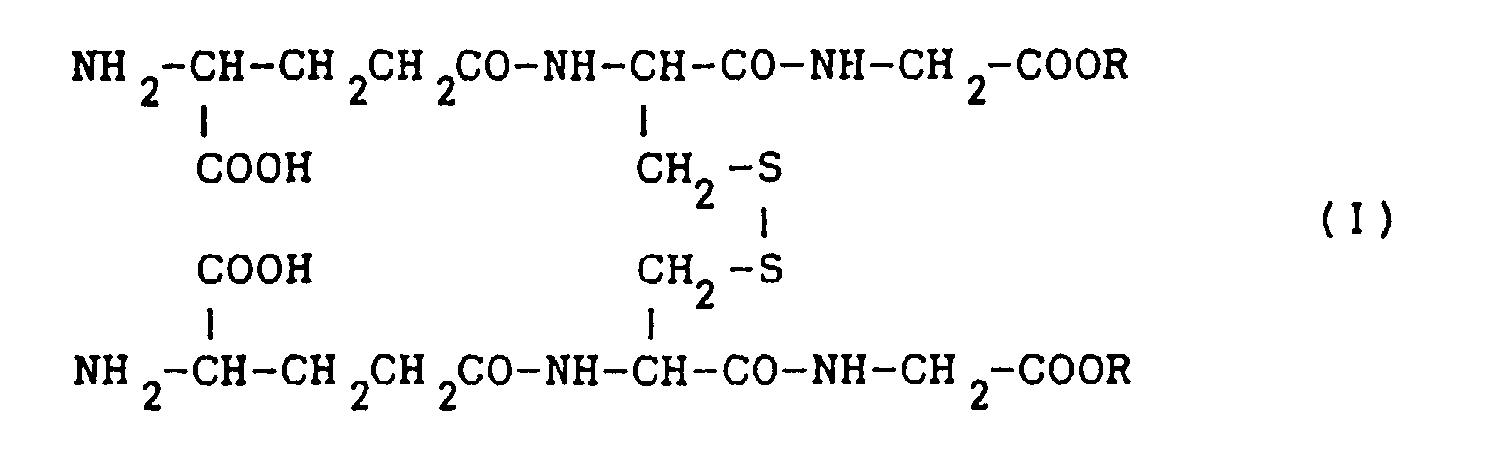
wherein R denotes a C1-10 alkyl group, or a pharmaceutically acceptable salt thereof.
wherein R denotes a C1-10 alkyl group, or a pharmaceutically acceptable salt thereof.
2. A pharmaceutical composition comprising in admixture with a pharmaceutically acceptable
carrier an oxidized-type glutathione alkyl ester represented by the formula (I),
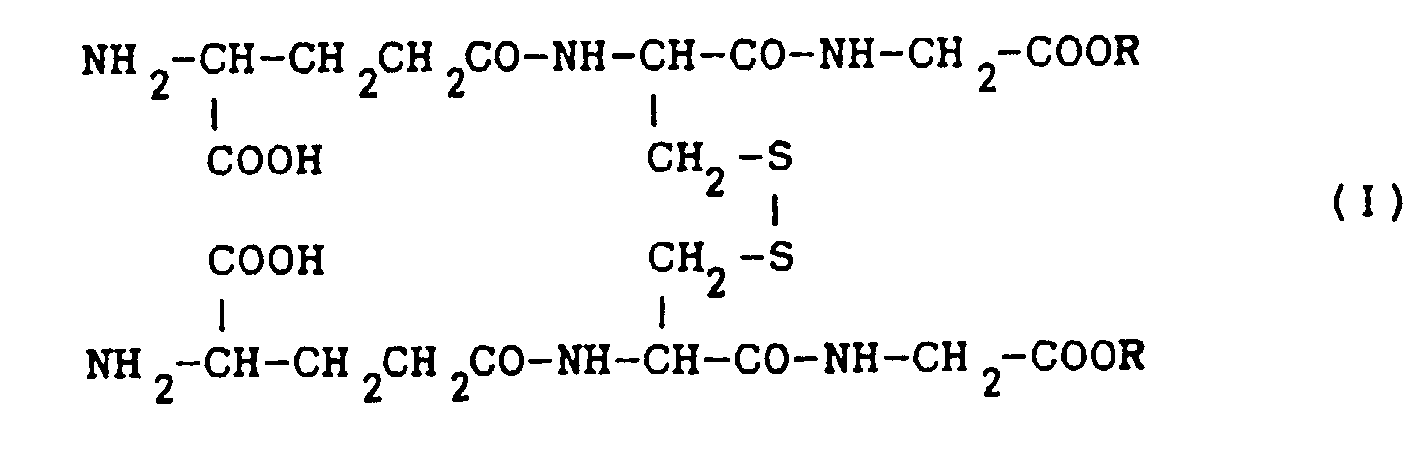
wherein R denotes a C1-10 alkyl group, or a pharmaceutically acceptable salt thereof.
wherein R denotes a C1-10 alkyl group, or a pharmaceutically acceptable salt thereof.
3. The pharmaceutical composition of Claim 2 which is in the form of tablets, granules,
powder, capsules or injection.
4. A process for preparing the pharmaceutical compositions of claims 2 and 3 which comprises
incorporating at least one oxydized-type glutathione alkyl ester of formula I as defined
in claim 1 or a pharmaceutically acceptable salt thereof into a suitable pharmaceutically
acceptable carrier.
5. The use of at least one oxydized-type glutathione alkyl ester of formula I as defined
in claim 1 for preparing a pharmaceutical composition for the treatment of or prophylaxis
against acute or chronic disorders of the liver of a human or animal.
Claims for the following Contracting State(s): ES
1. A process for preparing an oxidized-type glutathione alkyl ester represented by the
formula (I),
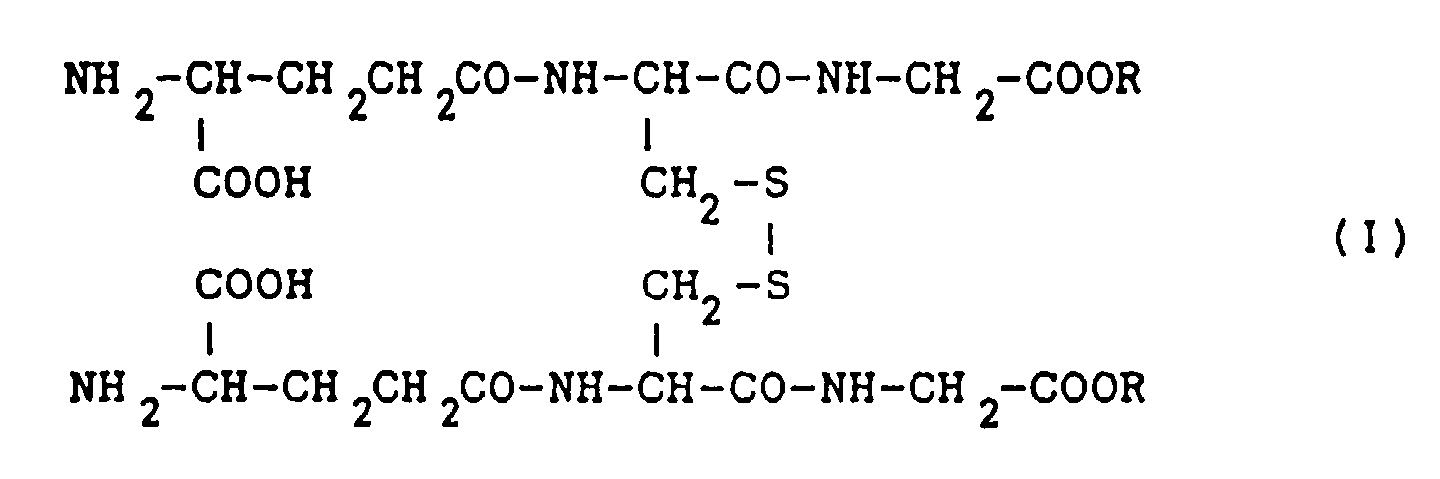
wherein R denotes a C1-10 alkyl group, or a pharmaceutically acceptable salt thereof, which process comprises oxidizing a compound of formula (II)

wherein R is as defined above, to yield a compound of formula (I).
wherein R denotes a C1-10 alkyl group, or a pharmaceutically acceptable salt thereof, which process comprises oxidizing a compound of formula (II)
wherein R is as defined above, to yield a compound of formula (I).
2. A process for preparing a pharmaceutical composition which process comprises incorporating
at least one oxidized-type glutathione alkyl ester represented by the formula (I),
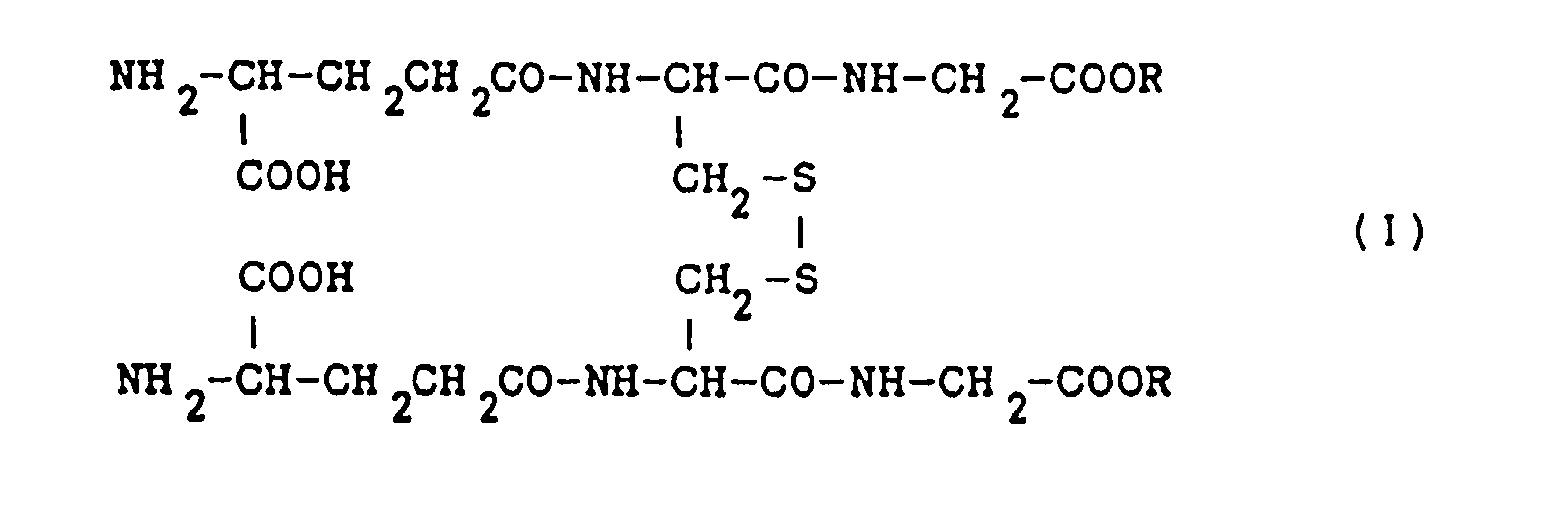
wherein R denotes a C1-10 alkyl group, or a pharmaceutically acceptable salt thereof into a suitable pharmaceutically acceptable carrier.
wherein R denotes a C1-10 alkyl group, or a pharmaceutically acceptable salt thereof into a suitable pharmaceutically acceptable carrier.
3. The process of claim 2, wherein a pharmaceutical composition in the form of tablets,
granules, powder, capsules or injection is obtained.
4. The use of at least one oxydized-type glutathione alkyl ester of formula I as defined
in claim 1 for preparing a pharmaceutical composition for the treatment of or prophylaxis
against acute or chronic disorders of the liver of a human or animal.
Patentansprüche für folgende(n) Vertragsstaat(en): AT, BE, CH, LI, DE, DK, FR, GB,
IT, LU, NL, SE, MC
1. Oxidierter Glutathion-Alkylester der Formel (I),
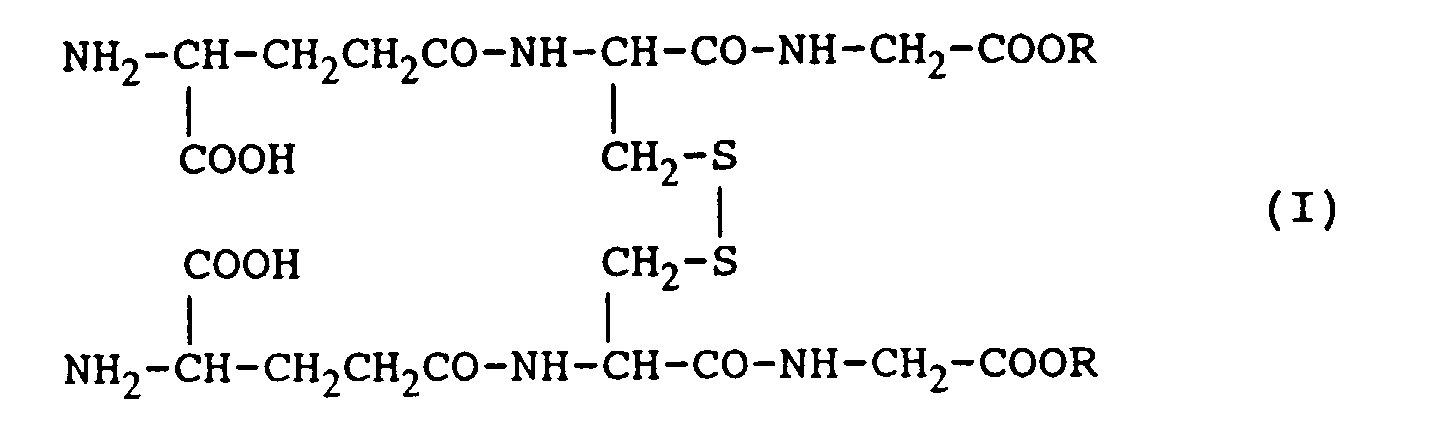
worin R für eine C1-10-Alkylgruppe steht, oder ein pharmazeutisch verträgliches Salz davon.
worin R für eine C1-10-Alkylgruppe steht, oder ein pharmazeutisch verträgliches Salz davon.
2. Pharmazeutisches Mittel, welches, im Gemisch mit einem pharmazeutisch verträglichen
Träger, einen oxidierten Glutathion-Alkylester der Formel (I)
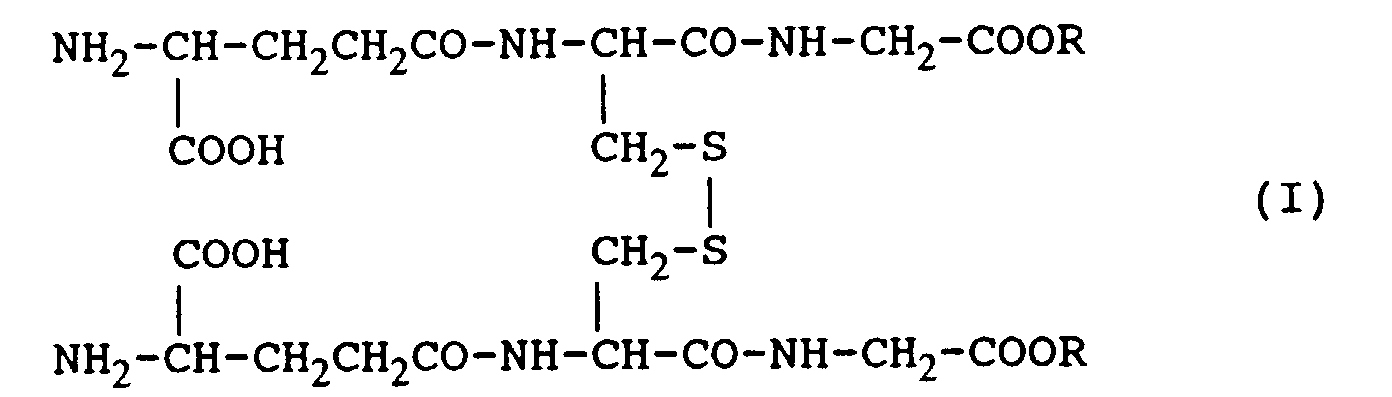
worin R für eine C1-10-Alkylgruppe steht, oder ein pharmazeuutisch verträgliches Salz davon umfaßt.
worin R für eine C1-10-Alkylgruppe steht, oder ein pharmazeuutisch verträgliches Salz davon umfaßt.
3. Pharmazeutisches Mittel nach Anspruch 2, welches als Tabletten, Granulat, Pulver oder
Kapseln oder in injizierbarer Form vorliegt.
4. Verfahren zur Herstellung der pharmazeutischen Mittel nach Anspruch 2 und 3, umfassend
die Aufnahme wenigstens eines wie in Anspruch 1 definierten oxidierten Glutathion-Alkylesters
der Formel I oder eines pharmazeutisch verträglichen Salzes davon in einen geeigneten,
pharmazeutisch verträglichen Träger.
5. Verwendung wenigstens eines wie in Anspruch 1 definierten oxidierten Glutathion-Alkylesters
der Formel I zur Herstellung eines pharmazeutischen Mittels zur Behandlung oder Prophylaxe
von akuten oder chronischen Erkrankungen der Leber bei Mensch und Tier.
Patentansprüche für folgende(n) Vertragsstaat(en): ES
1. Verfahren zur Herstellung eines oxidierten Glutathion-Alkylesters der Formel (I),
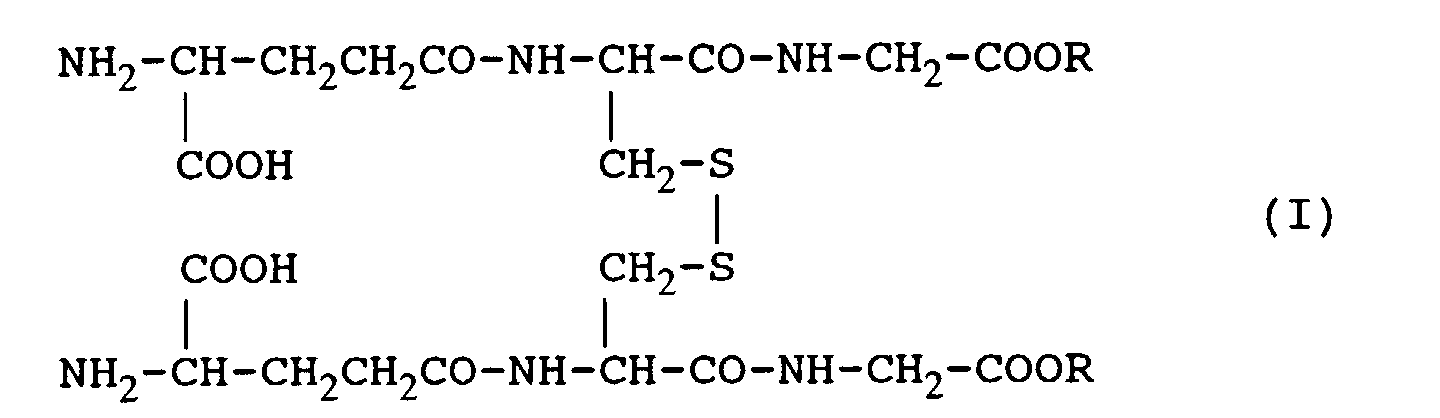
worin R für eine C1-10-Alkylgruppe steht, oder eines pharmazeutisch verträglichen Salzes davon, wobei das Verfahren die Oxidation einer Verbindung der Formel (II)

worin R wie oben definiert ist, zu einer Verbindung der Formel (I) umfaßt.
worin R für eine C1-10-Alkylgruppe steht, oder eines pharmazeutisch verträglichen Salzes davon, wobei das Verfahren die Oxidation einer Verbindung der Formel (II)
worin R wie oben definiert ist, zu einer Verbindung der Formel (I) umfaßt.
2. Verfahren zur Herstellung eines pharmazeutischen Mittels, welches die Aufnahme wenigstens
eines wie in Anspruch 1 definierten oxidierten Glutathion-Alkylesters der Formel I
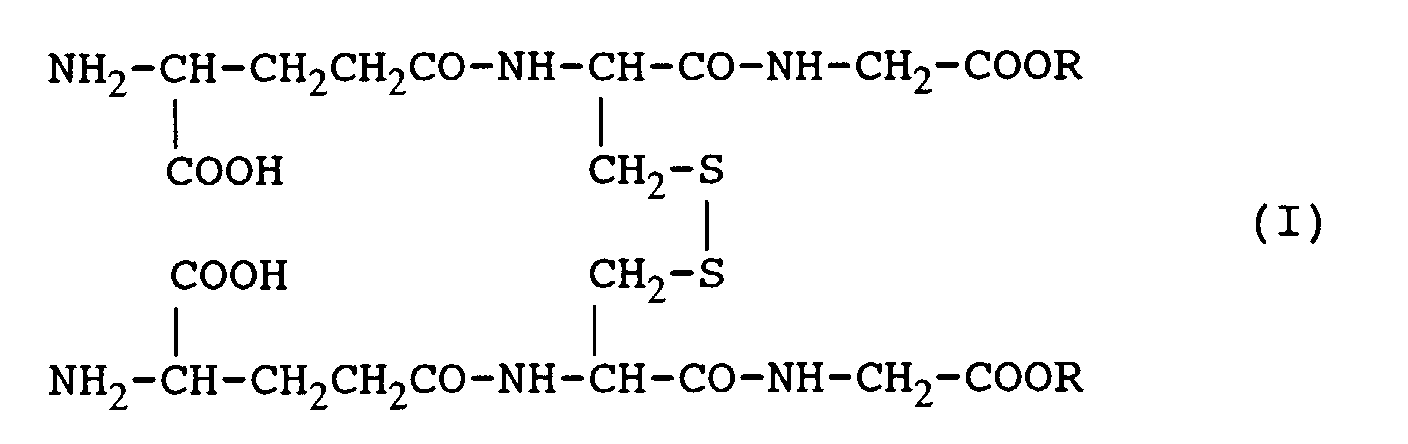
worin R für eine C1-10-Alkylgruppe steht, oder eines pharmazeutisch verträglichen Salzes davon in einen geeigneten, pharmazeutisch verträglichen Träger umfaßt.
worin R für eine C1-10-Alkylgruppe steht, oder eines pharmazeutisch verträglichen Salzes davon in einen geeigneten, pharmazeutisch verträglichen Träger umfaßt.
3. Verfahren nach Anspruch 2, wobei ein pharmazeutisches Mittel in Form Tabletten, Granulat,
Pulver oder Kapseln oder in injizierbarer Form erhalten wird.
4. Verwendung wenigstens eines wie in Anspruch 1 definierten oxidierten Glutathion-Alkylesters
der Formel I zur Herstellung eines pharmazeutischen Mittels zur Behandlung oder Prophylaxe
von akuten oder chronischen Erkrankungen der Leber bei Mensch und Tier.
Revendications pour l'(les) Etat(s) contractant(s) suivant(s): AT, BE, CH, LI, DE,
DK, FR, GB, IT, LU, NL, SE, MC
1. Ester alkylique du glutathion du type oxydé répondant à la formule (I)
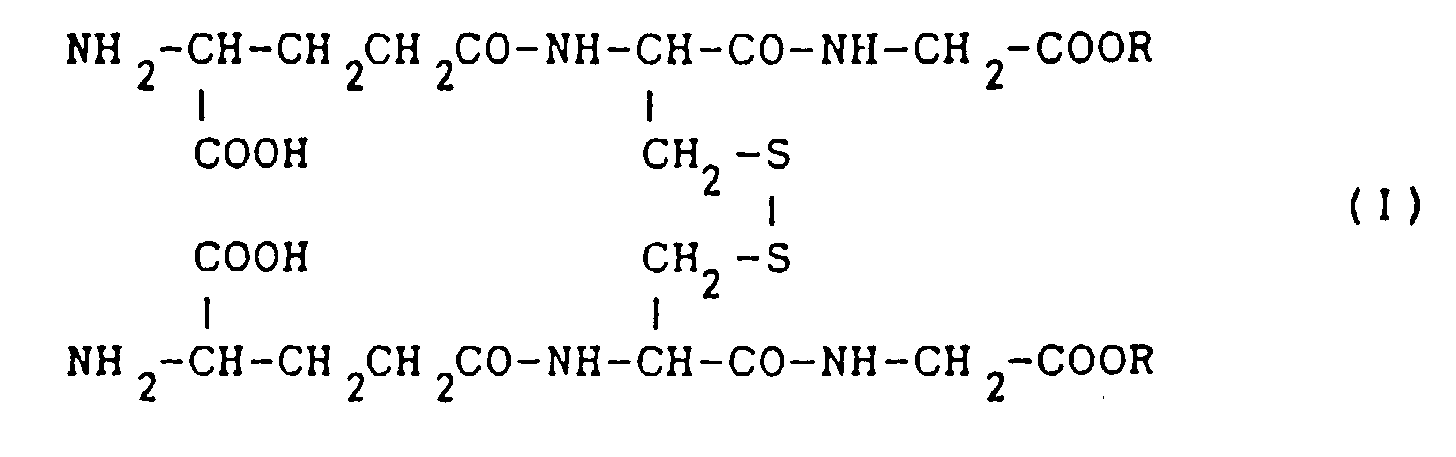
dans laquelle R désigne un groupe alkyle en C1 à C10 ou un de ses sels pharmaceutiquement acceptables.
dans laquelle R désigne un groupe alkyle en C1 à C10 ou un de ses sels pharmaceutiquement acceptables.
2. Composition pharmaceutique comprenant en mélange avec un support pharmaceutiquement
acceptable un ester alkylique du glutathion du type oxydé répondant à la formule (I)
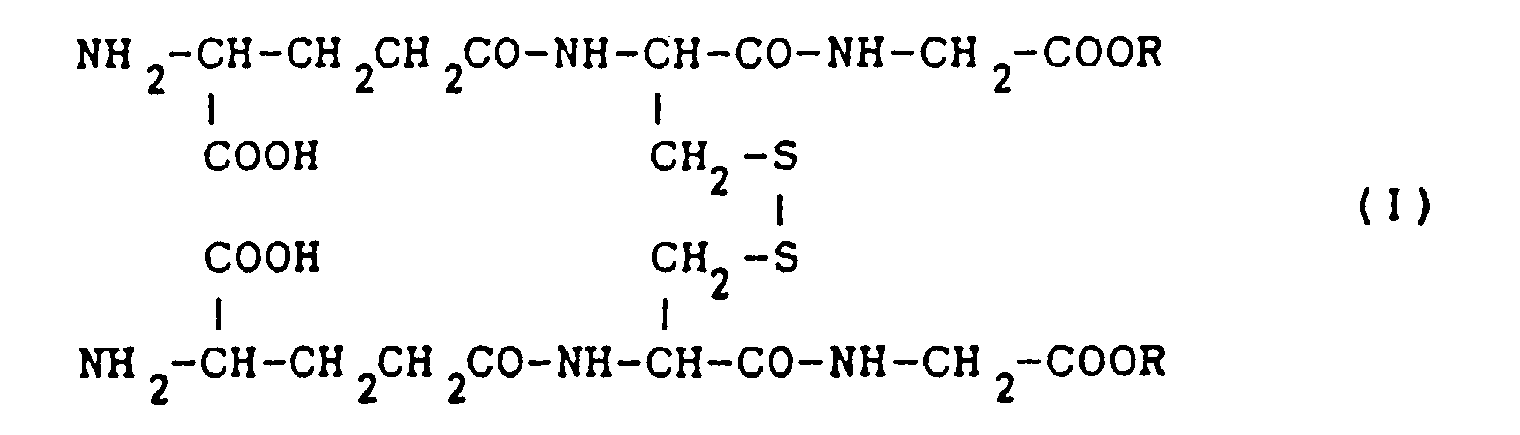
dans laquelle R désigne un groupe alkyle en C1 à C10, ou un de ses sels pharmaceutiquement acceptables.
dans laquelle R désigne un groupe alkyle en C1 à C10, ou un de ses sels pharmaceutiquement acceptables.
3. Composition pharmaceutique selon la revendication 2, qui est sous forme de comprimés,
de granulés, de poudres, de capsules ou de liquide pour injection.
4. Procédé de préparation des compositions pharmaceutiques selon les revendications 2
et 3, qui comprend le fait d'incorporer au moins un ester alkylique du glutathion
du type oxydé répondant à la formule (I) telle que définie dans la revendication 1
ou un de ses sels pharmaceutiquement acceptables dans un support pharmaceutiquement
acceptable.
5. Utilisation d'au moins un ester alkylique du glutathion du type oxydé répondant à
la formule (I) tel que défini dans la revendication 1 pour préparer une composition
pharmaceutique pour le traitement ou la prophylaxie des affections hépatiques aiguës
ou chroniques de l'homme ou de l'animal.
Revendications pour l'(les) Etat(s) contractant(s) suivant(s): ES
1. Procédé pour préparer un ester alkylique du glutathion du type oxydé répondant à la
formule (I)
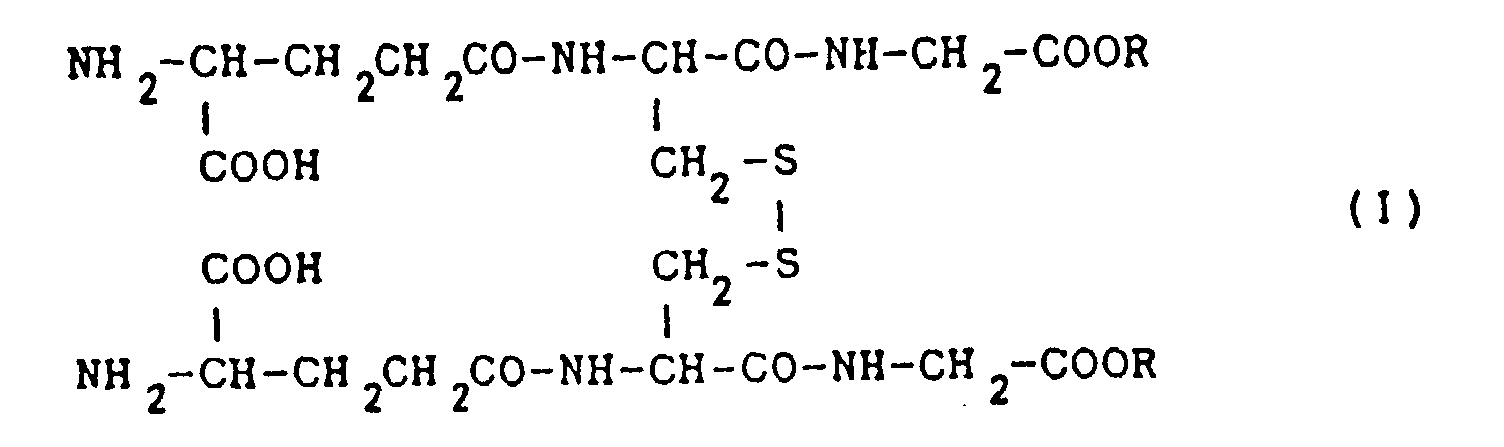
dans laquelle R désigne un groupe alkyle en C1 à C10 ou un de ses sels pharmaceutiquement acceptables, lequel procédé comprend le fait d'oxyder un composé répondant à la formule (II)

dans laquelle R est tel que défini ci-dessus, pour donner un composé répondant à la formule (I).
dans laquelle R désigne un groupe alkyle en C1 à C10 ou un de ses sels pharmaceutiquement acceptables, lequel procédé comprend le fait d'oxyder un composé répondant à la formule (II)
dans laquelle R est tel que défini ci-dessus, pour donner un composé répondant à la formule (I).
2. Procédé pour préparer une composition pharmaceutique, lequel procédé comprend l'incorporation
d'au moins un ester alkylique du glutathion du type oxydé répondant à la formule (I)
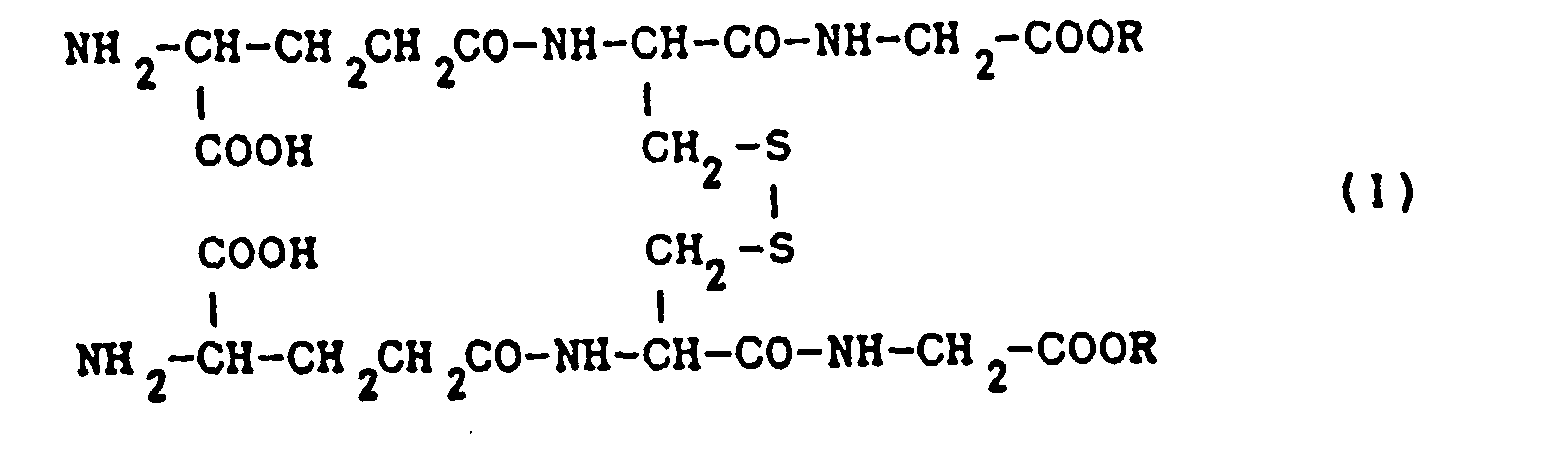
dans laquelle R désigne un groupe alkyle en C1 à C10 ou un de ses sels pharmaceutiquement acceptables, à un support pharmaceutiquement acceptable approprié.
dans laquelle R désigne un groupe alkyle en C1 à C10 ou un de ses sels pharmaceutiquement acceptables, à un support pharmaceutiquement acceptable approprié.
3. Procédé selon la revendication 2, dans lequel on obtient une composition pharmaceutique
sous forme de comprimés, de granulés, de poudre, de capsules ou de liquide pour injection.
4. Utilisation d'au moins un ester alkylique du glutathion du type oxydé répondant à
la formule (I) tel que défini dans la revendication 1 pour préparer une composition
pharmaceutique pour le traitement ou la prophylaxie des affections hépatiques aiguës
ou chroniques de l'homme ou de l'animal.