|
(11) | EP 0 497 898 B1 |

| (12) | EUROPEAN PATENT SPECIFICATION |
|
|
| (54) |
SULFONATED POLYANILINE SALT COMPOSITIONS, PROCESSES AND USES SULFONIERTE POLYANILINSALZVERBINDUNGEN, IHR HERSTELLUNGSVERFAHREN UND ANWENDUNGEN COMPOSITIONS DE SELS DE POLYANILINE SULFONES, PROCEDES ET UTILISATIONS |
|
|
|||||||||||||||||||||||||||||||
| Note: Within nine months from the publication of the mention of the grant of the European patent, any person may give notice to the European Patent Office of opposition to the European patent granted. Notice of opposition shall be filed in a written reasoned statement. It shall not be deemed to have been filed until the opposition fee has been paid. (Art. 99(1) European Patent Convention). |
[0001] The present invention relates to sulfonic acid-substituted polyaniline salt compositions, their derivatives, processes for their preparation, and uses thereof.
[0002] Polyaniline is a family of polymers that has been under intensive study recently because the electronic, chemical and optical properties of the polymers can be modified through variations of either the number of protons, the number of electrons, or both. The polyaniline polymer can occur in several general forms including the so-called reduced form (leucoemeraldine base), possessing the general formula
the partially oxidized so-called emeraldine base form, of the general formula
and the fully oxidized so-called pernigraniline form, of the general formula
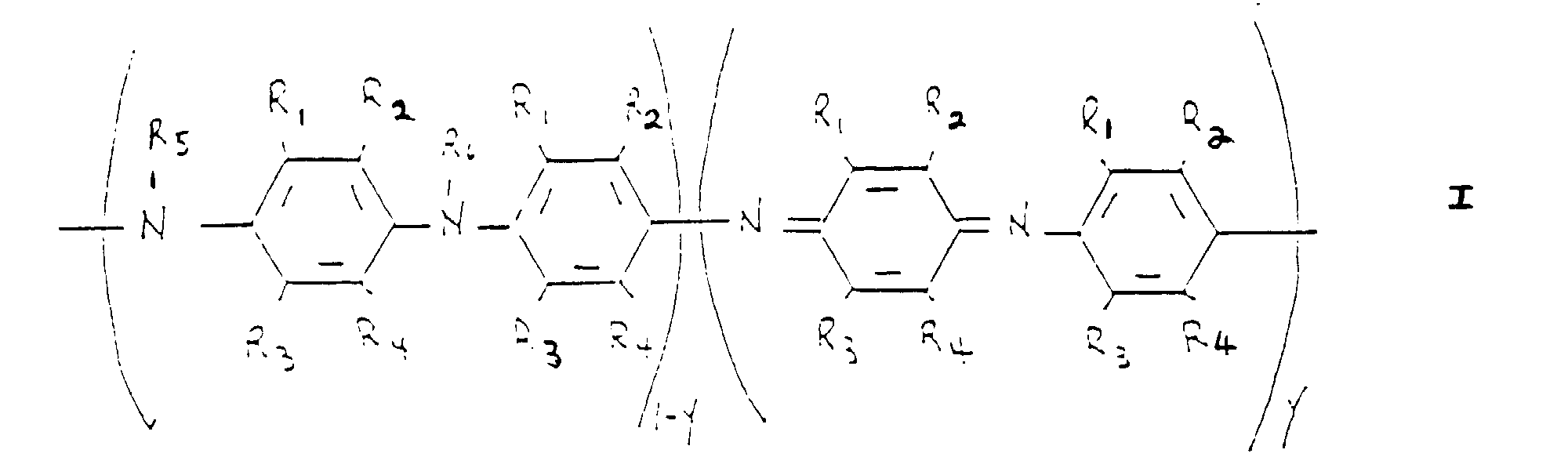
[0003] In practice, polyaniline generally exists as a mixture of the several forms with a general formula (I) of
[0004] When 0 ≤ y ≤ 1, the polyaniline polymers are referred to as poly(paraphenyleneamineimines) in which the oxidation state of the polymer continuously increases with decreasing value of y. The fully reduced poly(paraphenyleneamine) is referred to as leucoemeraldine, having the repeating units indicated above corresponding to a value of y = 1. The fully oxidized poly(paraphenyleneimine) is referred to as pernigraniline, of repeat unit shown above corresponds to a value of y = 0. The partly oxidized poly(paraphenyleneamineimine) with y in the range of greater than or equal to 0.35 and less than or equal to 0.65 is termed emeraldine, though the name emeraldine is often focused on y equal to or approximately 0.5 composition. Thus, the terms "leucoemeraldine", "emeraldine" and "pernigraniline" refer to different oxidation states of polyaniline. Each oxidation state can exist in the form of its base or in its protonated form (salt) by treatment of the base with an acid.
[0005] The use of the terms "protonated" and "partially protonated" herein includes, but is not limited to, the addition of hydrogen ions to the polymer by, for example, a protonic acid, such as mineral and/or organic acids. The use of the terms "protonated" and "partially protonated" herein also includes pseudoprotonation, wherein there is introduced into the polymer a cation such as, but not limited to, a metal ion, M+. For example, "50%" protonation of emeraldine leads formally to a composition of the formula
which may be rewritten as
[0006] Formally, the degree of protonation may vary from a ratio of [H+]/[-N=] = 0 to a ratio of [H+]/[-N=] = 1. Protonation or partial protonation at the amine (-NH-) sites may also occur.
[0007] The electrical and optical properties of the polyaniline polymers vary with the different oxidation states and the different forms. For example, the leucoemeraldine base, emeraldine base and pernigraniline base forms of the polymer are electrically insulating while the emeraldine salt (protonated) form of the polymer is conductive. Protonation of emeraldine base by aqueous HCl (lM HCl) to produce the corresponding salt brings about an increase in electrical conductivity of approximately 1012; deprotonation occurs reversibly in aqueous base or upon exposure to vapor of, for example, ammonia. The emeraldine salt form can also be achieved by electrochemical oxidation of the leucoemeraldine base polymer or electrochemical reduction of the pernigraniline base polymer in the presence of an electrolyte of the appropriate pH. The rate of the electrochemical reversibility is very rapid; solid polyaniline can be switched between conducting, protonated and nonconducting states at a rate of approximately 105 Hz for electrolytes in solution and even faster with solid electrolytes. (E. Paul, et al., J. Phys. Chem. 1985, 89, 1441-1447). The rate of electrochemical reversibility is also controlled by the thickness of the film, thin films exhibiting a faster rate than thick films. Polyaniline can then be switched from insulating to conducting form as a function of protonation level (controlled by ion insertion) and oxidation state (controlled by electrochemical potential). Thus, polyaniline can be turned "on" by either a negative or a positive shift of the electrochemical potential, because polyaniline films are essentially insulating at sufficiently negative (approximately 0.00 V vs. SCE) or positive (+0.7 V vs. SCE) electrochemical potentials. Polyaniline can also then be turned "off" by an opposite shift of the electrochemical potential.
[0008] The conductivity of polyaniline is known to span 12 orders of magnitude and to be sensitive to pH and other chemical parameters. It is well-known that the resistance of films of both the emeraldine base and 50% protonated emeraldine hydrochloride polymer decrease by a factor of approximately 3 to 4 when exposed to water vapor. The resistance increases only very slowly on removing the water vapor under dynamic vacuum. The polyaniline polymer exhibits conductivities of approximately 1 to 20 Siemens per centimeter (S/cm) when approximately half of its nitrogen atoms are protonated. Electrically conductive polyaniline salts, such as fully protonated emeraldine salt [(-C6H4-NH-C6H4-NH+)-Cl-]x, have high conductivity (10-4 to 10+2 S/cm) and high dielectric constants (20 to 200) and have a dielectric loss tangent of from below 10-3 to approximately 101. Dielectric loss values are obtained in the prior art by, for example, carbon filled polymers, but these losses are not as large nor as readily controlled as those observed for polyaniline.
[0009] The present invention is related to the invention disclosed in US-A-5079334 which concerns an optical information storage process which provides for erasable high density optical data storage which can be used in information storage and processing applications. The powerful information storage process is based upon the photoexcited optical transformations resulting from the optical absorptions of polyaniline.
[0010] While the preparation of sulfonated polyaniline compositions which are capable of being "self-protonated" or "self-doped" is disclosed in our European Patent Appln. No. 90915852.9, it is novel herein to prepare sulfonated polyaniline salt compositions.
[0011] The present invention provides nonprotonated sulfonated polyaniline salt compositions which are electrically insulating polymers and which are easy to dissolve in aqueous solutions. The present invention also relates to a process for producing the nonprotonated sulfonated polyaniline salt compositions which comprises reacting a sulfonated polyaniline polymer with a basic solution, such as NaOH, KOH and the like. The sulfonated polyaniline salt compositions are very soluble in water at high densities and are therefore useful as interim materials in producing self-protonated sulfonated polyaniline compositions.
[0012] The present invention further relates to the use of sulfonated polyaniline and derivatives thereof for absorbing electromagnetic radiation, including microwaves, radar waves, infrared waves, visible waves, and ultraviolet waves as needed. The invention further relates to the use of the radiation-absorbing sulfonated polyaniline compositions to modulate another electromagnetic beam.
[0013] The invention further relates to the use of the sulfonated polyaniline salt compositions as a high density erasable data storage medium intended for use in information storage and processing applications.
[0014] The present invention also relates to a method for the bit-wise or total erasure of the stored information. Further, the present invention relates to a method for the "layering" of information stored. As the intensity of the photoinduced (write bcam produced) change in absorption is proportional to the intensity of the write beam, discrimination of the amount of photoinduced optical absorption by the read beam enables more than one bit (0,1) to be written at a single bit location.
[0015] The present invention and the sulfonated polyaniline salt materials described herein may also be used to provide a medium for recording of hologram as done for example in photorefractive Bi12SiO20 [J. P. Herriau and J. P. Huignard, Appl. Phys. Lett. 49, 1140 (1986)] and BaTiO3 [J. Feinberg, Physics Today, 41 (10) 46 (1988)]. This technique allows for storage of information in a form of photoinduced fixed gratings within the sulfonated polyaniline salt material and formation of holographic images.
[0016] Fig. 1 is a graph illustrating the FTIR spectra of (a) self-doped sulfonated polyaniline; (b) emeraldine base, the parent polymer of sulfonated polyaniline in wave numbers cm-1.
[0017] Fig. 2 is a graph illustrating the electronic absorption spectra of (a) ---sulfonated polyaniline film cast from an aqueous NH4OH solution in a quartz substrate, then dried in air, (peaks at 3.88 and 2.16 eV in 0.1M NH4OH; (b)― emeraldine salt film, (peaks at 3.76 and 2.0 eV) in NMP.
[0018] Fig. 3 is a graph illustrating the electronic absorption spectra of (a) ―sulfonated polyaniline in NH4OH, maxima at 320nm (3.88eV) and 563nm (220eV); (b) ----emeraldine base in NMP, maxima at 330nm (3.76eV) and 620 nm (200eV).
[0019] Fig. 4 is a schematic illustration of the equilibria among different structures of self-doped sulfonated polyaniline.
[0020] Fig. 5 is a schematic illustration of the equilibrium between self-doped sulfonated polyaniline and its base form in aqueous NH4OH solution.
[0021] The present invention relates to sulfonic acid substituted polyaniline salt compositions, their derivatives, processes for their preparation and uses thereof.
[0022] The sulfonated polyaniline salt compositions have the formula I
wherein 0 ≤ y ≤ 1; R1, R2, R3, R4, R5 and R6 are independently selected from the group consisting of H, -SO3H, -R7SO3H, -SO3M, -R7SO3M, -OCH3, -CH3, -C2H5, -F, -Cl, -Br, -I, -NR7 2, -NHCOR7, -OH, -O-, -SR7, -OR7, -OCOR7, -NO2, -COOH, -COOR7, -COR7, -CHO and -CN, wherein R7 is a C1-C8 alkyl, aryl or aralkyl group and M is a positive cation or counterion, for example NH4+, Li, Na+, K+, Rb+, Cs+, Ca++, Ba++ and the like; and wherein x is that fraction of phenyl or quinoid rings that have an -SO3- group and where z is that fraction of these phenyl or quinoid rings that have the M positive cation; such that when z is much less than x, the composition is a conductor and as z approaches x, the composition becomes nonconducting.
[0023] The fraction of rings containing at least one R1, R2, R3 or R4 groups being an -SO3M, or -R7SO3M can be varied from a few percent to one hundred percent. In certain embodiments the percentage ranges from at least approximately 20% up to and including 100%. It is within the contemplated scope of the present invention that the -R7SO3M substituents can be varied so that the sulfonated polyaniline is soluble in a range of solvents in order to make the sulfonated polyaniline salt composition more easily blendable with other polymers and/or more easily cast onto a variety of surfaces.
[0024] The present invention discloses herein the synthesis, the electronic, electrochemical and optical properties of sulfonated polyaniline salt compositions. The sulfonated polyaniline has a conductivity of 0.5 S/cm without external doping which makes the sulfonated polyaniline a self-protonated conducting polymer. It is discloscd herein that, in contrast, a salt (Na+ or K+, for example) of the sulfonated polyaniline is a non-protonated insulating polymer.
[0025] The chemical synthesis of the sulfonated polyaniline salt compositions of the present invention is accomplished by reacting sulfonated polyaniline with a basic solution.
[0026] An example of the synthesis of sulfonated, non-protonated sodium polyaniline salt follows: lg of sulfonated, protonated polyaniline in the emeraldine oxidative state (structure a, compound I, in Fig.4) was dissolved in 40ml 0.1M NaOH solution. The color of the solution was blue-violet. The water was removed from the solution by slowly reducing the pressure of the polymer solution at room temperature. After most of the water was gone, the polymer was transferred to a vacuum desicator and dried under dynamic vacuum for 24 hours. The sulfonated, non-protonated sodium polyaniline salt, shown as structure b, compound II, in Fig. 4 was then obtained.
[0027] Infrared and electronic spectra. Infrared spectra were obtained by mixing the either compound I or the compound II into KBr matrix, pressing into pellets and recording on an FTIR spectrometer.
[0028] For taking electronic spectra the compound I was dissolved in 0.1M NH4OH to form a homogeneous solution, the polymer solution was then cast on a quartz substrate. Slow evaporation of the aqueous solution of the compound II (ammonium salt) in air at room temperature resulted in spontaneous removal of the weak volatile base, NH3 with reformation of the compound I. Compound II was dissolved in either H2O/NMP(N-Methyl 2-Pyrrolidinone/solution for taking the spectra.
[0029] Conductivity measurement. Conductivities of the compound I and compound II were measured on compressed pellets of the powder by using four point probe techniques with a Keithley 220 constant current source and Keithley 181 voltmeter.
[0030] Cyclic voltammetry studies. Cyclic voltammetry studies were carried out using a Hokto Corporation (HC) Model HA-301 potentiostat/galvanostat with HC HC-201 digital coulometer. The HC HB-III universal programmer was used for the generation of the sweep signals which were fed into the HA-301. "Voltammograms were recorded on a Hewlett-Packard Model 7046B XYY' recorder with an optional time base function. For the studies of current peak changing with the sweep rate, a Nicolet Model 370 digital oscilloscope with digitizer and disk-drive plug-in was used for recording ip in the high frequency characterization cxperiments. A standard three electrode system was enclosed in a dual compartment cell with a fine porosity glass frit separating the working electrode and reference electrode from the counter electrode. Platinum disks (1.0cm2) were used as working and counter electrodes. A Ag/AgCl, saturated KCl electrode encased with a luggin probe was used as a reference electrode. 1.0M HCl(20ml) was used as the electrolyte. All studies, except scan rate dependence of current peak, were performed at a sweep rate of 50mV/s. Since preliminary observations indicated that air did not have any effect on the cyclic voltammograms, all operations were carried out in the presence of air.
[0031] The compound I was cast on a Pt electrode by evaporating a solution of the polymer in 0.1M ammonium hydroxide and subsequently dried in air. In order to obtain reproducible cyclic voltammograms the electrode was preconditioned by cycling between -0.2 and 0.4 volts vs Ag/AgCl for ~ 10 minutes (25 cycles).
[0032] Structure Characterization and Physical Properties. Elemental analyses, infrared and electronic spectroscopy, conductivity and cyclic voltammetry studies are consistent with the sulfonation of emeraldine base with fuming sulfuric acid proceeding to give a self-doped, sulfonated, protonated forms of the emeraldine oxidative state of polyaniline, the compound I (shown as structure a in Fig. 4) which has a conductivity of ~0.5 S/cm. This polymer can be regarded as being formed by the hypothetically initial formation of the strong acid, shown as structure c in Fig. 4, which then immediately protonates the imine nitrogen atoms to give the conducting polymer in an entirely analogous manner to strong acids such as HCl. Treatment of the structure c compound with an aqueous base yields the sulfonated, non-protonated insulating salt forms analogous to emeraldine base, viz, the structure d compound shown in Fig 4.
[0033] With respect to the above structure, sulfonation occurs preferentially in alternating rings and that under the present experimental conditions, only half the rings were sulfonated. This is consistent with the increased stability of the semiquinone form. Further sulfonation and consequently double protonation of nitrogen atoms convert some of the -(NH)-to-(NH2+)- and hence reduce the conjugation of the polymer. The FTIR spectrum shown in Fig. 1 of the self-doped polyaniline, thc compound I, is consistent with the presence of -SO3-groups alternated to the aromatic rings. IR shows absorption maxima of out of plane bending of aromatic hydrogens at 820 and 870cm-1 are indicative of 1, 2, 4 trisubstitutents on the rings. The absorptions are not present in the 1, 2 disubstituted emeraldine base from which the compound I was synthesized. Absorption peaks at 1080, 700 and 590cm-1 are consistent with the presence of SO3- groups.
[0034] The conductivity of the compound I (σ ~ 0.5 S/cm) is similar to that of emeraldine hydrochloride measured under the same experimental conditions (σ ~ 1-5S/cm; laboratory air), but lower than that σ ~ 18S/cm of high molecular weight emeraldine hydrochloride. The self-doped sulfonated polyaniline with emeraldine oxidative state differs dramatically from nonexternally doped polyaniline, structure e shown in Fig. 4, in conductivity. Since sulfonic acid is a strong acid, approximately as strong as hydrochloric acid, the compound I is capable of doping itself. Pressed pellets of the dark green self-doped compound I had a room temperature conductivity of ~ 0.5S/cm in contrast to the purple color and insulating behavior of polyaniline emeraldine base form. Ilowever, the conductivity of compound I is lower than that of emeraldine hydrochloride pressed pellets; analogy with earlier study of poly(o-toluidine), the lower conductivity is in accord with increased conduction electron localization induced by the side chain effects of -SO3-.
[0035] The solubility of the compound I and compound II also differ markedly from that of the corresponding polyaniline polymer. The compound I dissolves completely in aqueous 0.1M NH4OH or NaOH to give a blue-violet solution while polyaniline washed with such solvent converts to the insoluble base form. When in the basic aqueous solvent, the polymer backbone is in the emeraldine base structure with SO3- forming a salt with NH4+ or Na+, i.e. compound II. The compound I partially dissolves in NMP to form a blue color solution and as well as DMSO (dimethyl sulfoxide) to show green color. The compound II dissolves in the water showing a blue-violet color and [H2O/NMP forming a blue solution. The compound II also partially dissolves in NMP with blue color and in DMSO with dark blue color. Treatment of the self-doped polyaniline, compound I, with an aqueous base proceeds consequently to the deprotonation of the backbone of the polymer to form the structure corresponding to emeraldine base, as shown in the reaction A or reaction B depicted in Fig. 5.
[0036] In both cases the deprotonation results in a 9 or 10 order of magnitude decrease in conductivity. The sulfonated, non-protonated polyaniline salt composition is analogous to the emeraldine base (shown as structure e in Fig. 4), except that t is a salt combining two anionic -SO3- groups per four (ring-N) units. Compound I and II differ from emeraldine hydrochloride in that they are soluble in aqueous 0.1M NH4OH and NaOH. The anionic polymer chain present in the compound II is responsible for its solubility in water.
[0037] Based on solid state 13C NMR studies, [T. Hjertberg, W.R. Salaneck, I. Landstrom, N.L. D. Somasiri and A.G. MacDiarmid, J. Blymer Sci; Polym. Lett. Ed., 23 (1985) 503] it has been reported that adjacent phenyl rings of the emeraldine backbone are noncoplanar. Introduction of sulfonic acid groups on phenyl rings of the polyaniline backbone can be expected to increase the torsional angle between adjacent rings to relieve steric strain.
[0038] Comparisons of the electronic absorption spectra of the compound I and the emeraldine salt, and compound II and emeraldine base provide insight into changes in the molecular geometry caused by the sulfonic group-substitution on the polyaniline backbone. Steric effects are considered in the interpretation of the electronic absorption spectra of the sulfonated polyaniline. In order to compare the feature of the electronic spectra of the self-doped polymer (compound I) and emeraldine hydrochloride, their spectra are given in Fig. 2. The high energy absorption band at 320nm(3.88eV) and 326nm(3.81eV) for compound I and emeraldine hydrochloride, respectively, is assigned to the pi-pi* transition based on earlier experimental and theoretical studies. The other two absorption bands at 435nm(2.38eV) and 850nm(1.46eV) for the compound I, 413nm(300eV) and 826nm(1.50eV) for emeraldine hydrochloride, have been assigned to the optical absorption of the metallic polaron band of the salt form. The hypsochromic shift of the pi-pi* transition in going from emeraldine hydrochloride to compound I is again in accord with decreased extent of conjugation caused by increased phenyl ring torsion angle which results from steric repulsion between the -SO3- groups and hydrogens on the adjacent phenyl rings. The bathochromic shift of the polaron band transition is also in agreement with relative energy band shifts expected for increased ring torsion angles.
[0039] Temperature dependent electron spin resonance studies show a ~ 0.4G peak to peak linewidth for compound I at room temperature similar in intensity to that of emeraldine salt. This result support that compound I is in the polysemiquinone (polaron energy band) state.
[0040] The electronic spectra of eompound II and emeraldine base consist of two major absorption bands as shown in Fig. 3. The first absorption band at 320nm(3.88eV) and 330nm(3.76eV) for compound II and emeraldine base, respectively, is assigned to the pi-pi* transition based on the earlier studies of polyaniline. This absorption shifts somewhat with increasing oligomer length. The pi-pi* transition band shows a hypsochromic shift from 3.76eV for emeraldine base to 3.88eV for compound II. The blue shift implies the decrease of the extent of the conjugation and an increase of the band gap of this polymer. The adjacent phenyl rings of the polymer have larger C-N=C angles with respect to the plane of the nitrogens due to the possible steric repulsion between -SO3-Na+ groups and hydrogens on the adjacent phenyl rings. The second absorption band at 563nm(2.20eV) and 620nm(2.00eV) for compound II in H2O and emeraldine base in NMP, respectively, also has a substantial hypsochromic shift with sulfonation. This band has been assigned to an absorption from the highest occupied molecular orgital (HOMO) based band centered on the benzenoid units to the lowest unoccupied molecular orbital (LUMO) centered on the quinoid units. When the absorption is intrachain, the excitation leads to formation of a "molecular" exciton (with positive charge on adjacent benzenoid units bound to the negative charge centered of the quinoid), while interchain charge transfer from HOMO to LUMO may lead to formation of positive and negative polarons. The increase in this transition energy is also in accord with increased ring torsion angles due to steric repulsion.
[0041] The sulfonation of polyaniline has dramatic changes in its solubility and solution properties. For example, compound II dissolved in water gave a 2.20eV absorption, however, the transition of such band is changed from 2.20eV to 2.00eV by adding NMP into the solution. The origin of this is that water is a more polar solvent with smaller volume comparing to NMP, hence it partially solvates the imine nitrogens resulting in larger torsional angle, causing the hypsochromic shift.
[0042] The present invention further relates to the uses of the sulfonated polyaniline salt compositions and their derivatives in electronic, electrochemical, chemical, and optical applications.
[0043] The sulfonated polyaniline salt compositions can be coated by a variety of techniques onto substrates of choice. The sulfonated polyaniline salt compositions can be applied to substrates according to the present invention by spray coating, dip coating, spin casting, transfer roll coating, brush-on coating, and the like. The sulfonated polyaniline polymers can also be electrochemically deposited onto conductive substrates by known electrochemical deposition techniques.
[0044] The sulfonated polyaniline salt compositions of the present invention are useful as an interim material in the making of self-protonated sulfonated polyaniline compositions. The sulfonated polyaniline salt compositions are very soluble in water, while the sulfonated polyaniline compositions are only slightly soluble in water. For example, the sulfonated polyaniline salt compositions can be dissolved in water at very high densities and can be very uniformly applied to a substrate. After application to the substrate the insulating sulfonated polyaniline salt composition can be converted to the conducting sulfonated polyaniline composition. In the case where the counterion is, for example, NH4+, the NH4+ can be evaporated off. In the case where the counterion is Na+, is dissolved or washed off by using an acid such as, for example HCl where the Na+ is then replaced by the proton H+.
[0045] The sulfonated polyaniline salt compositions and derivatives thereof have, or can be designed to have, desired processability in terms of, for example, viscosity, flexural strengths, solubility, adhesion to substrates, crosslinking, melting point, weight, adaptability to filler loading and the like. This is achieved by varying as desired the degree of protonation, the state of oxidation, and the type and degree of substituents on the polymer. Certain substituents may be preferred for the facilitation of desired processing parameters, such as increasing or decreasing solubility, altering extrusion parameters (rheology), achieving a specific viscosity, and the like. Derivatization is also useful for achieving compatibility with a copolymer, facilitating the tunability of the sulfonated polyaniline salt composition for non-linear optics applications, and for specific wavelength absorption, such as microwave attenuation or a particular photoresponse.
[0046] The present invention is therefore especially useful for absorbing electromagnetic radiation, wherein the electromagnetic radiation possess a wavelength generally in the range of from about 1000 Angstroms to about 50 meters, wherein the composition comprises a sulfonated polyaniline composition or a protonated salt thereof.
[0047] The sulfonated polyaniline salt compositions of the present invention are useful in preparing gradients of conductivity. The conductivity of the material can be varied by varying the density of the positive cation (e.g. Li+, Na+, K+, Rb+, Cs+, NH4+, Ca++ and the like) from 0 to 0.5 per phenyl or quinoid ring. As such, the composition changes from conducting to insulating as the number of positive cations approaches the number of sulfonyl groups in the compositions. Thus, by varying the ratio of conducting to nonconducting, a gradient of conductivity is established: where x is that fraction of phenyl or quinoid rings that have an -SO3- group, and where z is the fraction of these phenyl or quinoid rings that have a positive cation; when z is much less than x, the compound is a conductor and as z approaches x, the compound becomes nonconducting or insulating. Therefore, one can vary the conductivity by varying the z/x ratio.
[0048] The present invention is also useful with various devices such as optical devices and microwave devices which utilize the features, characteristics and properties of the sulfonated polyaniline salt compositions which are described in the parent co-pending patent application. For the purposes of illustration only, various example are given below. It should be understood that these examples are not limiting and that the sulfonated plyaniline salt compositions can also be used in other such applications as are known to those skilled in the art, including but not limited to the further examples given in the parent co-pending application.
EXAMPLE 1
[0049] In one embodiment of the method for reducing the detectability by radar of an object it is desirable to coat the object in such a way as to produce a gradient of absorption to minimize reflectance. Such a gradient of sulfonated polyaniline material can be achieved by varying the degree of self-protonation of the sulfonated polyaniline polymer or the degree of substitution on either the C6 ring or the nitrogen atoms or both with a chemical substituent such that an incoming radar beam first encounters a sulfonated polyaniline composition with little or no self-protonation, i.e., a material with limited absorption of radiation. As the beam further advances along the gradient of sulfonated polyaniline material covering the objcct, the beam encounters sulfonated polyaniline polymer with continually increasing degrees of self-protonation, and hence increasing degrees of electromagnetic absorption. The gradient of self-protonation can be controlled through the gradient of sulfonation or by having constant sulfonation vary the gradient of Na+ or other counterions. In this manner, little or no reflection of the bcam is produced and the object is not detectable by a radar wave reflection.
EXAMPLE 2
[0050] Sulfonated polyaniline compositions can also be used as a photoactive switch by manipulation of the index of refraction of the sulfonated polyaniline compositions. The extremely rapid photoresponse of the sulfonated polyaniline polymer, makes such polymer useful in nonlinear optical devices. The time dependence of the photo bleaching of the polymer is on the order of picoseconds. For example, the application of a laser beam of wavelength 6200 Angstroms (2.0eV) to sulfonated polyaniline polymer in emeraldine form (for example Na+ salt) produces significant photoinduced bleaching (i.e., increased transmission) in broad energy bands of 3,265 Angstrom to 4,590 Angstroms (approximately 1.5eV to 2.7eV) and again at 3,760 Angstroms to 2,880 Angstroms (approximately 3.3eV to 4.3eV). Simultaneously laser beam photoinduccd absorption (i.e., decreased transmission) for sulfonated polyaniline occurs at 24,800 Angstroms to 8,265 Angstroms (approximately 0.5eV to 1.5eV) and from 4,590 Angstroms to 3,760 Angstroms (2.7eV to 3.3eV). Photoinduced absorption and bleaching occur in sulfonated polyaniline compositions in less than 10-12 seconds. These photoinduced changes in absorption correspond to changes in the index of refraction at these wavelengths. These changes in optical constants have broad application in nonlinear optical signal processing and optical communications, which according to the present invention, are useful as means to switch, modulate, multiplex, focus, and provide optical bistability for commercial systems.
EXAMPLE 3
[0051] Sulfonated polyaniline is also useful in nonlinear optical signal processing. For example, a thin film coating of a sulfonated polyaniline salt composition can be applied to a phototransmissive substrate. A probe beam of light of a given wavelength is then propagated through the noncoated side of the substrate onto the coating at the critical angle to the sulfonated polyaniline salt such that the probe beam is wave-guided in the phototransmissive substrate. To activate the desired switching property of the sulfonated polyaniline salt coating, a pump beam of light, also called a modulator, of a different wavelength or some wavelength is applied to the coating through the coated or noncoated side of the substrate at a second angle such that the index of refraction of the sulfonated polyaniline composition is changed by the absorption by the sulfonated polyaniline of the electromagnetic radiation of the modulator beam. The wavelength of the modulator beam can vary widely, but for the emeraldine base form (for example Na+ salt) it is preferably within the range of from about 8265 Angstroms (1.5eV) to about 4590 Angstroms (2.7eV). The change in the refractive index of the sulfonated polyaniline composition coating alters the transmissive property of the sulfonated polyaniline and allows the probe beam to be refracted or otherwise modified by the sulfonated polyaniline coating. This refraction or other modification of the probe beam can, for example, be used to trigger a photocell, initiate or terminate an optical signal, encode information on the probe beam, or the like. By these means is produced a low cost, stable means of optical signal processing.
EXAMPLE 4
[0052] In another embodiment, a beam to be modulated is caused to impinge upon a thin coating of sulfonated polyaniline which is on a phototransmissive substrate. A portion of the beam is reflected, the remainder refracted, transmitted, and partly absorbed. Application of a modulator beam at a second angle changes the index of refraction of the sulfonated polyaniline thereby altering the direction and the percentage of the probe beam transmitted and reflected. One embodiment has the probe beam incident on the sulfonated polyaniline in its emeraldine base form (for example, Na+ salt) at a critical angle and the modulator beam preferably of wavelength between 8265 Angstroms (1.5eV) and 4590 Angstroms (2.7eV).
[0053] Thus, the present invention further relates to a method of changing the refractive index of sulfonated polyaniline comprising (a) applying sulfonated polyaniline to a phototransmissive substrate; (b) applying a first beam of light of wavelength x at the critical angle y to the sulfonated polyaniline surface; and, (c) applying a second beam of light of wavelength z to the sulfonated polyaniline surface, whereby the second beam is absorbed by the sulfonated polyaniline changing the index of refraction of the sulfonated polyaniline, whereby the transmission of the first beam through the phototransmissive substrate is altered. The preferred wavelength x of the first or probe beam of light is dependent on the form of sulfonated polyaniline utilized. For emeraldine base polymer, the preferred wavelength x of the first or probe beam of light is in one or more of the rangcs of approximately 0.6eV to 4.3eV; 0.8 to 1.1eV; 1.3 to 1.6eV; 1.7 to2.4eV; 1.6 to 2.4eV; 2.8 to 3.2eV; and 3.4 to 4.3eV. The preferred wavelengths will vary depending on the degree of self-protonation and oxidative state of the sulfonated polyaniline polymer and the nature of the substituents, if any, on the polymer. For the emeraldine base polymer, the preferred wavelength z of the second or modulating beam of light is in the range of approximately 1.7eV to 2.7eV. The preferred wavelength of the second or modulating beam is determined by the oxidation statc, self-protonation level, and substituents of the polymer. For the leucoemeraldine polymer the preferred wavelengths of the probe beam are in the range of 24,800 Angstroms to 8,265 Angstroms (0.5 to 1.5eV) and 4,590 Angstroms and 3,760 Angstroms 2.70 to 3.30eV, with shorter preferred modulator beam wavelength of 3,760 Angstroms to 2,880 Angstroms, 3.30 to 4.30eV. For pernigraniline base, the preferred probe and modulator wavelength are similar to those of emeraldine base.
EXAMPLE 5
[0054] The ability to permanently alter at will thc absorption charteristics of sulfonated polyaniline through the application of light or electrochemical potential provides a powerful technology for use in information storage. For instance, the focused writing beam of a low power helium neon laser operating at 632.8nm (1.69eV) may be used to write information on a thin (less than 1 micron) film of sulfonated polyaniline in the emeraldine form, (e.g., Na+ salt), thereby inducing a large increase in the optical absorption in the near infrared spectral region that can be read conveniently by an inexpensive compact semiconductor diode laser operating at 800nm, 1300nm, or 1550nm.
[0055] Transmission characteristics of the photoinduced absorption in sulfonated polyaniline compositions in the emeraldine form are also dependent upon the writing laser input intensity. That is, the amount of photoinduced absorption is proportional to the intensity of the writing laser. This ability to "stack" the transmission characteristics of the shifted photoabsorption spectrum of sulfonated polyaniline provides the capability to "stack" information storage at one given bit location on a storage unit. Thus, the read lasers can be utilized to correspond to the laser input intensity to read three-dimensionally at one bit location of the storage system.
[0056] Chemical or electrochemical erasure of the stored information in a total or bit-wise manner is possible by temporary conversion of the insulating forms of sulfonated polyaniline (e.g. Na+ salt) to the conducting form of the sulfonated polyaniline film.
[0057] The temperature for erasure of the photoinduced information is one of sulfonated controllable by judicious choice of the N or ring substituent. For example, use of polyortho-toluidine and naphthal versions of sulfonated polyaniline in the emeraldine equivalent oxidation state polyaniline will provide stability to higher temperatures, likely exceeding room temperature. Hence, some of these derivative systems will be usable at room temperature, with erasure occurring above room temperature.
EXAMPLE 6
[0058] The sulfonated polyaniline medium used for information storage may also be combined in composite form with other polymers to blend mechanical and optical storage function. The density of optical storage is limited only by the diffraction limits of thc writing and probing beams utilized.
EXAMPLE 7
[0059] Sulfonated polyaniline salt composition films can be used to produce holographic images and photoinduced grating in a two-dimensional framework. The two-dimensional framework is a sample configuration of a sulfonated polyaniline film supported by a transparent substrate. Two beams interfere in the sulfonated polyaniline film. For example, utilizing the emeraldine base form (e.g., Na+ salt), the two beams are focused low power Helium-Neon laser beams operating at 632.8nm. The interference of the two beams results in an interference pattern or holographic image within the emeraldine base form polymer. This interference or holographic image is then read conveniently by inexpensive, compact, semiconductor diode lasers operating at 800nm, 1300nm or 1550nm.
EXAMPLE 8
[0060] Sulfonated polyaniline salt compositions can be used in three-dimensional holographic and photoinduced grating applications. A thick sample of sulfonated polyaniline or sulfonated polyaniline can be dispersed in a transparent host polymer such as kapton or polycarbonate. Two beams interfere in the sulfonated polyaniline film. For example, utilizing the emeraldine base form (Na+ salt) the two beams are focused low power He-Ne laser beams operating at 632.8nm. The interference of the two beams results in an interference pattern or holographic image within the emeraldine base form polymer by inexpensive, compact, semiconductor diode lasers operating at 800nm, 1300nm or 1550nm.
1. A sulfonated polyaniline salt having recurring units of the formula (I)
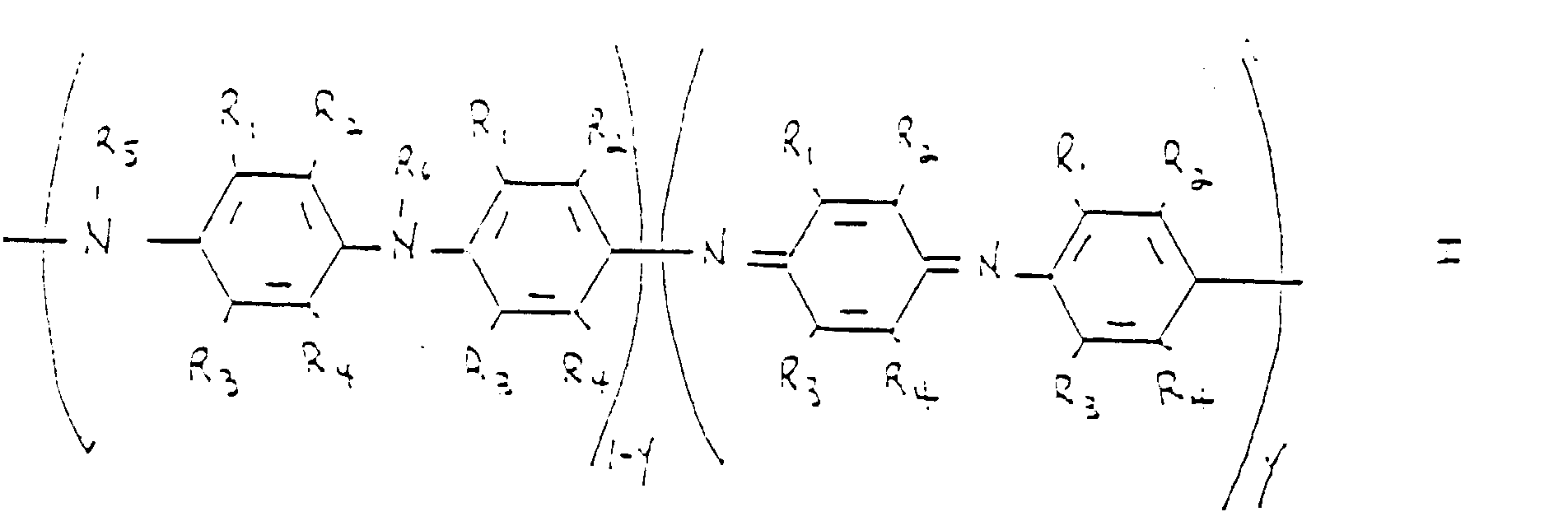
in which
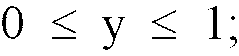
each R1, R2, R3, R4, R5 and R6 is selected from H, -SO3M, -SO3H, -R7SO3M, -R7SO3H, -OCH3, - CH3, -C2H5, -F, -Cl, -Br, -I, -N(R7)2, -NHCOR7, -OH, -O-, -SR7, OR7 -OCOR7, -NO2, -COOH, COOR7, -COR7, -CHO and -CN in which R7 is C1-C8 alkyl, aryl or aralkyl and M is a cation; and
the proportion of rings in which at least one cf R1, R2, R3 and R4 is -SO3M or -R7SO3M is from 20 to 100 percent.
in which
each R1, R2, R3, R4, R5 and R6 is selected from H, -SO3M, -SO3H, -R7SO3M, -R7SO3H, -OCH3, - CH3, -C2H5, -F, -Cl, -Br, -I, -N(R7)2, -NHCOR7, -OH, -O-, -SR7, OR7 -OCOR7, -NO2, -COOH, COOR7, -COR7, -CHO and -CN in which R7 is C1-C8 alkyl, aryl or aralkyl and M is a cation; and
the proportion of rings in which at least one cf R1, R2, R3 and R4 is -SO3M or -R7SO3M is from 20 to 100 percent.
2. A sulfonated polyaniline salt according to claim 1, in which each R1 is selected from -SO3M and -R7SO3M, each R2, R3 and R4 is H and 0.35 ≤ y ≤ 0.65.
3. A sulfonated polyaniline salt according to claim 1 or claim 2, having a molecular
weight from 300 (oligomers of sulfonated polyaniline) to in excess of 100,000.
4. A sulfonated polyaniline salt according to any one of claims 1 to 3, wherein M is
selected from Li+, Na+, K+, Rb+, Cs+, NH4+, Ca++ and Ba++.
5. A process for producing a sulfonated polyaniline salt according to any one of claims
1 to 4, comprising reacting a sulfonated protonated polyaniline with an aqueous base.
6. A process according to claim 5, in which the reaction is carried out at room temperature.
7. A process according to claim 5 or claim 6, in which the reaction is carried out in
air.
8. A process according to any one of claims 5 to 7, in which the chain length of the
polyaniline is not reduced during the reaction.
9. Use of a sulfonated polyaniline salt according to any one of claims 1 to 4 for absorbing
electromagnetic radiation.
10. Use according to claim 9 for coupling optical signals, in which the sulfonated polyaniline
salt is applied to and is contact with first and second phototransmissive substrates,
an optical signal is induced through the first phototransmissive substrate, the sulfonated
polyaniline salt is exposed to light of sufficient intensity and of such a wavelength
as to alter its refractive index such that the induced optical signal is coupled through
the sulfonated polyaniline salt into and through the second phototransmissive substrate.
11. Use according to claim 9 for attenuating microwave radiation.
12. Use according to claim 9 for the storage and retrieval of information in an optical
high density erasable format, in which a storage unit comprising a film of the sulfonated
polyaniline salt is maintained at a temperature at or below 100°K, the storage unit
is exposed to a writing beam representative of the information having a known photon
frequency and intensity to modify the optical absorption characteristics of the sulfonated
polyaniline salt, and the storage unit is exposed to a reading beam having a second
known photon frequency and intensity matched to the modified optical absorption characteristics
of the sulfonated polyaniline salt.
13. Use according to claim 12 in which the writing beam is a focused beam from a helium/neon
laser operating at 632.8 nm, the storage unit comprises the sulfonated polyaniline
salt as a film of thickness 1 µm or less and the reading beam is from a semiconductor
diode laser operating at 800 nm or 1550 nm.
14. Use according to claim 9 for producing a three dimensional holographic grating in
which a thick film of the sulfonated polyaniline salt is dispersed in a host polymer,
two light beams are focused at the film to create an interference pattern on the film
and the film is exposed to a reading beam.
15. Use according to claim 14 in which the two focused light beams are from a low power
helium/neon laser operating at 632.8 nm and the reading beam is from a semiconductor
diode laser operating at 800, 1300 or 1550 nm.
1. Sulfoniertes Polyanilinsalz mit sich wiederholenden Einheiten der Formel (I)
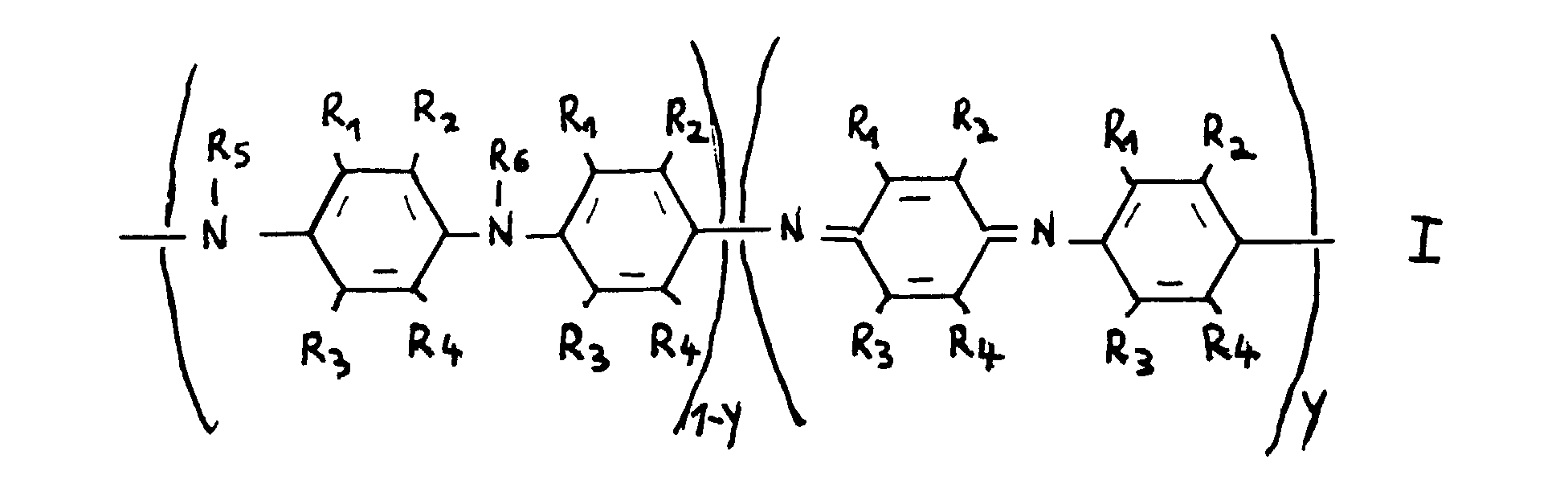
in welchem
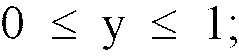
jedes R1, R2, R3, R4, R5 und R6 ausgewählt ist aus H, -SO3M, -SO3H, -R7SO3M, -R7SO3H, -OCH3, -CH3, -C2H5, -F, -Cl, -Br, -I, -N(R7)2, -NHCOR7, -OH, -O-, -SR7, OR7, -OCOR7, -NO2, -COOH, COOR7, -COR7, -CHO und -CN, in welchen R7 C1-C8-Alkyl, Aryl oder Aralkyl ist, und M ein Kation ist; und
das Verhältnis von Ringen, in welchen mindestens einer von R1, R2, R3 und R4 gleich -SO3M oder -R7SO3M ist, von 20 bis 100 Prozent beträgt.
in welchem
jedes R1, R2, R3, R4, R5 und R6 ausgewählt ist aus H, -SO3M, -SO3H, -R7SO3M, -R7SO3H, -OCH3, -CH3, -C2H5, -F, -Cl, -Br, -I, -N(R7)2, -NHCOR7, -OH, -O-, -SR7, OR7, -OCOR7, -NO2, -COOH, COOR7, -COR7, -CHO und -CN, in welchen R7 C1-C8-Alkyl, Aryl oder Aralkyl ist, und M ein Kation ist; und
das Verhältnis von Ringen, in welchen mindestens einer von R1, R2, R3 und R4 gleich -SO3M oder -R7SO3M ist, von 20 bis 100 Prozent beträgt.
2. Sulfoniertes Polyanilinsalz gemäß Anspruch 1, in welchem jedes R1 ausgewählt ist aus -SO3M und -R7SO3M, jedes R2, R3 und R4 gleich H ist, und 0,35 ≤ y ≤ 0,65 ist.
3. Sulfoniertes Polyanilinsalz gemäß Anspruch 1 oder Anspruch 2, mit einem Molekulargewicht
von 300 (Oligomere von sulfoniertem Polyanilin) bis über 100 000.
4. Sulfoniertes Polyanilinsalz gemäß einem der Ansprüche 1 bis 3, wobei M ausgewählt
ist aus Li+, Na+, K+, Rb+, Cs+, NH4+, Ca++ und Ba++.
5. Verfahren zur Herstellung eines sulfonierten Polyanilinsalzes gemäß einem der Ansprüche
1 bis 4, welches das Umsetzen eines sulfonierten protonierten Polyanilins mit einer
wäßrigen Base umfaßt.
6. Verfahren gemäß Anspruch 5, wobei die Umsetzung bei Raumtemperatur durchgeführt wird.
7. Verfahren gemäß Anspruch 5 oder Anspruch 6, wobei die Umsetzung an Luft durchgeführt
wird.
8. Verfahren gemäß einem der Ansprüche 5 bis 7, in welchem die Kettenlänge des Polyanilins
während der Umsetzung nicht verringert wird.
9. Verwendung eines sulfonierten Polyanilinsalzes gemäß einem der Ansprüche 1 bis 4 zum
Absorbieren von elektromagnetischer Strahlung.
10. Verwendung gemäß Anspruch 9 zum Kuppeln von optischen Signalen, in welchem das sulfonierte
Polyanilinsalz auf erste und zweite photoleitende Substrate angewendet wird und in
Kontakt mit ihnen steht, ein optisches Signal durch das erste photoleitende Substrat
induziert wird, das sulfonierte Polyanilinsalz Licht einer ausreichenden Intensität
und von einer derartigen Wellenlänge ausgesetzt wird, um seinen Brechungsindex so
zu verändern, daß das induzierte optische Signal durch das sulfonierte Polyanilinsalz
in und durch das zweite photoleitende Substrat gekoppelt wird.
11. Verwendung gemäß Anspruch 9 zur Dämpfung von Mikrowellenstrahlung.
12. Verwendung gemäß Anspruch 9 zur Speicherung und Abfrage von Informationen in einem
optischen hochdichten löschbaren Format, wobei eine einen Film des sulfonierten Polyanilinsalzes
umfassende Speichereinheit auf einer Temperatur von gleich oder weniger als 100°K
gehalten wird, die Speichereinheit einem der Information entsprechenden schreibenden
Strahl mit einer bekannten Photonenfrequenz und einer Intensität ausgesetzt wird,
um die optischen Absorptionscharakteristiken des sulfonierten Polyanilinsalzes zu
verändern, und die Speichereinheit einem lesenden Strahl mit einer zweiten bekannten
Photonenfrequenz und Intensität ausgesetzt wird, welche zu den veränderten optischen
Absorptionscharakteristiken des sulfonierten Polyanilinsalzes passen.
13. Verwendung gemäß Anspruch 12, wobei der schreibende Strahl ein fokussierter Strahl
eines bei 632,8 nm arbeitenden Helium/Neon-Lasers ist, die Speichereinheit das sulfonierte
Polyanilinsalz als einen Film der Dicke von 1 um oder weniger umfaßt und der lesende
Strahl von einem Halbleiter-Diodenlaser stammt, der bei 800 nm oder 1550 nm arbeitet.
14. Verwendung gemäß Anspruch 9 zur Herstellung eines dreidimensionalen holographischen
Gitters, wobei ein dicker Film des sulfonierten Polyanilinsalzes in einem Wirtspolymer
dispergiert wird, zwei Lichtstrahlen auf dem Film fokussiert werden, um ein Interferenzmuster
auf dem Film zu erzeugen, und der Film einem lesenden Strahl ausgesetzt wird.
15. Verwendung gemäß Anspruch 14, wobei die beiden fokussierten Lichtstrahlen von einem
bei 632,8 nm arbeitenden Niederenergie-Helium/Neon-Laser stammen und der lesende Strahl
von einem Halbleiter-Diodenlaser stammt, welcher bei 800, 1300 oder 1550 nm arbeitet.
1. Sel de polyaniline sulfonée ayant des unités récurrentes de formule (I) :
dans laquelle :
dans laquelle :
- 0 ≤ y ≤ 1 ;
- chaque R1, R2, R3, R4, R5 et R6 est choisi parmi H, -SO3M, -SO3H, -R7SO3M, -R7SO3H, -OCH3, -CH3, -C2H5, -F, -Cl, -Br, -I, -N(R7)2, -NHCOR7, -OH, -O-, -SR7, OR7, -OCOR7, -NO2, -COOH, COOR7, -COR7, -CHO et -CN, où R7 représente alkyle en C1-C8, aryle ou aralkyle et M est un cation ; et
- la proportion de noyaux dans lesquels au moins l'un parmi R1, R2, R3 et R4 représente -SO3M ou -R7SO3M est de 20 à 100 pour cent.
2. Sel de polyaniline sulfonée selon la revendication 1, dans lequel chaque R1 est choisi parmi -SO3M et -R7SO3M, chaque R2, R3 et R4 représente H et 0,35 ≤ y ≤ 0,65.
3. Sel de polyaniline sulfonée selon la revendication 1 ou la revendication 2, ayant
une masse moléculaire de 300 (oligomères de polyaniline sulfonée) à plus de 100 000.
4. Sel de polyaniline sulfonée selon l'une quelconque des revendications 1 à 3, dans
lequel M est choisi parmi Li+, Na+, K+, Rb+, Cs+, NH4+, Ca++ et Ba++.
5. Procédé de préparation d'un sel de polyaniline sulfonée, tel que défini à l'une quelconque
des revendications 1 à 4, comprenant la réaction d'une polyaniline protonée, sulfonée,
avec une base aqueuse.
6. Procédé selon la revendication 5, dans lequel la réaction est effectuée à la température
ambiante.
7. Procédé selon la revendication 5 ou la revendication 6, dans lequel la réaction est
effectuée dans l'air.
8. Procédé selon l'une quelconque des revendications 5 à 7, dans lequel la longueur de
chaîne de la polyaniline n'est pas réduite pendant la réaction.
9. Utilisation d'un sel de polyaniline sulfonée tel que défini à l'une quelconque des
revendications 1 à 4 pour absorber le rayonnement électromagnétique.
10. Utilisation selon la revendication 9 pour coupler des signaux optiques, dans laquelle
le sel de polyaniline sulfonée est appliqué sur et est mis en contact avec des premier
et second substrats phototransmetteurs, un signal optique est induit à travers le
premier substrat phototransmetteur, le sel de polyaniline sulfonée est exposé à de
la lumière d'une intensité suffisante pour, et d'une longueur d'onde capable de, modifier
son indice de réfraction de telle sorte que le signal optique induit soit couplé par
l'intermédiaire du sel de polyaniline sulfonée dans et à travers le second substrat
phototransmetteur.
11. Utilisation selon la revendication 9 pour atténuer le rayonnement micro-ondes.
12. Utilisation selon la revendication 9 pour le stockage et la recherche d'informations
dans un format effaçable à haute densité optique, dans laquelle une unité de stockage
comprenant un film du sel de polyaniline sulfonée est maintenue à une température
de, ou au-dessous de, 100°K, l'unité de stockage est exposée à un faisceau d'écriture
représentatif des informations ayant une fréquence et une intensité de photons connues
pour modifier les caractéristiques d'absorption optique du sel de polyaniline sulfonée,
et l'unité de stockage est exposée à un faisceau de lecture ayant une seconde fréquence
et une seconde intensité de photons connues, adaptées aux caractéristiques d'absorption
optique modifiées du sel de polyaniline sulfonée.
13. Utilisation selon la revendication 12, dans laquelle le faisceau d'écriture est un
faisceau focalisé provenant d'un laser à hélium et néon fonctionnant à 632,8 nm, l'unité
de stockage comprend le sel de polyaniline sulfonée sous la forme d'un film d'une
épaisseur de 1 µm ou au-dessous et le faisceau de lecture provient d'un laser à diodes
à semi-conducteurs fonctionnant à 800 nm ou 1550 nm.
14. Utilisation selon la revendication 9 pour produire un réseau holographique tridimensionnel
dans laquelle un film épais du sel de polyaniline sulfonée est dispersé dans un polymère
hôte, deux faisceaux lumineux sont focalisés sur le film pour créer un motif d'interférence
sur le film et le film est exposé à un faisceau de lecture.
15. Utilisation selon la revendication 14, dans laquelle les deux faisceaux lumineux focalisés
proviennent d'un laser à hélium et néon de basse puissance fonctionnant à 632,8 nm,
et le faisceau de lecture provient d'un laser à diodes à semi-conducteurs fonctionnant
à 800, 1300 ou 1550 nm.