|
(11) | EP 0 497 990 B1 |

| (12) | EUROPEAN PATENT SPECIFICATION |
|
|
| (54) |
PROCESS FOR PRODUCING TRIFLUORINATED HYDROCARBON COMPOUND VERFAHREN ZUR HERSTELLUNG EINES TRIFLUORSUBSTITUIERTEN KOHLENWASSERSTOFFS PROCEDE DE PRODUCTION D'UN COMPOSE D'HYDROCARBURE TRIFLUORE |
|
|
|||||||||||||||||||||||||||||||
| Note: Within nine months from the publication of the mention of the grant of the European patent, any person may give notice to the European Patent Office of opposition to the European patent granted. Notice of opposition shall be filed in a written reasoned statement. It shall not be deemed to have been filed until the opposition fee has been paid. (Art. 99(1) European Patent Convention). |
[0002] Various fluorine-containing compounds have heretofore been used as medicines, pesticides, detergents and solvents, and as raw materials and intermediates used for the preparation of these materials; e.g. an anesthetic inhalant containing a fluorinated aliphatic hydrocarbon as disclosed in JP-A-48-505.
[0003] In recent years, to cope with an environmental problem of depletion of the ozone layer caused by Freon® compounds, especially chlorofluorocarbons, other fluorine-containing compounds have been intensively investigated and developed as substitutes for Freon compounds.
[0004] As the process for preparing the fluorine-containing compounds, a process is known as having a high practical use which comprises converting a carbon-hydrogen bond of a hydrocarbon compound to a carbon-fluorine bond by using cobalt trifluoride (CoF₃) [see, for example, R. E. Banks, J. C. Tatlow, J. Fluorine Chem., 33, 227(1986)].
[0005] However, there are no great differences among the reactivities of the plurality of carbon-hydrogen bonds in the hydrocarbon compound used as the raw material, and therefore, a mixture of various fluorinated compounds having one or more bonded fluorine atoms or many isomers are inevitably produced, namely, the fluorination reaction is not selective. Thus, a process for selectively fluorinating hydrocarbon compounds by using a cobalt trifluoride is not known.
[0006] In view of the foregoing state of art, an object of the present invention is to solve the problems of the conventional process, and to provide a process by which a fluorine-containing compound can be efficiently prepared with high selectivity.
[0007] More specifically, an object of the present invention is to provide a process for the preparation of a fluorine-containing compound wherein a gem-difluorohydrocarbon compound is capable of being partially fluorinated under mild reaction conditions with high selectivity.
[0008] In accordance with the present invention, there is provided a process for preparing a trifluorohydrocarbon compound represented by the following formula (2):
wherein R is an alkyl group having 1 to 4 carbon atoms, and each of R' and R'' is a hydrogen atom, a halogen atom or an alkyl group having 1 to 4 carbon atom, which may have a halogen substituent,
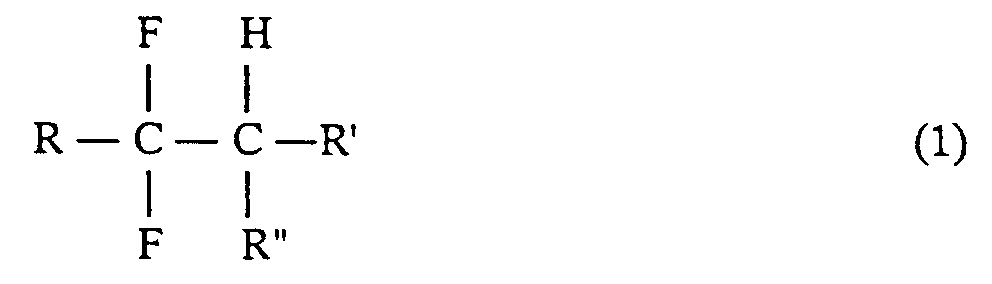
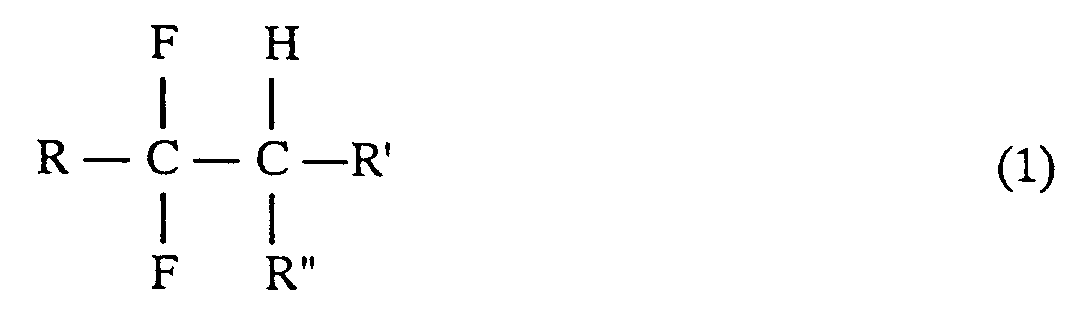
which comprises the step of reacting a difluorohydrocarbon compound represented by the following formula (1):
wherein R, R' and R'' are as defined above, with cobalt trifluoride.
[0009] The starting compound used in the process of the present invention is a difluorohydrocarbon compound which is represented by the above formula (1) wherein R is an alkyl group having 1 to 4 carbon atoms, each of R' and R'' is a hydrogen atom, a halogen atom or an alkyl group having 1 to 4 carbon atom, which may have a halogen substituent. As the alkyl groups, there can be mentioned, for example, a methyl group, an ethyl group, an isopropyl group, a butyl group and an isobutyl group. As the halogen atom, there can be mentioned, for example, a chlorine atom and a bromine atom. As specific examples of the difluorohydrocarbon compound of the formula (1), there can be mentioned 2,2-difluoropropane, 2,2-difluorobutane, 2,2-difluoropentane, 3,3-difluoropentane, 2,2-difluoro-1-chloropropane, 2,2-difluoro-1,1-dichloropropane, 3,3-difluoro-1-chlorobutane and 3,3-difluoro-1-chloropentane.
[0010] These difluorohydrocarbon compounds of the formula (1) can be prepared by known procedures. For example, there can be mentioned a process wherein a corresponding acetylene compound is reacted with hydrogen fluoride (HF), a process wherein a corresponding carbonyl compound is reacted with a fluorinating agent such as SF₄, and a process wherein a corresponding dichlorohydrocarbon compound is reacted with SbF₄.
[0011] The reaction of the difluorohydrocarbon of the formula (1) with cobalt trifluoride (CoF₃) is carried out at a temperature not higher than 150°C, preferably 100°C to -50°C. Where the temperature exceeds 150°C, a non-selective fluorination reaction may occur. Therefore, it is preferable that the temerature is gradually elevated and the reaction is carried out at the above-mentioned low temperature.
[0012] The reaction may be carried out either in the liquid or gaseous phase, and either in a batchwise manner or a continuous manner. The reation time is not particularly limited, but is usually in the range of about 10 minutes to about 5 days. The proportion of cobalt trifluoride to the difluorohydrocarbon is such that the amount of cobalt trifluoride is at least 2 moles, preferably 2 to about 200 moles, per mole of the difluorohydrocarbon compound.
[0013] When the reaction is carried out in the liquid phase, a liquid medium may be used. The liquid medium used is not particularly limited, and halogenated hydrocarbon liquid media such as carbon tetrachloride, dichlorodifluoromethane and trichlorofluoromethane are preferably used.
[0014] By reacting the difluorohydrocarbon compound with cobalt trifluoride under the above-mentioned conditions, the gem-difluorohydrocarbon compound can be selectively and partially fluorinated under mild conditions to yield the trifluorohydrocarbon compound of the formula (2) at a high efficiency.
[0015] The process for the preparation of the trifluorohydrocarbon compound in accordace with the present invention will be specifically described by the following examples.
Referential Example
[0016] To 351 milli-moles of hydrogen fluoride maintained at -20°C, 133 milli-moles of butyne-2 was gradually added and the temperature of the mixture was slowly elevated over a period of 1 hour, and the reaction was carried out at room temperature for 10 minutes.
[0017] After the completion of the reaction, hydrogen fluoride was removed from the the reaction mixture and the product was purified by distillation to give 70 milli-moles of 2,2-difluorobutane having a purity of 98%.
Example 1
[0018] A stainless steel reactor having an inner volume of 150 ml was charged with 200 milli-moles of CoF₃, and then 3 milli-moles of the 2,2-difluorobutane prepared in the referential example was added into the CoF₃ at a temperature of -196°C. The reactor was gradually heated and maintained at 50°C for 1 hour.
[0019] Hydrogen fluoride (by-product) was removed from the reaction mixture and the product was purified by distillation to give 2,2,3-trifluorobutane having a purity of 83% in a yield of 76%.
[0020] The purity was determined by the gas chromatography and the yield was calculated from the results of the ¹⁹F-NMR and the gas chromatography. The 2,2,3-trifluorobutane was identified by the analyses of ¹⁹F-NMR, ¹H-NMR and GC-MS.
Examples 2 - 5
[0021] By the same procedures described in Example 1, the reaction was carried out and the trifluorhydrocarbon compounds were separated wherein the reaction conditions described in Table 1 were employed. The purities and yields of the trifluorohydrocarbon compounds are shown in Table 1.
[0022] Thus, the trifluorhydrocarbon compounds could be obtained with high purity and in high yield.
Industrial Applicability
1. A process for preparing a trifluorohydrocarbon compound represented by the following
formula (2):

wherein R is an alkyl group having 1 to 4 carbon atoms, and each of R' and R'' is a hydrogen atom, a halogen atom or an alkyl group having 1 to 4 carbon atoms, which may have a halogen substituent,
which comprises the step of reacting a difluorohydrocarbon compound represented by the following formula (1):

wherein R, R' and R'' are as defined above, with cobalt trifluoride.
wherein R is an alkyl group having 1 to 4 carbon atoms, and each of R' and R'' is a hydrogen atom, a halogen atom or an alkyl group having 1 to 4 carbon atoms, which may have a halogen substituent,
which comprises the step of reacting a difluorohydrocarbon compound represented by the following formula (1):
wherein R, R' and R'' are as defined above, with cobalt trifluoride.
2. A process for preparing a trifluorohydrocarbon compound as claimed in claim 1, wherein
the reaction is carried out at a temperature not higher than 150°C.
3. A process for preparing a trifluorohydrocarbon compound as claimed in claim 1, wherein
the reaction is carried out at a temperature of -50°C to 100°C.
4. A process for preparing a trifluorhydrocarbon compound as claimed in claim 1, wherein
the reaction is carried out in the liquid phase or the gaseous phase.
5. A process for preparing a trifluorohydrocarbon compound as claimed in claim 1, wherein
the reaction is carried out in a batchwise manner or a continuous manner.
6. A process for preparing a trifluorohydrocarbon compound as claimed in claim 1, wherein
the reaction is carried out for 10 minutes to 5 days.
7. A process for preparing a trifluorohydrocarbon compound as claimed in claim 1, wherein
the amount of cobalt trifluoride is at least 2 moles per mole of the difluorohydrocarbon
compound.
8. A process for preparing a trifluorohydrocarbon compound as claimed in claim 1, wherein
the amount of cobalt trifluoride is 2 to 200 moles per mole of the difluorohydrocarbon
compound.
9. A process for preparing a trifluorohydrocarbon compound as claimed in claim 1, wherein
the reaction is carried out in the liquid phase by using a halogenated hydrocarbon
liquid medium.
1. Verfahren zur Herstellung einer Trifluorkohlenwasserstoffverbindung der folgenden
Formel (2):

wobei R ein Alkylrest mit 1 bis 4 Kohlenstoffatomen ist, und R' sowie R'' jeweils ein Wasserstoffatom, ein Halogenatom, oder ein Alkylrest, mit 1 bis 4 Kohlenstoffatomen, der einen Halogensubstituenten tragen kann, sind,
umfassend den Schritt der Umsetzung einer Difluorkohlenwasserstoffverbindung der folgenden Formel (1):
wobei R, R' und R'' wie vorstehend definiert sind,
mit Kobalttrifluorid.
wobei R ein Alkylrest mit 1 bis 4 Kohlenstoffatomen ist, und R' sowie R'' jeweils ein Wasserstoffatom, ein Halogenatom, oder ein Alkylrest, mit 1 bis 4 Kohlenstoffatomen, der einen Halogensubstituenten tragen kann, sind,
umfassend den Schritt der Umsetzung einer Difluorkohlenwasserstoffverbindung der folgenden Formel (1):
wobei R, R' und R'' wie vorstehend definiert sind,
mit Kobalttrifluorid.
2. Verfahren zur Herstellung einer Trifluorkohlenwasserstoffverbindung nach Anspruch
1, wobei die Reaktion bei einer Temperatur unterhalb von 150 °C durchgeführt wird.
3. Verfahren zur Herstellung einer Trifluorkohlenwasserstoffverbindung nach Anspruch
1, wobei die Reaktion bei einer Temperatur von -50° bis 100 °C durchgeführt wird.
4. Verfahren zur Herstellung einer Trifluorkohlenwasserstoffverbindung nach Anspruch
1, wobei die Reaktion in flüssiger Phase oder in der Gasphase durchgeführt wird.
5. Verfahren zur Herstellung einer Trifluorkohlenwasserstoffverbindung nach Anspruch
1, wobei die Reaktion absatzweise oder kontinuierlich durchgeführt wird.
6. Verfahren zur Herstellung einer Trifluorkohlenwasserstoffverbindung nach Anspruch
1, wobei die Reaktion innerhalb 10 Minuten bis 5 Tagen durchgeführt wird.
7. Verfahren zur Herstellung einer Trifluorkohlenwasserstoffverbindung nach Anspruch
1, wobei die Menge an Kobalttrifluorid wenigstens 2 Mol je Mol der Difluorkohlenwasserstoffverbindung
beträgt.
8. Verfahren zur Herstellung einer Trifluorkohlenwasserstoffverbindung nach Anspruch
1, wobei die Menge an Kobalttrifluorid 2 bis 200 Mol je Mol der Difluorkohlenwasserstoffverbindung
beträgt.
9. Verfahren zur Herstellung einer Trifluorkohlenwasserstoffverbindung nach Anspruch
1, wobei die Reaktion in flüssiger Phase unter Verwendung eines flüssigen, halogenierten
Kohlenwasserstoffs durchgeführt wird.
1. Procédé pour préparer un composé trifluorohydrocarbure représenté par la formule (2)
suivante :

dans laquelle R est un coupe alkyle en C₁-C₄ et R' et R'' sont chacun un atome d'hydrogène, un atome d'halogène ou un groupe alkyle en C₁-C₄, qui peut avoir un substituant halogène,
qui comprend l'étape de réaction d'un composé difluorohydrocarbure représenté par la formule (1) suivante :
dans laquelle R, R' et R'' sont définis comme ci-dessus,
avec le trifluorure de cobalt.
dans laquelle R est un coupe alkyle en C₁-C₄ et R' et R'' sont chacun un atome d'hydrogène, un atome d'halogène ou un groupe alkyle en C₁-C₄, qui peut avoir un substituant halogène,
qui comprend l'étape de réaction d'un composé difluorohydrocarbure représenté par la formule (1) suivante :
dans laquelle R, R' et R'' sont définis comme ci-dessus,
avec le trifluorure de cobalt.
2. Procédé pour préparer un composé trifluorohydrocarbure selon la revendication 1, dans
lequel la réaction est effectuée à une température de pas plus de 150°C.
3. Procédé pour préparer un composé trifluorohydrocarbure selon la revendication 1, dans
lequel la réaction est effectuée à une température de -50 à 100°C.
4. Procédé pour préparer un composé trifluorohydrocarbure selon la revendication 1, dans
lequel la réaction est effectuée en phase liquide ou en phase gazeuse.
5. Procédé pour préparer un composé trifluorohydrocarbure selon la revendication 1, dans
lequel la réaction est effectuée en discontinu ou en continu.
6. Procédé pour préparer un composé trifluorohydrocarbure selon la revendication 1, dans
lequel la réaction est effectuée pendant 10 min à 5 jours.
7. Procédé pour préparer un composé trifluorohydrocarbure selon la revendication 1, dans
lequel la quantité de trifluorure de cobalt est d'au moins 2 mol par mole du composé
difluorohydrocarbure.
8. Procédé pour préparer un composé trifluorohydrocarbure selon la revendication 1, dans
lequel la quantité de trifluorure de cobalt est de 2 à 200 mol par mole du composé
difluorohydrocarbure.
9. Procédé pour préparer un composé trifluorohydrocarbure selon la revendication 1, dans
lequel la réaction est effectuée en phase liquide avec un milieu liquide du type hydrocarbure
halogéné.