|
(11) | EP 0 500 131 A2 |

| (12) | EUROPEAN PATENT APPLICATION |
|
|
|
|
|||||||||||||||||||||||||||
| (54) | Polycarbonate resin solution for film formation by casting |
| (57) A polycarbonate resin solution for use in film formation by casting and a process
for producing the same are disclosed. The polycarbonate resin solution comprising
an organic solvent and dissolved therein a copolycarbonate resin having a structural
unit of formula (1) and a structural unit of formula (2), with the content of the
structural unit of formula (2) in all the structural units being from 0.1 to 50% by
weight. The polycarbonate resin having a viscosity average molecular weight of from
15,000 to 100,000. |
FIELD OF THE INVENTION
[0001] The present invention relates to a polycarbonate resin solution for use in film formation by casting. More particularly, this invention relates to a polycarbonate resin solution having excellent suitability for film formation by casting due to the polycarbonate resin having a specific structure, and also relates to a process for producing the polycarbonate resin solution.
BACKGROUND OF THE INVENTION
[0002] It is well known that in the cast-film process, a film is produced by casting a resin solution onto the surface of a drum or belt to form a wet film on the surface and removing the solvent from the wet film by hot-air drying, and that a roll, plate, or other various parts are dipped into a resin solution to coat or line the surface. However, polycarbonate resin solutions for such uses generally begin to become milky in 3 to 4 days when allowed to stand. It has therefore been necessary to use polycarbonate resin solutions having low resin concentrations or to redissolve the precipitate or otherwise treat the milky resin solution before use, resulting in a disadvantage of poor production efficiency in film formation by casting. Furthermore, films obtained from conventional polycarbonate resin solutions have been unsatisfactory in, for example, that they have low hardness and poor abrasion resistance.
SUMMARY OF THE INVENTION
[0003] An object of the present invention is to overcome these problems by using a specific polycarbonate resin.
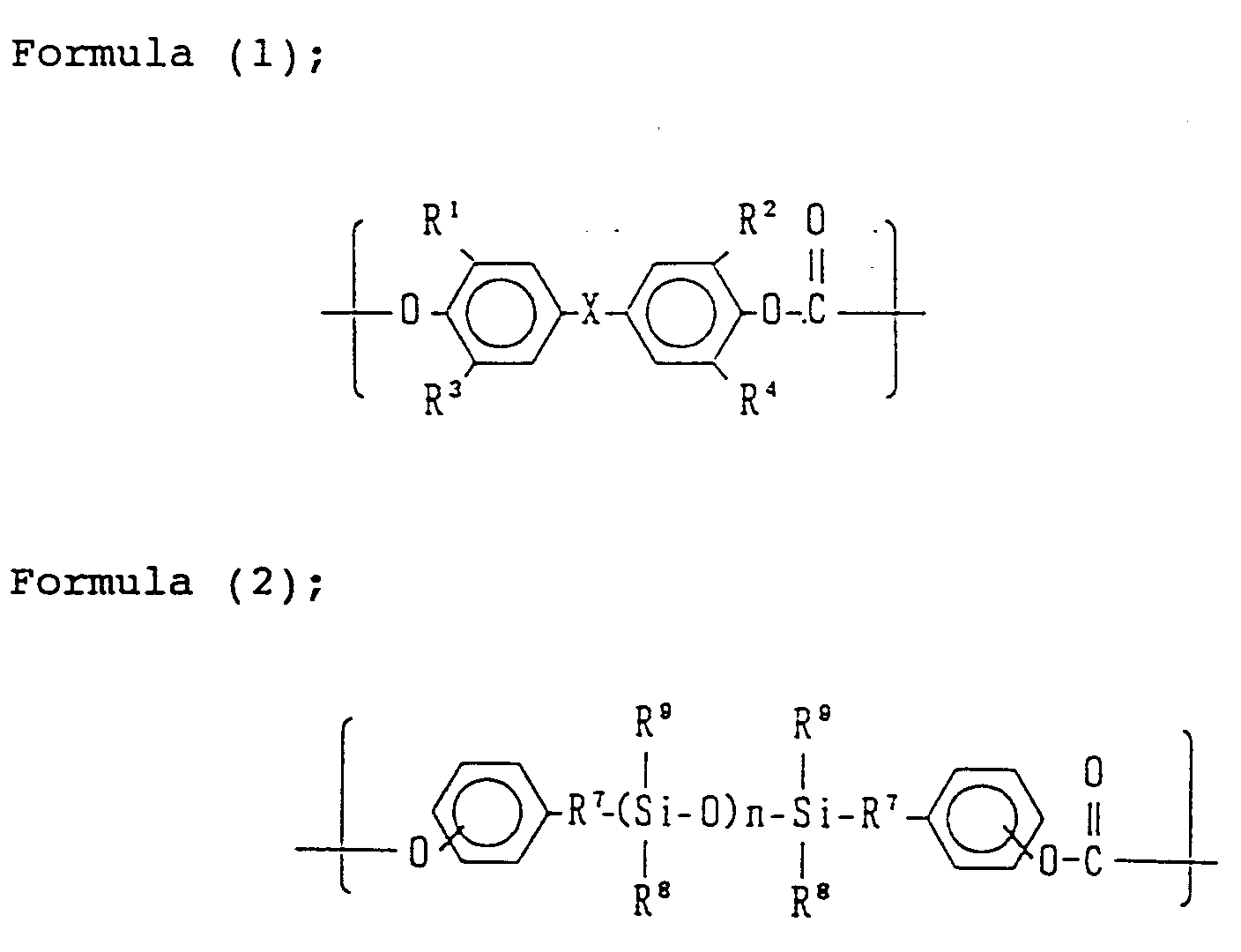
[0004] The present invention provides a polycarbonate resin solution for use in film formation by casting which comprises an organic solvent and dissolved therein a copolycarbonate resin having a structural unit represented by the following formula (1) and a structural unit represented by the following formula (2), with the content of the structural unit of formula (2) in all the structural units being from 0.1 to 50% by weight, and having a viscosity-average molecular weight of from 15,000 to 100,000:
wherein in formula (1), R¹ and R² each represents hydrogen atom, a halogen atom, or an alkyl group having from 1 to 4 carbon atoms, R³ and R⁴ each represents an alkyl group having from 1 to 4 carbon atoms, and -X- represents a straight-chain or branched alkylidene group having from 1 to 10 carbon atoms, an arylene group, sulfonyl group, a group
of the formula
wherein R⁵ represents hydrogen atom, a halogen atom, or an alkyl group having from 1 to 4 carbon atoms and R⁶ represents an alkyl group having from 1 to 3 carbon atoms or an aryl group, or a substituted or unsubstituted carbocyclic or heterocyclic ring of the formula
wherein Z represents a group of atoms necessary for forming the ring; and in formula (2), R⁷ represents an alkylene or alkylidene group having from 2 to 6 carbon atoms, R⁸ and R⁹ each represents an alkyl group having from 1 to 3 carbon atoms or an aryl group, and n is an integer of from 1 to 200.
[0005] The present invention further provides a process for producing the above polycarbonate resin solution.
DETAILED DESCRIPTION OF THE INVENTION
[0006] The polycarbonate resin used in the present invention can be obtained by copolymerizing dihydric phenols represented by the following formulae (3) and (4) with phosgene, a carbonic acid ester, or a chloroformate:
wherein in formula (3), R¹ and R² each represents hydrogen atom, a halogen atom, or an alkyl group having from 1 to 4 carbon atoms, R³ and R⁴ each represents an alkyl group having from 1 to 4 carbon atoms, and -X- represents a straight-chain or branched alkylidene group having from 1 to 10 carbon atoms, an arylene group, sulfonyl group, a group
of the formula
wherein R⁵ represents hydrogen atom, a halogen atom, or an alkyl group having from 1 to 4 carbon atoms and R⁶ represents an alkyl group having from 1 to 3 carbon atoms or an aryl group, or a substituted or unsubstituted carbocyclic or heterocyclic ring of the formula
wherein Z represents a group of atoms wherein Z represents a group of atoms necessary for forming the ring; and in formula (4), R⁷ represents an alkylene or alkylidene group having from 2 to 6 carbon atoms, R⁸ and R⁹ each represents an alkyl group having from 1 to 3 carbon atoms or an aryl group, and n is an integer of from 1 to 200. This polycarbonate resin has structural units respectively represented by formulae (1) and (2) described above and has a viscosity-average molecular weight of from 15,000 to 100,000, preferably from 20,000 to 50,000.
[0007] In the above copolymerization, the dihydric phenol of formula (4) is used in an amount of from 0.1 to 50% by weight, preferably from 0.1 to 30% by weight, based on the total amount of all the dihydric phenols used. If the amount used of the dihydric phenol of formula (4) is below 0.1% by weight, the polycarbonate resin obtained is poor in slip properties, abrasion resistance, and other properties. If the amount thereof exceeds 50% by weight, the resulting polycarbonate resin is low in solubility, and solutions of such a polycarbonate resin have poor stability and poor film-forming properties.
[0008] Examples of the dihydric phenol compound represented by formula (3) used as a raw material for producing the copolycarbonate resin of the present invention include bis(4-hydroxy-3-methylphenyl)methane, 1,1-bis(4-hydroxy-3-methylphenyl)ethane, 2,2-bis(4-hydroxy-3-methylphenyl)propane (=dimethylbisphenol A; DMBPA), 2,2-bis(4-hydroxy-3-methylphenyl)butane, 2,2-bis(4-hydroxy-3,5-dimethylphenyl)propane (=tetramethylbisphenol A; TMBPA), 2,2-bis(4-hydroxy-3-chloro-5-methylphenyl)propane,2,2-bis(4-hydroxy-3-bromo-5-methylphenyl)propane, 2,2-bis[4-hydroxy-3-(2-propyl)phenyl]propane (=diisopropylbisphenol A; DPBPA), 1,1-bis(4-hydroxy-3-methylphenyl)ethane, 1,1-bis(4-hydroxy-3,5-dimethylphenyl)ethane, bis(4-hydroxy-3-methylphenyl)sulfone, bis(4-hydroxy-3,5-dimethylphenyl)sulfone, 1,1-bis(4-hydroxyphenyl)-1-phenylethane (=bisphenol AP; BPAP), 1,1-bis(3-methyl-4-hydroxyphenyl)-1-phenylethane (=dimethylbisphenol AP; DMBPAP), 1,1-bis(3-bromo-4-hydroxyphenyl)-1-phenylethane, 1,1-bis(3-chloro-4-hydroxyphenyl)-1-phenylethane, 1,1-bis(3,5-dimethyl-4-hydroxyphenyl)-1-phenylethane, 1,1-bis(3,5-dibromo-4-hydroxyphenyl)-1-phenylethane, 1,1-bis(3,5-dichloro-4-hydroxyphenyl)-1-phenylethane, 1,1-bis(4-hydroxyphenyl)-1-phenylbutane, bis(4-hydroxyphenyl)diphenylmethane (=bisphenol BP; BPBP), bis-(4-hydroxyphenyl)phenylmethane, and the like. Further, representative examples of the compound of formula (3) which have a carbocyclic or heterocyclic ring include 1,1-bis(4-hydroxyphenyl)cyclohexane (=bisphenol Z; BPZ), 1,1-bis(3-methyl-4-hydroxyphenyl)cyclohexane (=dimethylbisphenol Z; DMBPZ), 1,1-bis(3-bromo-4-hydroxyphenyl)cyclohexane, 1,1-bis(3-chloro-4-hydroxyphenyl)cyclohexane, 1,1-bis(3,5-dimethyl-4-hydroxyphenyl)cyclohexane, 1,1-bis(3,5-dibromo-4-hydroxyphenyl)cyclohexane, 1,1-bis(3,5-dichloro-4-hydroxyphenyl)cyclohexane, and the like. Preferred of these are 2,2-bis(4-hydroxy-3-methylphenyl)propane, 2,2-bis(4-hydroxy-3,5-dimethylphenyl)propane,2,2-bis[4-hydroxy-3-(2-propyl)phenyl]propane, bisphenol AP, dimethylbisphenol AP, bisphenol BP, bisphenol Z, dimethylbisphenol Z, and the like.
[0009] In combination with the dihydric phenol of formula (3), a dihydric phenol represented by formula (4) is used as another raw material for producing the copolycarbonate resin of the present invention. Symbol n in formula (4) which indicates the number of repeated units is from 1 to 200, preferably from 5 to 100. Examples of R⁷ in formula (4) include ethylene, propylene, isopropylene, butylene, pentylene, and hexylene groups and the like, with -CH₂CH₂CH₂- and -CHR¹⁰-CH₂- (where R¹⁰ is linked to the benzene ring-bonded carbon atom and represents hydrogen atom or methyl group) being particularly preferred. The structural unit of formula (2) is introduced into the polycarbonate resin by using the dihydric phenol of formula (4) having a phenolic hydroxyl group at both ends thereof in the same manner as that for ordinary dihydric phenols. This dihydric phenol represented by formula (4) can be easily produced by subjecting a phenol compound having an olefinically unsaturated carbon-carbon bond, preferably vinylphenol, allylphenol, or isopropenylphenol, to hydrosilanation reaction with a polysiloxane having a desired degree of polymerization, n, to bond the phenol compound to both ends of the polysiloxane chain.
[0010] For the copolymerization, a chain terminator or molecular weight modifier is usually used, which can be a compound having one phenolic hydroxyl group. Besides ordinarily employed phenol, p-tert-butylphenol, tribromophenol, and the like, examples of the chain terminator or molecular weight modifier include (long-chain alkyl)phenols, aliphatic or aromatic carbonyl chlorides, aliphatic or aromatic carboxylic acids, hydroxybenzoic acid esters, hydroxyphenylalkyl acid esters, alkoxyphenols, and the like. The amount of the chain terminator or molecular weight modifier used is from 100 to 0.5 mol, preferably from 50 to 1 mol, per 100 mol of all the dihydric phenol compounds used. It is of course possible to use two or more such compounds in combination as the chain terminator or molecular weight modifier.
[0011] A branching agent can also be used in an amount of from 0.01 to 3 mol, preferably from 0.1 to 1.0 mol, per 100 mol of all the dihydric phenol compounds used, to produce a branched polycarbonate. Examples of the branching agent include polyhydroxy compounds such as phloroglucin, 2,6-dimethyl-2,4,6-tris(4-hydroxyphenyl)heptene-3, 4,6-dimethyl-2,4,6-tris(4-hydroxyphenyl)heptene-2, 1,3,5-tris(2-hydroxyphenyl)benzole, 1,1,1-tris(4-hydroxyphenyl)ethane, 2,6-bis(2-hydroxy-5-methylbenzyl)-4-methylphenol, and α,α',α''-tris(4-hydroxyphenyl)-1,3,5-triisopropylbenzene and other compounds including 3,3-bis(4-hydroxyaryl)oxindole (=isatinbisphenol), 5-chloroisatin, 5,7-dichloroisatin, 5-bromoisatin, and the like.
[0012] If required and necessary, various kinds of known additives or ingredients for use with conventional polycarbonate resins can be added to the polycarbonate resin of the present invention. For example, a reinforcement, filler, stabilizer, ultraviolet absorber, antistatic agent, lubricant, release agent, dye, pigment, flame retardant, and other additives, an elastomer for improving impact resistance, and the like can be added. Particularly preferred examples of the stabilizer are phosphorous acid and phosphites. Examples of the release agent include esters of saturated aliphatic acids with mono- or polyhydric alcohols. Preferred of these are stearyl stearate, behenyl behenate, pentaerythritol tetrastearate, dipentaerythritol hexaoctoate, and the like. Examples of the filler and reinforcement include such organic or inorganic materials as glass powder, glass beads, synthetic or fluorinated mica, zinc oxide, carbon fibers, glass fibers particularly those containing fibers with diameters of 2 µm or less, zinc oxide whiskers, stainless-steel fibers, Kevlar fibers, and the like. Examples of the elastomer include methyl methacrylate-butadiene-styrene copolymer(MBS), methyl methacrylate-acrylonitrile-butadiene-styrene copolymer(MABS), methyl methacrylate-acrylonitrile-styrene copolymer(MAS), and others. Further, an ordinary polycarbonate, a polyester carbonate, a polyarylate, or a similar resin may, of course, be also suitably used according to the use of final films obtained.
[0013] As the solvent for use in preparing the polycarbonate resin solution of the present invention, any solvent can be used so long as it dissolves the above-described polycarbonate resin and has appropriate volatility. For example, halogenated solvents such as chlorobenzene and methylene chloride can be used. From the standpoint of safe and hygienic operations during casting, use of a non-halogenated solvent, particularly a hydrocarbon-type solvent such as toluene, xylene, ethylbenzene, or the like, is preferred. The polycarbonate resin concentration in the solution is usually from 1 to 30% by weight, preferably from 5 to 20% by weight. Unlike ordinary polycarbonate resins, the polycarbonate resin used in the present invention has an advantage that it shows high solubility also in non-halogenated solvents, e.g., toluene, and its solutions are highly stable.
[0014] As described above, the polycarbonate resin solution of the present invention can diminish the safety and hygienic problems associated with conventional cast-film processes, because the solution of the present invention for use in film formation by casting can be a solution in a non-halogenated solvent due to the specific polycarbonate resin used therein which has high solubility in non-halogenated solvents. Further, since the polycarbonate resin solution shows excellent stability in the solution state, use of the solution in film formation by casting brings about improved film production efficiency. Moreover, the films obtained from the solution of the present invention have advantages of high surface strength and high abrasion resistance.
[0015] The present invention will be explained below in more detail by reference to the following examples, but the invention is not construed as being limited thereto.
EXAMPLE 1
[0016] In 42 liters of water was dissolved 3.7 kg of sodium hydroxide. While the temperature of this solution was kept at 20°C, 8.18 kg of dimethylbisphenol A (DMBPA), 0.18 kg of a compound of formula (4) in which the average repeating unit in the silicone chain was Si(CH₃)₂O and n was 50, and R⁷ was -CH₂CH₂CH₂- bonded at the ortho position, and 8 g of hydrosulfite (HD) were dissolved therein.
[0017] To the resulting solution was added 28 liters of methylene chloride (MC), followed by addition of 96 g of p-t-butylphenol (PTBP) with stirring. Subsequently, 3.5 kg of phosgene (PG) was blown into the mixture over a period of 60 minutes. After completion of the phosgene blowing, the reaction mixture was vigorously stirred to emulsify it, and 8 g of triethylamine (TEA) was then added thereto. The resulting mixture was stirred for about 1 hour to proceed polymerization.
[0018] After the polymerization, the reaction mixture was separated into an aqueous phase and an organic phase. The organic phase was neutralized with phosphoric acid and then washed repeatedly with water until the washing became neutral in pH. Thereafter, 35 liters of isopropanol was added to the resulting organic phase to precipitate a polymer. The precipitate was filtered off and then dried, thereby obtaining a polycarbonate resin in white powder form. Properties of this polycarbonate resin were evaluated, and the results obtained are shown in Table 1.
COMPARATIVE EXAMPLE 1
[0019] A polycarbonate resin was obtained and evaluated in the same manner as in Example 1 except that 7.3 kg of BPA was used in place of 8.18 kg of DMBPA and 0.18 kg of the compound of formula (4). The results obtained are shown in Table 1.
EXAMPLES 2 TO 6 AND COMPARATIVE EXAMPLES 2 TO 4
[0020] Polycarbonate resins, the compositions of which are shown in Table 1, were obtained in the same manner as in Example 1 except that the kinds and amounts of the dihydric phenols of formulae (3) and (4) were changed. The dihydric phenols of formula (4) used in Examples 2 to 6 and Comparative Examples 3 and 4 were as follows.
Example 2:
Example 3:
Example 4:
Example 5:
Example 6:
Comparative Example 3:
Comparative Example 4:
[0027] Repeating unit; Si(CH₃)₂O, n=50
R⁷; -CH₂CH₂CH₂- bonded at ortho position
Properties of the thus-obtained polycarbonate resins were evaluated, and the results obtained are shown in Table 1.
EXAMPLE 7
[0028] In 42 liters of water was dissolved 3.7 kg of sodium hydroxide. While the temperature of this solution was kept at 20°C, 9.24 kg of bisphenol AP (BPAP), 0.53 kg of a compound of formula (4) in which the average repeating unit in the silicone chain was Si(CH₃)₂O and n was 50, and R⁷ was -CH₂CH₂CH₂- bonded at the ortho position, and 8 g of hydrosulfite (HD) were dissolved therein.
[0029] To the resulting solution was added 28 liters of methylene chloride (MC), followed by addition of 96 g of p-t-butylphenol (PTBP) with stirring. Subsequently, 3.5 kg of phosgene (PG) was blown into the mixture over a period of 60 minutes. After completion of the phosgene blowing, the reaction mixture was vigorously stirred to emulsify it, and 8 g of triethylamine (TEA) was then added thereto. The resulting mixture was stirred for about 1 hour to proceed polymerization.
[0030] After the polymerization, the reaction mixture was separated into an aqueous phase and an organic phase. The organic phase was neutralized with phosphoric acid and then washed repeatedly with water until the washing became neutral in pH. Thereafter, 35 liters of isopropanol was added to the resulting organic phase to precipitate a polymer. The precipitate was filtered off and then dried, thereby obtaining a polycarbonate resin in white powder form. Properties of this polycarbonate resin were evaluated, and the results obtained are shown in Table 2.
COMPARATIVE EXAMPLE 5
[0031] A polycarbonate resin was obtained and evaluated in the same manner as in Example 7 except that 7.3 kg of BPA was used in place of 9.24 kg of BPAP and 0.53 kg of the compound of formula (4). The results obtained are shown in Table 2.
EXAMPLES 8 TO 12 AND COMPARATIVE EXAMPLES 6 TO 8
[0032] Polycarbonate resins, the compositions of which are shown in Table 2, were obtained in the same manner as in Example 7 except that the kinds and amounts of the dihydric phenols of formulae (3) and (4) were changed. The dihydric phenols of formula (4) used in Examples 8 to 12 and Comparative Examples 7 and 8 were as follows.
Example 8:
Example 9:
Example 10:
Example 11:
Example 12:
Comparative Example 7:
Comparative Example 8:
[0039] Repeating unit; Si(CH₃)₂O, n=50
R⁷; -CH₂CH₂CH₂- bonded at ortho position
Properties of the thus-obtained polycarbonate resins were evaluated, and the results obtained are shown in Table 2.
EXAMPLE 13
[0040] In 42 liters of water was dissolved 3.7 kg of sodium hydroxide. While the temperature of this solution was kept at 20°C, 8.57 kg of bisphenol Z (BPZ), 94.5 g of a compound of formula (4) in which the average repeating unit in the silicone chain was Si(CH₃)₂O and n was 40, and R⁷ was -CH₂CH₂CH₂- bonded at the ortho position, and 8 g of hydrosulfite (HD) were dissolved therein.
[0041] To the resulting solution was added 28 liters of methylene chloride (MC), followed by addition of 148 g of p-t-butylphenol (PTBP) with stirring. Subsequently, 3.5 kg of phosgene (PG) was blown into the mixture over a period of 60 minutes. After completion of the phosgene blowing, the reaction mixture was vigorously stirred to emulsify it, and 8 g of triethylamine (TEA) was then added thereto. The resulting mixture was stirred for about 1 hour to proceed polymerization.
[0042] After the polymerization, the reaction mixture was separated into an aqueous phase and an organic phase. The organic phase was neutralized with phosphoric acid and then washed repeatedly with water until the washing became neutral in pH. Thereafter, 35 liters of isopropanol was added to the resulting organic phase to precipitate a polymer. The precipitate was filtered off and then dried, thereby obtaining a polycarbonate resin in white powder form. Properties of this polycarbonate resin were evaluated, and the results obtained are shown in Table 3.
COMPARATIVE EXAMPLE 9
[0043] A polycarbonate resin was obtained and evaluated in the same manner as in Example 13 except that 7.3 kg of BPA was used in place of 8.57 kg of BPZ and 94.5 g of the compound of formula (4). The results obtained are shown in Table 3.
EXAMPLES 14 TO 17 AND COMPARATIVE EXAMPLES 10 TO 12
[0044] Polycarbonate resins, the compositions of which are shown in Table 3, were obtained in the same manner as in Example 13 except that the kinds and amounts of the dihydric phenols of formulae (3) and (4) were changed. The dihydric phenols of formula (4) used in Examples 14 to 17 and Comparative Examples 11 and 12 were as follows.
Example 14:
Example 15:
Example 16:
Example 17:
Comparative Example 11:
Comparative Example 12:
1. A polycarbonate resin solution for use in film formation by casting which comprises
an organic solvent and dissolved therein a copolycarbonate resin having a structural
unit represented by the following formula (1) and a structural unit represented by
the following formula (2), with the content of the structural unit of formula (2)
in all the structural units being from 0.1 to 50% by weight, and having a viscosity-average
molecular weight of from 15,000 to 100,000:
wherein in formula (1), R¹ and R² each represents hydrogen atom, a halogen atom, or an alkyl group having from 1 to 4 carbon atoms, R³ and R⁴ each represents an alkyl group having from 1 to 4 carbon atoms, and -X- represents a straight-chain or branched alkylidene group having from 1 to 10 carbon atoms, an arylene group, sulfonyl group, a group
of the formula

wherein R⁵ represents hydrogen atom, a halogen atom, or an alkyl group having from 1 to 4 carbon atoms and R⁶ represents an alkyl group having from 1 to 3 carbon atoms or an aryl group, or a substituted or unsubstituted carbocyclic or heterocyclic ring of the formula

wherein Z represents a group of atoms necessary for forming the ring; and in formula (2), R⁷ represents an alkylene or alkylidene group having from 2 to 6 carbon atoms, R⁸ and R⁹ each represents an alkyl group having from 1 to 3 carbon atoms or an aryl group, and n is an integer of from 1 to 200.
wherein in formula (1), R¹ and R² each represents hydrogen atom, a halogen atom, or an alkyl group having from 1 to 4 carbon atoms, R³ and R⁴ each represents an alkyl group having from 1 to 4 carbon atoms, and -X- represents a straight-chain or branched alkylidene group having from 1 to 10 carbon atoms, an arylene group, sulfonyl group, a group
of the formula
wherein R⁵ represents hydrogen atom, a halogen atom, or an alkyl group having from 1 to 4 carbon atoms and R⁶ represents an alkyl group having from 1 to 3 carbon atoms or an aryl group, or a substituted or unsubstituted carbocyclic or heterocyclic ring of the formula
wherein Z represents a group of atoms necessary for forming the ring; and in formula (2), R⁷ represents an alkylene or alkylidene group having from 2 to 6 carbon atoms, R⁸ and R⁹ each represents an alkyl group having from 1 to 3 carbon atoms or an aryl group, and n is an integer of from 1 to 200.
2. A solution as claimed in claim 1, wherein said organic solvent is a non-halogenated
solvent.
3. A solution as claimed in claim 1, which has a polycarbonate resin concentration of
from 1 to 30% by weight.
4. A solution as claimed in claim 1, wherein said structural unit represented by formula
(1) is derived from 2,2-bis(4-hydroxy-3-methylphenyl)propane or 2,2-bis[4-hydroxy-3-(2-propyl)phenyl]propane.
5. A solution as claimed in claim 1, wherein said structural unit represented by formula
(1) is derived from 1,1-bis(4-hydroxyphenyl)-1-phenylethane, 1,1-bis(4-hydroxy-3-methylphenyl)-1-phenylethane
or bis (4-hydroxyphenyl)diphenylmethane.
6. A solution as claimed in claim 1, wherein said structural unit represented by formula
(1) is derived from 1,1-bis(4-hydrophenyl)cyclohexane, or 1,1-bis(4-hydroxy-3-methylphenyl)cyclohexane.
7. A solution as claimed in claim 1, wherein the viscosity-average molecular weight of
said copolycarbonate resin is from 20,000 to 50,000.
8. A process for producing a polycarbonate resin solution suitable for use in film formation
by casting, which comprises copolymerizing a dihydric phenol represented by the following
formula (3) and a dihydric phenol represented by the following formula (4) by means
of interfacial polymerization, with the dihydric phenol of formula (4) being used
in an amount of from 0.1 to 50% by weight based on the total amount of all the dihydric
phenols, thereby to produce a copolycarbonate resin having a viscosity-average molecular
weight of from 15,000 to 100,000:

wherein in formula (3), R¹ and R² each represents hydrogen atom, a halogen atom, or an alkyl group having from 1 to 4 carbon atoms, R³ and R⁴ each represents an alkyl group having from 1 to 4 carbon atoms, and -X- represents a straight-chain or branched alkylidene group having from 1 to 10 carbon atoms, an arylene group, sulfonyl group, a group
of the formula

wherein R⁵ represents hydrogen atom, a halogen atom, or an alkyl group having from 1 to 4 carbon atoms and R⁶ represents an alkyl group having from 1 to 3 carbon atoms or an aryl group, or a substituted or unsubstituted carbocyclic or heterocyclic ring of the formula

wherein Z represents a group of atoms necessary for forming the ring; and in formula (4), R⁷ represents an alkylene or alkylidene group having from 2 to 6 carbon atoms, R⁸ and R⁹ each represents an alkyl group having from 1 to 3 carbon atoms or an aryl group, and n is an integer of from 1 to 200.
wherein in formula (3), R¹ and R² each represents hydrogen atom, a halogen atom, or an alkyl group having from 1 to 4 carbon atoms, R³ and R⁴ each represents an alkyl group having from 1 to 4 carbon atoms, and -X- represents a straight-chain or branched alkylidene group having from 1 to 10 carbon atoms, an arylene group, sulfonyl group, a group
of the formula
wherein R⁵ represents hydrogen atom, a halogen atom, or an alkyl group having from 1 to 4 carbon atoms and R⁶ represents an alkyl group having from 1 to 3 carbon atoms or an aryl group, or a substituted or unsubstituted carbocyclic or heterocyclic ring of the formula
wherein Z represents a group of atoms necessary for forming the ring; and in formula (4), R⁷ represents an alkylene or alkylidene group having from 2 to 6 carbon atoms, R⁸ and R⁹ each represents an alkyl group having from 1 to 3 carbon atoms or an aryl group, and n is an integer of from 1 to 200.