| (19) |
 |
|
(11) |
EP 0 500 253 B2 |
| (12) |
NEW EUROPEAN PATENT SPECIFICATION |
| (45) |
Date of publication and mentionof the opposition decision: |
|
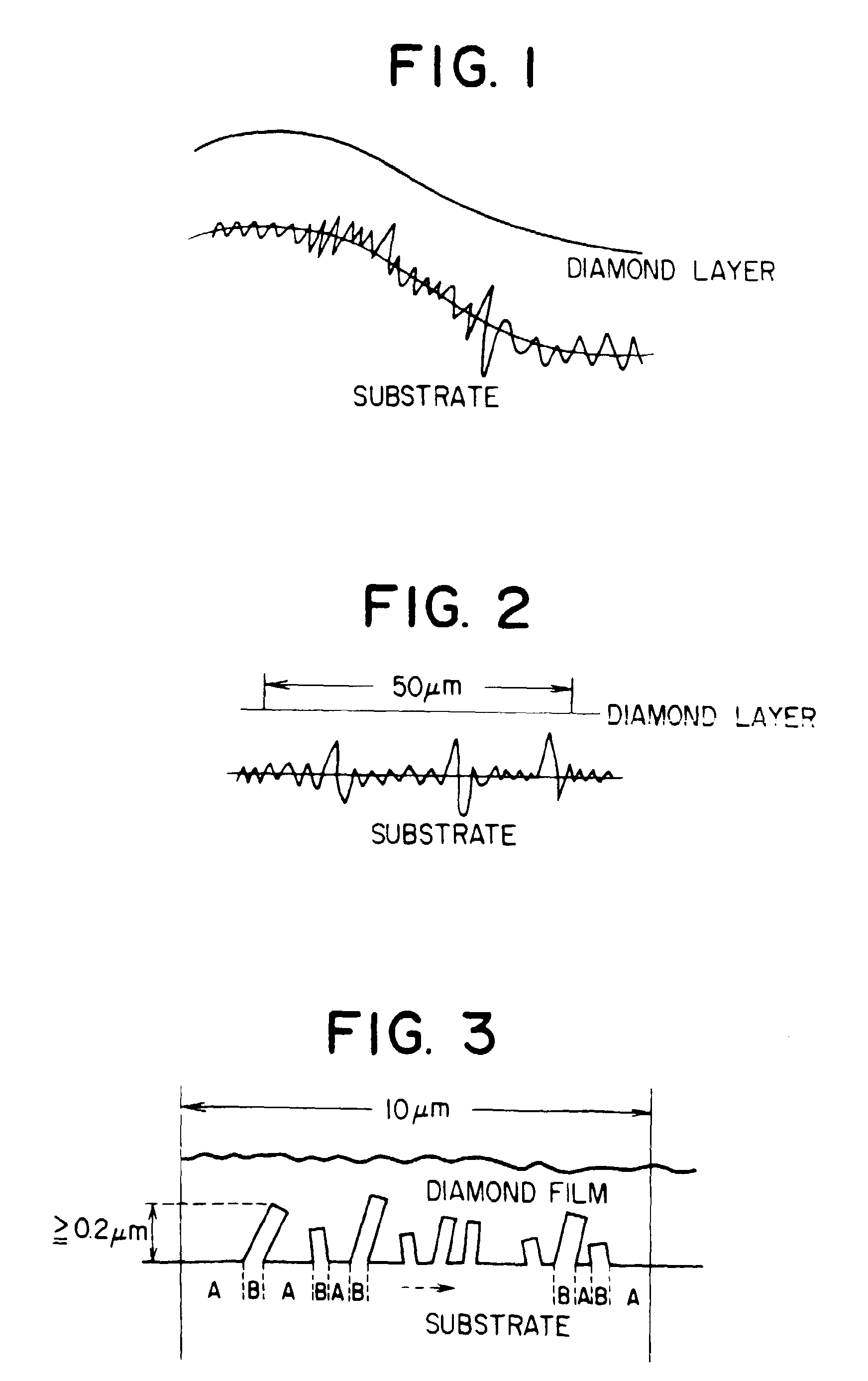
28.03.2001 Bulletin 2001/13 |
| (45) |
Mention of the grant of the patent: |
|
12.11.1997 Bulletin 1997/46 |
| (22) |
Date of filing: 12.02.1992 |
|
|
| (54) |
Diamond- or diamond-like carbon coated hard materials
Diamant-beschichtete bzw. mit diamantartigem Kohlenstoff beschichtete Hartstoffe
Revêtement de diamant ou de carbone ayant des propriètes semblable au diamant pour
matériaux durs
|
| (84) |
Designated Contracting States: |
|
DE FR GB IT SE |
| (30) |
Priority: |
18.02.1991 JP 2349591
18.02.1991 JP 2349691
|
| (43) |
Date of publication of application: |
|
26.08.1992 Bulletin 1992/35 |
| (73) |
Proprietor: SUMITOMO ELECTRIC INDUSTRIES, LIMITED |
|
Osaka 541 (JP) |
|
| (72) |
Inventors: |
|
- Omori, Naoya,
c/o Itami Works of Sumitomo
Itami-shi,
Hyogo (JP)
- Nomura, Toshio,
c/o Itami Works of Sumitomo
Itami-shi,
Hyogo (JP)
|
| (74) |
Representative: Allard, Susan Joyce et al |
|
BOULT WADE TENNANT,
Verulam Gardens
70 Gray's Inn Road
London WC1X 8BT
London WC1X 8BT (GB) |
| (56) |
References cited: :
|
| |
|
|
- PATENT ABSTRACTS OF JAPAN vol. 14, no. 425 (E-977)13 September 1990 & JP-A-2 163 955
- PATENT ABSTRACTS OF JAPAN vol. 10, no. 314 (C-380)24 October 1986 & JP-A-61 124 573
- PATENT ABSTRACTS OF JAPAN vol. 12, no. 482 (C-553)15 December 1988 & JP-A-63 199 870
- K. Saijo et al., "Improvements in adhesive strangth and cutting performance of diamond
coated tools", Surface and Coating Technology, 47 (1991), S. 646-653
- Katsumara et al., "Effects of cobalt content and surface state of substrate on cutting
performance of diamond deposited cemented carbide tool for Al-18%Si alloy",March 13,
1989, einschliesslich Übersetzung aus dem Japanischen
|
|
| |
|
|
|
Remarks: |
|
The file contains technical information submitted after the application was filed
and not included in this specification |
|
[0001] This invention relates to a diamond-coated hard material having a diamond- or diamond-like
carbon-coating layer with a high bonding strength to the substrate material.
[0002] Diamond has many excellent properties, for example, very high hardness, chemical
stability, high heat conductivity, high sound wave propagation speed, etc. and has
widely been used as a hard material utilizing these properties or as diamond or diamond-like
carbon coated hard materials, illustrative of which are as follows:-
(i) single crystal diamond, sintered diamonds or diamond-coated cutting tools such
as throwaway inserts, drills, microdrills, endmills, etc., which are capable of cutting
Al, Cu, light metals or alloys thereof at a high temperature to produce well finished
surfaces, because they hardly react with these metals or alloys.
(ii) various wear resistance tools such as bonding tools capable of working for a
long time with high dimensional precision, because of high wear resistance;
(iii) various machine parts such as radiating plates;
(iv) various vibration plates such as speakers, and
(v) various electronic parts.
[0003] In the production of artificial diamond, there are various methods of forming diamond
cutting layers from the gaseous phase, for example, the microwave plasma CVD method,
RF-plasma CVD method, EA-CVD-method, induction field microwave plasma CVD method,
RF hot plasma CVD method, DC plasma CVD method, DC plasma jet method, filament hot
CVD method or combustion method. These methods are useful for the production of diamond-coated
hard materials.
[0004] Since many of the diamond-coated hard materials are lacking in the bond strength
of the diamond-coating to the substrate, the diamond-coating becomes stripped off,
to shorten the life in many cases. The main reason therefor is that diamond is not
capable of forming intermediate layers with all materials and it has low wettability
with other materials.
[0005] In order to obtain a diamond-coated hard material having a high bonding strength,
there have been proposed a method comprising selecting a substrate having the same
heat expansion coefficient as diamond (Japanese Patent laid-Open Publication No. 291493/1986,
proposing sintered compacts containing Si
3N
4, as a predominant component, and sintered compacts containing SiC as a predominant
component), a method comprising subjecting the surface of a substrate to etching to
remove metals having bad influences upon formation of the diamond coating layer on
the substrate surface and thereby increasing the formation density of diamond nuclei
on the substrate surface (Japanese Patent Laid-Open Publication No. 201475/1989, etching
the surface of a cemented carbide with an acid solution to remove Co metal component
and to suppress graphitization of the diamond nuclei; Japanese Patent Laid-Open Publication
No.124573/1986, subjecting the surface of a substrate to a scratching treatment with
diamond grains or a diamond wheel and thereby improving the nuclei forming density
on the surface of the substrate), etc. EP-A-0445305 relates to a method for the vapour
phase synthesis of diamond on an electrochemically treated substrate and is comprised
in the state of the art by virtue of Article 54(3) and (4) EPC.
[0006] As described above, diamond is chemically stable and does not form intermediate compounds
with all materials. When a diamond-coated hard material having an excellent bonding
strength is prepared, therefore, such a condition must be provided that the diamond
coating layer and the substrate are strongly physically bonded.
[0007] We have found that when protrusions having a high bonding strength to a substrate
are formed on the surface of the substrate by chemical or mechanical means and a diamond
coating layer is formed thereon, thereby forming such a state that the protrusions
intrude into the diamond coating layer, the bonding strength between the diamond cutting
layer and the substrate is very high. This can be considered to be due to the fact
that the contact area of the diamond coating layer with the substrate is increased
and the protrusions have an anchoring action in the diamond coating layer, whereby
the diamond coating layer is hard to strip from the substrate.
[0008] Accordingly, for the contracting states other than DE and SE, the present invention
provides (I) a coated hard material comprising a diamond- and/or diamond-like carbon-coating
layer formed on the surface of a hard material, i. e. substrate, characterized in
that (1) microscopic roughness is present on the surface of the substrate and (2)
protrusive parts thereof are defined by the surface roughness Rmax within a range
of 1.0 to 30 µm in a standard length when the standard length is 50 µm in the interface
of the diamond- and/or diamond-like carbon coated layer and the substrate, and wherein
the protrusive parts are of a columnar or hexagonal pillar shape and/or needle shape
and (II) a coated hard material comprising a diamond- and/or diamond-like carbon-coating
layer formed on the surface of a hard material, i.e. substrate, characterized in that
(1) microscopic roughness is present on the surface of the substrate, (2) at least
one protrusive part is present in a standard length when the standard length is 10
µm in the interface of the diamond- and/or diamond-like carbon coated layer and the
substrate, (3) the ratio of the sum A of the lengths of dent parts to the sum B of
the lengths of the protrusions is in the range of 0.05 ≦ A/B ≦ 20 in the standard
length in the interface and (4) the protrusions are intruded into the diamond-coated
layer, and wherein the protrusive parts are of a columnar or hexagonal pillar shape
and/or needle shape.
[0009] For the contracting states of DE and SE, the present invention provides a process
for coating a substrate of a hard material as defined in the claims headed "For the
contracting states of DE and SE only".
[0010] The present invention is further described hereinbelow with reference to the accompanying
drawings, in which:
Figure 1 is a schematic view of a coating layer-substrate interface in one embodiment
of the present invention;
Figure 2 is a schematic view to illustrate the state shown in Figure 1 by linearly
drawing it; and
Figure 3 is a schematic view of a coating layer-substrate interface in another embodiment
of the present invention.
[0011] In the present invention, the roughness is not a macroscopic roughness formed by
scratching with (1) a diamond wheel or (2) diamond grinding grains, but a microscopic
roughness in a very small range, i.e. roughness in a standard length of 50 µm or 10µm
in a diamond coating layer-substrate interface.
[0012] We have made various roughened states and consequently, have found that when the
surface roughness in the substrate interface is defined by Rmax of 1.0 to 30 µm in
the standard length of 50 µm and the protrusive parts are intruded by at least 0.2
µm into the diamond coating layer-substrate interface, a strong bonding strength is
obtained. This surface roughness is defined as a surface roughness (Rmax) of a substrate
after coating by lapping a cross-section of the substrate coated with diamond, observing
and photographing to review the boundary line of the diamond coating layer-substrate
interface. This corresponds to the above described invention (I).
[0013] We have made various roughened states and consequently, have found that when at least
one protrusive part is present in the standard length of 10 µm and the ratio of the
sum A of the lengths of dent parts to the sum B of the lengths of the protrusions
is in the range of 0.05 ≦ A/B ≦ 20 in the standard length and the protrusions are
intruded by 0.2 µm into the diamond-coated layer, a high density strength is obtained.
This is calculated by lapping a cross-section of the substrate coated with diamond,
observing and photographing to review and model a boundary line of the diamond coating
layer-substrate interface. This corresponds to the above described invention (II).
[0014] In the present invention, it is preferred to carry out the commonly used scratching
treatment of a substrate with diamond grains in order to promote formation of diamond
nuclei on the whole surface of the substrate during the initial coating period. At
the same time, this scratching treatment is more preferably carried out by adding
the substrate and diamond grains to a solvent such as water, ethyl alcohol, acetone,
etc. and then applying ultrasonic wave thereto, since a scratching treatment by pressing
hard diamond grains against the substrate in physical manner results in breakage of
the resulting protrusions. Diamond nuclei are uniformly formed on the whole protrusive
and non-protrusive parts of the substrate surface by this scratching treatment, whereby
it is rendered possible to form such a state that the protrusions are intruded into
the diamond coated layer.
[0015] As a useful method for forming the specified roughness on a substrate, there are
(1) a method comprising depositing columnar or hexagonal pillar crystal grains and/or
needle crystal grains on the surface of a substrate.
[0016] Method (1) consists in subjecting a substrate to some heat treatment, freely growing
columnar or hexagonal pillar crystal grains or needle crystal grains and/or promoting
secondary crystal generation on the surface thereof by the substrate component.
[0017] The material for forming the protrusions may be silicon carbide, silicon carbide-containing
materials, tungsten, tungsten carbides or carbonitrides, carbides or carbonitrides
of tungsten with at least one metal, titanium nitrides, carbides, carbonitrides or
solid solutions thereof or mixtures thereof and materials containing them.
[0018] The material for forming the roughened part is preferably consolidated in one body
with the substrate and is preferably the same material as that of the substrate. Of
course, similar materials but differing in composition can be used.
[0019] In Fig. 1, the state of the diamond-coated layer- or diamond-like carbon-coated layer-substrate
interface according to the present invention (I) is schematically shown. That is,
a macroscopic undulation appears in the inter-layer, but Rmax is calculated regarding
this undulation as linear as shown in Fig. 2.
[0020] In Fig. 3, the state of the diamond-coated layer- or diamond-like carboncoated layer-substrate
interface according to the present invention (II) is schematically shown. Herein,
the ratio of sum A of the protrusion lengths, i.e. Σ A to sum B of the dent lengths,
i.e. Σ B must be in the range of 0.05 ≦ Σ A / Σ B ≦ 20 and the intruded lengths of
the protrusions are preferably at least 0.2 µm. For example, when one protrusion of
0.5 µm is present in 10 µm, Σ A / Σ B = 19.
[0021] In the present invention (I), the formed protrusive parts should satisfy the requirements
that when a standard length is 50 µm in the interface of a diamond- and/or diamond-like
carbon coated layer and a substrate, the surface roughness of the substrate interface
is represented by an Rmax of 1.0 to 30 µm in the standard length and the protrusive
parts are preferably intruded in the diamond coated layer with at least 0.2 µm. When
the surface roughness at the substrate interface is represented by a Rmax of less
than 1.0 µm, the bonding strength is not increased, while if more than 30 µm, on the
contrary, the bonding strength is lowered. When the maximum intrusive depth of the
protrusions is at most 0.2µm, the bonding strength is substantially similar to that
in the case of providing no protrusion.
[0022] In the present invention (II), it is required that when the standard length is 10
µm in the diamond- and/or diamond-like carbon coated layer-substrate interface, at
least one protrusion is formed in this standard length, the ratio of sum B of the
lengths of protrusions and sum A of the lengths of dent parts is in the range of 0.05
to 20 and the protrusions are intruded into the diamond-coated layer. In this case,
the intruded length is preferably at least 0.2µm. When the ratio of sum B of the lengths
of protrusions and sum A of the lengths of the protrusions is outside the range of
0.05 ≦ ΣA / ΣB ≦ 20, the bonding strength is not improved.
[0023] As the substrate, any hard materials can be used, for example, cemented carbides,
cermets, Al
2O
3, silicon carbide and other ceramics. Above all, when protrusions of titanium compounds
such as titanium carbides, nitrides and carbonitrides and/or titanium compounds-containing
materials, tungsten carbides and/or carbides of tungsten alloys and/ or materials
containing these compounds or materials are present, a high bonding strength can be
obtained. Furthermore, when the shape of the protrusion is a columnar or hexagonal
pillar crystal or needle crystal with an aspect ratio of at least 1.5, a bonding strength
is further increased.
[0024] As to the thickness of the diamond coated layer, if less than 0.1 µm, no improvement
of various properties by the coated layer, such as wear resistance, is found, while
if more than 200 µm, further improvement of the properties cannot be given. Therefore,
a thickness of 0.1 to 200 µm is preferable.
[0025] The foregoing illustration is conducted as to a case where diamond is coated, but
the present invention can be applied with similar benefits to cases where diamond-like
carbon is present in a diamond-coated layer, one or more of these layers are coated
and the coated layer contains foreign atoms such as boron, nitrogen, etc. Where diamond-like
carbon is coated, the excellent advantages of the present Invention can also be obtained.
[0026] The following examples are given in order to illustrate the present invention in
detail without limiting the same.
Example 1
[0027] A throwaway insert comprising silicon carbide whiskers ceramic (specifically, Al
2O
3-35 vol % SiC wiskers-5 wt % ZrO
2) as a substrate and having a shape of SPG 422 was made, brought into contact with
fused NaOH and etched to expose needle crystals of silicon carbide whiskers having
a minor axis of 1 µm and a major axis of 8 µm on the surface of the insert. This insert
and 2 g of diamond grains each having a grain diameter of 8 to 16 µm were added to
ethyl alcohol, to which supersonic wave vibration was added for 15 minutes. Using
2.45 GHz microwave plasma CVD apparatus, the thus resulting insert was heated at 1000°C
and maintained In a mixed plasma of hydrogen-2 % methane at a total pressure of 10665.8
Pa (80 Torr) for 8 hours to prepare a cutting insert coated with diamond of 8 µm in
layer thickness.
[0028] For comparison, a comparative insert was prepared by using a substrate having the
same shape and composition as described above without conducting the etching treatment
and providing a diamond coated layer on the insert having no needle crystals of silicon
carbide whiskers on the surface thereof (The ultrasonic wave treatment was not carried
out for the comparative sample).
[0029] In this test, it was confirmed by the Raman spectrometry that the coated layer deposited
on the surface of the substrate was a diamond coated layer.
[0030] Using these cutting inserts, intermittent cutting tests were carried out under the
following conditions.
| Workpiece to be cut |
Al-24 wt % Si alloy (block material) |
| Cutting Speed |
400 m/min |
| Feed |
0.1 mm/rev |
| Cutting Depth |
0.5 mm |
[0031] When the flank wear width, the wear state of the edge and the deposition state of
the workpiece, after 3 and 10 minutes, were observed, the cutting insert of the present
invention showed normal wearing represented by a flank wear width of 0.05 mm after
10 minutes from start of cutting and deposition of the workpiece was hardly observed.
On the other hand, in observation of the cutting edge after 3 minutes from start of
cutting, a large peeling of the diamond coated layer was found, the flank wear width
amounted to 0.16 mm and the workpiece was subject to marked metal deposition, so that
the cutting had to be stopped.
[0032] When the insert after the cutting test was cut, subjected to lapping and then the
interface of the substrate and diamond coated layer was observed by an optical microscope,
the insert of the present invention gave the results that silicon carbide whiskers
were intruded into the diamond-coated layer by at most 3.5 µm and in the interface,
the microscopic surface roughness was represented by an Rmax of 4 to 5 µm in the standard
length of 50 µm. In the comparative insert, on the contrary, there were found no silicon
carbide whiskers in the interface of the substrate and diamond-coated layer, nor intrusion
of the substrate into the diamond-coated layer.
Example 2
[0033] A throwaway insert comprising silicon carbide whiskers ceramic (specifically, AI
2O
3-35 vol % SiC whiskers-5 wt % ZrO
2) as a substrate and having a shape of SPG 422 was made, brought Into contact with
fused NaOH and etched to expose needle crystals of silicon carbide whiskers having
a minor axis of 1 µm and a major axis of 8 µm on the surface of the insert. This insert
and 2 g of diamond grains each having a grain diameter of 8 to 16 µm were added to
ethyl alcohol, to which supersonic wave vibration was added for 15 minutes. Using
2.45 GHz microwave plasma CVD apparatus, the thus resulting insert was heated at 1000°C
and maintained in a mixed plasma of hydrogen-2 % methane at a total pressure of 10665.8
Pa (80 Torr) for 7 hours to prepare a cutting insert coated with diamond of 9 µm in
layer thickness.
[0034] For comparison, a comparative insert was prepared by using a substrate having the
same shape and composition as described above without conducting the etching treatment
and providing a diamond coated layer on the insert having no needle crystals of silicon
carbide whiskers on the surface thereof (The ultrasonic wave treatment was not carried
out for the comparative sample).
[0035] In this test, it was confirmed by the Raman spectrometry that the coated layer deposited
on the surface of the substrate was a diamond coated layer.
[0036] Using these cutting inserts, Intermittent cutting tests were carried out under the
following conditions.
| Workpiece to be cut |
Al-24 wt % Si alloy (block material) |
| Cutting Speed |
400 m/min |
| Feed |
0.1 mm/rev |
| Cutting Depth |
0.5 mm |
[0037] When the flank wear width, the wear state of the edge and the deposition state of
the workpiece, after 3 and 10 minutes, were observed, the cutting insert of the present
invention showed normal wearing represented by a flank wear width of 0.05 mm after
10 minutes from start of cutting and deposition of the workpiece was hardly observed.
On the other hand, in observation of the cutting edge after 3 minutes from start of
cutting, a large peeling of the diamond coated layer was found, the flank wear width
amounted to 0.14 mm and the workpiece was subject to marked metal deposition, so that
the cutting had to be stopped.
[0038] When the insert after the cutting test was cut, subjected to lapping and then the
interface of the substrate and diamond coated layer was observed by an optical microscope,
the insert of the present invention gave the results that silicon carbide whiskers
were intruded into the diamond-coated layer by at most 4 µm and in the interface,
3 to 6 protrusions were present and A/B was 1.0 to 1.6 in the standard length of 10
µm. In the comparative insert, on the contrary, there were found no silicon carbide
whiskers in the interface of the substrate and diamond-coated layer, nor intrusion
of the substrate into the diamond-coated layer.
[0039] The diamond- and/or diamond-like carbon-coated hard material of the present invention
has better peeling resistance than the diamond- and/or diamond-like carbon-coated
hard materials of the prior art. The method of Example 1 and 2, relates to a surface
treatment utilizing the properties of a substrate. The above described examples are
given in the case of cutting tools, but of course, the hard materials of the present
invention can be applied to not only wear resistance tools such as TAB tools, but
also end mills, drills, drills for making hole on print substrates, reamers, etc.
Claims for the following Contracting State(s): FR, GB, IT
1. A coated hard material comprising a diamond- and/or diamond-like carbon-coating layer
formed on the surface of a hard material, i.e. substrate, characterized in that (1)
microscopic roughness is present on the surface of the substrate and (2) protrusive
parts thereof are defined by the surface roughness Rmax within a range of 1.0 to 30
µm in a standard length when the standard length is 50 µm in the interface of the
diamond- and/or diamond-like carbon coated layer and the substrate, and wherein the
protrusive parts are of a columnar or hexagonal pillar shape and/or needle shape.
2. A coated hard material comprising a diamond- and/or diamond-like carbon coating layer
formed on the surface of a hard material, i.e. substrate, characterized in that (1)
microscopic roughness is present on the surface of the substrate, (2) at least one
protrusive part is present in a standard length when the standard length is 10 µm
in the interface of the diamond- and/or dimaond-like carbon coated layer and the substrate,
(3) the ratio of the sum A of the lengths of dent parts to the sum B of the lengths
of the protrusions is in the range of 0.05 ≦ A/B ≦ 20 in the standard length in the
interface and (4) the protrusive parts intrude into the diamond-coated layer, and
wherein the protrusive parts are of a columnar or hexagonal pillar shape and/or needle
shape.
3. A coated hard material as claimed in claim 1 or claim 2, wherein the protrusive part(s)
intrude in the diamond- and/ or diamond-like carbon coated layer by at least 0.2 µm.
4. A coated hard material as claimed in claim 2 or claim 3, wherein the protrusive part
comprises silicon carbide or a silicon carbide-containing material.
5. A coated hard material as claimed in claim 1 or claim 2, wherein the protrusive part
comprises (1) tungsten, (2) tungsten carbide or carbonitride, (3) a carbide or carbonitride
of tungsten and at least one other metal or (4) a material containing these materials.
6. A coated hard material as claimed in anyone of claims 1 to 5, wherein the protrusive
part is of a columnar or hexagonal pillar shape with an aspect ratio of at least 1.5.
7. A coated hard material as claimed in anyone of claims 1 to 6, wherein the hard material
(1) a cemented carbide, (2) a cermet, (3) a ceramic (4) a composite material thereof.
8. A coated hard material as claimed in anyone of claims 1 to 7, wherein the material
forming the roughness at the interface of the diamond- or diamond-like carbon-coated
layer and the substrate is consolidated in one body with and of the same material
as the substrate.
9. A coated hard material as claimed in anyone of claims 1 to 7, wherein the material
forming the roughness at the interface of the diamond- or diamond-like carbon-coated
layer and the substrate is of the same material as the substrate but differs in composition
therefrom.
10. A coated hard material as claimed in claim 1 or 2, wherein the diamond- or diamond-like
carbon-coated layer has a thickness of from 0.1 to 20 µm.
Claims for the following Contracting State(s): DE, SE
1. A process for coating a substrate of a hard material comprising the steps of forming
microscopic roughness on the surface of the substrate by a method other than an electrochemical
treatment, followed by coating the surface of the substrate with a diamond- and/or
diamond-like carbon-coating layer, characterized in that protrusive parts of the microscopically
roughened surface of the substrate are defined by the surface roughness Rmax within
a range of 1.0 to 30 µm in a standard length when the standard length is 50 µm in
the interface of the diamond- and/ or diamond-like carbon coated layer and the substrate,
and wherein the protrusive parts are of a columnar or hexagonal pillar shape and/or
needle shape.
2. A process for coating a substrate of a hard material as claimed in claim 1, wherein
the protrusive parts intrude in the diamond- and/or diamond-like carbon coated layer
by at least 0.2 µm.
3. A process for coating a substrate of a hard material as claimed in claim 1 or claim
2, wherein the protrusive parts comprise silicon carbide or a silicon carbide-containing
material.
4. A process for coating a substrate of a hard material as claimed in claim 1, wherein
the protrusive parts comprise (1) tungsten, (2) tungsten carbide or carbonitride,
(3) a carbide or carbonitride of tungsten and at least one other metal or (4) a material
containing these materials.
5. A process for coating a substrate of a hard material as claimed in any one of claims
1 to 4, wherein the protrusive parts are of a columnar or hexagonal pillar shape with
an aspect ratio of at least 1.5.
6. A process for coating a substrate of a hard material as claimed in any one of claims
1 to 5, wherein the hard material is (1) a cemented carbide, (2) a cermet, (3) a ceramic
(4) a composite material thereof.
7. A process for coating a substrate of a hard material as claimed in any one of claims
1 to 6, wherein the material forming the roughness at the interface of the diamond-
or diamond-like carbon-coated layer and the substrate is consolidated in one body
with and of the same material as the substrate.
8. A process for coating a substrate of a hard material as claimed in any one of claims
1 to 6, wherein the material forming the roughness at the interface of the diamond-
or diamond-like carbon-coated layer and the substrate is of the same material as the
substrate but differs in composition therefrom.
9. A process for coating a substrate of a hard material as claimed in claim 1 ,wherein
the diamond- or diamond-like carbon-coated layer has a thickness of from 0.1 to 20
µm.
10. A coated hard material comprising a diamond- and/or diamond-like carbon coating layer
formed on the surface of a hard material, i.e. substrate, characterized in that (1)
microscopic roughness is present on the surface of the substrate, (2) at least one
protrusive part is present in a standard length when the standard length is 10 µm
in the interface of the diamond- and/or diamond-like carbon coated layer and the substrate,
(3) the ratio of the sum A of the lengths of dent parts to the sum B of the lengths
of the protrusions is in the range of 0.05 ≤ A/B ≤ 20 in the standard length in the
interface and (4) the protrusive parts intrude into the diamond-coated layer, and
wherein the protrusive parts are of a columnar or hexagonal pillar shape and/or needle
shape.
11. A coated hard material as claimed in claim 10
wherein the protrusive part(s) intrude in the diamond- and/or diamond-like carbon
coated layer by at least 0.2 µm.
12. A coated hard material as claimed in claim 10 or claim 11 wherein the protrusive part
comprises silicon carbide or a silicon carbide-containing material.
13. A coated hard material as claimed in claim 10
wherein the protrusive part comprises (1) tungsten, (2) tungsten carbide or carbonitride,
(3) a carbide or carbonitride of tungsten and at least one other metal or (4) a material
containing these materials.
14. A coated hard material as claimed in anyone of claims 10 to 13 wherein the protrusive
part is of a columnar or hexagonal pillar shape with an aspect ratio of at least 1.5.
15. A coated hard material as claimed in anyone of claims 10 to 14 wherein the hard material
is (1) a cemented carbide, (2) a cermet, (3) a ceramic (4) a composite material thereof.
16. A coated hard material as claimed in anyone of claims 10 to 15 wherein the material
forming the roughness at the interface of the diamond- or diamond-like carbon-coated
layer and the substrate is consolidated in one body with and of the same material
as the substrate.
17. A coated hard material as claimed in anyone of claims 10 to 16 wherein the material
forming the roughness at the interface of the diamond- or diamond-like carbon-coated
layer and the substrate is of the same material as the substrate but differs in composition
therefrom.
18. A coated hard material as claimed in claim 10
wherein the diamond- or diamond-like carbon-coated layer has a thickness of from
0.1 to 20 µm.
Patentansprüche für folgende(n) Vertragsstaat(en): DE, SE
1. Verfahren zur Beschichtung eines Substrats aus einem Hartmaterial mit den Schritten
Ausbildung einer mikroskopischen Rauheit auf der Oberfläche des Substrats durch ein
anderes verfahren als elektrochemische Behandlung,
anschließend Beschichtung der Oberfläche des Substrats mit einer Diamantschicht und/oder
einer Schicht aus einem diamantähnlichen Kohlenstoff,
dadurch gekennzeichnet, dass die hervorstehenden Teile der mikroskopisch aufgerauhten
Oberfläche des Substrats durch die Oberflächenrauheit Rmax in einem Bereich von 1,0
bis 30 µm in einer Standardlänge definiert werden, wenn die Standardlänge 50 µm in
der Grenzfläche zwischen der mit Diamant und/oder einem diamantähnlichen Kohlenstoff
beschichteten Schicht und dem Substrat beträgt, und wobei die hervorstehenden Teile
säulenförmig oder von hexagonaler Säulenform und/oder Nadelform sind.
2. Verfahren zur Beschichtung eines Substrats aus einem Hartmaterial gemäß Anspruch 1,
bei dem die hervorstehenden Teile um mindestens 0,2 µm in die mit Diamant und/oder
einem diamantähnlichen Kohlenstoff beschichtete Schicht eindringen.
3. Verfahren zur Beschichtung eines Substrats aus einem Hartmaterial nach Anspruch 1
oder 2, bei dem die hervorstehenden Teile Siliciumcarbid oder ein siliciumcarbidhaltiges
Material enthalten.
4. Verfahren zur Beschichtung eines Substrats aus einem Hartmaterial nach Anspruch 1,
bei dem die hervorstehenden Teile (1) Wolfram, (2) Wolframcarbid oder -carbonitrid,
(3) ein Carbid oder Carbonitrid von Wolfram und mindestens einem anderen Metall oder
(4) ein diese Substanzen enthaltendes Material aufweisen.
5. Verfahren zur Beschichtung eines Substrats aus einem Hartmaterial nach einem der Ansprüche
1 bis 4, bei dem die hervorstehenden Teile säulenförmig sind oder eine sechseckige
Säulenform mit einem Seitenverhältnis von mindestens 1,5 aufweisen.
6. Verfahren zur Beschichtung eines Substrats aus einem Hartmaterial nach einem der Ansprüche
1 bis 5, bei dem das Hartmaterial (1) ein Sintercarbid, (2) ein Cermet, (3) ein Keramikmaterial,
(4) ein Verbundmaterial daraus ist.
7. Verfahren zur Beschichtung eines Substrats aus einem Hartmaterial nach einem der Ansprüche
1 bis 6, bei dem das die Rauheit an der Grenzfläche zwischen der mit Diamant oder
einem diamantähnlichen Kohlenstoff beschichteten Schicht und dem Substrat bildende
Material in einen Körper mit und aus dem gleichen Material wie das Substrat konsolidiert
ist.
8. Verfahren zur Beschichtung eines Substrats aus einem Hartmaterial nach einem der Ansprüche
1 bis 6, bei dem das die Rauheit an der Grenzfläche zwischen der mit Diamant oder
einem diamantähnlichen Kohlenstoff beschichteten Schicht und dem Substrat bildende
Material aus dem gleichen Material besteht wie das Substrat, sich jedoch in der Zusammensetzung
davon unterscheidet.
9. Verfahren zur Beschichtung eines Substrats aus einem Hartmaterial nach Anspruch 1,
bei dem die mit Diamant oder einem diamantähnlichen Kohlenstoff beschichtete Schicht
eine Dicke von 0,1 bis 20 µm aufweist.
10. Beschichtetes Hartmaterial mit einer auf der Oberfläche des Hartmaterials ausgebildeten,
mit Diamant oder einem diamantähnlichen Kohlenstoff beschichteten Schicht, d.h. einem
Substrat, dadurch gekennzeichnet, dass (1) eine mikroskopische Rauheit auf der Oberfläche
des Substrats vorliegt, (2) mindestens ein hervorstehender Teil in einer Standardlänge
vorliegt, wenn die Standardlänge 10 µm in der Grenzfläche zwischen der mit Diamant
und/oder einem diamantähnlichen Kohlenstoff beschichteten Schicht und dem Substrat
beträgt, (3) das Verhältnis der Summe A der Längen der eingekerbten Teile zur Summe
B der Längen der hervorstehenden Teile im Bereich von 0,05 ≤ A/B ≤ 20 in der Standardlänge
in der Grenzfläche liegt und (4) die hervorstehenden Teile in die diamantbeschichtete
Schicht eindringen, und wobei die hervortehenden Teile säulenförmig oder von hexagonaler
Säulenform und/oder Nadelform sind.
11. Beschichtetes Hartmaterial nach Anspruch 10, bei dem der oder die hervorstehende(n)
Teil(e) um mindestens 0,2 µm in die mit Diamant und/oder einem diamantähnlichen Kohlenstoff
beschichtete Schicht eindringen.
12. Beschichtetes Hartmaterial nach Anspruch 10 oder 11, bei dem der hervorstehende Teil
Siliciumcarbid oder ein siliciumcarbidhaltiges Material enthält.
13. Beschichtetes Hartmaterial nach Anspruch 10, bei dem der hervorstehende Teil (1) Wolfram,
(2) Wolframcarbid oder -carbonitrid, (3) ein Carbid oder Carbonitrid von Wolfram und
mindestens einem anderen Metall und (4) ein diese Substanzen enthaltendes Material
aufweist.
14. Beschichtetes Hartmaterial nach einem der Ansprüche 10 bis 13, bei dem der hervorstehende
Teil säulenförmig ist oder eine sechseckige Säulenform mit einem Seitenverhältnis
von mindestens 1,5 aufweist.
15. Beschichtetes Hartmaterial nach einem der Ansprüche 10 bis 14, bei dem das Hartmaterial
(1) ein Sintercarbid, (2) ein Cermet, (3) ein Keramikmaterial, (4) ein Verbundmaterial
daraus ist.
16. Beschichtetes Hartmaterial nach einem der Ansprüche 10 bis 15, bei dem das die Rauheit
an der Grenzfläche zwischen der mit Diamant oder einem diamantähnlichen Kohlenstoff
beschichteten Schicht und dem Substrat bildende Material in einen Körper mit und aus
dem gleichen Material wie das Substrat konsolidiert ist.
17. Beschichtetes Hartmaterial nach einem der Ansprüche 10 bis 16, bei dem das die Rauheit
an der Grenzfläche zwischen der mit Diamant oder einem diamantähnlichen Kohlenstoff
beschichteten Schicht und dem Substrat bildende Material aus dem gleichen Material
besteht wie das Substrat, sich jedoch in der Zusammensetzung davon unterscheidet.
18. Beschichtetes Hartmaterial nach Anspruch 10, bei dem die mit Diamant oder einem diamantähnlichen
Kohlenstoff beschichtete Schicht eine Dicke von 0,1 bis 20 µm aufweist.
Patentansprüche für folgende(n) Vertragsstaat(en): FR, GB, IT
1. Beschichtetes Hartmaterial mit einer auf der Oberfläche eines Hartmaterials ausgebildeten
mit Diamant oder einem diamantähnlichen Kohlenstoff beschichteten Schicht, d.h. einem
Substrat, dadurch gekennzeichnet, dass (1) eine mikroskopische Rauheit auf der Oberfläche
des Substrats vorliegt und (2) daraus hervorstehende Teile durch die Oberflächenrauheit
Rmax in einem Bereich von 1,0 bis 30 µm in einer Standardlänge definiert werden, wenn
die Standardlänge 50 µm in der Grenzfläche zwischen der mit Diamant und/oder einem
diamantähnlichen Kohlenstoff beschichteten Schicht und dem Substrat beträgt, und wobei
die hervorstehenden Teile säulenförmig oder von hexagonaler Säulenform und/oder Nadelform
sind.
2. Beschichtetes Hartmaterial mit einer auf der Oberfläche des Hartmaterials ausgebildeten
mit Diamant oder einem diamantähnlichen Kohlenstoff beschichteten Schicht, d.h. einem
Substrat, dadurch gekennzeichnet, dass (1) eine mikroskopische Rauheit auf der Oberfläche
des Substrats vorliegt, (2) mindestens ein hervorstehender Teil in einer Standardläne
vorliegt, wenn die Standardlänge 10 µm in der Grenzfläche zwischen der mit Diamant
und/oder einem diamantähnlichen Kohlenstoff beschichteten Schicht und dem Substrat
beträgt, (3) das Verhältnis der Summe A der Längen der eingekerbten Teile zur Summe
B der Längen der hervorstehenden Teile im Bereich von 0,05 ≤ A/B ≤ 20 in der Standardlänge
in der Grenzfläche liegt und (4) die hervorstehenden Teile in die diamantbescichtete
Schicht eindringen, und wobei die hervorstehenden Teile säulenförmig oder von hexagonaler
Säulenform und/oder Nadelform sind.
3. Beschichtetes Hartmaterial nach Anspruch 1 oder 2, bei dem der oder die hervorstehende(n)
Teil(e) um mindestens 0,2 µm in die mit Diamant und/oder einem diamantähnlichen Kohlenstoff
beschichtete Schicht eindringen.
4. Beschichtetes Hartmaterial nach Anspruch 2 oder 3, bei dem der hervorstehende Teil
Siliciumcarbid oder ein siliciumcarbidhaltiges Material enthält.
5. Beschichtetes Hartmaterial nach Anspruch 1 oder 2, bei dem der hervorstehende Teil
(1) Wolfram, (2) Wolframcarbid oder -carbonitrid, (3) ein Carbid oder Carbonitrid
von Wolfram und mindestens einem anderen Metall oder (4) ein diese Substanzen enthaltendes
Material aufweist.
6. Beschichtetes Hartmaterial nach einem der Ansprüche 1 bis 5, bei dem der hervorstehende
Teil säulenförmig ist oder eine sechseckige Säulenform mit einem Seitenverhältnis
vor. mindestens 1,5 aufweist.
7. Beschichtetes Hartmaterial nach einem der Ansprüche 1 bis 6, bei dem das Hartmaterial
(1) ein Sintercarbid, (2) ein Cermet, (3) ein Keramikmaterial, (4) ein Verbundmaterial
daraus ist.
8. Beschichtetes Hartmaterial nach einem der Ansprüche 1 bis 7, bei dem das die Rauheit
an der Grenzfläche zwischen der mit Diamant oder einem diamantähnlichen Kohlenstoff
beschichteten Schicht und dem Substrat bildende Material in einen Körper mit und aus
dem gleichen Material wie das Substrat konsolidiert ist.
9. Beschichtetes Hartmaterial nach einem der Ansprüche 1 bis 7, bei dem das die Rauheit
an der Grenzfläche zwischen der mit Diamant oder einem diamantähnlichen Kohlenstoff
beschichteten Schicht und dem Substrat bildende Material aus dem gleichen Material
besteht wie das Substrat, sich jedoch in der Zusammensetzung davon unterscheidet.
10. Beschichtetes Hartmaterial nach Anspruch 1 oder 2, bei dem die mit Diamant oder einem
diamantähnlichen Kohlenstoff beschichtete Schicht eine Dicke von 0,1 is 20 µm aufweist.
Revendications pour l'(les) Etat(s) contractant(s) suivant(s): FR, GB, IT
1. Matériau dur revêtu comprenant une couche de revêtement de diamant et/ou de carbone
analogue au diamant formée sur la surface d'un matériau dur, c'est-à-dire un substrat,
caractérisé en ce que (1) une rugosité microscopique est présente sur la surface du
substrat, (2) des parties en projection de la surface du substrat sont formées par
la rugosité de surface Rmax dans une plage de 1,0 à 30 µm sur une longueur standard
lorsque la longueur standard est de 50 µm dans l'interface de la couche de revêtement
de diamant et/ou de carbone analogue au diamant et du substrat, et dans lequel les
parties en projection ont une forme de colonne ou de pilier hexagonal et/ou une forme
d'aiguille.
2. Matériau dur revêtu comprenant une couche de revêtement de diamant et/ou de carbone
analogue au diamant formée sur la surface d'un matériau dur, c'est-à-dire un substrat,
caractérisé en ce que (1) une rugosité microscopique est présente sur la surface du
substrat, (2) au moins une partie en projection est présente sur une longueur standard
lorsque la longueur standard est de 10 µm dans l'interface de la couche de revêtement
de diamant et/ou de carbone analogue au diamant et du substrat, (3) le rapport de
la somme A des longueurs des parties dentées à la somme B des longueurs des parties
en projection est dans la plage de 0,05 ≤ A/B ≤ 20 sur la longueur standard dans l'interface
et (4) les parties en projection pénètrent dans la couche de revêtement de diamant,
et dans lequel les parties en projection ont une forme de colonne ou de pilier hexagonal
et/ou une forme d'aiguille.
3. Matériau dur revêtu selon la revendication 1 ou la revendication 2, dans lequel la
ou les parties en projection pénètrent dans la couche de revêtement de diamant et/ou
de carbone analogue au diamant sur au moins 0,2 µm.
4. Matériau dur revêtu selon la revendication 2 ou la revendication 3, dans lequel la
partie en projection comprend du carbure de silicium ou un matériau renfermant du
carbure de silicium.
5. Matériau dur revêtu selon la revendication 1 ou la revendication 2, dans lequel la
partie en projection comprend (1) du tungstène, (2) du carbure ou carbonitrure de
tungstène, (3) un carbure ou carbonitrure de tungstène et au moins un autre métal
ou (4) un matériau renfermant ces matériaux.
6. Matériau dur revêtu selon l'une quelconque des revendications 1 à 5, dans lequel la
partie en projection est en forme de colonne ou de pilier hexagonal avec un rapport
d'allongement d'au moins 1,5.
7. Matériau dur revêtu selon l'une quelconque des revendications 1 à 6, dans lequel le
matériau dur est (1) un carbure cémenté, (2) un cermet, (3) une céramique, (4) un
matériau composite de ceux-ci.
8. Matériau dur revêtu selon l'une quelconque des revendications 1 à 7, dans lequel le
matériau formant la rugosité, à l'interface de la couche de revêtement de diamant
et/ou de carbone analogue au diamant et du substrat, est consolidé en un seul corps
avec le même matériau que le substrat et du même matériau que le substrat.
9. Matériau dur revêtu selon l'une quelconque des revendications 1 à 7, dans lequel le
matériau formant la rugosité, à l'interface de la couche de revêtement de diamant
et/ou de carbone analogue au diamant et du substrat, est du même matériau que le substrat
mais de composition différente.
10. Matériau dur revêtu selon la revendication 1 ou la revendication 2, dans lequel la
couche de revêtement de diamant et/ou de carbone analogue au diamant a une épaisseur
de 0,1 à 20 µm.
Revendications pour l'(les) Etat(s) contractant(s) suivant(s): DE, SE
1. Procédé pour revêtir un substrat d'un matériau dur comprenant les phases consistant
à former une rugosité microscopique sur la surface du substrat par un procédé autre
qu'un traitement électrochimique, puis à revêtir la surface du substrat d'une couche
de revêtement de diamant et/ou de carbone analogue au diamant, caractérisé en ce que
des parties en projection de la surface à rugosité microscopique du substrat sont
formées par la rugosité de surface Rmax dans une plage de 1,0 à 30 µm sur une longueur
standard lorsque la longueur standard est de 50 µm dans l'interface de la couche de
revêtement de diamant et/ou de carbone analogue au diamant et du substrat, et dans
lequel les parties en projection ont une forme de colonne ou de pilier hexagonal et/ou
une forme d'aiguille.
2. Procédé pour revêtir un substrat d'un matériau dur selon la revendication 1, dans
lequel les parties en projection pénètrent dans la couche de revêtement de diamant
et/ou de carbone analogue au diamant sur au moins 0,2 µm.
3. Procédé pour revêtir un substrat d'un matériau dur selon la revendication 1 ou la
revendication 2, dans lequel les parties en projection comprennent du carbure de silicium
ou un matériau renfermant du carbure de silicium.
4. Procédé pour revêtir un substrat d'un matériau dur selon la revendication 1, dans
lequel les parties en projection comprennent (1) du tungstène, (2) du carbure ou carbonitrure
de tungstène, (3) un carbure ou carbonitrure de tungstène et au moins un autre métal
ou (4) un matériau renfermant ces matériaux.
5. Procédé pour revêtir un substrat d'un matériau dur selon l'une quelconque des revendications
1 à 4, dans lequel les parties en projection sont en forme de colonne ou de pilier
hexagonal avec un rapport d'allongement d'au moins 1,5.
6. Procédé pour revêtir un substrat d'un matériau dur selon l'une quelconque des revendications
1 à 5, dans lequel le matériau dur est (1) un carbure cémenté, (2) un cermet, (3)
une céramique, (4) un matériau composite de ceux-ci.
7. Procédé pour revêtir un substrat d'un matériau dur selon l'une quelconque des revendications
1 à 6, dans lequel le matériau formant la rugosité, à l'interface de la couche de
revêtement de diamant et/ou de carbone analogue au diamant et du substrat, est consolidé
en un seul corps avec le même matériau que le substrat et du même matériau que le
substrat.
8. Procédé pour revêtir un substrat d'un matériau dur selon l'une quelconque des revendications
1 à 6, dans lequel le matériau formant la rugosité, à l'interface de la couche de
revêtement de diamant et/ou de carbone analogue au diamant et du substrat, est du
même matériau que le substrat mais de composition différente.
9. Procédé pour revêtir un substrat d'un matériau dur selon la revendication 1, dans
lequel la couche de revêtement de diamant et/ou de carbone analogue au diamant a une
épaisseur de 0,1 à 20 µm.
10. Matériau dur revêtu comprenant une couche de revêtement de diamant et/ou de carbone
analogue au diamant formée sur la surface d'un matériau dur, c'est-à-dire un substrat,
caractérisé en ce que (1) une rugosité microscopique est présente sur la surface du
substrat, (2) au moins une partie en projection est présente sur une longueur standard
lorsque la longueur standard est de 10 µm dans l'interface de la couche de revêtement
de diamant et/ou de carbone analogue au diamant et du substrat, (3) le rapport de
la somme A des longueurs des parties dentées à la somme B des longueurs des parties
en projection est dans la plage de 0,05 ≤ A/B ≤ 20 sur la longueur standard dans l'interface
et (4) les parties en projection pénètrent dans la couche de revêtement de diamant,
et dans lequel les parties en projection ont une forme de colonne ou de pilier hexagonal
et/ou une forme d'aiguille.
11. Matériau dur revêtu selon la revendication 10, dans lequel la ou les parties en projection
pénètrent dans la couche de revêtement de diamant et/ou de carbone analogue au diamant
sur au moins 0,2 µm.
12. Matériau dur revêtu selon la revendication 10 ou la revendication 11, dans lequel
la partie en projection comprend du carbure de silicium ou un matériau renfermant
du carbure de silicium.
13. Matériau dur revêtu selon la revendication 10, dans lequel la partie en projection
comprend (1) du tungstène, (2) du carbure ou carbonitrure de tungstène, (3) un carbure
ou carbonitrure de tungstène et au moins un autre métal ou (4) un matériau renfermant
ces matériaux.
14. Matériau dur revêtu selon l'une quelconque des revendications 10 à 13, dans lequel
la partie en projection est en forme de colonne ou de pilier hexagonal avec un rapport
d'allongement d'au moins 1,5.
15. Matériau dur revêtu selon l'une quelconque des revendications 10 à 14, dans lequel
le matériau dur est (1) un carbure cémenté, (2) un cermet, (3) une céramique, (4)
un matériau composite de ceux-ci.
16. Matériau dur revêtu selon l'une quelconque des revendications 10 à 15, dans lequel
le matériau formant la rugosité, à l'interface de la couche de revêtement de diamant
et/ou de carbone analogue au diamant et du substrat, est consolidé en un seul corps
avec le même matériau que le substrat et du même matériau que le substrat.
17. Matériau dur revêtu selon l'une quelconque des revendications 10 à 16, dans lequel
le matériau formant la rugosité, à l'interface de la couche de revêtement de diamant
et/ou de carbone analogue au diamant et du substrat, est du même matériau que le substrat
mais de composition différente.
18. Matériau dur revêtu selon la revendication 10, dans lequel la couche de revêtement
de diamant et/ou de carbone analogue au diamant a une épaisseur de 0,1 à 20 µm.