(57) This invention relates to abrasive products having a resinous binder. The abrasive
products can be bonded abrasives, coated abrasives, or nonwoven abrasives. In the
manufacture of coated abrasives, the make coat and abrasive grains are first applied
to the backing, then the size coat is applied, and finally, the construction is fully
cured. Generally, thermally curable binders provide coated abrasives with excellent
properties, e.g., heat resistance. In order to obtain the proper coating viscosities,
solvent is commonly added to these resins. When polyester or cellulosic backings are
used, curing temperature is limited to about 130°C. At this temperature, cure times
are long. The long cure time along with the solvent removal necessitates the use of
festoon curing areas. Disadvantages of festoon curing areas include the formation
of defects at the suspension rods, inconsistent cure due to temperature variations
in the large festoon ovens, sagging of the binder, wrinkling of very flexible webs,
and shifting of abrasive grains. Furthermore, festoon curing areas require large amounts
of space and enormous amounts of energy. Radiation curing processes have been used
in an attempt to avoid the disadvantages of festoon ovens. This invention provides
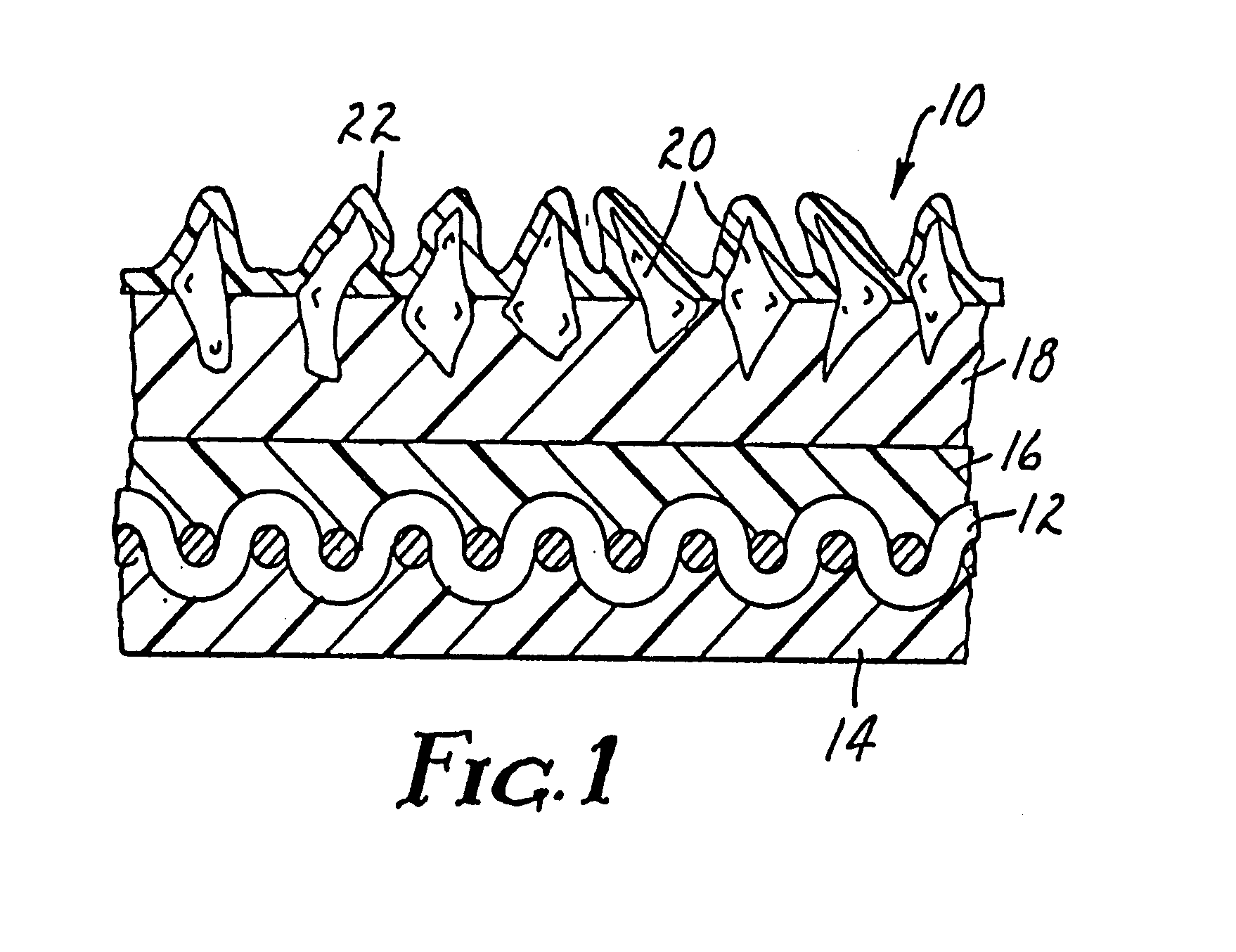
abrasive products comprising abrasive grains bonded together or bonded to a backing
by means of a binder comprising an oligomeric aminoplast resin having on average at
least one pendant Œ,[3-unsaturated carbonyl group per oligomeric unit. The oligomeric
aminoplast resins polymerize via free radical polymerization at the site of the α,β-unsaturation.
Polymerization is initiated by a source of free radicals. The source of free radicals
can be generated by electron beam radiation or by an appropriate curing agent or initiator
upon exposure to heat or radiation energy. The coated abrasive of this invention demonstrates
improved grinding performance under severe conditions as compared with coated abrasives
comprising radiation curable resins heretofore known.
|
|
