|
(11) | EP 0 500 952 A1 |

| (12) | EUROPEAN PATENT APPLICATION |
| published in accordance with Art. 158(3) EPC |
|
|
|
|
|||||||||||||||||||||||||||
| (54) | PROCESS FOR PRODUCING NITROGENOUS HETEROCYCLE |
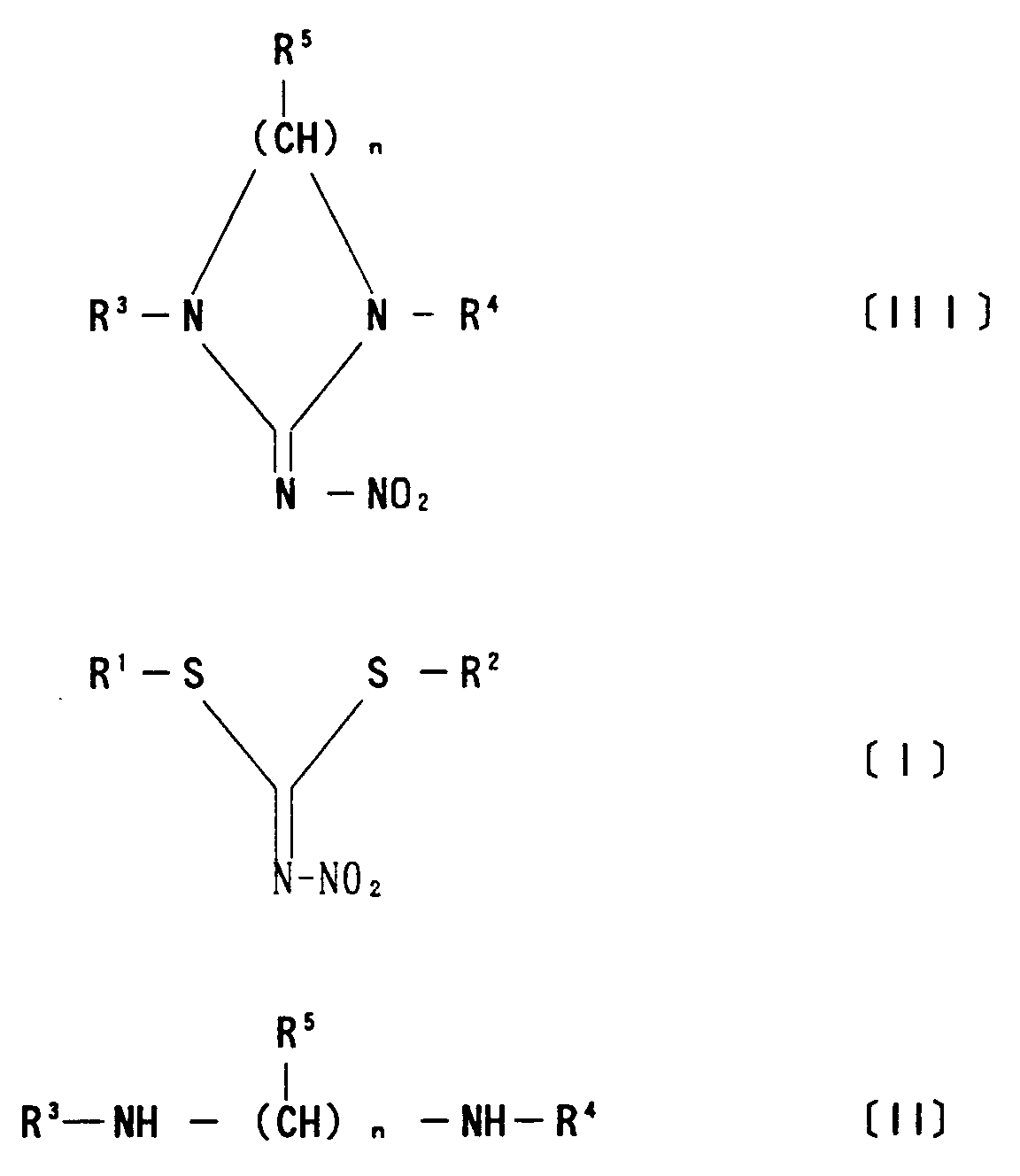
| (57) A process for producing a nitrogenous heterocycle represented by general formula
(III) by the reaction of an N-nitroimidodithiocarbonate represented by general formula
(I) with a diamine represented by general formula (II), wherein R¹ and R² represent
each alkyl; R³ and R⁴ represent each hydrogen or alkyl which may be substituted with
a heterocycle; R⁵ represents hydrogen or alkyl; and n represents 2 to 4.
|
Technical Field
[0001] The present invention relates to a process for preparation of nitrogen containing heterocyclic compounds which are useful for pesticides or intermediates of pharmaceuticals and pesticides.
Background Art
[0002] A synthetic method of compounds represented by general formula [III] was presented in "Journal of the American Chemical Society" .,70,430 (1948), but the yield was insufficient.
[0003] Purpose of the present invention is to prepare the nitrogen containing heterocyclic compounds more efficiently than so far by using a novel process composed of reactions between esters of N-nitroimidodithiocabonic acids and diamines.
Disclosure of Invention
[0004] The present invention is composed of the following synopses;
synthesizing process of the nitrogen containing heterocycles represented by the general formula [III] (wherein, R³ and R⁴ represent a hydrogen atom, an alkyl group or an alkyl group substituted by heterocycle respectively, R⁵ is a hydrogen atom or an alkyl group and n is 2 to 4), by a reaction between esters of N-nitroimidodithiocabonic acid represented by general formula [I] (wherein, R¹ and R² represent an alkyl group respectively) and diamines represented by general formula [II] (wherein, R³, R⁴, R⁵ and n are the same as defined above)
[0005] A term of an alkyl group means hereupon a straight or branched chained one having 1 to 4 carbon atoms. For example, methyl, ethyl, isopropyl and tertiary butyl may be given.
[0006] A heterocyclic ring which is defined in the expression of " an alkyl group substituted by heterocycle" means nitrogen containing five or six membered ring allowed to be substituted by halogen atom such as chlorine and bromine atom, or alkyl group such as methyl and ethyl group.
[0007] For examples of the esters of N-nitroimidodithiocabonic acids represented by the general formula [I] (wherein, R¹ and R² are the same as defined above), S,S'-dimethyl N-nitoroimidodithiocarbonate as R¹ and R² being identical alkyl group, or S-isopropyl S'-methyl N-nitroimidodithiocarbonate and S-methyl S'-t-butyl N-nit roimidodithiocarbonate as different alkyl groups may be given.
[0008] Thease compounds can be easily obtained. For example, they can be obtained according to the following equation:
[0009] For examples of the diamines represented by the general formula [II], ethylenediamine, N-(2-chloro-5-pyridylmethyl)ethylenediamine, N-(2-chloro-5-thiazoylmethyl)ethylenediamine, N-(2-chloro-5-pyridylmethyl)-N'-methylethylenediamine and the like may be given.
[0010] They can be prepared according to methods such as described in " Shin Jikken Kagaku Kouza" vol. 14 (III) pp 1332-1399.
[0011] Based on one mole of the esters of N-nitroimidodithiocarbonic acids represented by the general formula [I], 1.0 to 3.0 mole, preferably 1.0 to 1.5 mole of the diamines may be used.
[0012] The reaction solvent may not be particularly limited as far as it is inert for reagents and reaction products. Generally, halogenated hydrocarbon such as chloroform or dichloromethane, alcohol such as methanol or ethanol and aromatic hydrocarbon such as toluene or chlorobenzene and the like may be used.
[0013] The reaction temperature is from -30 °C to the boiling point of using solvent. Generally, the react ion can be proceed enough at around of the room temperature.
[0014] After completion of the reaction, the desired substance with high purity can be obtained by a direct filtration of deposited crystals from the reaction mixture. It is also able to be obtained by using common post-treatment such as recrystallization or column chromatography of residue material after evaporation of the solvents.
[0015] When either R³ or R⁴ is hydrogen or both R³ and R⁴ are hydrogen atoms in the general formula [IV], tautomeric isomers exist as follows:
The Best Mode for Carrying Out the Invention
[0016] The present invention is described in more detail with examples, but the invention shall not be limited within the examples.
(Reference Example)
Dimethyl N-nitroimidodithiocarbonate:
[0018] Into 122.4 g (1.2 mol) of acetic acid anhydride, 25.2 g (0.4 mol) of fuming nitric acid (spgr. 1.52) was dropped with stirring below 10 °C over 10 minutes. After cooling to 0°C, 0.3 g of conc. sulfuric acid and 24.2 g (0.2 mol) of dimethyl imidodithiocarbonate was dropped to the mixture at -5 to 5°C for 30 minutes. The reaction mixture was stirred at -5 to 0°C for more 70 minutes, then, the reaction mixture was poured into 1 ℓ o f ice water and the whole was stirred for more 30 minutes.
[0019] Deposited crystal was filtered, washed with water and 20.6 g of the desirable compound was obtained by drying. The yield was 62.0 %. Melting point 65-65. 5°C.
¹H-NMR spectrum (CDCl3) δ ppm : 2.62 (SCH3,s)
MASS spectrum (Cl-Dl): 167, 120, 74
(Example 1.)
2-(Nitroimino)imidazolidine:
[0021] To a solution of 1.66 g (10 mmol) of dimethyl N-nit roimidodithiocarbonate in 5ml of chloroform, a solution of 0.72 g (12 mmol) of ethylenediamine in 1 ml of chloroform was added with stirring at 27 to 33°C under cooling by ice water.
[0022] The reaction mixture was stirred at room temperature for more 3 hours followed by evaporation of the solvent under reduced pressure. Deposited crude crystal was collected and washed by diethyl ether. 1.25 g of the desired crystalline compound was obtained by drying. The yield was 96.1 %. Melting point 213-215°C(decomposed).
(Example 2. )
2-(Nitroimino)imidazoldine:
[0024] To a solution of 1.94 g (10 mmol) of S-isopropyl S'-methyl N-nitroim idodithiocarbonate in 5ml of chloroform, a solution of 0.66 g (11 mmol) of ethylenediamine in 1 ml of chloroform was added with stirring at 25 to 30°C under cooling by ice water.
[0025] The reaction mixture was stirred at room temperature for more 1.5 hours followed by the same treatment as Example 1. Thus, 1.20 g of the desired crystalline compound was obtained. The yield was 92.3 %.
(Example 3.)
4-Methyl 2-(nitroimino)imidazolidine:
[0027] To a solution of 1.66 g (10 mmol) of dimethyl N-nit roimidodithiocarbonate in 5ml of chloroform, a solution of 0.81 g (11 mmol) of 1,2-propanediamine in 1 ml of chloroform was added with stirring at 28 to 38 °C u nder cooling by ice water.
[0028] The reaction mixture was stirred at room temperature for more one hour followed by the same treatment as Example 1. Thus, 1.29 g of the desired crystal line compound was obtained. The yield was 89.6 %.Melting point 172-3 °C.
(Example 4. )
1-Methyl 2-(nitroimino)imidazolidine:
[0030] To a solution of 1.66 g (10 mmol) of dimethyl N-nitr oimidodithiocarbonate was dissolved and 0.82 g (11 mmol) of N-methylethylenediamine was added with stirring at 20 to 28 °C under cooling by ice water.
[0031] The reaction mixture was stirred at room temperature for more 3 hours followed by evaporating the solvent under reduced pressure. Crude crystal deposited was recrystallized from ethanol and dried. Thus 1.17 g of the desired compound was obtained. The yield was 81.3 %. Melting point 115-116.5 °C.
(Example 5. )
1-(2-Chloro-5-pyridylmethyl)-2-(nitroimino)imidazolidine:
[0033] To a solution of 2.50 g (15 mmol) of dimethyl N-ni troimidodithiocarbonate in 10 ml of dichloromethane, 2.78 a (15 mmol) of N-(2-chloro-5-pyridylmethyl)ethylenediamine was added with stirring at 25 to 32°C under ice cooling.
[0034] The reaction mixture was stirred at room temperature for more 3 hours, followed by evaporating the solvent under reduced pressure. Crude crystal deposited was recrystallized from ethanol and dried. Thus, 3.07 g of the desired compound was obtained, The yield was 80.0 %. Melting point 134-6 °C.
(Example 6.)
2-(Nitroimino)1,3-diazacyclohexane:
[0036] To a solution of 1.66 g (10 mmol) of dimethyl N-nitro imidodithiocarbonate in 5 ml of chloroform, 0.82 g (11 mmol) of trimethylenediamine was added with stirring at 25 to 37 °C under ice cooling.
[0037] After the reaction mixture was stirred at room temperature for more one hour, crude crystal deposited was filtered washed with chloroform and dried. Thus, 1.14 g of the desired compound was obtained. The yield was 79.2 %. Melting point 246,248°C (decomposed).
(Example 7. )
2-(Nitroimino)1,3-diazacycloheptane:
[0039] To a solution of 1.66 g (10 mmol) of dimethyl N-nit roimidodithiocarbonate in 5 ml of chloroform, 0.97 g (11 mmol) of tetramethylenediamine was added with stirring at 25 to 32 °C under ice cooling.
[0040] The reaction mixture was stirred at room temperature for more 1.5 hours, and treated as example 6. Thus, 1,42 g of the desired compound was obtained. The yield was 89.9 %. Melting point 182-4°C.
(Comparative Example 1. )
2-(Nitroimino)imidazolidine:
[0042] To a 50 ml of aqueous solution dissolving 22.4 g of potassium hydroxide (0.4 mol), 20.8 g (0.2 mol) of nitroguanidine and 26.6g (0.2mol) of ethylenediamine di-hydrochloride were subsequently added with stirring at room temperature. The reaction mixture was heated to 65 to 70°C for 20 minutes and then cooled to 1°C The deposited crystal was filtered and washed with small portion of cold water and dried. Thus, 9.6 g of the desired crystalline was obtained. The yield was 37 %.
Industrial Applicability
1. A preparation method of nitrogen containing heterocyclic compounds represented by
general formula [III] ( wherein, R³ and R⁴ are hydrogen atom , an alkyl group or an
alkyl group substituted by heterocycle respectively, R⁵ is hydrogen atom or an alkyl
group and n is 2 to 4), which is characterized by a reaction between esters of N-nitroimidodithiocarbonic
acid represented by general formula [I] ( wherein, R¹ and R² are an alkyl group respectively)
and the diamines represented by general formula [II] ( wherein, R³, R⁴, R⁵ and n are
the same as defined above).