|
(11) | EP 0 501 288 A1 |

| (12) | EUROPEAN PATENT APPLICATION |
|
|
|
|
|||||||||||||||||||||||||||
| (54) | Process for producing styrenic polymer |
| (57) The process of the present invention provides a styrenic polymer suitable for making
molded products which have excellent quality without the decrease in the productivity. The process of the present invention comprises polymerizing a compound consisiting essentially of a styrenic monomer in the presence of 10 to 500 ppm by weight of an organic peroxide represented by the following general formula (I): wherein R, R¹ and R² each are as defined in the specification. |
BACKGROUND OF THE INVENTION
1. Field of the Invention
[0001] The present invention relates to a process for producing a styrenic polymer and more particularly, to a process for producing without reducing the productivity of a styrenic polymer as the molding material suitable for molded products which have excellent quality.
2. Description of the Related Arts
[0002] Various types of high-molecular weight polystyrene have been produced for increasing strength of polystyrene. However, attempts to elevate molecular weight of polystyrene have been disturbed by the need for retarding the reaction rate, with the result that the productivity is extremely reduced.
[0003] There have been proposed methods of solving this technical difficulty by using organic peroxides or multifunctional compounds or special reactor, wherein these methods have the defects that the reaction rate is not adequately raised and that polystyrene produced therefrom has not acceptable quality. A method for producing high-molecular weight polystyrene of good quality without a decrease of the productivity have not been made available yet.
[0004] For example, in Japanese Patent Publication 19511/1966 a technique of producing polystyrene by using a particular organic peroxide has been disclosed but has a shortcoming that the organic peroxide is used too much and that polystyrene has low molecular weight, showing a low impact resistance. Japanese Patent Application Laid Open 170806/1990 discloses a method of producing a styrenic polymer with elevated impact resistance and the improved molecular weight distribution by carrying out the polymerization in the presence of a multifunctional vinyl compound, wherein this method has a defect that molded products made therefrom do not have a satisfactory degree of haze.
[0005] Further, although a method for producing styrenic resin with high molecular weight by using special reactors according to the continuous bulk polymerization has been described in Japanese Patent Application Laid Open 70507/1989, the method has a problem in providing the insufficient increase of the reaction rate.
[0006] Thus, those skilled in the art have been seeking a method for producing without reducing the productivity of a styrenic polymer with high molecular weight which are useful as the raw material of molded products excellent in the degree of haze and impact resistance.
[0007] The present inventors have made intensive studies in order to develop a process for producing the styrenic polymer from above-mentioned viewpoint.
[0008] As the result, it has been found that above-mentioned objects can be achieved by polymerizing a compound consisting essentially of a styrenic monomer (aromatic vinyl monomer) in the presence of 10 to 500 ppm by weight of a particular organic peroxide. The present invention has been completely on the basis of this finding.
SUMMARY OF THE INVENTION
[0009] Therefore, an object of the present invention is to provide a process for producing without reducing the productivity of a styrenic polymer as the molding material suitable for molded products which have excellent quality.
[0010] Another object of the present invention is to provide a styrenic polymer as the molding material suitable for making molded products having excellent quality, a high impact resistance and a satisfactory degree of haze.
[0011] Still another object of the present invention is to provide a styrenic polymer as the molding material suitable for use in the fields of household goods, electric appliances and the like.
[0012] The present invention provides a process for producing a styrenic polymer which comprises polymerizing a compound consisting essentially of a styrenic monomer in the presence of 10 to 500 ppm by weight of an or ganic peroxide represented by the following general formula (I):
wherein R represents a tertiary alkyl group or a tertiary aralkyl group, and R¹ and R² each represent an alkyl group having 1 to 2 carbon atoms, said styrenic polymer having weight average molecular weight of 30 x 10⁴ to 70 x 10⁴ and a ratio of weight average molecular weight (Mw) to number average molecular weight (Mn) of not more than 3.0 (Mw/Mn).
DESCRIPTION OF THE PREFERRED EMBODIMENTS
[0013] Styrenic monomers (that is, aromatic vinyl monomers) used in the present invention include styrene, α-substituted alkylstyrene such as α-methylstyrene, α-ethylstyrene and α-isopropylstyrene, nucleus substituted alkylstyrene such as p-methylstyrene, m-methylstyrene and 2, 5-dimethylstyrene, nucleus substituted-halogenated styrene such as p-chlorostyrene, p-bromostryrene and dibromostyrene or a mixture thereof.
[0014] According to the present invention, above-mentioned styrenic monomers can be used as the starting material singly or in combination with other compounds (monomers) which are copolymerizable therewith. Examples of these monomers (comonomers) include acrylic monomers such as acrylonitrile, methacrylonitrile, methacrylic acid, methyl methacrylate, acrylic acid and methyl acrylate and further maleimide, phenylmaleimide and nucleus substituted phenylmaleimide.
[0015] Therefore, styrenic polymers according to the present invention include not only homopolymers and copolymers (random, graft and the like) of styrenic monomer selected from said styrene and substituted styrene but also copolymers of this styrenic monomer with above-mentioned other types of monomers which are copolymerizable therewith.
[0016] Organic peroxides to be used in the present invention are those represented by the general formula (I). Therein, R represents a tertiary alkyl group (that is, tertiary butyl group, tertiary amyl group, tertiary octyl group and the like) or a tertiary aralkyl group (cumyl group. 1-ethyl-1-phenylpropyl group and the like), and R¹ and R² each represent an alkyl group having 1 to 2 carbon atoms (that is, methyl group or ethyl group). Specific examples of these organic peroxides include 2, 2-bis(4, 4-ditertiarybutylperoxycyclohexyl) propane; 2,2-bis (4, 4-ditertiaryamylperoxycyclohexyl) propane; 2, 2-bis(4, 4-dicumylperoxycyclohexyl) propane; and 2, 2-bis(4, 4-ditertiarybutylperoxycyclohexyl) butane. Among them, 2, 2-bis (4, 4-ditertiarybutylperoxycyclohexyl) propane is preferred. A mixture of these organic peroxides is used as well. The amount of the organic peroxides added is 10 to 500 ppm by weight, preferably 100 to 450 ppm by weight based on styrenic monomers. When the amount of the organic peroxide is less than 10 ppm by weight, their presence is not substantially effective. When the amount of the organic peroxide added is more than 500 ppm by weight, the polymers obtained have lower molecular weight.
[0017] The organic peroxides are incorporated into the reaction system by a variety of means, the methods thereof are not otherwise limited and usually the following methods are adopted: their amount is fed either as a whole in the initial stage of the polymerization or in two divided lots in the initial and midway stage of the polymerization.
[0018] The method of the present invention is carried out by the use of above-mentioned organic peroxides and, if necessary, usual polymerization initiators may be used in combination. These polymerization initiators include organic peroxides such as tertiarybutylhydroperoxide; ditertiarybutylperoxide; cumene hydroperoxide; dicumylperoxide; benzoylperoxide; 1, 1-bi s(tertiarybutylperoxy)cyclohexane; and 1, 1-bis(tertiarybutylperoxy)-3, 3, 5-trimethylcyclohexane, and azo compounds such as azo bisisobutyronitrile; azobis-2, 4-dimethylvaleronitrile; azobiscyclohexanecarbonitrile; azobismethyl isolactate; and azobiscyano valerate. Further, other polymerization initiators may as well be used.
These polymerization initiators are used either singly or in combination in consideration of existing conditions.
[0019] The polymerization according to the present invention usually is the continuous bulk polymerization, but includes the batch polymerization.
[0020] The continuous bulk polymerization is carried out in a following way: the monomers (styrenic monomers) are fed into a system consisting of 2 to 6 units of full mixing flow type and/or plug flow type reactors and one or more units of monomer devolatilizing equipments which are connected in series. The reaction temperatures are preferably 90 to 200 °C. Further, the reaction temperature difference among the reactors should be preferably not higher than 40°C. As described above, the amount of organic peroxides represented by the general formula (I) is incorporated either as a whole in the initial stage of the polymerization or as divided lots in the initial and midway stage of the polymerization. A small amount of solvent such as ethylbenzene and xylene may as well be added to the reaction system. The reaction rate r is not otherwise limited, is selected suitably in consideration of existing conditions and preferably in a range of 5 to 15%/hr. If weight average molecular weight at the outlet of the last reactor is expressed as Mw0, Mw0 ≧(75-3 x r) x 10⁴ is particularly preferred from the viewpoint of the productivity. Further, the conversion of a styrenic monomer at the last reactor is preferably 40 to 90% by weight.
Discharged out of the last reactor, polymers (styrenic polymers) are fed into monomer devolatilizing equipments to remove residual monomers and finally pelletized. Examples of monomer devolatilizing equipments include thin film type evaporator and flush drum, and the equipments are operated, for example under the conditions of temperature of 180 to 300°C and of pressure of 1 to 600 Torr. Residual monomers are discharged from the outlet of devolatilizing equipment usually in an amount of not more than 5000 ppm by weight, preferably not more than 1000 ppm by weight and more preferably not more than 500 ppm by weight. Additives such as antioxidant, inner lubricating agent, outer lubricating agent, mold releasing agent, weather resistant agent, flame retardant and colorant may be added to polymers when they are pelletized.
[0021] In batch bulk polymerization, the similar process as that of the above continuous bulk polymerization is conducted.
[0022] According to the present invention, styrenic polymers having weight average molecular weight (Mw) of 30 x 10⁴ to 70 x 10⁴, preferably 30 x 10⁴ to 60 x 10⁴ and a ratio of weight average molecular weight (Mw) to number average molecular weight (Mn) of not more than 3.0, preferably 2.0 to 3.0 (Mw/Mn) (measured with gel permeation chromatography) are obtained by varying the polymerizing conditions including the amount of organic peroxides represented by the general formula (I), the reaction temperatures among the reactors of the multi-stage continuous polymerization (or the batch polymerization) and the like.
[0023] When styrenic polymers have a weight average molecular weight of less than 30 x 10⁴, the molded products made therefrom have an insufficient impact resistance. When styrenic polymers have a weight average molecular weight of more than 70 x 10⁴, the degree of haze of molded products is deteriorated.
[0024] Further, styrenic polymers according to the present invention must have the ratio of weight average molecular weight (Mw) to number average molecular weight (Mn), that is, Mw/Mn ratio of not more than 3.0, preferably 2.0 to 3.0. When the Mw/Mn ratio exceeds 3.0, the degree of haze deteriorates so that the object of the present invention is not achieved.
[0025] According to the present invention, high-molecular styrenic polymers can be obtained without the decrease in the productivity, and the molded products made therefrom exhibit significantly improved haze and impact resistance in comparison with the conventional products, as stated above.
[0026] Therefore, styrenic polymers according to the present invention will be used as a molding material in the fields of various different household goods, electric appliances and the like.
[0027] The present invention will now be described in greater detail referring to the following examples and comparative examples. In examples and comparative examples, all of % and ppm are based on weight.
[0028] Furthermore, weight average molecular weight and number average molecular weight of obtained styrenic polymers and impact resistance and the degree of haze of molded products are respectively obtained by measurement in the following way. The results of said measurements are shown in Table 1.
Measurement of Molecular Weight
[0029] The measurement was conducted according to gel permeation chromatography (GPC) using ALC/GPC (150-C model) supplied by Waters Company and the columns for GPC (TSK-GEL GMH6 and TSK-GEL HM) supplied by Toyo Soda Co., Ltd.
Impact Resistance
[0030] Impact resistance was measured with an Izod type impact tester using test pieces without notch as directed in JISK7110.
Degree of haze
Example 1
[0032] Styrene dissolving 400 ppm of 2, 2-bis (4, 4-ditertiarybutylperoxy-cyclohexyl) propane (Perkadox 12 brand: supplied by Kayaku Akuzo Corporation) was fed at a rate of 12.5 liter/hr into a continuous bulk polymerization system consisting of 1 unit of full mixing vessel type reactor having 23 liter capacity, 2 units of column type reactor having 33 liter capacity and 2 units of devolatilizing equipment which were connected in series. 3 units of reactors were maintained at the temperatures of 110 °C/110°C/120°C. The conversion of styrene was found to be 75.2% at the outlet of the 3rd reactor. After residual styrene was removed by devolatilizing equipment, polymers were pelletized. The obtained pellets were found to have weight average molecular weight Mw of 45.2 x 10⁴ and a Mw/Mn ratio of 2.64.
[0033] The pellets were subjected to injection molding of 3 mm thick plates to prepare test pieces without notch, and then impact resistance on the Izod type tester was measured by the use of the obtained test pieces. The degree of haze was measured as well. The results thereof are shown in Table 1.
Examples 2 to 5
[0034] The polymerization was carried out in the same procedure as in Example 1, except that the amount of 2, 2-bis(4, 4-diter tiarybutylperoxy-cyclohexyl) propane, the feed of styrene and the reaction temperatures were changed. The results are shown in Table 1.
Comparative Example 1
[0035] The polymerization was carried out in the same procedure as in Example 1, except that 2, 2-bis (4, 4-ditertiarybutylperoxy-cyclohexyl) propane was not used and that styrene was fed in a different amount. The results are shown in Table 1.
Comparative Example 2
[0036] The polymerization was carried out in the same procedure as in Example 1, except that 2, 2-bis (4, 4-ditertiarybutylperoxy-cyclohexyl) propane was incorporated in an amount of 700 ppm. The results are shown in Table 1.
Comparative Example 3
[0037] The polymerization was carried out in the same procedure as in Example 1, except that 3 units of the reactors were maintained at the temperatures of 90°C/110°C/150°C. The results are shown in Table 1.
Comparative Example 4
[0038] The polymerization was carried out in the same procedure as in Example 1, except that 3 units of the reactors were maintained at the temperatures of 80°C/80°C/90°C and that styrene was fed at a rate of 4.0 liter/hr. The results are shown in Table 1.
Comparative Example 5
[0039] The polymerization was carried out in the same procedure as in Example 1, except that 2, 2-bis (4, 4-ditertiarybutylperoxy-cyclohexyl) propane used therein was replaced by 1, 1-bis(tertiarybutyl-peroxy)-3, 3, 5-trimethylcyclohexane (Perhexa 3M brand; supplied by Japan Oils and Fats Co., Ltd.). The results are shown in Table 1.
Comparative Example 6
1. A process for producing a styrenic polymer which comprises polymerizing a compound
consisting essentially of a styrenic monomer in the presence of 10 to 500 ppm by weight
of an organic peroxide represented by the following general formula (I):
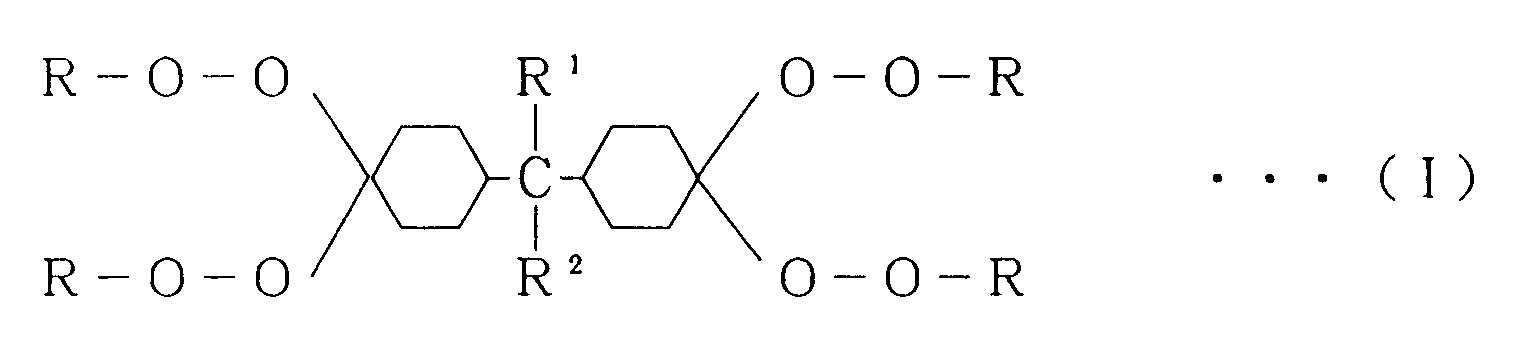
wherein R represents a tertiary alkyl group or a tertiary aralkyl group, and R¹ and R² each represent an alkyl group having 1 to 2 carbon atoms, said styrenic polymer having weight average molecular weight of 30 x 10⁴ to 70 x 10⁴ and a ratio of weight average molecular weight (Mw) to number average molecular weight (Mn) of not more than 3.0 (Mw/Mn).
wherein R represents a tertiary alkyl group or a tertiary aralkyl group, and R¹ and R² each represent an alkyl group having 1 to 2 carbon atoms, said styrenic polymer having weight average molecular weight of 30 x 10⁴ to 70 x 10⁴ and a ratio of weight average molecular weight (Mw) to number average molecular weight (Mn) of not more than 3.0 (Mw/Mn).
2. The process according to Claim 1 which comprises feeding the compound consisting essentially
of the styrenic monomer to 2 to 6 units of reactors connected in series and carrying
out the continuous bulk polymerization under the conditions of reaction temperatures
of 90 to 200°C and of difference of the reaction temperatures among the reactors of
not more than 40°C.
3. The process according to Claim 2 wherein, a reaction rate r of the continuous bulk
polymerization is 5 to 15%/hour.
4. The process according to Claim 1, wherein the organic peroxide is at least one peroxide
selected from the group consisting of 2,2-bis(4,4-ditertiarybutylperoxycyclohexyl)propane,
2,2-bis(4,4-ditertiaryamylperoxycyclohexyl)propane, 2,2-bis(4,4-dicumyl-peroxycyclohexyl)propane,
and 2,2-bis(4,4-ditertiary-butylperoxycyclohexyl)butane.
5. The process according to Claim 1, wherein the organic peroxide is 2,2-bis(4,4-ditertiary-butylperoxycyclohexyl)propane.
6. The process according to Claim 1, wherein the weight average molecular weight of the
styrenic polymer is 30 x 10⁴ to 60 x 10⁴.
7. The process according to Claim 1, wherein the ratio of weight average molecular weight
(Mw) to number average molecular weight (Mn) is 2.0 to 3.0.
8. The process accoridng to Claim 2, wherein the conversion of a styrenic monomer at
the last reactor is 40 to 90% by weight.
9. The process according to Claim 2, wherein the styrenic polymers discharged out of
the last reactor are fed into a monomer devolatilizing equipments.