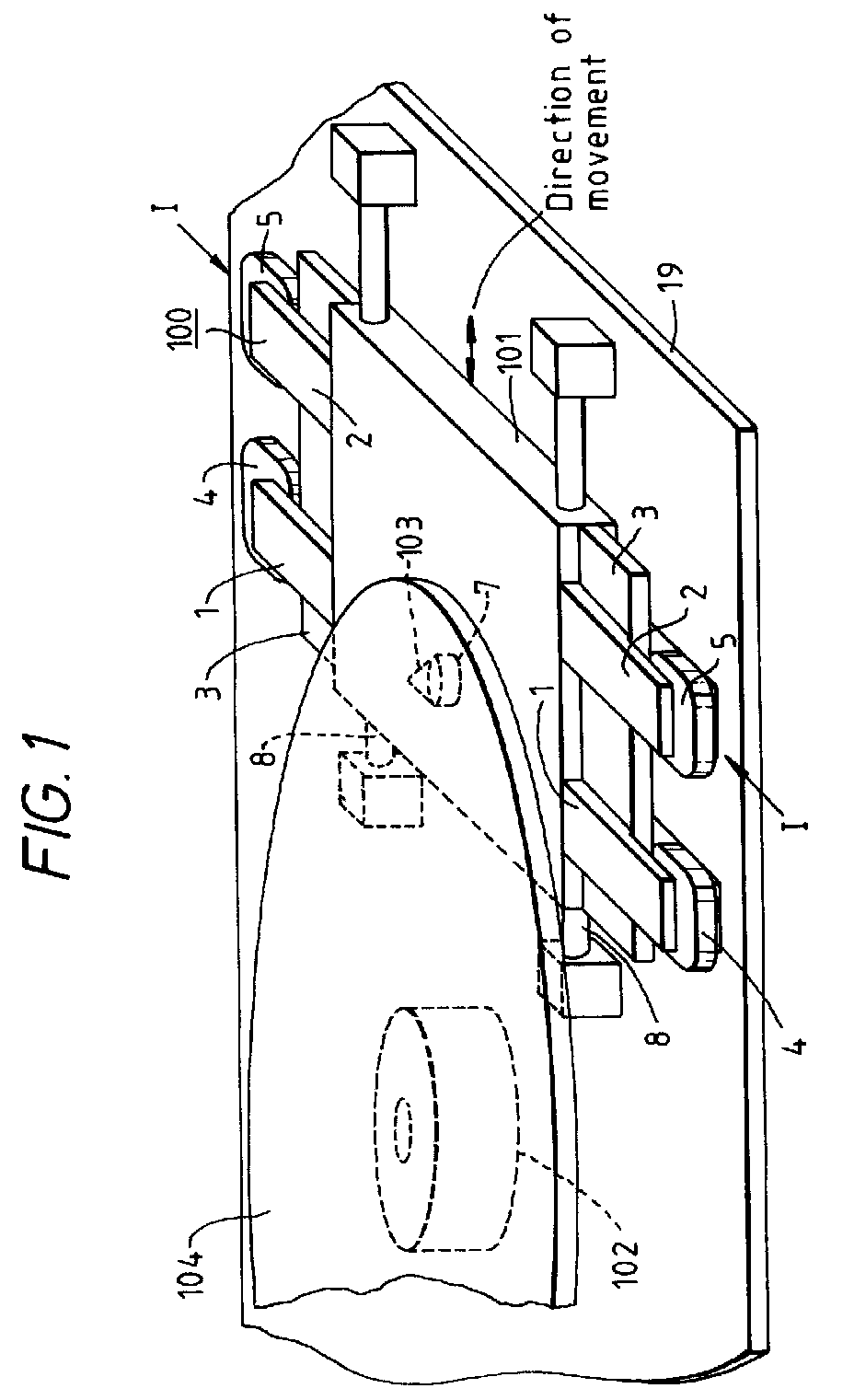
(57) A linear actuator for e.g. a disk drive has a fixed member (19) and a movable member
(101). One of those members (19,101) carries at least one track (3) of permanent magnets
extending in the direction in which the movable member (3) is to move, with adjacent
permanent magnets having alternate magnetic polarity. The other member (19,101) has
first and second drive parts each having at least one pair of opposed sets of teeth
(1,2). The or each track (3) passes between those teeth (1,2). Each pair of teeth
(1,2) is associated with a corresponding drive coil (4,5) giving the teeth (1,2) a
magnetic polarity so that there is a magnetic alignment between a polarity of the
teeth (1,2) and the permanent magnets (3). The drive parts are arranged so that, for
any given relative position of the first and second members (19,101), the magnetic
alignment of the teeth (1,2) of one drive part is out of phase with the magnetic alignment
of the teeth (1,2) of the other part. In order to ensure that the magnetic alignments
are out of phase, there may be a physical displacement between the teeth (1,2) of
the two drive parts. This displacement may be (m ± 1/2).Tp where m is an integer and Tp is the teeth pitch. This gives a phase displacement of 180°. Alternatively, the drive
parts may be aligned, and two tracks (3) of permanent magnets be provided with the
magnets thereof having opposite polarity for a given track position, or the drive
current to the drive coils (4,5) may be controlled to be out of phase. Such arrangements
permits smooth driving of the movable member (101).
|
|
