|
(11) | EP 0 505 070 A1 |

| (12) | EUROPEAN PATENT APPLICATION |
|
|
|
|
|||||||||||||||||||||||||||
| (54) | Motor fuel composition having enhanced water tolerance |
| (57) A motor fuel composition comprising a base fuel and: (I) the reaction product of
(a) a hydrocarbyl-substituted dibasic acid anhydride and (b) a polyoxyalkylene diamine;
(II) a polymeric component which is a polyolefin polymer/copolymer or the corresponding
aminated or hydrogenated polymer/copolymer, or mixtures thereof; (III) a polyalkylene
glycol having a molecular weight in the range of 500-2000; (IV) a lubricating oil
composition, and (V) a polyoxyalkylene adduct of a linear or branched aliphatic alcohol,
or an alkyl phenol. The adduct is employed as a surfactant additive and in an amount
sufficient to enhance the water tolerance of the motor fuel composition. |
[0001] This invention relates generally to a motor fuel composition and, more particularly, to a motor fuel composition having enhanced water tolerance which is ascribed to the presence of a surfactant additive.
[0002] It is well known that water and moisture can be present in motor fuel compositions, especially under field storage conditions. Typically, the water and motor fuel exist as water-in-petroleum macroemulsions, that is, the water becomes trapped in the petroleum substrate. The shortcomings associated with the presence of water in motor fuels are numerous. In particular, unstable hazy blends can result when water is present as macroemulsions in such systems. Hazy motor fuel blends are unacceptable by the public, since they are typically perceived as being contaminated and, hence, unable to perform at a satisfactory level. Also, macroemulsions can cause the motor fuel to become too viscous, making it difficult to filter, and can clog fuel filters. Furthermore, where excess water is being pumped through gas lines, an inadequate combustion can result. Corrosion is also a problem ascribed to the presence of water in motor fuel compositions.
[0003] In addition to the foregoing shortcomings, if water dissipates out at the bottom of the macroemulsion as a separate layer, some of the motor fuel additives may partition into that water phase, thereby depriving the fuel of the full intended benefit of these additives. Also, by driving some of the motor fuel into the excess water phase, this partitioning may cause the formation of undesirable macroemulsions with a milky appearance in that phase. This situation could occur in surface storage facilities and underground storage tanks at gasoline stations, due to rain conditions and/or improper maintenance of these tanks. Presumably, some emulsion may be pumped into an automobile gasoline tank, resulting in automobile operability problems, and, accordingly, customer dissatisfaction.
[0004] In contrast, if it were possible to retain water in the motor fuel composition as a microemulsion, a significant contribution would be made to the art, inasmuch as microemulsions are optically clear, thermodynamically stable and retain the viscosity of their continuous phase.
[0005] In the past, attempts have been made to improve the water-tolerance of certain fuels. For instance, U.S. Patent No. 4,808,195 describes a chemical mixture for use as an additive in liquid hydrocarbon fuel and/or water. In particular, the mixture includes a chemical compound having hydrophilic qualities selected from the group consisting of ethylene glycol, n-butyl alcohol, ether and cellosolve (methyl ether of ethylene glycol); ethoxylated nonylphenol; nonylphenol polyethylene glycol ether and, optionally, methanol.
[0006] U.S. Patent No. 4,599,088 describes a clear stable gasoline-alcohol-water motor fuel composition which includes certain alcohols; about 0.10 to 0.50 weight percent water; about 0.10 to 3.0 weight percent of a nonionic adduct of alkylphenol and ethylene oxide surfactant having 9 to 24 carbon atoms in the alkyl group and 6 to 10.0 ethylene oxide groups; and gasoline.
[0007] U.S. Patent No. 4,568,354 describes a process for converting hazy gasoline to clear stable gasoline by adding a nonionic surfactant of an aminated polyisopropoxylated polyethoxylated alkylphenol to the hazy gasoline.
[0008] U.S. Patent No. 4,410,334 describes a hydrocarbon fuel composition which includes, inter alia, a polyether in an amount sufficient to provide a desired level of water tolerance. Ethoxylated alkylphenols are contemplated as one type of polyether which may be used.
[0009] U.S. Patent No. 4,158,551 describes a gasoline-water emulsion which is formed by mixing gasoline, water and a nonionic ethoxylated alkenylphenol surfactant.
[0010] U.S. Patent No. 3,876,391 describes a process for preparing microemulsions. In their process, patentees employ at least one water soluble surfactant. A nonylphenol ethoxylated surfactant is employed in Example I.
[0011] U.S. Patent No. 4,968,321 describes an ORI-inhibited motor fuel composition which comprises a base fuel and (I) the reaction product of (a) a hydrocarbyl-substituted dibasic acid anhydride and (b) a polyoxyalkylene diamine; (II) a polymeric component which is a polyolefin polymer/copolymer or the corresponding aminated or hydrogenated polymer/copolymer, or mixtures thereof, of a C₂-C₁₀ hydrocarbon; (III) a polyalkylene glycol having a molecular weight in the range of 500-2000; and (IV) a lubricating oil composition.
[0012] The motor fuel composition of the present invention comprises a mixture of hydrocarbons boiling in the range of from about 90°F (32°C) to about 450°F (232°C) and (I) the reaction product of (a) a hydrocarbyl-substituted dibasic acid anhydride and (b) a polyoxyalkylene diamine; (II) a polymeric component including a polyolefin polymer, a polyolefin copolymer, an aminated polyolefin polymer, an aminated polyolefin copolymer, a halogenated polyolefin polymer, a halogenated polyolefin copolymer or mixtures thereof; (III) a polyoxyalkylene glycol having a molecular weight in the range of about 500 to about 2000; (IV) a lubricating oil; and (V) a polyoxyalkylene adduct of a linear or branched aliphatic alcohol, or an alkyl phenol, said adduct being employed as a surfactant additive and in an amount sufficient to enhance the water tolerance of said motor fuel composition.
[0013] It has advantageously been discovered that the present motor fuel composition retains more water in the microemulsion phase as opposed to the unstable, viscous and opaque macroemulsion phase. As a result, the motor fuel composition of the present invention overcomes those problems identified above which are characteristic of the prior art motor fuel compositions.
[0014] It is further believed that the motor fuel composition described herein exhibits unexpected levels of water tolerance relative to similar compositions which are known.
[0015] The present motor fuel composition is expected to exhibit its enhanced tolerance to water under field storage conditions in both surface and underground tanks and in automobile gas tanks.
[0016] The hydrocarbyl-substituted dibasic acid anhydride reactant used to prepare the reaction product component (I) of the instant invention may be represented by the formula:
where R₁ is a hydrocarbyl group having a molecular weight range of 500-10,000, preferably 500-2500, more preferably 600-1500, and most preferably 1290, and y has a value of 0-3. In a preferred embodiment, R₁ is a polypropenyl or polybutenyl group. Most preferably, R₁ is a polyisobutenyl group. Where R₁ is the preferred polyisobutenyl group, y preferably has a value of 0, and the preferred hydrocarbyl-substituted dibasic anhydride reactant for use is a polyisobutenyl succinic acid anhydride of the formula:
where x has a value of 10-25, preferably 20-25. This polyisobutenyl succinic acid anhydride is most preferably formed by reacting maleic anhydride and a polybutene, such as a polybutene commercially available from Amoco Chemical Company under the INDOPOL series trade name, the most preferred polybutene reactant being commercially available as INDOPOL H-300. Methods of formulating the above described polyisobutenyl succinic acid anhydride reactant are disclosed in, inter alia, U.S.-A-4,496,746, 4,431,825, 4,414,397, and 4,325,876.
[0017] The polyoxyalkylene diamine reactant used to prepare the reaction product component (I) of the instant invention is preferably a diamine of the formula:
where R₂ and R₃ are C₁-C₁₂ alkylene groups, q and r are integers having a value of 0-1, c has a value of from 2-150, preferably 2-50; b+d has a value of from 2-150, preferably 2-50; and a+e has a value of 2-12, preferably 2-8.
[0018] In another preferred embodiment, q=1, r=0, R₂ is a propylene group, a+e has a value of zero, and the polyoxyalkylene diamine reactant is of the formula:
where c and b+d, respectively, have a value of from 2-150, preferably 2-50. As merely illustrative, polyoxyalkylene diamines of the above structure suitable for use include those available from Texaco Chemical Company under the JEFFAMINE® ED-Series trade name. Specific examples of such compounds are set forth below:
[0019] The polymeric component (II) of the motor fuel composition of the present invention is generally described as a polyolefin polymer, copolymer, or corresponding aminated or hydrogenated polymer or copolymer, or mixtures thereof, of a C₂-C₁₀ hydrocarbon. Accordingly, as used in this description and in the claims which follow, the phrase "polymers" is intended to include the polyolefin polymers and their corresponding hydrogenated or aminated derivatives. The polymeric component (II) is usually employed in admixture with a hydrocarbon solvent to facilitate its addition into a base motor fuel composition.
[0020] In one preferred embodiment of the instant invention, the polymeric component is polypropylene with an average molecular weight of 750-1000, preferably 80.0. In another preferred embodiment, the polymeric component is polyisobutylene with an average molecular weight of 100-1500, preferably 1300. In yet another preferred embodiment of this invention, the polymeric component is a mixture of a major amount of polyisobutylene ethylene diamine and a minor amount of polyisobutylene in admixture with a suitable amount of hydrocarbon solvent. In this embodiment, the polyisobutylene ethylene diamine sub-component of the polymeric component is typically present in a concentration range of 50-75 parts, preferably about 60 parts by weight, based upon the weight of the entire composition which makes up the polymeric component. The polyisobutylene ethylene diamine sub-component is of the formula:
where z has a value of 10-40, preferably 30-35.
[0021] The polyisobutylene sub-component of the polymeric component is typically present in a concentration range of 5-25 parts, preferably 10-20 parts by weight, based upon the weight of the entire composition which makes up the polymeric component. The polyisobutylene sub-component is of the formula:
where z again has a value of 10-40, preferably 30-35.
[0022] The hydrocarbon solvent employed to facilitate admixture of the polymeric component into a base motor fuel composition is preferably a light aromatic distillate composition. A commercially available light aromatic distillate composition containing the above described polyisobutylene ethylene diamine and polyisobutylene compounds in the above specified concentrations and, therefore, most preferred for use as the polymeric component of the instant invention, is the commercial gasoline additive ORONITE OGA-472, available from Chevron Chemical Company. ORONITE OGA-472 is a composition containing approximately 60 parts by weight of polyisobutylene ethylene diamine, approximately 13 parts by weight of polyisobutylene, and approximately 27 parts by weight of light aromatic distillate, including xylene and C₉ alkylbenzenes. Fuel compositions containing ORONITE OGA-472 as an additive include those described in U.S.-A-4,141,693, 4,028,065, and 3,966,429.
[0023] The polyoxyalkylene glycol component (III) of the motor fuel composition of the instant invention has a molecular weight in the range of 500-2000, preferably 750-1000. The polyoxyalkylene glycol component is preferably selected from the group consisting of polyethylene glycol, polypropylene glycol, and polybutylene glycol, and is most preferably a polypropylene glycol having a molecular weight in the range of 750-1000.
[0024] The lubricating oil component (IV) of the motor fuel composition of the instant invention may be a natural, synthetic or heavy oil. Suitable lubricating oils for use in the motor fuel composition of the instant invention are described, for example, at columns 29-30 of U.S.-A-4,670,173 and include, in one preferred embodiment, natural oils, such as animal oils, vegetable oils, mineral lubricating oils (e.g., liquid petroleum oils, solvent-treated and acid-treated mineral oils of paraffinic, naphthenic, and mixed paraffinic-naphthenic types), and lubricating oils derived from shale or coal.
[0025] In another preferred embodiment, the lubricating oils employed is a synthetic lubricating oil. Synthetic oils suitable for use include hydrocarbon oils, halo-substituted hydrocarbon oils, such as polymerized and interpolymerized olefins, oligo-alkenes, alkylbenzenes, polyphenyls, alkylated diphenyl ethers and sulfides, and substituted and unsubstituted polyalkylenes and alkylene oxide polymers and copolymers (e.g., oils prepared through polymerization of ethylene oxide or propylene oxide, the alkyl and aryl ethers of these polyoxyalkylene polymers, or mono- and polycarboxylic esters thereof, such as acetic acid or fatty acid esters). Polyalkylene lubricating oil compositions having a molecular weight in the range of 500-2000, preferably 800-1400, are preferred for use as the lubricating oil component, with polypropylene having a molecular weight in the range of 800-1400 and polyisobutylene having a molecular weight in the range of 800-1000 being particularly preferred.
[0026] Yet another particularly preferred class of oils for use as the lubricating oil component are unrefined or refined heavy oils. Unrefined oils are those obtained directly- from a natural or synthetic source without further purification treatment. Refined oils are similar to unrefined oils, except they have been further treated in one or more purification steps to improve one or more properties. Many such purification techniques (e.g., solvent extraction, secondary distillation, acid or base extraction, filtration, percolation) are well known to those skilled in the art. A particularly preferred class of heavy oils for use are known to those skilled in the art as paraffinic Solvent Neutral Oils (SNO). An example of a paraffinic SNO for use as the lubricating oil component of the instant invention is SNO-600, which has a viscosity of about 20-60 cSt at 40°C.
[0027] As stated above, the motor fuel composition of the present invention further includes a surfactant additive which is employed to enhance the water tolerance of the motor fuel composition. In particular, the surfactant additives are generally referred to as alkylphenol alkoxylates or alcohol alkoxylates, which may be used alone or in combination. Similarly, the surfactants are also referred to as polyoxyalkylene alkylphenols or alcohols. More specifically, they are, in one aspect, polyoxyalkylene adducts of alkylphenols and, in another aspect, polyoxyalkylene adducts of linear or branched aliphatic alcohols. Thus, the surfactants are derived from alkylphenols and linear or branched aliphatic alcohols which have been reacted with an alkylene oxide to various degrees of alkoxylation.
[0028] The surfactant additives used in the motor fuel composition of the present invention may be represented by the general formula:
where x is an integer from 1 to 10, R₁ is either (a) Cn H2n+1, where n is an integer from 10 to 18, or (b) Cn H2n+1 - C₆H₄, where n is an integer from 8 to 18 and where R₂ is H , CH₃ - or CH₃CH₂-.
[0029] In the formula used to represent the preferred surfactant additive, R₂ is H and, thus, the preferred surfactant is, in one aspect, a polyoxyethylene adduct of an alkylphenol and, in another aspect, a polyoxyethylene adduct of linear or branched aliphatic alcohols.
[0030] More specifically, the preferred ethoxylated alkylphenol surfactants used herein are represented by the general formula:
where n is an integer between 8-18 and x is from 1 to 10. Particularly preferred ethoxylated alkylphenol surfactants are selected from nonylphenol ethoxylates in the HLB range of 3-11, that is, with between 1 and 6 ethylene oxide units. SURFONIC® N-40, an ethoxylated nonylphenol surfactant available from Texaco Chemical Company is representative of the preferred surfactant.
[0031] The preferred ethoxylated alcohol surfactants used herein are represented by the general formula:
Cn H2n+1-O-(CH₂CH₂O)x-H,
where n is an integer between 8-18 and x is from 1 to 10.
[0032] An important criterion for characterizing the surfactant is the Hydrophile-Lipophile Balance (HLB). More specifically, the HLB refers to the relative simultaneous attraction that the surfactant demonstrates for water and oil. Substances having a high HLB, above about 12, are highly hydrophilic (and poorly lipophilic) while substances having a low HLB, below 8, are lipophilic and consequently poorly hydrophilic. Those having an HLB between 8 and 12 are intermediate. An extensive discussion of HLB can be found in the literature particularly in "Emulsions: Theory and Practice," by P. Becher, published by Reinhold Publishing Corp., N.Y., 1957. The HLB for the surfactants used herein, is in the range of 3 to 11. More preferably, the HLB of the surfactants is from 5 to 10. Surfactants having an HLB within the preferred range advantageously exhibit a greater affinity or solubility in oil than in water.
[0033] The motor fuel composition of the instant invention may comprise a major amount of a base motor fuel and: (I) from 0.0005 to 5.0 weight percent, preferably 0.001-1.0 weight percent of the above described reaction product of (a) the hydrocarbyl-substituted dibasic acid anhydride, and (b) the polyoxyalkylene diamine; (II) from 0.001 to 1.0 weight percent, preferably 0.01-0.5 weight percent of the above described polymeric component; (III) from 0.001 to 1.0 weight percent, preferably 0.001-0.5 weight percent of the above described polyoxyalkylene glycol component; (IV) from 0.001 to 1.0 weight percent, preferably 0.001-0.5 weight percent of the above described lubricating oil component; and (V) from 0.001 to 5.0 weight percent of the above described surfactant additive. Preferably, the surfactant additive is employed in an amount of up to 1.0 weight percent and, most preferably, is employed in an amount of .5 weight percent.
[0034] Preferred base motor fuel compositions are those intended for use in spark ignition internal combustion engines. Such motor fuel compositions, generally referred to as gasoline base stocks, preferably comprise a mixture of hydrocarbons boiling in the gasoline boiling range, preferably from 90°F to 450°F. This base fuel may consist of straight chains or branched chains or paraffins, cycloparaffins, olefins, aromatic hydrocarbons, or mixtures thereof. The base fuel can be derived from, among others, straight run naphtha, polymer gasoline, natural gasoline, or from catalytically cracked or thermally cracked hydrocarbons and catalytically reformed stock. The composition and octane level of the base fuel are not critical and any conventional motor fuel base can be employed in the practice of this invention.
[0035] In the following examples, inventive and comparative motor fuel compositions were prepared to determine the extent of macroemulsion and microemulsion formation. The extent of macroemulsion formation was determined by visual inspection of the emulsion and by measuring the time it took to clear the gasoline and water phase. The extent of microemulsion formation was determined by the experimental approaches of water retention analysis and water uptake analysis.
[0036] More specifically, water uptake and water retention experiments are employed to quantify the amount of water that can be solubilized and, thus, tolerated, in a motor fuel composition. Advantageously, the two techniques approach the same equilibrium state from two directions. Accordingly, by employing these two analytic techniques, the results provided below reflect a true thermodynamic equilibrium.
[0037] In the examples used to determine water uptake (Examples I-V and Comparative Examples VI-XV), water and gasoline were mixed at a water:gasoline ratio of 10:40 and at the varying temperatures identified in Table I and, thereafter, were permitted to equilibrate in a circulation bath and settle at the various temperatures. The resulting clear gasoline layers were twice sampled and analyzed (two separate runs) for water content by the Karl Fischer titration method. In Examples I-V, each of the gasoline compositions included .5 weight percent of SURFONIC® N-40. The gasoline compositions produced in Comparative Examples VI-XV did not include the surfactant additive. In Examples I-V and Comparative Examples VI-X, regular unleaded gasoline having the composition described in U.S.-A-4,968,321 was employed. In Examples XI-XV, an unrelated commercial brand of regular unleaded gasoline was employed.
EXAMPLES I-V AND COMPARATIVE EXAMPLES VI-XV
[0039] As these data demonstrate, the inventive gasoline compositions produced in Examples I-V, which include the SURFONIC® N-40 surfactant additive, exhibit an increased water content of the microemulsion relative to the non-inventive gasoline compositions produced in Comparative Examples VI-X and the gasoline compositions produced in Comparative Examples XI-XV, all of which are devoid of the surfactant additive.
[0040] In the examples used to determine water retention (Examples XVI-XX and Comparative Examples XXI-XXV), water and gasoline were mixed at a water:gasoline ratio of 10:40 at room temperature. The mixtures were then allowed to equilibrate and settle at room temperature. Thereafter, the water and gasoline layers were separated in a separatory funnel. The gasoline is pressed to contain the equilibrium amount of water at room temperature. The gasoline phase (layer) was then divided into five parts, each of which was cooled down to a different temperature listed in Table II. Two samples were drawn from each part (at different temperatures), and analyzed (two separate runs) for water content. This experiment allows one to determine if the water content drops or stays the same as the temperature is decreased.
[0041] The gasoline employed in the mixtures of Examples XVI-XX was the same gasoline employed above in Examples I-V and Comparative Examples VI-X and that employed in Examples XXI-XXV was another commercial brand of unleaded gasoline. The mixtures of Examples XVI-XX and Comparative Examples XXI-XXV all included .5 percent by weight of SURFONIC® N-40.
EXAMPLES XVI-XX AND COMPARATIVE EXAMPLES XXI-XXV
[0043] As these data demonstrate, the water content of the gasoline composition formed in Examples XVI-XX retained more water in microemulsion form at all temperatures than did the non-inventive gasoline compositions formed in Examples XXI-XXV.
[0044] In the following Examples XXVI-XXXI, the water content of five (5) different gasoline/water admixtures (Example XXVII was a straight gasoline sample) were determined by the Karl Fisher titration method. In each of the examples (except XXVII) water and gasoline were mixed and shaken at the water:gasoline ratios identified in Table III and at a temperature of 25°C. The samples of Examples XXVII-XXXI contained .5 weight percent of SURFONIC® N-40. Example XXVI did not contain any SURFONIC® N-40. The Karl Fisher titration results are also reported in Table III. In Example XXVI and Examples XXVIII-XXXI, the resulting macroemulsions were observed as they broke up, leaving behind optically clear gasoline (water retained in microemulsion) and water layers. The gasoline layers were sampled twice (two runs) for water content analysis. The gasoline used in Examples XXVI-XXXI was, again, that described in U.S. Patent No. 4,968,321. The samples of Examples XXVI and XXVII represented baseline data, inasmuch as the gasoline in Example XXVI contained no added surfactant such as SURFONIC® N-40, and in Example XXVII, the gasoline contained the added surfactant but was not brought in contact with water.
EXAMPLE5 XXVI-XXXI
[0046] As these data demonstrate, when the surfactant of this invention is included with the additives described in U.S. Patent No. 4,968,321, the water content in the gasoline in microemulsion form is significantly increased at all the water-to-gasoline ratios that were investigated. Without the surfactant of this invention, Example XXVI shows that only a minor increase in the water tolerance of the gasoline is achieved.
[0047] In the following Examples XXXII-XXXVII, the water content of five (5) additional gasoline/water admixtures (Examples XXXIII was a straight gasoline sample) were determined by the Karl Fisher titration method. In each of the examples (except XXXIII) water and gasoline were mixed and shaken at the water:gasoline ratios identified in Table IV and at a temperature of 25°C. The samples of Examples XXXIII-XXXVII each contained .5 weight percent of SURFONIC® N-40. The sample of Example XXXII contained no added surfactant. The Karl Fisher titration results are also reported in Table IV. In Examples XXXIV-XXXVII, the resulting macroemulsions were observed as they broke up, leaving behind optically clear gasoline (water retained in microemulsion) and water layers. The gasoline layers were sampled twice (two runs) for water content analysis.
EXAMPLES XXXII-XXXVII
[0049] As demonstrated by these data and those data presented above in Table 111, the motor fuel composition of the present invention (Examples XXVIII-XXXI) retains a substantially greater amount of water in microemulsion form relative to the amount retained by non-inventive compositions (XXXIV-XXXVII).
[0050] As evidenced by the data in Tables I-IV, the surfactant of this invention alone does not substantially increase the amount of water in microemulsion form in the gasoline. Analogously, the motor fuel composition including the additives described in U.S. Patent No. 4,968,321 alone do not substantially increase the amount of water in microemulsion form in the gasoline. However, when the surfactant of this invention is included in the gasoline composition described in U.S. Patent No. 4,968,321, a substantial increase in the water tolerance of the gasoline is obtained.
1. A motor fuel composition comprising a mixture of hydrocarbons boiling in the range
of from about 32°C to about 232°C and (I) the reaction product of (a) a hydrocarbyl-substituted
dibasic acid anhydride and (b) a polyoxyalkylene diamine; (II) a polymeric component
including a polyolefin polymer, a polyolefin copolymer, an aminated polyolefin polymer,
an aminated polyolefin copolymer, a halogenated polyolefin polymer, a halogenated
polyolefin copolymer or mixtures thereof; (III) a polyoxyalkylene glycol having a
molecular weight in the range of about 500 to about 2000; (IV) a lubricating oil;
characterised in that said composition further comprises (V) a polyoxyalkylene adduct
of a linear of branched aliphatic alcohol, or an alkyl phenol, in an amount sufficient
to enhance the water tolerance of said motor fuel composition.
2. A motor fuel composition as claimed in Claim 1 wherein said polyoxyalkylene adduct
is represented by the formula:
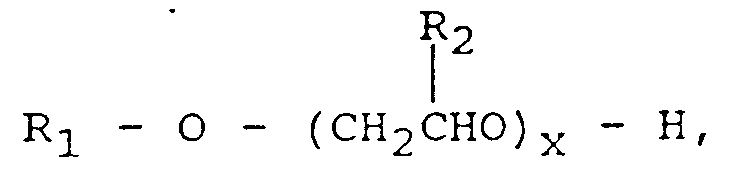
where x is an integer from 1 to 10, R₁ is either (a) Cn H2n+1, where n is an integer from 10 to 18, or (b) Cn H2n+1 - C₆H₄, where n is an integer from 8 to 18 and where R₂ is H, CH₃- or CH₃CH₂-.
where x is an integer from 1 to 10, R₁ is either (a) Cn H2n+1, where n is an integer from 10 to 18, or (b) Cn H2n+1 - C₆H₄, where n is an integer from 8 to 18 and where R₂ is H, CH₃- or CH₃CH₂-.
3. A motor fuel composition as claimed in Claim 1 wherein said adduct comprises an alkylphenol
ethoxylate of formula
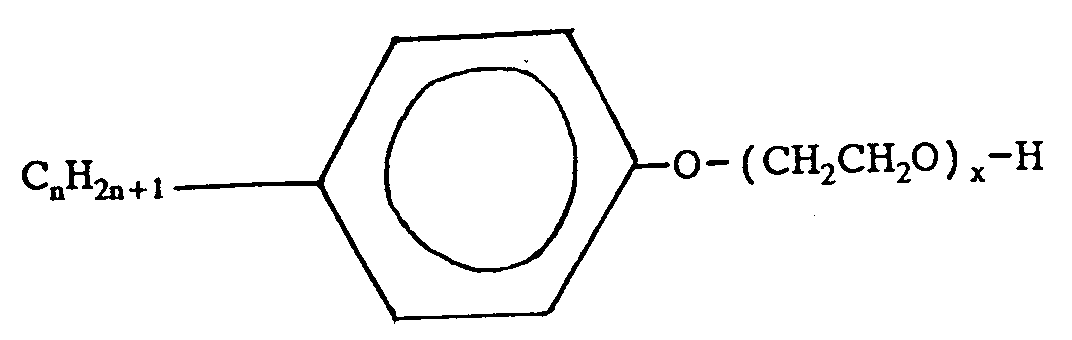
where n is an integer between 8 and 18 and x is an integer from 1 to 10.
where n is an integer between 8 and 18 and x is an integer from 1 to 10.
4. A motor fuel composition as claimed in Claim 1 wherein said adduct comprises an alcohol
ethoxylate of formula
Cn H2n+1 -O-(CH₂CH₂O)x-H,
where n is an integer between 8 and 18 and x is an integer from 1 to 10.
Cn H2n+1 -O-(CH₂CH₂O)x-H,
where n is an integer between 8 and 18 and x is an integer from 1 to 10.
5. A motor fuel composition as claimed in any one of Claims 1 to 4 wherein said adduct
has a hydrophile-lipophile balance of from 3 to 11.
6. A motor fuel composition as claimed in any one of Claims 1 to 4 wherein said adduct
has a hydrophile-lipophile balance of from 5 to 10.
7. A motor fuel composition as claimed in Claim 1 wherein said adduct comprises a nonylphenol
ethoxylate having a hydrophile-lipophile balance of from 3 to 11.
8. A motor fuel composition as claimed in any one of the preceding claims wherein said
adduct is employed in an amount of from 0.001 to 5.0 weight percent.
9. A motor fuel composition as claimed in any one of the preceding claims wherein said
polymeric component is employed in admixture with a hydrocarbon solvent to facilitate
the addition of said polymeric component into said mixture of hydrocarbons.
10. A motor fuel composition as claimed in Claim 9 wherein said hydrocarbon solvent comprises
a light aromatic distillate composition.