| (19) |
 |
|
(11) |
EP 0 505 099 B1 |
| (12) |
EUROPEAN PATENT SPECIFICATION |
| (45) |
Mention of the grant of the patent: |
|
30.07.1997 Bulletin 1997/31 |
| (22) |
Date of filing: 12.03.1992 |
|
|
| (54) |
Method and apparatus for determining the flow rate of a viscous fluid stream
Verfahren und Vorrichtung zur Bestimmung des Durchsatzes einer Strömung einer viskosen
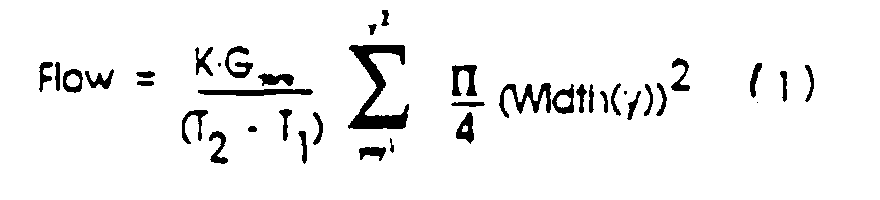
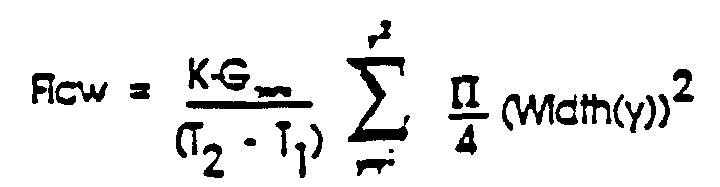
Flüssigkeit
Procédé et dispositif pour déterminer le débit de l'écoulement d'un fluide visceux
|
| (84) |
Designated Contracting States: |
|
AT BE CH DE DK ES FR GB GR IT LI LU NL PT SE |
| (30) |
Priority: |
22.03.1991 US 673531
|
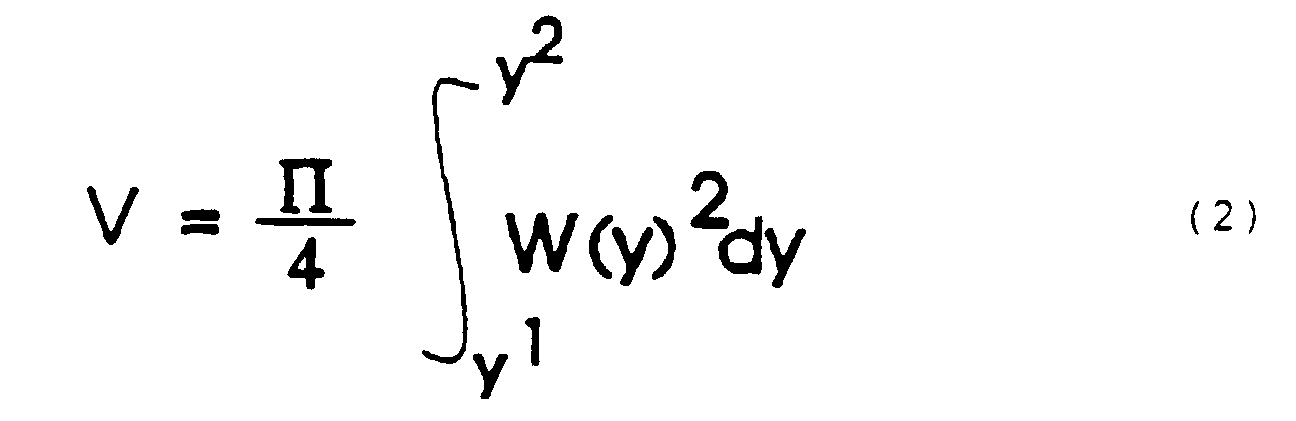
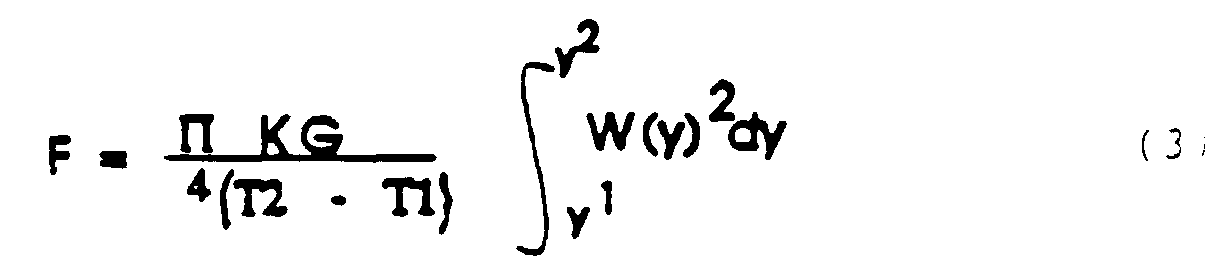
| (43) |
Date of publication of application: |
|
23.09.1992 Bulletin 1992/39 |
| (73) |
Proprietor: ERIN TECHNOLOGIES INC. |
|
Erin,
Ontario N0B 1TO (CA) |
|
| (72) |
Inventors: |
|
- Anger, Steven J.
Hamilton,
Ontario L8S 1V5 (CA)
- Devonshire, William J.
Orton,
Ontario L0N 1NO (CA)
|
| (74) |
Representative: Adams, William Gordon et al |
|
RAWORTH, MOSS & COOK
36 Sydenham Road
Croydon
Surrey CR0 2EF
Croydon
Surrey CR0 2EF (GB) |
| (56) |
References cited: :
EP-A- 0 100 304
US-A- 4 205 973
US-A- 4 517 845
US-A- 4 866 639
|
GB-A- 2 091 418
US-A- 4 297 893
US-A- 4 837 708
|
|
| |
|
|
|
|
| |
|
| Note: Within nine months from the publication of the mention of the grant of the European
patent, any person may give notice to the European Patent Office of opposition to
the European patent
granted. Notice of opposition shall be filed in a written reasoned statement. It shall
not be deemed to
have been filed until the opposition fee has been paid. (Art. 99(1) European Patent
Convention).
|
Field of the Invention
[0001] This invention relates to an apparatus for determining the volumetric flow rate of
a viscous fluid stream, such as a molten glass stream.
Description of the Prior Art
[0002] In the manufacture of glass fibre, it is important to know accurately the volumetric
flow rate, known as the pull rate, of the molten glass emerging from the heated forming
bushing. The pull rate must be varied by continually adjusting the heat input to the
forming bushing to maintain the characteristics desired in the finished fibre.
[0003] An apparatus is known for determining the flow rate of a molten glass stream by detecting
bubbles naturally present in the stream and measuring the time taken for a bubble
to flow between two predetermined points. Such apparatus is disclosed, for example,
in U.S. Patent No. 4,517,845 to Gullfiber. This apparatus employs a pair of spaced
photodetectors which generate pulses as a bubble passes, and which after suitable
shaping can be used to measure the time between the passage of the bubbles past the
respective detectors. From the flow velocity thus measured, the volumetric flow rate
can be determined by measuring the width of the fluid stream with the aid of a linear
array of photodiodes.
[0004] While the apparatus described is capable of making a rough approximation of the volumetric
flow rate, it suffers from inaccuracies due to the fact that in reality the width
of the fluid stream varies as it flows between the photodetectors, leading to inaccuracies
in the calculated volumetric rate.
[0005] Various other systems for measuring flow rate are known and are described, for example,
in the following patents:
[0006] US Patent no. 4,877,436, I. Sheinkop, discloses an arrangement where an auxiliary
falling stream of molten glass passes through a laser beam and the diameter of the
stream is measured along with the time taken for air bubbles or 'seeds' to pass through
the beam. This patent depends on the detection of specular reflection from bubbles
passing through a laser beam. As it requires lots of seeds, it is not suitable for
highly refined glass.
[0007] US Patent no. 4,205,973, W.H. Ryan (Owens-Illinois Inc.), discloses an arrangement
whereby the rate of fall, volume and section of a gob of glass are measured by two
vertically spaced photodetectors and a pair of cameras arranged at 90 degrees in a
horizontal plane. This arrangement suffers from the same disadvantage as Gullfiber
mentioned above.
[0008] US Patent no. 3,739,636, (AA Versaci), discloses means for injecting a bubble into
a fluid conduit, measuring the time taken to pass between two optical detectors and
computing the flow rate. The arrangement suffers from the same disadvantage as Gullfiber.
[0009] British patent no. 2 091 418 discloses an arrangement for measuring the volume flow
rate of a stream of molten glass in which two linear photodiode detectors view respective
parts of the stream which are spaced in the flow direction. The delay between the
signals from the two detectors is used to derive an indication of flow speed. This
arrangement also suffers from the same disadvantage as Gullfiber.
[0010] US patent no. 4,297,893, L.J. Ryan, discloses an arrangement for measuring the temperature
and/or mass flow rate of a free falling molten stream of material, in which the scan
rate of a linear photodiode detector array is varied so as to limit the maximum voltage
generated by any one photodiode. Successive scans made at intervals, indicative of
successive slices of the gob at a single vertical point in the flow, provide signals
from which flow rate is derived.
[0011] A number of other arrangements for measuring fluid flow rate are disclosed in US
4,866,639, R.J. Adrian (University of Illinois); US 4,737,178, L.G. Relfschneider
et al., (Owens-Corning Fiberglas Corp.); US 4,837,708, T.B. Wright; US 4,331,132,
S. Mukasa (Olympus Optical Co. Ltd.); US 4,554,832 - T. Hasegawa et al. (Nippon Furnace
KK Ltd.); US 4,925,296, J. Reichmuth; GB 2083612, P.H. Casswell; DE 1934583, C.T.
Boe et al. (Instituttet fur Porduktudvickling Danmarks Tekniske Hojskole); JP56-147013A,
H. Mukal (Klyouto Denshi KK); JP 55-040918A, K. Yamaguchi et al, (Niksuklsou KK).
[0012] An object of the present invention is to alleviate the disadvantages of the aforementioned
prior art and provide a method and apparatus capable of more accurately providing
the volumetric flow rate of a stream of viscous fluid, more particularly a stream
of molten glass.
SUMMARY OF THE INVENTION
[0013] According to a first aspect of the present invention there is provided a method of
determining the flow rate of a viscous fluid stream, of the type wherein electronic
imaging means is used to detect bubbles in the fluid stream and to provide an indication
of the speed of motion of said bubbles; characterized in that the electronic imaging
means has a field of view which includes the fluid stream, said imaging means producing
output signals representing images of said fluid stream at successive times t
0, t
1 ... t
n, storing in first memory means said signals representing an image of said fluid stream
at a first time t
1, storing in second memory means said signals representing an image of said fluid
stream at a second time t
j, the interval t
j - t
i being chosen so that a point travelling with said fluid stream is within the images
at both times t
i and t
j, analysing said stored signals to derive width signals W(y) representing the width
of said fluid stream as a function of y, where y represents a coordinate in the direction
of fluid flow, comparing said first and second stored signals to identify a bubble
at a common point on said fluid stream in the respective images represented thereby,
deriving signals representing at least the y coordinates y
1, y
2 of said common point in the respective images, and deriving a signal representing
the flow rate of said fluid stream from said width signals W(y) and said signals representing
at least the y coordinates y
1, y
2 of said common point in the respective images.
[0014] In a preferred embodiment the output signals produced by the camera are digitized
and stored at discrete addresses in the first memory means. The digitized signal at
each address represents the intensity at a corresponding pixel in the image.
[0015] In order to determine the width of the fluid stream as a function of y, the images
are first scanned line by line to identify the edges of the fluid stream. These are
defined by changes in intensity exceeding a predetermined threshold relative to background
intensity.
[0016] The stored images are then scanned to identify groups of adjacent pixels having values
above a previously determined threshold. These groups are assumed to represent bubbles
in the fluid stream. Once identified, the pixels of each group are set to a predetermined
value, preferably 255, which designates them as parts of the bubbles.
[0017] The digitized signals are then compared to match the bubbles identified in the stored
images. The bubbles are matched by determining the X and Y coordinates of all bubbles
in the images. Since the lateral movement of bubbles in a fluid stream is very limited,
bubble paths for which the difference in X coordinates exceeds a predetermined value,
preferably 10 pixels, can be eliminated. Similarly, the distance travelled by the
bubbles in the Y or longitudinal direction is limited by the limits on the changes
in fluid stream velocity. For electronic scanning at 60 fields per second, the difference
in the Y coordinates must lie in the range 320 and 380 pixels for a given lens magnification
and image height of 512 pixels.
[0018] From the fluid stream width and velocity, the mass flow rate can be determined from
the following expression:
where,
- Gdens =
- density of glass
- T2 - T1 =
- Time interval between frames
- y1 =
- Y coordinate of bubble at time T1
- y2 =
- Y coordinate of bubble at time T2
- Width (y) =
- Stream width as a function of Y coordinate.
- K =
- Calibration constant.
[0019] The processing means is preferably in the form of a microprocessor with associated
memory devices.
[0020] In another aspect, the invention provides an apparatus for determining the flow rate
of a viscous fluid stream of the type in which electronic imaging means is used to
detect bubbles in the fluid stream and to provide an indication of the speed of motion
of the bubbles; characterized in that the electronic imaging means has a field of
view through which the fluid stream passes, said imaging means producing output signals
representing images of said fluid stream at successive time intervals t
0, t
1, ... t
n, first memory means for storing said signals representing an image of said fluid
stream at a first time t
i, second memory means for storing said signals representing an image of said fluid
stream at a second time t
j, the interval t
j - t
i being chosen so that a point travelling with said fluid stream is within the images
at both times t
j and t
i, means for analysing said stored signals to identify the edges of said fluid stream
and derive signals W(y) representing the width thereof as a function of y, where y
represents a coordinate in the direction of fluid flow, means for analysing said stored
signals to identify a bubble at a common point on said fluid stream in said respective
images and derive signals representing at least the y coordinates y
1, y
2 of said common point in the respective images, and processing means for deriving
a signal representing the volumetric flow rate of said fluid stream from said width
signals W(y) and said signals representing at least the y coordinates y
1, y
2 of said common point in the respective images.
[0021] The imaging means is preferably in the form of a CCD (charge-coupled device video
camera). The camera is not restricted to operating in the visible region, and may,
for example operate at infra-red or ultra-violet wavelengths.
BRIEF DESCRIPTION OF THE DRAWINGS
[0022] The invention will now be described in more detail, by way of example only, with
reference to the accompanying drawings, in which :-
Figure 1 is a diagram illustrating the relationship between the camera and the molten
glass stream;
Figure 2 is a diagram diagrammatic view of a camera for use in a apparatus in accordance
with the invention;
Figure 3 is a diagram illustrating the movement of bubbles in the molten glass stream;
Figure 4 is a block diagram in accordance with the invention; and
Figures 5a to 5 j are flow charts illustrating the mode of operation of the processor
in accordance with the invention.
DESCRIPTION OF PREFERRED EMBODIMENTS
[0023] In Figure 1, a molten glass stream 1, which is to be drawn into a filament, flows
out of a controlled forming bushing 2. The forming bushing is heated, and by varying
the amount of energy applied, the viscosity of the glass flowing through it can be
changed, thereby varying the characteristics of the glass flowing out of the bushing
to determine the properties of the glass filament 1.
[0024] The glass stream 1 flows across the field of view of a video camera 3, which is conveniently
a CCD (charge coupled device) camera with an electronic shutter. The CCD camera consists
of an array of light sensitive cells that store a charge dependent on the intensity
of light falling on them. The cells are sequentially accessed to provide an output
signal that is a line by line scan of the image formed in the camera.
[0025] In accordance with standard video technology, the image is scanned at a rate of 30
frames per second, each frame being divided into two fields, the first field consisting
of the even numbered lines and the second field consisting of the odd numbered lines,
consequently 60 fields per second.
[0026] In a conventional video camera, the electronic shutter is programmed to operate once
per frame. Each image is made up of the two interleaved fields. Consequently, although
there are only 30 images per second, the actual flicker rate is 60 fields per second,
and this creates the impression of continuous movement. In this apparatus, the camera's
shutter is programmed to operate once per field, so that each interleaved field contains
a different image.
[0027] The physical arrangement of the camera is shown in Figure 2. The camera unit 3 contains
the CCD camera 4 in an industrial, dust-tight camera housing with air cooling. The
unit 3 has a transparent window 5 behind which is located lens system 6 consisting
of a close-up lens 7, a 75 mm. zoom lens 8, and two times extender 9. This arrangement
focuses the molten glass stream 1 onto the image plane of the CCD camera 4.
[0028] The purpose of the camera arrangement is to measure the width W(y) of the glass stream
1 (Figure 3) and identify air bubbles 10 naturally occurring in the molten glass stream
1.
[0029] Referring now to Figure 3, the volume of glass V contained between coordinates y
1, y
2, is given by the expression
where W(y) is the width of the glass stream as a function of y.
The mass flow rate F is therefore given by the expression
where T
1, T
2 are the times of measurement of the coordinates y
1, y
2, K is a calibration constant as defined above, and G is the density of the glass.
[0030] Consequently, since the incremental distance between each scanning line can be assumed
to be a constant, the volumetric flow rate F can be derived from the sum of the widths
of the glass stream 1 at each line between coordinates y
1, y
2, in accordance with formula (1) above which is the discrete form of expression (3).
[0031] The apparatus for determining these parameters is shown in Figure 4. In Figure 4,
there are two camera units 3, 3' that each operate independently on different glass
streams. Each video camera unit 3, 3' generates sufficient information alone to enable
the volumetric flow rate of each glass stream to be monitored. However, two or more
streams, each with its respective camera unit 3, can be monitored simultaneously,
and for this purpose the outputs of the camera units 3, 3' are fed to a video multiplexer
unit 11, which time division multiplexes the outputs of the camera units 3, 3' into
a common multiplexed output signal 12.
[0032] Each cell of the CCD array in the camera units 3, 3' represents a picture element,
or pixel, of the image formed in the camera. The output signals of the CCD cameras
consist of analog pulses having a value related to the intensity of light falling
on the corresponding cell in the CCD array.
[0033] The multiplexed analog pulses output at 12 are fed to a video digitizer 13, which
quantizes the analog pulses into 256 levels represented by 8 bit bytes (0 to 255).
The output of the video digitizer 13 is fed directly to video display monitor 14,
where each image can be viewed directly by the operator for monitoring purposes.
[0034] The output of the video digitizer 13 is also fed to a processing unit 15, which can
conveniently be an IBM 80286 AT personal computer attached to a keyboard and monitor
16. The computer can be programmed in a manner to be described later, or alternatively
the processing unit 15 can be a hard wired custom designed circuit implementing the
processing functions to be described.
[0035] The processing unit 15 outputs a signal representing the calculated flow rate, which
signal is passed to a digital-to-analog convertor 17 that outputs an analog signal
representative of the volumetric flow rate and that in turn is connected to a bushing
controller 18 that controls the energy applied to the bushing in accordance with the
measured volumetric flow rate and a desired set point. The operation of the apparatus
will now be described as follows:
[0036] The video signals from the cameras 3 are fed into the video multiplexer 11, which
allows the video signal from any single camera to be selected by the computer 15.
The output from the multiplexer 11 is fed into the high speed video digitizer 13,
which captures single frames of video and presents them to the computer in digital
form. The captured images can be viewed directly on the monitor.
[0037] The computer 15 analyses the video frames and calculates a volumetric flow rate.
The resulting flow rate is displayed on the computer screen in the form of a number
and a graph and is also sent to the digital-to-analog converter, which produces an
analog output signal proportional to the calculated flow rate. In the case where more
than one camera is used, the computer 15 selects the video signal from each camera
in turn, performing the flow rate calculations and updating the analog outputs for
each camera.
[0038] The digitizer 13 captures and digitizes a single frame from the camera. This results
in an array of numbers with 512 elements vertically and 512 elements horizontally.
Each element in the array represents the intensity of the image at the corresponding
pixel in the image. The intensities range from O for minimum intensity to 255 for
maximum intensity.
[0039] Each captured frame contains two separate images defined by the fields as described
above. The first field is contained in the even numbered lines (0,2,4,...,508,510).
The second field is contained in the odd numbered lines (1,3,5,...,509,511). These
fields represent two images taken at an interval of one-sixtieth of a second.
[0040] The first stage in the analysis involves identifying which part of the image represents
the glass stream. To locate the left edge of the stream, each line of the image is
scanned from left to right until the intensity of the pixels exceeds a certain threshold
value (see Fig. 5D). The right edge is similarly located by scanning from right to
left. This operation is performed for every line in the image to generate a table
representing the left and right locations of the stream edge for every point along
its vertical axis. In the event that an edge is not detected, the left and right locations
are set to zero.
[0041] The second step determines the average width of the stream by taking the average
distance between the left and right edges of the stream for each point along its vertical
axis (see Fig. 5E).
[0042] In order to enable the apparatus to adapt to changing lighting conditions, the threshold
value is adjusted to lie midway between the average intensity of the stream and the
average intensity of the background after each image is processed. The stream intensity
is calculated as the average pixel intensity of the pixels lying within the boundaries
of the stream as determined in step 1. The background intensity is calculated as the
average intensity of all pixels outside of the stream boundary.
[0043] Next, the pixels representing bubbles within the stream must be identified. Bubbles
show up in the image as bright regions within the stream. The only significant movement
in the image is that of the bubbles. As a result, the bubbles can be highlighted by
subtracting the pixels in the second field from the corresponding pixels in the first
field. This resulting image represents the changes that have occurred between the
two image fields. If the magnitude of the pixel difference is larger than a threshold
value, then that pixel is assumed to be part of a bubble. If the difference is positive,
the pixel belongs to a bubble located in the first field and if it is negative, it
is located in the second fields. The pixels that are determined to represent bubbles
in each of the fields are set to 255 and all other are set to zero (see Fig. 5F).
[0044] All of the bubbles, in both fields are then identified and their x, y locations and
sizes determined. Bubbles with sizes above or below certain limits are ignored to
eliminate noise.
[0045] Once the bubbles have been located, an attempt is made to identify bubbles that have
shifted in location from one field to the next. This is accomplished by trying every
possible combination of pairs of bubbles (one bubble from each field) and comparing
their coordinates and sizes to see if they are the same bubble. Accurately matching
the bubble pairs is possible because of the following:
1) Bubbles move very little horizontally between fields.
2) The distances the bubbles travel vertically between fields tend to lie within a
small range.
3) The bubbles vary only slightly in size between fields. Using this information a
bubble in the second field is considered to match a bubble in the first field the
following conditions are met:
1) The difference between the X coordinates is less than 10.
2) The Y coordinate of the second bubble minus the Y coordinate of the first bubble
lies between 320 and 380.
3) The ratio of the two bubbles sizes is no larger than 2 and no less than 0.5.
[0046] The actual number (320, 380 etc.) depends on the resolution of the camera and the
magnification of the lens.
[0047] Figure 3 shows an image of the stream with the two matching bubbles identified. Bubbles
A and B have been rejected because of the above criteria. Bubble A is located too
far to the right to be considered, while bubble B located directly below the first
bubble is too small, and is rejected.
[0048] Once a pair of bubbles has been identified the flow rate can be calculated. Assuming
that the glass stream is moving at the same rate as the bubbles, the amount of glass
that has flowed past the camera during the time interval between fields is equal to
the total volume of glass contained in the stream between the two Y coordinates of
the bubbles. The flow rate can then be calculated from formula 1.
[0049] If no bubble pairs are found for this image, the flow rate can still be updated based
on the width change alone using the equation:

where,
- Width =
- Average width of stream
- LastFlow =
- Last flow rate calculated
- LastWidth =
- Average stream width at the time that LastFlow was calculated.
[0050] In this equation, the flow rate is estimated by multiplying the last determined flow
rate by a factor that represents the ratio of the cross-sectional areas of the average
width of the stream during the measurement to the area of the average width of the
stream during the last measurement.
[0051] Once the digital signal representing the volumetric flow rate of the molten glass
has been determined, this is output from the computer and converted back into an analog
signal in the digital-to-analog converter 17. From there it is fed to PI (proportional
integral) 18 controller, which in turn controls bushing controller 19 to set the energy
input of the bushing 2. The control signal generated by the bushing controller 19
thereby controls the current flowing through the bushing 2, which in turn controls
the glass flow rate.
[0052] The PI controller 18 adjusts the signal to the bushing controller 19 so as to maintain
the glass flow rate at a given set point determined by the operator. The control is
adjusted according to the formula:

where:
- Control =
- Control signal
- P =
- Proportional gain (constant)
- I
- = Integral gain (constant)
- Eo =
- Present control error (Setpoint - Flow Rate)
- E1 =
- Previous control error
[0053] In the event that the camera is unable to calculate the flow rate, the flow rate
output from the camera is dropped to zero. When the control algorithm detects this,
the PI algorithm is disabled and the control output is set to the average value of
the control output over the previous ten minutes. When the output from the camera
returns, the PI algorithm is re-enabled.
[0054] When the processing unit comprises an IBM AT2 86 computer, the following program
can implemented:
Initialize hardware
Initialize data structures
loop
for Each Camera
Capture two successive images from selected camera
Isolate stream from background and determine W(y)
Calculate average stream width (W)
Isolate bubbles from stream
Determine x, y coordinates and sizes of all bubbles
Match bubble pairs from the two images
if Bubble Pair Found
Calculate flow rate (F) by summing widths W(y)
between bubble pairs using equation 1
Replace Fo with F
Replace Wo with W
else
Calculate flow rate (F) using equation 2
endif
Calculate filtered flow (Ff) to D/A converter
Update user display
endfor
endloop
end
[0055] The described method and apparatus allow the volumetric flow rate to be controlled
on a continuous basis while taking into account variations in the width of the glass
stream. In accordance with the set point determined by the operator, the output characteristics
of the molten glass stream can be continuously maintained within desired tolerances.
1. A method of determining the flow rate of a viscous fluid stream, of the type wherein
electronic imaging means is used to detect bubbles in the fluid strem and to provide
an indication of the speed of motion of said bubbles; characterized in that the electronic
imaging means (3) has a field of view which includes the fluid stream (1), said imaging
means producing output signals representing images of said fluid strem at successive
times to, tl ... tn, storing in first memory means said signals representing an image of said fluid stream
at a first time tl, storing in second memory means said signals representing an image of said fluid
stream at a second time tj, the interval tj - ti being chosen so that a point (10) travelling with said fluid stream is within the
images at both times ti and tj, analyzing said stored signals to derive width signals W(y) representing the width
of said fluid stream as a function of y, where y represents a coordinate in the direction
of fluid flow, comparing said first and second stored signals to identify a bubble
at a common point on said fluid stream in the respective images represented thereby,
deriving signals representing at least the y coordinates y1, y2 of said common point in the respective images, and derving a signal representing
the flow rate of said fluid stream from said width signals W(y) and said signals representing
at least the y coordinates y1, y2 of said common point in the respective images.
2. A method as claimed in claim 1, wherein said output signals produced by said imaging
means are digitized and stored at discrete addresses in said respective first and
second memory means, the digitized signal stored at each address representing the
intensity of the image at a corresponding pixel in the image.
3. A method as claimed in claim 2, wherein the signals representing said stored images
are first scanned line by line to identify the edges of the fluid stream (1) defined
by changes in intensity exceeding a predetermined threshold, thereby permitting the
width of said fluid stream to be determined for each line.
4. A method as claimed in claim 3, wherein said stored images are scanned line by line
to identify groups of adjacent pixels having values above a predetermined threshold,
said groups being assumed to represent bubbles (10) in the fluid stream, and the pixels
of said identified groups are all set to predetermined values designating them as
parts of bubbles.
5. A method as claimed in claim 4, wherein the signals representing said stored images
are compared to match the bubbles identified therein, and the y coordinates of the
matched bubbles between the images is determined from the pixel locations of a matched
bubble in the first image and the second image.
6. A method as claimed in claim 5, wherein the bubbles are matched by determining the
X and Y coordinates of all the bubbles in said images, comparing all the pairs of
bubbles, and identifying bubbles as a matched pair if a) the difference in their X
coordinates is less than a first predetermined value determined by the allowable lateral
movement of a bubble in the fluid stream, b), the difference in their Y coordinates
lies within predetermined limits defined by the minimum and maximum distance travelled
by a point on the fluid stream at the minimum and maximum possible flow speeds, and
c) the ratio of the two bubble sizes lies between predetermined limits.
7. A method as claimed in claim 6, wherein said first predetermined value is about 10,
the difference in the predetermined limits of the Y coordinates lies between 320 and
380 pixels, the ratio of the two bubbles sizes is not less than about 0.5 and not
more than about 2.0.
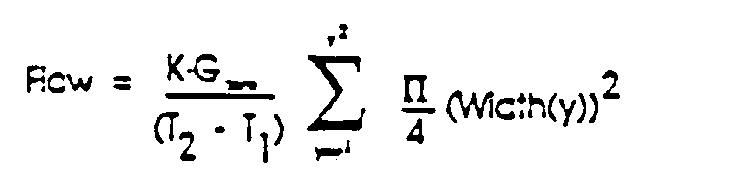
8. A method as claimed in claim 7, wherein the flow rate is calculated from the width
of the fluid stream W(y) and the y coordinates y
1, y
2 of a matched bubble is determined in accordance with the expression:
9. A method as claimed in claim 8, wherein when no matching bubble pairs are located
in said images, a signal representing an updated flow rate is derived from the last
determined flow rate and the square of the ratio of the average width of the fluid
stream during the measurement and the average width of the fluid stream during the
last measurement.
10. A method as claimed in claim 1, wherein said imaging means comprises a video camera
(3).
11. A method as claimed in claim 10, wherein said imaging means comprises a CCD (charge
coupled device) video camera.
12. A method as claimed in claim 1 which is used in the production of glass filaments
wherein the signal representing the volumetric flow rate is used to control a forming
bushing (2) through which a molten glass stream is drawn.
13. An apparatus for determining the flow rate of a viscous fluid stream of the type in
which electronic imaging means is used to detect bubbles in the fluid stream and to
provide an indication of the speed of motion of the bubbles; characterized in that the
electronic imaging means (3) has a field of view through which the fluid stream
(1) passes, said imaging means producing output signals representing images of said
fluid stream at successive time intervals to, tl, ... tn, first memory means for storing said signals representing an image of said fluid
stream at a first time ti, second memory means for storing said signals representing an image of said fluid
stream at a second time tj, the interval tj - ti being chosen so that a point (10) travelling with said fluid stream is within the
images at both times tj and ti, means for analyzing said stored signals to identify the edges of said fluid stream
and derive signals W(y) representing the width thereof as a function of y, where y
represents a coordinate in the direction of fluid flow, means for analyzing said stored
signals to identify a bubble at a common point on said fluid stream in said respective
images and derive signals representing at least the y coordinates y1, y2 of said common point (10) in the respective images, and processing means for deriving
a signal representing the volumetric flow rate of said fluid stream from said width
signals W(y) and said signals representing at least the y coordinates y1, y2 of said common point in the respective images.
14. An apparatus as claimed in claim 13, further comprising means for digitizing the output
signals produced by said imaging means, said first and second memory means having
a plurality of addresses at which said digitized signals are stored, each said stored
digitized signal representing a corresponding pixel in the image.
15. An apparatus as claimed in claim 14 wherein said means for analyzing said stored signals
to identify the edges of said fluid stream (1) scan the stored signals line by line
to identify the edges of the fluid stream, said edges being defined by changes in
intensity exceeding a predetermined threshoid, and thereby determine the width of
said fluid stream from the number of pixels between said edges.
16. An apparatus as claimed in claim 15 wherein said means for analyzing said stored signals
to identify a common point on said fluid stream scan said stored signals to identify
groups of adjacent pixels having values above a set threshold, said analyzing means
thereby changing the values of the signals in the associated addresses to predetermined
values, said predetermined values identifying the pixels that are represented thereby
as parts of bubbles (10).
17. An apparatus as claimed in claim 16, comprising comparator means to compare the bubbles
(10) identified in said stored images to match up said bubbles, and the distance travelled
by the matched bubbles between the images being determined from the number of pixels
between the location of a matched bubble in the first image and its location in the
second image.
18. An apparatus as claimed in claim 17 wherein said comparator means matches the bubbles
by determining the X and Y coordinates of all the bubbles in said images, comparing
all pairs of bubbles, and identifying bubbles as a matched pair if a) the difference
in their X coordinates is less than a first predetermined value determined by the
allowable lateral movement of a bubble in the fluid stream, b) the difference in their
Y coordinates lies within predetermined limits defined by the minimum and maximum
distance travelled by a point on the fluid stream and the minimum and maximum possible
flow speeds, and c) the ratio of the two bubble sizes lies between predetermined limits.
19. An apparatus as claimed in claim 18 wherein said first predetermined value is about
10, the difference in the predetermined limits of the Y coordinates lies between 320
and 380 pixels, the ratio of the two bubble sizes is not less than about 0.5 and not
more than about 2.0.
20. An apparatus as claimed in claim 19 wherein the flow rate is calculated from the width
of the fluid stream (1) and the distance travelled by a matched bubble (10) in accordance
with the expression:
21. An apparatus as claimed in claim 20, further comprising means for deriving a signal
representing an updated flow rate from the last determined flow rate and the square
of the ratio of the average width of the fluid stream during the measurement and the
average width of the fluid stream during the last measurement when no matching bubble
pairs are located in said images.
22. An apparatus as claimed in claim 13 which is used in the production of glass filaments,
further comprising means (17, 18, 19) for controlling a forming bushing (2) through
which a molten glass stream is drawn in response to the signal representing the volumetric
flow rate and a signal representing a desired setpoint.
1. Verfahren zur Bestimmung des Durchsatzes eines Stromes einer viskosen Flüssigkeit,
bei dem ein elektronisches Bilderzeugungsmittel verwendet wird, um Blasen in dem Flüssigkeitsstrom
zu erfassen und eine Anzeige der Bewegungsgeschwindigkeit dieser Blasen zu liefern;
dadurch gekennzeichnet, daß das elektronische Bilderzeugungsmittel (3) ein Gesichtsfeld
aufweist, das den Flüssigkeitsstrom (1) einschließt, wobei das Bilderzeugungsmittel
Ausgangssignale erzeugt, die Bilder dieses Flüssigkeitsstromes zu aufeinanderfolgenden
Zeitpunkten t0, t1, ... tn darstellen, in ersten Speichermitteln die Signale speichert, welche ein Bild des
Flüssigkeitsstromes zu einem ersten Zeitpunkt t1 darstellen, in zweiten Speichermitteln die Signale speichert, welche ein Bild des
Flüssigkeitsstromes zu einem zweiten Zeitpunkt tj darstellen, wobei das Intervall tj - ti so gewählt wird, daß sich ein Punkt (10), der mit dem Flüssigkeitsstrom wandert,
zu beiden Zeitpunkten ti und tj im Bild befindet, die gespeicherten Signale analysiert, um Breitensignale W(y) abzuleiten,
welche die Breite des Flüssigkeitsstromes als Funktion von y darstellen, wobei y eine
Koordinate in Strömungsrichtung der Flüssigkeit darstellt, die ersten und zweiten
gespeicherten Signale vergleicht, um eine Blase an einem gemeinsamen Punkt auf dem
Flüssigkeitsstrom in den jeweiligen durch diese dargestellten Bildern zu identifizieren,
Signale ableitet, welche mindestens die Y-Koordinaten y1, y2 des gemeinsamen Punktes in den jeweiligen Bildern darstellen, und aus den Breitensignalen
W(y) und den Signalen, welche mindestens die Y-Koordinaten y1, y2 des gemeinsamen Punktes in den jeweiligen Bildern darstellen, ein Signal ableitet,
das den Durchsatz des Flüssigkeitsstromes darstellt.
2. Verfahren nach Anspruch 1, bei dem die von den Bilderzeugungsmitteln erzeugten Ausgangssignale
digitalisiert und an diskreten Adressen in den jeweiligen ersten und zweiten Speichermitteln
gespeichert werden, wobei das an jeder Adresse gespeicherte digitalisierte Signal
die Intensität des Bildes an einem entsprechenden Pixel im Bild darstellt.
3. Verfahren nach Anspruch 2, bei dem die Signale, welche die gespeicherten Bilder darstellen,
zunächst zeilenweise abgetastet werden, um die Ränder des Flüssigkeitsstromes (1)
zu identifizieren, die durch Intensitätsänderungen definiert werden, welche einen
vorbestimmten Schwellenwert überschreiten, wodurch die Bestimmung der Breite des Flüssigkeitsstromes
für jede Zeile ermöglicht wird.
4. Verfahren nach Anspruch 3, bei dem die gespeicherten Bilder zeilenweise abgetastet
werden, um Gruppen benachbarter Pixel zu identifizieren, die Werte oberhalb eines
vorbestimmten Schwellenwertes besitzen, wobei angenommen wird, daß diese Gruppen Blasen
(10) in dem Flüssigkeitsstrom darstellen, und die Pixel dieser identifizierten Gruppen
sämtlich auf vorbestimmte Werte gesetzt werden, die sie als Teile von Blasen kennzeichnen.
5. Verfahren nach Anspruch 4, bei dem die Signale, welche die gespeicherten Bilder darstellen,
verglichen werden, um die darin identifizierten Blasen einander zuzuordnen, und die
Y-Koordinaten der einander zugeordneten Blasen der verschiedenen Bilder anhand der
Pixelpositionen einer gleichen Blase in dem ersten und dem zweiten Bild bestimmt werden.
6. Verfahren nach Anspruch 5, bei dem die Blasen einander zugeordnet werden, indem die
X- und Y-Koordinaten sämtlicher Blasen in den Bildern bestimmt werden, alle Blasenpaare
verglichen werden und Blasen als zusammengehöriges Paar identifiziert werden, wenn
a) der Unterschied in ihren X-Koordinaten geringer ist als ein erster vorbestimmter
Wert, der durch die zulässige seitliche Bewegung einer Blase in dem Flüssigkeitsstrom
bestimmt wird, b) der Unterschied in ihren Y-Koordinaten innerhalb vorbestimmter Grenzen
liegt, die durch die kleinste und die größte Weglänge definiert werden, die von einem
Punkt auf dem Flüssigkeitsstrom bei der kleinsten und der größten möglichen Strömungsgeschwindigkeit
durchwandert werden, und c) das Verhältnis der beiden Blasengrößen zwischen vorbestimmten
Grenzen liegt.
7. Verfahren nach Anspruch 6, bei dem der erste vorbestimmte Wert etwa 10 ist, der Unterschied
innerhalb der vorbestimmten Grenzen der Y-Koordinaten zwischen 320 und 380 Pixeln
liegt und das Verhältnis der zwei Blasengrößen nicht geringer als etwa 0,5 und nicht
größer als etwa 2,0 ist.
8. Verfahren nach Anspruch 7, bei dem der Durchsatz anhand der Breite des Flüssigkeitsstromes
W(y) berechnet wird und die Y-Koordinaten y
1, y
2 einer gleichen Blase gemäß dem Ausdruck:

bestimmt wird.
9. Verfahren nach Anspruch 8, bei dem, wenn keine zusammengehörigen Blasenpaare in den
Bildern ausfindig gemacht werden, ein Signal, das einen aktualisierten Durchsatz darstellt,
aus dem zuletzt bestimmten Durchsatz und dem Quadrat des Quotienten aus mittlerer
Breite des Flüssigkeitsstromes während der Messung und mittlerer Breite des Flüssigkeitsstromes
während der letzten Messung abgeleitet wird.
10. Verfahren nach Anspruch 1, bei dem das Bilderzeugungsmittel eine Videokamera (3) umfaßt.
11. Verfahren nach Anspruch 10, bei dem das Bilderzeugungsmittel eine CCD-Videokamera
(ladungsgekoppelte Videokamera) umfaßt.
12. Verfahren nach Anspruch 1, das bei der Herstellung von Glasfilamenten verwendet wird,
wobei das Signal, das den Volumenstrom darstellt, zur Regelung einer Formdüse (2)
verwendet wird, durch die ein geschmolzener Glasstrom gezogen wird.
13. Vorrichtung zur Bestimmung des Durchsatzes eines Stromes einer viskosen Flüssigkeit,
worin ein elektronisches Bilderzeugungsmittel verwendet wird, um Blasen in dem Flüssigkeitsstrom
zu erfassen und eine Anzeige der Bewegungsgeschwindigkeit der Blasen zu liefern; dadurch
gekennzeichnet, daß das elektronische Bilderzeugungsmittel (3) aufweist: ein Gesichtsfeld,
durch das der Flüssigkeitsstrom (1) hindurchläuft, wobei das Bilderzeugungsmittel
Ausgangssignale erzeugt, die Bilder dieses Flüssigkeitsstromes in aufeinanderfolgenden
Zeitintervallen t0, t1, ... tn darstellen, erste Speichermittel zum Speichern der Signale, die ein Bild des Flüssigkeitsstromes
zu einem ersten Zeitpunkt t1 darstellen, zweite Speichermittel zum Speichern der Signale, die ein Bild des Flüssigkeitsstromes
zu einem zweiten Zeitpunkt tj darstellen, wobei das Intervall tj - ti so gewählt wird, daß sich ein Punkt (10), der mit dem Flüssigkeitsstrom wandert,
zu beiden Zeitpunkten tj und ti im Bild befindet, Mittel zur Analyse der gespeicherten Signale, um die Ränder des
Flüssigkeitsstromes zu identifizieren und Breitensignale W(y) abzuleiten, welche die
Breite desselben als Funktion von y darstellen, wobei y eine Koordinate in Strömungsrichtung
der Flüssigkeit darstellt, Mittel zur Analyse der gespeicherten Signale, um eine Blase
an einem gemeinsamen Punkt auf dem Flüssigkeitsstrom in den jeweiligen Bildern zu
identifizieren und Signale abzuleiten, welche mindestens die Y-Koordinaten y1, y2 des gemeinsamen Punktes (10) in den jeweiligen Bildern darstellen, und Verarbeitungsmittel,
um aus den Breitensignalen W(y) und den Signalen, welche mindestens die Y-Koordinaten
y1, y2 des gemeinsamen Punktes in den jeweiligen Bildern darstellen, ein Signal abzuleiten,
das den Volumenstrom des Flüssigkeitsstromes darstellt.
14. Vorrichtung nach Anspruch 13, welche außerdem Mittel zur Digitalisierung der von den
Bilderzeugungsmitteln erzeugten Ausgangssignale umfaßt, wobei die ersten und zweiten
Speichermittel eine Vielzahl von Adressen aufweisen, an denen die digitalisierten
Signale gespeichert werden, wobei jedes gespeicherte digitalisierte Signal ein entsprechendes
Pixel im Bild darstellt.
15. Vorrichtung nach Anspruch 14, bei welcher die Mittel zur Analyse der gespeicherten
Signale zwecks Identifizierung der Ränder des Flüssigkeitsstromes (1) die gespeicherten
Signale zeilenweise abtasten, um die Ränder des Flüssigkeitsstromes zu identifizieren,
wobei diese Ränder durch Intensitätsänderungen definiert werden, welche einen vorbestimmten
Schwellenwert überschreiten, und dabei die Breite des Flüssigkeitsstromes anhand der
Zahl der Pixel zwischen diesen Rändern zu bestimmen.
16. Vorrichtung nach Anspruch 15, bei welcher die Mittel zur Analyse der gespeicherten
Signale zwecks Identifizierung eines gemeinsamen Punktes auf dem Flüssigkeitsstrom
die gespeicherten Signale abtasten, um Gruppen benachbarter Pixel zu identifizieren,
die Werte oberhalb eines festgesetzten Schwellenwertes besitzen, wobei die Analysemittel
dabei die Werte der Signale in den zugehörigen Adressen in vorbestimmte Werte ändern,
wobei diese vorbestimmten Werte die durch sie dargestellten Pixel als Teile von Blasen
(10) kennzeichnen.
17. Vorrichtung nach Anspruch 16, welche Vergleichsmittel zum Vergleichen der in den gespeicherten
Bildern identifizierten Blasen (10) umfaßt, um diese Blasen einander zuzuordnen, wobei
die von den einander zugeordneten Blasen zwischen den Bildern durchwanderte Weglänge
anhand der Zahl der Pixel zwischen der Position einer gleichen Blase in dem ersten
Bild und ihrer Position in dem zweiten Bild bestimmt wird.
18. Vorrichtung nach Anspruch 17, bei welcher das Vergleichsmittel die Blasen einander
zuordnet, indem es die X-und Y-Koordinaten sämtlicher Blasen in den Bildern bestimmt,
alle Blasenpaare vergleicht und Blasen als zusammengehöriges Paar identifiziert, wenn
a) der Unterschied in ihren X-Koordinaten geringer ist als ein erster vorbestimmter
Wert, der durch die zulässige seitliche Bewegung einer Blase in dem Flüssigkeitsstrom
bestimmt wird, b) der Unterschied in ihren Y-Koordinaten innerhalb vorbestimmter Grenzen
liegt, die durch die kleinste und die größte Weglänge definiert werden, die von einem
Punkt auf dem Flüssigkeitsstrom bei der kleinsten und der größten möglichen Strömungsgeschwindigkeit
durchwandert werden, und c) das Verhältnis der beiden Blasengrößen zwischen vorbestimmten
Grenzen liegt.
19. Vorrichtung nach Anspruch 18, bei welcher der erste vorbestimmte Wert etwa 10 ist,
der Unterschied innerhalb der vorbestimmten Grenzen der Y-Koordinaten zwischen 320
und 380 Pixeln liegt und das Verhältnis der zwei Blasengrößen nicht geringer als etwa
0,5 und nicht größer als etwa 2,0 ist.
20. Vorrichtung nach Anspruch 19, bei welcher der Durchsatz anhand der Breite des Flüssigkeitsstromes
(1) und der von einer gleichen Blase (10) durchwanderten Weglänge gemäß dem Ausdruck:

berechnet wird.
21. Vorrichtung nach Anspruch 20, welche außerdem Mittel umfaßt, um ein Signal, das einen
aktualisierten Durchsatz darstellt, aus dem zuletzt bestimmten Durchsatz und dem Quadrat
des Quotienten aus mittlerer Breite des Flüssigkeitsstromes während der Messung und
mittlerer Breite des Flüssigkeitsstromes während der letzen Messung abzuleiten, wenn
keine zusammengehörigen Blasenpaare in den Bildern ausfindig gemacht werden.
22. Vorrichtung nach Anspruch 13, die bei der Herstellung von Glasfilamenten verwendet
wird und ferner Mittel (17, 18, 19) umfaßt, um eine Formdüse (2), durch die ein geschmolzener
Glasstrom gezogen wird, in Antwort auf das Signal, das den Volumenstrom darstellt,
und ein Signal, das einen gewünschten Sollwert darstellt, zu regeln.
1. Procédé de détermination du débit d'un courant de fluide visqueux, du type dans lequel
un moyen d'imagerie électronique est utilisé pour détecter des bulles dans le courant
de fluide et fournir une indication de la vitesse de déplacement de ces bulles, caractérisé
par le fait que le moyen d'imagerie électronique (3) a un champ de vision qui contient
le courant de fluide (1), ce moyen d'imagerie produisant des signaux de sortie représentant
des images du courant de fluide à des instants successifs to, tl, ..., tn, mémorisant dans une première mémoire les signaux représentant une image du courant
de fluide à un premier instant ti, mémorisant dans une deuxième mémoire les signaux représentant une image du courant
de fluide à un deuxième instant tj, l'intervalle tj - ti étant choisi de façon qu'un point (10) se déplaçant avec le courant de fluide soit
dans les images aux deux instants ti et tj, analysant les signaux mémorisés pour établir des signaux de largeur W(y) représentant
la largeur du courant de fluide en fonction de y, y représentant une coordonnée dans
la direction d'écoulement du fluide, comparant les premier et deuxième signaux mémorisés
pour identifier une bulle à un point commun du courant de fluide sur les images respectives
représentées par ceux-ci, établissant des signaux représentant au moins les coordonnées
y1, y2 du point commun sur les images respectives, et établissant un signal représentant
le débit du courant de fluide à partir des signaux de largeur W(y) et des signaux
représentant au moins les coordonnées y1, y2 du point commun sur les images respectives.
2. Procédé selon la revendication 1, dans lequel les signaux de sortie produits par le
moyen d'imagerie sont numérisés et mémorisés à des adresses discrètes dans la première
et dans la deuxième mémoires, le signal numérisé mémorisé à chaque adresse représentant
l'intensité de l'image à un pixel correspondant de celle-ci.
3. Procédé selon la revendication 2, dans lequel les signaux représentant les images
mémorisées sont d'abord explorés ligne par ligne pour l'identification des bords du
courant de fluide (1) définis par des changements d'intensité dépassant un seuil prédéterminé,
ce qui permet de déterminer pour chaque ligne la largeur du courant de fluide.
4. Procédé selon la revendication 3, dans lequel les images mémorisées sont explorées
ligne par ligne pour l'identification de groupes de pixels voisins ayant des valeurs
supérieures à un seuil prédéterminé, ces groupes étant supposés représenter des bulles
(10) dans le courant de fluide, et les pixels des groupes identifiés sont tous fixés
à des valeurs prédéterminées les désignant comme parties de bulles.
5. Procédé selon la revendication 4, dans lequel les signaux représentant les images
mémorisées sont comparés pour l'appariement des bulles qui y sont identifiées, et
les coordonnées y des bulles appariées entre les images sont déterminées à partir
des emplacements de pixels d'une bulle appariée sur la première image et la deuxième
image.
6. Procédé selon la revendication 5, dans lequel les bulles sont appariées par détermination
des coordonnées X et Y de toutes les bulles sur les images, comparaison de toutes
les paires de bulles et identification de bulles comme paire appariée si a) la différence
de leurs coordonnées X est inférieure à une première valeur prédéterminée déterminée
par le mouvement transversal admissible d'une bulle dans le courant de fluide, b)
la différence de leurs coordonnées Y est située dans des limites prédéterminées définies
par les distances minimale et maximale parcourues par un point du courant de fluide
aux vitesses minimale et maximale possibles d'écoulement, et c) le rapport des dimensions
des deux bulles est situé entre des limites prédéterminées.
7. Procédé selon la revendication 6, dans lequel la première valeur prédéterminée est
d'environ 10, la différence entre les limites prédéterminées des coordonnées Y est
comprise entre 320 et 380 pixels, et le rapport des dimensions des deux bulles n'est
pas inférieur à environ 0,5 ni supérieur à environ 2,0.
8. Procédé selon la revendication 7, dans lequel le débit est calculé à partir de la
largeur du courant de fluide W(y) et les coordonnées y
1, y
2 d'une bulle appariée sont déterminées selon l'expression :

9. Procédé selon la revendication 8, dans lequel, lorsqu'il n'y a pas de paires de bulles
assorties sur les images, un signal représentant un débit mis à jour est établi à
partir du dernier débit déterminé et du carré du rapport de la largeur moyenne du
courant de fluide pendant la mesure à la largeur moyenne du courant de fluide pendant
la dernière mesure.
10. Procédé selon la revendication 1, dans lequel le moyen d'imagerie comprend une caméra
vidéo (3).
11. Procédé selon la revendication 10, dans lequel le moyen d'imagerie comprend une caméra
vidéo à CCD (dispositif à couplage de charges).
12. Procédé selon la revendication 1 qui est utilisé dans la production de filaments de
verre, dans lequel le signal représentant le débit volumétrique est utilisé pour la
commande d'une douille de formage (2) par laquelle un courant de verre fondu est étiré.
13. Appareil pour la détermination du débit d'un courant de fluide visqueux, du type dans
lequel un moyen d'imagerie électronique est utilisé pour détecter des bulles dans
le courant de fluide et fournir une indication de la vitesse de déplacement des bulles,
caractérisé par le fait que
le moyen d'imagerie électronique (3) a un champ de vision dans lequel passe le
courant de fluide (1), ce moyen d'imagerie produisant des signaux de sortie représentant
des images du courant de fluide à des intervalles de temps successifs to, tl, ..., tn, une première mémoire pour la mémorisation des signaux représentant une image du
courant de fluide à un premier instant ti, une deuxième mémoire pour la mémorisation des signaux représentant une image du
courant de fluide à un deuxième instant tj, l'intervalle tj - ti étant choisi de façon qu'un point (10) se déplaçant avec le courant de fluide soit
dans les images aux deux instants tj et ti, un moyen d'analyse des signaux mémorisés pour l'identification des bords du courant
de fluide et l'établissement de signaux W(y) représentant la largeur de celui-ci en
fonction de y, y représentant une coordonnée dans la direction d'écoulement du fluide,
un moyen d'analyse des signaux mémorisés pour l'identification d'une bulle à un point
commun du courant de fluide sur les images respectives et l'établissement de signaux
représentant au moins les coordonnées y1, y2 de ce point commun (10) sur les images respectives, et un moyen de traitement pour
l'établissement d'un signal représentant le débit volumétrique du courant de fluide
à partir des signaux de largeur W(y) et des signaux représentant au moins les coordonnées
y1 et y2 du point commun sur les images respectives.
14. Appareil selon la revendication 13, comprenant en outre un moyen de numérisation des
signaux de sortie produits par le moyen d'imagerie, les première et deuxième mémoires
ayant une série d'adresses auxquelles les signaux numérisés sont mémorisés, chaque
signal numérisé mémorisé représentant un pixel correspondant de l'image.
15. Appareil selon la revendication 14, dans lequel le moyen d'analyse des signaux mémorisés
pour l'identification des bords du courant de fluide (1) explore les signaux mémorisés
ligne par ligne pour identifier les bords du courant de fluide, ces bords étant définis
par des changements d'intensité dépassant un seuil prédéterminé, et par là déterminer
la largeur du courant de fluide à partir du nombre de pixels entre les bords.
16. Appareil selon la revendication 15, dans lequel le moyen d'analyse des signaux mémorisés
pour l'identification d'un point commun sur le courant de fluide explore les signaux
mémorisés pour identifier des groupes de pixels voisins ayant des valeurs supérieures
à un seuil fixé, ce moyen d'analyse changeant par là les valeurs des signaux aux adresses
associées en des valeurs prédéterminées, ces valeurs prédéterminées identifiant les
pixels qui sont représentés par celles-ci comme parties de bulles (10).
17. Appareil selon la revendication 16, comprenant un moyen de comparaison des bulles
(10) identifiées sur les images mémorisées pour apparier les bulles, et la distance
parcourue par les bulles appariées entre les images étant déterminée à partir du nombre
de pixels entre l'emplacement d'une bulle appariée sur la première image et l'emplacement
de celle-ci sur la deuxième image.
18. Appareil selon la revendication 17, dans lequel le moyen de comparaison apparie les
bulles en déterminant les coordonnées X et Y de toutes les bulles sur les images,
comparant toutes les paires de bulles et identifiant des bulles comme paire appariée
si a) la différence de leurs coordonnées X est inférieure à une première valeur prédéterminée
déterminée par le mouvement transversal admissible d'une bulle dans le courant de
fluide, b) la différence de leurs coordonnées Y est située dans des limites prédéterminées
définies par les distances minimale et maximale parcourues par un point du courant
de fluide et les vitesses minimale et maximale possibles d'écoulement, et c) le rapport
des dimensions des deux bulles est situé entre des limites prédéterminées.
19. Appareil selon la revendication 18, dans lequel la première valeur prédéterminée est
d'environ 10, la différence entre les limites prédéterminées des coordonnées Y est
comprise entre 320 et 380 pixels, et le rapport des dimensions des deux bulles n'est
pas inférieur à environ 0,5 ni supérieur à environ 2,0.
20. Appareil selon la revendication 19, dans lequel le débit est calculé à partir de la
largeur du courant de fluide (1) et de la distance parcourue par une bulle appariée
(10) selon l'expression

21. Appareil selon la revendication 20, comprenant en outre un moyen d'établissement d'un
signal représentant un débit mis à jour à partir du dernier débit déterminé et du
carré du rapport de la largeur moyenne du courant de fluide pendant la mesure à la
largeur moyenne du courant de fluide pendant la dernière mesure lorsqu'il n'y a pas
de paires de bulles assorties sur les images.
22. Appareil selon la revendication 13 qui est utilisé dans la production de filaments
de verre, comprenant en outre un moyen (17, 18, 19) de commande d'une douille de formage
(2) par laquelle un courant de verre fondu est étiré en réponse au signal représentant
le débit volumétrique et à un signal représentant une valeur de consigne.