|
(11) | EP 0 505 210 B2 |

| (12) | NEW EUROPEAN PATENT SPECIFICATION |
|
|
| (54) |
Assay for measuring the degradation of type I collagen Verfahren zum Nachweis des Abbaus von Typ-I-Kollagen Procédé pour déterminer la dégradation du collagène du type I |
|
|
|||||||||||||||||||||||||||||||
[0001] This invention relates to an assay for measuring the degradation of type I collagen and thus to assessing the rate of bone resorption, and a kit suitable for carrying out this assay.
[0002] Type I collagen is the most abundant collagen type in the human body. It occurs together with other collagen types in soft connective tissues, but it also forms the scaffold of mineralized bone, where it is practically the only collagen type present and where it accounts for about 90% of the total organic material. Type I collagen is also found in the bones of non-human vertebrates.
[0003] Throughout life, bone is a metabolically active tissue. The processes of new matrix synthesis and turnover of existing matrix are normally closely coupled to each other with respect to both space and time. In disease states this balance can be disturbed, e.g. in osteoporosis bone resorption on the long run exceeds synthesis, leading to a diminished bone mass. Similarly rheumatoid arthritis and various carcinomas with bone metastases induce local bone destruction.
[0004] WO 88/08980 describes the preparation of the aminoterminal telopeptide of type I II collagen.
[0005] EP-A-171176 describes a composition for repairing bone defects by use of suspensions containing purified telopeptide, reconstituted fibrillar skin collagen or bone collagen powder or a mixture thereof. The bone collagen powder may be prepared by cleaning, freezing, pulverising and demineralising bone; separating the residual organic matter and digesting it using proteolytic enzymes such as trypsin. The resulting bone collagen powder apparently retains the original molecular architecture of the bone collagen and is free of the telopeptides.
[0006] The amount of type I collagen synthesized can be estimated on the basis of an assay method for the carboxyterminal propeptide of type I procollagen, which is carried out on blood samples. The degradation of collagen has long been assessed by determining urinary hydroxyproline excretion. However, this method is tedious, needs 24 hour urine collection, and is not specific for a particular collagen type.
[0007] WO 89/04491 discloses a method for assaying bone resorption rates that consists of quantitating the concentration of specific peptide fragments having 3-hydroxypyridinium crosslinks derived from bone collagen found in a body fluid. The method uses antibodies raised to peptide fragments isolated from the urine of Paget's disease patients. The peptide fragment believed initially to be carboxyterminal telopeptide of type I collagen subsequently was found to be not a covalent structure in vivo. The method assesses collagen-derived pyridinoline cross-links in urine. Despite some advantages over the hydroxyproline assay, this method shares its major drawbacks. There is a need for a specific method for determining type I collagen degradation based on serum samples.
[0009] We have found that during bone collagen degradation, when a number of different fragments are formed, a certain cross-linked fragment is liberated which is resistant to further degradation and retains intact its immunochemical structure. It therefore appears in the circulation in a form which can easily be quantitatively measured using an immunoassay. This carboxyterminal non-helical end of the type I collagen molecule, the so-called telopeptide region, which participates in intermolecular multivalent cross-links in an insoluble collagenous matrix can be assayed by immunological methods, e.g. by a radioimmunoassay, and provides significant information on the degradation of type I collagen.
[0010] This discovery can be used in any known method of immunoassay using an antibody specific to the carboxyterminal telopeptide of type I collagen obtainable from bone from a human or animal vertebrate. The invention accordingly provides a method for assaying a type I collagen degradation product, which comprises contacting in any order (i) a sample which is known or suspected to contain such product; (ii) an antibody specific to type I collagen carboxyterminal telopeptide obtainable from bone from a human or animal vertebrate; and (iii) a label; under conditions such that the label becomes bound in an amount which depends on the amount of type I collagen degradation product present in said sample and then assaying the bound and/or unbound label as a measure of the presence or level of type I collagen degradation product present in said sample.
[0011] Such a method would be of use in assessing collagen degradation in either human or non-human vertebrates. For example, in humans, disease states associated with a disturbance of the synthesis or turnover of bone matrix may be diagnosed or monitored. In non-human vertebrates such as rodents, canines, bovines and felines, similar assessments may be made which may have use in veterinary science or in the assessment of pharmaceuticals.
[0012] The immunoassay requires the use of an antibody specific to type I collagen carboxyterminal telopeptide. A suitable antibody is one which has been raised against type I collagen carboxy-terminal cross-linked telopeptide obtainable from bone from a human or animal vertebrate, and is provided by the present invention. The telopeptide used in raising the antibody may be obtained from bone from a human or non-human vertebrate. In the more detailed discussion which follows, the collagen referred to is human collagen, but it will be appreciated that the facts may be applied appropriately to the collagen of any vertebrate.
[0013] The cross-linked telopeptide used as the antigen for raising the antibody may be isolated from bone collagen. As indicated above the cross-linked fragment of the telopeptide is resistant to further degradation and is therefore a suitable choice as an antigen for raising the antibody.
[0014] The present invention also provides a process for isolating type I collagen carboxyterminal cross-linked telopeptide which comprises subjecting decalcified, insoluble bone tissue to denaturation, and chromatography using a plurality of steps of reverse phase separation with high performance liquid chromatography (HPLC), at least two of the separation steps being at different pH.
[0015] When type I collagen molecules are assembled into collagen fibres, intermolecular cross-links are formed between the carboxyterminal telopeptide region of one molecule and a particular site within the aminoterminal half of the triple-helical region of another molecule. These young cross-links mature slowly into multivalent cross-links, which in bone collagen have the chemical structure of pyridinoline or dehydropyridinoline and which are derived from two hydroxylysines or lysine or their aldehydes in the carboxyterminal telopeptides and one hydroxylysine reside (amino acid number 87 counted from the aminoterminus) in the helical region. Such pyridinoline structures have a characteristic fluorescence, on the basis of which peptides containing pyridinoline can be easily identified. These multivalent cross-links render the collagen insoluble in ordinary extraction procedures with either neutral or acidic solutions. Peptides still linked together by such cross-links can be isolated after subjecting decalcified insoluble bone tissue containing mainly cross-linked type I collagen after denaturation to a thorough digestion with a proteolytic enzyme such as trypsin or bacterial collagenase. The liberated cross-linked peptides are then purified by chromatographic methods preferably using a plurality of steps of reverse phase separation with high performance liquid chromatography (HPLC).
[0016] The isolated cross-linked telopeptide region coupled to a non-related protein, e.g. albumin, or intact type I collagen molecules, isolated in soluble form from salt or acidic extracts of tissues, may then be used to produce a specific antibody, e.g. by immunization of a suitable animal using techniques well known in the art, see, for example, "Immunochemistry of the Extracellular Matrix", ed. H Furthmayr, CRC Press, Boca Raton, U.S.A. 1982 and especially the articles by Furthmayr pp 143-178, Linsenmayer et al pp 179-198 and Timpl et al pp 199-235. A highly specific type I collagen telopeptide antibody is best produced by the subcutaneous injection of type I collagen into test animals, e.g. rabbits in the case of polyclonal antibodies and mice for monoclonal antibodies, in the presence of a suitable adjuvant. The antibody may be monoclonal or polyclonal and of IgG or IgM-type.
[0017] The antibody produced by the above method is specific for the carboxyterminal telopeptide region, either cross-linked or not. The telopeptide measured in assaying a serum sample is cross-linked, since uncross-linked telopeptide is not resistant against further degradation during turnover of type I collagen and thus cannot be found in serum. However, the nature of the cross-link is not critical, since a peptide isolated from soft tissue type I collagen containing another type of cross-link (derived from lysine/hydroxylysine and also from histidine) can be detected by an antibody raised by the process described above. Also the same antibody can be used to measure soluble type I collagen molecules (e.g. during cell culture experiments etc) which contain the telopeptide region, but are not cross-linked. Such situations are not encountered with serum samples, but may appear when other physiological or tissue fluids (ascitic fluid, wound fluid etc) are assayed.
[0018] The immunoassay itself may be carried out using any method, but preferably a heterogenous method involving a phase separation step, such as one known by the initials RIA, ELISA, FIA, TR-FIA, EIA, and IRMA is used.
[0019] Preferably the assay is operated as a radioimmunoassay using isolated human cross-linked carboxyterminal type I collagen telopeptide, and an antibody specific to it. The telopeptide is labelled with a radionuclide, preferably iodine 125, using for example for the chloramine-T method, the free iodine being separated by a disposable reverse phase cartridge. Other methods of labelling using enzymatic or fluorescent labels, e.g. europium, can also be used. Known techniques which may be used in the immunoassay have been described in the literature, e.g. in the book "Immuochemistry of the Extracellular Matrix" mentioned above. For example, in one method, labelled cross-linked type I collagen carboxyterminal propeptide and the sample are both contacted with the antibody, the antigen-antibody complex so formed is separated from uncomplexed starting material and the complexed or uncomplexed label is assayed. Separation of the antigen-antibody complex may be facilitated by contacting the antigen-antibody complex with a second antibody specific to the first antibody and separating the antigen-antibody-antibody complex from the uncomplexed starting materials.
[0020] The immunoassay method of the invention permits the determination of type I collagen degradation products in human serum or other body fluids. The concentration of the cross-linked telopeptide in normal serum is about 1.5 to 4.2 micrograms/liter and is raised e.g. in prostatic or breast carcinoma patients with osteolytic metastases, who may have as much as a twentyfold increase in the concentration of the type I collagen degradation products. The assay method is capable of detecting 0.5 microgram/liter of the cross-linked telopeptide.
EXAMPLE I
Preparation of cross-linked carboxyterminal telopeptide of type I collagen from human bone or from bone of experimental animal and production of a specific antibody against it:
[0022] First, insolubled type I collagen is isolated from human or experimental animal (e.g. rat, guinea pig, dog, bovine) bone. In the case of human bone, one cm slices of femoral bone are obtained from the head of femur removed during elective hip joint replacement surgery. In the case of experimental animal, the femoral bone is prepared after decapitation of the animal. The bones are extracted with acetone to remove the fat present in bone marrow. After drying in air the slices are cut into smaller pieces and finally pulverized under liquid nitrogen using a mineral mill (Raetsch AG, Germany). Non-collagenous proteins are extracted at +4°C for 24 h by 4 M guanidine/HCl in 50 mM Tris/HCl-buffer, pH 7.4, containing protease-inhibitors (0.1 M aminocapronic acid, 5 mM benzamidine/HCl and 1 mM phenylmethylsulphonylfluoride). After extraction the bone powder is washed several times with distilled water to remove the traces of the extraction buffer. Then the still mineralized bone powder is demineralized by extraction at +4°C for 24 h with 0.5 M EDTA adjusted to pH 7.4 and containing 6 M urea. The extraction is repeated twice. The insoluble residue is collected by centrifugation (15 000 x g for 30 min) and washed several times with distilled water to remove the traces of the extraction buffer. Thereafter the residue is lyophilized. About one g of insoluble collagen can be obtained from a one cm slice of human femoral bone.
[0023] For the preparation of degradation peptides 2 g of insoluble bone collagen is suspended in 100 ml of 0.2 M ammonium bicarbonate and denatured at +70°C for 30 min. After decreasing the temperature of the solution to +37°C the material is digested at +37°C for 8 h with bacterial collagenase (CLSPA grade, Worthington, USA) using 10 mg of the enzyme. After renewed denaturation (30 min at +70°C) more enzyme (10 mg) is added and the mixture is incubated at +37°C for another 12 h. After digestion the mixture is centrifuged (15000 x g for 30 min) to remove undigested insoluble material. Then the supernatant is adjusted to pH 2.5 with concentrated HCl, and isopropanol is added to the final concentration of 20%. This mixture (about 100 ml) is then passed in 5 ml portions through a preparative Sep-PakR C18 cartridge. The cross-linked carboxyterminal telopeptide of type I collagen is bound to the cartridge from which it is detached with 3 ml of 50% isopropanol in 0.1 M acetic acid. The eluate is then lyophilized to dryness. A mixture containing about 40 mg of peptides is obtained from 2 g of insoluble collagen.
[0024] The purification of the cross-linked carboxyterminal telopeptide of type I collagen is performed using two different reverse phase steps in high performance liquid chromatography (HPLC). The lyophilized peptide mixture is first dissolved in 0.1% trifluoroacetic acid and applied to a C18 reverse phase column (VydacR 218TP1010). The bound peptides are eluted with increasing concentrations of isopropanol (10 - 70%, 0 - 45 min). The eluate is monitored for the fluorescence characteristic for pyridinoline cross-links (excitation 295 nm, emission 395 nm). The fluorescent peptide peak containing the crosslinked carboxyterminal telopeptide of type I collagen is collected and lyophilized. Then the peptide (which still contains a minor amount of other contaminating peptides) is dissolved in 50 mM ammonium acetate, pH 7.4, and applied to a C18 pH stable reverse phase column (VydacR 228TP104). The bound peptide is eluted with increasing concentrations of acetonitrile (0 - 90%, 0 - 45 min). The eluate is monitored for fluorescence as above and the now homogenous cross-linked carboxyterminal telopeptide of type I collagen is collected and lyophilized. The origin and identity of the peptide are verified by N-terminal amino acid sequencing. The following sequences can be obtained for the cross-linked human peptide derived from two carboxyterminal telopeptides of α1-chains of type I collagen and a region from the helical part of either α1-chain of α2-chain of type I collagen:
where Hyp is hydroxproline, Hylys is hydroxylysine and
indicates the position of the cross-link.
[0025] Depending on the enzyme used to liberate the peptide and varying also between different preparations the starting sequences may be a few amino acids longer or shorter. However, this does not affect the assay, since the immunological determinants measured are around the cross-link (marked
) in the α1-chain telopeptide region.
[0026] The antiserum specific for the carboxyterminal telopeptide can be obtained by immunizing rabbits with 0.1 mg of the purified cross-linked telopeptide solubilized in 1 ml 0.2 M NH4HCO3 and mixed together with 1 ml of Freund's complete adjuvant. A two ml aliquot of the suspension is given intradermally in the back of a rabbit in 50 different places. A similar booster injection is given after three weeks and, after testing the antiserum for binding of radioactively labelled antigen, repeated if necessary. When mice are immunized only 0.1 ml of a similar suspension is given in the back of a mouse. A similar booster injection is given after three weeks and another is given intraperitoneally a few days before removing the spleen for hybridoma production.
EXAMPLE II
Performance of the equilibrium type of radioimmunoassay:
[0027] Five micrograms of the cross-linked carboxyterminal telopeptide of type I collagen produced as described in Example I are labelled with 1 millicurie of iodine-125 using chloramine-T (5 micrograms). The free iodine is removed, after acidifying the solution with 0.1 M acetic acid, with a preparative Sep-PakR C18 cartridge. The labelled peptide is eluted from the cartridge with 50% isopropanol in 0.1 M acetic acid.
[0028] Antibody binding curves are prepared with 50 000 radio-activity counts per minute of the labelled cross-linked telopeptide. The telopeptide concentration in an unknown sample of serum or other body fluid is determined in the following radioimmuno inhibition assay. A pretested amount of the antiserum is incubated with the unknown sample and 50 000 counts per minute of the tracer for 2 hours at +37°C. Then a second antibody against rabbit gamma globulin in 1.2 M (NH4)2SO4 is added and after 30 min incubation at +4°C the antigen bound in the immune complex is separated by centrifugation from the solution. The inhibition activity of the unknown sample is compared with the activity of the standard concentrations of unlabelled cross-linked carboxyterminal telopeptide of type I collagen.
Claims for the following Contracting State(s): AT, BE, CH, LI, DE, DK, FR, GB, GR,
IT, LU, MC, NL, PT, SE
1. Use of an antibody specific to type I collagen carboxyterminal telopeptide obtainable
from bone from a human or animal vertebrate in testing for the presence or level of
a type I collagen degradation product, in a sample which is known or suspected to
contain said degradation product.
2. A method for assaying a type I collagen degradation product, which comprises contacting
in any order (i) a sample which is known or suspected to contain such product; (ii)
an antibody specific to type I collagen carboxyterminal telopeptide obtainable from
bone from a human or animal vertebrate; and (iii) a label; under conditions such that
the label becomes bound in an amount which depends on the amount of type I collagen
degradation product in said sample and then assaying the bound and/or unbound label
to determine the presence or level of the type I collagen degradation product in said
sample.
3. A method according claim 2 in which the antibody is raised against type I collagen
carboxyterminal cross-linked telopeptide.
4. A method according to claims 2 or 3 in which the antibody is a monoclonal antibody.
5. A method according to claim 4 in which the monoclonal antibody specifically binds
to a peptide having the sequence
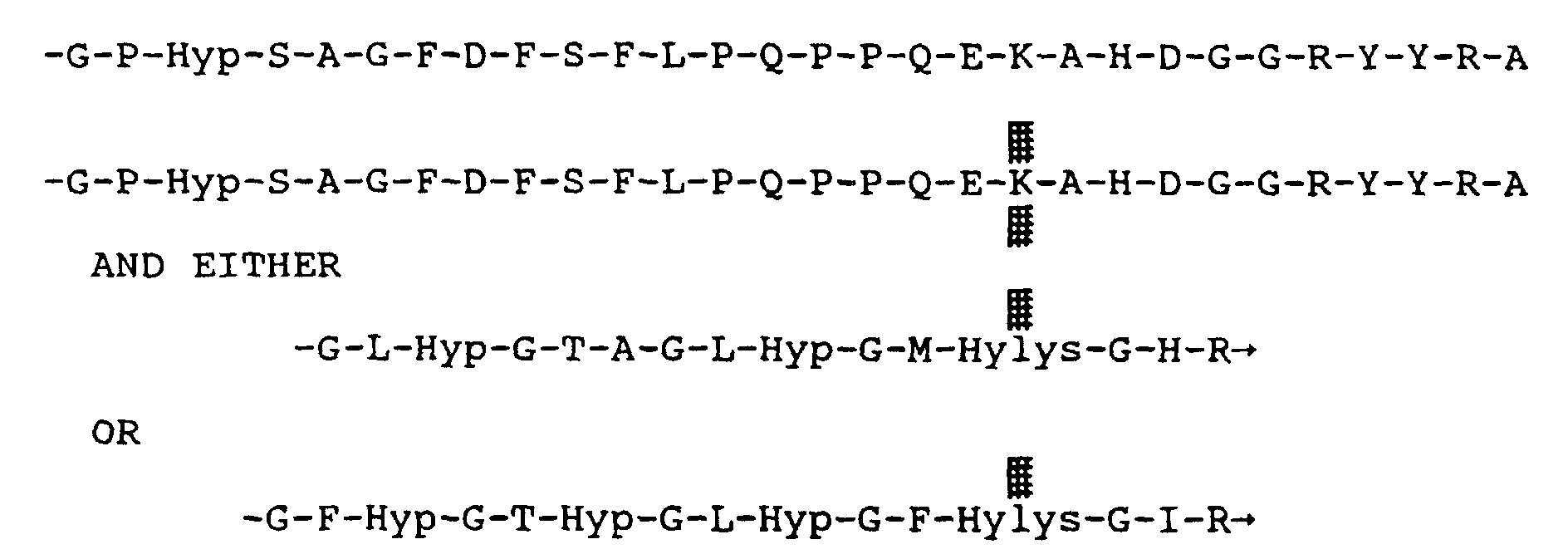
where Hyp is hydroxproline, Hylys is hydroxylysine and

indicates the position of the cross-link.
where Hyp is hydroxproline, Hylys is hydroxylysine and
indicates the position of the cross-link.
6. A method according to any one of claims 2 to 5 in which labelled type I collagen carboxyterminal
telopeptide and the sample are both contacted with the said antibody, the antigen-antibody
complex so formed is separated from uncomplexed starting materials, and the complexed
or the uncomplexed label is assayed.
7. A method according to claim 6 in which the antigen-antibody complex is contacted with
a second antibody which is an antibody to the first antibody, and the antigen-antibody-antibody
complex so formed is separated from the uncomplexed starting materials.
8. A method according to any one of claims 2 to 7 in which the label is a radioactive,
enzyme, or fluorescent label.
9. A method according to any one of claims 2 to 8 in which the first antibody or, if
present, the second antibody is bound to a solid support, and the antigen-antibody
or antigen-antibody-antibody complex formed is separated from the medium in which
the contact takes place by separating said solid support.
10. A kit suitable for use in carrying out an assay method according to any one of claims
2 to 9 comprising an antibody specific to type I collagen carboxyterminal telopeptide
and a label.
11. A kit suitable for use in carrying out an assay method according to claim 9 comprising
a first antibody which is specific to said type I collagen carboxyterminal telopeptide,
a second antibody which is an antibody to the first antibody, a label, and a solid
support to which is bound the first or second antibody.
12. An antibody raised against type I collagen carboxyterminal cross-linked telopeptide
obtainable from bone from a human or non-human vertebrate.
13. An antibody as claimed in claim 12 which is a monoclonal antibody specific for a type
I collagen carboxyterminal telopeptide.
14. An antibody as claimed in claim 12 which is a monoclonal antibody which specifically
binds to a peptide having the sequence
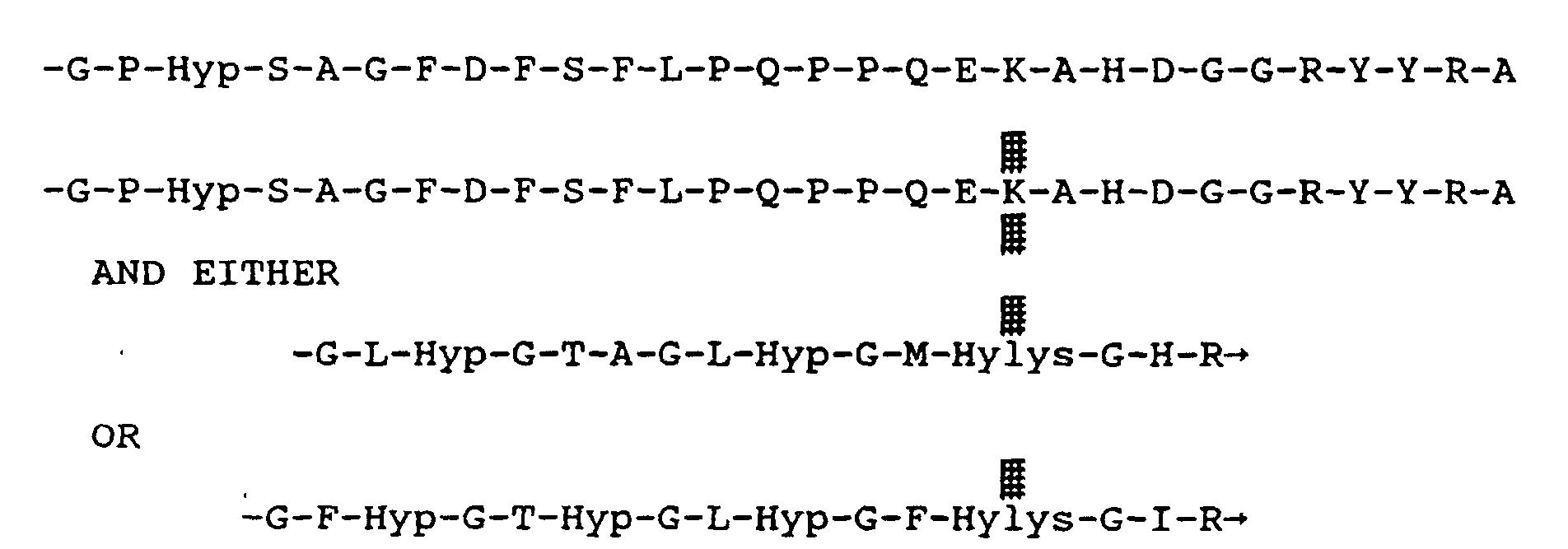
where Hyp is hydroxproline, Hylys is hydroxylysine and
indicates the position of the cross-link.
where Hyp is hydroxproline, Hylys is hydroxylysine and
indicates the position of the cross-link.
15. A process for isolating type I collagen carboxyterminal cross-linked telopeptide which
comprises subjecting decalcified, insoluble bone tissue to denaturation, and chromatography
using a plurality of steps of reverse phase separation with high performance liquid
chromatography, at least two of the chromatography steps being at different pH.
Claims for the following Contracting State(s): ES
1. A method for assaying a type I collagen degradation product, which comprises contacting
in any order (i) a sample which is known or suspected to contain such product; (ii)
an antibody specific to type I collagen carboxyterminal telopeptide obtainable from
bone from a human or animal vertebrate; and (iii) a label; under conditions such that
the label becomes bound in an amount which depends on the amount of type I collagen
degradation product in said sample and then assaying the bound and/or unbound label
to determine the presence or level of the type I collagen degradation product in said
sample.
2. A method according to claim 1 in which the antibody is raised against type I collagen
carboxyterminal cross-linked telopeptide.
3. A method according to claim 1 or 2 in which the antibody is a monoclonal antibody.
4. A method according to claim 3 in which the monoclonal antibody specifically binds
to a peptide having the sequence
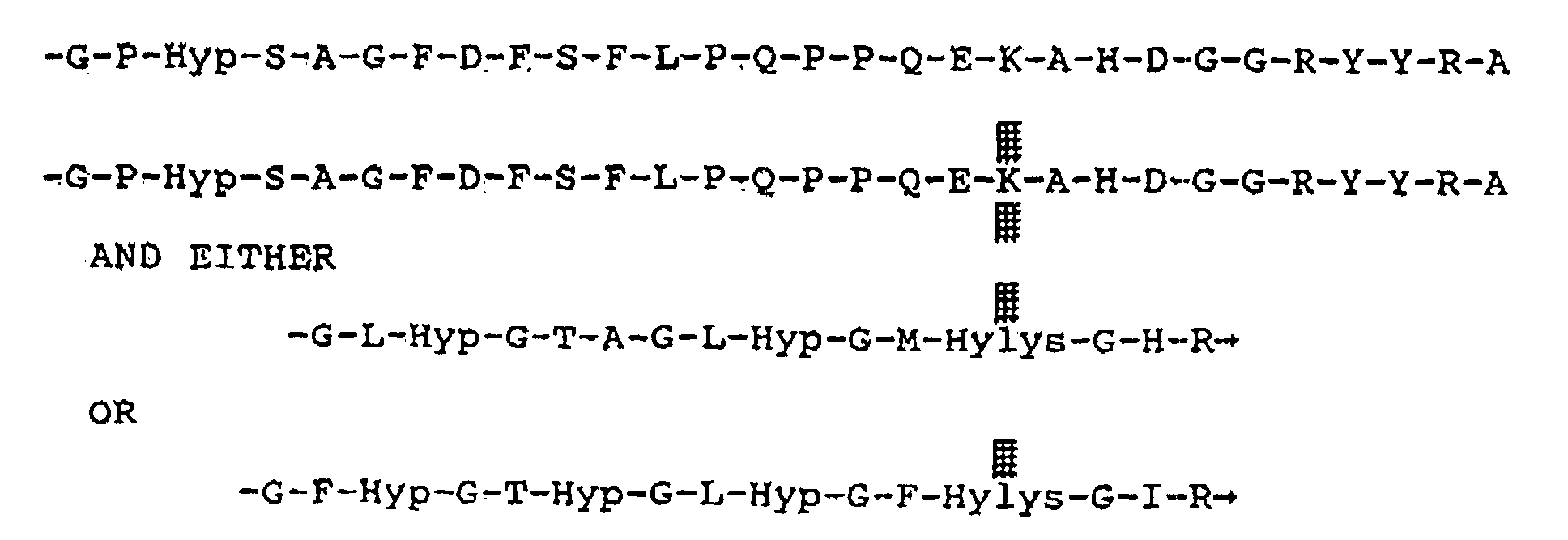
where Hyp is hydroxproline, Hylys is hydroxylysine and
indicates the position of the cross-link.
where Hyp is hydroxproline, Hylys is hydroxylysine and
indicates the position of the cross-link.
5. A method according to any one of claims 1 to 4 in which labelled type I collagen carboxyterminal
telopeptide and the sample are both contacted with the said antibody, the antigen-antibody
complex so formed is separated from uncomplexed starting materials, and the complexed
or the uncomplexed label is assayed.
6. A method according to claim 5 in which the antigen-antibody complex is contacted with
a second antibody which is an antibody to the first antibody, and the antigen-antibody-antibody
complex so formed is separated from the uncomplexed starting materials.
7. A method according to any one of claims 1 to 6 in which the label is a radioactive,
enzyme, or fluorescent label.
8. A method according to any one of claims 1 to 7 in which the first antibody or, if
present, the second antibody is bound to a solid support, and the antigen-antibody
or antigen-antibody-antibody complex formed is separated from the medium in which
the contact takes place by separating said solid support.
9. A process for isolating type I collagen carboxyterminal cross-linked telopeptide which
comprises subjecting decalcified, insoluble bone tissue to denaturation, and chromatography
using a plurality of steps of reverse phase separation with high performance liquid
chromatography, at least two of the chromatography steps being at different pH.
10. Use of an antibody specific to type I collagen carboxyterminal telopeptide obtainable
from bone from a human or animal vertebrate in testing for the presence or level of
a type I collagen degradation product, in a sample which is known or suspected to
contain said degradation product.
11. A kit suitable for use in carrying out an assay method according to any one of claims
1 to 8 comprising an antibody specific to type I collagen carboxyterminal telopeptide
and a label.
12. A kit suitable for use in carrying out an assay method according to claim 8 comprising
a first antibody which is specific to said type I collagen carboxyterminal telopeptide,
a second antibody which is an antibody to the first antibody, and a solid support
to which is bound the first or second antibody.
13. An antibody raised against type I collagen carboxyterminal cross-linked telopeptide
obtainable from bone from a human or non-human vertebrate.
14. An antibody as claimed in claim 13 which is a monoclonal antibody specific for a type
I collagen carboxyterminal telopeptide.
15. An antibody as claimed in claim 13 which is a monoclonal antibody which specifically
binds to a peptide having the sequence
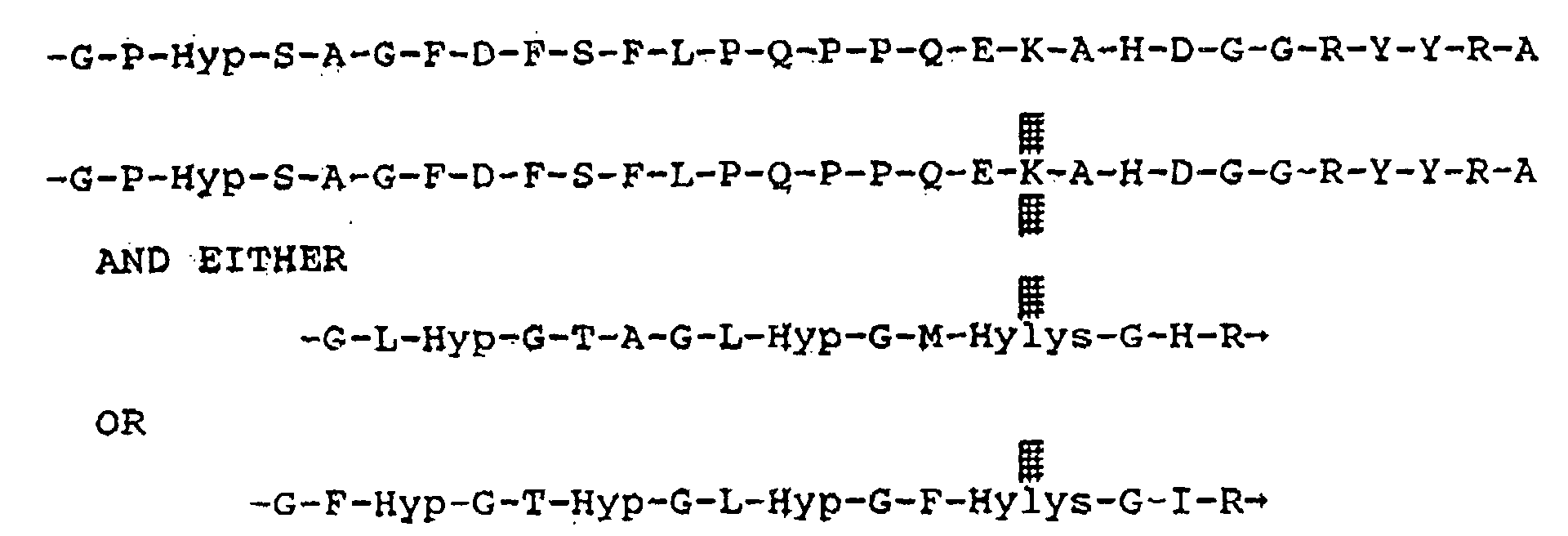
where Hyp is hydroxproline, Hylys is hydroxylysine and
indicates the position of the cross-link.
where Hyp is hydroxproline, Hylys is hydroxylysine and
indicates the position of the cross-link.
Patentansprüche für folgende(n) Vertragsstaat(en): AT, BE, CH, LI, DE, DK, FR, GB,
GR, IT, LU, MC, NL, PT, SE
1. Verwendung eines Antikörpers, der für das carboxyterminale Telopeptid von Kollagen
Typ I spezifisch ist, welches aus Knochen aus einem humanen oder tierischen Wirbeltier
erhältlich ist, beim Testen auf das Vorliegen oder den Gehalt eines Abbauproduktes
von Kollagen Typ I in einer Probe, von welcher bekannt ist oder vermutet wird, daß
sie das Abbauprodukt enthält.
2. Verfahren zum Testen auf ein Abbauprodukt von Kollagen Typ I, welches umfaßt: In-Kontakt-Bringen
in beliebiger Reihenfolge von (i) einer Probe, von welcher bekannt ist oder vermutet
wird, daß sie ein solches Produkt enthält; (ii) einem Antikörper, der für das carboxyterminale
Telopeptid von Kollagen Typ I spezifisch ist, welches aus Knochen aus einem humanen
oder tierischen Wirbeltier erhältlich ist; und (iii) einem Marker; unter solchen Bedingungen,
daß der Marker in einer Menge gebunden wird, die von der Menge des Abbauproduktes
von Kollagen Typ I in der Probe abhängt, und dann Testen auf den gebundenen und/oder
nicht gebundenen Marker, um das Vorliegen oder den Gehalt des Abbauproduktes von Kollagen
Typ I in der Probe zu bestimmen.
3. Ein Verfahren gemäß Anspruch 2, bei welchem der Antikörper gegen das carboxyterminale
quervernetzte Telopeptid von Kollagen Typ I hervorgerufen wird.
4. Ein Verfahren gemäß Anspruch 2 oder 3, bei welchem der Antikörper ein monoklonaler
Antikörper ist.
5. Ein Verfahren gemäß Anspruch 4, bei welchem der monoklonale Antikörper spezifisch
an ein Peptid bindet, welches die folgende Sequenz aufweist
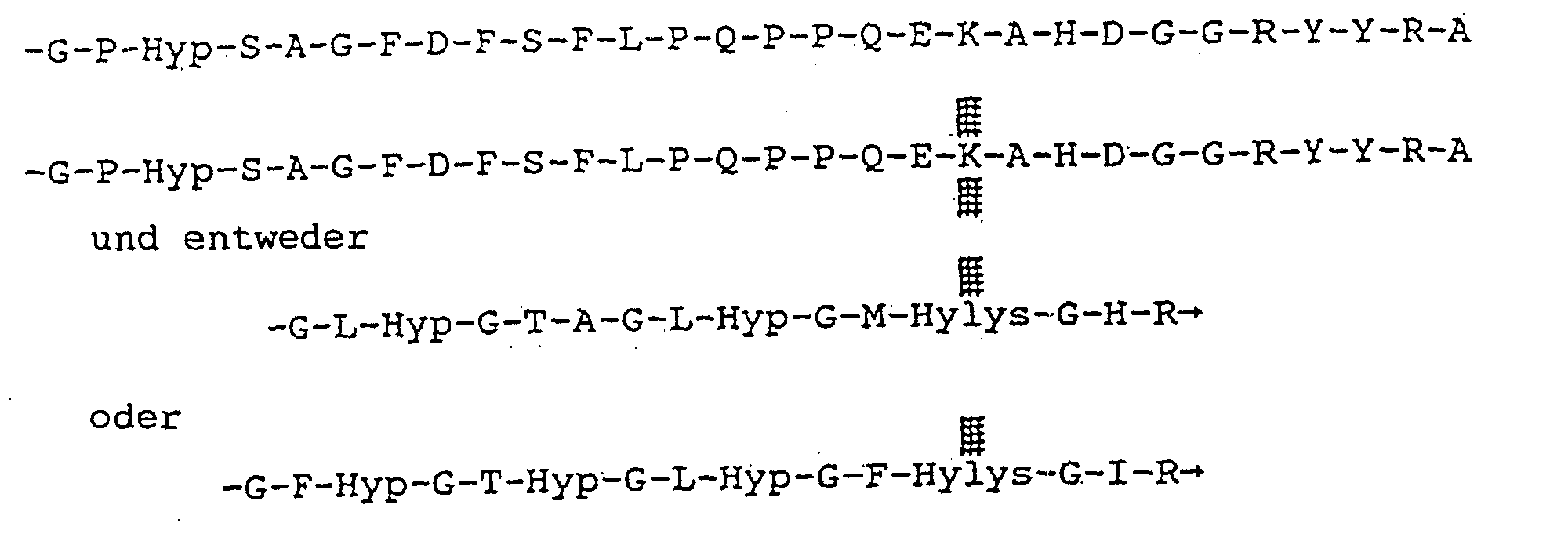
wobei Hyp Hydroxyprolin ist, Hylys Hydroxylysin ist und

die Position der Querverknüpfüng anzeigt.
wobei Hyp Hydroxyprolin ist, Hylys Hydroxylysin ist und
die Position der Querverknüpfüng anzeigt.
6. Ein Verfahren gemäß einem der Ansprüche 2 bis 5, in welchem markiertes carboxylterminales
Telopeptid von Kollagen Typ I und die Probe beide mit dem genannten Antikörper in
Kontakt gebracht werden, der so gebildete Antigen-Antikörper-Komplex von dem nicht
komplexierten Ausgangsmaterial abgetrennt wird und auf den komplexierten oder den
nicht komplexierten Marker getestet wird.
7. Ein Verfahren gemäß Anspruch 6, bei welchem der Antigen-Antikörper-Komplex mit einem
zweiten Antikörper in Kontakt gebracht wird, welcher ein Antikörper gegen den ersten
Antikörper ist, und der so gebildete Antigen-Antikörper-Antikörper-Komplex von dem
nicht kömplexierten Ausgangsmaterial abgetrennt wird.
8. Ein Verfahren gemäß einem der Ansprüche 2 bis 7, in welchem der Marker ein radioaktiver,
ein Enzym- oder ein fluoreszierender Marker ist.
9. Ein Verfahren gemäß einem der Ansprüche 2 bis 8, in welchem der erste Antikörper oder,
wenn vorhanden, der zweite Antikörper an einen festen Träger gebunden ist, und der
gebildete Antigen-Antikörper- oder Antigen-Antikörper-Antikörper-Komplex von dem Medium
abgetrennt wird, in welchem der Kontakt stattfindet, indem der feste Träger abgetrennt
wird.
10. Ein Kit, welches zur Verwendung bei der Durchführung eines Testverfahrens gemäß einem
der Ansprüche 2 bis 9 geeignet ist, das einen Antikörper, der für das carboxyterminale
Telopeptid von Kollagen Typ I spezifisch ist, und einen Marker umfaßt.
11. Ein Kit, welches zur Verwendung bei der Durchführung eines Testverfahrens gemäß Anspruch
9 geeignet ist, das einen ersten Antikörper, welcher für das carboxyterminale Telopeptid
von Kollagen Typ I spezifisch ist, einen zweiten Antikörper, welcher ein Antikörper
gegen den ersten Antikörper ist, einen Marker und einen festen Träger umfaßt, an welchen
der erste oder zweite Antikörper gebunden ist.
12. Ein Antikörper, der gegen das carboxyterminale quervernetzte Telopeptid von Kollagen
Typ I hervorgerufen wurde, welches aus Knochen aus einem humanen oder nicht-humanen
Wirbeltier erhältlich ist.
13. Ein Antikörper wie in Anspruch 12 beansprucht, welcher ein monoklonaler Antikörper
ist, der für das carboxyterminale Telopeptid von Kollagen Typ I spezifisch ist.
14. Ein Antikörper wie in Anspruch 12 beansprucht, welcher ein monoklonaler Antikörper
ist, der spezifisch an ein Peptid mit der Sequenz
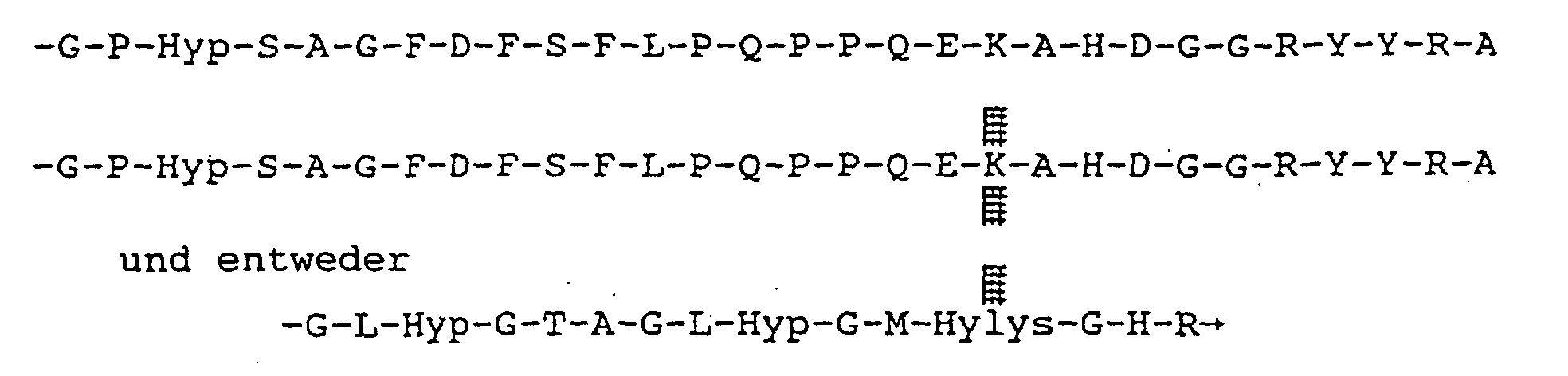

bindet, wobei Hyp Hydroxyprolin ist, Hylys Hydroxylysin ist und
die Position der Querverknüpfung anzeigt.
bindet, wobei Hyp Hydroxyprolin ist, Hylys Hydroxylysin ist und
die Position der Querverknüpfung anzeigt.
15. Ein Verfahren zum Isolieren von carboxyterminalem quervernetztem Telopeptid von Kollagen
Typ I, welches ein Unterwerfen von entkalktem, unlöslichem Knochengewebe unter eine
Denaturierung und eine Chromatographie unter Verwendung einer Mehrzahl von Schritten
einer Umkehrphasentrennung mit einer Hochleistungsflüssigchromatographie umfaßt, wobei
wenigstens zwei der Chromatographieschritte bei einem unterschiedlichen pH stattfinden.
Patentansprüche für folgende(n) Vertragsstaat(en): ES
1. Verfahren zum Testen auf ein Abbauprodukt von Kollagen Typ I, welches umfaßt: In-Kontakt-Bringen
in beliebiger Reihenfolge von (i) einer Probe, von welcher bekannt ist oder vermutet
wird, daß sie ein solches Produkt enthält; (ii) einem Antikörper, der für das carboxyterminale
Telopeptid von Kollagen Typ I spezifisch ist, welches aus Knochen aus einem humanen
oder tierischen Wirbeltier erhältlich ist; und (iii) einem Marker; unter solchen Bedingungen,
daß der Marker in einer Menge gebunden wird, die von der Menge des Abbauproduktes
von Kollagen Typ I in der Probe abhängt, und dann Testen auf den gebundenen und/oder
nicht gebundenen Marker, um das Vorliegen oder den Gehalt des Abbauproduktes von Kollagen
Typ I in der Probe zu bestimmen.
2. Ein Verfahren gemäß Anspruch 1, bei welchem der Antikörper gegen das carboxyterminale
quervernetzte Telopeptid von Kollagen Typ I hervorgerufen wird.
3. Ein Verfahren gemäß Anspruch 1 oder 2, bei welchem der Antikörper ein monoklonaler
Antikörper ist.
4. Ein Verfahren gemäß Anspruch 3, bei welchem der monoklonale Antikörper spezifisch
an ein Peptid bindet, welches die folgende Sequenz aufweist
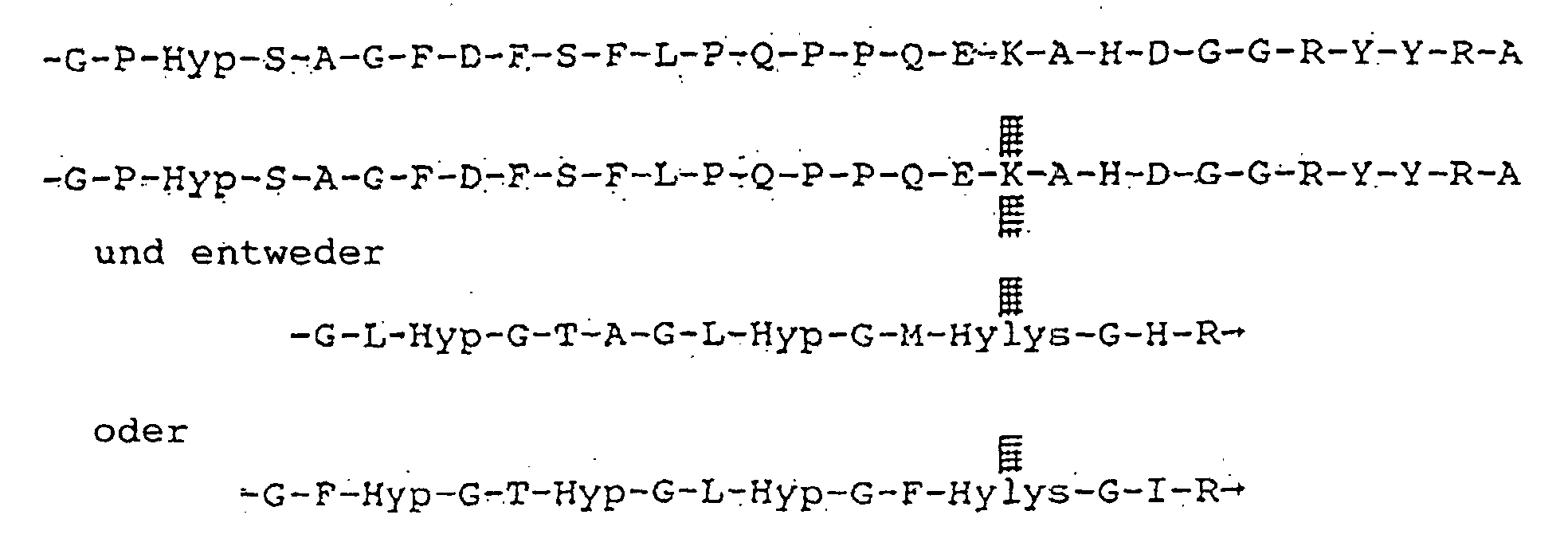
wobei Hyp Hydroxyprolin ist, Hylys Hydroxylysin ist und
die Position der Querverknüpfung anzeigt.
wobei Hyp Hydroxyprolin ist, Hylys Hydroxylysin ist und
die Position der Querverknüpfung anzeigt.
5. Ein Verfahren gemäß einem der Ansprüche 1 bis 4, in welchem markiertes carboxylterminales
Telopeptid von Kollagen Typ I und die Probe beide mit dem genannten Antikörper in
Kontakt gebracht werden, der so gebildete Antigen-Antikörper-Komplex von dem nicht
komplexierten Ausgangsmaterial abgetrennt wird und auf den komplexierten oder den
nicht komplexierten Marker getestet wird.
6. Ein Verfahren gemäß Anspruch 5, bei welchem der Antigen-Antikörper-Komplex mit einem
zweiten Antikörper in Kontakt gebracht wird, welcher ein Antikörper gegen den ersten
Antikörper ist, und der so gebildete Antigen-Antikörper-Antikörper-Komplex von dem
nicht komplexierten Ausgangsmaterial abgetrennt wird.
7. Ein Verfahren gemäß einem der Ansprüche 1 bis 6, in welchem der Marker ein radioaktiver,
ein Enzym- oder ein fluoreszierender Marker ist.
8. Ein Verfahren gemäß einem der Ansprüche 1 bis 7, in welchem der erste Antikörper oder,
wenn vorhanden, der zweite Antikörper an einen festen Träger gebunden ist, und der
gebildete Antigen-Antikörper- oder Antigen-Antikörper-Antikörper-Komplex von dem Medium
abgetrennt wird, in welchem der Kontakt stattfindet, indem der feste Träger abgetrennt
wird.
9. Ein Verfahren zum Isolieren von carboxyterminalem quervernetztem Telopeptid von Kollagen
Typ I, welches ein Unterwerfen von entkalktem, unlöslichem Knochengewebe unter eine
Denaturierung und eine Chromatographie unter Verwendung einer Mehrzahl von Schritten
einer Umkehrphasentrennung mit einer Hochleistungsflüssigchromatographie umfaßt, wobei
wenigstens zwei der Chromatographieschritte bei einem unterschiedlichen pH stattfinden.
10. Verwendung eines Antikörpers, der für das carboxyterminale Telopeptid von Kollagen
Typ I spezifisch ist, welches aus Knochen aus einem humanen oder tierischen Wirbeltier
erhältlich ist, beim Testen auf das Vorliegen oder den Gehalt eines Abbauproduktes
von Kollagen Typ I in einer Probe, von welcher bekannt ist oder vermutet wird, daß
sie das Abbauprodukt enthält.
11. Ein Kit, welches zur Verwendung bei der Durchführung eines Testverfahrens gemäß einem
der Ansprüche 1 bis 8 geeignet ist, das einen Antikörper, der für das carboxyterminale
Telopeptid von Kollagen Typ I spezifisch ist, und einen Marker umfaßt.
12. Ein Kit, welches zur Verwendung bei der Durchführung eines Testverfahrens gemäß Anspruch
8 geeignet ist, das einen ersten Antikörper, welcher für das carboxyterminale Telopeptid
von Kollagen Typ I spezifisch ist, einen zweiten Antikörper, welcher ein Antikörper
gegen den ersten Antikörper ist, und einen festen Träger umfaßt, an welchen der erste
oder zweite Antikörper gebunden ist.
13. Ein Antikörper, der gegen das carboxyterminale quervernetzte Telopeptid von Kollagen
Typ I hervorgerufen wurde, welches aus Knochen aus einem humanen oder nicht-humanen
Wirbeltier erhältlich ist.
14. Ein Antikörper wie in Anspruch 13 beansprucht, welcher ein monoklonaler Antikörper
ist, der für das carboxy-terminale Telopeptid von Kollagen Typ I spezifisch ist.
15. Ein Antikörper wie in Anspruch 13 beansprucht, welcher ein monoklonaler Antikörper
ist, der spezifisch an ein Peptid mit der Sequenz
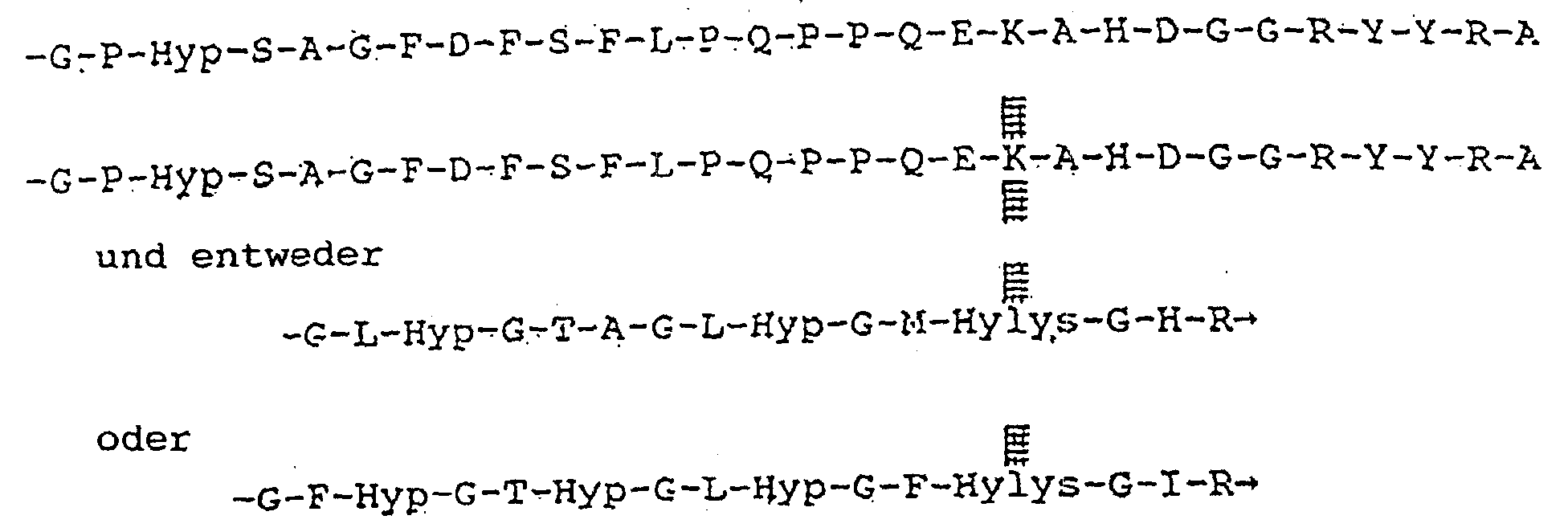
bindet, wobei Hyp Hydroxyprolin ist, Hylys Hydroxylysin ist und
die Position der Querverknüpfung anzeigt.
bindet, wobei Hyp Hydroxyprolin ist, Hylys Hydroxylysin ist und
die Position der Querverknüpfung anzeigt.
Revendications pour l'(les) Etat(s) contractant(s) suivant(s): AT, BE, CH, LI, DE,
DK, FR, GB, IT, LU, MC, NL, PT, SE
1. Utilisation d'un antigène spécifique du télopeptide carboxyterminal de collagène de
type I pouvant être obtenu à partir d'os d'un vertébré humain ou animal dans le contrôle
de la présence ou du taux de produit de dégradation de collagène de type I dans un
échantillon qui est connu comme contenant ou soupçonné de contenir ledit produit de
dégradation.
2. Procédure de dosage d'un produit de dégradation de collagène de type I qui comprend
la mise en contact dans un ordre quelconque (i) d'un échantillon qui est connu comme
contenant ou soupçonné de contenir un tel produit; (ii) d'un anticorps spécifique
de télopeptide carboxyterminal de collagène de type I pouvant être obtenu à partir
d'os d'un vertébré humain ou animal; et (iii) d'un marqueur ; dans des conditions
telles que le marqueur se fixe en une quantité qui dépende de la quantité de produit
de dégradation du collagène de type I dans ledit échantillon et le dosage du marqueur
lié et/ou non lié pour déterminer la présence ou le taux de produit de dégradation
de collagène de type I dans ledit échantillon.
3. Procédure selon la revendication 2 dans laquelle l'anticorps est dirigé contre le
télopeptide carboxyterminal de collagène de type I réticulé.
4. Procédure selon la revendication 2 ou la revendication 3 dans laquelle l'anticorps
est un anticorps monoclonal.
5. Procédure selon la revendication 4 dans laquelle l'anticorps monoclonal se fixe spécifiquement
sur un peptide ayant la séquence
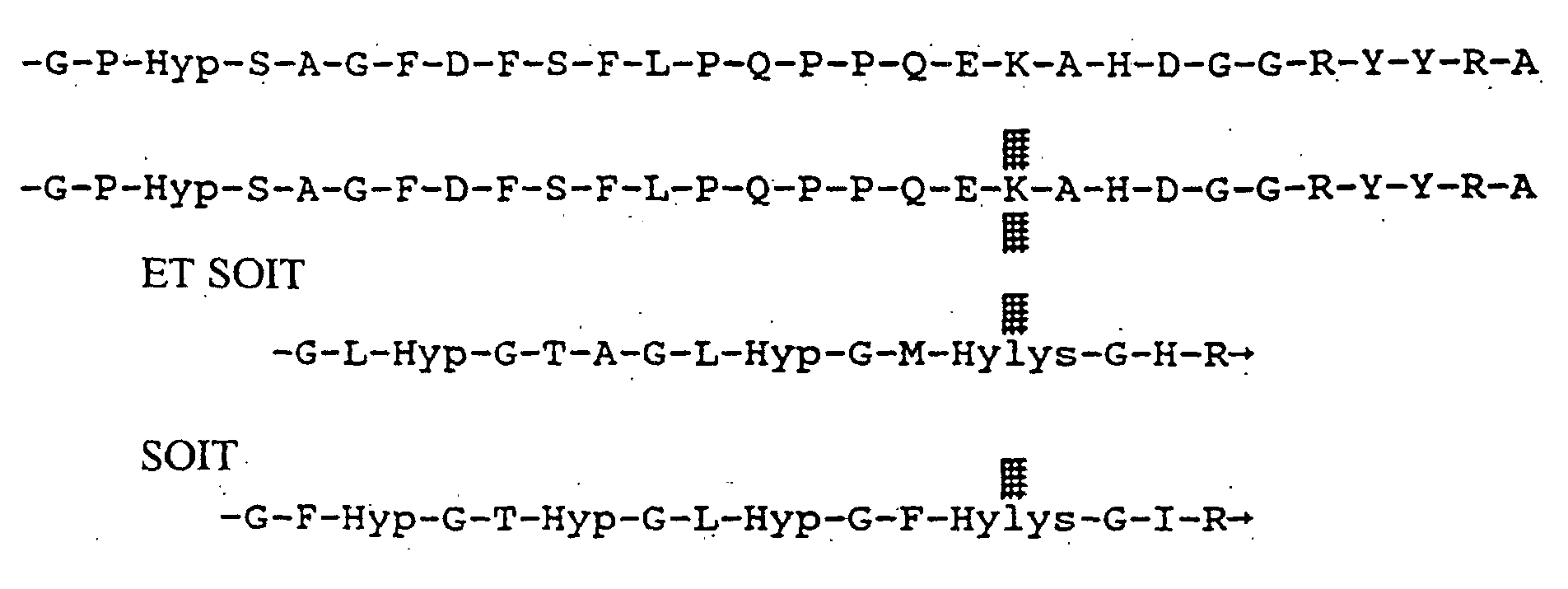
où Hyp est l'hydroxyproline, Hylys est l'hydroxylysine et

indique la position de la réticulation.
où Hyp est l'hydroxyproline, Hylys est l'hydroxylysine et
indique la position de la réticulation.
6. Procédure selon l'une quelconque des revendications 2 à 5 dans laquelle le télopeptide
carboxyterminal de collagène de type I et l'échantillon sont tous deux mis en contact
avec ledit anticorps, le complexe antigène-anticorps ainsi formé est séparé des produits
de départ non complexés et le marqueur complexé ou non complexé est dosé.
7. Procédure selon la revendication. 6, dans laquelle le complexe antigène-anticorps
est mis en contact avec un second anticorps qui est un anticorps du premier anticorps,
et le complexe antigène-anticorps-anticorps ainsi formé est séparé des produits de
départ non complexés.
8. Procédure selon l'une quelconque des revendications 2 à 7 dans laquelle le marqueur
est un marqueur radioactif, enzymatique ou fluorescent.
9. Procédure selon l'une quelconque des revendications 2 à 8 dans laquelle le premier
anticorps ou s'il est présent, le second anticorps, est lié à un support solide et
le complexe antigène-anticorps ou antigène-anticorps-anticorps ainsi formé est séparé
du milieu dans lequel a lieu le contact, par séparation dudit support solide.
10. Kit approprié à l'utilisation dans la mise en oeuvre d'une procédure de dosage selon
l'une quelconque des revendications 2 à 9, comprenant un anticorps spécifique du télopeptide
carboxyterminal de collagène de type I et un marqueur.
11. Kit approprié à l'utilisation dans la mise en oeuvre d'une procédure de dosage selon
la revendication 9 comprenant un premier anticorps qui est spécifique dudit télopeptide
carboxyterminal de collagène de type I, un second anticorps qui est un anticorps du
premier anticorps, un marqueur et un support solide auquel est lié le premier ou le
second anticorps.
12. Anticorps dirigé contre le télopeptide carboxyterminal de collagène de type I réticulé
pouvant être obtenu à partir d'os d'un vertébré humain ou non humain.
13. Anticorps selon la revendication 12, qui est un anticorps monoclonal spécifique d'un
télopeptide carboxyterminal de collagène de type I.
14. Anticorps selon la revendication 12, qui est un anticorps monoclonal qui se fixe spécifiquement
sur un peptide ayant la séquence :
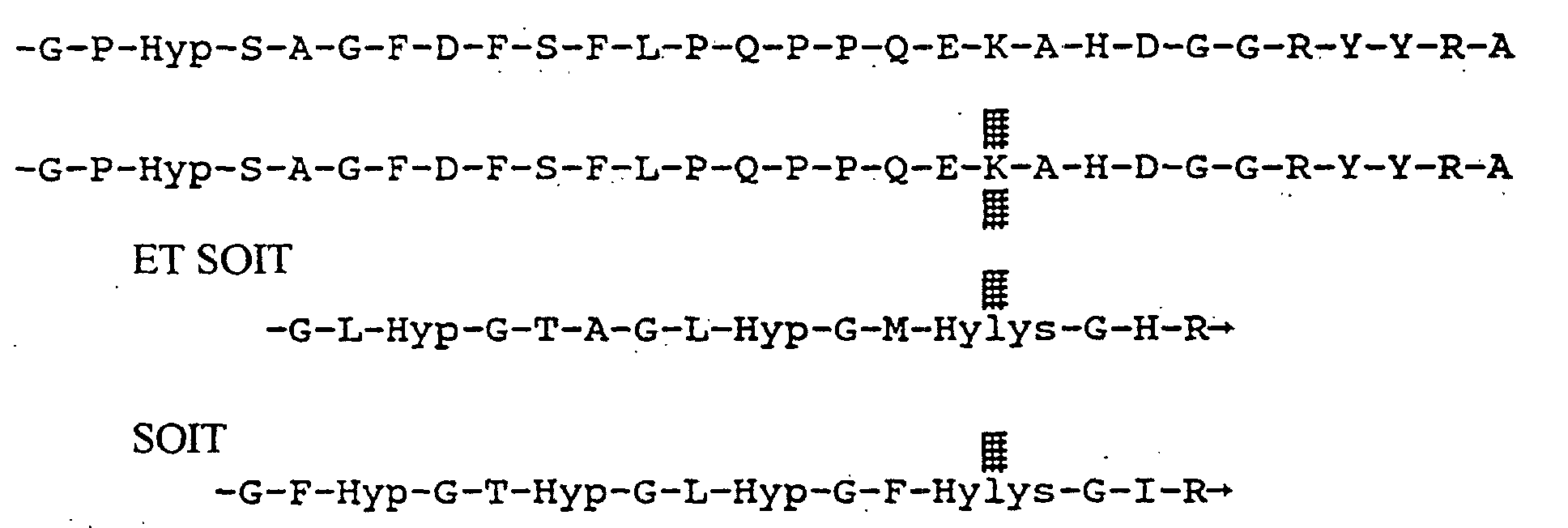
où Hyp est l'hydroxyproline, Hylys est l'hydroxylysine et
indique la position de la réticulation.
où Hyp est l'hydroxyproline, Hylys est l'hydroxylysine et
indique la position de la réticulation.
15. Procédé d'isolement de télopeptide carboxyterminal de collagène de type I réticulé
qui comprend la soumission à la dénaturation, d'un tissu osseux décalcifié insoluble
et une chromatographie utilisant une pluralité d'étapes de séparation en phase inversée
avec chromatographie liquide haute performance, deux au moins des étapes de chromatographie
étant à des pH différents.
Revendications pour l'(les) Etat(s) contractant(s) suivant(s): ES
1. Procédure de dosage d'un produit dé dégradation de collagène de type I qui comprend
la mise en contact dans un ordre quelconque (i) d'un échantillon qui est connu comme
contenant ou soupçonné de contenir un tel produit ; (ii) d'un anticorps spécifique
de télopeptide carboxyterminal de collagène de type I pouvant être obtenu à partir
d'os d'un vertébré humain ou animal ; et (iii) d'un marqueur; dans des conditions
telles que le marqueur se fixe en une quantité qui dépende de la quantité de produit
de dégradation du collagène de type I dans ledit échantillon et le dosage du marqueur
lié et/ou non lié pour déterminer la présence ou le taux de produit de dégradation
de collagène de type I dans ledit échantillon.
2. Procédure selon la revendication 1 dans laquelle l'anticorps est dirigé contre le
télopeptide carboxyterminal de collagène de type I réticulé.
3. Procédure selon la revendication 1 ou la revendication 2 dans laquelle l'anticorps
est un anticorps monoclonal.
4. Procédure selon la revendication 3 dans laquelle l'anticorps monoclonal se fixe spécifiquement
sur un peptide ayant la séquence
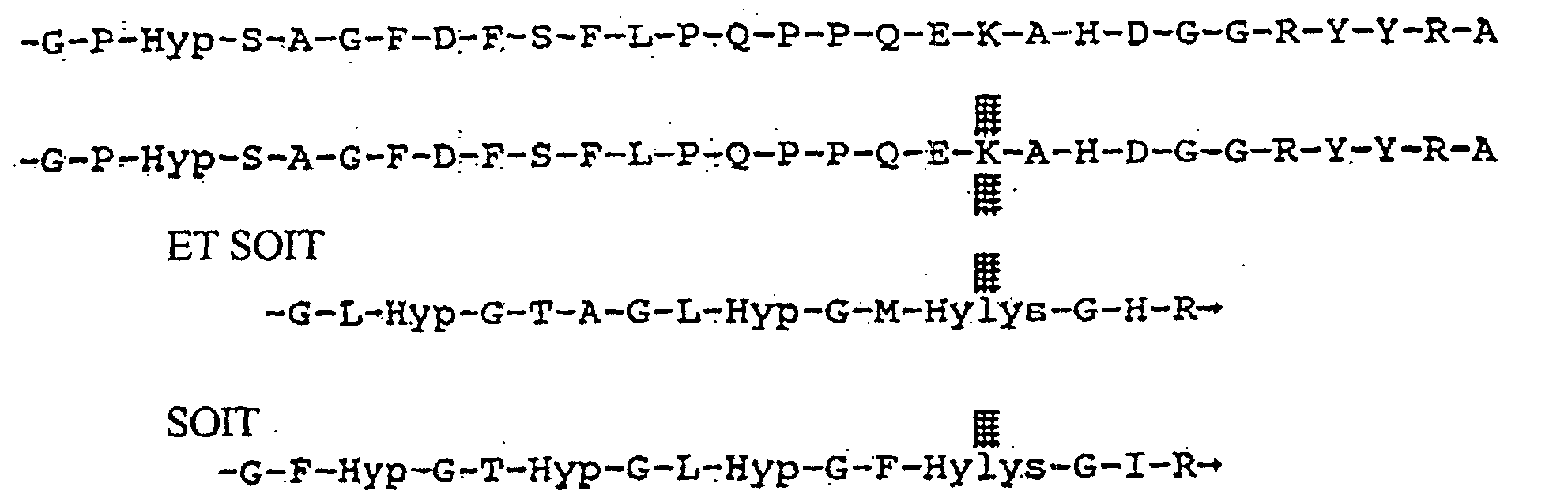
où Hyp est l'hydroxyproline, Hylys est l'hydroxylysine et
indique la position de la réticulation.
où Hyp est l'hydroxyproline, Hylys est l'hydroxylysine et
indique la position de la réticulation.
5. Procédure selon l'une quelconque des revendications 1 à 4 dans laquelle le télopeptide
carboxyterminal de collagène de type I et l'échantillon sont tous deux mis en contact
avec ledit anticorps, le complexe antigène-anticorps ainsi formé est séparé des produits
de départ non complexés et le marqueur complexé ou non complexé est dosé.
6. Procédure selon la revendication 5, dans laquelle le complexe antigène-anticorps est
mis en contact avec un second anticorps qui est un anticorps du premier anticorps,
et le complexe antigène-anticorps-anticorps ainsi formé est séparé des produits de
départ non complexés.
7. Procédure selon l'une quelconque des revendications 1 à 6 dans laquelle le marqueur
est un marqueur radioactif, enzymatique ou fluorescent.
8. Procédure selon l'une quelconque des revendications 1 à 7 dans laquelle le premier
anticorps ou s'il est présent, le second anticorps, est lié à un support solide et
le complexe antigène-anticorps ou antigène-anticorps-anticorps ainsi formé est séparé
du milieu dans lequel a lieu le contact, par séparation dudit support solide.
9. Procédé d'isolement de télopeptide carboxyterminal de collagène de type I réticulé
qui comprend la soumission à la dénaturation, d'un tissu osseux décalcifié insoluble
et une chromatographie utilisant une pluralité d'étapes de séparation en phase inversée
avec chromatographie liquide haute performance, deux au moins des étapes de chromatographie
étant à des pH différents.
10. Utilisation d'un antigène spécifique du télopeptide carboxyterminal de collagène de
type I pouvant être obtenu à partir d'os d'un vertébré humain ou animal dans le contrôle
de la présence ou du taux de produit de dégradation de collagène de type I dans un
échantillon qui est connu comme contenant ou soupçonné de contenir ledit produit de
dégradation.
11. Kit approprié à l'utilisation dans la mise en oeuvre d'une procédure de dosage selon
l'une quelconque des revendications 1 à 8, comprenant un anticorps spécifique du télopeptide
carboxyterminal de collagène de type I et un marqueur.
12. Kit approprié à l'utilisation dans la mise en oeuvre d'une procédure de dosage selon
la revendication 8 comprenant un premier anticorps qui est spécifique dudit télopeptide
carboxyterminal de collagène de type I, un second anticorps qui est un anticorps du
premier anticorps et un support solide auquel est lié le premier ou le second anticorps.
13. Anticorps dirigé contre le télopeptide carboxyterminal de collagène de type I réticulé
pouvant être obtenu à partir d'os d'un vertébré humain ou non humain.
14. Anticorps selon la revendication 13, qui est un anticorps monoclonal spécifique d'un
télopeptide carboxyterminal de collagène de type I.
15. Anticorps selon la revendication 13, qui est un anticorps monoclonal qui se fixe spécifiquement
sur un peptide ayant la séquence :
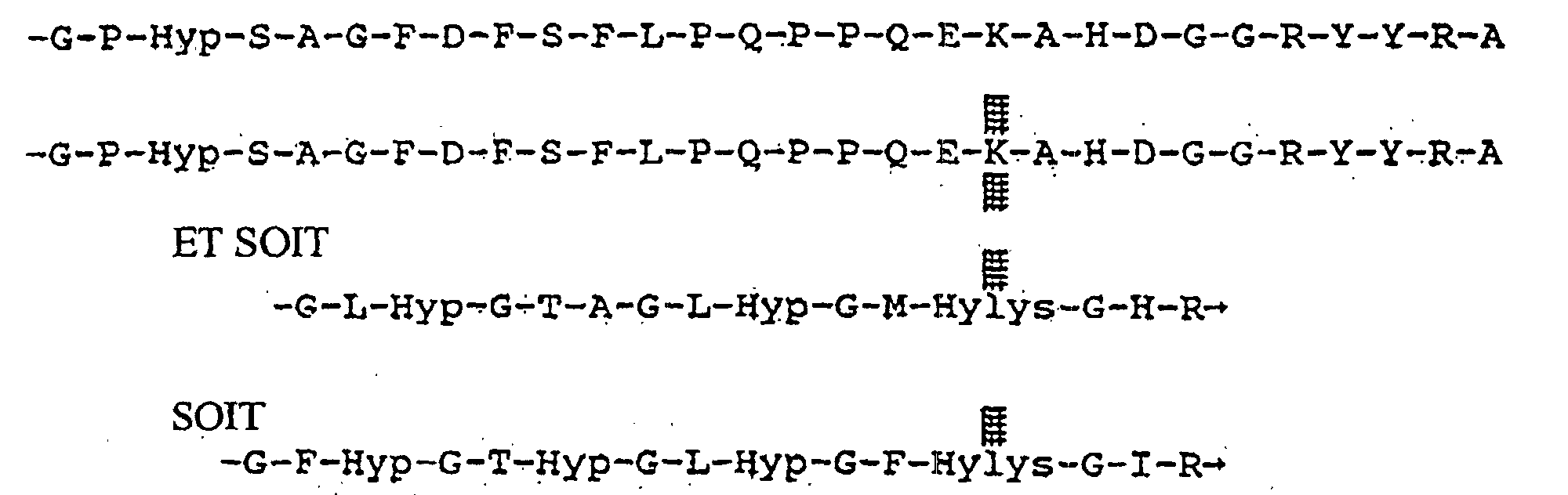
où Hyp est l'hydroxyproline, Hylys est l'hydroxylysine et
indique la position de la réticulation.
où Hyp est l'hydroxyproline, Hylys est l'hydroxylysine et
indique la position de la réticulation.