|
(11) | EP 0 506 979 B1 |

| (12) | EUROPEAN PATENT SPECIFICATION |
|
|
| (54) |
ORGANIC POLYMER COMPOUND AND PRODUCTION THEREOF ORGANISCHE POLYMERVERBINDUNG UND IHRE HERSTELLUNG COMPOSE POLYMERE ORGANIQUE ET SA PRODUCTION |
|
|
|||||||||||||||||||||||||||||||
| Note: Within nine months from the publication of the mention of the grant of the European patent, any person may give notice to the European Patent Office of opposition to the European patent granted. Notice of opposition shall be filed in a written reasoned statement. It shall not be deemed to have been filed until the opposition fee has been paid. (Art. 99(1) European Patent Convention). |
[Field of the Invention]
[0001] The present invention relates to an acrylic or methacrylic polymer to which a chemical compound having physiological activity is chemically bonded. More particularly, the present invention relates to a polymeric drug comprising an acrylic or methacrylic polymer to which a chemical compound having physiological activity releasing a physiological active substance in vivo is chemically bonded, and to a process for the preparation of said polymer by means of mechanochemical polymerization method.
[Prior arts and the Subject Matters to be resolved by the Invention]
[0002] In general, a polymeric substance has a various kinds of properties and functions and is significantly different from a low molecular substance in its behavior in vivo.
[0003] Therefore, an attempt has been made to bond chemically a low molecular physiological active substance to a polymeric substance having no physiological activity in order to form a polymeric drug, so that behavior in vivo or interaction with cells may be controlled.
[0004] US-A-4 430 265 discloses an amino sugar with immuno-stimulatory activity linked to a poly(meth)acrylic homopolymer or copolymer.
[0005] JP-A-64 60615 describes the chemical synthesis of a 5-fluorouracil derivative linked to (meth)acrylic acid or an ester derivative thereof via the hydroxyl group of the hydroxymethylated uracil residue. This monomer is subsequently subjected to homopolymerization or, in the presence of another vinyl compound, copolymerization.
[0006] US-A-4 772 463 discloses macromolecular CDP-choline derivatives obtained by covalently binding CDP-choline to a preformed polymeric matrix such as poly(meth)acrylic acid or copolymers of polymerizable acids with acrylic acid or acrylamide.
[0007] EP-A-0 413 281 relates to a drug carrier wherein certain drugs are chemically bonded to a temperature-sensitive polymer such as poly(N-substituted (meth)acrylamide) derivatives, their copolymers, polymethylvinylether derivatives and partially acetylated polyvinyl alcohol derivatives.
[0008] As a process for the preparation of a polymeric drug, there is known a process for bonding a low molecular physiological active substance to a polymeric substance such as dextrane, albumin and the like. However, this process has drawbacks in requiring a great deal of labor for purification of the reaction products, removal of reaction solvents, and the like. While there are known processes for obtaining polymeric drugs by polymerization of a monomer to which a low molecular physiological substance is bonded, there is no practical use, since the prior processes have several disadvantages that a removal of residual solvent is required because the processes are carried out in a solvent, and molecular weight distribution of the polymeric drugs obtained is wide and it is moreover difficult to obtain the product in a yield of 100%.
[0009] On the other hand, there has been made a study that mechanochemical reactions, that is, chemical reactions caused by mechanical actions are effected with respect to polymeric substances or inorganic substances. For example, a mechanochemical polymerization reaction in a solid phase is most frequently carried out in the presence of a catalyst under an addition of mechanical forces such as grinding, rubbing and so forth.
[0010] It is known that a solid phase polymerization reaction of vinyl monomer such as acrylamide etc. makes progress under an irradiation with high energy radiation such as γ-ray, X-ray to effect polymerization. However, the radiation polymerization process has the defects that the polymerization rate is low and the physiological active substance used may be unfavorably decomposed.
[0011] As a result of devoted study on the syntheses of a novel polymeric drug, the present inventors have found that the drawbacks of the above-mentioned prior arts for a polymeric drug can be overcome by using a mechanochemical reaction and that the mechanochemical reaction used is therefore novel per se, and established the present invention.
[Means for resolving the Subject matters]
[0012] Accordingly, the present invention relates to a polymeric drug obtained by polymerizing acrylic or methacrylic acid derivatives to which a low molecular physiological active substance is bonded by virtue of an ester linkage or amide linkage and also to a process for the synthesis thereof by mechanochemical polymerization reaction.
[0013] The polymeric drug according to the present invention may be termed as "prodrug", since it is hydrolyzed or decomposed by enzyme in vivo, to release a low molecular physiological active compound.
[0014] Accordingly, an object of the present invention is to provide a novel polymeric drug for a prodrug releasing a low molecular physiological active substance in vivo and a process for the preparation thereof by virtue of mechanochemical polymerization reaction.
[0015] In the present invention, the low molecular physiological active compound may be one having a molecular weight of 1,000 or less and a functional group such as a hydroxyl group or amino group which is able to react with a carboxyl group contained in an acrylic acid or methacrylic acid. Illustrative of the low molecular physiological active compounds include various kinds of drugs having remedial effects such as acetaminophene, theophylline, fluorouracil, amphotericin B, methyldopa, nicotinic acid amide, cephalexin, and the like.
[0016] When it is difficult to react directly acrylic acid or methacrylic acid with a low molecular physiological active substance, any appropriate spacer may be interposed between acrylic acid or methacrylic acid and a low molecular physiological active substance. The spacer may have a functional group at the ends of carbon chain containing 1 to 10 carbon atoms such as hydroxyl group or amino group which is able to react with a carboxyl group contained in acrylic acid or methacrylic acid or a functional group contained in a low molecular physiological active substance.
[0017] In the present invention, the mechanochemical polymerization reaction is meant for a polymerization reaction resulted from by adding mechanical energy such as grinding, rubbing, high-speed vibration or compression etc. at a room temperature to an acrylic acid monomer or methacrylic acid monomer to which a low molecular physiological active compound is chemically bonded. Any various optional processes may be selected, depending upon the properties of the monomer used.
[0018] Accordingly, when the low molecular physiological active compound is bonded by ester linkage to an acrylic acid or methacrylic acid, the mechanochemical polymerization reaction is made progress by only carrying out grinding or high-speed vibration in a metal container at a room temperature under atmosphere of nitrogen, thereby obtaining a polymeric drug to which the physiological active substance is chemically bonded. It may be conceived that the polymerization reaction in this case starts by transferring electrons onto a vinyl group of the monomer from the surface of metal to result free radicals. The polymerization reaction may be supposed to progress by chain reaction, once the radicals are formed.
[0019] The significant characteristics of the process of the present invention is that while the molecular weight of the polymeric drug formed at the initial stage of the polymerization reaction is so high as to reach rapidly the maximum value, a lowering of molecular weight continues until it reaches into the limiting molecular weight, when the polymer chain of the polymer formed is cut by grinding.
[0020] The time required for reaching the limiting molecular weight is not unconditionally critical depending upon the size and performance of the apparatus used, although it will be normally 20 minutes and over. The average molecular weight at the limiting molecular weight may be 3,000 or thereabout. The polymeric drug synthesized by the process of the present invention is so-called homopolymer, and a random copolymer may be obtained by grinding it together with another solid monomer such for example as acrylamide. The physico-chemical properties of the resulting prodrug may be changed by the use of acrylamide, etc. Mechanochemical polymerization reaction does not proceed by the use of only a compound, wherein a cyclic low molecular compound having physiological activity is directly bonded to methacrylic acid, such as methacryloyl derivatives of 5-fluorouracil, for example, 1-methacryloyl-5-fluorouracil. In this case, the mechanochemical polymerization reaction can be taken place by introducing an acryloyl group for a methacryloyl group to form a monomer or by carrying out the operations including grinding under atmosphere of nitrogen together with a compound easily forming a mechanoradical such as polyacrylic acid, polymethylacrylate, polymethylmethacrylate, polyacrylamide and polymethacrylamide. The container used in this case may be glass container or TEFLON container. According to the aspect of the present invention, the mechanoradical formation resulted from the cleavage of polyacrylic acid etc. by means of mechanical energy is the starting stage of polymerization reaction, followed by the same reaction process as above mentioned to form a polymer having the limiting molecular weight, and a polymeric drug having average molecular weight of 30,000 or thereabout can be obtained. The polymeric drug synthesized by the process is so-called blockcopolymer.
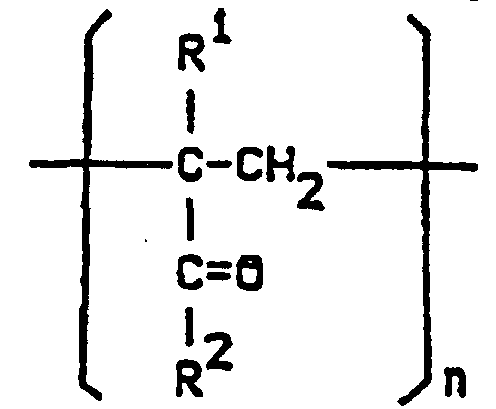
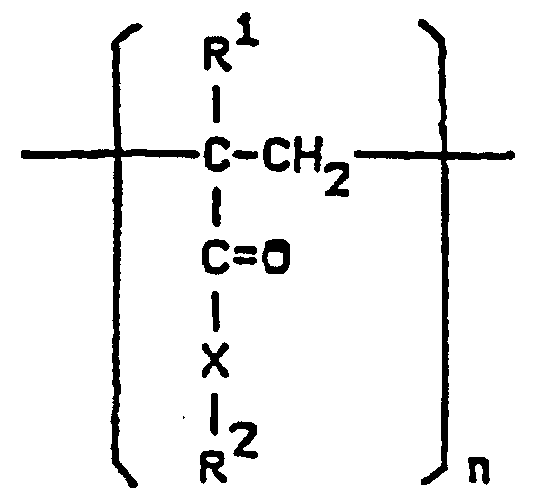
[0021] The polymeric drug of the present invention is a homopolymer having the general formula:
wherein R1 represents a hydrogen atom or methyl group; R2 represents a residue after bonding by ester linkage or amide linkage in the compound having physiological activity, and containing a functional group capable of ester linkage or amide linkage with a carboxyl group in its chemical structural formula; and, in case of a random copolymer, R2 represents a residue as defined above or a residue of the other monomer.
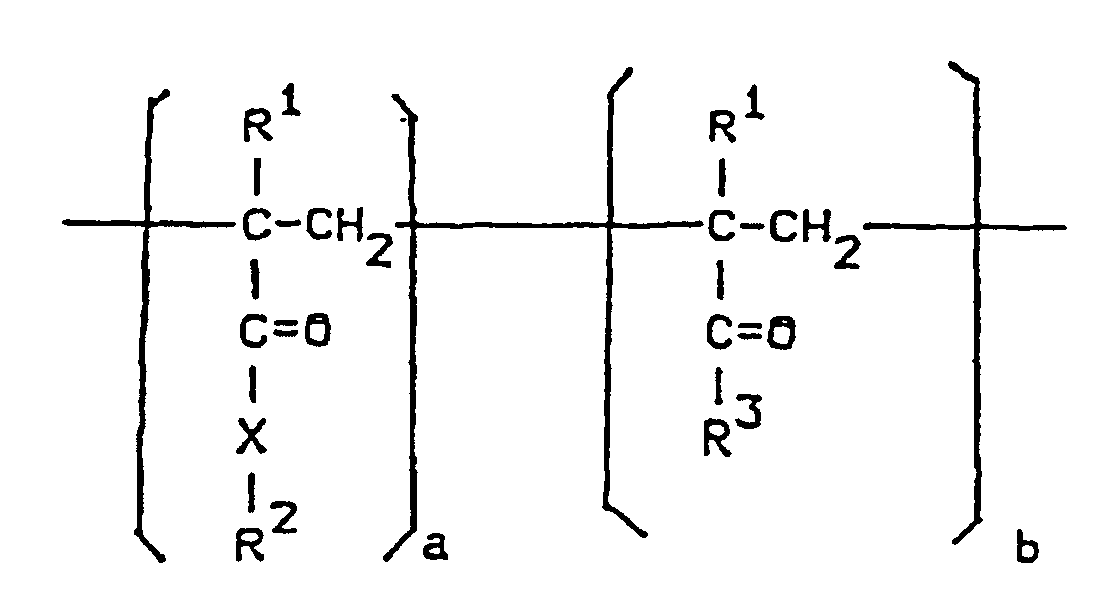
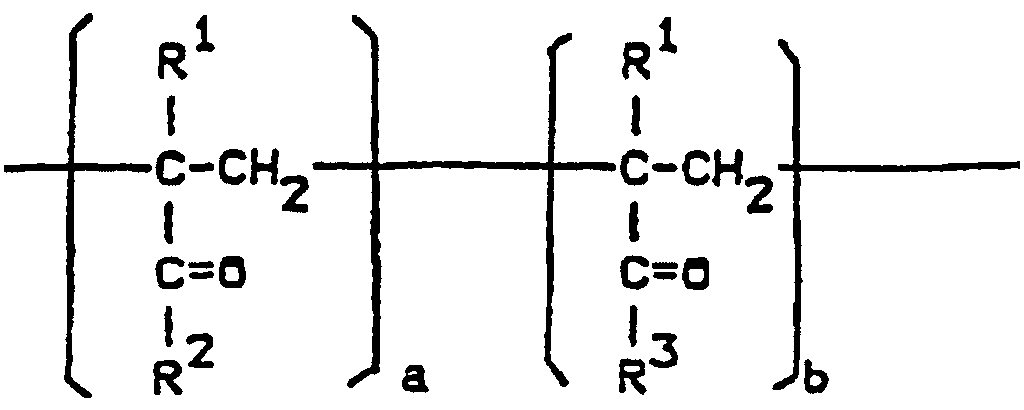
[0022] Alternatively, the polymeric drug is a block copolymer having the general formula:
wherein R1 and R2 have the same meaning as defined above; R3 represents a hydroxyl group, an alkoxyl group or amino group; a represents an integer ranging from 20 to 1,500; and b represents an integer ranging from 1 to 100, respectively.
[0023] Number-average molecular weight ranges from 20,000 to 200,000, providing that it varies depending upon polymerization time, physiological active substance bonded to main chain and so forth.
[0024] The simbol "a" in the general formula (II) is ranging from about 150 to 1,500, when the molecular weight of R2 is 100 and ranging from about 20 to 200 when it is 1000. Accordingly, "a" may have a value of ranging from about 20 to 1,500.
[0025] And, the simbol "b" in the general formula (II) may have, in general, a value of ranging from 1 to 100 depending upon the radical initiator such as polyacrylic acid, etc. Since it is difficult in a polymer to define precisely the values of "a" and "b", the values for "a" and "b" above shown are nothing but standards.
[0026] As stated above, a spacer may be interposed between acrylic acid or methacrylic acid and a low molecular physiological active substance. The polymeric drug in this case is represented by the general formula:
wherein R1 represents a hydrogen atom or methyl group; R2 represents a reside after bonding by ester linkage or amide linkage in the compound having a physiological activity, and containing functional group in its chemical structural formula capable of ester linkage or amide linkage with a carboxyl group or amino group; X represents a residue after bonding by ester linkage or amide linkage with a carboxyl group contained in acrylic acid or methacrylic acid and the functional group represented by R2 contained in the physiological active compound in the compound having a hydroxyl group, amino group or carboxyl group at both the ends in its chemical structural formula; and number-average molecular weight ranges from 20,000 to 200,000.
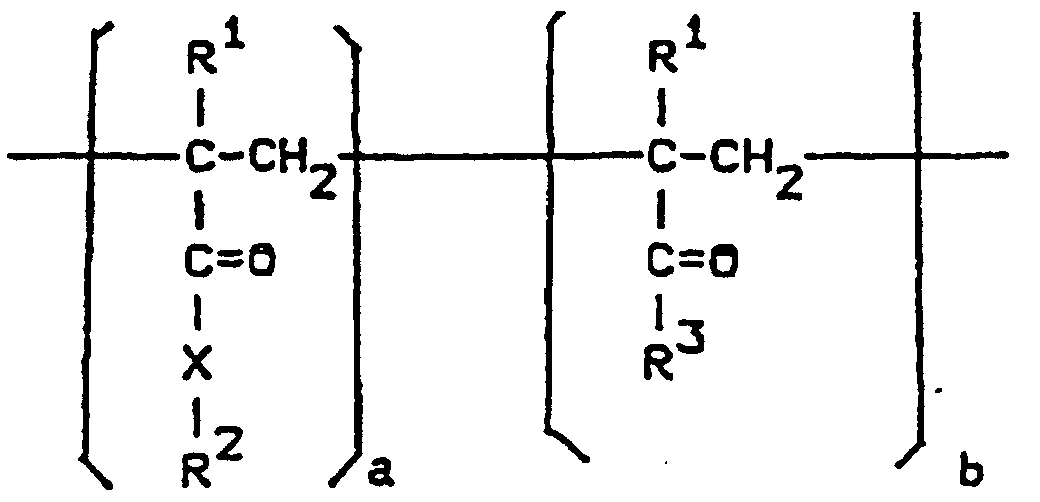
[0027] Alternatively, the polymeric drug is represented by the general formula:
wherein R1 represents a hydrogen atom or methyl group; R2 represents a residue after bonding by ester linkage or amide linkage in the compound having a physiological activity, and containing a functional group capable of ester linkage or amide linkage with a carboxyl group or amino group in its chemical structural formula; X represents a residue after bonding by ester linkage or amide linkage with a carboxyl group contained in acrylic acid or methacrylic acid and the functional group represented by R2 contained in the physiological active compound in the compound having a hydroxyl group, amino group or carboxyl group at both the ends in its chemical structural formula; R3 represents a hydroxyl group, methoxyl group or amino group; a represents an integer ranging from 20 to 1,500; and b represents an integer ranging from 1 to 100, respectively.
[0028] The polymeric drug of the present invention has a polydispersibility of 1.1 or less, and has the great advantage in that the molecular-weight distribution is very narrow.
[0029] It is known that the mechanism of polymer in vivo is so dependent upon its molecular weight and it means a possibility of precise control of the polymeric drug in vivo that the polydispersibility of the polymeric drug obtained by the present invention is low and molecular-weight distribution is narrow.
[0030] Further, the polymerization reaction proceeds approximately 100%, according to the mechanochemical reaction of the present invention, and hence, the present invention has the advantage of requiring no after-treatments such as purification, etc. due to no use of solvents.
[0031] In order to obtain the polymeric drug of the present invention, it is firstly required to obtain a monomer of acrylic acid or methacrylic acid derivatives by reacting a low molecular physiological active substance with acrylic acid or methacrylic acid. The above-mentioned monomer may be obtained in the manner as stated below, in case of using p-acetaminophenone, for example. That is, p-acetaminophenone is dissolved in an acetonitirile anhydride, and methacryloyl chloride is added drop by drop to the solution. The resulting reaction solution is stirred for 30 minutes at a room temperature, followed by the removal of a reaction solvent by distillation. The residue is dissolved in chloroform, and dried, followed by the recrystallization from benzene to obtain p-methacryloyloxyacetanilide.
[0032] The monomer thus obtained is put into a grinding mill made of stainless steel and ground for 45 minutes under atmosphere of nitrogen to obtain the polymeric drug.
[0033] The present invention is explained more in detail by referring to the following Examples given by way of illustration, but not by way of limitation.
[EXAMPLES]
Example 1
[0034] To dried acetonitrile (60 ml) were added p-acetaminophenone (1 g ; 6 mmols), followed by slowly adding by dropwise methacryloyl chloride (0.73 g ; 7.2 mmols). After the resultant reaction solution was stirred for 30 minutes at a room temperature, the reaction solvent was removed by distillation. The residue was dissolved in chloroform (30 ml), washed twice with water (10 ml) and dried, followed by the removal of chloroform by distillation, and then subjected to recrystallization from benzene.
[0036] The following are the data on crystalline form, melting point, elemental analysis, IR, 1H-NMR and UU-spectrum:
Colorless needle
[0037] Melting point: 120 - 121 °C
| Elemental analysis: C12H13NO3 (219.24) | |||
| C | H | N | |
| Calculated | 65.74 | 5.98 | 6.39 |
| Found | 65.53 | 5.98 | 6.14 |
1H-NMR(270MHz, DMSO-d6) : δ : 2.00(S, 6H, -CH3), 5.8-6.3 (d, 2H, >=CH2), 7.0-7.7 (q, 4H, benzene ring), 10.0(S, 1H, >NH)
UV(ethanol) : λmax ; 273nm(ε =8000), MS:m/e 219(M+)
[0038] The resulting monomer (100 mg) was put under atmosphere of nitrogen into the grinder provided with a stainless steel mill, and ground for 45 minutes to obtain a polymer.
[0039] When the polymer obtained was analyzed by means of 1H-NMR spectrum, the protons contained in olefin constituting the monomer were completely disappeared and peaks of strength (broad) corresponding to alkyl site were observed. It may be, therefore, conceived that the polymerization reaction was performed in 100%. A number-average molecular weight was 29,700 and polydispersibility of the polymer obtained was 1.10, respectively.
IR(KBr) : 1740, 1665cm-1 (>C=O)
1H-NMR(270MHz, DMSO-d6) : δ : 1.40(br, 3H) 2.01 (s, 5H), 7.00 (br, 2H), 7.53 (br, 2H), 9.89 (br, 1H) IR and NMR data corresponded with those of polymeric compound obtained by solution polymerization using radical initiator.
Example 2
[0040] To dried dimethylformamide (DMF) (20 ml) were added potassium salt (0.58g; 2.1 mmol) of theophylline acetate so as to suspend the latter, followed by slowly adding by dropwise 1-chloro-2-methacryloyloxyethylene (0.4 g; 2.7 mmols) and heated at 100°C for 5 hours. After the completion of the reaction, the solvent was removed by distillation. The residue was dissolved in chloroform (100 ml), followed by washing twice with water (20 ml). After removing the solvent by distillation, the recyrstallization from benzene was carried out.
[0042] The following are the data on crystalline form, melting point, elemental analysis, IR, 1NMR and UU spectrum.
Colorless plate crystal
[0043] Melting point: 125 - 126 °C
| Elemental analysis: C15H18N4O6 (350.33) | |||
| C | H | N | |
| Calculated | 51.43 | 5.18 | 15.99 |
| Found | 51.48 | 5.24 | 15.87 |
1H-NMR(270MHz, CDCl3) :δ ; 1.9 (S, 3H, CH3; vinyl group), 3.3-3.6 (d, 6H, CH3 : theophylline), 4.3-5.1 (m, 6H, -CH2-), 5.5-6.0 (d, 2H, >C=CH2), 7.5 (s, 1H, 8-H : theopylline)
UV(ethanol) :λ max ; 244nm(ε =13500), MS:m/e 350(M+)
[0044] The resulting monomer (100 mg) were put into the grinder provided with a stainless steel mill under atmosphere of nitrogen and ground for 45 minutes to obtain a polymer.
[0045] When the polymer obtained was analyzed by means of 1H-NMR spectrum, the protons contained in olefin constituting the monomer were completely disappeared and peaks of strength (broad) corresponding to alkyl site were observed. It may be therefore conceived that the polymerization reaction was performed in 100%.
IR(KBr) : 1700, 1655cm-1 (>C=O)
1H-NMR(270MHz, CdCl3) : δ : 0.86-1.03(br, 3H), 1.90 (br, 2H),3.30 (s, 3H), 4.19 (br, 2H), 4.40 (br, 2H) 5.17 (br, 2H), 7.70 (s, 3H),
IR and 1H-NMR spectra corresponded with those of polymeric compound obtained by solution polymerization using radical initiator.
Example 3
[0046] 1-Methacryloyloxymethyl-5-fluorouracil was synthesized according to the process described in the Publication (SHOICHIRO OZAKI et al., Japanese Patent Application Laid-open No.61467/1989). The monomer (100 g) thus obtained were ground under atmosphere of nitrogen for 45 minutes by using a grinder provided with a stainless steel mill to obtain a polymer. When the polymer obtained was analyzed by means of 1H-NMR spectrum, the protons contained in olefin constituting the monomer were completely disappeared and peaks of strength (broad) corresponding to alkyl site were observed, It may be therefore conceived that the polymerization reaction was performed in 100%.
IR(KBr) : 3450, 1700cm-1, 1H-NMR(DMSO-d6) :
δ: 0.80-1.05(br, 3H), 1.90 (br, 2H), 5.58 (br, 2H), 8.11 (br, 1H), 12.00 (br, 1H)
[0047] IR and 1H-NMR spectra corresponded with those of polymer obtained by solution polymerization using radical initiator.
Example 4
[0048] 25 Mg of acrylamide and 77 mg of p-methacryloydoxyacetanilide were ground under atmosphere of nitrogen for 45 minutes by using a grinder provided with a stainless steel mill. To the sample thus ground were added 20 ml of water and left to stand at a room temperature for one hour. The whole was centrifuged twice times at 3000 rpm for 45 minutes. The resultant precipitate was dired under reduced pressure at 60 °C. Then, 20 ml of a mixed solution of water and dimethylformamide in the ratio of the 1 to 1 were added. The whole was left to stand at a room temperature for one hour, followed by centrifuging twice times at 3000 rpm for 15 minutes. The resultant supernatant liquid was removed by distillation. The precipitate was dried under a reduced pressure at 60 °C. The yield of a random copolymer of p-methacryloyloxyacetanilide and acrylamide was 88.4 mg.
Example 5
[0049] 50 Mg of polyacrylamide and 50 mg of 1-methacryloyl-5-fluorouracil were ground under atmosphere of nitrogen for 45 minutes by using a grinder provided with a stainless steel mill. To the sample thus ground were added 20 ml of acetone and left to stand at a room temperature for 30 minutes. The whole was then contrifuged twice at 3000 rpm for 15 minutes. The resultant supernatant liquid was removed. To the reminder was added 20 ml of acetone again and the whole was treated in the same manner. The residue was dried under reduced pressure. Then, 20 ml of water were added. The whole was left to stand at a room temperature for one hour, following by centirifuing twice at 3000 rpm for 15 minutes. After removal of the supernatant liquid by distillation, the resultant precipitate was dried under reduced pressure at 60 °C. The yield of a block copolymer of 1-methacryloyl-5-fluorouracil and polyacrylamide was 18.8 mg.
[0050] 1-Methacryloyl-5-fluorouracil was synthesized according to the process described in the publication (Mitsuru AKASHI et al., J. Bioact. Compat. Polym. 1987 2. pp. 120 - 130).
[Effects of the Invention]
[0051] The following experiments are given, in order to confirm that the polymeric drug of this invention is a prodrug releasing a physiological active substance.
Experiment 1
[0052] Into an egg apple shaped flask of 30 ml were added 5 mg of the polymer obtained by Example 1 or 2, followed by adding 2 ml of DMF to dissolve the former. The whole was then dried under reduced pressure using rotary evaporator on a water bath heated at 80 °C to form a thin layer on the inner wall of the flask. 20 Ml of hydrolytic solution having the composition specified below were added into the flask and sampling was carried out at 37±0.2 °C with lapse of time to determine the quantity of the drug released.
[0053] Composition of hydrolytic solution:
dioxane : pH 8 0.05 M phosphoric acid buffer solution = 1:1
[0054] The quantity of the drug released was determined by 245 nm UV absorption of Example 1 and by 274 nm UU absroption of Example 2, respectively. The results obtained are shown in Table 1.
Table 1
| Rate of hydrolysis (%) | ||
| Time | Example 1 | Example 2 |
| 0 | 0 | 0 |
| 1 | 60 | 28 |
| 3 | 62 | 40 |
| 5 | 63 | 52 |
| 20 | 77 | 70 |
| 30 | -- | 75 |
| 40 | 80 | -- |
| 120 | 83 | 95 |
[0055] As shown in Table 1, it is clear that the polymeric drug of this invention can release drug in a solution.
Experiment 2
[0056] 5 Mg of the polymer obtained by Example 2 were subjected to form a thin layer on the inner wall of the flask in the same manner as Experiment 1. And, the quantity of the drug released was determined similarly as Experiment 1 by using a hydrolytic solution having the composition specified below. The results obtained are shown in Table 2.
1. A homopolymer of acrylic acid or methacrylic acid derivatives having the following
structural formula:
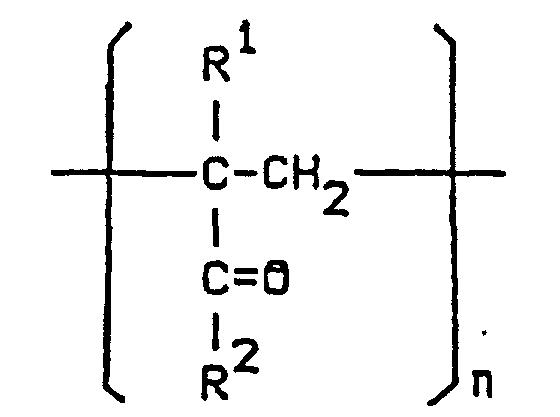
wherein R1 represents a hydrogen atom or a methyl group; R2 represents a residue bonded by an ester linkage or an amide linkage, having physiological activity and containing a functional group capable of forming an ester linkage or an amide linkage with a carboxyl group; and n represents an integer corresponding to a number-average molecular weight ranging from 20,000 to 200,000, characterized in that the polymer has a polydispersity of 1.1 or less.
wherein R1 represents a hydrogen atom or a methyl group; R2 represents a residue bonded by an ester linkage or an amide linkage, having physiological activity and containing a functional group capable of forming an ester linkage or an amide linkage with a carboxyl group; and n represents an integer corresponding to a number-average molecular weight ranging from 20,000 to 200,000, characterized in that the polymer has a polydispersity of 1.1 or less.
2. A homopolymer of acrylic acid or methacrylic acid derivatives having the following
structural formula:
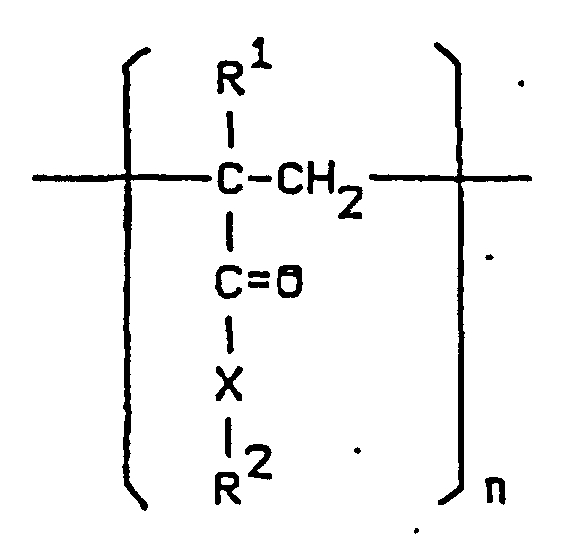
wherein R1 represents a hydrogen atom or a methyl group; R2 represents a residue bonded by an ester linkage or an amide linkage, having physiological activity and containing a functional group capable of forming an ester linkage or an amide linkage with a carboxyl group or amino group; X represents a residue bonded by an ester linkage or an amide linkage to the carboxyl group of acrylic acid or methacrylic acid and to the functional group contained in R2 and having a hydroxyl group, an amino group or a carboxyl group at both ends of its chemical structure; and n represents an integer corresponding to a number-average molecular weight ranging from 20,000 to 200,000, characterized in that the polymer has a polydispersity of 1.1 or less.
wherein R1 represents a hydrogen atom or a methyl group; R2 represents a residue bonded by an ester linkage or an amide linkage, having physiological activity and containing a functional group capable of forming an ester linkage or an amide linkage with a carboxyl group or amino group; X represents a residue bonded by an ester linkage or an amide linkage to the carboxyl group of acrylic acid or methacrylic acid and to the functional group contained in R2 and having a hydroxyl group, an amino group or a carboxyl group at both ends of its chemical structure; and n represents an integer corresponding to a number-average molecular weight ranging from 20,000 to 200,000, characterized in that the polymer has a polydispersity of 1.1 or less.
3. A random copolymer or block copolymer of acrylic acid or methacrylic acid derivatives,
having the following structural formula:
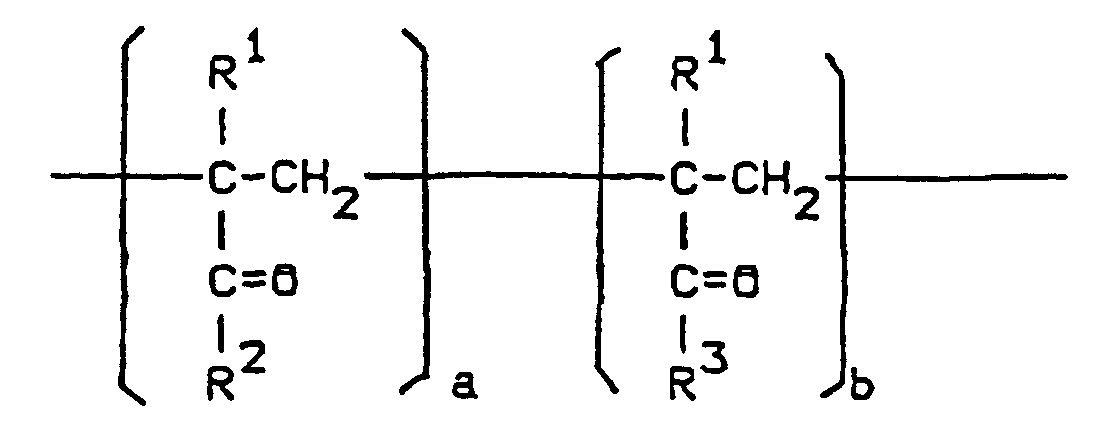
wherein R1 represents a hydrogen atom or a methyl group; R2 represents a residue bonded by an ester linkage or an amide linkage, having physiological activity and containing a functional group capable of forming an ester linkage or an amide linkage with a carboxyl group or amino group; R3 represents a hydroxyl group, an alkoxyl group or an amino group; a is an integer ranging from 20 to 1,500; and b is an integer ranging from 1 to 100, characterized in that the polymer has a polydispersity of 1.1 or less.
wherein R1 represents a hydrogen atom or a methyl group; R2 represents a residue bonded by an ester linkage or an amide linkage, having physiological activity and containing a functional group capable of forming an ester linkage or an amide linkage with a carboxyl group or amino group; R3 represents a hydroxyl group, an alkoxyl group or an amino group; a is an integer ranging from 20 to 1,500; and b is an integer ranging from 1 to 100, characterized in that the polymer has a polydispersity of 1.1 or less.
4. A random copolymer or block copolymer of acrylic acid or methacrylic acid derivatives,
having the following structural formula:
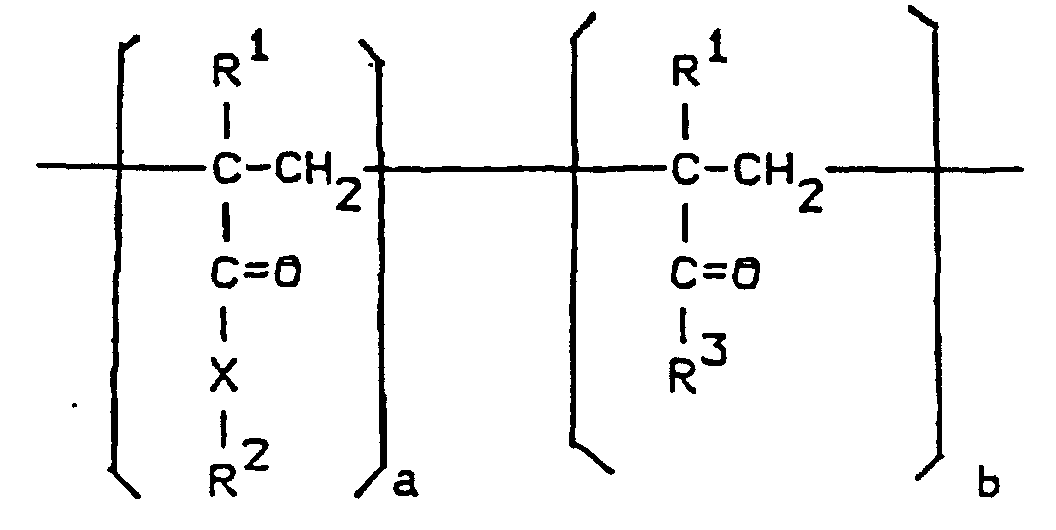
wherein R1 represents a hydrogen atom or a methyl group; R2 represents a residue bonded by an ester linkage or an amide linkage, having physiological activity and containing a functional group capable of forming an ester linkage or an amide linkage with a carboxyl group or amino group; X represents a residue bonded by an ester linkage or an amide linkage to the carboxyl group of acrylic acid or methacrylic acid and to the functional group contained in R2 and having a hydroxyl group, an amino group or a carboxyl group at both ends of its chemical structure; R3 represents a hydroxyl group, an alkoxyl group or an amino group; a is an integer ranging from 20 to 1,500; and b is an integer ranging from 1 to 100, characterized in that the polymer has a polydispersity of 1.1 or less.
wherein R1 represents a hydrogen atom or a methyl group; R2 represents a residue bonded by an ester linkage or an amide linkage, having physiological activity and containing a functional group capable of forming an ester linkage or an amide linkage with a carboxyl group or amino group; X represents a residue bonded by an ester linkage or an amide linkage to the carboxyl group of acrylic acid or methacrylic acid and to the functional group contained in R2 and having a hydroxyl group, an amino group or a carboxyl group at both ends of its chemical structure; R3 represents a hydroxyl group, an alkoxyl group or an amino group; a is an integer ranging from 20 to 1,500; and b is an integer ranging from 1 to 100, characterized in that the polymer has a polydispersity of 1.1 or less.
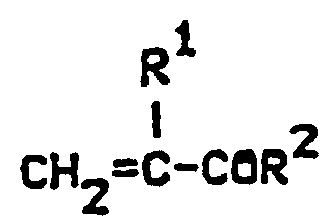
5. A process for the preparation of a homopolymer according to claim 1, comprising the
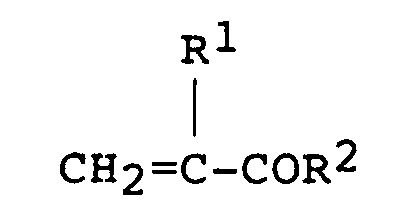
step of mechanochemically polymerizing a compound having the general formula:
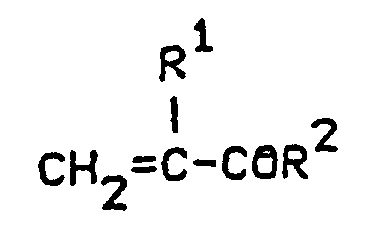
wherein R1 and R2 have the same meanings as defined in claim 1, whereby mechanical energy is added by grinding, rubbing, high-speed vibration or compression under reduced pressure or an atmosphere of nitrogen in a metal container.
wherein R1 and R2 have the same meanings as defined in claim 1, whereby mechanical energy is added by grinding, rubbing, high-speed vibration or compression under reduced pressure or an atmosphere of nitrogen in a metal container.
6. A process for the preparation of a homopolymer according to claim 2, comprising the
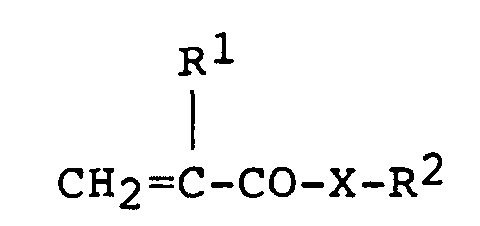
step of mechanochemically polymerizing a compound having the general formula:
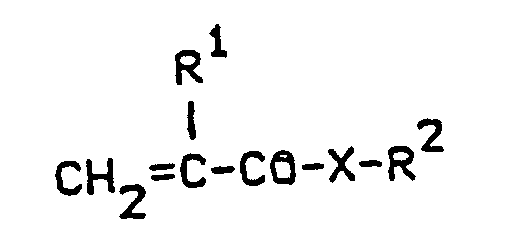
wherein R1, R2 and X have the same meanings as defined in claim 2, whereby mechanical energy is added by grinding, rubbing, high-speed vibration or compression under reduced pressure or an atmosphere of nitrogen in a metal container.
wherein R1, R2 and X have the same meanings as defined in claim 2, whereby mechanical energy is added by grinding, rubbing, high-speed vibration or compression under reduced pressure or an atmosphere of nitrogen in a metal container.
7. A polymeric drug comprising a polymer of acrylic acid or methacrylic acid derivatives
according to claims 1 to 4.
8. A prodrug comprising a polymer of acrylic acid or methacrylic acid derivatives according
to claims 1 to 4.
1. Homopolymer aus Acrylsäure- oder Methacrylsäure-Derivaten, das die folgende Strukturformel
hat:

worin R1 ein Wasserstoffatom oder eine Methyl-Gruppe darstellt; R2 einen durch eine Ester-Bindung oder eine Amid-Bindung gebundenen Rest darstellt, der physiologische Aktivität hat und eine funktionelle Gruppe enthält, die fähig ist, mit einer Carboxyl-Gruppe eine Ester-Bindung oder eine Amid-Bindung zu bilden; und n eine ganze Zahl darstellt, die einem Zahlenmittel des Molekulargewichts im Bereich von 20 000 bis 200 000 entspricht,
dadurch gekennzeichnet, daß
das Polymer eine Polydispersität von 1,1 oder weniger hat.
worin R1 ein Wasserstoffatom oder eine Methyl-Gruppe darstellt; R2 einen durch eine Ester-Bindung oder eine Amid-Bindung gebundenen Rest darstellt, der physiologische Aktivität hat und eine funktionelle Gruppe enthält, die fähig ist, mit einer Carboxyl-Gruppe eine Ester-Bindung oder eine Amid-Bindung zu bilden; und n eine ganze Zahl darstellt, die einem Zahlenmittel des Molekulargewichts im Bereich von 20 000 bis 200 000 entspricht,
dadurch gekennzeichnet, daß
das Polymer eine Polydispersität von 1,1 oder weniger hat.
2. Homopolymer aus Acrylsäure- oder Methacrylsäure-Derivaten, das die folgende Strukturformel
hat:
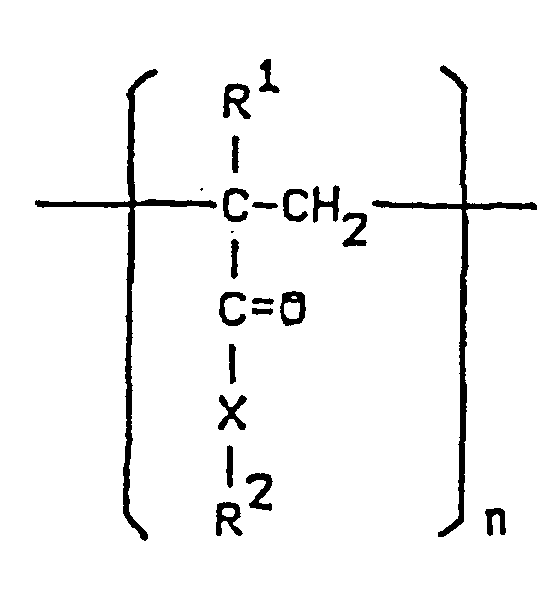
worin R1 ein Wasserstoffatom oder eine Methyl-Gruppe darstellt; R2 einen durch eine Ester-Bindung oder eine Amid-Bindung gebundenen Rest darstellt, der physiologische Aktivität hat und eine funktionelle Gruppe enthält, die fähig ist, mit einer Carboxyl-Gruppe oder Amino-Gruppe eine Ester-Bindung oder eine Amid-Bindung zu bilden; X einen Rest darstellt, der durch eine Ester-Bindung oder eine Amid-Bindung an die Carboxyl-Gruppe von Acrylsäure oder Methacrylsäure und an die in R2 enthaltene funktionelle Gruppe gebunden ist, und der eine Hydroxyl-Gruppe, eine Amino-Gruppe oder eine Carboxyl-Gruppe an beiden Enden seiner chemischen Struktur hat; und n eine ganze Zahl darstellt, die einem Zahlenmittel des Molekulargewichts im Bereich von 20 000 bis 200 000 entspricht,
dadurch gekennzeichnet, daß
das Polymer eine Polydispersität von 1,1 oder weniger hat.
worin R1 ein Wasserstoffatom oder eine Methyl-Gruppe darstellt; R2 einen durch eine Ester-Bindung oder eine Amid-Bindung gebundenen Rest darstellt, der physiologische Aktivität hat und eine funktionelle Gruppe enthält, die fähig ist, mit einer Carboxyl-Gruppe oder Amino-Gruppe eine Ester-Bindung oder eine Amid-Bindung zu bilden; X einen Rest darstellt, der durch eine Ester-Bindung oder eine Amid-Bindung an die Carboxyl-Gruppe von Acrylsäure oder Methacrylsäure und an die in R2 enthaltene funktionelle Gruppe gebunden ist, und der eine Hydroxyl-Gruppe, eine Amino-Gruppe oder eine Carboxyl-Gruppe an beiden Enden seiner chemischen Struktur hat; und n eine ganze Zahl darstellt, die einem Zahlenmittel des Molekulargewichts im Bereich von 20 000 bis 200 000 entspricht,
dadurch gekennzeichnet, daß
das Polymer eine Polydispersität von 1,1 oder weniger hat.
3. Statistisches Copolymer oder Blockcopolymer aus Acrylsäure- oder Methacrylsäure-Derivaten,
das die folgende Strukturformel hat:
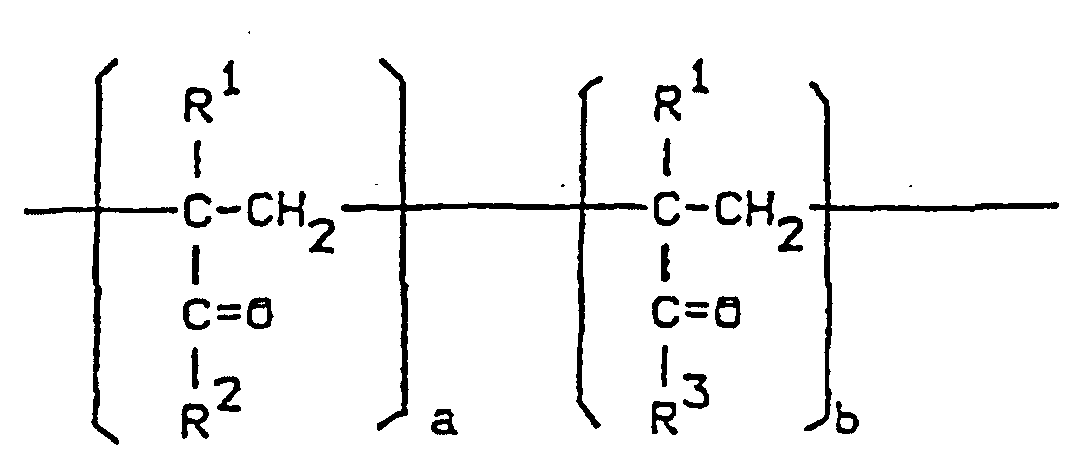
worin R1 ein Wasserstoffatom oder eine Methyl-Gruppe darstellt; R2 einen durch eine Ester-Bindung oder eine Amid-Bindung gebundenen Rest darstellt, der physiologische Aktivität hat und eine funktionelle Gruppe enthält, die fähig ist, mit einer Carboxyl-Gruppe oder Amino-Gruppe eine Ester-Bindung oder eine Amid-Bindung zu bilden; R3 eine Hydroxyl-Gruppe, eine Alkoxy-Gruppe oder eine Amino-Gruppe darstellt; a eine ganze Zahl im Bereich von 20 bis 1 500 ist; und b eine ganze Zahl im Bereich von 1 bis 100 ist,
dadurch gekennzeichnet, daß
das Polymer eine Polydispersität von 1,1 oder weniger hat.
worin R1 ein Wasserstoffatom oder eine Methyl-Gruppe darstellt; R2 einen durch eine Ester-Bindung oder eine Amid-Bindung gebundenen Rest darstellt, der physiologische Aktivität hat und eine funktionelle Gruppe enthält, die fähig ist, mit einer Carboxyl-Gruppe oder Amino-Gruppe eine Ester-Bindung oder eine Amid-Bindung zu bilden; R3 eine Hydroxyl-Gruppe, eine Alkoxy-Gruppe oder eine Amino-Gruppe darstellt; a eine ganze Zahl im Bereich von 20 bis 1 500 ist; und b eine ganze Zahl im Bereich von 1 bis 100 ist,
dadurch gekennzeichnet, daß
das Polymer eine Polydispersität von 1,1 oder weniger hat.
4. Statistisches Copolymer oder Blockcopolymer aus Acrylsäure- oder Methacrylsäure-Derivaten,
das die folgende Strukturformel hat:
worin R1 ein Wasserstoffatom oder eine Methyl-Gruppe darstellt; R2 einen durch eine Ester-Bindung oder eine Amid-Bindung gebundenen Rest darstellt, der physiologische Aktivität hat und eine funktionelle Gruppe enthält, die fähig ist, mit einer Carboxyl-Gruppe oder Amino-Gruppe eine Ester-Bindung oder eine Amid-Bindung zu bilden; X einen Rest darstellt, der durch eine Ester-Bindung oder eine Amid-Bindung an die Carboxyl-Gruppe von Acrylsäure oder Methacrylsäure und an die in R2 enthaltene funktionelle Gruppe gebunden ist und der eine Hydroxyl-Gruppe, eine Amino-Gruppe oder Carboxyl-Gruppe an beiden Enden seiner chemischen Struktur hat; R3 eine Hydroxyl-Gruppe, eine Alkoxy-Gruppe oder eine Amino-Gruppe darstellt; a eine ganze Zahl im Bereich von 20 bis 1 500 ist; und b eine ganze Zahl im Bereich von 1 bis 100 ist,
dadurch gekennzeichnet, daß
das Polymer eine Polydispersität von 1,1 oder weniger hat.
worin R1 ein Wasserstoffatom oder eine Methyl-Gruppe darstellt; R2 einen durch eine Ester-Bindung oder eine Amid-Bindung gebundenen Rest darstellt, der physiologische Aktivität hat und eine funktionelle Gruppe enthält, die fähig ist, mit einer Carboxyl-Gruppe oder Amino-Gruppe eine Ester-Bindung oder eine Amid-Bindung zu bilden; X einen Rest darstellt, der durch eine Ester-Bindung oder eine Amid-Bindung an die Carboxyl-Gruppe von Acrylsäure oder Methacrylsäure und an die in R2 enthaltene funktionelle Gruppe gebunden ist und der eine Hydroxyl-Gruppe, eine Amino-Gruppe oder Carboxyl-Gruppe an beiden Enden seiner chemischen Struktur hat; R3 eine Hydroxyl-Gruppe, eine Alkoxy-Gruppe oder eine Amino-Gruppe darstellt; a eine ganze Zahl im Bereich von 20 bis 1 500 ist; und b eine ganze Zahl im Bereich von 1 bis 100 ist,
dadurch gekennzeichnet, daß
das Polymer eine Polydispersität von 1,1 oder weniger hat.
5. Verfahren zur Herstellung eines Homopolymeren nach Anspruch 1, umfassend den Schritt
eines mechanochemischen Polymerisierens einer Verbindung mit der allgemeinen Formel:
worin R1 und R2 dieselben Bedeutungen, wie sie in Anspruch 1 definiert sind, haben, unter Zuführung mechanischer Energie durch Vermahlen, Reiben, Hochgeschwindigkeitsvibration oder -kompression unter reduziertem Druck oder Stickstoffatmosphäre in einem Metallbehälter.
worin R1 und R2 dieselben Bedeutungen, wie sie in Anspruch 1 definiert sind, haben, unter Zuführung mechanischer Energie durch Vermahlen, Reiben, Hochgeschwindigkeitsvibration oder -kompression unter reduziertem Druck oder Stickstoffatmosphäre in einem Metallbehälter.
6. Verfahren zur Herstellung eines Homopolymeren nach Anspruch 2, umfassend den Schritt
eines mechanochemischen Polymerisierens einer Verbindung mit der allgemeinen Formel:
worin R1, R2 und X dieselben Bedeutungen haben, wie sie in Anspruch 2 definiert sind, unter Zuführung mechanischer Energie durch Vermahlen, Reiben, Hochgeschwindigkeitsvibration oder -kompression unter reduziertem Druck oder Stickstoffatmosphäre in einem Metallbehälter.
worin R1, R2 und X dieselben Bedeutungen haben, wie sie in Anspruch 2 definiert sind, unter Zuführung mechanischer Energie durch Vermahlen, Reiben, Hochgeschwindigkeitsvibration oder -kompression unter reduziertem Druck oder Stickstoffatmosphäre in einem Metallbehälter.
7. Polymeres Arzneimittel, das ein Polymer aus Acrylsäure- oder Methacrylsäure-Derivaten
nach den Ansprüchen 1 bis 4 umfaßt.
8. Prodrug, das ein Polymer aus Acrylsäure- oder Methacrylsäure-Derivaten nach den Ansprüchen
1 bis 4 umfaßt.
1. Homopolymère de dérivés d'acide acrylique ou d'acide méthacrylique présentant la formule
développée suivante :
dans laquelle R1 représente un atome d'hydrogène ou un groupement méthyle, R2 représente un reste lié par une liaison ester ou une liaison amide, présentant une activité physiologique et contenant un groupement fonctionnel capable de former une liaison ester ou une liaison amide avec un groupement carboxyle, et n représente un nombre entier correspondant à une masse moléculaire moyenne en nombre allant de 20 000 à 200 000, caractérisé en ce que le polymère présente une polymolécularité de 1,1 ou moins.
dans laquelle R1 représente un atome d'hydrogène ou un groupement méthyle, R2 représente un reste lié par une liaison ester ou une liaison amide, présentant une activité physiologique et contenant un groupement fonctionnel capable de former une liaison ester ou une liaison amide avec un groupement carboxyle, et n représente un nombre entier correspondant à une masse moléculaire moyenne en nombre allant de 20 000 à 200 000, caractérisé en ce que le polymère présente une polymolécularité de 1,1 ou moins.
2. Homopolymère de dérivés d'acide acrylique ou d'acide méthacrylique présentant la formule
développée suivante :
dans laquelle R1 représente un atome d'hydrogène ou un groupement méthyle, R2 représente un reste lié par une liaison ester ou une liaison amide, présentant une activité physiologique et contenant un groupement fonctionnel capable de former une liaison ester ou une liaison amide avec un groupement carboxyle ou un groupement amino, X représente un reste lié par une liaison ester ou une liaison amide au groupement carboxyle de l'acide acrylique ou de l'acide méthacrylique et au groupement fonctionnel contenu dans R2 et comportant un groupement hydroxyle, un groupement amino ou un groupement carboxyle aux deux extrémités de sa structure chimique, et n représente un nombre entier correspondant à une masse moléculaire moyenne en nombre allant de 20 000 à 200 000, caractérisé en ce que le polymère présente une polymolécularité de 1,1 ou moins.
dans laquelle R1 représente un atome d'hydrogène ou un groupement méthyle, R2 représente un reste lié par une liaison ester ou une liaison amide, présentant une activité physiologique et contenant un groupement fonctionnel capable de former une liaison ester ou une liaison amide avec un groupement carboxyle ou un groupement amino, X représente un reste lié par une liaison ester ou une liaison amide au groupement carboxyle de l'acide acrylique ou de l'acide méthacrylique et au groupement fonctionnel contenu dans R2 et comportant un groupement hydroxyle, un groupement amino ou un groupement carboxyle aux deux extrémités de sa structure chimique, et n représente un nombre entier correspondant à une masse moléculaire moyenne en nombre allant de 20 000 à 200 000, caractérisé en ce que le polymère présente une polymolécularité de 1,1 ou moins.
3. Copolymère statistique ou copolymère séquencé de dérivés d'acide acrylique ou d'acide
méthacrylique, présentant la formule développée suivante :
dans laquelle R1 représente un atome d'hydrogène ou un groupement méthyle, R2 représente un reste lié par une liaison ester ou une liaison amide, présentant une activité physiologique et contenant un groupement fonctionnel capable de former une liaison ester ou une liaison amide avec un groupement carboxyle ou un groupement amino, R3 représente un groupement hydroxyle, un groupement alcoxyle ou un groupement amino, a est un nombre entier allant de 20 à 1 500, et b est un nombre entier allant de 1 à 100, caractérisé en ce que le polymère présente une polymolécularité de 1,1 ou moins.
dans laquelle R1 représente un atome d'hydrogène ou un groupement méthyle, R2 représente un reste lié par une liaison ester ou une liaison amide, présentant une activité physiologique et contenant un groupement fonctionnel capable de former une liaison ester ou une liaison amide avec un groupement carboxyle ou un groupement amino, R3 représente un groupement hydroxyle, un groupement alcoxyle ou un groupement amino, a est un nombre entier allant de 20 à 1 500, et b est un nombre entier allant de 1 à 100, caractérisé en ce que le polymère présente une polymolécularité de 1,1 ou moins.
4. Copolymère statistique ou copolymère séquencé de dérivés de l'acide acrylique ou de
l'acide méthacrylique, présentant la formule développée suivante :
dans laquelle R1 représente un atome d'hydrogène ou un groupement méthyle, R2 représente un reste lié par une liaison ester ou une liaison amide, présentant une activité physiologique et contenant un groupement fonctionnel capable de former une liaison ester ou une liaison amide avec un groupement carboxyle ou un groupement amino, X représente un reste lié par une liaison ester ou une liaison amide au groupement carboxyle de l'acide acrylique ou de l'acide méthacrylique et au groupement fonctionnel contenu dans R2 et comportant un groupement hydroxyle, un groupement amino ou un groupement carboxyle aux deux extrémités de sa structure chimique, R3 représente un groupement hydroxyle, un groupement alcoxyle ou un groupement amino, a est un nombre entier allant de 20 à 1 500, et b est un nombre entier allant de 1 à 100, caractérisé en ce que le polymère présente une polymolécularité de 1,1 ou moins.
dans laquelle R1 représente un atome d'hydrogène ou un groupement méthyle, R2 représente un reste lié par une liaison ester ou une liaison amide, présentant une activité physiologique et contenant un groupement fonctionnel capable de former une liaison ester ou une liaison amide avec un groupement carboxyle ou un groupement amino, X représente un reste lié par une liaison ester ou une liaison amide au groupement carboxyle de l'acide acrylique ou de l'acide méthacrylique et au groupement fonctionnel contenu dans R2 et comportant un groupement hydroxyle, un groupement amino ou un groupement carboxyle aux deux extrémités de sa structure chimique, R3 représente un groupement hydroxyle, un groupement alcoxyle ou un groupement amino, a est un nombre entier allant de 20 à 1 500, et b est un nombre entier allant de 1 à 100, caractérisé en ce que le polymère présente une polymolécularité de 1,1 ou moins.
5. Procédé destiné à la préparation d'un homopolymère selon la revendication 1, comprenant
l'étape consistant à polymériser de façon mécanochimique un composé présentant la
formule générale :
dans laquelle R1 et R2 ont les mêmes significations que définies dans la revendication 1, dans lequel une énergie mécanique est ajoutée par broyage, frottement, vibration à grande vitesse ou compression sous pression réduite ou sous une atmosphère d'azote dans un récipient de métal.
dans laquelle R1 et R2 ont les mêmes significations que définies dans la revendication 1, dans lequel une énergie mécanique est ajoutée par broyage, frottement, vibration à grande vitesse ou compression sous pression réduite ou sous une atmosphère d'azote dans un récipient de métal.
6. Procédé destiné à la préparation d'un homopolymère selon la revendication 2, comprenant
l'étape consistant à polymériser de facon mécanochimique un composé présentant la
formule générale :
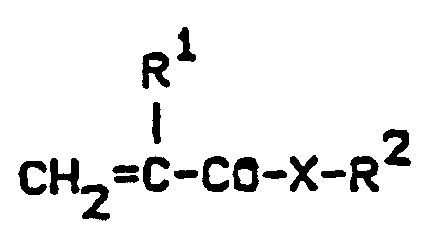
dans laquelle R1, R2 et X ont les mêmes significations que définies dans la revendication 2, dans lequel une énergie mécanique est ajoutée par broyage, frottement, vibration à grande vitesse ou compression sous pression réduite ou sous une atmosphère d'azote dans un récipient de métal.
dans laquelle R1, R2 et X ont les mêmes significations que définies dans la revendication 2, dans lequel une énergie mécanique est ajoutée par broyage, frottement, vibration à grande vitesse ou compression sous pression réduite ou sous une atmosphère d'azote dans un récipient de métal.
7. Médicament polymère comprenant un polymère de dérivés de l'acide acrylique ou de l'acide
méthacrylique selon les revendications 1 à 4.
8. Promédicament contenant un polymère de dérivés de l'acide acrylique ou de l'acide
méthacrylique selon les revendications 1 à 4.