|
(11) | EP 0 507 484 A1 |

| (12) | EUROPEAN PATENT APPLICATION |
|
|
|
|
|||||||||||||||||||||||||||
| (54) | A pharmaceutical formulation of aureobasidins |
| (57) There is provides a solid formulation of Aureobasidin suitable for clinical use.
The solid formation of Aureobasidin contains at least one Aureobasidin and a surface-active
agent. As the Aureobasidins, Aureobasidin A, its related compounds, or its derivatives
can be used. As the surface-active agent, a nonionic kind is preferable. Other usual
additives may be included. Oral administration of the formulation of this invention results in a concentration of the Aureobasidin in the blood high enough to give pharmaceutical effect such as antifungal activity. |
Field of industrial applications:
[0001] This invention relates to novel formulations of Aureobasidins that can be used as antifungal agents and the like.
State of the prior art:
[0002] Aureobasidins, antibiotics with antifungal activity produced by a strain of an Aureobasidium species, referred to as antibiotics R106, have been disclosed in U.S. Patent Appln. No. 07/379629, and their related compounds and derivatives have also been disclosed in U.S. Patent Appln. No. 07/379629, Japan Laid-Open Patent Application 3-44398, and U.S. Patent Appln. No. 07/643948.
[0003] The structure of Aureobasidins are represented by general formula [I];
wherein:
R is methyl or ethyl;
A1 is Phe, o-FPhe, m-FPhe, or Tyr;
A2 is MePhe, β-HOMePhe, Phe, o-FMePhe, m-FMePhe, MeTyr, Sar, MeSer, β-oxoMePhe, or β-R2 OMePhe (wherein R2 is a lower acyl group having 1 to 4 carbon atoms);
A3 is Pro, 4Hyp, or SPro;
A4 is allo-Ile, Val, Leu, or Nle;
A5 is MeVal or Val;
A6 is Leu or Nva;
A7 is β-HOMeVal, γ-HOMeVal, MeVal, N,β-MeAsp, β-HOMePhe, MePhe, MeDH2,3Val, MeDH3,4Val, or Sar.
[0004] The compound with the strongest antifungal activity of all of these compounds has been named Aureobasidin A, and it has the structure shown below in formula [II];
Abbreviations for amino acids used in the general formula described above are given below.
- Phe:
- phenylalanine
- o-FPhe:
- o-fluorophenylalanine
- m-FPhe:
- m-fluorophenylalanine
- MePhe:
- N-methylphenylalanine
- β-HOMePhe:
- β-hydroxy-N-methylphenylalanine
- β-R2OMePhe:
- β-acyloxy-N-methylphenylalanine
- β-oxoMePhe:
- β-oxo-N-methylphenylalanine
- o-FMePhe:
- o-fluoro-N-methylphenylalanine
- m-FMePhe:
- m-fluoro-N-methylphenylalanine
- Tyr:
- tyrosine
- MeTyr:
- N-methyltyrosine
- Val:
- valine
- MeVal:
- N-methylvaline
- Nva:
- norvaline
- β-HOMeVal:
- β-hydroxy-N-methylvaline
- γ-HOMeVal:
- γ-hydroxy-N-methylvaline
- MeDH2,3Val:
- N-methyl-2,3-didehydrovaline
- MeDH3,4Val:
- N-methyl-3,4-didehydrovaline
- allo-Ile:
- alloisoleucine
- Leu:
- leucine
- Nle:
- norleucine
- N,β-MeAsp:
- N,β-dimethylaspartic acid
- Pro:
- proline
- 4Hyp:
- 4-hydroxyproline
- SPro:
- thioproline
- Sar:
- sarcosine
- MeSer:
- N-methylserine
Problem to be solved by the invention:
[0005] Formulations in solid form are desired so that Aureobasidin A, its related compounds, and its derivatives (referred to hereafter as "Aureobasidins") can be used in clinical applications. The purpose of this invention is to provide formulations of Aureobasidins in solid form for use in clinical applications.
Steps taken to solve the problem:
[0006] Briefly, this invention relates to a pharmaceutical formulation of Aureobasidins in solid form which comprises a pharmacologically effective amount of Aureobasidin and a nontoxic surface-active agent.
[0007] As the Aureobasidins of this invention, the compounds shown in the detailed descriptions of U.S. Patent Appl. No. 07/379629, Japan Laid-Open Patent Application 3-44398, and U.S. Patent Appl. No. 07/643948, which include Aureobasidin A, are included. For clinical use, Aureobasidin A is preferred.
[0008] The surface-active agents that can be used in this invention include ionic surface-active agents (cationic, anionic, or amphoteric; examples are alkyl sulfonate and benzalkonium chloride) and nonionic surface-active agents (examples are polyoxyethylene-hydrogenated castor oil, polyoxyethylenesorbit fatty acid esters, polyoxyethylenesorbitan fatty acid esters, polyoxyethyleneglycerol fatty acid esters, polyoxyethyleneglycol fatty acid esters, and polyoxyethylenealkyl phenyl ethers). For the surface-active agents used in this invention, nonionic surface-active agents are preferable, and among these are included, for example, polyoxyethylene-hydrogenated castor oil, such as Nikkol HCO-40, HCO-50, HCO-60 (Nikko Chemicals Co., Ltd.), and Uniox HC-40, HC-50, and HC-60 (Nippon Oil & Fats Co., Ltd.).
[0009] Of polyoxyethylenesorbit fatty acid esters, there are, for example, Nikkol GO-430, GO-440, GO-460, GL-1, Atlox 1045A, 1196, G-1045, and G-1441 (Kao Atlas Co., Ltd.). As polyoxyethylenesorbitan fatty acid esters, there are, for example, Tween 20, Tween 40, Tween 60, Tween 80, Emasol 1130, Emasol 3130, Nikkol TL-1010, TP-10, and TS-10. As polyoxyethyleneglycerol fatty acid esters, there are, for example, Nikkol TMGS-15 and TMGS-5. As polyoxyethyleneglycol fatty acid esters, there are, for example, Nikkol MYL-110 and MYS-10. As polyoxyethylenealkyl phenyl ethers, there are, for example, Nikkol NP-10 and Emulgen 810.
[0010] Of nonionic surface-active agents, polyoxyethylene-hydrogenated castor oil is particularly suitable, because compared with, for example, the polyoxyethylenesorbitan fatty acid ester Tween 80, it is more readily used for solid formulation, restrictions on its daily use are less, and its safety is greater.
[0011] In this invention, it is sufficient for the solid formulation to include at least one Aureobasidin and a surface-active agent, but it is also possible that a coating agent, a viscosity agent, a filler, and the like to be included as a carrier, and additives that are approved for use in pharmaceutical agents, such as stabilizers, coloring agents, fragrance agents, etc., may be included.
[0012] As a coating agent, the following may be used:
hydroxypropylmethyl cellulose (for example, TC-5 from Shin-Etsu Chemical Co., Ltd.), polyvinylacetaldiethylamino acetate (AEA from Sankyo Co., Ltd.), hydroxypropyl cellulose (HPC-L from Nisso Co., Ltd.), aminoalkylmethacrylate copolymer E (Eudragit E100 from Röhm Pharma GmbH Weiterstadt), hydroxypropylmethyl cellulose phthalate (HPMCP from Shin-Etsu), hydroxypropylmethyl cellulose acetatesuccinate (AQOAT from Shin-Etsu), carboxymethylethyl celluose (CMEC OS and AQ from Freund Industrial Co., Ltd.), methacrylic acid copolymer L (Eudragit L100), methacrylic acid copolymer LD (Eudragit L30 D-55 ), and methacrylic acid copolymer S (Eudragit S100).
[0013] As a viscosity agent, there are, for example, glycerin, polyethylene glycol, polyglycerin, polyvinylpyrrolidone, polylactic acid, polyvinylalcohol, gelatin, hydroxypropyl starch, pullulan, carboxymethyl cellulose, sodium hyalurate, chitosan, and gum arabic.
[0014] As a shaping agent, there are, for example, D-mannitol, glucose, lactose, fructose, and other saccharides; dextran and other polysaccharides; a-cyclodextrin, β-cyclodextrin, γ-cyclodextrin, dextrinhydroxypropyl starch, and other dextrins;
[0015] citric acid, maleic acid, tartric acid, malic acid, and other acids; urea and other neutral substances, lecithin, soya lecithin, and other phospholipids, and capric acid, myristic acid, and other middle-chain fatty acids.
[0016] The form of the formulation of this invention can be that of tablets, granules, soft capsules, hard capsules, drops, or any other solid form.
[0017] The formulations of this invention can be manufactured by any ordinary method for the formulation forms listed immediately above. For example, at least one Aureobasidin and a surface-active agent can be dissolved in an organic solvent such as ethanol, methanol, acetone, dimethylformamide, or chloroform, and mixed with, for example, a coating agent, if desired, after which the solvent is removed and the agent can be made into solid form, or, for example, an Aureobasidin can be added to a heated surface-active agent, after which a viscosity agent can be added and mixed in, after which the mixture can be solidified by being cooled.
[0018] The solid material obtained can be pulverized to give a powder. The powder can be made into granules in the usual way. For example, the powder can be mixed with a small amount of a solvent such as water, ethanol, or acetone, and the mixture can be passed through a mesh with holes of a suitable size to make granules, after which the granules can be dried. The proportions of the Aureobasidin and the surface-active agent may be in the ratio by weight of 1:0.01 to 1:100, preferably 1:1 to 1:10.
[0019] The solid formulation of Aureobasidins of this invention is suitable for clinical use and gives high concentrations in blood and various organs when taken orally.
[0020] Next, this invention will be explained by examples, but this invention is not to be taken to be restricted to these examples alone.
Example 1.
[0021] First, 10 g of surface-active agent HCO-50 (Nikko Chemicals Co., Ltd.) was melted by being heated to 65°C, and to this, 10 g of Aureobasidin A and 100 g of polyethylene glycol 4000 were added. After the combination was thoroughly mixed, it was allowed to solidify at room temperature and granules were prepared.
Example 2.
[0022] First, 50 g of surface-active agent HCO-50 (Nikko Chemicals Co., Ltd.) was melted by being heated to 65°C, and to this, 10 g of Aureobasidin A and 60 g of polyethylene glycol 4000 were added. After the combination was thoroughly mixed, it was allowed to solidify at room temperature and granules were prepared.
Reference example 1.
[0023] First, 50 g of Aureobasidin A and 150 g of hydroxypropyl cellulose were dissolved in 95% (v/v) ethanol and the solvent was then removed under reduced pressure. The dry material obtained was pulverized to give a powder.
Test Example 1.
[0025] To two groups of male Wistar rats five weeks old (with four rats in each group), the granular formulations obtained in Examples 1 and 2 were given orally at the dose of 40 mg/kg. The granules administered were 2 mm in diameter and 3 mm long. To the control group, the powder obtained in Reference Example 1 was administered in the same way. Blood was collected 1, 3, 6, and 8 hours after the administration, and the concentration of Aureobasidin A in the serum was assayed by high-pressure liquid chromatography. Results are in Table 1.
*HPLC conditions:
[0026]
- Column:
- Capcell Pak C18 6φ x 150 mm (Shiseido)
- Mobile phase:
- 80% acetontrile/20% water, 1.0 ml/min
- Detection:
- UV absorption at 220 nm
[0027] As seen in Table 1, the formulations of this invention give higher concentrations of the agent in the serum than the formulation given to the control group.
[0028] As described above, by oral administration of the formulations of this invention, the concentrations of the agent in blood are high enough for pharmacological activity such as antifungal activity, so the formulations can be used in the treatment of fungal infections and the like.
1. A pharmaceutical composition in solid form comprising a pharmacologically effective
amount of Aureobasidin represented by the general formula [I];
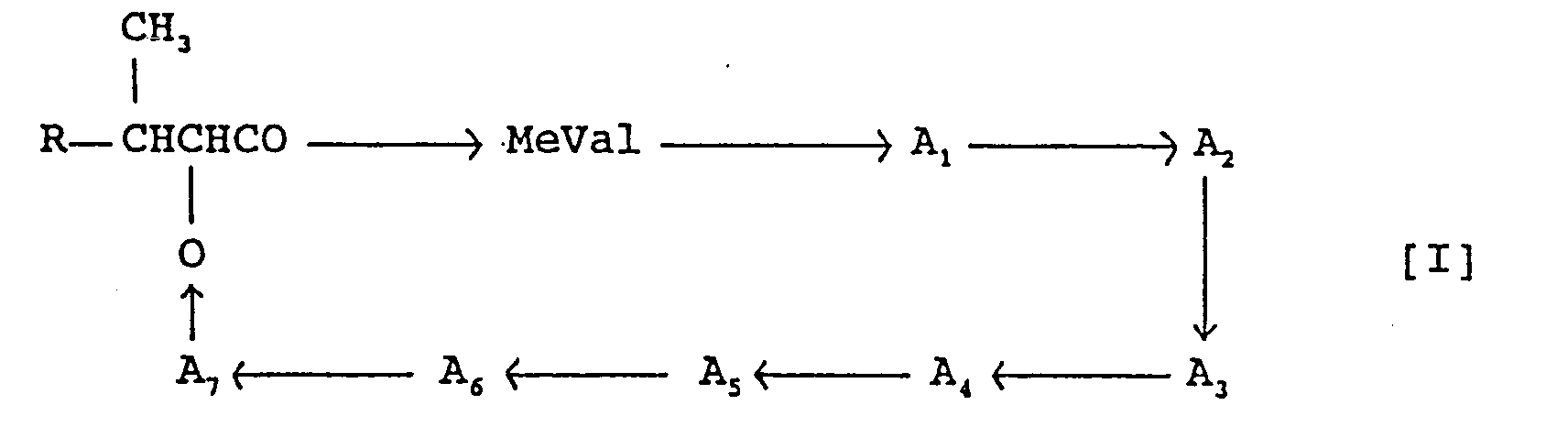
in which:
R is methyl or ethyl;
A1 is Phe, o-FPhe, m-FPhe, or Tyr;
A2 is MePhe, β-HOMePhe, Phe, o-FMePhe, m-FMePhe, MeTyr, Sar, MeSer, β-oxoMePhe, or β-R2OMePhe (wherein R2 is a lower acyl group having 1 to 4 carbon atoms);
A3 is Pro, 4Hyp, or SPro;
A4 is allo-Ile, Val, Leu, or Nle;
A5 is MeVal or Val;
A6 is Leu or Nva; and
A7 is β-HOMeVal, γ-HOMeVal, MeVal, N,β-MeAsp, β-HOMePhe, MePhe, MeDH2,3Val, MeDH3,4Val, or Sar,
and a nontoxic surface-active agent.
in which:
R is methyl or ethyl;
A1 is Phe, o-FPhe, m-FPhe, or Tyr;
A2 is MePhe, β-HOMePhe, Phe, o-FMePhe, m-FMePhe, MeTyr, Sar, MeSer, β-oxoMePhe, or β-R2OMePhe (wherein R2 is a lower acyl group having 1 to 4 carbon atoms);
A3 is Pro, 4Hyp, or SPro;
A4 is allo-Ile, Val, Leu, or Nle;
A5 is MeVal or Val;
A6 is Leu or Nva; and
A7 is β-HOMeVal, γ-HOMeVal, MeVal, N,β-MeAsp, β-HOMePhe, MePhe, MeDH2,3Val, MeDH3,4Val, or Sar,
and a nontoxic surface-active agent.
2. A pharmaceutical composition according to claim 1, in which the surface-active agent
is a nonionic agent.
3. A pharmaceutical composition according to claim 2, in which the nonionic agent is
polyoxyethylene-hydrogenated castor oil.