| (19) |
 |
|
(11) |
EP 0 508 959 B1 |
| (12) |
EUROPEAN PATENT SPECIFICATION |
| (45) |
Mention of the grant of the patent: |
|
01.05.1996 Bulletin 1996/18 |
| (22) |
Date of filing: 29.01.1992 |
|
|
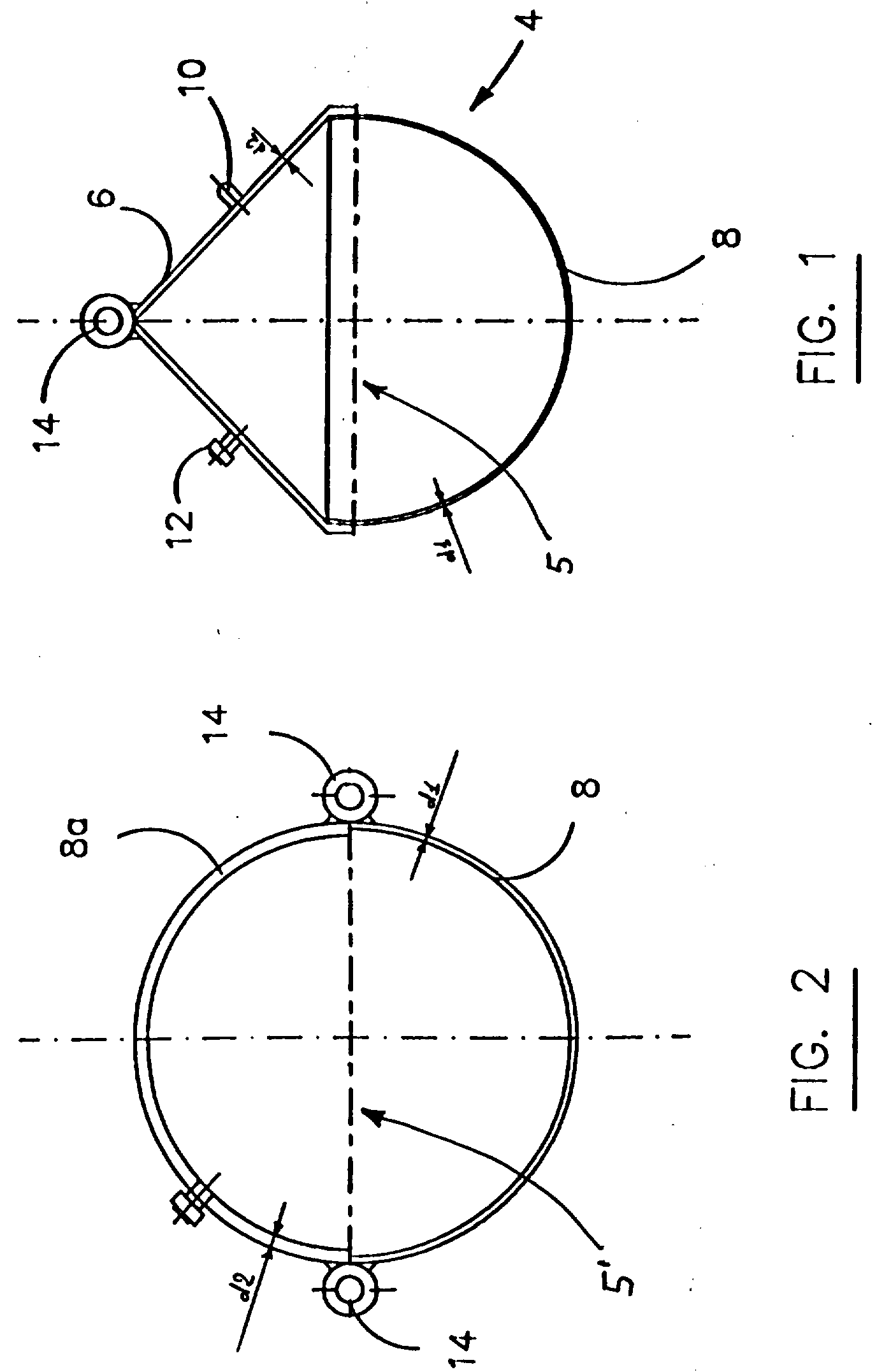
| (54) |
Method and apparatus for putting out fires fed by a pressurized medium having a high
degree of inflammability, in particular fires of oil wells
Verfahren und Vorrichtung zum Löschen von durch einen unter Druck stehenden, hochentflammbaren
Brennstoff genährten Bränden, insbesondere Bränden von Ölbohrungen
Méthode et dispositif pour l'extinction de feux alimentés par un combustible sous
pression ayant un degré d'inflammabilité élevé, notemment de feux de puits de pétrole
|
| (84) |
Designated Contracting States: |
|
AT BE CH DE DK ES FR GB GR LI LU NL PT SE |
| (30) |
Priority: |
09.04.1991 IT RM910239
|
| (43) |
Date of publication of application: |
|
14.10.1992 Bulletin 1992/42 |
| (73) |
Proprietor: Ente per le nuove tecnologie, l'energia e l'ambiente (ENEA) |
|
I-00198 Roma (IT) |
|
| (72) |
Inventors: |
|
- Candelieri, Tommaso
I-75025 Policoro (Matera) (IT)
- Gerardi, Antonio
I-75025 Policoro (Matera) (IT)
- Marino, Angelo
I-00137 Roma (IT)
- Nifosi, Olindo
I-75025 Policoro (Matera) (IT)
|
| (74) |
Representative: Sarpi, Maurizio |
|
Studio FERRARIO
Via Collina, 36
I-00187 Roma
I-00187 Roma (IT) |
| (56) |
References cited: :
EP-A- 0 302 797
WO-A-80/01987
GB-A- 2 159 707
US-A- 3 918 526
US-A- 4 830 114
|
EP-A- 0 390 384
DE-A- 4 000 010
US-A- 3 833 064
US-A- 4 337 831
|
|
| |
|
|
|
|
| |
|
| Note: Within nine months from the publication of the mention of the grant of the European
patent, any person may give notice to the European Patent Office of opposition to
the European patent
granted. Notice of opposition shall be filed in a written reasoned statement. It shall
not be deemed to
have been filed until the opposition fee has been paid. (Art. 99(1) European Patent
Convention).
|
[0001] The present invention relates to a method of and an apparatus for putting out fires
under pressure, in particular fires of oil wells and the like.
[0002] The main feature of such a system is that of using in combination the extinguishing
effect of suitable compositions and the pressure wave directed to the fire so as to
dispense instantaneously and homogeneously such compositions on the whole area on
fire causing fire to extinguish at once.
[0003] Techniques and devices for putting fires out are well known and tested. Generally,
difficulties and failures are due to the particular conditions of the fuel (shape
and size, pressure in case of a fluid, a.s.o.) rather than to the inefficiency of
the used compositions, which extinguishing features in the specific application field
are very good.
[0004] Putting out a burning oil well, where the favourable circumstance of the limited
extension of the burning area is made useless by the particular violence of the fire
fed by a pressure liquid with high degree of inflammability, is particularly complex.
[0005] Under such conditions putting out systems using extinguishing compositions do not
find any application because unlike "extended" fires, (where it is possible to put
out fire "progressively" by a continuous, progressive extinguishment of the flames),
in case of burning oil wells it is necessary to extinguish fire at once so that the
oil continuously fed from the well does not fire any longer.
[0006] Methods and means known at the present status of art for putting out burning oil
wells envisage the following three different categories of operations:
1) blowing up the well with dynamite to put out the fire by the explosion shock wave
and removing the latticework damaged by the fire;
2) boring the soil up to the oil body and providing a new well through which the oil
flow is turned so that the geologic pressure at the fire spot is dropped;
3) pumping baryta or similar solid material and water into a side pipeline reaching
the bottom of the oil well so that the well is chocked.
[0007] Such techniques, however, are expensive from the economical and operational point
of view.
[0008] Therefore, the present invention seeks to solve the problem of easily and economically
putting out fires under pressure avoiding the drawbacks involved by the present methods.
The object is attained by releasing at once a predetermined amount of an extinguishing
composition or mixture of compositions at a suitable pressure and in such a position
as to be effective against the fire.
[0009] It is known from WO -A-80/01987, a fire extinguisher comprising a container with
halogen hydro-carbons as extinguishing means and adapted to open by an inner overpressure,
in such a way that the gas generated by heating is released to fill the surrounding
room and soffocate the fire.
[0010] Unlike the known systems, the present method is based upon the combination of the
extinguishing effect of the used compositions and the homogeneous, effective, instant
distribution of said compositions over the whole front of the fire because of a shock
wave.
[0011] This has been achieved according to the invention through the combined use of a composition
or a mixture of liquefied compositions having extinguishing and/or inert capability
and a container of such compositions having two peculiar operation features:
a) if the container is suitably placed over the fire spot, it can collapse because
of the increase of the internal pressure due to the thermal gradient, thus releasing
simultaneously the contained compositions; and
b) the container is able to dispense at once the above mentioned compositions homogeneously
and effectively over the whole solid angle covered by the fire.
[0012] In practice, both the shape and size of the container may be varied and fitted to
the characteristics of the fire to be put out provided that the cone of diffusion
formed as a result of the collapse is able to cover the whole front of the fire.
[0013] Therefore this invention consists according to claim 1 of a method of putting out
fires fed by a pressurised medium having a high degree of inflammability, in particular
fires of oil wells, wherein a shock wave is used to dispense an extinguishing composition
at once and homogeneously over the whole front of the fire, the method including the
use of a container of an extinguishing composition or with a mixture of extinguishing
an/or inert compositions alone or in any combination with one another, said container
being adapted to collapse at a predetermined break line relative to the shape of the
container as a result of the increase of the internal pressure of the contained composition(s)
due to the thermal gradient created by the fire to be put out, thereby creating said
shock wave, whereby a preferential and effective distribution of said composition(s)
over the front of the fire to be put out is obtained thus causing concurrently the
fire to be put out.
[0014] The invention consists also of an apparatus according to claims 3 and 4 .
[0015] Further features and advantages of this invention will be made apparent from the
following detailed description with reference to the accompanying drawings illustrating,
by way of a non-limitative example, two preferred embodiments. In the drawings:
Fig. 1 shows schematically a section view of a container according to the invention
having the form of a cone with a hemispherical bowl;
Fig. 2 shows a section of an alternate container having a spherical form.
[0016] With reference to Figure 1, the empty container 4 is formed as a hemisphere 8 having
walls of thickness d1 and a conical body 6 of thickness d2 overlapped thereto and
provided at the top with a hook means 14.
[0017] The thicknesses d1 and d2 are designed as a function of the material of which the
container is made so that the container collapses under the effect of the increasing
pressure generated by the temperature gradient causing the expansion of the compositions
contained therein and it releases at once and at a predetermined pressure the extinguishing
mixture which is conveyed to the whole front of the fire.
[0018] The container may be formed of any material provided that it is uninflammable. By
way of example, containers of aluminum and alloys thereof, copper and bronze have
been used in the experimental tests.
[0019] The loading of the compositions to be used is carried out through common sealing
input means 10 and 12 which are usually provided under safety conditions.
[0020] All of the extinguishing compositions alone or in combination with one another and
with inerts may be used. The best results have been achieved by the use of compositions
having a very low boiling point, i.e. under liquefied form. Among the latter there
are the halogen derivatives of methane and ethane, in particular C₂F₅Cl, CHClF₂, CCl₂F₂,
CHF₃, used alone or in combination with one another, at varying relative proportions
and with or without liquid nitrogen which besides the extinguishing characteristic
has also a propellant effect causing a more effective diffusion of the used compositions.
[0021] Also the effectiveness of liquid nitrogen or other inert gas with high expansion
capacity alone or in combination with said compositions has been tested.
[0022] The putting out method according to the present invention is extremely easy and immediate:
after having partially filled the container with the composition or mixture of extinguishing
compositions, the sealed container is suitably placed over the fire by any known means.
As a result of the high thermal gradient the inner pressure of the container is quickly
increased, and when the value determined by the characteristics of the material and
by the thickness of the thinner walls is reached, the container collapses and spreads
vapours of the contained compositions under pressure onto the fire through the broken
sheet. As illustrated in fig. 1, the collapse occurs at the lower portion of the container
as the walls of the hemishere have a lower thickness than that of the overlapped conical
body. This upper part of the container above the predetermined break line remains
integral after the collapse of the container and prevents the vapours from dissipating
upwards so that said vapours are conveyed downwards to attack the flames and put fire
out.
[0023] In order to avoid that parts of the broken sheet are thrown all around the place
of operation, it is useful to put said apparatus into a cage made of any material
having a mesh pattern resistant to the operating conditions.
[0024] An alternate embodiment of the device of the invention is shown in Figure 2. In such
case the container has a spherical geometry without prejudice to the difference in
the thicknesses d1 and d2 of the two hemispheres 8 and 8a, respectively, and has a
predetermined break line at the section of largest diameter.
1. A method of putting out fires fed by a pressurized medium having a high degree of
inflammability, in particular fires of oil wells, wherein a shock wave is used to
dispense an extinguishing composition at once and homogeneously over the whole front
of the fire, the method including the use of a container of an extinguishing composition
or a mixture of extinguishing and/or inert compositions alone or in any combination
with one another, said container being adapted to collapse at a predetermined value
of pressure according to a predetermined break line relative to the shape of the container
as a result of the increase of the internal pressure of the contained composition(s)
due to the thermal gradient created by the fire to be put out, thereby creating said
shock wave, whereby a preferential and effective distribution of said composition(s)
over the front of the fire to be put out is obtained thus causing concurrently the
fire to be put out.
2. The method of the preceding claim characterized in that said composition or the percentage
ratio of said mixture of compositions included in said container is selected according
to the characteristics of the fire to be put out.
3. Apparatus for putting out fires fed by a pressurised medium having a high degree of
inflammability, in particular fires of oil wells, including a container of extinguishing
compositions, whereby the container is of a form, size and material which is adapted
to collapse at a predetermined value of internal pressure, and after collapsing to
dispense the extinguishing compositions at once and homogeneously over the whole front
of the fire, characterized in that the container consists of a hemisphere (8) to which
a conical body (6) is overlapped, the walls of the hemisphere having a lesser thickness
(d1) than that (d2) of the overlapped conical body, whereby the collapse occurs at
the lower portion of the container.
4. Apparatus for putting out fires fed by a pressurised medium having a high degree of
inflammability, in particular fires of oil wells, including a container of extinguishing
compositions, whereby the container is of a form, size and material which is adapted
to collapse at a predetermined value of internal pressure, and after collapsing to
dispense the extinguishing compositions at once and homogeneously over the whole front
of the fire, characterized in that the container has a spherical form, whereby it
is comprised of two hemispheres (8,8a) of different wall thicknesses (d1,d2) and in
that it has a predetermined break line (5') at the section of largest diameter.
5. The apparatus of claim 3 or 4, characterized in that said extinguishing compositions
belong to the class of halogen derivatives, mainly methane and ethane, having extinguishing
features.
6. The apparatus of claims 3 or 4, and 5 characterized in that said compositions are
used alone or in combination with one another at varying proportions or admixed to
liquefied inert compounds such as liquid nitrogen.
7. The apparatus of claims 3 or 4, and followings, characterized in that only an amount
of nitrogen or other inert gases alone or admixed to one another having high expansion
capacity is used as extinguishing composition.
8. The apparatus of claims 3 or 4 and followings, characterized in that it is contained
in a cage which can be made of metal or other material having a mesh pattern resistant
to the operating conditions with the function of avoiding that parts of the broken
sheet are thrown all around the place of operation.
9. The apparatus of claims 3 or 4 and followings, characterized in that it is made of
uninflammable material.
10. The apparatus of claims 3 or 4 and followings, characterized in that it provides input
and sealing means for filling inert and/or extinguishing liquids into the container
under safety conditions.
1. Ein Verfahren zur Löschung von Bränden, die von einem unter Druck befindlichen Medium
mit hohem Grad an Entflammbarkeit gespeist werden, insbesondere von Bränden in Ölbohrungen,
wobei eine Schockwelle zur sofortigen und homogenen Verteilung eineir Löschverbindung
über die gesamte Feuerfront verwendet wird, wobei das Verfahren die Verwendung eines
Containers einer Löschverbindung oder eines Löschgemisches und/oder einer Inertverbindung
alleine oder in jeder Kombination miteinander umfaßt, wobei besagter Container derart
ausgeführt ist, daß er bei einem vorbestimmten Druckwert gemäß einer vorbestimmten
Sollbruchlinie bezüglich der Form des Containers als Resultat der Erhöhung des inneren
Drucks der eingeschlossenen Verbindung(en) aufgrund des Temperaturgradienten, der
durch das zu löschende Feuer erzeugt wird, kollabiert, wodurch besagte Schockwelle
erzeugt wird, wobei eine bevorzugte und effektive Verteilung der besagten Verbindung(en)
über die Front des zu löschenden Feuers erreicht wird, so daß das Feuer gleichzeitig
gelöscht wird.
2. Das Verfahren nach dem vorstehenden Anspruch, dadurch gekennzeichnet, daß die Verbindung
oder der Prozentanteil besagten Verbindungsgemisches, welches in besagtem Container
enthalten ist, entsprechend den Merkmalen des zu lö-schenden Feuers gewählt ist.
3. Vorrichtung zur Löschung von Bränden, die von einem unter Druck befindlichen Medium
mit hohem Grad an Entflammbarkeit gespeist werden, insbesondere von Bränden in Ölbohrungen,
mit einem Container, der Löschverbindungen enthält, wobei der Container von einer
Form, Größe und einem Material ist, welche zum Kollabieren bei einem vorbestimmten
inneren Druck, und nach dem Kollabieren zur sofortigen und homogenen Verteilung der
Löschverbindungen geeignet ist, dadurch gekennzeichnet, daß er eine Hemisphäre (8)
umfaßt, an die ein konischer Körper (6) überlappt, wobei die Wände der Hemisphäre
eine geringere Dicke (d1) als die Dicke (d2) der Wände des überlappenden Körpers haben,
wobei das Kollabieren im unteren Bereich des Containers erfolgt.
4. Vorrichtung zur Löschung von Bränden, die von einem unter Druck befindlichen Medium
mit hohem Grad an Entflammbarkeit gespeist werden insbesondere von Bränden in Ölbohrungen,
mit einem Container, der Löschverbindungen enthält, wobei der Container von einer
Form, Größe und einem Material ist, welche zum Kollabieren bei einem vorbestimmten
inneren Druck, und nach dem Kollabieren zur sofortigen und homogenen Verteilung der
Löschverbindungen geeignet ist, dadurch gekennzeichnet, daß der Container eine sphärische
Form hat, wobei er zwei Hemisphären (8, 8a) mit unterschiedlichen Wanddicken (d1,d2)
umfaßt, und daß er eine vorbestimmte Sollbruchlinie (5') im Bereich des größten Durchmessers
hat.
5. Die Vorrichtung nach Anspruch 3 oder 4, dadurch gekennzeichnet, daß die Löschverbindungen
zu der Klasse der Halogenderivaten, hauptsächlich Methan und Ethan mit Löscheigenschaften
gehört.
6. Die Vorrichtung nach Ansprüchen 3 oder 4 und 5, dadurch gekennzeichnet, daß die Verbindungen
alleine oder in Kombination miteinander mit verschiedenen Verhältnissen oder als Beimischung
zu flüssigen Inertverbindungen, wie beispielsweise flüssiger Stickstoff, verwendet
werden.
7. Die Vorrichtung nach Ansprüchen 3 oder 4 und folgenden, dadurch gekennzeichnet, daß
nur eine Menge von Stickstoff oder anderen Inertgasen alleine oder miteinander zusammengemischt
mit hoher Ausdehnungskapazität als Löschverbindung verwendet wird.
8. Die Vorrichtung nach Ansprüchen 3 oder 4 und folgenden, dadurch gekennzeichnet, daß
diese in einer Ummantelung eingeschlossen ist, die aus Metall oder anderen Materialien
gefertigt ist, welche gegen die Betriebsbedingungen widerstandsfähig sind und ein
derartiges Gittermuster haben, daß das Umherfliegen von Bruchteilen der Schicht um
den gesamten Einsatzort herum vermieden wird.
9. Die Vorrichtung nach Ansprüchen 3 oder 4 und folgenden, dadurch gekennzeichnet, daß
diese aus nichtentflammbaren Material gefertigt ist.
10. Die Vorrichtung nach Ansprüchen 3 oder 4 und folgenden, dadurch gekennzeichnet, daß
diese Befüllungs- und Dichtungsmittel umfaßt, zur Befüllung des Containers mit Inertstoffen
und/oder Löschflüssigkeiten unter sicheren Bedingungen.
1. Un procédé pour l'extinction de feux alimentés par un combustible sous pression ayant
un degré d'inflammabilité élevé, notamment de feux de puits de pétrole, dans lequel
on utilise une onde de souffle pour distribuer une composition d'extinction en une
seule fois et de manière homogène sur tout le front du feu, le procédé comprenant
l'utilisation d'un récipient d'une composition d'extinction ou d'un mélange d'une
composition d'extinction et/ou d'une composition inerte, seule ou en combinaison quelconque
l'une avec l'autre, ledit récipient étant prévu pour s'écraser à une valeur de pression
prédéterminée selon une ligne de rupture prédéterminée par rapport à la forme du récipient
à la suite d'une augmentation de la pression interne de la ou des compositions contenues
du fait du gradient thermique créé par le feu à éteindre, en créant ainsi ladite onde
de souffle, de sorte qu'une distribution préférentielle et efficace de la ou desdites
compositions sur le front du feu à éteindre est obtenue en provoquant en même temps
l'extinction du feu.
2. Le procédé de la revendication précédente, caractérisé en ce que ladite composition
ou le rapport en pourcent dudit mélange de compositions contenu dans ledit récipient
est choisi selon les caractéristiques du feu à éteindre.
3. Dispositif pour l'extinction de feux alimentés par un combustible sous pression ayant
un degré d'inflammabilité élevé, notamment de feux de puits de pétrole, comprenant
un récipient de compositions d'extinction. par lequel le récipient est d'une forme,
d'une dimension et d'une matière prévues pour s'écraser à une valeur prédéterminée
de pression interne et qui, après son écrasement, distribue les compositions d'extinction
en une seule fois et de manière homogène sur tout le front du feu, caractérisé en
ce que le récipient se compose d'une hémisphère (8) recouverte par un corps conique
(6), les parois de l'hémisphère présentant une épaisseur (d1) plus faible que celle
(d2) du corps conique de recouvrement, de sorte que l'écrasement se produit à la partie
inférieure du récipient.
4. Dispositif pour l'extinction de feux alimentés par un combustible sous pression ayant
un degré d'inflammabilité élevé, notamment de feux de puits de pétrole, comprenant
un récipient de compositions d'extinction, par lequel le récipient est d'une forme,
d'une dimension et d'une matière prévues pour s'écraser à une valeur prédéterminée
de pression interne et qui, après son écrasement, distribue les compositions d'extinction
en une seule fois et de manière homogène sur tout le front du feu, caractérisé en
ce que le récipient présente une forme sphérique, par laquelle il se compose de deux
hémisphères (8, 8a) d'épaisseur de parois différentes (d1, d2), et en ce qu'il présente
une ligne de rupture prédéterminée (5') au niveau de la section de plus grand diamètre.
5. Le dispositif de la revendication 3 ou 4, caractérisé en ce que lesdites compositions
d'extinction appartiennent à la classe des dérivés halogénés, principalement le méthane
et l'éthane, ayant des caractéristiques d'extinction.
6. Le dispositif des revendications 3 ou 4, et 5, caractérisé en ce que lesdites compositions
sont utilisées seule ou en combinaison l'une avec l'autre à des proportions variées
ou mélangées à des compositions inertes liquéfiées, telles que de l'azote liquide.
7. Le dispositif des revendications 3 ou 4, et suivantes, caractérisé en ce que seulement
une quantité d'azote ou d'autre gaz inerte, seul ou mélangé l'un à l'autre, ayant
un pouvoir de dilatation élevé est utilisée en tant que composition d'extinction.
8. Le dispositif des revendications 3 ou 4, et suivantes, caractérisé en ce qu'il est
contenu dans une cage qui peut être réalisée en métal ou en une autre matière présentant
un maillage résistant aux conditions de fonctionnement dans le but d'éviter que des
parties de tôles brisées soient projetées tout autour du lieu de fonctionnement.
9. Le dispositif des revendications 3 ou 4, et suivantes, caractérisé en ce qu'il est
réalisé en matière ininflammable.
10. Le dispositif des revendications 3 ou 4 et suivantes, caractérisé en ce qu'on prévoit
des moyens d'entrée et d'obturation pour remplir de liquides inertes et/ou d'extinction
le récipient sous des conditions de sécurité.