| (19) |
 |
|
(11) |
EP 0 509 367 B1 |
| (12) |
EUROPEAN PATENT SPECIFICATION |
| (45) |
Mention of the grant of the patent: |
|
03.07.1996 Bulletin 1996/27 |
| (22) |
Date of filing: 07.04.1992 |
|
| (51) |
International Patent Classification (IPC)6: B05B 7/08 |
|
| (54) |
Baffle for HVLP spray gun
Verteilerscheibe für Hochdurchfluss-Niederdruck-Sprühpistole
Bague répartitrice pour pistolet de pulvérisation à grand volume et basse pression
d'air
|
| (84) |
Designated Contracting States: |
|
BE DE ES FR GB IT NL SE |
| (30) |
Priority: |
19.04.1991 US 687977
|
| (43) |
Date of publication of application: |
|
21.10.1992 Bulletin 1992/43 |
| (73) |
Proprietor: RANSBURG CORPORATION |
|
Indianapolis,
Indiana 46208-0511 (US) |
|
| (72) |
Inventors: |
|
- Robinson, Frank A.
Toledo, Ohio 43623 (US)
- Orr, Albert S.
Indianapolis,
Indiana 46260 (US)
- Burns, Marvin D.
Millbury,
Ohio 43447 (US)
- Fritz, Alan H. .
Toledo,
Ohio 43611 (US)
|
| (74) |
Representative: Vetter, Ewald Otto, Dipl.-Ing. |
|
Patentanwaltsbüro
Allgeier & Vetter
Postfach 10 26 05
D-86016 Augsburg
D-86016 Augsburg (DE) |
| (56) |
References cited: :
EP-A- 0 327 296
DE-U- 8 911 932
GB-A- 656 824
|
EP-A- 0 381 072
FR-A- 2 548 555
US-A- 5 090 623
|
|
| |
|
|
|
|
| |
|
| Note: Within nine months from the publication of the mention of the grant of the European
patent, any person may give notice to the European Patent Office of opposition to
the European patent
granted. Notice of opposition shall be filed in a written reasoned statement. It shall
not be deemed to
have been filed until the opposition fee has been paid. (Art. 99(1) European Patent
Convention).
|
[0001] The invention relates to a fluid spray gun of the type operated from a source of
high pressure air and using a high volume low pressure flow of air at a nozzle for
fluid atomization and for pattern shaping according to the preamble of claim 1.
[0002] Such a fluid spray gun is known from the DE-U-8 911 932.
[0003] The GB-A-656 824 teaches a spray gun with an air baffling member between a body of
the gun and a spray nozzle with spray ports, said baffling member having passages
therein for distributing air circumferentially about the axis of the spray nozzle
and delivering it forwardly to the nozzle ports. Said baffling means do not contain
any calibrated orifices to reduce the pressure in the gun. The air is delivered with
high pressure to the spray nozzle, the air expansion taking place outside the spray
gun.
[0004] In order to meet environmental regulation in many jurisdictions, there is an increased
interest in using spray guns which atomize the paint with a high volume flow of low
pressure air. Such guns produce less overspray than spray guns which use a higher
velocity high pressure air for achieving atomization. An HVLP paint spray gun is generally
defined as a spray gun using air at no greater than 0,6897·10
5 Pa (10 psig, 0.7 Kg/cm
2) at the nozzle for atomization and for pattern shaping. In California, for example,
if the spray gun operates with no more than 0,6897·10
5 Pa (10 psig) at the nozzle, it is exempt from licensing requirements.
[0005] There are two general types of HVLP paint spray guns. In one type, an air turbine
is used to supply the HVLP air through a relatively large diameter hose to the gun.
The large hose can interfere with use of the gun. In a second type of HVLP spray gun,
high pressure air is supplied to the gun from a conventional source, such as an air
compressor or a compressed air line in a factory. The spray gun has one or more internal
orifices for dropping the high air pressure to a low pressure of no more than 0,6897·10
5 Pa (10 psig). Difficulty can occur in maintaining the maximum 0,6897·10
5 Pa (10 psig) pressure in the gun when air flow requirements change. The spray gun
requires low pressure air both for atomization and for pattern shaping. During spraying,
the atomization air does not change. However, the operator can adjust the flow of
pattern shaping air to produce a round pattern where no pattern shaping air is required
or a long narrow fan shaped pattern, where a maximum flow of pattern shaping air is
required at a pattern between the two extremes. If a single orifice is used to drop
the air pressure for both the atomization air and the pattern shaping air, changing
the flow of pattern shaping air will result in a change in the pressure drop across
the orifice. Consequently, selecting the orifice to produce the maximum 0,6897·10
5 Pa (10 psig) atomization air when there is no pattern shaping air flow will result
in a drop in the atomization air pressure when pattern air flow is increased. The
drop in atomization air pressure can adversely affect the quality of the paint atomization.
In one improved design HVLP spray gun operated from a source of high pressure air,
different fixed orifices are used to drop high air pressure air to a maximum of 0,6897·10
5 Pa (10 psig) for atomization and for pattern shaping. By using different orifices,
a change in the flow of pattern shaping air has little adverse affect on the pressure
of the atomization air. However, the orifices have been fixed in the spray gun body.
The fixed orifices are calibrated for a particular size fluid tip which discharges
the paint and for a particular size air cap which discharges the atomization air and
the pattern shaping air. In another type of HVLP spray gun, a pattern shaping air
control valve and an atomization air control valve are operated together to maintain
a constant atomization air pressure as the pattern shaping air flow is adjusted. These
valves also are designed for a particular fluid tip/air cap configuration and are
not changeable by the gun operator. Consequently, the prior art HVLP spray guns are
suitable for applying only a selected group of paints having flow characteristics
matching the design of the fluid tip and the air cap. It has been necessary to have
different HVLP spray guns available for applying paints with substantially different
flow properties.
[0006] Baffles have been used in HVLP spray guns of the type operated from a high pressure
air source. The high pressure air is dropped to a low pressure by fixed orifices in
the gun body. A baffle has been used to split atomization and shaping air at the front
of the spray gun and also to uniformly distribute the low pressure air to pattern
shaping orifices on opposite sides of the air cap and to the atomization orifice.
Typically, the baffle is designed for minimum pressure drop. Since low pressure air
is supplied to the baffle, there may be an uneven pressure drop through the baffle.
Disclosure Of Invention
[0007] As defined in independent claim 1, an improved baffle is provided for an HVLP paint
spray gun of the type operated from a high pressure air source. The baffle is provided
with a plurality of calibrated orifices, some of which drop the high pressure air
to low pressure air for atomization and others of which drop the high pressure air
to low pressure air for pattern shaping. The pattern shaping air is dropped through
a single orifice to an intermediate pressure and then through a plurality of orifices
to the maximum 0,6897·10
5 Pa (10 psig, 0.7 Kg/cm
2) for pattern shaping. The orifices uniformly distribute the low pressure air and
dampen shock waves to pattern shaping air orifices in the air cap. The flow of pattern
shaping air is controlled by a valve located upstream of the first orifice to limit
the maximum pattern shaping air pressure, thus permitting a single valve to reduce
the flow of pattern shaping air. The atomization air pressure is dropped through a
plurality of orifices which uniformly distribute the air flow around the baffle. The
low pressure air is discharged from these orifices into an annular distribution chamber
to impinge against a fixed surface on the baffle. The air then is distributed through
a plurality of holes in the fluid tip to provide a uniform flow of atomization air
in the nozzle. The fluid tip is screwed onto the spray gun barrel to releasably retain
the baffle on the gun barrel. When paint having different properties is to be sprayed
with the gun requiring a change in the air cap and/or fluid tip, a different baffle
may be attached to the gun barrel to provide the necessary air flow to the nozzle
while limiting the air pressure at the nozzle to the 0,6897·10
5 Pa (10 psig) maximum. Since all of the pressure reduction is accomplished in the
baffle, the gun is easily adapted to different materials by merely changing the baffle
and the air cap. Thus, the limitation on prior art HVLP spray guns to operation with
a single design air cap is avoided.
[0008] Accordingly, it is an object of the invention to provide an improved baffle for an
HVLP paint spray gun which may be changed to allow the use of different designed air
caps and/or fluid tips with the gun, while limiting the maximum pressure at the air
cap and preventing shock waves in the air delivered through the baffle.
[0009] Other objects and advantages of the invention will be apparent from the following
detailed description and the accompanying drawings.
Brief Description Of The Drawings
[0010]
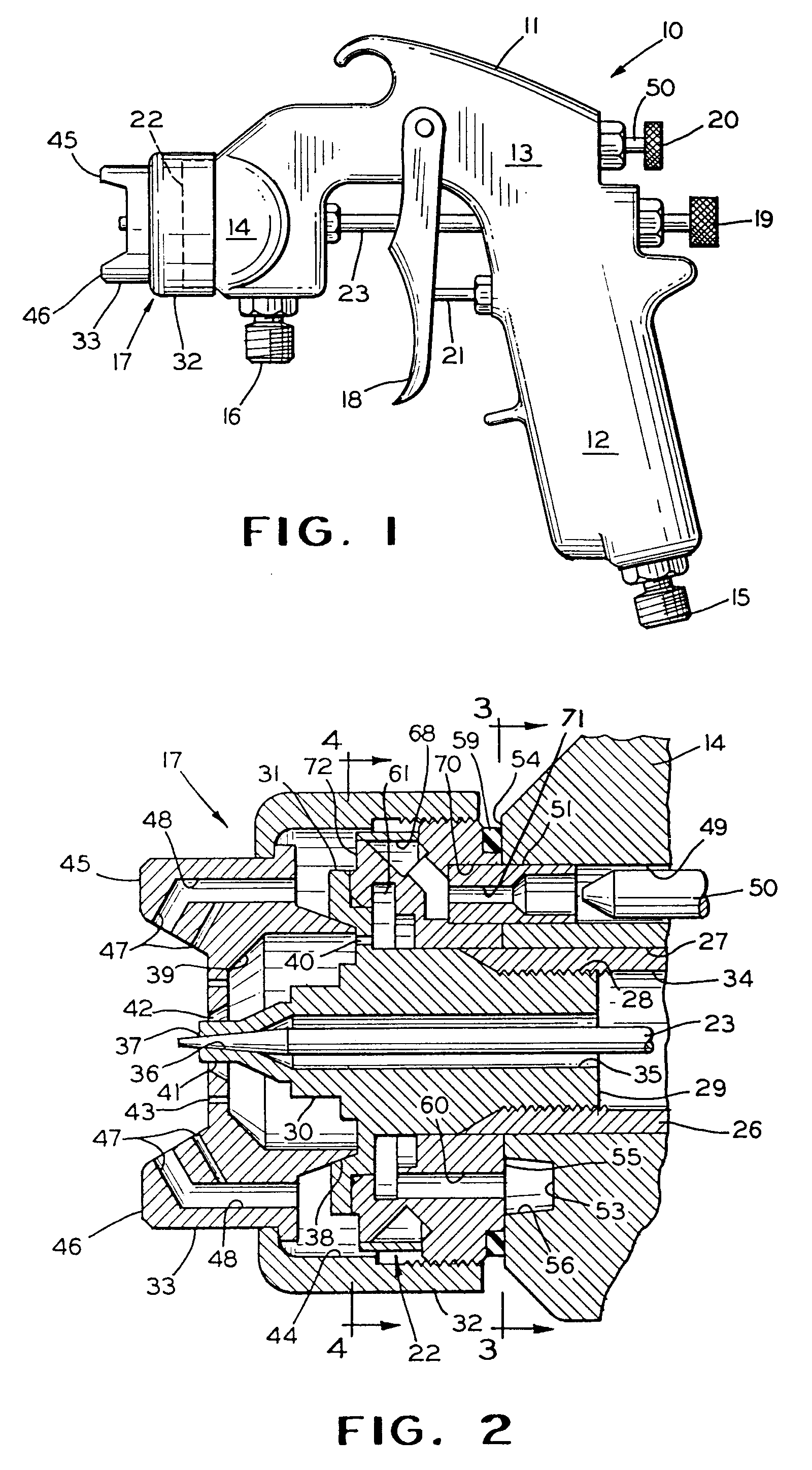
Fig. 1 is a side elevational view of an HVLP paint spray gun according to the invention;
Fig. 2 is an enlarged fragmentary cross sectional view through the air cap, the fluid
tip, the baffle and the end of the barrel of the spray gun of Fig. 1;
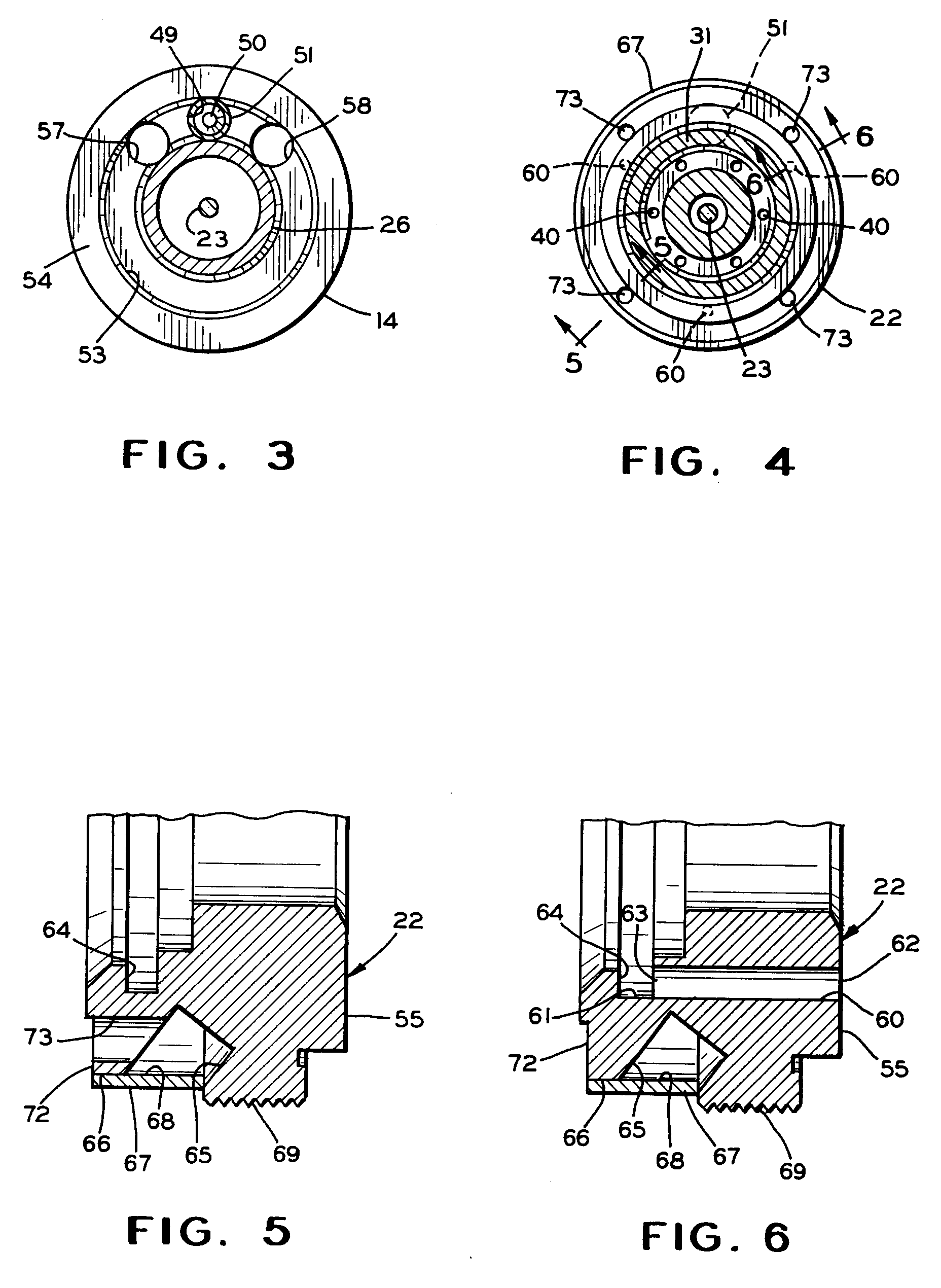
Fig. 3 is a cross sectional view as taken along line 3-3 of Fig. 2;
Fig. 4 is a cross sectional view as taken along line 4-4 of Fig. 2, but with the air
cap and the air cap retainer ring omitted;
Fig. 5 is an enlarged fragmentary cross sectional view as taken along line 5-5 of
Fig. 4; and
Fig. 6 is an enlarged fragmentary cross sectional view as taken along line 6-6 of
Fig. 4.
Best Mode For Carrying Out The Invention
[0011] Referring to Fig. 1 of the drawings, a hand held HVLP spray gun 10 is illustrated
embodying the invention. The spray gun 10 generally includes a body 11 having a handle
12, a central portion 13 and a barrel 14. A fitting 15 is mounted on the handle 12
for securing a hose connected to a high pressure air source (not shown), such as an
air compressor or a compressed air line in a factory. The source air typically is
at a pressure of between 1,724·10
5 Pa (25 psig, 1.75 Kg/cm
2) and 6,897·10
5 Pa (100 psig, 7.0 Kg/cm
2), with between 2,759·10
5 Pa (40 psig, 2.8 Kg/cm
2) and 5,518·10
5 Pa (80 psig, 5.6 Kg/cm
2) most common. A fitting 16 is mounted on the gun barrel 14 for attachment to a paint
source (not shown), such as a paint cup secured directly to the fitting 16. Because
of the low pressure used to atomize the paint, suction feed may not be adequate and
the paint cup is typically pressurized to establish a pressure paint feed to the spray
gun 10. The spray gun 10 further includes a nozzle assembly 17 attached to the barrel
14 for atomizing paint, a trigger 18, a paint flow adjustment knob 19 and a pattern
shaping air flow adjustment knob 20. As the trigger 18 is squeezed by a gun operator,
a valve stem 21 is initially moved to initiate the flow of high pressure air to the
nozzle assembly 17 for paint atomization and pattern shaping. According to the invention,
a baffle 22 is located between the nozzle assembly 17 and the barrel 14 to reduce
the high pressure air received from the remote source to a low pressure, preferably
of no more than 0,6897·10
5 Pa (10 psig, 0.7 Kg/cm
2), at the nozzle assembly 17. After the air flow is initiated, further squeezing of
the trigger 18 moves a valve needle 23 to initiate the flow of paint to the nozzle
assembly 17.
[0012] Fig. 2 is an enlarged cross sectional view showing details of the end of the barrel
14, the nozzle assembly 17 and the baffle 22. An internally threaded tubular sleeve
26 is secured to a passage 27 in the gun barrel 14. The baffle 22 is positioned coaxially
around the sleeve 26. An externally threaded end 28 on a fluid tip 29 is threaded
into the sleeve 26 to releasably attach the baffle 22 to the gun barrel 14. The fluid
tip 29 has a hexagonal portion 30 for receiving a wrench (not shown) to facilitate
attaching and removing the fluid tip 29. The fluid tip 29 has a radially extending
flange 31 which engages and retains the baffle 22 on the gun barrel 14. Thus, the
baffle 22 may be removed and replaced by removing the fluid tip 29 from the barrel
14. A retainer ring 32 is threaded onto the baffle 22 to retain an air cap 33 on the
gun barrel 14. The fluid tip 29, the air cap 33 and the retainer ring 32 form the
nozzle assembly 17.
[0013] Paint is delivered under pressure from the fitting 16 to a chamber 34 within the
sleeve 26 in the gun barrel 14. The paint valve needle 23 extends coaxially through
the chamber 34, through a chamber 35 in the fluid tip 29 and normally contacts a seat
36 in the fluid tip 29. When the trigger 18 is squeezed, the valve needle 23 moves
in an axial direction away from the seat 36 to open a fluid tip orifice 37 through
which the pressurized paint is discharged.
[0014] The air cap 33 delivers an annular flow of atomization air around the discharged
paint and also delivers jets of pattern shaping air against diametrically opposite
sides of the envelope of atomized paint to flatten the envelope. The air cap 33 has
a spherical inner end 38 which seats against the fluid tip 29. An annular atomization
air chamber 39 is formed between the air cap 33 and the fluid tip 29. Low pressure
atomization air is delivered through a plurality of passages 40 in the fluid tip flange
31 to the chamber 39. As best seen in Figs. 2 and 4, the passages 40 are spaced around
the flange 31 to uniformly distribute the air flow to the chamber 39. The fluid tip
29 has an end 41 which extends coaxially through an opening 42 in the center of the
air cap 33. The opening 42 and the fluid tip end 41 form an annular orifice coaxial
with the paint orifice 37 through which low pressure air from the chamber 39 discharges
to atomize the paint. Optionally, two or more small orifices 43 may extend through
the air cap at a location spaced from the opening 42. The orifices 43 provide a low
flow of air which prevents paint accumulation on the air cap 33.
[0015] A pattern shaping air chamber 44 is formed between the air cap 33, the fluid tip
flange 31, the baffle 22 and the retainer ring 32. The air cap 33 has two diametrically
opposing horns 45 and 46 on opposite sides of the paint discharge orifice 37. Each
horn 45 and 46 has one or more orifices 47 (two shown) connected through a passage
48 to the chamber 44. As will be discussed below, a portion of the high pressure air
delivered to the gun handle fitting 15 flows through a passage 49 in the gun barrel
14, through the baffle 22 where the pressure drops to a predetermined low pressure,
to the pattern shaping air chamber 44 and thence through the passages 48 to the horn
orifices 47. The knob 20 on the gun body 11 (Fig. 1) is attached to a pattern shaping
air valve needle 50. As shown in Figs. 2 and 3, a tube 51 attached to the baffle 22
extends into the pattern shaping air passage 49 in the barrel 14. The needle 50 cooperates
with the baffle tube 51 for adjusting the pattern shaping air flow between a maximum
flow when a maximum flat pattern is desired to no flow when a round pattern is desired.
The air cap normally is oriented either as shown with the horns 45 and 46 in a vertical
plane for establishing a horizontal pattern for the atomized paint or with the air
horns 45 and 46 in a horizontal plane for establishing a vertical pattern for the
atomized paint.
[0016] As shown in Figs. 2 and 3, an annular groove 53 is formed in the front face 54 of
the barrel 14. The groove 53 is closed by a rear surface 55 on the baffle 22 to form
an annular chamber 56. The baffle tube 51 extends through the chamber 56. Two high
pressure passages 57 and 58 in the gun barrel 14 supply high pressure atomization
air to the chamber 56 on opposite sides of the tube 51. An annular gasket 59 is positioned
between the barrel face 54 and the baffle 22 to prevent air pressure leakage from
the chamber 56.
[0017] Details of the baffle 22 of the invention are illustrated in Figs. 2, 4, 5 and 6.
The baffle 22 has a plurality of long narrow passages 60 (three shown) which deliver
atomization air from the chamber 56 to an annular chamber 61 formed between the baffle
22 and the fluid tip 29. The chamber 61 is connected through the fluid tip passages
40 to the chamber 39 and thence to the atomization air opening 42. Each passage 60
has an inlet end 62 at the chamber 56 and an outlet end 63 at the chamber 61. The
passages 60 are spaced around the baffle 22 to evenly distribute the air delivered
to the chamber 61. Further, each passage outlet end 63 is directed at a radially inwardly
directed flange 64 on the baffle 22 to disperse the air in the chamber 61. The passages
60 are calibrated to have a total area which provides the desired pressure drop between
the chambers 56 and 61 so that the pressure of the atomization air at the air cap
chamber 39 is no greater than a predetermined maximum low pressure, such as no greater
than 10 psig (0.7 Kg/cm
2). Since the passages 60 supply only atomization air, the air pressure in the chamber
61 is not affected by changes in pattern shaping air flow. Preferably, the passages
60 have a significantly greater length than diameter. By making the passage length
5 or more times greater than the passage diameter, small hole diameter variations
in manufacturing tolerances will have a lesser effect on the pressure drop through
the passages 60 than if the passage length were short as compared to the diameter.
[0018] A groove 65 is formed around the perimeter 66 of the baffle 22. A tubular sleeve
67 is pressed over a portion of the baffle perimeter 66 to cover the groove 65 and
form a closed annular chamber 68. The sleeve 67 is slightly smaller in diameter than
a threaded portion 69 which receives the air cap retainer ring 32. As shown in Fig.
2, the tube 51 is pressed into an opening 70 in the baffle 22. The tube 51 has a stepped
opening 71 which is calibrated to provide a predetermined pressure drop between the
gun barrel passage 49 and the baffle chamber 68. When pattern shaping air is flowing,
the baffle chamber 68 is at an intermediate pressure between the pressure of the source
air at the gun barrel passage 49 and the predetermined low pressure at the chamber
44. The baffle 22 has an annular front surface 72 at the pattern shaping air chamber
44. A plurality of holes 73 (preferably 4 holes 73) are uniformly spaced around the
surface 72 to deliver air from the baffle chamber 68 to the chamber 44. The holes
are calibrated to provide a predetermined pressure drop between the chambers 68 and
44 to limit the maximum pressure in the chamber 44, preferably to no more than 10
psig (0.7 Kg/cm
2). The maximum pressure is present in the chamber 44 when the pattern shaping air
valve formed by the needle 50 and the tube 51 is open to allow a maximum air flow.
As the needle 50 is moved toward the tube 51, pattern shaping air flow decreases and
there will be a corresponding decrease in the pressure in the chambers 68 and 44.
By dropping the pattern shaping air from a high pressure to a low pressure in two
stages, pressure shock waves are dampened and the air flow is more uniformly distributed
to the horn passages 48 than can be achieved with a single stage pressure drop.
[0019] It will be noted that the tube 51 always orients the baffle 22 relative to the gun
barrel 14. Preferably, the holes 73 are located at 45°, 135°, 225° and 315° relative
to a vertical plane through the spray gun 10. During normal spraying with pattern
shaping air, the air horns 45 and 46 will be located either at 90° and 270° when spraying
with a vertical fan shaped pattern or at 0° and 180° when spraying with a horizontal
fan shaped pattern. Consequently, the air horn passages 48 normally will not align
with any of the baffle holes 73.
[0020] It will be appreciated that various modifications and changes may be made to the
above described preferred embodiment of the HVLP spray gun 10 and of the baffle 22
without departing from the scope of the following claims. In its broadest aspects,
the invention covers a baffle for an HVLP spray gun which is replaceable. The baffle
has a plurality orifices which provide separate air pressure drops to establish low
pressure air at a predetermined maximum pressure for atomization and for pattern shaping.
The orifices are calibrated for a specific maximum source air pressure and for a particular
air cap design having specific size orifices for discharging atomization air and pattern
shaping air. Different air cap designs may be used with the spray gun merely by changing
the baffle to one matched to supply the air flow requirements of the air cap. It also
will be appreciated that although the spray gun 10 has been described as having no
greater than 0,6897·10
5 Pa (10 psig, 0.7 Kg/cm
2) air pressure at the nozzle assembly 17, other maximum low air pressures may be established
to satisfy local regulatory requirements.
1. Fluid spray gun of the type operated from a source of high pressure air and using
a high volume low pressure flow of air at a nozzle (17) for fluid atomization and
for pattern shaping, said spray gun nozzle having a first chamber (61) for receiving
atomization air and a second chamber (44) for receiving pattern shaping air, the spray
gun further comprising a replaceable baffle (22) located in said spray gun between
the high pressure air source and said nozzle (17), said baffle (22) including at least
one first calibrated orifice (60) between the source of high pressure and said first
chamber (61), said at least one first orifice (60) delivering a flow of atomization
air from the high pressure source to said first chamber (61) at no greater than a
predetermined low pressure lower than the high pressure, and wherein said baffle (22)
includes at least one second calibrated orifice (73) between the source of high pressure
air and said second chamber (44), said at least one second orifice (73) delivering
a flow of pattern shaping air from the high pressure source to said second chamber
(44) at no greater than a predetermined low pressure lower than the high pressure,
characterized in that
an annular flange (64) is located on said baffle (22) in said first chamber (61) opposite
an air discharge end (63) of the at least one first calibrated orifice (60), wherein
air discharged from said at least one first calibrated orifice (60) impinges against
said annular flange (64).
2. In a spray gun of the type connected to a source of high pressure air and using a
high volume low pressure flow of air at a nozzle for atomization and for pattern shaping,
a replaceable baffle as set forth in claim 1, and wherein said baffle (22) is annular
and has a plurality of first orifices (60) spaced around said baffle for distributing
the air delivered to said first chamber (61).
3. In a spray gun of the type connected to a source of high pressure air and using a
high volume low pressure flow of air at a nozzle for atomization and for pattern shaping,
a replaceable baffle as set forth in claim 2, wherein each of said first orifices
(60) has a length at least 5 times its diameter.
4. In a spray gun of the type connected to a source of high pressure air and using a
high volume low pressure flow of air at a nozzle for atomization and for pattern shaping,
a replaceable baffle as set forth in claim 1, and wherein said baffle (22) is annular
and wherein said at least one second calibrated orifice comprises a plurality of said
second orifices (73) spaced around said baffle (22) to distribute atomization air
delivered to said second chamber (44).
5. In a spray gun of the type connected to a source of high pressure air and using a
high volume low pressure flow of air at a nozzle for atomization and for pattern shaping,
a replaceable baffle as set forth in claim 4, and wherein said baffle (22) has an
annular internal chamber (68) connected to an inlet end of each of said second orifices
(73), and including a third orifice (71) on said baffle (22) located between said
internal chamber (68) and the source of high pressure air, said third orifice (71)
dropping the pressure of the high pressure air to an intermediate pressure and said
second orifices (73) dropping the pressure of said intermediate pressure air to a
pressure no greater than said predetermined low pattern shaping air pressure.
6. In a spray gun of the type connected to a source of high pressure air and using a
high volume low pressure flow of air at a nozzle for atomization and for pattern shaping,
a replaceable baffle as set forth in claim 5, and including means (50, 51) in said
spray gun cooperating with said third orifice (71) for adjusting the flow of pattern
shaping air through said third orifice (71) to adjust the pattern of fluid atomized
by said spray gun.
7. In a spray gun of the type connected to a source of high pressure air and using a
high volume low pressure flow of air at a nozzle for atomization and for pattern shaping,
a replaceable baffle as set forth in claim 5, and wherein said at least one first
calibrated orifice comprises a plurality of first orifices (60) spaced around said
baffle (22) for distributing the air delivered to said first chamber (61).
8. In a spray gun of the type connected to a source of high pressure air and using a
high volume low pressure flow of air at a nozzle for atomization and for pattern shaping,
a replaceable baffle as set forth in claim 7, and wherein said first orifices (60)
consists of three orifices having the same size and wherein said second orifices (73)
consists of four orifices having the same size.
9. In a spray gun of the type connected to a source of high pressure air and using a
high volume low pressure flow of air at a nozzle for atomization and for pattern shaping,
a replaceable baffle as set forth in claim 8, and wherein said four second orifices
(73) are located at angles of 45°, 135°, 225° and 315° relative to a vertical plane
through said spray gun, whereby said second orifices (73) are not aligned with pattern
shaping air ports (47) in said spray gun nozzle while spraying with vertically and
horizontally oriented patterns.
10. In a spray gun of the type connected to a source of high pressure air and using a
high volume low pressure flow of air at a nozzle for atomization and for pattern shaping,
a replaceable baffle as set forth in claim 2, and wherein each of said first orifices
(60) has a length to diameter ratio sufficient to prevent shock waves in the air flow
delivered to said first chamber (61).
11. In a spray gun of the type connected to a source of high pressure air and using a
high volume low pressure flow of air at a nozzle for atomization and for pattern shaping,
a replaceable baffle as set forth in claim 5, wherein said internal chamber (68) contains
any stationary shock waves in the air flow discharged from said third orifice (71)
and wherein said second orifices (73) are sized and spaced to distribute and limit
the velocity of air flow to said second chamber (44) to a subsonic level.
12. In a spray gun of the type connected to a source of high pressure air and using a
high volume low pressure flow of air at a nozzle for atomization and for pattern shaping,
a replaceable baffle as set forth in claim 1, wherein said baffle (22) includes means
(60, 64, 68, 71, 73) for preventing shock waves in the air delivered through said
baffle (22) to said first and second chambers (61, 44).
1. Fluid-Sprühpistole des Typs, welcher von einer Hochdruckluftquelle betrieben wird
und einen Hochdurchfluß-Niederdruck-Luftstrom an einer Düse (17) zur Fluid-Zerstäubung
und zur Musterformung verwendet, wobei die Sprühpistolendüse eine erste Kammer (61)
zur Aufnahme von Zerstäubungsluft hat und eine zweite Kammer (44) zur Aufnahme von
Musterformungsluft, wobei die Sprühpistole ferner eine austauschbare Verteilerscheibe
(22) enthält, welche in der Sprühpistole zwischen der Hochdruckluftquelle und der
Düse (17) angeordnet ist, wobei die Verteilerscheibe (22) mindestens eine erste kalibrierte
Öffnung (60) zwischen der Hochdruckquelle und der ersten Kammer (61) hat, und die
mindestens eine erste Öffnung (60) einen Strom von Zerstäubungsluft von der Hochdruckquelle
zu der ersten Kammer (61) liefert mit nicht mehr als einem vorbestimmten Niederdruck,
welcher niedriger ist als der Hochdruck, und wobei die Verteilerscheibe (22) mindestens
eine zweite kalibrierte Öffnung (73) zwischen der Hochdruckquelle und der zweiten
Kammer (44) enthält und die mindestens eine zweite Öffnung (73) einen Strom von Musterformungsluft
von der Hochdruckquelle zur der zweiten Kammer (44) liefert mit nicht mehr als einem
vorbestimmten Niederdruck, welcher niedriger ist als der Hochdruck,
dadurch gekennzeichnet,
daß ein ringförmiger Flansch (64) auf der Verteilerscheibe (22) in der ersten Kammer
(61) gegenüber von einem Luftabgabeende (63) der mindestens einen ersten kalibrierten
Öffnung (60) angeordnet ist, wobei Luft, welche von der mindestens einen ersten kalibrierten
Öffnung (60) abgegeben wird, gegen den ringförmigen Flansch (64) prallt.
2. In einer Sprühpistole des Typs, welcher mit einer Hochdruckluftquelle verbunden ist
und einen Hochdurchfluß-Niederdruck-Luftstrom an einer Düse zur Zerstäubung und zur
Musterformung verwendet, eine austauschbare Verteilerscheibe wie in Anspruch 1 dargelegt,
und worin die Verteilerscheibe (22) ringförmig ist und eine Vielzahl von ersten Öffnungen
(60) hat, welche um die Verteilerscheibe herum mit Abstand angeordnet sind zum Verteilen
der Luft, welche der ersten Kammer (61) zugeführt wird.
3. In einer Sprühpistole des Typs, welcher mit einer Hochdruckluftquelle verbunden ist
und einen Hochdurchfluß-Niederdruck-Luftstrom an einer Düse zur Zerstäubung und zur
Musterformung verwendet, eine austauschbare Verteilerscheibe wie in Anspruch 2 dargelegt,
wobei jede der ersten Öffnungen (60) eine Länge hat, welche mindestens fünfmal so
groß wie ihr Durchmesser ist.
4. In einer Sprühpistole des Typs, welcher mit einer Hochdruckluftquelle verbunden ist
und einen Hochdurchfluß-Niederdruck-Luftstrom an einer Düse zur Zerstäubung und zur
Musterformung verwendet, eine austauschbare Verteilerscheibe wie in Anspruch 1 dargelegt,
und worin die Verteilerscheibe (22) ringförmig ist und worin die mindestens eine zweite
kalibrierte Öffnung eine Vielzahl von zweiten Öffnungen (73) enthält, welche mit Abstand
um die Verteilerscheibe (22) herum angeordnet sind, um Zerstäubungsluft zu verteilen,
welche der zweiten Kammer (44) zugeführt wird.
5. In einer Sprühpistole des Typs, welcher mit einer Hochdruckluftquelle verbunden ist
und einen Hochdurchfluß-Niederdruck-Luftstrom an einer Düse zur Zerstäubung und zur
Musterformung verwendet, eine austauschbare Verteilerscheibe wie in Anspruch 4 dargelegt,
und worin die Verteilerscheibe (22) eine ringförmige innere Kammer (68) hat, welche
mit einem Einlaßende von jeder der zweiten Öffnungen (73) verbunden ist, und eine
dritte Öffnung (71) auf der Verteilerscheibe (22) enthält, welche zwischen der inneren
Kammer (68) und der Hochdruckluftquelle angeordnet ist, wobei die dritte Öffnung (71)
den Druck der Hochdruckluft auf einen Zwischendruck absenkt, und die zweiten Öffnungen
(73) den Druck der Zwischendruckluft auf einen Druck von nicht mehr als einem vorbestimmten
niedrigen Musterformungsluftdruck absenken.
6. In einer Sprühpistole des Typs, welcher mit einer Hochdruckluftquelle verbunden ist
und einen Hochdurchfluß-Niederdruck-Luftstrom an einer Düse zur Zerstäubung und zur
Musterformung verwendet, eine austauschbare Verteilerscheibe wie in Anspruch 5 dargelegt,
und enthaltend Mittel (50, 51) in der Sprühpistole , welche mit der dritten Öffnung
(71) zusammenwirken, um den Strom der Musterformungsluft durch die dritte Öffnung
(71) einzustellen, um das Muster des durch die Sprühpistole zerstäubten Fluides einzustellen.
7. In einer Sprühpistole des Typs, welcher mit einer Hochdruckluftquelle verbunden ist
und einen Hochdurchfluß-Niederdruck-Luftstrom an einer Düse zur Zerstäubung und zur
Musterformung verwendet, eine austauschbare Verteilerscheibe wie in Anspruch 5 dargelegt,
und worin die mindestens eine erste kalibrierte Öffnung eine Vielzahl von ersten Öffnungen
(60) enthält, welche um die Verteilerscheibe (22) herum mit Abstand angeordnet sind,
um die Luft zu verteilen, welche der ersten Kammer (61) zugeführt wird.
8. In einer Sprühpistole des Typs, welcher mit einer Hochdruckluftquelle verbunden ist
und einen Hochdurchfluß-Niederdruck-Luftstrom an einer Düse zur Zerstäubung und zur
Musterformung verwendet, eine austauschbare Verteilerscheibe wie in Anspruch 7 dargelegt,
und worin die ersten Öffnungen (60) aus drei Öffnungen bestehen, welche die gleiche
Größe haben, und worin die zweiten Öffnungen (73) aus vier Öffnungen bestehen, welche
die gleiche Größe haben.
9. In einer Sprühpistole des Typs, welcher mit einer Hochdruckluftquelle verbunden ist
und einen Hochdurchfluß-Niederdruck-Luftstrom an einer Düse zur Zerstäubung und zur
Musterformung verwendet, eine austauschbare Verteilerscheibe wie in Anspruch 8 dargelegt,
und worin die vier zweiten Öffnungen (73) bei Winkeln von 45°, 135°, 225° und 315°
relativ zu einer vertikalen Ebene durch die Sprühpistole angeordnet sind, wobei die
zweiten Öffnungen (73) nicht mit Musterformungsluft-Öffnungen (47) in der Sprühpistolendüse
ausgerichtet sind, während sie mit vertikal und horizontal ausgerichteten Mustern
sprühen.
10. In einer Sprühpistole des Typs, welcher mit einer Hochdruckluftquelle verbunden ist
und einen Hochdurchfluß-Niederdruck-Luftstrom an einer Düse zur Zerstäubung und zur
Musterformung verwendet, eine austauschbare Verteilerscheibe wie in Anspruch 2 dargelegt,
und worin jede der ersten Öffnungen (60) ein Längen-zu-Durchmesser-Verhältnis hat,
welches ausreichend ist, um Stoßwellen im Luftstrom, welcher der ersten Kammer (61)
zugeführt wird, zu verhindern.
11. In einer Sprühpistole des Typs, welcher mit einer Hochdruckluftquelle verbunden ist
und einen Hochdurchfluß-Niederdruck-Luftstrom an einer Düse zur Zerstäubung und zur
Musterformung verwendet, eine austauschbare Verteilerscheibe wie in Anspruch 5 dargelegt,
worin die innere Kammer (68) jegliche stehenden Stoßwellen im Luftstrom, welcher von
der dritten Öffnung (71) abgegeben wird, enthält und worin die zweiten Öffnungen (73)
so bemessen und mit Abstand angeordnet sind, daß sie den Luftstrom verteilen und seine
Geschwindigkeit zu der zweiten Kammer (44) auf ein subsonisches Niveau begrenzen.
12. In einer Sprühpistole des Typs, welcher mit einer Hochdruckluftquelle verbunden ist
und einen Hochdurchfluß-Niederdruck-Luftstrom an einer Düse zur Zerstäubung und zur
Musterformung verwendet, eine austauschbare Verteilerscheibe wie in Anspruch 1 dargelegt,
worin die Verteilerscheibe (22) Mittel (60, 64, 68, 71, 73) enthält zum Verhindern
von Stoßwellen in der Luft, welche durch die Verteilerscheibe zu den ersten und zweiten
Kammern (61, 44) geliefert wird.
1. Pistolet de pulvérisation de fluide du type actionné par une source d'air sous haute
pression et utilisant un écoulement d'air à volume élevé, basse pression, à une buse
(17) pour l'atomisation d'un fluide et pour la mise en forme d'une gerbe, ladite buse
du pistolet de pulvérisation ayant une première chambre (61) destinée à recevoir de
l'air d'atomisation et une seconde chambre (44) destinée à recevoir de l'air de mise
en forme de la gerbe, le pistolet de pulvérisation comportant en outre un répartiteur
(22) pouvant être remplacé, situé dans ledit pistolet de pulvérisation entre la source
d'air à haute pression et ladite buse (17), ledit répartiteur (22) présentant au moins
un premier orifice calibré (60) entre la source de haute pression et ladite première
chambre (61), ledit ou chaque premier orifice (60) délivrant un écoulement d'air d'atomisation
de la source à haute pression vers ladite première chambre (61), sous une pression
qui n'est pas supérieure à une basse pression prédéterminée et inférieure à la haute
pression, et dans lequel ledit répartiteur (22) présente au moins un second orifice
calibré (73) entre la source d'air à haute pression et ladite seconde chambre (44),
ledit ou chaque second orifice (73) délivrant un écoulement d'air de mise en forme
de la gerbe de la source de haute pression à ladite seconde chambre (44) sous une
pression qui n'est pas supérieure à une basse pression prédéterminée inférieure à
la haute pression,
caractérisé en ce qu'un rebord annulaire (64) est situé sur ledit répartiteur (22)
dans ladite première chambre (61), opposé à une extrémité (63) de décharge d'air du
ou de chaque premier orifice calibré (60), de façon que l'air déchargé du ou de chaque
premier orifice calibré (60) soit projeté contre ledit rebord annulaire (64).
2. Dans un pistolet de pulvérisation du type relié à une source d'air à haute pression
et utilisant un écoulement d'air à volume élevé, basse pression, à une buse pour l'atomisation
et la mise en forme d'une gerbe, un répartiteur pouvant être remplacé selon la revendication,
1 et dans lequel ledit répartiteur (22) est annulaire et présente plusieurs premiers
orifices (60) espacés autour dudit répartiteur pour distribuer l'air amené à ladite
première chambre (61).
3. Dans un pistolet de pulvérisation du type relié à une source d'air à haute pression
et utilisant un écoulement d'air à volume élevé, basse pression, à une buse pour l'atomisation
et la mise en forme d'une gerbe, un répartiteur pouvant être remplacé selon la revendication,
2, dans lequel chacun desdits premiers orifices (60) présente une longueur égale à
au moins 5 fois son diamètre.
4. Dans un pistolet de pulvérisation du type relié à une source d'air à haute pression
et utilisant un écoulement d'air à volume élevé, basse pression, à une buse pour l'atomisation
et la mise en forme d'une gerbe, un répartiteur pouvant être remplacé selon la revendication,
1, et dans lequel ledit répartiteur (22) est annulaire, et dans lequel ledit ou chaque
second orifice calibré comprend plusieurs desdits seconds orifices (73) espacés autour
dudit répartiteur (22) pour distribuer de l'air d'atomisation amené à ladite seconde
chambre (44).
5. Dans un pistolet de pulvérisation du type relié à une source d'air à haute pression
et utilisant un écoulement d'air à volume élevé, basse pression, à une buse pour l'atomisation
et la mise en forme d'une gerbe, un répartiteur pouvant être remplacé selon la revendication
4, et dans lequel ledit répartiteur (22) présente une chambre intérieure annulaire
(68) reliée à une extrémité d'entrée de chacun desdits seconds orifices (73) et comprenant
un troisième orifice (71) sur ledit répartiteur (22), situé entre ladite chambre intérieure
(68) et la source d'air à haute pression, ledit troisième orifice (71) faisant chuter
la pression d'air à haute pression jusqu'à une pression intermédiaire, et ledit second
orifice (73) faisant chuter la pression dudit air à pression intermédiaire jusqu'à
une pression qui n'est pas supérieure à ladite basse pression prédéterminée de l'air
de mise en forme de la gerbe.
6. Dans un pistolet de pulvérisation du type relié à une source d'air à haute pression
et utilisant un écoulement d'air à volume élevé, basse pression, à une buse pour l'atomisation
et la mise en forme d'une gerbe, un répartiteur pouvant être remplacé selon la revendication,
5, et comprenant des moyens (50, 51) dans ledit pistolet de pulvérisation, coopérant
avec ledit troisième orifice (71) pour régler l'écoulement de l'air de mise en forme
de la gerbe à travers ledit troisième orifice (71) afin de régler la gerbe de fluide
atomisé par ledit pistolet de pulvérisation.
7. Dans un pistolet de pulvérisation du type relié à une source d'air à haute pression
et utilisant un écoulement d'air à volume élevé, basse pression, à une buse pour l'atomisation
et pour la mise en forme d'une gerbe, un répartiteur pouvant être remplacé selon la
revendication 5, dans lequel ledit ou chaque premier orifice calibré comprend plusieurs
premiers orifices (60) espacés autour dudit répartiteur (22) pour distribuer l'air
amené à ladite première chambre (61).
8. Dans un pistolet de pulvérisation du type relié à une source d'air à haute pression
et utilisant un écoulement d'air à volume élevé, basse pression, à une buse pour l'atomisation
et pour la mise en forme de la gerbe, un répartiteur pouvant être remplacé selon la
revendication 7, et dans lequel lesdits premiers orifices (60) sont constitués de
trois orifices ayant la même dimension, et dans lequel lesdits seconds orifices (73)
sont constitués de quatre orifices ayant la même dimension.
9. Dans un pistolet de pulvérisation du type relié à une source d'air à haute pression
et utilisant un écoulement d'air à volume élevé, basse pression, à une buse pour l'atomisation
et pour la mise en forme de la gerbe, un répartiteur pouvant être remplacé selon la
revendication 8, et dans lequel lesdits quatre seconds orifices (73) sont situés à
des angles de 45°, 135°, 225° et 315° par rapport à un plan vertical traversant ledit
pistolet de pulvérisation, grâce à quoi lesdits seconds orifices (73) ne sont pas
alignés avec les orifices (47) de mise en forme de la gerbe dans ladite buse de pistolet
de pulvérisation, pendant une pulvérisation formant des gerbes orientées verticalement
et horizontalement.
10. Dans un pistolet de pulvérisation du type relié à une source d'air à haute pression
et utilisant un écoulement d'air à volume élevé, basse pression, à une buse pour l'atomisation
et pour la mise en forme de la gerbe, un répartiteur pouvant être remplacé selon la
revendication 2, et dans lequel chacun desdits premiers orifices (60) présente un
rapport de la longueur au diamètre suffisant pour éviter des ondes de choc dans l'écoulement
d'air amené à ladite première chambre (61).
11. Dans un pistolet de pulvérisation du type relié à une source d'air à haute pression
et utilisant un écoulement d'air à volume élevé, basse pression, à une buse pour l'atomisation
et pour la mise en forme de la gerbe, un répartiteur pouvant être remplacé selon la
revendication 5, dans lequel ladite chambre intérieure (68) retient toutes ondes de
choc stationnaires dans l'écoulement d'air déchargé dudit troisième orifice (71),
et dans lequel lesdits deuxièmes orifices (73) sont dimensionnés et espacés de façon
à distribuer et limiter un niveau inférieur à celui du son la vitesse de l'écoulement
de l'air vers ladite seconde chambre (44).
12. Dans un pistolet de pulvérisation du type relié à une source d'air à haute pression
et utilisant un écoulement d'air à volume élevé, basse pression, à une buse pour l'atomisation
et pour la mise en forme de la gerbe, un répartiteur pouvant être remplacé selon la
revendication 1, dans lequel ledit répartiteur (22) comprend des moyens (60, 64, 68,
71, 73) destinés à éviter des ondes de choc dans l'air amenées par l'intermédiaire
dudit répartiteur (22) auxdites première et seconde chambres (61, 44).