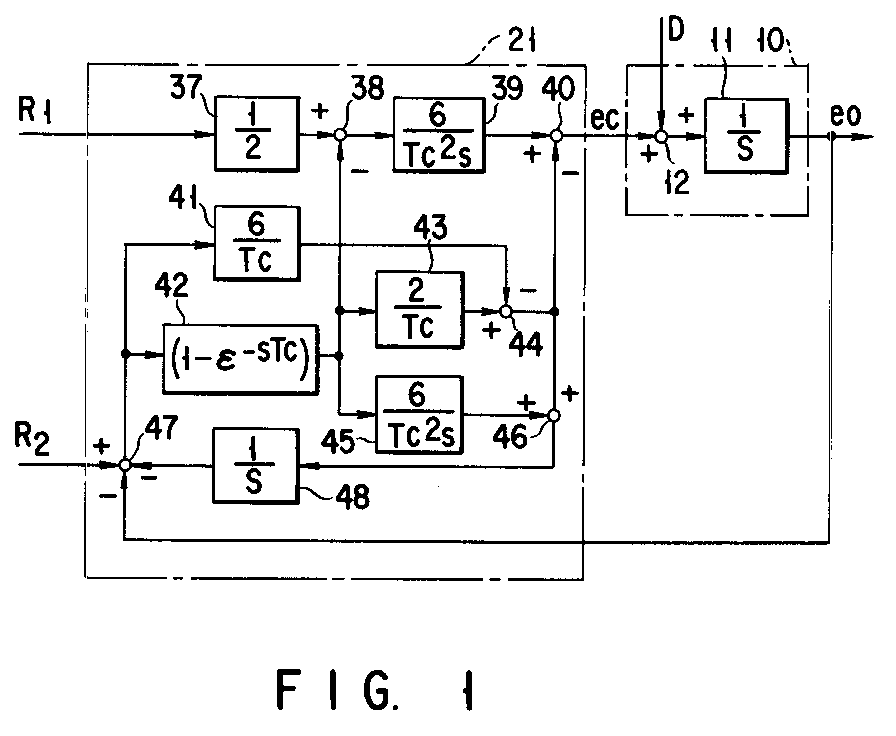
(57) A feedback controller of the present invention comprises a controller (21). The controller
controls to input a reference value (R) instructing a controlled variable (eo) output
from a controlled object (10) operated in accordance with a manipulated variable and
a controlled variable (10), to calculate a manipulated variable such that the controlled
variable (eo) is equal with said reference value (R), and to supply the calculated
manipulated variable the controlled object (10). The controller (21) has a transfer
function Gf (s), and functions to generate the following response waveform f (t) to
a disturbance. That is, a response waveform of the controlled variable (eo) at the
time when the disturbance is added to the controlled object (10) is set to f (t),
a response waveform of said controlled variable (eo) in an opened loop state that
feedback of said controlled variable (eo) is turned off is set to p (t), a relative
degree of the disturbance is set to "d", and a relative degree of the controlled object
is set to "g", at time (t = 0) in which the disturbance is added to the controlled
object (10), each differential value of the response waveform f (t) up to at least
a degree (2g + d - 2) is equal to each differential value corresponding to the response
waveform p (t), and at finite time (t = Tc), each differential value of the response
waveform f (t) up to at least a degree (2g + d - 2) becomes zero and after the finite
time, the differential values relative to all degrees become zero.
|
|
