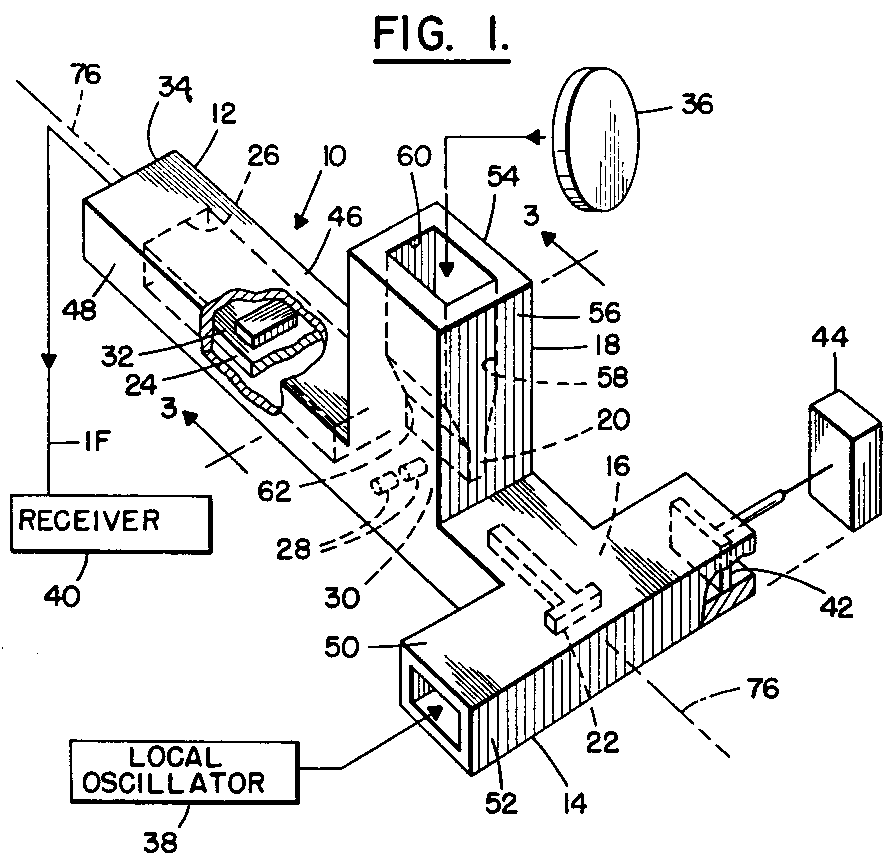
(57) A microwave mixer (10) is formed of three orthogonally oriented waveguides (12, 14,
16), each having a rectangular cross-section defined by a pair of opposed broad walls
(46) and a pair of opposed sidewalls (48) wherein the ratio of cross-sectional dimensions
typically is 2:1. The mixer includes an input coupling probe (22), a mixing region
(30), and an output filter (24) disposed serially along a first of the waveguides.
A second of the waveguides applies a reference LO signal via the probe to the mixing
region, the mixing region employed in the preferred embodiment of the invention. A
section of dielectric board (32) serves to support the diodes of the mixing region,
components of the filter (24), and the probe in the first waveguide. The third waveguide
applies an RF input signal to the mixing region via an input port (16) in a side of
the first waveguide, and via an impedance matching taper (58) and a waveguide section
of reduced height (62) which impedes egress of both an IF and an image signal produced
in the mixing region by interaction of the LO and the RF signals. The filter (24)
is located at the mixer IF output port (34) for reflecting an image-frequency signal
back to the diodes of the mixing region for further interaction with the LO signal
to generate additional IF signal in phase with the originally produced IF signal for
additional power and a significantly higher signal-to-noise ratio.
|
|
