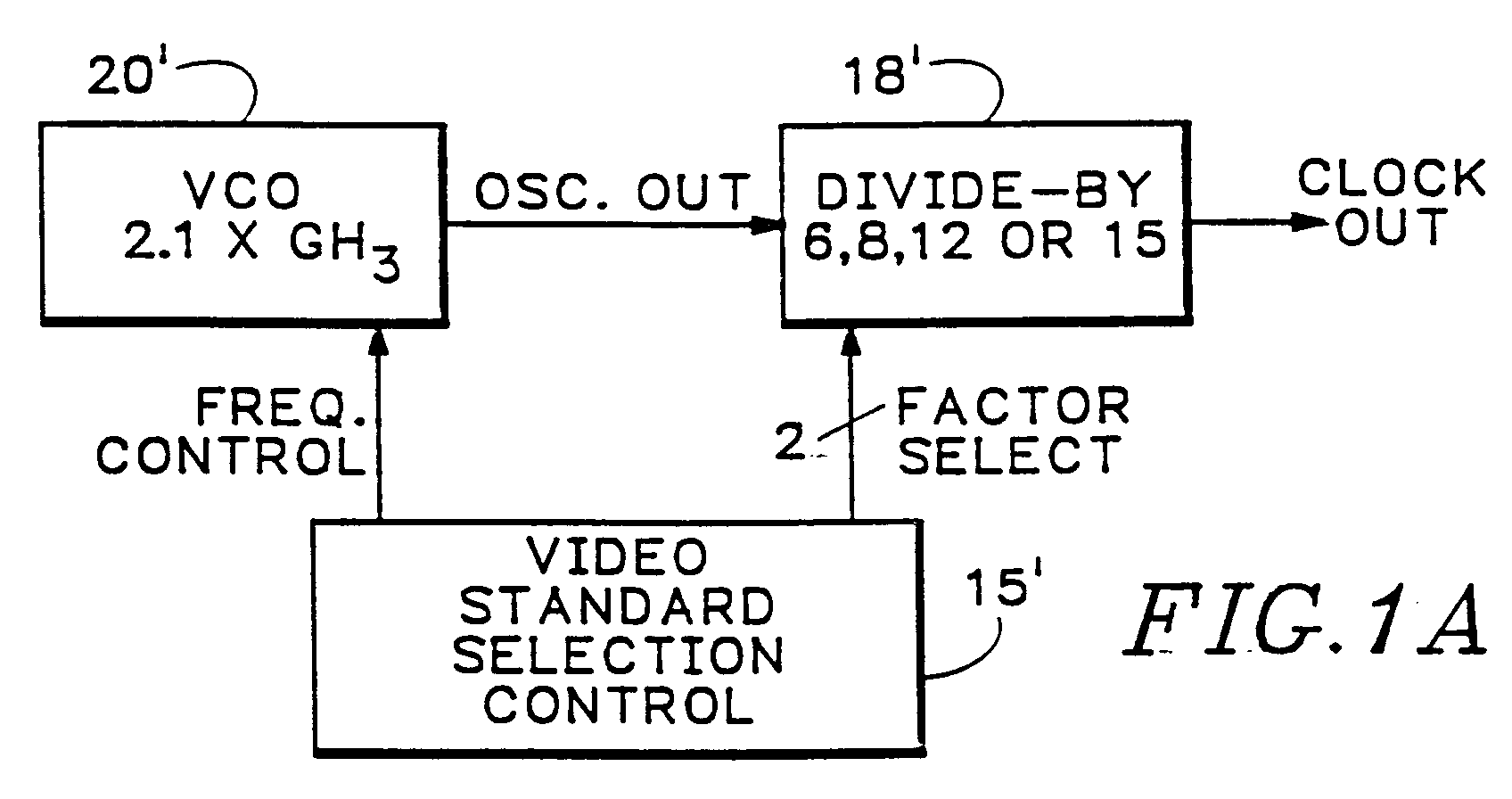
(57) A voltage controlled reference oscillator (20) with a high Q and narrow tunability
bandwidth produces an output oscillator frequency which is frequency divided (18)
by four alternative constants to produce four different clock frequencies for four
different digital video standards, D1 component at 270 MHz, NTSC D2 composite at 143
MHz, PAL D2 composite at 177 MHz, and a proposed new composite video standard that
is to operate at a 360 MHz clock rate. Automatic identification of which serial digital
video is present is accomplished by having the clock generator (20,18) produce a clock
signal at the frequency required by one of the video formats while a phase lock loop
(90,26) attempts to lock onto the incoming signals at that frequency. If no lock occurs
within a predetermined time interval, the clock generator (20,18) is made to produce
a clock signal at the frequency required by a different one of the video formats and
the phase lock (90,26) is attempted again. This is repeated until a lock is attained.
Optionally, when a lock occurs, the video is tested (80) for validity within the format
that is consistent with the clock frequency that produced the lock.
|
|
