|
(11) | EP 0 512 304 A1 |

| (12) | EUROPEAN PATENT APPLICATION |
|
|
|
|
|||||||||||||||||||||||||||
| (54) | Silver halide color photographic elements containing a pyrazolo-triazole magenta coupler |
| (57) Silver halide color photographic element comprising a support and at least one silver
halide emulsion layer containing at least one nondiffusible magenta coupler of the
1H-pyrazolo[3,2-c]-1,2,4-triazole series having at a position other than the coupling
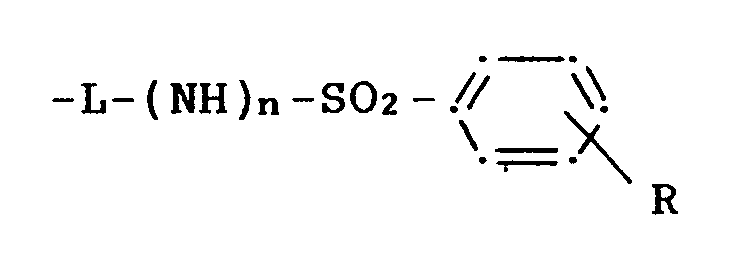
position a group expressed by the general formula (I)
wherein L is an aralkylene divalent linking group containing a ballasting residue and having the arylene group of said aralkylene group directly connected to -(NH)n-SO₂-, n is 0 or 1, and R is a substituent selected within the group consisting of a hydrogen atom, an alkyl group, an alkoxy group, a sulfonamido group and an acetylsulfonamido group. |
FIELD OF THE INVENTION
[0001] The present invention relates to a silver halide color photographic light-sensitive element containing a photographic coupler and, more in particular, a 1H-pyrazolo[3,2-c]-1,2,4-triazole magenta coupler having at a position other than the coupling position a ballasting group.
BACKGROUND OF THE ART
[0002] It is known that color images are obtained in the photographic silver halide elements by reaction between the oxidation product of an aromatic primary amine developing agent and a dye-forming coupler and it is known to use a combination of a yellow coupler, a cyan coupler and a magenta coupler as such dye-forming couplers.
[0003] In color photographic couplers, 5-pyrazolone couplers are normally used as magenta dye-forming couplers. It is known that dyes formed from 5-pyrazolone couplers are excellent in fastness to heat and light and have the predominant absorption which approaches to the ideal one, but they tend to have absorptions other than the predominant one at about 430 nm which necessitates the use of masking couplers or other masking techniques. The dyes also display low resistance to the action of formaldehyde.
[0004] For overcoming these problems, there have been proposed as magenta dye-forming couplers, pyrazolobenzimidazole couplers as described in GB Pat. No. 1,047,612, pyrazolo-triazole couplers as described in US Pat. No. 3,725,067, and, more recently, 1H-imidazolo[1,2-b]-pyrazole couplers as described in US Pat. No. 4,500,630, 1H-pyrazolo[1,3-b]-1,2,4-triazole as described in EP Pat. No. 119860, 1H-pyrazolo[1,5-d]-tetrazole as described in Research Disclosure No. 24220, and 1H-pyrazolo[1,5]-pyrazole as described in JP Pat. Appl. No. 43659/85.
[0005] When intended for incorporation in photographic elements, couplers are normally dispersed with the aid of a high boiling solvent or adsorbed onto a polymer latex. Couplers are rendered nondiffusible in the photographic elements and compatible with the coupler solvent or the polymer latex by including a ballast group on the coupler in a position other than the coupling position. Pyrazolotriazole and pyrazolobenzimidazole magenta couplers with a ballast group having a p-hydroxyphenylsulfonyl group or a p-hydroxyphenylsulfinyl group as a terminal group are described in EP Pat. Appl. No. 73636. Pyrazolobenzimidazole, pyrazolotriazole and imidazopyrazole magenta couplers having a subsituted p-hydroxyphenylsulfonyl group or a substituted p-hydroxyphenylsulfinyl group as a terminal group are described in US Pat. No. 4,513,082. Pyrazolotriazole magenta couplers with a ballast group having an aminosulfonyl or aminocarbonyl group as a terminal group are described in US Pat. Nos. 4,548,899 and 4,822,730. Pyrazolotriazole magenta couplers with a ballast group comprising a carboxy group are described in EP Pat. Appl. No. 284240 and in US Pat. No. 4,835,094.
[0006] Although these couplers may overcome the above-described problems of 5-pyrazolone magenta couplers, there is a continuing desire to improve, or optimize the couplers for particular applications. Many properties of the coupler and the resulting dye are desirably modified, in particular providing pyrazoloazole couplers which yield dyes having predominant absorption maxima at wavelengths substantially corresponding to that of 5-pyrazolone magenta couplers.
SUMMARY OF THE INVENTION
[0007] The invention relates to a silver halide color photographic element comprising a support and at least one silver halide emulsion layer containing at least one non-diffusible magenta coupler of the 1H-pyrazolo[3,2-c]-1,2,4-triazole series having at a position other than the coupling position a group expressed by the general formula (I)
wherein L is an aralkylene divalent linking group containing a ballasting residue and having the arylene group of said aralkylene group directly connected to -(NH)n-SO₂-, n is 0 or 1, and R is a substituent selected within the group consisting of a hydrogen atom, an alkyl group, an alkoxy group, a sulfonamido group and an acetylsulfonamido group.
[0008] Magenta dyes can be obtained by chromogenic development of said magenta couplers with high reactivity, high color density, little absorption in the blue and green regions, little change in hue irrespective of storage conditions, and absorption maxima at wavelengths corresponding to that of 5-pyrazolone magenta couplers.
DETAILED DESCRIPTION OF THE INVENTION
[0009] The magenta couplers according to the present invention can be expressed by the following general formula (II)
wherein R₁ is a hydrogen atom, an alkyl group or an aryl group, Z is a hydrogen atom, a halogen atom or a group which can be eliminated upon coupling reaction with the oxydized product of a color developing agent and L, n and R each has the same meaning as in the general formula (I).
[0010] As shown above, R₁ in formula (II) represents a hydrogen atom, an alkyl group, or an aryl group. Preferred alkyl groups are those having 1 to 8 carbon atoms. More preferred alkyl groups are those having 1 to 4 carbon atoms, such as methyl, trifluorometyl, ethyl, ethoxyethyl and t-butyl. A preferred aryl group represented by R₁ is a phenyl group which may be substituted, such as p-methoxyphenyl, 4-t-butylphenyl or m-chloromethylphenyl.
[0011] Z represents a hydrogen atom or a group which can be eliminated upon coupling reaction with the oxidized product of a color developing agent. Specific examples of such group include a halogen atom (e.g. chlorine or fluorine) or a group, preferably a cyclic group, which is linked to the coupling position through an oxygen atom, a nitrogen atom or a sulfur atom (e.g. an aryloxy group such as phenoxy, p-methoxyphenoxy or p-tert.butylcarbonamidophenoxy, an arylthio group such as phenylthio, and a heterocyclic thio group such as 1-ethyltetrazole-5-thioyl). If the eliminable group is a cyclic group, it may be attached to the coupling position of the coupler molecule directly through an atom which forms part of a ring, e.g. a nitrogen atom. A halogen atom is preferred, and a chlorine atom is particularly preferred.
[0012] R represents a hydrogen atom, an alkyl group (preferably of about 1 to 4 carbon atoms, e.g. methyl, ethyl, propyl, butyl), which may be substituted with known substituents such as halogen atoms, an alkoxy group (preferably of about 1 to 4 carbon atoms, e.g. methoxy, ethoxy, propoxy, butoxy) which may be substituted, a sulfonamido group or an acetylsulfonamido group.
[0013] The divalent linking group L attached to a non-coupling position of the 1H-pyrazolo[3,2-c]-1,2,4-triazole magenta coupler is an aralkylene group having an alkylene group linked to an arylene group either directly or having in the main chain of said aralkylene group -O-, -S-, -NHCO-, -CONH-, -NHSO₂- or -SO₂NH-. The arylene group is preferably a phenylene group which may substituted, e.g. with an alkyl, alkoxy, halogen or acylamino. The divalent linking group L contains a ballasting residue which may consist of the totality of the divalent linking group or may be formed by said divalent linking group L containing a ballast residue in the form of a substituent. The alkylene group, for example , may be a 1,2-alkylene group with up to 20 carbon atoms, or the arylene group may be substituted, e.g. with an alkoxy group or acylamino group containing up to 20 carbon atoms.
[0014] Said ballasting groups enable the magenta couplers according to this invention to be incorporated in a non-diffusible form in the gelatin layers used in the silver halide photographic elements. These groups are organic groups generally containing straight or branched chain aliphatic groups with generally 8 to 20 carbon atoms. These ballasting groups are attached to the coupler molecule either directly or indirectly, e.g. through one of the following groups: NHCO, NHSO₂, NR (wherein R represents hydrogen or alkyl), COO, O or S.
[0015] A preferred divalent linking group L is represented by the general formula (III)
wherein R₂ is an alkyl group of 4 to 20 carbon atoms.
[0017] Particularly preferred couplers used in this invention have the general formula (IV):
wherein R, R₁, R₂ and Z are as defined above.
[0018] Specific examples of 1H-pyrazolo[3,2-c]-1,2,4-triazole couplers for use in this invention are shown below but they are not limited to those specific compounds.
[0019] The magenta couplers for use in the present invention may be readily synthesized by any of the known techniques. Specific examples of the couplers for use in the present inventiom are shown below.
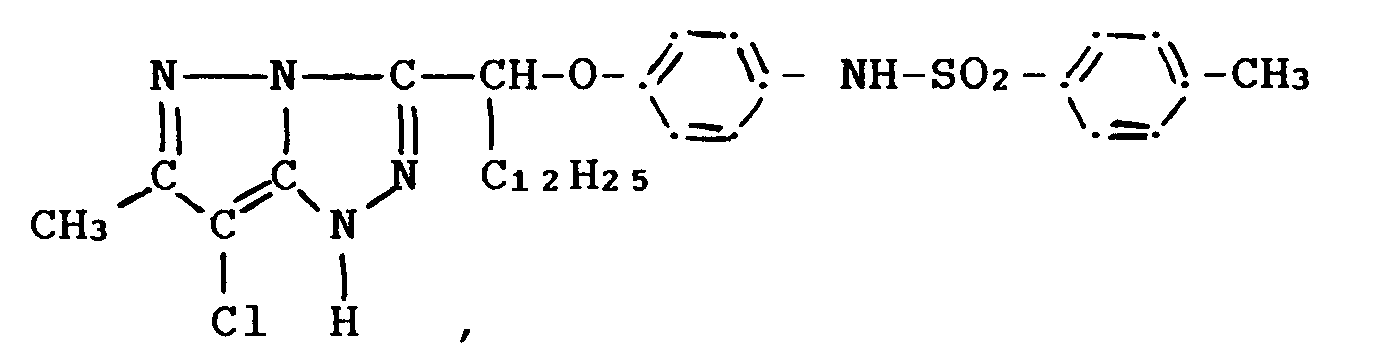
Example of Synthesis 1 [Preparation of Coupler (1)]
[0020] 3-[1-(4-aminophenoxy)tridecyl]-6-methyl-1H-pyrazolo[-3,2-c]-1,2,4-triazole (2.45 g, 0.00549 mole), prepared as described in EP 284,240, were dissolved in 30 ml of tetrahydrofuran, and toluene-4-sulfonylchloride (1.1 g, 0,00576 mole) and N,N-dimethylaniline (1.4 g, 0,0115 mole) were added. After stirring at room temperature for sixteen hours, the solution was poured into cold dilute hydrochloric acid and extracted with diethyl ether. The collected organic layers were washed with water, dried and evaporated. The product was crystallized from nitromethane. The yield was 3.3 g.
| Elemental analysis: | ||||
| C%=62.03 | H%=7.05 | N%=11.67 | S%=5.36 | (Theoretical) |
| C%=61.80 | H%=7.13 | N%=11.69 | S%=5.41 | (Found) |
NMR Analysis:
¹H NMR: δ=0.86(t,3H); 1.1-1.7(m,2H); 2.0-2.3(m,2H); 2.24(s,3H); 2.34(s,3H); 5.1-5.4(m,1H); 6.40(s,1H); 6.83(s,4H); 7.15-7.25(d,2H); 7.40-7.55(d,2H); 9.50(s,1H).
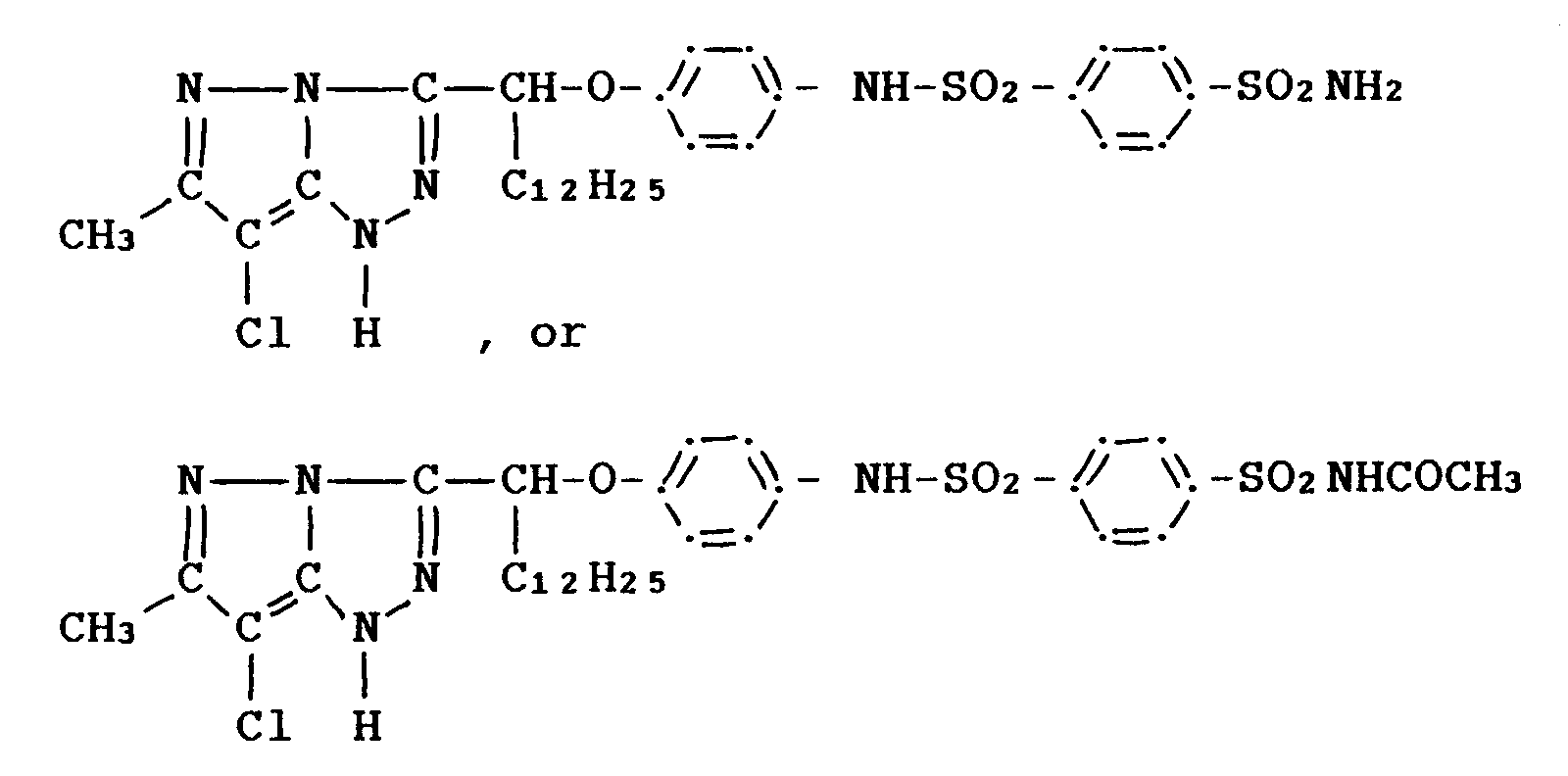
Example of Synthesis 2 [Preparation of Coupler (2)]
[0021] 3-[1-(4-aminophenoxy)tridecyl]-6-methyl-1H-pyrazolo[-3,2-c]-1,2,4-triazole (8.92 g, 0.02 mole) were dissolved in 90 ml of tetrahydrofuran, and 4-(aminosulfonyl)-benzenesulfonyl chloride (5.37 g, 0.021 mole), prepared according to A.V. Kirsanov and N.A. Kirsanova (Inst. Org. Chem, Kiev), Zhur. Obshchei Khim. 29, 1802-13, 1959 (C.A. 54,8693F) and N,N-diethylaniline (5.01 g, 0.042 mole) were added. After stirring at room temperature for six hours the solution was poured into cold dilute hydrochloric acid and extracted with ethyl acetate. The collected organic layers were washed with water, dried and evaporated to dark oil. The product was chromatographed on silica gel to obtain after trituration with ligroin a solid. Yield: 10 g.
| Elemental analysis: | ||||
| C%=54.16 | H%=6.21 | N%=12.63 | S%=9.64 | (Theoretical) |
| C%=53.90 | H%=6.18 | N%=12.33 | S%=9.05 | (Found) |
NMR Analysis:
¹ H NMR: δ=0.80(t,3H); 1.1-1.7(m,20H); 2.0-2.3(m,2H); 2.20(s,3H); 5.25(t,1H); 6.75(d,2H); 6.89(d,2H); 6.88(s,2H); 7.71(d,2H); 7.85(d,2H); 9.66(s,1H); 12.59(s,1H).
Example of Synthesis 3 [Preparation of Coupler (3)]
[0022]
1) Synthesis of 4-(N-acetamido-sulfonyl)-benzenesulfonyl chloride.
4-(aminosulfonyl)-benzenesulfonyl chloride (10.22 g, 0.04 mole) were added to 100 ml of acetic anhydride. The solution was stirred and heated at 100°C for four hours, then it was poured into water. A white product was obtained, filtered washed with water and dried. Yield: 10.1 g.
| Elemental analysis: | ||||
| C%=32.27 | H%=2.71 | N%=4.70 | S%=21.54 | (Theoretical) |
| C%=32.15 | H%=2.64 | N%=4.77 | S%=21.44 | (Found) |
¹H NMR: δ=1.83(s,3H); 7.99(d,2H); 8.09(d,2H); 11.9(s,1H).
2) 3-[1-(4-aminophenoxy)tridecyl]-6-methyl-1H-pyrazolo[-3,2-c]-1,2,4-triazole (7.87 g, 0.0176 mole) were dissolved in 100 ml of tetrahydrofuran, and 4-(N-acetamidosulfonyl)benzenesulfonyl chloride (5.51 g, 0.0185 mole) and N,N-diethylaniline (4.49 g, 0.037 mole) were added. After stirring at room temperature for sixteen hours, the solution was poured into cold dilute hydrochloric acid and extracted with ethyl acetate. The collected organic layers were washed with water, dried and evaporated. The product was chromatographed on silica gel. The obtained oil was dissolved in diethyl ether and precipitated in petrol ether. Yield: 7 g.
| Elemental analysis: | ||||
| C%=54.34 | H%=6.13 | N%=11.88 | S%=9.07 | (Theoretical) |
| C%=54.04 | H%=5.98 | N%=11.58 | S%=9.38 | (Found) |
¹ H NMR: δ=0.75(t,3H); 1.1-1.6(m,20H); 1.78(s,3H); 2.0-2.3(m,2H); 2.17(s,3H); 5.24(t,1H); 6.71(d,2H); 6.85(d,2H); 7.62(d,2H); 7.84(d,2H).
[0023] The magenta dye forming couplers for use in this invention may be incorporated in a silver halide photographic material by any of the methods known in the art for incorporation of nondiffusible couplers, such as, for example, a solid dispersion method, a latex dispersion method, and preferably an oil dispersion method. For example, in the oil dispersion method the couplers can be dissolved in a high boiling water insoluble solvent and the resulting solution emulsified into an aqueous medium as described for example in US Pat. Nos. 2,304,939, 2,322,027, etc., or said hydrophobic couplers are dissolved in said high boiling organic solvents in combination with low boiling organic solvents and the resulting solution emulsified into the aqueous medium as described for example in US Pat. Nos. 2,801,170, 2,801,171, 2,949,360, etc. Typical known high boiling solvents include phthalate esters (e.g. dibutyl phthalate and dioctyl phthal- ate), phosphate esters (e.g. tricresyl phosphate and trioctyl phosphate) and N-substituted acid amides (e.g. N,N-diethyllauramide). Typical known low boiling solvents include ethyl acetate, butyl acetate, methyl ethyl ketone, cyclohexanone, 2-ethoxyethyl acetate, dimethylformamide, etc. Specific examples of the latex dispersion method are described in US Pat. No. 4,199,363, etc.
[0024] The pyrazolotriazole magenta couplers for use in this invention are preferably incorporated in light-sensitive silver halide emulsion layers. The addition amount thereof is from 0.003 to 1 mole, preferably from 0.005 to 0.3 mole per mole of silver halide for color photographic light sensitive elements. The silver halide emulsion layer containing the pyrazolotriazole magenta couplers described above or a layer sensitive to same region of the visible spectrum may contain conventional magenta dye-forming couplers, DIR couplers, BAR couplers, FAR couplers, DAR couplers and colored couplers (all these couplers exibiting variuos effects upon processing) as described below.
[0025] The photographic elements of the present invention are preferably multilayer color elements comprising a blue sensitive or sensitized silver halide emulsion layer associated with yellow dye-forming couplers, a green sensitized silver halide emulsion layer associated with magenta dye-forming couplers and a red sensitized silver halide emulsion layer associated with cyan dye-forming couplers, at least one of the couplers in the element being a coupler as described above. Each layer can comprise a single emulsion layer or of multiple emulsion sub-layers sensitive to a given region of the visible spectrum. When multilayer elements contain multiple blue, green or red sublayers, there can be in any case relatively faster and slower sub-layers. The photographic elements can contain additional layers, such as filter layers, interlayers, overcoat layers, subbing layers, and the like.
[0026] The term "associated" is used to denote that the coupler is positioned in such a relation to the silver halide emulsion layer that the coupler and the layer are capable of interacting to give rise to an imagewise correspondence between the silver image formed on development and the color image produced from the coupler. This is generally achieved by arranging the coupler in the silver halide emulsion layer or in an adjacent layer of binder which may be light-insensitive. Preferred couplers for use in this invention include those which are nondiffusible due to the presence of hydrophobic ballast group in the molecule.
[0027] Typical examples of useful color couplers are naphtholic, phenolic or pyrazoloazole cyan dye-forming couplers, pyrazolone or pyrazoloazole magenta dye-forming couplers and open chain or heterocyclic ketomethylene yellow dye-forming couplers. Cyan, magenta and yellow couplers, which can be used in this invention, are described in Research Disclosures No. 17643, Chapter VII (December 1978) and No. 18717 (November 1979).
[0028] Typical examples of the yellow dye-forming couplers which can be used in this invention include known open chain acylacetamide couplers, such as pivaloyl acetanilide and benzoyl acetanilide couplers. In this invention two-equivalents yellow couplers are preferably used, such as those which are oxygen atom-releasing yellow couplers and nitrogen atom-releasing yellow couplers. Illustrative yellow dye-forming couplers are shown in US Pat. Nos. 2,407,210, 2,875,057, 3,265,506, 3,408,194, 3,447,928, 3,933,501, 4,022,620, 4,326,024 and 4,401,752, in GB Pat. Nos. 1,077,874 and 1,425,020, in DE Pat. Appl. Nos. 2,219,917, 2,261,361, 2,329,587, and 2,433,812, JA Pat. Nos. 19031/71, 19956/70, and 10739/83, and in JA Pat. Public Disclosure Nos. 123342/75, 87650/75, 133329/79, 66835/73, 94432/73, 28834/75, 99433/79, 70841/80, 74249/81, 102636/76 and 87041/81.
[0029] Cyan couplers which can be used in this invention include naphtholic, phenolic and pyrazoloazole couplers. Specific examples of the naphtholic couplers are the naphtholic couplers described in US Pat. No. 2,474,293 and the oxygen atom-releasing two-equivalent naphtholic couplers described in US Pat. Nos. 4,052,212, 4,146,396, 4,228,233, and 4,296,200. Specific examples of the phenolic couplers are described in US Pat. Nos. 2,369,929, 2,423,730, 2,772,162, 2,895,826, and 3,772,002. Specific examples of pyrazoloazole cyan couplers are described in EP Pat. Appl. 287,265. Cyan couplers preferably used in this invention are 2,5-diacylamino substituted phenolic cyan couplers described in US Pat. Nos. 2,772,162, 3,758,308, 4,126,396, 4,334,011, and 4,327,173, in DE Pat. Appl. No. 3,229,729 and in JA Pat. Appl. 42761/83, and the phenolic couplers having a phenylureido group at the 2-position and an acylamino group at the 5-position described in US Pat. Nos. 3,446,622, 4,333,999, 4,451,559, 4,427,767, etc.
[0030] The magenta dye-forming couplers defined above according to this invention may be used either alone or in combination with themselves. If desired, they may be used in combination with known magenta dye-forming couplers such as pyrazolone, indazolone, cyanoacetyl, pyrazoloazole and pyrazolotriazole couplers. Useful magenta dye-forming couplers may include those described in US Pat. Nos. 2,600,788, 2,983,608, 3,026,653, 3,127,269, 3,311,476, 3,419,391, 3,519,429, 3,558,319, 3,582,322, 3,615,506, 3,384,908, and 3,891,445, in DE Pat. No. 1,810,464, in DE Pat. Appl. Nos. 2,408,665, 2,417,945, 2,418,959, and 2,424,467, JA Pat. No. 6031/65, and in JA Provisional Pat. Publ. Nos. 20826/76, 58922/77, 129538/74, 74027/74, 159336//75, 42121/77, 74028/74, 60233/75, 26541/76 and 55122/78.
[0031] The color couplers may be 4-equivalent or they may be 2-equivalent couplers. The latter are derived, as is known, from 4-equivalent couplers in that they contain, in the coupling position, a group which is released in the coupling reaction. The 2-equivalent couplers include both those which are colourless and those which have an intense color which disappears during the coupling reaction and may replaced by the color of the image dye produced. The latter (masking couplers) are used, together with the above described couplers, for correcting the undesired absorption of the image dyes of the magenta and cyan couplers at a short wavelength region.
[0032] Typical examples of masking couplers are the yellow-colored magenta couplers described in US Pat. No. 4,163,670 and in JA Pat. No. 39413/82, and the magenta-colored cyan couplers described in US Pat. Nos. 4,004,929, 4,138,258, and in GB Pat. No. 1,146,368.
[0033] Also, couplers providing diffusible colored dyes can be used together with the above mentioned couplers for improving graininess and specific examples of these couplers are magenta couplers described in US Pat. No. 4,366,237 and GB Pat. No. 2,125,570 and yellow, magenta and cyan couplers described in EP Pat. No. 96,873, and in DE Pat. Appl. No. 3,324,533.
[0034] Also, among the 2-equivalent couplers are those couplers wich carry in the coupling position a group which is released in the color development reaction to give a certain photographic activity, e.g. as development inhibitor or accelerator or bleaching accelerator, either directly or after removal of one or further groups from the group originally released. Examples of such 2-equivalent couplers include the known DIR couplers as well as DAR, FAR and BAR couplers. Typical examples of said couplers are described in DE Pat. Appl. Nos. 2,703,145, 2,855,697, 3,105,026, 3,319,428, 1,800,420, 2,015,867, 2,414,006, 2,842,063, 3,427,235, 3,209,110, and 1,547,640, in GB Pat. Nos. 953,454 and 1,591,641, and in EP Pat. Appl. Nos. 89,843, 117,511, 118,087, 193,389, and 301,477.
[0035] The light-sensitive silver halide color photographic element may contain high molecular weight color couplers as described for example in US Pat. No. 4,080,211, in EP Pat. Appl. No. 27,284 and in DE Pat. Appl. Nos. 1,297,417, 2,407,569, 3,148,125, 3,217,200, 3,320,079, 3,324,932, 3,331,743, and 3,340,376.
[0036] The silver halide emulsions used in the present invention may be fine dispersions of silver chloride, silver bromide, silver chloro-bromide, silver iodo-bromide and silver chloro-iodo-bromide grains in a hydrophilic binder. The silver halide grains may have different phases between the inside thereof and the surface thereof. Also, the silver halide grains may be ones forming mainly surface latent images or ones forming latent images mainly in the inside thereof. As hydrophilic binder, any hydrophilic polymer of those conventionally used in photography can be advantageously employed including gelatin, a gelatin derivative such as acylated gelatin, graft gelatin, etc., albumin, gum arabic, agar agar, a cellulose derivative, such as hydroxyethyl-cellulose, carboxymethyl-cellulose, etc., a synthetic resin, such as polyvinyl alcohol, polyvinylpyrrolidone, polyacrylamide, etc. Preferred silver halide grains are silver iodo-bromide or silver iodobromo-chloride containing 1 to 20% by mole of silver iodide per mole of silver halide. The silver halide grains may have any crystal form such as cubic, octahedral, spherical or tabular or a mixed crystal form. The silver halide grains may have a uniform grain size or a broad grain size distribution. The size of the silver halide ranges from about 0.1 to 5 µm. The silver halide grains may have different phases between the inside thereof and the surface thereof. Also, the silver halide grains may be ones forming latent images mainly on the surfaces thereof or ones forming latent images mainly in the insides thereof. The total silver halide content in the blue sensitive, green sensitive and red sensitive emulsion layers of the photographic elements comprising the pyrazolotriazole couplers according to this invention is 7.5 g/m² or more as calculated on silver, with proportions in each sensitive layer varying as desired according to the particular needs. The silver halide emulsions may be prepared using a single-jet method, a double-jet method, or a combination of these methods or may matured using, for example, an ammonia method, a neutralization method, an acid method, etc., as described in Research Disclosure 17643, I and II, December 1978. The emulsions which can be used in the present invention can be chemically and optically sensitized, as described in Research Disclosure 17643, III and IV, December 1978. They can contain optical brighteneres, antifogging agents and stabilizers, antistain agents and image dye stabilizers, filter and antihalo dyes, hardeners, coating aids, plasticizers and lubricants, matting agents, development modifiers and other auxiliary substances, as described for example in Research Disclosure 17643, V, VI, VII, VIII, XI, XIII, XVI and XXI, December 1978. The layers of the photographic element can contain various colloids, alone or in combination, such as binders, as for example described in Research Disclosure 17643, IX, December 1978. The above described layers can be coated onto several support bases (cellulose triacetate, paper, resin-coated paper, polyester) by adopting various methods, as described in Research Disclosure 17643, XV and XVI, December 1978. The light-sensitive silver halides contained in the photographic element after exposure can be processed to form a visible image by associating the silver halides with an aqueous alkaline medium in the presence of a developing agent contained in the medium or in the element. Processing formulations and techniques are described in Research Disclosure 17643, XIX, XX and XXI, December 1978.
[0037] The invention will be now illustrated in greater details by reference to the following example.
EXAMPLE
[0038] Film 1 (comparison) was prepared by coating a cellulose triacetate support base, subbed with gelatin, with the following layers in the following order:
(a) a layer of green-sensitized silver halide emulsion comprising a blend of a low-sensitivity silver bromoiodide emulsion (having 2.5% silver iodide moles and a mean grain size of 0.18 µm) and a medium-sensitivity silver chloro-bromo-iodide (having 7.2% silver iodide moles and 5% silver chloride moles and a mean grain size of 0.4 µm) coated at a silver coverage of 2.0 g/m² and a gelatin coverage of 1.8 g/m² and the magenta dye forming coupler A, dispersed in the layer with high boiling water insoluble organic solvents, at a coverage of 1.18 millimole/m².
[0039] Film 2 (comparison) was prepared as Film 1, except that the magenta dye forming coupler was coupler B.
[0040] Film 3 (invention) was prepared as Film 1, except that the magenta dye forming coupler was coupler (1).
[0041] Film 4 (invention) was prepared as Film 1, except that the magenta dye forming coupler was coupler (2).
[0042] Samples of the films 1, 2, 3 and 4 were exposed to a light source having a color temperature of 5,500°K through an optical step wedge and developed in a standard type C 41 processing chemistry as described in British Journal of Photography, July 12, 1974, pp. 597-598. Table 1 reports the sensitometric results, wherein Speed1 and Speed2 are the sensitivity expressed as -logE, in which E is exposure in meter-candle-seconds, measured at density, respectively, 0.2 and 1 above fog, Contr.1 and Contr.2 are, respectively, the toe and medium contrast of the sensitometric curve, and λmax is, in the spectral region, the absorption maximum wavelenghth (nm) of the magenta dye formed from the coupler upon development.
Table 1
| Film | Fog | Dmax | Speed1 | Speed2 | Contr.1 | Contr.2 | λmax |
| 1 | .20 | 2.36 | 1.91 | 1.23 | 1.06 | 0.79 | 554 |
| 2 | .27 | 2.33 | 1.96 | 1.10 | 0.75 | 0.60 | 546 |
| 3 | .15 | 2.90 | 1.98 | 1.35 | 1.21 | 0.98 | 554 |
| 4 | .19 | 2.52 | 1.96 | 1.42 | 1.36 | 0.93 | 556 |
[0043] From the results shown in Table 1, it is apparent that the magenta couplers of the present invention have good values of fog, sensitivity and contrast, and absorption maxima comparable with that of the 5-pyrazolone magenta coupler A. The comparison pyrazolotriazole coupler B, on the other hand, has inferior photographic results and is more reddish in hue.
1. A silver halide color photographic element comprising a support and at least one silver
halide emulsion layer containing at least one nondiffusible magenta coupler of the
1H-pyrazolo[3,2-c]-1,2,4-triazole series having at a position other than the coupling
position a group expressed by the general formula
wherein L is an aralkylene divalent linking group containing a ballasting residue and having the arylene group of said aralkylene group directly connected to -(NH)n-SO₂-, n is 0 or 1, and R is a substituent selected within the group consisting of a hydrogen atom, an alkyl group, an alkoxy group, a sulfonamido group and an acetylsulfonamido group.
wherein L is an aralkylene divalent linking group containing a ballasting residue and having the arylene group of said aralkylene group directly connected to -(NH)n-SO₂-, n is 0 or 1, and R is a substituent selected within the group consisting of a hydrogen atom, an alkyl group, an alkoxy group, a sulfonamido group and an acetylsulfonamido group.
2. A photographic element according to claim 1 wherein in the main chain of said aralkylene
group -O-, -S-, -NHCO- or -CONH- may be contained.
3. A photographic element according to claim 1 wherein L represents a divalent group
of general formula
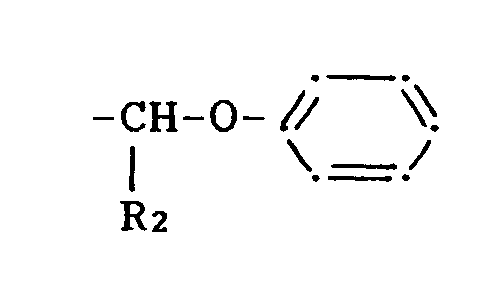
wherein R₂ is an alkyl group of 4 to 20 carbon atoms.
wherein R₂ is an alkyl group of 4 to 20 carbon atoms.
4. A photographic element according to claim 1 wherein the coupler has the general formula
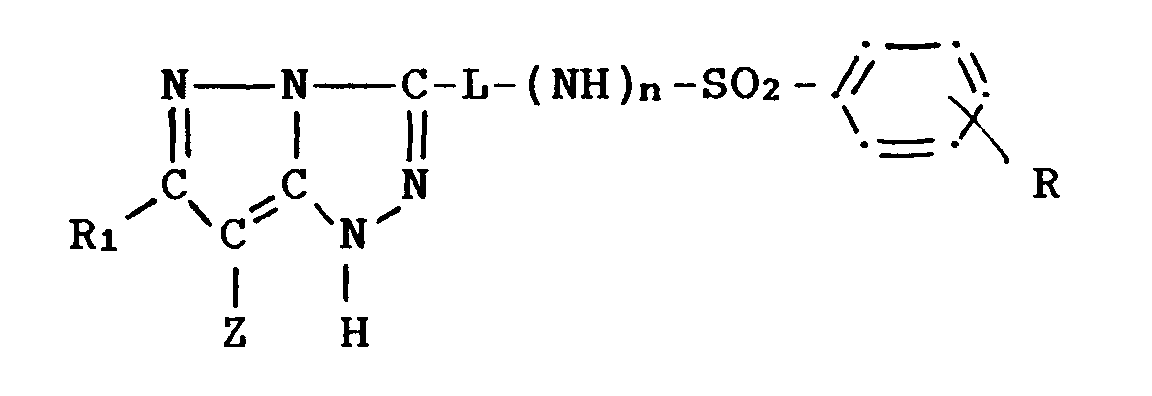
wherein R₁ is a hydrogen atom, an alkyl group or an aryl group, and Z is a hydrogen atom, a halogen atom or a group which can be eliminated upon coupling reaction with the oxydized product of a color developing agent.
wherein R₁ is a hydrogen atom, an alkyl group or an aryl group, and Z is a hydrogen atom, a halogen atom or a group which can be eliminated upon coupling reaction with the oxydized product of a color developing agent.
5. A photographic element according to claim 1, wherein the coupler has the general formula

wherein R₂ is an alkyl group of 4 to 20 carbon atoms, R₁ is a hydrogen atom, an alkyl group or an aryl group, and Z is a hydrogen atom, a halogen atom or a group which can be eliminated upon coupling reaction with the oxydized product of a color developing agent.
wherein R₂ is an alkyl group of 4 to 20 carbon atoms, R₁ is a hydrogen atom, an alkyl group or an aryl group, and Z is a hydrogen atom, a halogen atom or a group which can be eliminated upon coupling reaction with the oxydized product of a color developing agent.
6. A photographic element according to claim 1, wherein the coupler has the structure