|
(11) | EP 0 512 522 A1 |

| (12) | EUROPEAN PATENT APPLICATION |
|
|
|
|
|||||||||||||||||||||||
| (54) | Novel antibiotic compounds and their production |
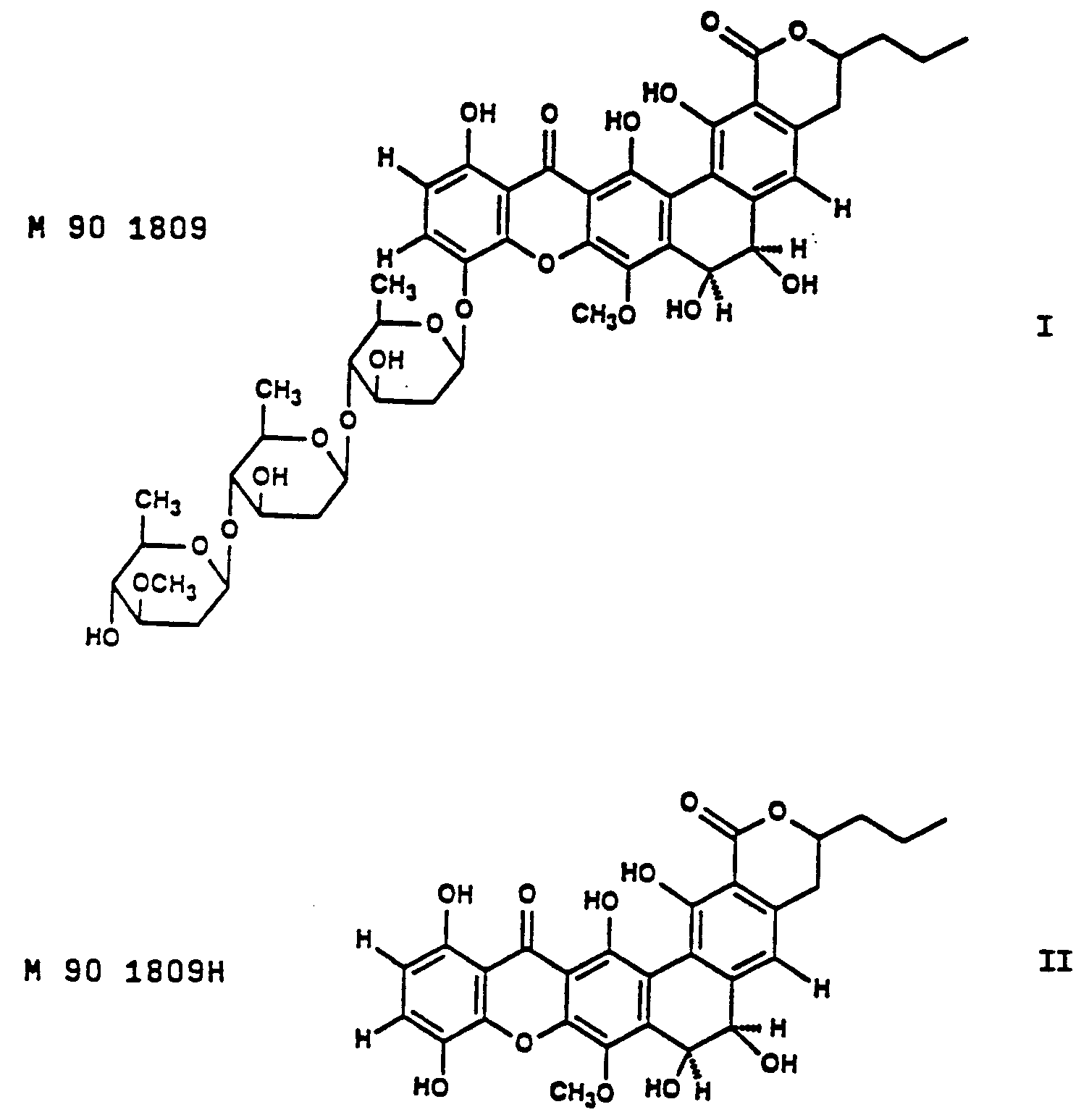
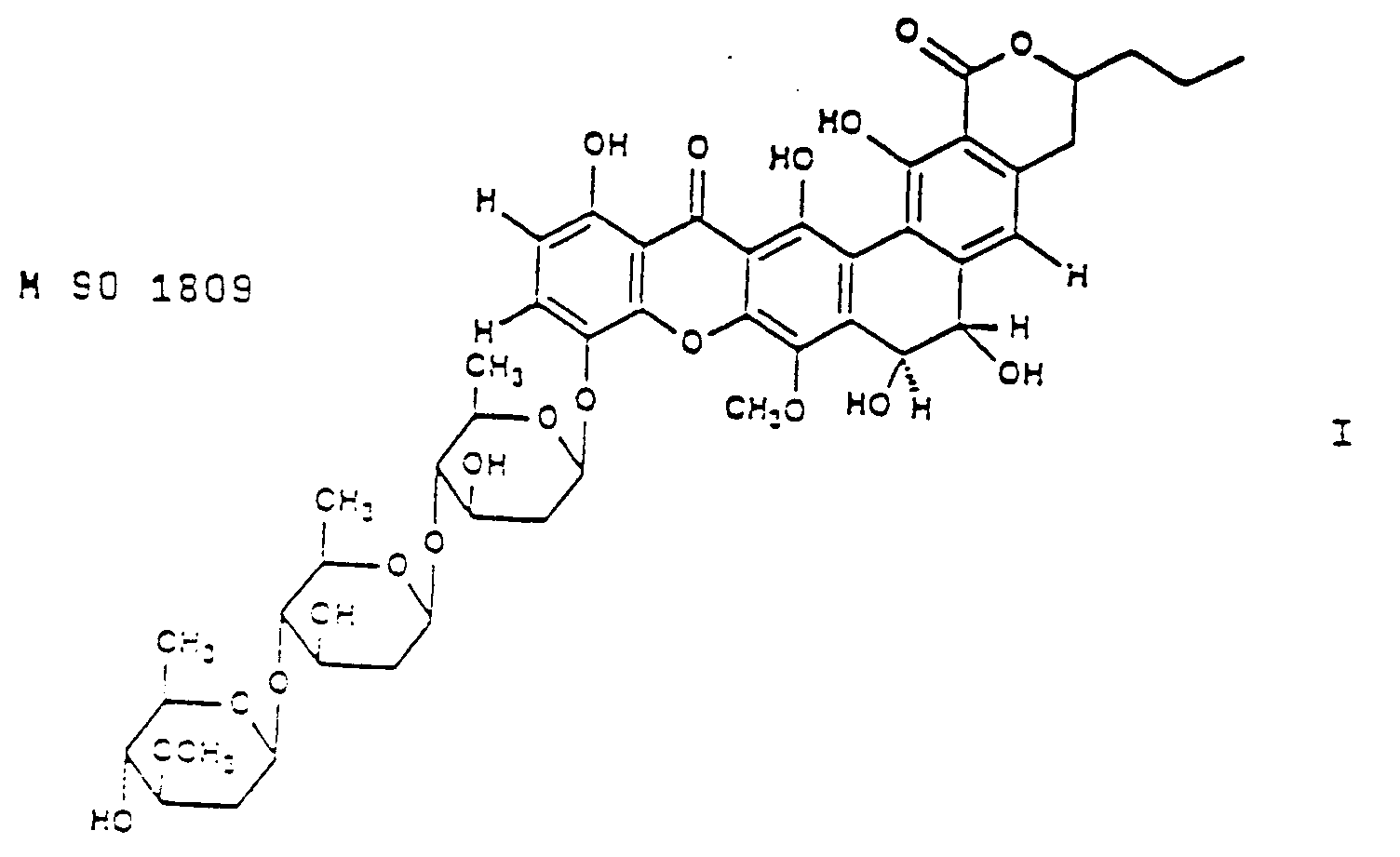
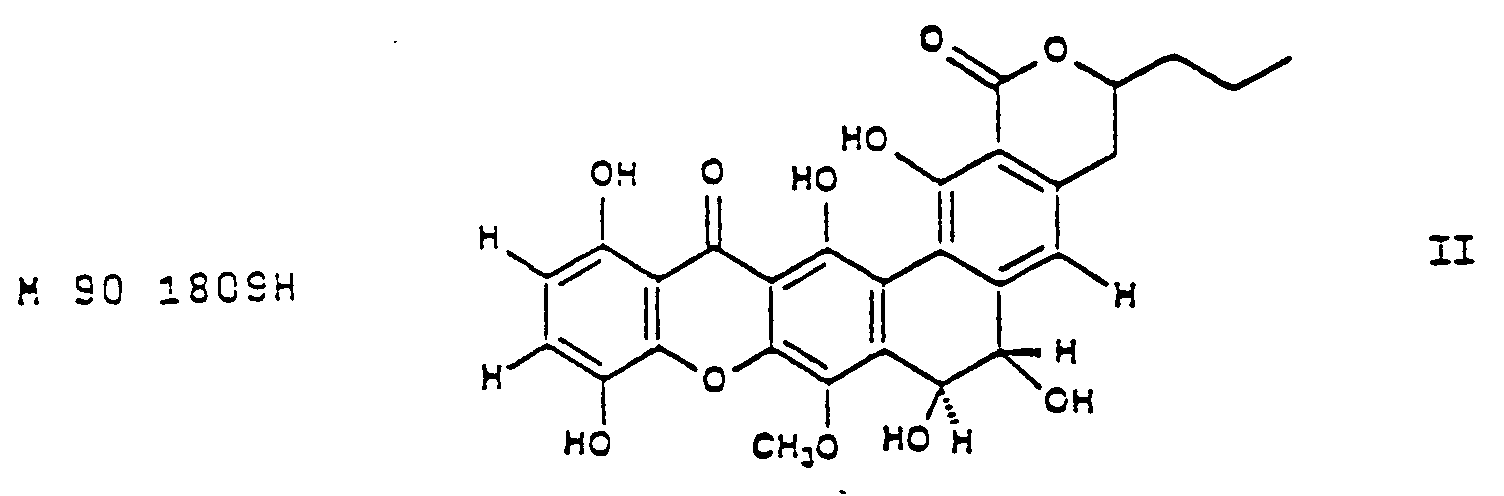
| (57) The novel compounds of formulas I and II
have an antibiotic activity. |
[0001] The instant invention relates to the new compounds of formula I and II
as well as to a process for their production with the help of Streptomyces species culture number HIL Y-90,31665 (Str. sp. Y-90,31665). Said microorganism has been deposited under the conditions of the Treaty of Budapest on February 25, 1991 (DSM 6389).
[0002] Str. sp. Y-90,31665 was isolated from soil collected at the Bharatpur Game Reserve, Rajasthan, India. Variants and mutants of culture number HIL Y-90,31665 can be obtained in a known manner using a mutagen, such as N-methyl-N'-nitro-N-nitrosoguanidine or ultraviolet light. The microorganism Str. sp. Y-90,31665 belongs to the order Actinomycetales, family Streptomycetaceae and genus Streptomyces.
[0003] Str. sp. Y-90,31665 is considered to be a new strain since it differs from the known strains in some of its morphological, cultural and physiological characteristics. It is considered to be a new strain also because it produces a new compound herein called M901809 as will be clear from the description hereinafter.
[0004] Str. sp. Y-90,31665 can be isolated from soil using a nutrient medium at a pH of 6.5 to 8.5 in known manner.
[0005] The nutrient medium used for isolation of the microorganism from soil preferably consists of the following carbon and nitrogen sources, inorganic nutrient salts and solidifying agents. Sources of carbon may be glucose, starch, dextrin, glycerol, sucrose or molasses. Sources of nitrogen may be peptone, yeast extract, beef extract, malt extract, casein or amino acids such as arginine or asparagine. The solidifying agent may, for example, be agar. The inorganic nutrient salts may be saris of sodium, potassium, magnesium, calcium, iron, zinc, manganese, copper, phosphorous or sulphur.
The microorganism of this invention elongates colourless aerial mycelia from branched substrate mycelia. Spores are formed in straight chains on top of aerial mycelia representative of Section Spirales. Neither whirl nor ascospores are observed. Mature spore chains contain more than 30 spores per chain. Based on the cultural and morphological characteristics of the microorganism on various agar media, as well as cell wall analysis which shows the presence of LL-diaminopimelic acid, the producing organism was identified as a Streptomyces sp.
[0006] It may be well understood to those skilled in the art that this invention is not limited to the particular organism which has been specified above but includes all those spontaneous and artificial mutants and variants derived from the said microorganism which are capable of producing the new compound M901809.
[0007] The chemical structure of the compound M901809 has been elucidated from its spectroscopie data and by using two-dimersional NMR spectroscopic techniques. M901809 consists of a trisaccharide unit linked to a polycyclic xanthone containing aglycone. Under acidic conditions, M901809 can be hydrolysed to yield the aglycone M901809H which also is a novel antibitotic. Both M901809 and M901809H represent a new type of natural product.
[0008] There are several antibiotics known which exhibit the same carbon frame-work but a lactame function instead of the lactone function in ring F and, in addition, quite a different substitution pattern:
- Lysolipion I.
- M. Dobler and W. Keller-Schierlein; Helv. Chim. Acta 60 (1977), 178.
- Cervinomycin.
- S. Omura, A. Nakagawa, K. Kushida and G. Lukacs; J. Amer. Chem. Soc. 108 (1986), 6088.
- Actinoplanones A-G.
- K. Kobayashi, C. Nishino, J. Ohja, S. Sato, T. Mikawa, Y. Shiobara and M. Kodama; J. Antibiotics XLI (1988, 741.
- Simaomicins.
- T.M. Lee, G.t. Carter and D.B. Borders; J. Chem. Soc., Chem. Commun. (1989), 1771.
- LL-E19085.
- W.M. Maiese, M.P. Lechevalier, H.A Lechevalier, J. Korshala, J. Goddmann, M.J. Wildey, N. Kuck and M. Greenstein; J. Antibiotics XLII (1989), 846.
- Citreaminicins.
- G.T. Carter, J.A. Nietsche, D.R. Wlliams and D.B. Borders; J. Antibiotics XLIII (1990, 504.
[0009] According to the present invention there is also provided a process for the production of M901809 which contains the novel aglycone M901809H, said process comprising cultivating Str. sp. Y- 90,31665 by fermentation at a pH between 6.0 and 8.0 and a temperature between 20-40 °C under aerobic conditions in a nutrient medium containing sources of carbon and nitrogen, nutrient inorganic salts, and trace elements, and isolating the compound from the culture broth in a known manner such as herein described.
[0010] The carbon sources used in the nutrient medium for the production of the novel compounds may be for instance starch, dextrin, glycerol, sucrose, molasses or oil. Sources of nitrogen used in the nutrient medium for production of the novel antibiotics may be for instance soyabean meal, yeast extract, beef extract, malt extract, cornsteep liquor, peptone,gelatin or casein. Nutrient inorganic salts/mineral salts used in the nutrient medium for production of the novel antibiotics may be e.g. sodium chloride, magnesium sulphate, ammonium sulphate or calcium carbonate. As trace elements, for example iron, manganese, copper, zinc or cobalt may be used.
[0011] Preferably Str. sp. Y-90,31665 is cultivated at 27 °C and pH 7.2. The fermentation is preferably stopped after 66-72 hours when maximum yields of the compounds are obtained. The fermentation may, preferably, be submerged fermentation. The process of fermentation and formation of the novel compound can be monitored by the antibacterial activity of the culture fluid and mycelium against Staphylococcus aureus 209 P in agar medium and by thin layer chromatography on silica gel plates with ethyl acetate as developing solvent.
[0012] If desired, an antifoaming agent such as Desmophen(R) (Polyols, Bayer AG, Leverkusen, Germany) may be used in the nutrient medium during fermentation of the culture.
[0013] Compound M901809 is found predominantly in the mycelium and can be extracted out using an organic solvent such as methanol, acetone, acetonitrile, chloroform or ethyl acetate. The preferred solvent is acetone. After concentration of the mycelium extract the aqueous concentrate is diluted with water and extracted with a water-immiscible solvent such as butanol, ethyl acetate or chloroform. The preferred solvent is ethyl acetate. Antibiotic M901809 is also obtained from the culture filtrate by extraction with a water-immiscible solvent after the pH has been adjusted to 6.8 -7.2. The solvents could be ethyl acetate or chloroform ; preferably, it is ethyl acetate and the preferred pH is 7.0. The solvent extracts of the mycelium and the culture filtrate are concentrated to remove the solvent and then chromatographed further. Compound M901809 can also be obtained from the culture broth by direct adsorption on suitable adsorbents such as Amberlite(R) XAD-4 or 7 (Rohm and Haas Co., U.S.A.), or Diaion(R) HP-20 (Mitsubishi Chemical Industries, Japan); the preferred adsorbent being Diaion(R) HP-20. The compound according to the invention is eluted from the adsorbent using appropriate mobile phases, such as methanol or acetone, either singly, in combination with each other, or with water, and the eluates are then evaporated to dryness. The preferred eluant is methanol. The active eluates thus obtained are pooled and concentrated.
[0014] The aforementioned concentrated eluates or extracts containing compound M901809, can be further purified in a number of ways. For example, re-adsorption and elution processes with activated carbon, Amberlite(R) XAD-4 and 7 or Diaion(R) HP-20; gel filtration with Sephadex(R) LH-20 gel (Pharmacia Fine Chemicals AB, Sweden) and its equivalents; adsorption chromatography on alumina and silica gel, can be conveniently combined for further purification. In addition, thin-layer chromatography, medium-pressure and high-pressure liquid chromatography using suitable adsorbents such as silica gel and modified silica gel-C₁₈ with suitable solvent systems may be used. Furthermore, counter current chromatography with a particular biphasic solvent system may work well for the said purpose. Preferably, silica gel chromatography with dichloromethane and ethyl acetate as the eluting solvents is used. Another purification process used either alone, or in combination with the abovementioned purification procedures, is based on the differential solubility of compound M901809 in organic solvents. The aforementioned concentrated extracts or eluates containing compound M901809 may be precipitated with hexane or petroleum ether, repeatedly, in a known manner.
[0015] Compound M901809 may also be washed with methanol:water (99:1) and methanol:ethyl acetate (1:1) to remove impurities. Finally, compound M901809 may be crystallized in a suitable solvent, or mixture of solvents.
[0016] Hydrolysis of compound M901809 using acidic conditions yields the acid hydrolysis product M901809H. The acids used may be acetic acid, sulfuric acid, hydrochloric acid, nitric acid or phosphoric acid. The hydrolysis may be carried out directly in the acid of various strengths, or in combination with organic solvents such as methanol, acetone or acetonitrile, with or without heating. The preferred method involves refluxing of M901809 with methanol:HCl (1:1).
[0017] The aglycone M901809H may be recovered from the reaction mixture by distillation under reduced pressure to remove the solvent. The residue is washed with water and extracted with a water-immiscible solvent such as dichloromethane. Chromatography of the concentrated dichloromethane extract over silica gel using a dichloromethane to ethyl acetate gradient gives the pure M901809H.
[0018] The above data was subjected to a CAS (Chemical Abstract Service) On-Line search which proved that compounds M901809 and M901809H are novel.
[0019] Compound M901809 and its acid hydrolysis product M901809H are active against gram-positive bacteria. The minimum inhibitory concentrations (MIC) of both compounds, determined by the agar- dilution method in Mueller-Hinton agar, are shown in Table II below:
[0020] In addition compound M901809 was also found active in the treatment of experimental animals infected with staphylococci and streptococci.
[0021] The invention will be further illustrated by preferred examples and by the content of the patent claims.
EXAMPLE I
Isolation of Streptomyces sp. Y-90,31665 from soil
(a) Preparation of nutrient isolation media
[0022]
| Medium 1: | Starch | 10.0 g |
| Casein | 0.3 g | |
| KNO₃ | 2.0 g | |
| NaCl | 2.0 g | |
| K₂HPO₄ | 2.0 g | |
| MgSO₄.7H₂O | 0.05 g | |
| CaCO₃ | 0.02 g | |
| FeSO₄.7H₂O | 0.01 g | |
| Agar | 15.0 g | |
| Distilled water | 1 litre | |
| pH | 7.2-7.5 |
[0023] The media were sterilised at 121 °C for 30 minutes. In all cases, the sterilized media were cooled to 45 °C, poured into petri plates and allowed to solidify.
(b) Preparation of soil suspension
[0024] One gram of soil was suspended in distilled water and shaken well. The soil was allowed to settle and the supernatant fluid was used to inoculate each one of the above mentioned isolation media at a time.
(c) Inoculation of the isolation medium
[0025] One ml of the soil suspension was inoculated onto petri dishes containing 50 ml of any of the above mentioned nutrient isolation media.
(d) Isolation of Streptomyces sp. Y-90,31665
[0026] The inoculated petri dish was incubated at 30 °C for 10 days and Streptomyces sp. Y-90,31665 isolated from among the growing microorganisms.
EXAMPLE II
Cultivation of Streptomyces sp. Y-90,31665 for the fermentative production of compound M901809
[0027] Streptomyces sp. Y-90,31665 was maintained on yeast extract-malt extract having the following composition :
| Malt extract | 10.0 g |
| Yeast extract | 4.0 g |
| Glucose | 4.0 g |
| Agar | 15.0 g |
| Distilled water | 1 litre |
| pH | 7.0 |
[0028] The medium was distributed in test tubes and sterilized at 121 °C for 30 minutes. The tubes were cooled in a slanting position for preparation of agar slants. The slants were inoculated with the culture and incubated at 28 °C for 10-15 days when good growth and sporulation were observed. A suspension of the spores in distilled water from one slant was used to inoculate five 500 ml Erlenmeyer flasks each containing 100 ml of the seed culture medium.
| Composition of the seed culture medium | |
| Glucose | 15.0 g |
| Soyabean meal | 15.0 g |
| Cornsteep liquor | 5.0 g |
| CaCO₃ | 2.0 g |
| NaCl | 5.0 g |
| Distilled water | 1 litre |
| pH | 6.5 |
[0029] Three litres of the above medium was distributed in 100 ml amounts in 500 ml Erlenmeyer flasks and sterilized at 121 °C for 30 minutes. The flasks were cooled, inoculated with spore suspension or mycelial plugs and shaken at 240 r.p.m. for 72 hours at 27 ° (+ 1 °C) on a rotary shaker with 1.5 inch throw. The resultant growth was used to inoculate the 100 L fermenter containing 85 L of the production culture medium at 3% (v/v).
| Composition of the production medium | |
| Glucose | 20.0 g |
| Soyabeanmeal | 10.0 g |
| CaCO₃ | 0.2 g |
| K₂HPO₄ | 0.5 g |
| CoCl₂.6N₂O | 1.0 mg |
| Distilled water | 1 litre |
| pH | 7.2 |
[0030] 35 ml of Desmophen(R) was added as antifoam agent to 85 L of the production medium taken in a 100 L fermenter. The medium was sterilized through direct and indirect steam for 20 minutes at 121 °C. The fermenter was cooled and inoculated with seed culture (3%v/v). The fermentation was carried out at 27°C (± 1°C) under stirred conditions at 100 r.p.m. with aeration at a rate of 60 litres per minute. When fermentation was discontinued at the end of 66 hours the pH of the culture broth was pH 6.7. The diameter of the zone of inhibition, when tested by the agar well method, versus Staphylococcus aureus 209 P and Micrococcus luteus was 11 and 15 mm respectively when the culture filtrate was was tested, and 14 and 16 mm respectively when mycelium extract. The packed cell volume was 18% (v/v). The culture broth was processed as in Example III.
EXAMPLE III
Isolation and purification of compound M901809
[0031] The culture filtrate (75 litres) from the fermentation as outlined in Example II, was extracted with 45 litres of ethyl acetate at pH 7.0 using a Westphalia(R) counter current extractor. The ethyl acetate extract was concentrated to dryness to give 35 g crude extract. The mycelium (3.5 kg. wet weight) was extracted twice with 20 litres each of acetone. The acetone extract was concentrated to remove the organic solvent and then diluted to 25 litres with distilled water, followed by extraction twice with 15 litres each of ethyl acetate. This second extraction yielded 165 g of crude mycelium extract. The crude extracts were pooled, dissolved in a minimum amount of dichloromethane, and charged onto a 4.5 x 40 cm glass column packed with silica gel (200-300 mesh). The column was eluted with a dichloromethane to ethyl acetate gradient. At a dichloromethane:ethyl acetate ratio of 70:30 an unidentified neutral macrolide antibiotic was isolated. When the ratio was 50:50 to 40:60 the known macrolide antibiotic chalcomycin was obtained. compound M901809 began to elute out when the ratio of the said solvents was 10:90 and eluted out completely with 100% ethyl acetate. The yellow powder obtained (4.2 g) was washed first with two 100 ml volumes of petroleum ether (40-60 °C), then with two 50 ml volumes of methanol, and finally with 50 ml of an ethyl acetate:methanol (1:1) mixture to afford 2.0 g pure compound M901809. M901809 is identified on the basis of its physico-chemical properties and biological activity as described in Tables I and II.
EXAMPLE IV
Preparation of the acid hydrolysis product M901809H
[0032] M901809 (2 g) was dissolved in MeOH (50 ml) to which was added 50 ml of conc. HCl. The reaction mixture was refluxed on a water bath for 3 hours after which the solvent mixture was distilled under reduced pressure to remove all the solvent. The residue was washed with 2 X 25 ml of distilled water and then extracted with 25 ml CH₂Cl₂. The CH₂Cl₂ layer was separated, concentrated under vacuum and dried. The concentrate was loaded onto a 2 X 30 cm glass column containing 50 g silica gel 200-300 mesh in CH₂Cl₂. The column was eluted with a CH₂Cl₂: ethyl acetate gradient with increasing amounts of ethyl acetate, M 901809H eluted out when the ratio of CH₂Cl₂:ethyl acetate was 50:50 to yield 600 mg of the pure compound. M901809H is identified on the basis of its physico-chemical properties and biological activity as described in Table I and II.
1. Compounds of the formula I and II
2. A process for the preparation of a compound of formula II as claimed in claim 1 by
acid treatment of a compound of formula I as claimed in claim 1.
3. A process for the preparation of the compound of formula I as claimed in claim 1,
which comprises cultivation of Str. sp Y-90,31665 under aerobic conditions in an aqueous
nutrient medium which contains carbon sources, nitrogen sources, inorganic nutrient
sources and trace elements and isolating the compound from the culture broth.
4. A process as claimed in claim 3, wherein the cultivation is carried out at a pH between
6 and 8 and at a temperature between 20 and 40 °C.
5. A process as claimed in claims 3 or 4, wherein the cultivation is carried out at pH
about 7.2 and a temperature about 27 °C.
6. A process as claimed in claim 3-5, wherein the cultivation is stopped after 66-72
hours.
7. A pharmaceutical containing an active amount of a compound of formula I and/or of
formula II as claimed in claim 1.
8. The use of a compound of formulas I or II as claimed in claim 1 as an antibiotic agent.
9. A process wherein a compound of formulas I or II are brought into a form suitable
for administration.
10. Streptomyces species Y-90,31665 (DSM 6389).
Claims for the following Contracting State(s): ES, GR
1. A process for the preparation of of the compound of formula I which comprises cultivation
of Str. sp. Y-90,31665 under aerobic conditions in an aqueous nutrient medium which
contains carbon sources, nitrogen sources, inorganic nutrient sources and trace elements
and isolating the compound from the culture broth.
2. A process as claimed in claim 1, wherein the cultivation is carried out at a pH between
6 and 8 and at a temperature between 20 and 40°C.
3. A process as claimed in claims 1 or 2, wherein the cultivation is carried out a pH
about 7.2 and a temperature about 27°C.
4. A process as claimed in claim 1 - 3, wherein the cultivation is stopped after 66-72
hours.
5. A process for the preparation of a compound of formula II
by acid treatment of a compound of formula I as claimed in claim 1.
by acid treatment of a compound of formula I as claimed in claim 1.
6. A pharmaceutical containing an active amount of a compound of formula I and/or of
formula II as claimed in claims 1 or 5.
7. The use of a compound of formulas I or II as claimed in claims 1 or 5 as an antibiotic
agent.
8. A process wherein a compound of formulas I or II are brought into a form suitable
for administration.
9. Streptomyces species Y-90,31665 (DSM 6389).