(57) A description is given of a system for recording and reproducing a signal of an extended
aspect ratio with a magnetic record carrier. An ED video signal, such as a PAL-PLUS
video signal, comprises first lines having a first luminance signal (Y₁) and a chrominance
signal (C), and second lines comprising no chrominance signal but a second luminance
signal (Y₂) in the form of a modulated luminance signal with suppressed carrier.
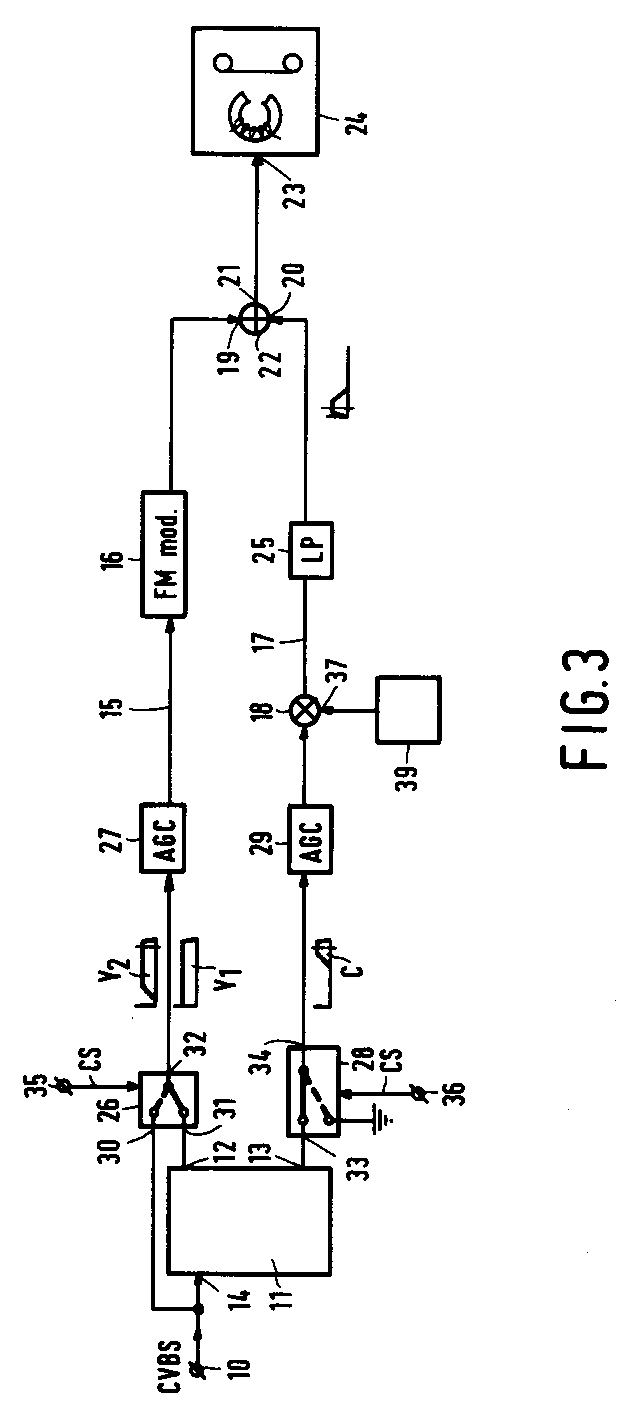
The recording device in the system comprises a first signal path (11,31,32,15) for
processing the first luminance signal, a second signal path (11,33,34,17) for processing
the chrominance signal and a third signal path (30,32,15) for processing the second
luminance signal prior to the three signals being combined (22) and recorded on the
record carrier.
The reproducing device in the system also includes a first (48,50) a second (51,52,53)
and a third signal path (48,73,83) for processing the first luminance signal, the
chrominance signal and the second luminance signal respectively.
Furthermore, converter means are described with which an ED video signal may be converted
to a signal that may be recorded by an SD video recorder and with which a signal read
out by an SD video recorder may be converted to an ED video signal.
The SD video recorder might be a digital video recorder and comprise DCT coding and
decoding.
|
|
