|
(11) | EP 0 512 754 A1 |

| (12) | EUROPEAN PATENT APPLICATION |
|
|
|
|
|||||||||||||||||||||||||||
| (54) | Reduction products of rapamycin as immunosuppressants antiinflammatory or antifungal agents |
| (57) Products of formula (I) obtained from the chemical reduction of one or more of the
ketone groups at positions 15, 27 and 33 of Rapamycin with diisobutylaluminum hydride
or sodium triacetoxyborohydride have been shown to have pharmacological properties
which would make them useful in the treatment of transplantation rejection, autoimmune
diseases, diseases of inflammation and Candida albicans infections.
|
[0001] This invention relates to reduction products derived from Rapamycin where the ketone functionality at positions 15, 33, 15 and 27, 15 and 33 or 15, 27 and 33 is replaced with a hydroxy group, which are useful in the treatment of transplantation rejection, autoimmune diseases (i.e lupus, rheumatoid arthritis, diabetes mellitus, multiple sclerosis), Candida albicans infections, and diseases of inflammation; to their preparation and to pharmaceutical compositions containing them.
[0002] Rapamycin is a macrocyclic triene antibiotic produced by Streptomyces hygroscopicus, which was found to have antifungal activity, particularly against Candida albicans both in vitro and in vivo [C. Vezina et al., J. Antibiot. 28, 721 (1975); S.N. Seghal et al., J. Antibiot. 28, 727 (1975); H. A. Baker et al., J. Antibiot. 31, 539 (1978); U.S. Patent 3,929,992; and U.S. Patent 3,993,749].
[0003] Rapamycin alone (U.S. Patent 4,885,171) or in combination with picibanil (U.S. Patent 4,401,653) has been shown to have antitumor activity. R. Martel et al. [Can. J. Physiol. Pharmacol. 55, 48 (1977)] disclosed that rapamycin is effective in the experimental allergic encephalomyelitis model, a model for multiple sclerosis; in the adjuvant arthritis model, a model for rheumatoid arthritis; and effectively inhibited the formation of IgE-like antibodies.
[0004] The immunosuppressive effects ofrapamycin have been disclosed in FASEB 3, 3411 ( 1989). Rapamycin has been shown to be effective in inhibiting transplant rejection (U.S. Patent Application Ser. No. 362,544 filed June 6, 1989). Cyclosporin A and FK-506, other macrocyclic molecules, also have been shown to be effective as immunosuppressive agents, therefore useful in preventing transplant rejection [FASEB 3, 3411 (1989); FASEB 3, 5256 (1989); and R. Y. Calne et al., Lancet 1183 (1978)].
[0005] Mono- and diacylated derivatives of rapamycin (esterified at the 28 and 43 positions) have been shown to be useful as antifungal agents (U.S. Patent 4,316,885) and used to make water soluble prodrugs of rapamycin (U.S. Patent 4,650,803). Recently, the numbering convention for rapamycin has been changed; therefore according to Chemical Abstracts nomenclature, the esters described above would be at the 31- and 42- positions.
[0006] This invention provides derivatives of rapamycin which are useful as immunosuppressive, antiinflammatory, antifungal and antitumor agents. The invention compounds thus are useful in the treatment of transplant rejection, autoimmune diseases, Candida albicans infections, and diseases of inflammation.
[0007] The compounds of this invention are represented by Formula I below wherein the groups X, Y, and Z at positions 15, 27 and 33 respectively are -CO- or -CHOH- and at least one of X or Z must be -CHOH and when Y is CHOH then X is CHOH:
[0008] Formula I also encompasses the pharmaceutically acceptable salts which may be formed from inorganic cations such as sodium, potassium and the like.
[0009] This invention also provides processes for preparing the compounds of formula I. Accordingly this invention provides a process for preparing a compound of formula I which comprises reducing rapamycin with one or sequentially in either order with two reducing agents, said reducing agents being selected from diisobutylaluminium hydride (or similar standard ketone reagent such as a boron or aluminium reagent of formula R₂MH where R is a ligand and M is Al or B) and a β-hydroxyketone reducing agent such as sodium triacetoxyborohydride or other similar boron or aluminium 'ate' reagent of formula R₃MH⁻M′⁺ where M′⁺ is an alkali metal.
[0010] In detail the formula I compounds are prepared by reduction of rapamycin with a suitable reducing agent. Diisobutylaluminium hydride (DIBAL) or similar reagent will reduce the ketone functionalities of rapamycin at positions 15 or 15 and 27, depending on the reaction conditions. The ketone functionality at position 33 of rapamycin is reduced selectively with sodium tracetoxyborohydride, a reagent reported to selectively reduce β-hydroxyketones predominantly in an anti-fashion (Evans, D.A.; Chapman, K. T.; Carreira, E. M.; J Amer. Chem. Soc. 1988, 110, 3560-3568) or by using other reagents known to reduce β-hydroxyketones. If the hydroxy groups at positions 31 and 42 are protected by a hydroxy protecting agent e.g as the t-butyldimethylsilyl ethers then reduction using an 'ate' reagent of formula R₃MH-M′⁺ e.g potassium triphenyl borohydride occurs at position 15. (Silyl ethers of rapamycin are disclosed in EPA 92302843.5 filed 31 March 1992) If the hydroxy groups are not protected then reduction at position 15 may follow the reduction at position 33. Thus reduction of rapamycin with sodium triacetoxyborohydride in tetrahydrofuran (THF) yields the 33-hydroxy analog or 33-deoxo-33-hydroxyrapamycin shown as Compound II in Scheme A. The predominant R isomer was obtained upon chromatographic separation of the reaction products. Further reduction gives the 15,33-dihydroxy analog.
Scheme A: Reduction of Rapamycin at Position 33.
[0012] Rapamycin can be cleaved between the C-31 and C-32 carbons due to base degradation attributed to a reverse aldol reaction. Reduction of the C-33 ketone functionality removes this pathway for decomposition.
[0013] Reduction of rapamycin with DIBAL at -78°C in THF results in the C-15 ketone group being reduced as shown in the following reaction scheme.
Scheme B: Reduction of Rapamycin at Position 15.
[0015] When the reaction mixture is allowed to proceed at -20°C following addition of DIBAL at -78°C, reduction of the keto groups at positions 15 and 27 occurs giving the 15, 27-diol as shown in Scheme C.
Scheme C. Reduction of Rapamycin at positions 15 and 27
[0016]
Diastereomers obtained in Scheme C are separated by chromatographic procedures, i.e., preparative high pressure liquid chromatography.
[0017] Reduction of the two carbonyl groups X and Z and three carbonyl groups X, Y and Z of rapamycin can be accomplished by sequential reduction steps. Still other reducing agents known to those skilled in the art may be used to effect selective reductions at these positions - see for example the publication by Evans et al, cited above.
Example 1.
15-Deoxo-15-hydroxyrapamycin
[0019] To a solution of 750 mg (821 µmol) of rapamycin in 15 mL of dry THF was added dropwise at -78°C, 3.6 mL (3.6 mmol) of a 1.0 M solution of DIBAL in hexanes. After 1 h, the reaction was worked up by adding 1.0 N HCl to dissolve the aluminum salts. The aqueous solution was extracted three times with ethyl acetate, the combined organics washed with brine, dried over sodium sulfate, and concentrated in vacuo to give a colorless transparent solid. The residue was recrystallized from diisopropyl ether/hexane to give after filtration, 275 mg (37%) of 15-deoxo-15-hydroxyrapamycin, mp 118 - 122°C. The spectral data follow: ¹HNMR (CDCl₃, 400 MHz) δ 4.42 (d, 1H, -OH), 4.17 (bs, 1H, anomeric OH), 3.40 (s, 3H, OCH₃), 3.39 (s, 3H, OCH₃), 3.14 (s, 3H, OCH₃), 1.75 (s, 3H, CH₃C=C), 1.60 (s, 3H, CH₃C=C); ¹³C NMR (CDCl₃, 100 MHz) δ 216.0, 209.0, 174.5, 169.9; IR (KBr) 3440, 2940, 2860, 1740, 1720, 1630, 1450, 1380, 1195, 1090 cm⁻¹; MS (neg. ion FAB) 914 (M-H), 592, 339, 184, 168 (100).
Example 2.
15,27-di(deoxo)-15,27-di(hydroxy)rapamycin
[0020] To a solution of 1.43 g (1.56 mmol) of rapamycin in 20 mL of dry THF at -78°C was added dropwise 6.87 mL (6.87 mmol) of a 1.0 M solution of DIBAL in toluene. The reaction was slowly warmed to -20° over a 4 h period and then quenched by stirring over 1.0 N HCl for 20 min. The reaction mixture was extracted three times with ethyl acetate, the organic layers combined, washed with brine, dried over sodium sulfate, filtered, and concentrated in vacuo to give a foamy solid. The residue was purified via HPLC chromatography (2 in Dynamax silica column, 100% ethyl acetate, 35 mL/min) gave 90 mg (6%) of 15,27-bis(deoxy)- 15,27-bis(hydroxy)rapamycin. The spectral data follow: ¹H NMR (CDCl₃, 400 MHz) δ 4.35 (m, 1H, -OH), 4.17 (bs, 1H, anomeric OH), 3.39 (s, 3H, OCH₃), 3.33 (s, 3H, OCH₃), 3.12 (s, 3H, OCH₃), 1.71 (s, 3H, CH₃C=C), 1.58 (s, 3H, CH₃C=C); IR (KBr) 3435, 2930, 2870, 1740, 1720, 1640, 1450, 1380, 1195, 1090 cm⁻¹; MS (neg. ion FAB) 917 (M-).
Example 3
15,27-di(deoxo)-15,27-di(hydroxy)rapamycin
[0021] In the above procedure, a second fraction, 60 mg (4%) of 15,27-bis(deoxo)-15,27-bis(hydroxy)rapamycin, was also collected.
The spectral data follow: ¹H NMR (CDCl₃, 400 MHz) δ 4.39 (m, 1H, -OH), 4.21 (m, 1H, anomeric OH), 3.41 (s, 3H, OCH₃), 3.40 (s, 3H, OCH₃), 3.15 (s, 3H, OCH₃), 1.73 (s, 3H, CH₃C=C), 1.60 (s, 3H, CH₃C=C); IR (KBr) 3440, 2930, 2880, 1740, 1720, 1640, 1450, 1380, 1190, 1090 cm⁻¹; MS (neg. ion FAB) 917 (M-), 359, 168 (100).
Example 4
33-Deoxy-33-hydroxyrapamycin
[0022] A solution of rapamycin (1.05 g, 1. 15 mmol) in tetrahydrofuran (40 mL) was treated with powdered sodium triacetoxyborohydride (0.52 g, 2.46 mmol) and stirred under nitrogen at room temperature for 2h. The reaction mixture was then stored at -20°C for seven days. TLC indicated the reaction to be about 70% complete so the reaction mixture was partitioned between diethyl ether (50 mL) and IN HCl (50 mL). The organic layer was washed with brine (50 mL), dried (MgSO₄), concentrated and chromatographed on silica gel (
, ethyl acetate). The product fractions which contained unreacted rapamycin were combined and chromatographed by Prep HPLC (8 µm silica gel,
, 1/1: THF/hexane). The clean fractions were combined and dissolved in aqueous methanol. The mixture was concentrated to effect crystallization and the powder was filtered off to give 200 mg of the R-isomer. Spectral Data follows. IR (KBr) 1680, 1730, 2920, 3430 cm⁻¹, ¹H-NMR (CDCl₃) δ 1.28 (3H, t, J=7.14 Hz), 1.65 (3H, s), 1.74 (3H, s), 3.14 (3H, s), 3.34 (3H, s), 3.41 (3H, s), 4.20 (2H, q, J=7.14 Hz), 4.30 (2H, dd); Mass Spec (neg. ion FAB) m/z 999 (94%), 590 (15%), 407 (16%), 379 (4%), 253 (6%), 167 (100%).
Example 5
15, 27, 33-tri(deoxo)-15, 27, 33-tri(hydroxy)rapamycin
[0023] Following the reduction procedures of Example 4, the title compound is obtained from 15, 27-di(deoxo)- 15,27-di(hydroxy)rapamycin as prepared in Examples 2 and 3.
Example 6
15,33-di(deoxo)- 15,33-di(hydroxy)rapamycin
[0024] Following the reduction procedures of Example 4, the title compound is obtained from 15-deoxo-15-hydroxyrapamycin as prepared in Example 1.
[0025] Immunosuppressive activity was evaluated in an in vitro standard pharmacological test procedure to measure lymphocyte proliferation (LAF) and in two in vivo standard pharmacological test procedures. The first in vivo procedure was a popliteal lymph node (PLN) test procedure which measured the effect of compounds of this invention on a mixed lymphocyte reaction and the second in vivo procedure evaluated the survival time of a pinch skin graft.
[0026] The comitogen-induced thymocyte proliferation procedure (LAF) was used as an in vitro measure of the immunosuppressive effects of representative compounds. Briefly, cells from the thymus of normal BALB/c mice are cultured for 72 hours with PHA and IL-1 and pulsed with tritiated thymidine during the last six hours. Cells are cultured with and without various concentrations of rapamycin, cyclosporin A, or test compound. Cells are harvested and incorporated; radioactivity is determined. Inhibition of lymphoproliferation is assessed in percent change in counts per minute from non-drug treated controls. The results are expressed by the following ratio, or as the percent inhibition of lymphoproliferation of 1 µM.
[0027] A mixed lymphocyte reaction (MLR) occurs when lymphoid cells from genetically distinct animals are combined in tissue culture. Each stimulates the other to undergo blast transformation which results in increased DNA synthesis that can be quantified by the incorporation of tritiated thymidine. Since stimulating a MLR is a function of disparity at Major Histocompatibility antigens, an in vivo popliteal lymph node (PLN) test procedure closely correlates to host vs. graft disease. Briefly, irradiated spleen cells from BALB/c donors are injected into the right hind foot pad of recipient C3H mice. The drug is given daily, p.o. from Day 0 to Day 4. On Day 3 and Day 4, tritiated thymidine is given i.p., b.i.d. On Day 5, the hind popliteal lymph nodes are removed and dissolved, and radioactivity counted. The corresponding left PLN serves as the control for the PLN from the injected hind foot. Percent suppression is calculated using the non-drug treated animals as allogenic control. Rapamycin at a dose of 6 mg/kg, p.o. gave 86% suppression, whereas cyclosporin A at the same dose gave 43% suppression. Results are expressed by the following ratio:
[0028] The second in vivo test procedure is designed to determine the survival time of pinch skin graft from male DBA/2 donors transplanted to male BALB/c recipients. The method is adapted from Billingham R.E. and Medawar P.B., J. Exp. Biol. 28:385- 402, (1951). Briefly, a pinch skin graft from the donor is grafted on the dorsum of the recipient as a homograft, and an autograft is used as control in the same region. The recipients are treated with either varying concentrations of cyclosporin A as test control or the test compound, intraperitoneally. Untreated recipients serve as rejection control. The graft is monitored daily and observations are recorded until the graft becomes dry and forms a blackened scab. This is considered as the rejection day. The mean graft survival time (number of days ± S.D.) of the drug treatment group is compared with the control group.
[0029] The following table summarizes the results of the compounds of this invention in these three standard test procedures.
[0030] The results of these standard pharmacological test procedures demonstrate immunosuppressive activity both in vitro and in vivo for the compounds of this invention. Positive ratios in the LAF and PLN test procedures indicate suppression of T cell proliferation. As transplanted pinch skin grafts are typically rejected with 6-7 days without the use of an immunosuppressive agent, the increased survival time of the skin graft when treated with the compounds of this invention further demonstrates their utility as immunosuppressive agents.
[0031] Antifungal activity of the compounds of this invention was measured against 5 strains of Candida albicans using a plate test procedure for measurement of inhibition. The following represents the typical procedure used. The compound to be tested was placed on sterile dried 1/4˝ plate disks, and allowed to dry. Agar plates were seeded with fungi and allowed to solidify. The impregnated disks were placed on the seeded Agar surface and incubated for the time required for the particular culture. Results are expressed in MIC (µg/ml) to inhibit growth. The results of this test procedure showed that the compounds of this invention have antifungal activity.
[0032] The compounds of Examples 1 and 4 had the following minimal inhibitory concentrations (50%) against 5 strains of Candida albicans.
[0033] Based on the results of these standard pharmacological test procedures, the compounds are useful in the treatment of transplantation rejection such as, heart, kidney, liver, bone marrow, and skin transplants; autoimmune diseases such as, lupus, rheumatoid arthritis, diabetes mellitus, myasthenia gravis, and multiple sclerosis; and diseases of inflammation such as, psoriasis, dermatitis, eczema, seborrhea, inflammatory bowel disease; and fungal infections.
[0034] The compounds may be administered neat or with a pharmaceutical carrier to a mammal in need thereof. The pharmaceutical carrier may be solid or liquid and the active compound shall be a therapeutically effective amount.
[0035] A solid carrier can include one or more substances which may also act as flavoring agents, lubricants, solubilizers, suspending agents, fillers, glidants, compression aids, binders or tablet-disintegrating agents; it can also be an encapsulating material. In powders, the carrier is a finely divided solid which is in admixture with the finely divided active ingredient. In tablets, the active ingredient is mixed with a carrier having the necessary compression properties in suitable proportions and compacted in the shape and size desired. The powders and tablets preferably contain up to 99% of the active ingredient. Suitable solid carriers include, for example, calcium phosphate, magnesium stearate, talc, sugars, lactose, dextrin, starch, gelatin, cellulose, methyl cellulose, sodium carboxymethyl cellulose, polyvinylpyrrolidine, low melting waxes and ion exchange resins.
[0036] Liquid carriers are used in preparing solutions, suspensions, emulsions, syrups, elixirs and pressurized compositions. The active ingredient can be dissolved or suspended in a pharmaceutically acceptable liquid carrier such as water, an organic solvent, a mixture of both or pharmaceutically acceptable oils or fats. The liquid carrier can contain other suitable pharmaceutical additives such as solubilizers, emulsifiers, buffers, preservatives, sweeteners, flavoring agents, suspending agents, thickening agents, colors, viscosity regulators, stabilizers or osmo-regulators. Suitable examples of liquid carriers for oral and parenteral administration include water (partially containing additives as above, e.g. cellulose derivatives, preferably sodium carboxymethyl cellulose solution), alcohols (including monohydric alcohols and polyhydric alcohols, e.g. glycols) and their derivatives, and oils (e.g. fractionated coconut oil and arachis oil). For parenteral administration, the carrier can also be an oily ester such as ethyl oleate and isopropyl myristate. Sterile liquid carriers are useful in sterile liquid form compositions for parenteral administration. The liquid carrier for pressurized compositions can be halogenated hydrocarbon or other pharmaceutically acceptable propellent.
[0037] Liquid pharmaceutical compositions which are sterile solutions or suspensions can be utilized by, for example, intramuscular, intraperitoneal or subcutaneous injection. Sterile solutions can also be administered intravenously. The compound can also be administered orally either in liquid or solid composition form.
[0038] Preferably, the pharmaceutical composition is in unit dosage form, e.g. as tablets or capsules. In such form, the composition is sub-divided in unit dose containing appropriate quantities of the active ingredient; the unit dosage forms can be packaged compositions, for example, packeted powders, vials, ampoules, prefilled syringes or sachets containing liquids. The unit dosage form can be, for example, a capsule or tablet itself, or it can be the appropriate number of any such compositions in package form. The dosage to be used in the treatment must be subjectively determined by the attending physician.
1. A compound having the formula:
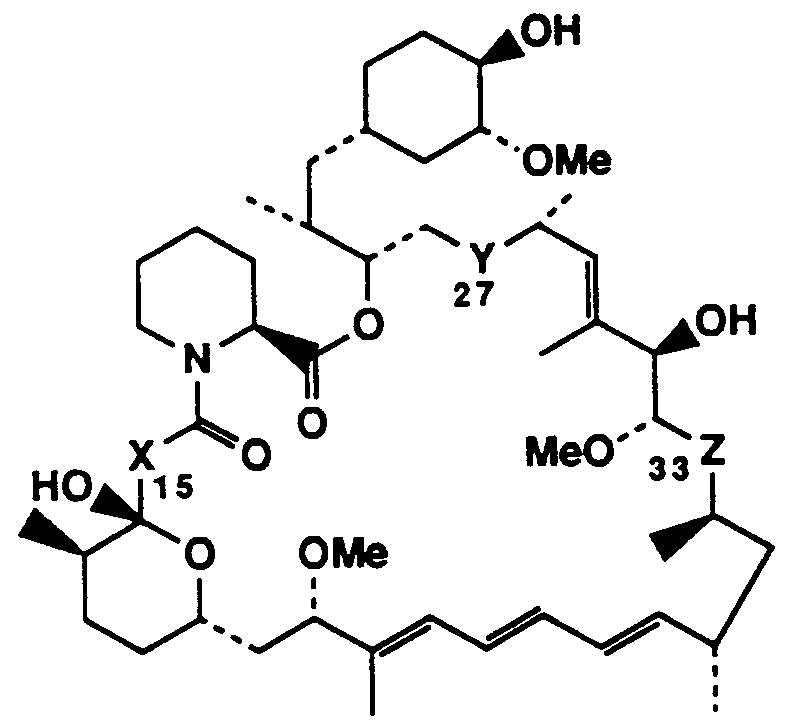
wherein X, Y, and Z are -CO or -CHOH- and where at least one of X or Z must be -CHOH- providing that if Y is CHOH then X is CHOH or a pharmaceutically acceptable salt thereof.
wherein X, Y, and Z are -CO or -CHOH- and where at least one of X or Z must be -CHOH- providing that if Y is CHOH then X is CHOH or a pharmaceutically acceptable salt thereof.
2. 15-Deoxo-15-hydroxyrapamycin or a pharmaceutically acceptable salt thereof.
3. 15,27-Bis(deoxo)-15,27-bis(hydroxy)rapamycin or a pharmaceutically acceptable salt
thereof.
4. 33-Deoxy-33-hydroxyrapamycin or a pharmaceutically acceptable salt thereof.
5. 33-Deoxy-33-(R)-hydroxyrapamycin or a pharmaceutically acceptable salt thereof.
6. 15,33-Bis(deoxy)-15,33-bis(hydroxy)rapamycin or a pharmaceutically acceptable salt
thereof.
7. 15,27,33-Tri(deoxy)-15,27,33-tri(hydroxy)rapamycin or a pharmaceutically acceptable
salt thereof.
8. A process for preparing a compound having the formula I as defined in Claim 1 wherein
X, Y and Z are -CO- or -CHOH- and where at least one of X or Z must be -CHOH- or a
pharmaceutically acceptable salt thereof, which comprises reducing rapamycin or a
31,42- OH protected derivative thereof using a reducing agent, or two reducing agents
sequentially in either order, selected from diisobutylaluminium hydride or similar
standard ketone reducing agent and a β-hydroxyketone reducing agent and removing any
protecting groups present to give a compound of formula I, if desired isolating as
a pharmaceutically acceptable salt thereof.
9. A pharmaceutical composition comprising a pharmaceutical carrier and a compound of
formula I as defined in Claim 1.
10. A compound of formula I as claimed in any one of Claims 1 to 7 for use as pharmaceutical.
11. Use of a compound of formula I as claimed in Claim 1 in the manufacture of a medicament
for use as an immunosuppressant, antiinflammatory or antifungal agent.
Claims for the following Contracting State(s): ES, GR
1. A process for preparing compound having the formula:

wherein X, Y, and Z are -CO or -CHOH- and where at least one of X or Z must be -CHOH- providing that if Y is CHOH then X is CHOH or a pharmaceutically acceptable salt thereof, which comprises reducing rapamycin or a 31,42- OH protected derivative thereof using a reducing agent, or two reducing agents sequentially in either order, selected from (a) diisobut-ylaluminium hydride or similar standard ketone reducing agent and (b) a β-hydroxyketone reducing agent, and removing any protecting groups present to give a compound of formula I, if desired isolating as a pharmaceutically acceptable salt thereof.
wherein X, Y, and Z are -CO or -CHOH- and where at least one of X or Z must be -CHOH- providing that if Y is CHOH then X is CHOH or a pharmaceutically acceptable salt thereof, which comprises reducing rapamycin or a 31,42- OH protected derivative thereof using a reducing agent, or two reducing agents sequentially in either order, selected from (a) diisobut-ylaluminium hydride or similar standard ketone reducing agent and (b) a β-hydroxyketone reducing agent, and removing any protecting groups present to give a compound of formula I, if desired isolating as a pharmaceutically acceptable salt thereof.
2. A process as claimed in Claim 1 in which the β-hydroxyketone reducing agent is sodium
triacetoxyborohydride.
3. A process as claimed in Claim 1 in which the product is 15-deoxo-15-hydroxyrapamycin
or a pharmaceutically acceptable salt thereof.
4. A process as claimed in Claim 1 in which the product is 15,27-bis(deoxo)-15,27-bis(hydroxy)rapamycin
or a pharmaceutically acceptable salt thereof.
5. A process as claimed in Claim 1 in which the product is 33-deoxy-33-hydroxyrapamycin
or a pharmaceutically acceptable salt thereof.
6. A process as claimed in Claim 1 in which the product is 33-deoxy-33-(R)-hydroxyrapamycin
or a pharmaceutically acceptable salt thereof.
7. A process as claimed in Claim 1 in which the product is 15,33-bis(deoxy)-15,33-bis(hydroxy)rapamycin
or a pharmaceutically acceptable salt thereof.
8. A process as claimed in Claim 1 in which the product is 15,27,33-tri(deoxy)-15,27,33-tri(hydroxy)rapamycin
or a pharmaceutically acceptable salt thereof.
9. A process for preparing a pharmaceutical composition which comprises bringing a pharmaceutical
carrier and a compound of formula I as defined in Claim 1 into association.
10. Use of a compound of formula I as defined in Claim 1 in the manufacture of a medicament
for use as an immunosuppressant, antiinflammatory or antifungal agent.