| (19) |
 |
|
(11) |
EP 0 516 599 A1 |
| (12) |
EUROPEAN PATENT APPLICATION |
| (43) |
Date of publication: |
|
02.12.1992 Bulletin 1992/49 |
| (22) |
Date of filing: 13.04.1992 |
|
| (51) |
International Patent Classification (IPC)5: E21B 4/06 |
|
| (84) |
Designated Contracting States: |
|
AT CH DE ES FR GB IT LI |
| (30) |
Priority: |
30.05.1991 SE 9101639
|
| (71) |
Applicant: UNIROC AKTIEBOLAG |
|
S-737 25 Fagersta (SE) |
|
| (72) |
Inventors: |
|
- Rodert, Jörgen
S-132 41 Saltsjö-Boo (SE)
- Andersson, Kurt
S-135 54 Tyresö (SE)
|
| (74) |
Representative: Grundfelt, Erik Gunnar |
|
Atlas Copco Tunnelling & Mining AB
Patents & Trademarks
S-105 23 Stockholm
S-105 23 Stockholm (SE) |
|
| |
|
| (54) |
Device in hammer machines |
(57) Device in hammer machines. The device comprises a machine housing (1) and a hammer
piston (2) movable to-and-fro in the machine housing. A drilling tool connected to
the machine housing comprises a drill bit (5), a set of tubes (4) for rotating the
drill bit and a set of rods (3) for transferring impact energy to the drill bit. A
rod (11) situated adjacent to the drill bit is procided with an axial channel (7)
and a radial channel (8) for supplying flushing medium to the flushing channel (6)
of the drill bit. The distance (S) from the front end (9) of the drill bit to channel
(8) is larger than the length (L) of the hammer piston (2).
|
|
[0001] The present invention relates to a device in hammer machines for drilling, preferably
in rock, by means of a drill string comprising a set of tubes and a set of rods arranged
in the set of tubes.
[0002] When drilling with drill strings of the above mentioned kind, see SE-A-8900590-4,
one has used drill strings where the drill bit and the rod closest to the drill bit
together have a length which is equal to the length of the hammer piston in order
to efficiently transfer the energy of the hammer piston to the drill bit. The rod
adjacent to the drill bit is provided with a channel which connects the external surface
of the rod with a centrally positioned channel through which flushing medium is supplied
to the drill bit. It has turned out that this build-up of the drill string in drilling
creates large stresses in the rod at the channel between the external surface and
the central channel.One reason for this is that the shock wave from the hammer piston
has not passed the channel between the external surface and the central channel before
the reflex from the rock reaches this section.
[0003] The present invention, which is defined in the subsequent claims, aims at achieving
a device in hammer machines where the stress at the channel between the external surface
of the rod and the central flushing channel is substantially reduced in order to improve
the service life of the rod. It has surprisingly turned out that the drilling rate
is not affected in any essential degree if the length of the drill bit and the adjacent
rod is increased moderately. This deviates considerably from accepted opinions which
say that the length of the drill bit and the adjacent rod together should be equal
to the length of the hammer piston. It has turned out to be advantageous if the distance
from the front end of the drill bit to the channel between the external surface of
the rod and the central flushing channel is 5-10% larger than the length of the hammer
piston.
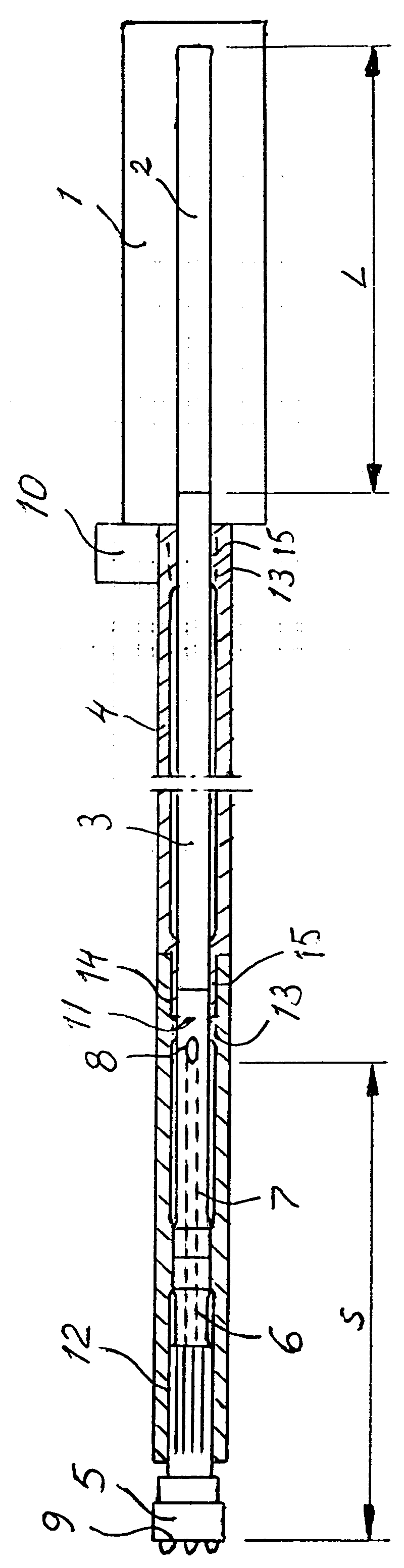
[0004] An embodiment of the invention is described below with reference to the accompanying
drawing which schematically shows a rock drilling device according to the invention.
[0005] The device shown in the drawing comprises a hammer machine which is provided with
a machine housing 1 and a hammer piston 2 having a length L and being movable to-and-fro
in the machine housing. A drilling tool, comprising a set of tubes 4, a set of rods
arranged therein and a drill bit 5, is connected to the hammer machine. The set of
tubes comprises a number of tubes which during drilling are connected with each other
by means of thread connections 14. The set of rods comprises a number of rods loosely
resting against each other for transferring the impact energy of hammer piston 2 to
drill bit 5. Drill bit 5 is by means of a splined coupling 12 connected with the set
of tubes 4. The set of tubes and thus the drill bit 5 is rotated by a rotation device
10. The drill bit is provided with an end 9 which is turned away from the machine
housing 1 and an axial flushing channel 6. Adjacent to the drill bit a rod 11 forming
part of the set of rods 3 is arranged. Rod 11 is provided with an axial channel 7
and a further channel 8 which connects the axial channel with the external surface
of the rod. Flushing medium for removal of drill cuttings is supplied through the
space between the set of rods and the set of tubes to the further channel 8 and from
there through channels 7 and 6 to the front surface 9 of the drill bit. The set of
tubes 4 is provided with guides 15 for the set of rods 3. These guides are provided
communications 13 for passage of flushing medium. In order to decrease the stresses
in the material at channel 8 the distance S between the end 9 of the drill bit turned
away from the machine housing and channel 8 is larger than the length L of hammer
piston 2. Through this it is ensured that the shock wave generated by the hammer piston
passes channel 8 before the reflex from the rock reaches channel 8. The distance S
is suitably 5-10% larger than the length L of hammer piston 2.
1. Device in hammer machines comprising a machine housing (1), a hammer piston (2) movable
to-and-fro in the machine housing and arranged for delivering impacts against a tool,
and a rotation device (10) for rotating the tool, the tool comprising a drill bit
(5) provided with an axial flushing channel (6), a central set of rods (3) for transferring
impact energy from the hammer piston to the drill bit, a set of tubes (4) about the
set of rods for transferring rotation from the rotation device to the drill bit, and
a rod (11) adjacent to the drill bit and provided with an axial channel (7) and a
further channel (8) which connects said axial channel with the external surface of
the rod, characterized in that the distance (S) between the end (9) of the drill bit (5) turned away from
the machine housing (1) and said further channel (8) is larger than the length (L)
of the hammer piston.
2. Device according to claim 1, characterized in that the distance (S) between the end (9) of the drill bit (5) turned away from
the machine housing (1) and said further channel (8) is 5-10% larger than the length
(L) of the hammer piston.