|
(11) | EP 0 517 969 A1 |

| (12) | EUROPEAN PATENT APPLICATION |
|
|
|
|
||||||||||||||||||||||||
| (54) | Process for increasing the bleaching efficiency of an inorganic persalt or of hydrogen peroxide |
| (57) A process for increasing the bleaching efficiency of an inorganic persalt or hydrogen
peroxide by adding to said persalt or H₂O₂ an activating agent. The activating agent
is an acetylated gluconic acid derivative, such as N-methyl pentaacetyl gluconamide,
N-methyl-N-acetyl pentaacetyl gluconamide, N-methyl-N-acetyl pentaacetyl gluconamide
or tetraacetyl gluconolactone. The invention also relates to the acetylated gluconic
acid derivatives themselves. |
[0001] The invention relates to a process for increasing the bleaching efficiency of an inorganic persalt or hydrogen peroxide and to bleaching and/or detergent compositions suitable for removing stains from textiles or from other products such as paper, cellulose, cork, hair etc.. The inorganic persalts to which the composition of the present invention can be applied are substances capable of releasing hydrogen peroxide in an agueous solution. Examples of such inorganic persalts are alkali metal percarbonates, persulfates, persilicates, perpyrophoshates and their mixtures. Preferred alkali metals are Na, K and Li, particularly Na.
[0002] When an inorganic persalt is used alone its provide a satisfactory bleaching effect at the boil, but at a lower temperature, such as at 40°C or 60°C, where the washing machines operate, its bleaching efficiency is extremely low.
[0003] Due to the trend of lowering the washing temperature and of energy saving as well as to the diffused use of synthetic and coloured fabrics, bleaching activators have been developed which improve the bleaching efficiency of inorganic persalts.
[0004] Among the known bleaching activators the TAED (tetraacetyl-ethylenediamine) is the most efficacious one, which increases at a high extend the bleaching activity of inorganic persalts (peroxide). However, the TAED being a compound directly or indirectly derived from oil, has the disadvantage of contaminating the environment.
[0005] US-A-2955905 describes a bleaching composition containing an inorganic persalt together with an organic carboxylic ester which acts as a bleaching activator. Examples of esters are among others esters of polyhydric aliphatic alcohols such as mannitol-hexa-acetate, sorbitol hexa-acetate, and esters of mono- and -disaccharides such as fructose-penta-acetate, glucose-penta-acetate, glucose-tetra -acetate and sucrose-octa-acetate.
[0006] These organic carboxylic esters do not pollute the environment and, in some conditions, expose acceptable improvement in the bleaching activity of inorganic persalts; however, test results carried out by the Applicant show that the bleaching activity of inorganic persalts cannot be significantly improved by increasing the ratio by weight of said organic carboxylic esters to the inorganic persalts. This property of said carboxylic esters does not make them attractive, since the aim is to always improve the bleaching.
[0007] Thus, object of the present invention is to provide a process for increasing the bleaching activity of inorganic persalts by adding to said persalts a bleaching activator which is lack of the above-cited disadvantegous properties.
[0008] The Applicant has now surprisingly found that some acetylated gluconic acid derivatives deriving from natural, renewable substances, are endowed with those above-reported properties not possessed by TAED or the acetylated carbohydrates of US-A-2955905. Therefore, they forming a new class of bleaching activators, are suitable to be used as such for inorganic persalts or hydrogen peroxide.
[0009] According to the present invention a process is provided for increasing the bleaching efficiency of an inorganic persalt or hydrogen peroxide, e.g. sodium perborate, mono-or tetra-hydrate, wherein an acetylated gluconic acid derivative is added to said inorganic persalt or hydrogen peroxide; the gluconic acid derivative has the formula (I) or (II):
wherein X is
-OR⁴, where R² and R³ may have the same or different meaning, and are H, alkyl having from 1 to 5 carbon atoms, alylcarbonyl having from 1 to 3 carbon atoms, hydroxyalkyl having from 1 to 5 carbon atoms and carboxyalkyl having from 1 to 5 carbon atoms and from 1 to 3, preferably from 1 to 2 carboxyl groups, with the proviso that when R² is H, R³ is different from H; R⁴ is an alkyl group having from 1 to 5 carbon atoms; and R¹ is H or alkylcarbonyl having from 1 to 3 carbon atoms.
[0010] Among the preferred compounds are those having formula (II) wherein X is
and where R¹, R² and R³ are characterized hereinbefore.
[0011] Examples of acetylated gluconic acid derivatives are N-methyl pentaacetyl gluconamide, N-methyl-N-acetyl pentaacetyl gluconamide, tetraacetyl gluconolactone, N-hydroxyethyl tetraacetyl gluconamide, N-succinyl tetraacetyl gluconamide and N-carboxymethyl pentaacetyl gluconamide.
[0012] The average O-acetylation degree of said acetylated gluconic acid derivatives is from 2 to 5, preferably from 3 to 5 and most preferably from 4 to 5.
[0013] When also the X group is acetylated in the compounds having formula (II), the total acetylation degree is from 2 to 6, preferably from 3 to 6 and most preferably from 4 to 6.
[0014] The acetylated gluconic acid derivatives according to the invention, hereinafter referred to as GAD, can be prepared, according to well known methods, either by direct acetylation of the gluconolactone having formula (I) followed by the introduction of X groups or via acetylation of the compounds having formula (II).
[0015] The GADs according to the present invention show, contrary to other acetylated carbohydrate derivatives, a bleaching efficiency equal to or even higher than the best known activating agent, i.e. the TAED (tetraacetylethylenediamine). The GADs according to the present invention show the advantage with respect to TAED that they are recovered from natural, renewable substances and not from compounds directly or indirectly derived from oil. Therefore, GADs contribute to the protection of the environment.
[0016] The higher the amount of GADs (up to the stoichiometric ratio with the persalt or hydrogen peroxide), the higher the bleaching efficiency of the activating agent. Such property, common with the TAED, makes the GADs particularly suitable for satisfying the requirement of using higher amount of activating agents in the bleaching and/or detergent compositions, aiming to an always increasing bleaching.
[0017] GADs may be directly added as such to a composition containing the persalt or it can be previously admixed with the persalt used in the bleaching process. In the case of granular compositions, GAD may be added in granular form, showing suitable mechanical features and suitable granulometric distribution. The bleaching and/or detergent compositions containing GAD and persalt may also contain other usual components, such as anionic, non-ionic or amphoteric surfactants, alkali metal salts (e.g. sodium carbonate, sodium tripolyphosphate), neutral salts (e.g. sodium sulphate), zeolites, carboxymethyl cellulose, perfumes, enzymes etc..
[0018] The molar ratio between the bleaching activator and the persalt or hydrogen peroxide usually is from 10:90 to 50:50. When the bleaching efficiency of a persalt or hydrogen peroxide is exploited at a low temperature and for a short time, the molar ratio of GAD to persalt or hydrogen peroxide should preferably be increased.
[0019] The following examples are provided for merely illustrative purpose and do not limit in any way the scope of the invention.
[0020] GAD of example 1 hereinafter referred to as GAD-1, having the structure corresponding to N-methyl pentaacetyl gluconamide, was prepared as follows:
A suspension of 50 g gluconolactone in 500 ml of isopropanol/methanol (4/1) was treated with 23.8 ml of a 40% N-methylamine solution for 30 minutes. The N-methylgluconamide obtained in quantitative yields, was treated at 60°C with 69 ml acetic anhydride and 35 ml acetic acid in the presence of 1% concentrated sulphuric acid.
[0021] GAD of examples 4-6, hereinafter referred to as GAD-2, having the structure corresponding to N-methyl N-acetyl penta acetyl gluconamide, was synthetized by following the procedure of the preparation of GAD-1, however, during the acetylation step the amount of sulphuric acid was increased to 10% to obtain addionally N-acetylation.
[0022] GAD of example 7-9, hereinafter referred to as GAD-3, having the structure corresponding to tetra acetyl gluconolactone, was prepared in a classical acetylation procedure at 60-100°C.
[0023] GAD of examples 10-12, hereinafter referred to as GAD-4, having the structure corresponding to N-acetyl N-succinyl penta acetyl gluconamide, was prepared by acetylation of N-succinyl gluconamide.
[0024] GAD of examples 13-15, hereinafter referred to as GAD-5, having the structure corresponding to N-carboxymethyl penta acetyl gluconamide, was prepared by amidation of gluconolactone with glycine followed by acetylation.
[0025] Further GAD can be prepared by known processes, e.g. N-succinyl tetra acetyl gluconamide can be obtained by amidation of GAD-3, i.e. tetra acetyl gluconolactone, with L-aspartic acid; N-hydroxyethyl tetraacetyl gluconamide can be prepared by amidation of GAD-3 with ethanolamine.
EXAMPLE 1
[0026] An automatic washing machine (IGNIS) was made to run under the following conditions:
- washing program at 60°C;
- linen load: 3 kg of cotton swatch (white and clean) per washing cycle;
- 6 g/washing cycle of GAD-1, corresponding to 4% bleaching activator in the detergent, as reported in Table 1, were added to the following detergent composition (which was also used in all the other examples):
| - sodium perborate tetrahydrate: | 30 g/washing |
| - detergent base (phosphorous-free, free of bleaching agents) | 114 g/washing. |
[0027] Said detergent base contained:
| (%) w/w | |
| - overall surfactants (linear sodium dodecylbenzene sulphonate + soap + C₁₃-C₁₅ alcohol, ethoxylated with 7 EO) | 15.4 |
| - zeolite (4Å) | 28.6 |
| - sodium silicate (SiO₂/Na₂O=2) | 4.4 |
| - sodium carbonate | 16.5 |
| - sodium sulfate | 26.5 |
| - carboxymethyl cellulose | 1.2 |
| - antiincrustation copolymers | 4.8 |
| - optical bleaching agents | 0.3 |
| - water up to | 100.0 |
[0028] For the determination of the bleaching efficiency (bleaching booster activity) the clean linen was washed together with 2 samples (swatches)/washing cycle, previously stained in a standard way, with red wine, according to the test of the European Institute of Sankt Gallen (EMPA 114). At the end of each washing cycle said 2 samples were dried and ironed; the whiteness degree was then measured by means of an Elrepho-Zeiss reflectometer. The resulting bleaching percentage (measure of the bleaching efficiency), reported in Table 1, was determined by the formula:
where:
A = whiteness degree of the swatch after the washing;
B = whiteness degree of the swatch before the washing;
C = whiteness degree of the swatch completely bleached.
[0029] The whiteness degree of the swatches is expressed as percentage of the whiteness degree of MgO, as standard, when measured with a filter No.6 (wavelength = 464 nm). The thus obtained percentage (71.2%) is reported in Table 1, along with the results of the other examples.
EXAMPLES 2-3
[0030] Example 1 was repeated by respectively increasing the amount of activator GAD-1 to 12 and 18 g/washing cycle, corresponding to 8 and 12% in the detergent, respectively. The obtained results are reported in Table 1.
EXAMPLES 4-6
[0031] Examples 1-3 were repeated with the difference that GAD-2 (N-acetyl N-methyl penta acetyl gluconamide) was used instead of GAD-1. The results obtained are reported in Table 1.
EXAMPLES 7-9
[0032] Examples 1-3 were repeated with the difference that GAD-3 (tetra acetyl gluconolactone) was used instead of GAD-1. The results obtained are reported in Table 1.
EXAMPLES 10-12
[0033] Examples 1-3 were repeated with the difference that GAD-4 (N-succinyl tetraacetyl gluconamide) was used instead of GAD-1. The results obtained are reported in Table 1.
EXAMPLES 13-15
[0034] Examples 1-3 were repeated with the difference that GAD-5 (N-carboxymethyl penta acetyl gluconamide) was used instead of GAD-1. The results obtained are reported in Table 1.
EXAMPLES 16-24 (Comparative examples)
[0035] Examples 1-3 were repeated with the difference that TAED or octa acetyl sucrose or hexa acetyl sorbitol was used instead of GAD-1. The results obtained are reported in Table 1.
EXAMPLE 25 (Comparative example)
1. Process for increasing the bleaching efficiency of an inorganic persalt or hydrogen
peroxide by adding to said persalt or hydrogen peroxide an activating agent characterized
in that the activating agent is an acetylated gluconic acid derivative, wherein the
gluconic acid derivative has the formula (I) or (II):
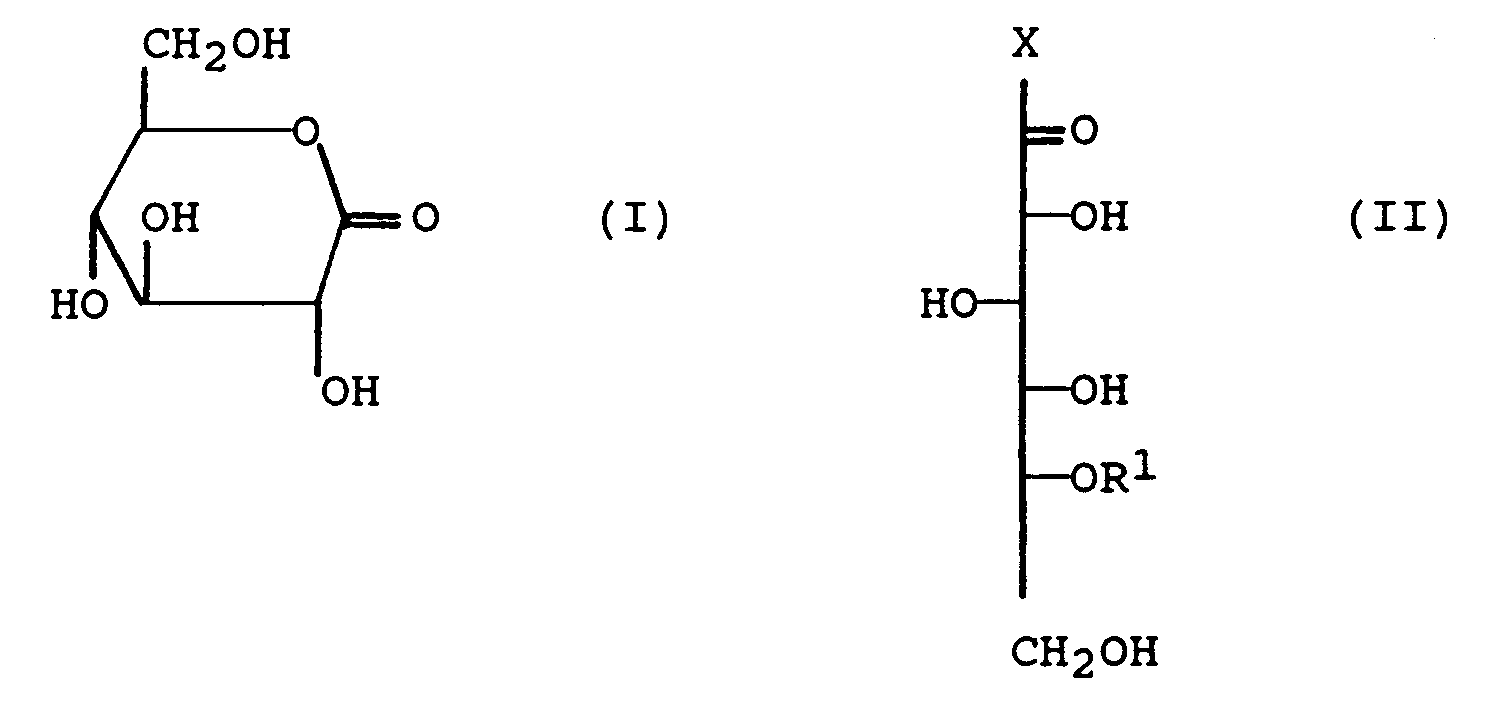
where X is
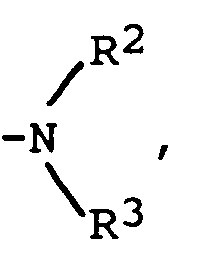
-OR⁴, wherein R² and R³ have the same or different meaning, and are H, alkyl having from 1 to 5 carbon atoms, alkylcarbonyl having from 1 to 3 carbon atoms, hydroxyalkyl having from 1 to 5 carbon atoms and carboxyalkyl having from 1 to 5 carbon atoms and from 1 to 3, preferably from 1 to 2 carboxyl groups, with the proviso that when R² is H, R³ is different from H; R⁴ is alkyl having from 1 to 5 carbon atoms; and R¹ is H or alkylcarbonyl having from 1 to 3 carbon atoms.
where X is
-OR⁴, wherein R² and R³ have the same or different meaning, and are H, alkyl having from 1 to 5 carbon atoms, alkylcarbonyl having from 1 to 3 carbon atoms, hydroxyalkyl having from 1 to 5 carbon atoms and carboxyalkyl having from 1 to 5 carbon atoms and from 1 to 3, preferably from 1 to 2 carboxyl groups, with the proviso that when R² is H, R³ is different from H; R⁴ is alkyl having from 1 to 5 carbon atoms; and R¹ is H or alkylcarbonyl having from 1 to 3 carbon atoms.
2. Process according to claim 1, characterized in that in formula (II) X is
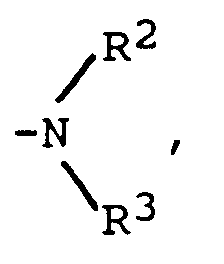
and R¹, R² and R³ have the meanings defined in claim 1.
and R¹, R² and R³ have the meanings defined in claim 1.
3. Process according to claim 2, characterized in that the acetylated gluconic acid derivative
is N-methylpentaacetyl gluconamide.
4. Process according to claim 2, characterized in that the acetylated gluconic acid derivative
is N-methyl-N-acetyl pentaacetyl gluconamide.
5. Process according to claim 1, characterized in that the acetylated gluconic acid derivative
is tetraacetyl gluconolactone.
6. Process according to claim 1 or 2, characterized in that the acetylated gluconic acid
derivative has a total acetylation degree of from 2 to 6.
7. Process according to claim 1 or 2, characetrized in that the acetylated gluconic acid
derivative has preferably a total acetylation degree of from 4 to 6.
8. Process according to any of the preceding claims, characterized in that the molar
ratio between the acetylated gluconic acid derivative and the inorganic persalt or
hydrogen peroxide is from 10:90 to 50:50.
9. Process according to any of the preceding claims, characterized in that the inorganic
persalt is selected from sodium perborate monohydrate, sodium perborate tetrahydrate
and mixtures thereof.
10. Bleaching and/or detergent compositions containing an inorganic persalt or hydrogen
peroxide and an activating agent comprising acetylated gluconic acid derivatives defined
in claims 1-7.
11. Acetylated gluconic acid derivatives wherein the gluconic acid derivatives have the
formula (I) or (II):
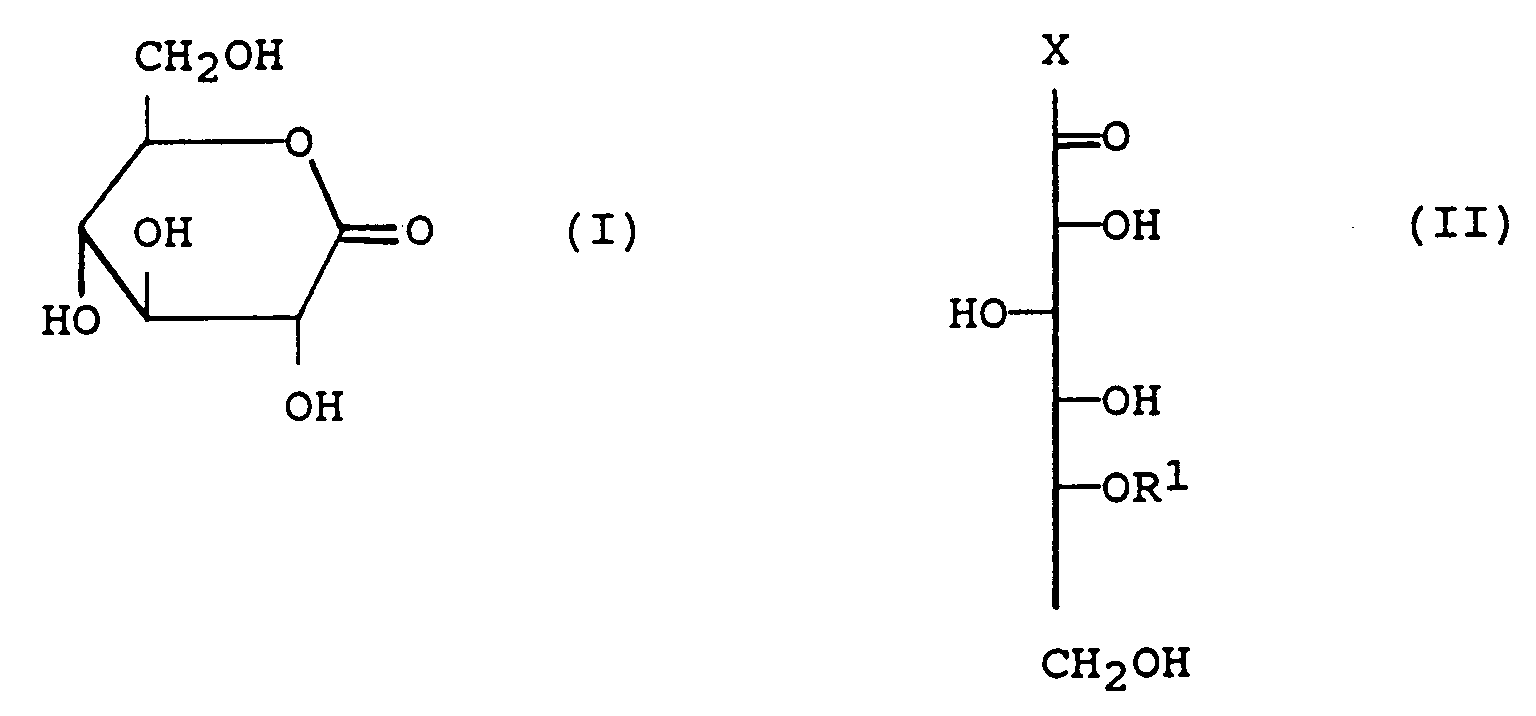
where X is
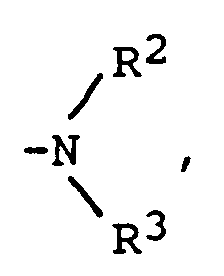
-OR⁴, wherein R² and R³ have the same or different meaning, and are H, alkyl having from 1 to 5 carbon atoms, alkylcarbonyl having from 1 to 3 carbon atoms, hydroxyalkyl having from 1 to 5 carbon atoms and carboxyalkyl having from 1 to 5 carbon atoms and from 1 to 3, preferably from 1 to 2 carboxyl groups, with the proviso that when R² is H, R³ is different from H; R⁴ is alkyl having from 1 to 5 carbon atoms; and R¹ is H or alkylcarbonyl having from 1 to 3 carbon atoms.
where X is
-OR⁴, wherein R² and R³ have the same or different meaning, and are H, alkyl having from 1 to 5 carbon atoms, alkylcarbonyl having from 1 to 3 carbon atoms, hydroxyalkyl having from 1 to 5 carbon atoms and carboxyalkyl having from 1 to 5 carbon atoms and from 1 to 3, preferably from 1 to 2 carboxyl groups, with the proviso that when R² is H, R³ is different from H; R⁴ is alkyl having from 1 to 5 carbon atoms; and R¹ is H or alkylcarbonyl having from 1 to 3 carbon atoms.