|
(11) | EP 0 518 681 A2 |

| (12) | EUROPEAN PATENT APPLICATION |
|
|
|
|
|||||||||||||||||||||||||||
| (54) | Tape guide post |
| (57) A tape guide post 10 includes a tape engaging surface 11 having a longitudinal contour
with a compound radius of curvature. The longitudinal contour has a smoothly varying
radius of curvature. The outer portions of the contour have relatively large radii
12 and 14 of curvature and blend smoothly into a central portion which is of a relatively
small radius 13 of curvature to allow for any desired bending of tape in its easy
direction. The combination minimises both friction and stiction between the tape 1
and the guide. The guide is also laterally contoured to accommodate droop at the edges
of the tape, caused by low air pressure at the edges. |
[0002] Web and tape guiding apparatus are well known. Perhaps the most common use of such an apparatus is for guiding tapes in magnetic tape drives over a magnetic read/write head. Guiding of the tape over the head is critical to the writing of data to and the reading of data from the magnetic tape. A typical magnetic tape drive includes several elements in the tape path to ensure proper alignment and operation of the tape and head. For example, the tape path of the IBM 3480/3490 tape drives includes a supply reel inside a tape cartridge, a vibration decoupler, a cleaner blade, an arcuate supply side air bearing device, a magnetic read/write head, an arcuate storage side air bearing device, a tension transducer, a storage reel, and tape edge guides along the sides of the bearing surfaces. The tape edge guides are located along the arcuate bearing surfaces because the tape in such proximity can support a larger guiding force without collapsing than can a freely suspended tape. The tape edge guides physically align the lateral position (i.e. in the direction of the tape width) of the tape relative to the read/write head. Lateral positioning maintains proper alignment between the read/write elements of the head and the data tracks on the magnetic tape The tape guides also support and guide the tape in its easy direction of bending (i.e. in the direction of tape travel).
[0003] Three basic types of guides are known for easy direction tape guiding. The first such guide is a fixed cylindrical post. The, use of this type of guide is based on the theory that a hydrodynamic film of air forms between the tape and the post when the tape is in motion, thereby reducing friction and wear. However, in practice, such posts fail to produce an air film of sufficient thickness to reduce friction and wear to a significant extent. Also, when the tape is stopped and rests on the post under tension it sticks to the post. Such "stiction" makes the initiation of tape movement difficult and may result in damage to the tape.
[0004] Another type of easy direction tape guide is a roller. As compared to posts, rollers reduce friction with a tape in motion and stiction with a tape at rest. However, rollers introduce another source of vibration into the tape path (which may disrupt the head-tape interface). Also, rollers store energy that must be positively controlled to maintain adequate closed loop tension control. Finally, rollers and posts do not steer tape in the same manner, and rollers often require grooves or other surface geometries to prevent the tape from flying over them.
[0005] The third type of easy direction tape guide is an externally pressurised air bearing. Although an air bearing can dramatically reduce tape friction and stiction, it is more complex and expensive than a post or a roller. An air bearing is complex because it requires the space and parts for air to be provided under controlled pressure. An air bearing is expensive because of such complexity, and because a source of compressed air must be provided. Finally, more than one type of easy direction guide can be used in a tape path to form a variety of tape path configurations.
[0006] None of these guides is a simple, low cost, low friction/stiction tape guide which accommodates changes in tape direction (i.e. easy direction bending).
[0008] This invention also seeks the reduction of friction and/or stiction in an easy direction tape guide.
[0009] This invention further seeks to provide such a guide at a minimum of additional expense and complexity, yet accommodating changes in tape direction.
[0010] Accordingly, this invention provides a guide for a flexible tape including a tape engaging surface having a longitudinal contour with a compound radius of curvature.
[0011] In a preferred embodiment, the longitudinal contour has a smoothly varying radius of curvature. The outer portions of the contour have a relatively large radius of curvature and blend smoothly into a central portion which is of a relatively small radius of curvature to allow for any desired bending of the tape in its easy direction. The combination minimises both friction and stiction between the tape and the guide. The guide may also be laterally contoured to accommodate droop at the edges of the tape, caused by low air pressure at the edges.
[0012] The term "tape" in this specification is to be taken to include webs and the like, capable of longitudinal translation.
[0013] The scope of the invention is defined by the appended claims; and how it can be carried into effect is hereinafter particularly described with reference to the accompanying drawings in which:-
Fig. 1 is a plan view of a tape guide according to the invention;
Fig. 2a is a lateral cross-sectional view of the guide of Fig. 1;
Fig. 2b is a view, similar to Fig. 2, of an alternative form of guide; and
Fig. 3 is a schematic diagram of a magnetic tape drive incorporating guides according to the invention.
[0014] In the application of the invention to a magnetic tape drive, a magnetic tape 1 (Fig. 1) is bent in its easy direction around, and in close proximity to, a tape guide 10. Guide 10 is a fixed post including a tape engaging surface 11. Tape 1 may travel in either longitudinal direction as indicated by the arrows at either end thereof.
[0015] It is known that the hydrodynamic film of air which separates a tape from a tape engaging surface is largely determined by the curvature at the entrance to the tape engaging surface, and is thereafter relatively constant along its length. The entrance to a guide is the portion of the guide which is first approached by a tape as it moves past the guide. For example, if tape 1 is moving from the lower left to the extreme right of Fig. 1, the entrance to guide 10 is at the lower left portion of tape engaging surface 11. For a cylinder of radius R, the thickness t of the uniform air film is given approximately by:
where µ is the viscosity of air, U is the tape velocity, and T is the tape tension per unit width. For further description of equation (1), see Gross et al, Fluid Film Lubrication, John Wiley and Sons, Inc., NY, 1980, p. 493. As used herein, a tape and a guide are in "close proximity" when they are at least close enough to apply equation (1).
[0016] In view of equation (1), it is therefore, known that the air film between a tape and a guide can be made, vary large by increasing R. It is also known that a thick air film can reduce, contact between a tape and a guide, thereby reducing friction. Thus, a simple cylindrical guide with a very large radius of curvature would achieve a thick air film and low friction. However, at least three other factors must be considered. First, a large radius of curvature is incompatible with the trend towards small form factor tape drives. Second, if the tape is laterally guided by exerting force on its edges, a small radius of curvature is required to prevent the tape from buckling. Third, when there is no tape motion the tape will rest against the guide. The larger the radius of curvature the more contact there will be between the tape and the tape engaging surface, resulting in increased stiction.
[0017] Friction and stiction are minimised in the guide 10 (Fig. 1) by tape engaging surface 11 having a longitudinal contour (i.e. along the direction of tape movement) with a compound radius of curvature. In the preferred embodiment shown, the longitudinal contour includes five adjacent portions. Two outer portions have relatively large radii 12 and 14 of curvature, and therefore establish a thick air film that will lubricate the other portions. The central portion is of a relatively small radius 13 of curvature to allow for any desired bending of the tape in its easy direction. The outer portions minimise friction by guaranteeing that the separation between tape 1 and guide 10 is significantly greater than their respective RMS surface roughness. The central portion minimises stiction and allows for easy direction bending.
[0018] Two blending portions join the outer portions with the central portion to provide a smooth transition between the distinct radii. The blending portions minimise adverse effects of tape stiffness by ensuring a continuous second derivative along the contour. This also aids in maintaining the large air film through the central portion. There is a variety of ways to accomplish the transition between the outer and central portions. They can be joined, for example, by an elliptical contour, or a contour whose radius of curvature changes smoothly as a function of distance along the bearing, or simply by a polishing process that removes the discontinuity between the curvatures. In the preferred embodiment, the blending portion is described by
where s is the distance along the contour, R(s) is the radius of curvature at any point along the contour, R₁ is the radius of curvature in the outer portion, 0.5< x <2, and k is a constant.
[0019] Magnetic tape heads having a compound radius of contour are known from US-A-4,479,158, but are designed to achieve a very low flying height of the tape (or actual contact of the tape with the head) to maintain the signal-to-noise ratio and are thus not designed as previously described. Such heads use outer portions of a small radius of curvature to achieve a very low flying height.
[0020] In the preferred embodiment, radius 12 of curvature is greater than radius 13 of curvature and approximately the same as radius 14 of curvature, to accommodate tape travel in both directions equally. Preferably, radii 12 and 14 of curvature are at least five times greater than radius 13 of curvature. A suitable guide has radii 12 and 14 of curvature of approximately 20.0 mm and a radius 13 of curvature of approximately 3.2 mm for a tape approximately 8.0 mm wide and 12 µm (microns) thick. The outer portion of tape engaging surface 11 having radius 12 of curvature extends over an arc of approximately 15 degrees, the central portion of tape engaging surface 11 having radius 13 of curvature extends over an arc of approximately 60 degrees, and the outer portion of tape engaging surface 11 having radius 14 of curvature extends over an arc of approximately 50 degrees. The entrance to guide 10 preferably extends over an arc of at least 6 degrees to ensure that equation (1) applies. The blending portions are created using surface polishing. The optimal radii of curvature, arcs (i.e. length of each portion), and other dimensions of guide 10 depend upon the actual application of the guide. Thus, in alternative embodiments, the longitudinal contour of guide 10 may be changed to accommodate particular needs. For example, radius 12 of curvature differs from radius 14 of curvature in applications in which the tape travels in a single direction only.
[0021] Friction is also reduced by proper lateral contouring of guide 10. It has been shown that enough air leaks from beneath the sides of a tape flying over a simple cylindrical post to produce a lateral tape contour such that the edges of the tape sag or curl (see Deckert et al, Dynamic Response of Self-acting Foil Bearings, IBM Journal of Research and Development, November, 1974, pp. 513-520). Such sagging of the tape edges tends to increase the area of contact between the tape and the guide, thereby increasing friction. By designing the lateral contour of the tape engaging surface to match the lateral profile of the tape, such friction is minimised.
[0022] In the embodiment illustrated in Fig. 2a, the tape 1 flies above guide 10, the lateral profile of whose tape engaging surface 11 is convex and crowned to match the lateral profile of tape 1. Suitable crowned guides have lateral radii of curvature of 300 mm upwards for a tape approximately 8.0 mm wide and 12 µm (microns) thick. In the embodiment illustrated in Fig. 2b, the width of guide 10 is reduced and the convex lateral contour is created by edge rounding. The optimum lateral contour for an application will vary depending upon the stiffness of the tape, longitudinal contour of the guide, and operating parameters of the application.
[0023] Such guides may be used in a magnetic tape drive 20 (Fig. 3) which includes a tape path 21, which is that portion of drive 20 in contact or close proximity with magnetic recording tape 1. Tape 1 may be any flexible magnetic recording tape; the composition of the tape is not relevant to the subject invention, but a.suitable tape is disclosed in US-A-4,467,411.
[0024] Tape 1 is wound at one end upon a first tape reel 22 and wound at the other end upon a second tape reel 23. Reels 22 and 23 are mechanically driven to rotate in either direction, as required to position the desired portion of tape 1 in close proximity adjacent to a magnetic tape head 24. Head 24 includes one or more magnetic transducers capable of magnetically writing data to and/or reading data from tape 1. The type of head is not relevant to the subject invention, but a suitable head is disclosed in US-A-4,685,005.
[0025] Data (including analog or digitally encoded audio, visual or any computer related data) is recorded in one or more tracks on tape 1 using any available recording format. Two guides, 10a and 10b, similar to that described in relation to Fig. 1, maintain the position of tape 1. Guides 10a and 10b are positioned to maximise, their utility. Because the amount of tape 1 wound upon a reel changes over time, the outer portion of the tape engaging surface of each guide closest to a reel must be able to accommodate a varying angle of tape approach (i.e. from a reel to a guide). The outer portion of the tape engaging surface of each guide which is closest to a reel is of greater arc than the outer portion closest to head 24, thereby preventing tape 1 from abrading against the pointed edge tip of a guide. Again, the optimal design of the guides will depend upon the characteristics of the application. The friction produced in tape path 21 can be tested for optimisation by using a simple strain gauge. By mounting a guide on an axle, and coupling the axle to the strain gauge, the gauge monitors the tendency of the guide to rotate and hence the friction between the tape and the guide.
[0026] Many tape paths include the transducing head on the same side of the tape as the tape guides. In addition, one or both of the reels may be packaged into a tape cartridge. In the embodiment shown in Fig. 3, head 24 is on the opposite side of tape 1 from guides 10a and 10b, and reels 22 and 23 can be packaged into a single tape cartridge. Head 24 is not part of the cartridge, but is mounted in drive 20 and mated with tape 1 upon insertion of the cartridge.
[0027] In another embodiment, head 24 may be located on the same side of tape 1 as guides 10a and 10b and the tape cartridge include only one of the reels. The other reel, head 24, and guides 10a and 10b would not be part of the cartridge, but are mounted in drive 20. Upon insertion of the cartridge into drive 20, the end of tape 1 is removed from the cartridge reel and threaded through the tape path. and onto to the reel in drive 20. A tape cartridge and threading apparatus suitable for such an embodiment is shown in US-A-4,334,656.
[0028] If guides 10a and 10b are part of a tape cartridge, they are preferably moulded of plastics material to reduce weight and cost. If guides 10a and 10b are part of drive 20, they are preferably cast or machined of stainless steel or other wear resistant materials. In either case, the guides are simple in shape and therefore inexpensive to manufacture.
[0029] The operation of reels 22 and 23 and head 24 is managed by a controller 25 to write data to and/or read data from tape 1. The electrical and mechanical connections to controller 25, the operation of controller 25, and additional components in path 21 are not relevant to the invention, but may be derived from US-A-4,467,411, US-A-4,406,425, and US-A-4,389,600.
[0030] While the invention has been described with respect to a preferred embodiment thereof, it will be understood by those skilled in the art that various changes in detail may be made the,rein without departing from the scope of the invention. For example, the guide described herein could be used for flexible web guiding applications other than magnetic tape drives. Such applications include optical tape drives and film and fabric winding. Also, a tape path could include any number of guides as shown herein, as required for the application. The guides, reels, and other path components can be arranged in various configurations.
1. A guide for a flexible web, comprising a web engaging surface (11) on a body (10),
the surface (11) having a longitudinal contour with a compound radius of curvature.
2. A guide according to Claim 1, wherein the compound radius of curvature includes a
first portion and a second portion, each having a relatively large radius (12, 14)
of curvature, and a third portion having a relatively small radius (13) of curvature
between the first and the second portions.
3. A guide according to Claim 2, wherein the radii (12, 14) of curvature of the first
and second portions are at least five times the radius (13) of curvature of the third
portion.
4. A guide according to Claim 2 or 3, wherein the radius (12) of curvature of the first
portion is approximately the same as the radius (14) of curvature of the second portion.
5. A guide according to Claim 2, 3 or 4, wherein each of the first and second portions
is joined to the third portion by a blending portion which provides a smoothly varying
radius of curvature along the guide.
6. A guide according to Claim 5, wherein each blending portion is described by
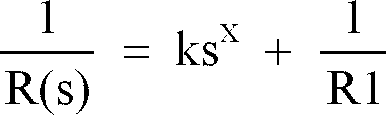
where s is the distance along the web engaging surface, R(s) is the radius of curvature at any point along the web engaging surface, R₁ is the radius of curvature in the first and second portions, 0.5< x <2, and k is a constant.
where s is the distance along the web engaging surface, R(s) is the radius of curvature at any point along the web engaging surface, R₁ is the radius of curvature in the first and second portions, 0.5< x <2, and k is a constant.
7. A guide according to any preceding claim, wherein the web engaging surface (11) has
a convex lateral contour.
8. A guide according to Claim 7, wherein the convex lateral contour is crowned.
9. A path for a flexible web comprising a first rotatable reel (22), a second rotatable
reel (23), a flexible web (1) having its first end wound upon the first reel (22)
and its second end wound upon the second reel (23), and at least one guide according
to any preceding claim, in close proximity to the web.
10. A recording tape path comprising a first rotatable reel (22), a second rotatable reel
(23), a flexible tape (1) having its first end wound upon the first reel (22) and
its second end wound upon the second reel (23), first and second guides (10a, 10b)
according to any of claims 1 to 8, each in close proximity to the tape (1), and a
transducing head (24) adjacent the tape (1) between the first and the second guides
(10a, 10b) in the direction of tape length.
11. A tape drive comprising means for mounting a tape cartridge, the tape cartridge including
a first and a second rotatable reel, a flexible tape having its first end wound upon
the first reel. and its second end wound upon the second reel and a guide according
to any of claims 1 to 8, and in close proximity to the tape, a transducing head mounted
to be adjacent the tape when the tape cartridge is mounted in the tape drive, means
for controllably rotating the first and second reels to advance the tape past the
head, the means being coupled to the first and second reels when the tape cartridge
is mounted in the tape drive, and means coupled to the head for controllably operating
the head to write to and/or read from the tape.
12. A tape drive comprising a first rotatable reel, means for mounting a tape cartridge,
the tape cartridge including a second rotatable reel, and a flexible tape having a
first end and a second end, the second end wound upon the second reel, a guide according
to any of claims 1 to 8, and in close proximity to the tape when the tape cartridge
is mounted in the tape drive, means for extending the tape around the guide and winding
the first end of the tape upon the first reel when the tape cartridge is mounted in
the tape drive, the tape being guided between the first reel and the second reel by
the guide, a transducing head mounted to be adjacent the tape when the tape cartridge
is mounted in the tape drive, means for controllably rotating the first and second
reels to advance the tape past the head, the means being coupled to the first and
second reels when the tape cartridge is mounted in the tape drive, and means coupled
to the head for controllably operating the head to write to and/or read from the tape.