[0001] The present invention relates to a method of manufacturing sintered titanium based
carbonitride alloys with powder metallurgical methods. By using a powder with a certain
agglomerate size and distribution it has turned out that lower compaction pressure
as well as lower porosity can be obtained.
[0002] Sintered titanium based carbonitride alloys, so-called cermets, are today well established
as insert material in the metal cutting industry and are especially used for finishing.
They contain mainly carbonitride hard constituents embedded in a binder phase. The
hard constituent grains generally have a complex structure with a core surrounded
by a rim of other composition. Their grain size is usually <2 µm.
[0003] In addition to Ti, other metals of the groups IVa, Va and VIa, i.e., Zr, Hf, V, Nb,
Ta, Cr, Mo and/or W, are normally found in the carbonitride hard constituents but
may also be present as carbide and/or nitride hard constituents. The binder phase
generally contains cobalt as well as nickel. The amount of binder phase is generally
5 - 25 % by weight.
[0004] Sintered carbonitride alloys are as conventional cemented carbide manufactured by
powder metallurgical methods, namely, milling, pressing and sintering. The milling
is generally performed in an inorganic milling liquid and normally together with a
pressing agent. The object of the pressing agent is to act lubricating during the
subsequent tool pressing. The pressing agent, however, also has another object, namely,
to protect the fresh surfaces resulting from the milling against oxygen pick up. After
the milling the milling liquid is removed usually by spray drying. By a proper choice
of conditions during the spray drying spherical agglomerates are obtained with desired
size and size distribution. These agglomerates are more or less completely covered
by the pressing agent. The larger the size of the agglomerates is, the more favourable
ratio surface/volume such agglomerates have. It can, thus, be expected that materials
sensitive to oxygen shall have as large agglomerate size as possible in order to minimize
this oxygen pick up.
[0005] The size and distribution of the agglomerates can be determined by sieving or in
any other way and can be characterized by the mean agglomerate size, C, and the span
defined by (A-B)/C, where A = the agglomerate size below which 90% of all agglomerates
are found and B = the agglomerate size below which 10% of all agglomerates are found.
[0006] For conventional cemented carbide a mean agglomerate size of 100-150 µm with a span
<2 has been found suitable. It has now surprisingly turned out that for titanium based
carbonitride alloys the mean agglomerate size shall be 40-80 µm, preferably 40-60
µm and the span <1.5, preferably <1.2. In this way lower compaction pressure and less
porosity is obtained than if the usual mean agglomerate size for conventional cemented
carbide is used.
[0007] High compaction pressure is linked to an increased risk for the generation of cracks
as well as uneven density distribution in connection with the compaction. The presence
of cracks and uneven density distribution can lead to problems with crack generation
as well as deviations in dimension in the sintered carbonitride alloy. The presence
of pores also can result in deviations in dimensions and influence on the mechanical
properties of the finished alloy.
[0008] The type of porosity which easily arises in carbonitride alloys manufactured using
agglomerates with a mean agglomerate size corresponding to that for normal cemented
carbide, i.e., 100-150 µm is often so called agglomerate porosity, i.e., the original
agglomerates are visible and material has not filled the voids between them. Such
porosity can be very disastrous since these pores are relatively large, on one hand,
and can be angular and have a strong notch effect, on the other. Carbonitride alloys
as such are from a general point of view more brittle than cemented carbide and have
more difficulty to stop possible cracks. They are, thus, more notch sensitive than
cemented carbide.
[0009] The present invention, thus, relates to a way of manufacturing carbonitride alloys
using a powder with a mean agglomerate size which is considerably smaller that the
size which has turned out to be suitable for conventional cemented carbide. In spite
of the general relations between oxygen pick up and agglomerate size the decrease
of mean agglomerate size leads to improved properties such as lower compaction pressure
and less porosity. As a result a densely sintered product with less deviations in
dimensions is obtained.
Example
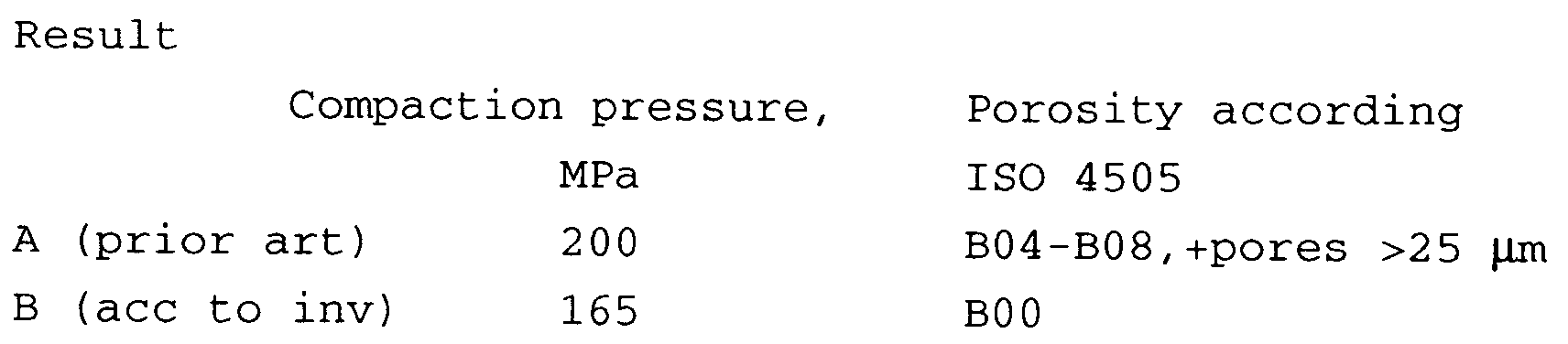
[0010] Titanium based carbonitride alloys with the following composition in weight-% 15
W, 39.2 Ti, 5.9 Ta, 8.8 Mo, 11.5 Co, 7.7 Ni, 9.3 C, 2.6 N were manufactured with an
agglomerate size of 125 µm and span 1.8, A, and with an agglomerate size of 55 µm
and span 1.1, B, (according to the invention). During pressing the compaction pressure
was measured and after sintering the porosity was evaluated. Sintering took place
in vacuum at 1430°C for 90 min.
1. Method of manufacturing a sintered body of titanium based carbonitride alloy comprising
hard constituents in 5-25 % binder phase where the hard constituents contain, in addition
to Ti, one or more of the metals Zr, Hf, V, Nb, Ta, Cr, Mo or W and the binder phase
is based on cobalt and/or nickel by powder metallurgical methods, i.e., milling, pressing
and sintering characterised in that the powder to be compacted is agglomerated with a mean agglomerate size of
40-80 µm and a span of <1.5.
