|
(11) | EP 0 519 278 B2 |

| (12) | NEW EUROPEAN PATENT SPECIFICATION |
| After opposition procedure |
|
|
| (54) |
Use of a sheet for protecting the surface of an automobile paint film Verwendung einer Folie zum Schutz der Oberfläche eines Automobillackfilms Utilisation d'une feuille pour protéger la surface du film de peinture d'un véhicule automobile |
|
|
|||||||||||||||||||||||||||||||
|
||||||||||||||||||||||||||||||||
[0001] The present invention relates to the use of a paint-film-protective sheet which is hard to cause a paint film deformation for protecting the surface of an automobile paint film.
[0002] An effective measure is desired to prevent automobile paint films from suffering damages, dulling, discoloration, and other defects due to various suspended or impinging matters such as dust particles and raindrops. Such paint film protection is necessary, for example, in the case of loading painted automobiles or automotive parts into trucks or ships and transporting these to remote places such as overseas.
[0003] A method of covering painted automobiles or automotive parts with a 5-20 µm-thick coating comprising a wax has been known as a measure for such paint film protection. However, this method has had, for example, the following various problems. It is difficult to form a wax coating at a uniform thickness, so that uniform protection of the paint film cannot be obtained; wax coatings are prone to be fouled and have poor resistance to acid rain; part of the wax may penetrate into the paint film to cause discoloration or other defects; formation of a wax coating and removal thereof require much labor; and use of solvents and treatment of waste liquids can lead to environmental problems.
[0004] On the other hand, various kinds of surface-protective sheets are known which comprise a substrate and a pressure-sensitive adhesive layer formed thereon.
[0005] Laminates comprising a pressure-sensitive adhesive layer are known from US-A-4155319, US-A-2463452 and EP-A-0104005. JP-A-61281163 discloses an adhesive composition for a surface protection sheet which consists of a block copolymer of the A-B-A type. The adhesive composition has a dynamic modulus of from 2 Mpa to 200 Mpa at 60°C (1Hz).
[0006] Furthermore, a protective sheet comprising a radiation-curable pressure-sensitive adhesive layer having a lowered glass transition point has been proposed for use on adherends having a paint film (JP-A-2-199184). (The term "JP-A" as used herein means an "unexamined published Japanese patent application".)
[0007] The above surface-protective sheet, however, has been defective in that preparation of a radiation-curable pressure-sensitive adhesive used to form the pressure-sensitive adhesive layer requires a complicated and special technique. In addition, the protective sheet has had other problems that the pressure-sensitive adhesive layer obtained shows poor adhesion strength and that the pressure-sensitive adhesive layer has poor heat resistance, probably because the adhesive layer has been made to have a lowered glass transition point to impart a particular performance required in paint film-protective sheets, i.e., preventing the deformation of the paint film. Due to such a pressure-sensitive adhesive layer, application of the protective sheet to automobiles has had a problem that the adhesion strength of the sheet applied to an automobile increases with increasing temperature, e.g. during outdoor transportation, making stripping of the sheet difficult. Thus, the proposed surface-protective sheet has been unsatisfactory in basic performance.
[0008] An object of the present invention is to provide an automobile paint film-protective sheet which has an excellent ability to maintain the initial adhesion strength thereof even when exposed to temperature-rising conditions due to, for example, outdoor transportation of automobiles covered with the protective sheet, which retains an excellent balance between protective properties due to good adhesion and strippability over a long period of time, and which protects the paint film covered with the sheet from deformation, such as formation of a gap as illustrated in the Figure. The Figure illustrates minute deformations 21 formed in an automobile paint film 2 near the boundaries between the area to which a paint film-protective sheet 1 comprising a substrate 11 and a pressure-sensitive adhesive layer 12 is bonded and the area not covered with the protective sheet 1. Such minute deformations can usually appear when a paint film-protective sheet is applied to a paint film and allowed to stand for about 10 hours at a temperature slightly lower than the heat distortion temperature of the paint film, and the depth (d) of gaps such as a depression-projection deformation generally is from 0.1 to 0.5 µm.
[0009] The present invention is directed to the use of a sheet for protecting the surface of an automobile paint film, according to claims 1 and 2.
[0010] The sheet used according to the present invention for protecting the surface of an automobile paint film comprises either from 0.005 to 0.5 parts by weight of a silicone oil or from 0.01 to 2 parts by weight of an acrylic polymer having a weight-average molecular weight of from 1,000 to 50,000 per 100 parts by weight of the rubber-based pressure-sensitive adhesive.
[0011] According to the present invention, by using a rubber-based pressure-sensitive adhesive having a dynamic modulus of from 0.02 to 0.7 MPa (2 x 10⁵ to 7 x 10⁶ dyne/cm2) at 60°C, the paint film-protective sheet not only hardly suffers a change in adhesion strength due to the good heat resistance of the pressure-sensitive adhesive layer even under temperature-rising conditions, e.g. during outdoor transportation, but also has two excellent basic performances of protective properties due to good adhesion and strippability and retains a good balance between the two basic performances over a long period of time. Further, by blending a silicone oil or an acrylic polymer having a molecular weight in the specific range with a rubber-based pressure-sensitive adhesive, the adhesion strength of the pressure-sensitive adhesive to paint films can be reduced and regulated in a proper range. Due to this and because of the good heat resistance of the rubber-based pressure-sensitive adhesive used, the adhesion strength of the protective sheet applied to painted automobiles or automotive parts is effectively prevented from increasing even when the protective sheet is exposed to temperature-rising conditions, e.g. due to outdoor transportation. As a result, adhesive remaining and paint film deformations such as gap formation, particularly at the edge parts of the protective sheet, can be avoided; such troubles and defects have been involved by the use of conventional protective sheets due to differences in expansion and contraction degree between the paint film and the protective sheet with changing temperature.
[0012] The Figure is a sectional view showing minute deformations formed in an automobile paint film covered with a conventional paint film-protective sheet.
[0014] The protective sheet used according to the present invention comprises a substrate having formed on one side thereof a rubber-based pressure-sensitive adhesive layer which contains a silicone oil or a low molecular weight acrylic polymer. The adhesion strength of the protective sheet to automobile paint films is from 1.28 to 6.87 N/20 mm (130 to 700 g/20 mm). If the protective sheet has an adhesion strength outside the above range, the protective sheet applied on an automobile may peel off the adherend during transportation of the automobile or the protective sheet cannot be stripped smoothly after transportation of the sheet-covered automobile.
[0015] According to the present invention the pressure-sensitive adhesive has a dynamic modulus of from 0.02 to 0.7 MPa (2x10⁵ to 7x10⁶ dyne/cm2) at 60°C, measured at a frequency of 1Hz, from the standpoint of preventing adhesive remaining or paint film deformations such as gap formation, from occurring at the edge parts of the protective sheet due to its changes, such as expansion and contraction with changing temperature.
[0016] According to the present invention the rubber-based pressure-sensitive adhesive layer comprises an isobutylene-based polymer and optionally a tackifier or a softener which imparts the desired dynamic modulus.
[0017] The rubber-based pressure-sensitive adhesive may contain suitable fillers and additives such as a pigment, antioxidant, and stabilizer.
[0018] From the standpoints of preventing the adhesive strength from increasing with the lapse of time and avoiding e.g. adhesive remaining and minute deformations of the paint film, according to the present invention the rubber-based pressure-sensitive adhesive preferably has an SP value which is different from that of the paint film by 1 or more, especially 1.5 or more.
[0019] In order to ensure stably maintaining the adhesive performance over a long period of time, the ruber-type polymer contains isobutylene-based polymers which do not have unsaturated bonds and are not curable.
[0020] As the tackifier and softener, suitable materials may be used, but materials having good compatibility with the rubber-type polymer are preferred. Generally employed tackifiers include hydrocarbon resins, alkylphenol resins, and terpene resins. Generally employed softeners include low molecular weight polyisobutylene.
[0021] A silicone oil or a low molecular weight acrylic polymer is added to the rubber-based pressure-sensitive adhesive for the purpose of reducing the adhesion strength of the pressure-sensitive adhesive and preventing the adhesion strength from increasing with increasing temperature, thereby effecting that the protective sheet prevents paint film deformations, such as gaps. Such adhesive strength control by the addition of a silicone oil or a low molecular weight acrylic polymer is considered to be attributable to migration of the silicone oil or acrylic polymer, both of which show poor adhesion and are thermally inactive, to the surface of the pressure-sensitive adhesive layer (the interface between the pressure-sensitive adhesive layer and the paint film) due to, for example, the poor compatibility of the silicone oil or acrylic polymer with the rubber-based pressure-sensitive adhesive.
[0022] Examples of the silicone oil include dimethylpolysiloxane of the following formula [I], methylphenylpolysiloxane of the following formula [II], methylhydrogenpolysiloxane of the following formula [III], or modified silicone oils obtained by incorporating various functional groups into these polysiloxanes to improve solubility in water, compatibility, reactivity, or other properties. Examples thereof include epoxy-modified silicone oils, alkyl-modified silicone oils, amino-modified silicone oils, carboxyl-modified silicone oils, alcohol-modified silicone oils, fluorine-modified silicone oils, alkyl-aralkyl-polyether-modified silicone oils, epoxy-polyether-modified silicone oils, and polyether-modified silicone oils.
[0023] Specific examples of the above-described silicone oil include the following materials which all are trade names: SH-200, SH-203, SH-340, SH-3746, SF-8411, SF-8417, SF-8418, SF-8419, SF-8421, SF-8427, FS-1265 (manufactured by Toray Silicone Co., Ltd., Japan), TSF-400, TSF-401, TSF-4300, TSF-4445, TSF-4446, TSF-4452, TSF-4460, TSF-4700 (manufactured by Toshiba Silicone Co., Ltd., Japan), KP-301, KP-310, KP-316, KP-321, KP-322, KP-330, KP-354, and KP-390 (manufactured by Shin-Etsu Chemical Co., Ltd., Japan).
[0024] The amount of the silicone oil added is from 0.005 to 0.5 parts by weight, preferably 0.01 to 0.2 parts by weight, per 100 parts by weight of the rubber-based pressure-sensitive adhesive. If the amount of the silicone oil added is below 0.005 parts by weight, a sufficient effect cannot be obtained and the adhesion strength of the pressure-sensitive adhesive is not lowered satisfactorily. If the amount thereof exceeds 0.5 parts by weight, the adhesion strength of the pressure-sensitive adhesive can be reduced excessively.
[0025] On the other hand, the acrylic polymer used in the present invention is a polymer having a weight-average molecular weight of from 1,000 to 50,000. Examples thereof include liquid acrylic polymers having a structural unit represented by the following formula:
wherein R1 is hydrogen or methyl and R2 is an alkyl group having from 1 to 18 carbon atoms, and preferably from 1 to 8 carbon atoms.
[0026] Such acrylic polymers can for example be produced by solution polymerization of one or more alkyl esters of acrylic or methacrylic acid having from 1 to 18 carbon atoms in the alkyl moiety, such as ethyl acrylate, n-, i-, or t-butyl acrylate, 2-ethylhexyl acrylate, and 2-ethylhexyl methacrylate, and other monomer(s), if required and necessary.
[0027] In the present invention, a liquid acrylic polymer having a glass transition point of 0°C or less is preferably used, which is obtained using, as the major monomer component, a monomer that forms a soft polymer having a glass transition point of from -20 to -65°C. Specific examples of the liquid acrylic polymer include commercially available products such as Modaflow (manufactured by Monsanto Company), Polyflow S, Polyflow No.9 (both manufactured by Kyoeisha Chemical Co., Ltd., Japan), and Dispalon #1970 (manufactured by Kusumoto Chemicals Ltd., Japan).
[0028] The amount of the acrylic polymer added is from 0.01 to 2 parts by weight per 100 parts by weight of the rubber-based pressure-sensitive adhesive. If the amount of the acrylic polymer added is below 0.01 parts by weight, a sufficient effect cannot be obtained and the adhesion strength of the pressure-sensitive adhesive is not lowered satisfactorily. If the amount thereof exceeds 2 parts by weight, the adhesion strength of the pressure-sensitive adhesive can be reduced excessively.
[0029] The protective sheet used according to the present invention can be prepared by the conventional method such as a method in which a solution of the pressure-sensitive adhesive in a solvent or a melt of the pressure-sensitive adhesive is coated on a substrate, or a method in which a pressure-sensitive adhesive layer formed on a separator is transferred onto a substrate. The thickness of the pressure-sensitive adhesive layer to be formed can be suitably determined. Generally, however, the thickness is 200 µm or less, and preferably from 5 to 50 µm. If required and necessary, the pressure-sensitive adhesive layer formed on a substrate may be protected by temporarily covering e.g. with a separator, until the protective sheet is subjected to practical use.
[0030] As the substrate, a suitable material can be used. In general, for example a plastic film, porous film, paper or nonwoven fabric is used. The substrate generally has a thickness of 300 µm or less, and preferably from 10 to 100 µm. However, the thickness of the substrate is not limited thereto.
[0031] The protective sheet used according to the present invention is, for example, suitable for the surface protection of automotive bodies or parts covered with a paint film e.g. of the melamine-alkyd type, melamine-acrylic type or urethane type, against impingement of minute particles to the adherends and against chemicals and other substances. In particular, the protective sheet can be advantageously applied to automotive bodies or parts which are exposed to temperature-rising conditions due to outdoor transportation or other factors, or which are surface-protected over a long period of time.
[0032] As described above, the protective sheet used according to the present invention protects the paint film against deformations, such as gaps, and also prevents adhesive remaining when the protective sheet is stripped after use. Furthermore, the protective sheet has an excellent ability to maintain its initial adhesion strength even under temperature-rising conditions and retains an excellent balance between protective properties over a long period of time due to good adhesion and strippability.
[0033] The present invention will be explained below in more detail by reference to the following examples, but the invention is not construed as being limited thereto. Unless otherwise indicated, all percents, parts, ratios and the like are by weight. The protective sheets of REFERENCE EXAMPLES 1-5, 9 and 12 are not comprised within the scope of the claims.
Ref. EXAMPLE 1
[0034] A toluene solution of a rubber-based pressure-sensitive adhesive comprising a mixture of 50 parts of a polyisobutylene having a viscosity-average molecular weight of 1,200,000 and 50 parts of a polyisobutylene having a viscosity-average molecular weight of 35,000 was coated on a 40 µm-thick film made of a polypropylene/polyethylene blend (weight ratio; 1/9), and then dried at 120°C for 3 minutes, thereby obtaining a protective sheet having a pressure-sensitive adhesive layer having a dynamic modulus of 0.12 MPa (1.2x10⁶ dyne/cm2) at 60°C and a thickness of 10 µm. The dynamic modulus was determined by a measurement with a Vibron tester at a frequency of 1 Hz (hereinafter the same).
Ref. EXAMPLE 2
[0035] A protective sheet was obtained in the same manner as in Example 1 except that a rubber-based pressure-sensitive adhesive comprising a mixture of 25 parts of a polyisobutylene having a viscosity-average molecular weight of 1,200,000 and 75 parts of a polyisobutylene having a viscosity-average molecular weight of 35,000 was used to form a pressure-sensitive adhesive layer having a dynamic modulus of 0,04 MPa (4x10⁵ dyne/cm2) at 60°C.
Ref. EXAMPLE 3
[0036] A protective sheet was obtained in the same manner as in Example 1 except that a rubber-based pressure-sensitive adhesive consisting of only a polyisobutylene having a viscosity-average molecular weight of 1,200,000 was used to form a pressure-sensitive adhesive layer having a dynamic modulus of 0,3 MPa (3x10⁶ dyne/cm2) at 60°C.
Ref. EXAMPLE 4
[0037] A protective sheet was obtained in the same manner as in Example 1 except that a rubber-based pressure-sensitive adhesive comprising a mixture of 75 parts of a polyisobutylene having a viscosity-average molecular weight of 1,200,000 and 0.28 parts of a polyisobutylene having a viscosity-average molecular weight of 35,000 was used to form a pressure-sensitive adhesive layer having a dynamic modulus of 0,28 MPa (2.8x10⁶ dyne/cm2) at 60°C.
REFERENCE EXAMPLE 5
[0038] A toluene solution of a pressure-sensitive adhesive prepared by adding 0.01 part of a silicone oil (dimethylpolysiloxane; SH-200) to 90 parts of a polyisobutylene having a viscosity-average molecular weight of about 35,000 and a dynamic modulus of 0,03 MPa (3x10⁵ dyne/cm2) at 60°C and 10 parts of a polyisobutylene having a viscosity-average molecular weight of 1,200,000 and a dynamic modulus of 0,3 MPa (3x10⁶ dyne/cm2) at 60°C was coated on a 40 µm-thick film made of a polypropylene/ polyethylene blend (weight ratio; 9/1), and then dried at 120°C for 3 minutes, thereby obtaining a protective sheet having a pressure-sensitive adhesive layer with a thickness of 10 µm.
EXAMPLE 6
[0039] A protective sheet was obtained in the same manner as in Example 5 except that the amount of the silicone oil added was changed to 0.3 part.
EXAMPLE 7
[0040] A protective sheet was obtained in the same manner as in Example 5 except that a pressure-sensitive adhesive prepared by adding 0.1 part of a silicone oil (alkyl-aralkyl-polyether-modified silicone oil; SF-8419) to 100 parts of a polyisobutylene having a viscosity-average molecular weight of 1,200,000 and a dynamic modulus of 0,3 MPa (3x10⁶ dyne/cm2) at 60°C was used.
EXAMPLE 8
[0041] A protective sheet was obtained in the same manner as in Example 7 except that the amount of the silicone oil added was changed to 0.4 part.
REFERENCE EXAMPLE 9
[0042] A toluene solution of a pressure-sensitive adhesive prepared by adding 0.015 part of an acrylic polymer (Polyflow No.9) having a weight-average molecular weight of 30,000 to 90 parts of a polyisobutylene having a viscosity-average molecular weight of about 35,000 and a dynamic modulus of 0,03 MPa (3x10⁵ dyne/cm2) at 60°C and 10 parts of a polyisobutylene having a viscosity-average molecular weight of 1,200,000 and a dynamic modulus of 0,3 MPa (3x10⁶ dyne/cm2) at 60°C was coated on a 40 µm-thick film made of a polypropylene/polyethylene blend (weight ratio; 1/9), and then dried at 120°C for 3 minutes, thereby obtaining a protective sheet having a pressure-sensitive adhesive layer with a thickness of 10 µm.
EXAMPLE 10
[0043] A protective sheet was obtained in the same manner as in Example 9 except that the amount of the acrylic polymer added was changed to 0.3 part.
EXAMPLE 11
[0044] A protective sheet was obtained in the same manner as in Example 9 except that a pressure-sensitive adhesive prepared by adding 0.2 part of an acrylic polymer (Modaflow) having a weight-average molecular weight of 37,000 to 100 parts of a polyisobutylene having a viscosity-average molecular weight of 1,200,000 and a dynamic modulus of 30 MPa (3x10⁶ dyne/cm2) at 60°C was used.
REFERENCE EXAMPLE 12
[0045] A protective sheet was obtained in the same manner as in Example 11 except that the amount of the acrylic polymer added was changed to 1.5 parts.
COMPARATIVE EXAMPLE 1
[0046] A protective sheet was obtained in the same manner as in Ref. Example 1 except that a rubber-based pressure-sensitive adhesive consisting of only a polyisobutylene having a viscosity-average molecular weight of 35,000 was used to form a pressure-sensitive adhesive layer having a dynamic modulus of 0,01 MPa (1x10⁵ dyne/cm2) at 60°C.
COMPARATIVE EXAMPLE 2
[0047] A protective sheet was obtained in the same manner as in Ref. Example 1 except that a rubber-based pressure-sensitive adhesive consisting of Kraton G-1657 only was used to form a pressure-sensitive adhesive layer having a dynamic modulus of 0,9 MPa (9x10⁶ dyne/cm2) at 60°C.
EVALUATION TESTS
[0048] Each of the protective sheets obtained in the Examples and Comparative Examples was subjected to the following tests.
Adhesive remaining
[0049] The protective sheet was adhered at room temperature to a plate covered with an alkyd-melamine paint film having a glass transition point of 95°C. The resulting plate was placed in a chamber under high-temperature conditions, taken out therefrom, and then allowed to stand at room temperature for 3 hours. Subsequently, the protective sheet was stripped off the plate, and the plate was examined as to whether part of the pressure-sensitive adhesive had remained on the plate surface especially around the area corresponding to the edge parts of the protective sheet.
Paint film deformation
[0051] The alkyd-melamine paint film after the adhesive remaining test described above was visually examined as to whether a gap had been formed in the paint film especially around the area corresponding to the edge parts of the protective sheet. Gaps having a depth below 0.1 µm were regarded as none, while gaps having a depth of 0.1 µm or more were regarded as present; the Figure illustrates the depth (d) of a gap 21.
Initial adhesion strength
[0052] The protective sheet was adhered to a plate covered with an alkyd-melamine paint film having a glass transition point of 95°C by moving a 2 kg rubber roller forward and backward once on the protective sheet at a temperature as specified below. The resulting plate was allowed to stand for a period of time as specified below at the same temperature, and the protective sheet was then peeled to measure the adhesion strength (180° peeling; peeling rate, 300 mm/min).
Adhesion strength after exposure (Strippability)
[0054] The protective sheet was adhered to a plate covered with an alkyd-melamine paint film having a glass transition point of 95°C by moving a 2 kg rubber roller forward and backward once on the protective sheet at a temperature as specified below. The resulting plate was exposed under conditions as specified below, subsequently allowed to stand at 23°C for 30 minutes, and then examined for adhesion strength in the same manner as in the initial adhesion strength test above.
[0055] For Comparative Examples 1 and 2, the temperature was 23°C and the exposure was conducted by 100 hour irradiation in a sunshine weatherometer. For the remaining examples and reference Examples the temperature was 23°C and the exposure was conducted by 3 month outdoor weathering in Okinawa.
[0056] The results obtained are shown in the Table below.
Table 1
| Adhesion strength [N/20mm] (g/20 mm) | ||||
| Adhesive remaining | Paint film deformation | Initial | After exposure | |
| Ref. Ex. 5 | None | None | 7.85(800) | 7.95(810) |
| Ex. 6 | None | None | 3.92(400) | 4.12(420) |
| Ex. 7 | None | None | 2.84(290) | 2.94(300) |
| Ex. 8 | None | None | 1.47(150) | 1.77(180) |
| Ref. Ex. 9 | None | None | 7.36(750) | 7.75(790) |
| Ex. 10 | None | None | 2.45(250) | 2.94(300) |
| Ex. 11 | None | None | 2.16(220) | 2.35(240) |
| Ref. Ex. 12 | None | None | 0.59(60) | 0.93(95) |
| Comp. Ex. 1 | Present | None | Cohesive failure | Measurement impossible |
| Comp. Ex. 2 | None | Present | 0.34(35) | 1.57(160) |
1. Use of a sheet for protecting the surface of an automobile paint film, said sheet
comprising a substrate having formed on one side thereof a rubber-based pressure-sensitive
adhesive layer having a dynamic modulus at 60°C, measured at a frequency of 1 Hz,
of 0.02 to 0.7 MPa (2 x 10⁵ to 7 x 10⁶ dyne/cm2) and an adhesion strength to the paint film of from 130 to 700 g/20 mm, said rubber-based
pressure-sensitive adhesive layer comprising polyisobutylene which is not curable
as a rubber-based polymer, wherein the rubber-based pressure-sensitive adhesive layer
contains 0.005 to 0.5 parts by weight of a silicone oil per 100 parts by weight of
the rubber-based pressure-sensitive adhesive.
2. Use of a sheet for protecting the surface of an automobile paint film, said sheet
comprising a substrate having formed on one side thereof a rubber-based pressure-sensitive
adhesive layer having a dynamic modulus at 60°C, measured at a frequency of 1 Hz,
of 0.02 to 0.7 MPa (2 x 10⁵ to 7 x 10⁶ dyne/cm2) and an adhesion strength to the paint film of from 130 to 700 g/20 mm, said rubber-based
pressure-sensitive adhesive layer comprising polyisobutylene which is not curable
as a rubber-based polymer, wherein the rubber-based pressure-sensitive adhesive layer
contains 0.01 to 2 parts by weight of an acrylic polymer having a weight-average molecular
weight of from 1,000 to 50,000 per 100 parts by weight of the rubber-based pressure-sensitive
adhesive.
3. The use of claim 1, wherein the silicone oil is dimethylpolysiloxane, methylphenylpolysiloxane,
methylhydrogenpolysiloxane or modified products thereof.
4. The use of claim 2, wherein the acrylic polymer is obtained by solution polymerization
of at least one alkyl ester of acrylic acid or methacrylic acid having 1 to 18 carbon
atoms in the alkyl moiety.
5. The use of claim 4, wherein the acrylic polymer is a liquid acrylic polymer having
a structural unit represented by the formula
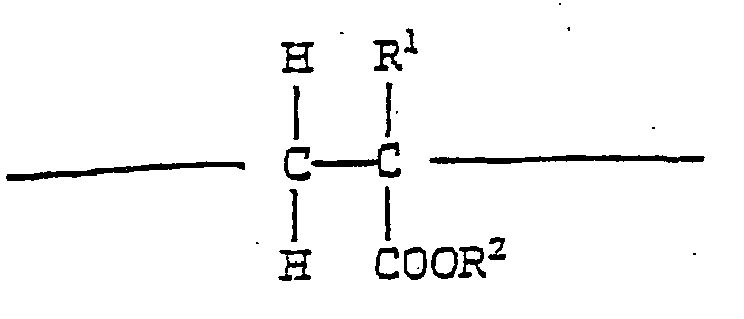
wherein R1 is hydrogen or methyl, and R2 is an alkyl group having 1 to 8 carbon atoms.
wherein R1 is hydrogen or methyl, and R2 is an alkyl group having 1 to 8 carbon atoms.
6. The use of claim 5, wherein the liquid acrylic polymer has a glass transition point
of 0°C or less.
7. The use of claim 1 or 2, wherein the rubber-based pressure-sensitive adhesive layer
contains a tackifier.
1. Verwendung einer Folie zum Schutz der Oberfläche eines Automobillackfilms, wobei die
Folie einen Träger aufweist, auf dessen einer Seite eine druckempfindliche Kleberschicht
auf Kautschukbasis mit einem dynamischen Modul von 0,02 bis 0,7 MPa (2 x 10⁵ bis 7 x 10⁶ dyn/cm2) bei 60°C, gemessen bei einer Frequenz von 1 Hz, und mit einer Haftfestigkeit an
dem Lackfilm von 130 bis 700 g/20 mm gebildet ist, wobei die druckempfindliche Kleberschicht
auf Kautschukbasis Polyisobutylen enthält, welches nicht als ein Polymer auf Kautschukbasis
härtbar ist, worin die druckempfindliche Kleberschicht auf Kautschukbasis 0,005 bis
0,5 Gewichtsteile eines Siliconöls pro 100 Gewichtsteile des druckempfindlichen Klebers
auf Kautschukbasis enthält.
2. Verwendung einer Folie zum Schutz der Oberfläche eines Automobillackfilms, wobei die
Folie einen Träger aufweist, auf dessen einer Seite eine druckempfindliche Kleberschicht
auf Kautschukbasis mit einem dynamischen Modul von 0,02 bis 0,7 MPa (2 x 10⁵ bis 7 x 10⁸ dyn/cm2) bei 60°C, gemessen bei einer Frequenz von 1 Hz, und mit einer Haftfestigkeit an
dem Lackfilm von 130 bis 700 g/20 mm gebildet ist, wobei die druckempfindliche Kleberschicht
auf Kautschukbasis Polyisobutylen enthält, welches nicht als ein Polymer auf Kautschukbasis
härtbar ist, worin die druckempfindliche Kleberschicht auf Kautschukbasis 0,01 bis
2 Gewichtsteile eines Acrylpolymers mit einem gewichtsmittleren Molekulargewicht von
1 000 bis 50 000 pro 100 Gewichtsteile des druckempfindlichen Klebers auf Kautschukbasis
enthält.
3. Verwendung nach Anspruch 1, worin das Siliconöl Dimethylpolysiloxan, Methylphenylpolysiloxan,
Methylhydrogenpolysiloxan oder modifizierte Produkte davon ist.
4. Verwendung nach Anspruch 2, worin das Acrylpolymer durch Lösungspolymerisation von
wenigstens einem Alkylester von Acrylsäure oder Methacrylsäure mit 1 bis 18 Kohlenstoffatomen
in dem Alkylteil erhalten wird.
5. Verwendung nach Anspruch 4, worin das Acrylpolymer ein flüssiges Acrylpolymer mit
einer Struktureinheit ist, die durch die Formel
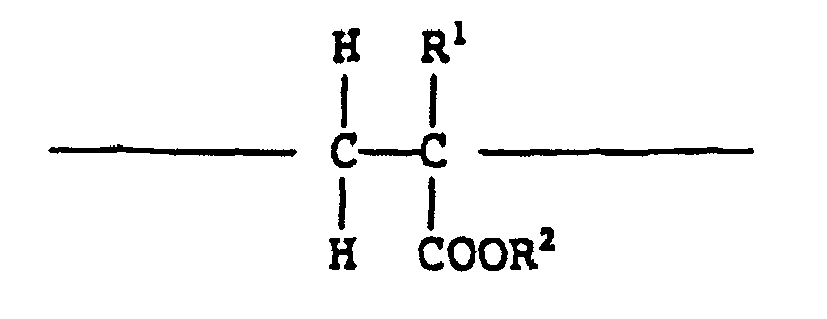
wiedergegeben wird, worin R1 Wasserstoff oder Methyl ist, und R2 eine Alkylgruppe mit 1 bis 8 Kohlenstoffatomen ist.
wiedergegeben wird, worin R1 Wasserstoff oder Methyl ist, und R2 eine Alkylgruppe mit 1 bis 8 Kohlenstoffatomen ist.
6. Verwendung nach Anspruch 5, worin das flüssige Acrylpolymer einen Glasübergangspunkt
von 0°C oder weniger hat.
7. Verwendung nach Anspruch 1 oder 2, worin die druckempfindliche Kleberschicht auf Kautschukbasis
einen Klebrigmacher enthält.
1. Utilisation d'une feuille pour protéger la surface d'un film de peinture de véhicule
automobile, ladite feuille comprenant un substrat sur un côté duquel est formée une
couche adhésive sensible à la pression à base de caoutchouc ayant un module dynamique
à 60°C, mesuré à une fréquence de 1 Hz, de 0,02 à 0,7 MPa (2 x 10⁵ à 7 x 10⁶ dyne/cm2) et une force d'adhérence au film de peinture de 130 à 700 g/20 mm, ladite couche
adhésive sensible à la pression à base de caoutchouc comprenant du polyisobutylène
qui n'est pas durcissable en tant que polymère à base de caoutchouc, dans laquelle
la couche adhésive sensible à la pression à base de caoutchouc contient 0,005 à 0,5
parties en masse d'une huile de silicone pour 100 parties en masse de l'adhésif sensible
à la pression à base de caoutchouc.
2. Utilisation d'une feuille pour protéger la surface d'un film de peinture de véhicule
automobile, ladite feuille comprenant un substrat sur un côté duquel est formée une
couche adhésive sensible à la pression à base de caoutchouc ayant un module dynamique
à 60°C, mesuré à une fréquence de 1 Hz, de 0,02 à 0,7 MPa (2 x 10⁵ à 7 x 10⁶ dyne/cm2) et une force d'adhérence au film de peinture de 130 à 700 g/20 mm, ladite couche
adhésive sensible à la pression à base de caoutchouc comprenant du polyisobutylène
qui n'est pas durcissable en tant que polymère à base de caoutchouc, dans laquelle
la couche adhésive sensible à la pression à base de caoutchouc contient 0,01 à 2 parties
en masse d'un polymère acrylique ayant une masse moléculaire moyenne en poids de 1
000 à 50 000 pour 100 parties en masse de l'adhésif sensible à la pression à base
de caoutchouc.
3. Utilisation selon la revendication 1 dans laquelle l'huile de silicone est un diméthylpolysiloxane,
un méthylphénylpolysiloxane, un méthylhydrogénopolysiloxane ou leurs produits modifiés.
4. Utilisation selon la revendication 2 dans laquelle le polymère acrylique est obtenu
par polymérisation en solution d'au moins un ester alkylique d'acide acrylique ou
d'acide méthacrylique ayant 1 à 18 atomes de carbone dans le groupement alkyle.
5. Utilisation selon la revendication 4 dans laquelle le polymère acrylique est un polymère
acrylique liquide ayant une unité structurale représentée par la formule
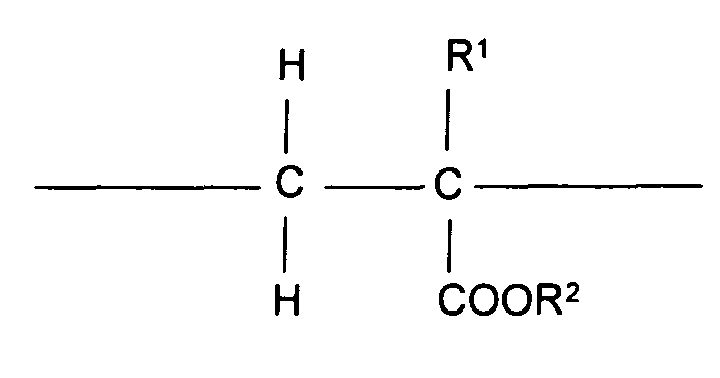
dans laquelle R1 est hydrogène ou méthyle et R2 est un groupe alkyle ayant 1 à 8 atomes de carbone.
dans laquelle R1 est hydrogène ou méthyle et R2 est un groupe alkyle ayant 1 à 8 atomes de carbone.
6. Utilisation selon la revendication 5 dans laquelle le polymère acrylique liquide a
une température de transition vitreuse de 0°C ou moins.
7. Utilisation selon la revendication 1 ou 2 dans laquelle la couche adhésive sensible
à la pression à base de caoutchouc contient un agent de pégosité.
REFERENCES CITED IN THE DESCRIPTION
This list of references cited by the applicant is for the reader's convenience only. It does not form part of the European patent document. Even though great care has been taken in compiling the references, errors or omissions cannot be excluded and the EPO disclaims all liability in this regard.
Patent documents cited in the description