|
(11) | EP 0 519 877 A1 |

| (12) | EUROPEAN PATENT APPLICATION |
|
|
|
|
|||||||||||||||||||||||||||
| (54) | 3-Acylamino-2-pyrrolidinones as enhancers of the processes of learning and memory and pharmaceutical compositions containing same |
| (57) 3-acylamino-2-pyrrolidinones of general formula (I)
wherein R is selected from pyrrolidin-2-one-1-acetyl, p-methoxybenzoyl, N-benzyloxycarbonyl-(S)-prolyl, phenylbutanoyl, 3-trifluoromethylbenzoyl, 3,4,5-trimethoxybenzoyl, nicotinoyl and acyl having 1-5 carbon atoms; and R₁ is selected from hydrogen, methoxycarbonilmethyl, amminocarbonylmethyl, 2-hydroxyethyl and formylmethyl, are potent enhancers of the processes of learning and memory. Orally or parenterally administrable compositions in unit dosage form comprise from about 100 to about 500 mg of a compound of formula (I). |
[0001] The presente invention relates to 3-acylamino-2-pyrrolidinones of general formula (I)
wherein R is selected from pyrrolidin-2-one-1-acetyl, p-methoxybenzoyl, N-benzyloxycarbonyl-(S)-prolyl, phenylbutanoyl, 3-trifluoromethylbenzoyl, 3,4,5-trimethoxybenzoyl, nicotinoyl and acyl having 1-5 carbon atoms; and R₁ is selected from hydrogen, methoxycarbonilmethyl, amminocarbonylmethyl, 2-hydroxyethyl and formylmethyl.
[0003] Because of the presence of one chiral carbon atom, they can exist as two enantiomers designated (R) and (S); although both enantiomers are pharmacologically active, for the sake of simplicity reference shall be made hereinbelow to the (S)-type enantiomer.
[0004] The present invention also relates to orally and parenterally administrable pharmaceutical compositions for enhancing the processes of learning and memory, comprising a novel compound of general formula (I) as active ingredient.
[0005] The known compounds that structurally and pharmacologically are most strictly related to the compound of general formula (I) are PIRACETAM [see e.g. Curr. Dev. Psycopharmacol. 3, 22, (1976] and OXIRACETAM [see e. g. Il Farmaco, Ed. Sc. 39/ 1, 16, ( 1984)].
[0006] As it will be shown hereinbelow, the compounds of the present invention are more potent than the known compounds. The compounds of formula (I) are prepared by a process illustrated in the following reaction scheme.
[0007] (S)-3-amino-2-pyrrolidinone (ST 802, prepared as disclosed in Synthesis, 614, 1978) is reacted in an anhydrous organic solvent such as acetonitrile or methylene chloride or an acetonitrile-water mixture at room temperature, for 10-24 hours, with an equimolar amount of a carboxylic acid (Y = COX wherein X is an activating group) activated by a halogenating agent such as thionyl or oxalyl chloride, or a condensating agent such as dicyclohexyl carbodiimide (DCC), carbonyldiimidazole (CDI), 2-ethoxy-1-ethoxycarbonyl-1,2-dihydroquinoline (EEDQ). The condensation product thus obtained is purified by crystallization or silica gel chromatography. When R₁ is other than H, the compound of formula I′ is reacted with a halogen derivative (ratio 1:2) in an inert solvent such as acetonitrile or tetrahydrofuran in the presence of sodium or potassium hydride (1:1 to 1:2 ratio), at room temperature or at reflux temperature, for 2-24 hours, thus obtaining the compound of formula (I).
[0008] The following non limiting examples describe the preparation of some compounds of formula (I).
Example 1
Preparation of (S)-3-(3-trifluoromethylbenzoylamino)-2-pyrrolidinone (ST 835)
[0009] CDI (2.67 g; 16.48 mmoles) was added to 3-trifluoromethylbenzoic acid (2.85 g; 14.98 mmoles) in 100 mL CH₂Cl₂ under stirring at room temperature. After one hour, (S)-3-amino-2-pyrrolidinone (1.5 g; 14.98 mmoles) was added and the resulting solution was kept at room temperature under stirring for 20 hours. The solution was washed with 1N NaOH, 1N HCl, H₂O, saturated solution of NaCl and dried over anhydrous Na₂SO₄. Following solvent evaporation, 2 g of the product were obtained which was further purified by crystallization from EtOAc/n-hexane, giving 1.6 g of the title compound. Yield 40% (calculated on the crystallized product).
M.P. = 133- 155°C
[α]
= -31.5° MeOH (C = 0.5)
TLC = silica gel Eluant = EtOAc - MeOH 9 : 1 Rf = 0.37
Elementary analysis for C₁₂H₁₁F₃N₂O₂
- Calculated
- C 52.9 H 4.0 N 10.2
- Found
- C 52.9 H 4.07 N 10.4
¹H NMR (CDCl₃): δ 8.08 (s ,1H, aromatic), 7.98 (d, 1H, aromatic) 7.8 (d, 1H, -CHNHCO) - 7.7 (d, 1H, aromatic), 7.5 (t, 1H, aromatic), 6.7 (s, 1H, -CH₂NHCO-), 4.7-4.6 (m, 1H, -CHNCO-), 3.5-3.38 (m, 2H, -CH₂NCO-), 2.82-2.7 (m, 1H, -CHHCHN-), 2.2-2 (m, 1H, -CHHCHN-)
HPLC
µ Bondapack - C₁₈ Length = 300 mm Inner diameter = 3.9 mm Size = 10 µm
Eluant = KH₂PO₄ 0.05M/CH₃CN (80 : 20)
Flow-rate = 1 mL/min
Permanence time = 13.38 min
Example 2
Preparation of (S)-3-(formylamino)-2-pyrrolidinone (ST 879)
[0010] CDI (4.08 g; 25.17 mmoles) was added to formic acid (965.5 mg; 20.97 mmoles) in 100 mL CH₂Cl₂ and the resulting solution was kept under stirring at room temperature for one hour. (S)-3-amino-2-pyrrolidinone (2.1 g; 20.97 mmoles) was added under stirring. After some hours, a white precipitate formed. After 24 hours, Et₂O was added till complete precipitation. The precipitate was collected by filtration and chromatographed on silica gel using EtOAc - MeOH 8 : 2 as eluant. 2.03 g of product which was further purified by refluxing it with CHCl₃ were obtained. 1.2 g of the title compound were obtained.
Yield = 44% (calculated on 1.2 g)
M. P. = 177- 179°C
[α]
= -86.25° MeOH (C = 0.56)
TLC = silica gel Eluant = EtOAc - MeOH 7 : 3 Rf = 0.4
Elementary analysis for C₅H₈N₂O₂
- Calculated
- C 46.86 H 6.29 N 21.86
- Found
- C 46.92 H 5.76 N 22.16
¹H NMR (D₂O): δ 8.15-8.05 (2s ,1H, -NCHO), 4.62-4.4 (m, 1H, -CHNHCO) - 3.48-3.3 (m, 1H, -CH₂NCO-), 2.6-2.45 (m, 1H, -CHHCHN-), 2.15-2 (m, 1H, -CHHCHN-)
HPLC
µ Bondapack - C₁₈ Length = 300 mm Inner diameter = 3.9 mm Size = 10 µm
Eluant = KH₂PO₄ 0.05M/CH₃CN (95 : 5)
Flow- rate = 1 mL/min
Permanence time = 3.2 min
Assessment of the antiamnesic activity
[0011] In order to assess the antiamnesic activity the passive avoidance test in mice was used. Amnesia was brought about by administration of electroconvulsive shock (ECS) (cfr. Banfi et al., A screening method for substances potentially active on learning and memory. J. Pharmacol. Methods Vol.: 8 (4) 255-263, 1982).
[0012] Male CDI mice (Charles River) weighting 25-26 g fed on a normal diet were used for the ECS-induced amnesia test.
[0013] The compounds were administered i.p.at doses equimolar to 9 and 0.9 mg/kg PIRACETAM. The compounds were dissolved in saline.
[0014] The apparatus for passive avoidance conditioning was a black plastic chamber (42 x 42 cm, height 40 cm) provided with a floor constructed of metal rods that could be 'electrified. From the front wall extended a white runway, 30 cm long and 10 cm wide provided with side walls 12 cm high, which led into the box through a guillotine door. The runway was lightened by a 60 W lamp whereas the box remained in the dark (cfr. Ader et al., Retention of passive avoidance response as a function of the intensity and duration of electric shock. Psychon. Sci., 26 (3), 125-127, 1972).
[0015] 30 minutes following treatment with the compounds, the animals were placed on the runway. After one minute of adaptation, the door was raised and the time employed by the animal to enter the darkened box with all four feet was recorded.
[0016] Upon entry, the guillotine door was lowered and three seconds thereafter the rods were electrified, 0.24 mA for 2 seconds.
[0017] The mouse was then removed from the chamber and immediately administered an electroshock delivered through spring clips attached to the ears (square wave, intensity 20 mA, amplitude 0.6 msec, duration 0.5 s, frequency 50 Hz).
[0018] Immediately thereafter the animal was placed in the housing cage. Retention was assessed 24 hours later by placing the animal on the runway and again evaluating the latency in entering the chamber, using an endpoint of 300 seconds (Bammer, loc.cit.).
[0019] In each experiment, two groups of animals in addition to the treated ones were used, that were defined as follows:
(1) ceiling control animals (treated with placebo and not subjected to amnesia treatment) to ensure that these animals not treated with the amnesia agent remembered the task;
(2) base-line control animals (treated with placebo and subjected to amnesia treatment) to ensure that ECS produced amnesia in the animals not treated with the compounds of the present invention.
[0020] The results of each compound under examination were expressed as percentage of amnesia reversal (AR) in order to make comparisons across the tested compounds.
AR is defined as follows:
wherein CI, Comparison Index (the subscripts "t" and "c" refer to "treated" and "ceiling control", respectively) is defined by the formula
wherein
- Ni is the number of animals belonging to the i-nth group (ceiling control or treated animals);
- Nj is the number of animals belonging to the j-nth group (base-line control animals); and
- Aij is a binary function that can take only the values +1,0 or -1 depending on whether the latency time (in seconds) of an animal belonging to the i-nth group, Xi, is higher than, the same as or smaller than the latency time (in seconds) of an animal of the j-nth group, Xj.
[0021] The sum ΣAij encompasses all the possible pairs obtained by combining each term Xi with each term Xj.
[0022] Whenever in performing the test the Comparison Index (CI) between ceiling control animals and base-line control animals, generally expected to range between 60 and 80%, turned out to be lower than 40% the data for the whole experiment were discarded.
[0024] In particular, at the dose of 9 mg/kg, PIRACETAM and ST 802 are inactive and ST 879 is poorly active (AR 9%); at the lower dose, 0.9 mg/kg, PIRACETAM is still inactive, whereas ST 802 and ST 879 were shown to be active, AR 24% and 53%, respectively. ST 835 is highly active both at 9 mg/kg (AR 58%) and 0.9 mg/kg (AR 51%).
Behavioural profile
[0025] The behavioural profile was assessed in male CDI mice (Charles River, Italy) weighing 22-24 g, using the Irwin test (IRWIN S., Drug screening and evaluation procedures; 136, 123-128 1962). The animals had been caged under normal conditions and kept fasting for the last 18 hours.
[0026] Following administration of the compounds, the behaviour of the animals was monitored for 6 hours.
[0027] The compounds were suspended in 10% arabic gum and orally administered at doses equimolar to 90, 23, 5.4 and 1.4 mg PIRACETAM/ 10mL/kg of body weight.
Analgesic activity
[0030] The analgesic activity was assessed in CDI mice (Charles River, Italy) weighing 22-24 g, utilizing the hot plate test (56°C).
[0031] The animals, kept under normal caging conditions and kept fasting for 18 hours, were placed on the hot plate for 30, 60, 120 and 180 minutes following the oral administration of 90, 23, 5.4 and 1.4 mg/10 mL/kg equimolar to piracetam of each compound under examination.
[0032] The analgesic activity was assessed by measuring the increase (in seconds) of the time the animals continued to stay on the hot plate.
[0034] The compounds of the present invention are orally or parenterally administered, in any of the usual pharmaceutical forms which are prepared via the conventional procedures well-known to those persons skilled in pharmaceutical technology. These forms include solid and liquid oral unit dosage forms such as tablets, capsules, solutions, syrups and the like as well as injectable forms such as sterile solutions for ampoules and phials.
[0035] For these pharmaceutical forms the usual solvents, diluents and excipients are used. Optionally, sweetening, flavouring and preservative agents can also be present. Non limiting examples of such agents are sodium carboxymethylcellulose, polysorbate, mannitol, sorbitol, starch, avicel, talcum and other agents which will be apparent to those skilled in the pharmaceutical technology.
[0036] The dose which is administered will be determined by the attending physician having regard to the age, weight and general conditions of the patient, utilizing sound professional judgement. Although effective results can be noticed at doses as low as 5 to 8 mg/kg of body weight daily, a dose of from about 10 to 50 mg/kg of body weight is preferred. Whenever necessary, larger doses can be safely administered in view of the low toxicity of the compounds of this invention.
1. 3-acylamino-2-pyrrolidinones of general formula (I)
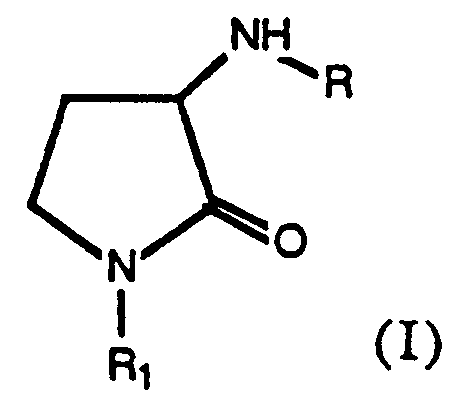
wherein R is selected from pyrrolidin-2-one-1-acetyl, p-methoxybenzoyl, N-benzyloxycarbonyl-(S)-prolyl, phenylbutanoyl, 3-trifluoromethylbenzoyl, 3,4,5-trimethoxybenzoyl, nicotinoyl and acyl having 1-5 carbon atoms; and R₁ is selected from hydrogen, methoxycarbonilmethyl, amminocarbonylmethyl, 2-hydroxyethyl and formylmethyl.
wherein R is selected from pyrrolidin-2-one-1-acetyl, p-methoxybenzoyl, N-benzyloxycarbonyl-(S)-prolyl, phenylbutanoyl, 3-trifluoromethylbenzoyl, 3,4,5-trimethoxybenzoyl, nicotinoyl and acyl having 1-5 carbon atoms; and R₁ is selected from hydrogen, methoxycarbonilmethyl, amminocarbonylmethyl, 2-hydroxyethyl and formylmethyl.
2. The compound of claim 1, wherein R₁ is H and R is 3-trifluoromethylbenzoyl.
3. The compound of claim 1, wherein R₁ is H and R is formyl.
4. An orally or parenterally administrable pharmaceutical composition for enhancing the
processes of learning and memory, comprising as active ingredient a 3-acylamino-2-pyrrolidinone
of general formula (I)
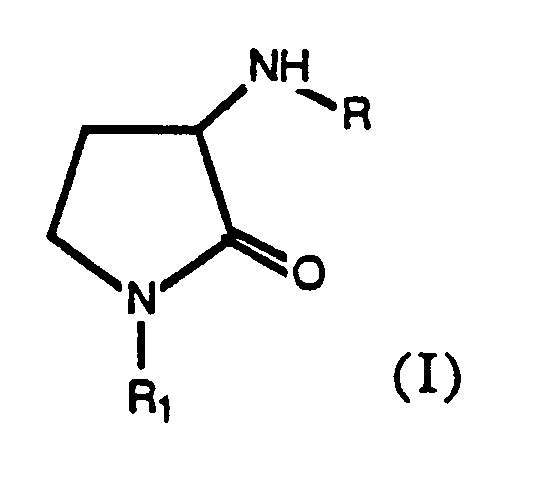
and a pharmacologically acceptable excipient therefor.
and a pharmacologically acceptable excipient therefor.
5. The pharmaceutical composition of claim 4 in unit dosage form, comprising between
about 50 to about 500 mg of a compound of general formula (I).