|
(11) | EP 0 520 005 B1 |

| (12) | EUROPEAN PATENT SPECIFICATION |
|
|
| (54) |
NITROXIDES FOR WEIGHT REDUCTION STICKOXIDE ZUR GEWICHTSREDUKTION NITROXYDES UTILISES POUR LA REDUCTION DU POIDS |
|
|
|||||||||||||||||||||||||||||||||||
| Note: Within nine months from the publication of the mention of the grant of the European patent, any person may give notice to the European Patent Office of opposition to the European patent granted. Notice of opposition shall be filed in a written reasoned statement. It shall not be deemed to have been filed until the opposition fee has been paid. (Art. 99(1) European Patent Convention). |
Field of the Invention
Summary of the Invention
[0002] According to the present invention, a metal-independent nitroxide or an oxazolidine compound capable of forming an oxazolidine-oxyl, eg. oxazolidine-1-oxyl, or a physiologically-acceptable salt thereof, is used for the manufacture of a medicament for inducing weight reduction.
[0003] Preferred methods of administration of such a medicament include oral and intravenous administration.
Description of the Invention
[0004] Examples of compounds that are useful in the present invention have the formula
wherein R1 is -CH3; R2 is -C2H5, -C3H7, -C4H9, -C5H11, -C6H13, -CH2-CH(CH3)2, -CHCH3C2H5, or -(CH2)7-CH3, or wherein R1 and R2 together form spirocyclopentane, spirocyclohexane, spirocycloheptane, spirocyclooctane, 5-cholestane, or norbornane; R3 is -O• or -OH, or a physiologically acceptable salt thereof which has antioxidant activity.
[0005] Compounds which may be useful in the present invention also include any compound having a 〉N-O• or 〉N-OH group, or a salt thereof. These compounds can be represented broadly by the formula:
wherein R3 is as defined above, and R4 and R5 combine together with the nitrogen to form a heterocyclic group. The atoms in the heterocyclic group (other than the N atom shown in the formula) may be all C atoms or may be C atoms as well as one or more N, O and/or S atoms. The heterocyclic group preferably has 5 or 6 total atoms. The heterocyclic group may be preferably a pyrrole, imidazole, oxazole, thiazole, pyrazole, 3-pyrroline, pyrrolidine, pyridine, pyrimidine, or purine, or derivatives thereof, for example.
[0006] Further compounds which may be useful in the present invention also include those wherein R4 and R5 themselves comprise a substituted or unsubstituted cyclic or heterocyclic group.
[0007] Physiologically acceptable salts include acid addition salts formed with organic and inorganic acids, for example, hydrochlorides, hydrobromides, sulphates such as creatine sulphate salts, phosphates, citrates, fumarates and maleates. The compounds of the invention have been shown to exhibit little or no in vitro cytotoxicity at concentrations of from 1-5 mM for 5 hours.
[0008] The above compounds may be included in biologically-compatible pharmaceutical compositions in amounts of from 0.1%-99% by weight of the total composition, preferably 1 to 90% by weight of the total composition. For intravenous injection, the dose may be about 0.1 to about 300 mg/kg/day. If applied topically as a liquid, ointment, or cream, the compound may be present in an amount of about 0.01 to about 100 mg/ml of the composition. For inhalation, about 0.1 to about 200 mg/kg body weight of the compound should be administered per day. For oral administration, the compound should be administered in an amount of about 0.1 to about 300 mg/kg/day.
[0009] The term "biologically compatible" refers to a composition which does not cause any adverse effects to an organism to which it is applied. The composition is preferably free of toxic substances or other substances which would render it unsuitable for the intended use.
[0010] The invention is now further illustrated by way of the accompanying drawing, and the following Examples.
EXAMPLE 1
Synthesis of oxazolidine derivatives in vitro.
[0012] Desferrioxamine (DF) was a gift from Ciba Geigy; hypoxanthine (HX) was purchased from Calbiochem - Boehringer Co.; 2,2,6,6-tetramethylpiperidine-1-oxyl (TEMPO), 4-hydroxy-2,2,6,6-tetramethylpiperidine-1-oxyl (TEMPOL), 4-hydroxypyrazolo[3,4,-d] - pyrimidine (allopurinol), p-toluene sulfonic acid, 2-amino-2-methyl-1-propanol, 2-butanone, and cyclohexanone were purchased from Aldrich Chemical Co.; trioxalato chromiate(III) (CrOx) was purchased from Pfaltz and Bauer, Inc., and recrystallized; xanthine oxidase (EC 1.2.3.2. xanthine: oxygen oxidoreductase) grade III from buttermilk, superoxide dismutase (SOD), and grade V ferricytochrome c were obtained from Sigma. H2O2 was bought from Fisher Scientific Co. XO was further purified on a G25 sephadex column. All other chemicals were prepared and used without further purification. Distilled-deionized water was used throughout all experiments.
[0013] CHD, 2-spirocyclohexane doxyl (2-spirocyclohexane-5,5-dimethyl-3-oxazolidinoxYl) and OXANO, 2-ethyl-2,5,5-trimethyl-3-oxazolidine-1-oxyl as well as other nitroxides were synthesized as described by Keana et al (J. Am. Chem. Soc., 89, 3055-3056, 1967). For the general synthesis of the cyclic amines, the appropriate starting ketone was reacted with 2-amino-2-methyl-1-propanol in benzene in the presence of catalytic amounts of p-toluene sulfonic acid. As the cyclic structure formed, water was eliminated. The volume of water collected in a Dean Stark apparatus was monitored and used to gauge the reaction progress. The amines thus produced were purified through fractional distillation under reduced pressure, characterized by 220 MHz 1H NMR, IR, UV, either EI or CI mass spectroscopy, and subsequently oxidized to the corresponding nitroxides using m-chloroperbenzoic acid. The nitroxides were purified by silica flash chromatography (Still et al, J. Org. Chem., 43, 2923-2925, 1978). Water/octanol ratios were determined by placing a quantity of nitroxide in water+octanol within a separatory funnel. The mixture was shaken thoroughly and allowed to separate for 15 min, whereupon aliquots were taken from both fractions and the ratio of nitroxide distribution was determined using electron paramagnetic resonance (EPR) spectroscopy, by comparing the intensities of signal obtained under N2.
EXAMPLE 2
Nitroxide-Induced Weight Loss in Animals.
[0014] Six week old female C3H mice (6 animals in each group) were allowed to drink an unlimited supply of water alone (control) or 4-hydroxy tempo (TEMPOL) dissolved in water at a concentration of 10 mg per ml. Chronic oral administration (>3 weeks) results in no apparent toxicity to the animals, but a reduction of weight compared to controls by 12.5% as shown in Figure 1. Thus, nitroxide given over extended periods appears to cause weight loss in animals.
1. Use of a metal-independent nitroxide or an oxazolidine compound capable of forming
an oxazolidine-oxyl, or a physiologically-acceptable salt thereof, for the manufacture
of a medicament for inducing weight reduction.
2. Use as claimed in claim 1, wherein the compound has the formula
R3-NR4R5
wherein R3 is -O• or -OH; and either NR4R5 is a heterocyclic group, or R4 and R5 themselves comprise a substituted or unsubstituted cyclic or heterocyclic group.
R3-NR4R5
wherein R3 is -O• or -OH; and either NR4R5 is a heterocyclic group, or R4 and R5 themselves comprise a substituted or unsubstituted cyclic or heterocyclic group.
3. Use as claimed in claim 1, wherein the compound has the formula
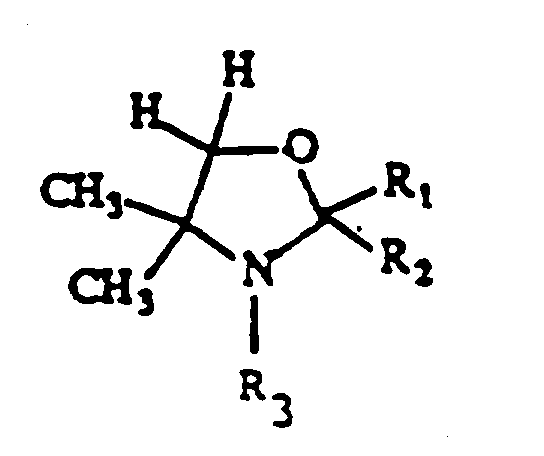
wherein either R1 is -CH3 and R2 is -C2H5, -C3H7, -C4H9, -C5H11, -C6H13, -CH2-CH(CH3)2, -CHCH3C2H5 or -(CH2)27-CH3, or wherein R1 and R2 together form spirocyclopentane, spirocyclohexane, spirocycloheptane, spirocyclooctane, 5-cholestane or norbornane; and R3 is -O• or -OH; or a physiologically-acceptable salt thereof.
wherein either R1 is -CH3 and R2 is -C2H5, -C3H7, -C4H9, -C5H11, -C6H13, -CH2-CH(CH3)2, -CHCH3C2H5 or -(CH2)27-CH3, or wherein R1 and R2 together form spirocyclopentane, spirocyclohexane, spirocycloheptane, spirocyclooctane, 5-cholestane or norbornane; and R3 is -O• or -OH; or a physiologically-acceptable salt thereof.
4. Use as claimed in claim 2, wherein the compound is 4-hydroxy-2,2,6,6-tetramethylpiperidine-1-oxyl.
5. Use as claimed in any preceding claim, wherein the medicament is for oral administration.
6. Use as claimed in any of claims 1 to 4, wherein the medicament is for intravenous
administration.
1. Verwendung einer metallunabhängigen Nitroxid- oder einer Oxazolidin-Verbindung, die
in der Lage ist, ein Oxazoladin-Oxyl oder ein physiologisch annehmbares Salz hiervon
zu bilden, zur Herstellung eines Medikaments zum Herbeiführen einer Gewichtsabnahme.
2. Verwendung nach Anspruch 1, wobei die Verbindung die Formel
R3-NR4R5
hat, wobei R3 entweder -O• oder -OH ist, und wobei entweder NR4R5 eine heterozyklische Gruppe ist oder R4 und R5 ihrerseits eine substituierte oder nicht substituierte zyklische oder heterozyklische Gruppe umfassen.
R3-NR4R5
hat, wobei R3 entweder -O• oder -OH ist, und wobei entweder NR4R5 eine heterozyklische Gruppe ist oder R4 und R5 ihrerseits eine substituierte oder nicht substituierte zyklische oder heterozyklische Gruppe umfassen.
3. Verwendung nach Anspruch 1, wobei die Verbindung die Formel
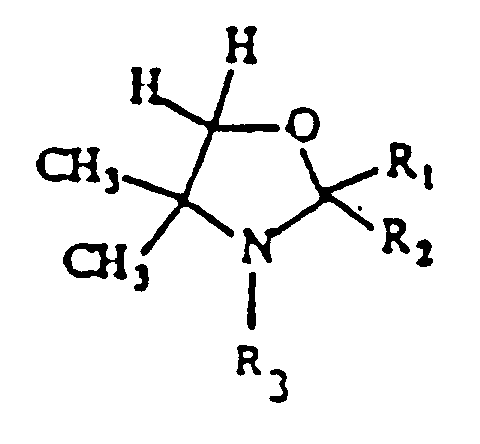
hat, wobei entweder R1 die Form -CH3 hat und R2 die Form -C2H5, -C3H7, -C4H9, -C5H11, -C6H13, -CH2-CH(CH3)2, -CHCH3C2H5 oder -(CH2)27-CH3 hat, oder wobei R1 und R2 zusammen Spirozyclopentan, Spirozyclohexan, Spirozyclohektan, Spirozyklooktan, 5-Cholestan oder Norbornan bilden, und wobei R3 entweder -O• oder -OH ist, oder Verwendung eines physiologisch annehmbaren Salzes hiervon.
hat, wobei entweder R1 die Form -CH3 hat und R2 die Form -C2H5, -C3H7, -C4H9, -C5H11, -C6H13, -CH2-CH(CH3)2, -CHCH3C2H5 oder -(CH2)27-CH3 hat, oder wobei R1 und R2 zusammen Spirozyclopentan, Spirozyclohexan, Spirozyclohektan, Spirozyklooktan, 5-Cholestan oder Norbornan bilden, und wobei R3 entweder -O• oder -OH ist, oder Verwendung eines physiologisch annehmbaren Salzes hiervon.
4. Verwendung nach Anspruch 2, wobei die Verbindung 4-Hydroxy-2,2,6,6-Tetramethylpiperidin-1-Oxyl
ist.
5. Verwendung nach einem der vorhergehenden Ansprüche, wobei das Medikament für orale
Verabreichung vorgesehen ist.
6. Verbindung nach einem der Ansprüche 1 bis 4, wobei das Medikament für intravenöse
Verabreichung vorgesehen ist.
1. Utilisation d'un nitroxyde à métal indépendant ou d'un composé d'oxazolidine capable
de former un oxazolidino-oxyle, ou d'un de leurs sels physiologiquement acceptables,
pour la fabrication d'un médicament destiné à induire une diminution de poids.
2. Utilisation selon la revendication 1, dans laquelle le composé répond à la formule
R3-NR4R5
dans laquelle R3 est -O• ou -OH; et soit NR4R5 est un groupe hétérocyclique, soit R4 et R5 comprennent eux-mêmes un groupe cyclique ou hétérocyclique, substitué ou non substitué.
R3-NR4R5
dans laquelle R3 est -O• ou -OH; et soit NR4R5 est un groupe hétérocyclique, soit R4 et R5 comprennent eux-mêmes un groupe cyclique ou hétérocyclique, substitué ou non substitué.
3. Utilisation selon la revendication 1, dans laquelle le composé répond à la formule
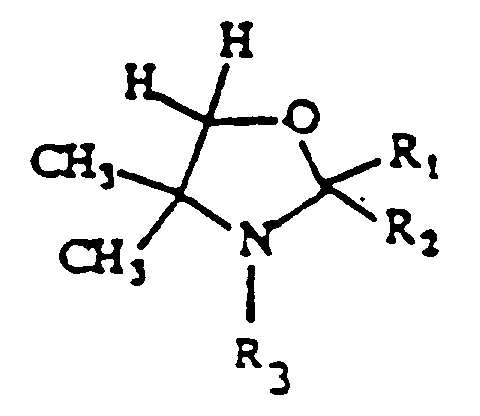
dans laquelle soit R1 est -CH3 et R2 est -C2H5, -C3H7, -C4H9, -C5H11, -C6H13, -CH2-CH(CH3)2, -CHCH3C2H5, ou -(CH2)7-CH3, soit R1 et R2 ensemble forment un spirocyclopentane, un spirocyclohexane, un spirocycloheptane, un spirocyclooctane, un 5-cholestane, ou un norbornane; et R3 est -O• ou -OH; ou un de leurs sels physiologiquement acceptables.
dans laquelle soit R1 est -CH3 et R2 est -C2H5, -C3H7, -C4H9, -C5H11, -C6H13, -CH2-CH(CH3)2, -CHCH3C2H5, ou -(CH2)7-CH3, soit R1 et R2 ensemble forment un spirocyclopentane, un spirocyclohexane, un spirocycloheptane, un spirocyclooctane, un 5-cholestane, ou un norbornane; et R3 est -O• ou -OH; ou un de leurs sels physiologiquement acceptables.
4. Utilisation selon la revendication 2, dans laquelle le composé est le 4-hydroxy-2,2,6,6-tétraméthylpipéridino-1-oxyle.
5. Utilisation selon l'une quelconque des revendications précédentes, dans laquelle le
médicament est destiné à une administration par voie orale.
6. Utilisation selon l'une quelconque des revendications 1 à 4, dans laquelle le médicament
est destiné à une administration par voie intraveineuse.