|
(11) | EP 0 521 711 A1 |

| (12) | EUROPEAN PATENT APPLICATION |
|
|
|
|
|||||||||||||||||||||||||||
| (54) | Silver halide photographic light-sensitive material |
| (57) Disclosed is a silver halide photographic light-sensitive material comprising a silver
salt of at least one dye Formula I, Formula II, Formula III, Formula IV, Formula V
and Formula VI:
|
FIELD OF THE INVENTION
[0001] The present invention relates to a silver halide photographic light-sensitive material containing a new non-diffusible dye, more specifically a silver halide photographic light-sensitive material containing a new non-diffusible dye exhibiting improved an efflux-decoloring property during processing.
BACKGROUND OF THE INVENTION
[0002] With respect to silver halide photographic light-sensitive materials (hereinafter referred to as light-sensitive materials), it is a well-known fact that a dye is added to a structural layer of the light-sensitive material to absorb light in a particular wavelength band for the purpose of light absorbing filtration, prevention of halation, prevention of irradiation or regulation of the sensitivity of light-sensitive emulsion; accordingly, it is a conventional practice to color the hydrophilic colloid layer with such a dye.
[0003] Of the structural layers of the light-sensitive material, the filter layer, usually located on a light-sensitive emulsion layer or between said emulsion layer and another emulsion layer, serves to change the incident light coming in the emulsion layer into light with the desired spectrum. The anti-halation layer, provided between a light-sensitive emulsion layer and the support or on the back face of the support for the purpose of improving image sharpness, serves to absorb harmful reflected light in the interface between the emulsion layer and the support or on the back face of the support to improve image sharpness.
[0004] It is another practice to improve image sharpness by preventing irradiation by absorbing reflected light, scattered light and other light which are harmful to silver halide grains by the use of a dye to color a light-sensitive emulsion layer.
[0005] The dyes used for these purposes must not only possess an absorption spectral characteristic suitable to the purpose of use thereof but also meet various requirements, such as complete decoloring during development, easy dissolution from the light-sensitive material during development, freedom of residual color stain dy the dye after processing, absence of adverse effects, such as fogging and desensitization, on the light-sensitive emulsion, prevention of dye diffusion from the colored layer to another layer, and excellent storage stability with no discoloration or fading in the light-sensitive material or in aqueous solutions.
[0006] To date, numerous investigations have been made to develop a dye meeting these requirements, including the benzylidene dyes proposed in US Patent Nos. 3,540,887, 3,544,325 and 3,560,214, Japanese Patent Examined Publication No. 10578/1956 and Japanese Patent Publication Open to Public Inspection (hereinafter referred to as Japanese Patent O.P.I. Publication) No. 3623/1976, the oxonol dyes proposed in British Patent No. 506,385 and Japanese Patent Examined Publication No. 22069/1964, the merocyanine dye proposed in US Patent No. 2,493,747 and the styryl dye proposed in US Patent No. 1,845,404.
[0007] Although some of these conventional dyes relatively little affect emulsion performance and are bleacheable, soluble, discolorable or otherwise changeable during processing, they are unsatisfactory as to diffusion resistance. Specifically, they have a drawback that when a particular one of the plurality of layers is selectively colored to use as a filter layer or an anti-halation layer, they not only diffuse considerably into other layers and degrade the light absorption effect but also exhibit undesirable spectral action on other layers.
[0008] Thus, as a means of selectively dying a particular hydrophilic colloid layer, there have been proposed the use of a mordant to immobilize the dye and the use of a non-diffusible dye.
[0009] However, the method using a mordant is faulty that coatability is poor, interlayer diffusion cannot be suppressed satisfactorily, and, in addition, an efflux-decoloring property during processing are poor, a high pH processing bath is required, and suitability to rapid processing is poor.
[0010] There have been made a large number of investigations of the use of a non-diffusible dye, including the silver salts of oxonol dye having a thiobarbituric acid parent nucleus with a particular structure described in British Patent No. 1,077,049 and US Patent No. 3,471,293.
[0011] Although these known silver salts of dye possess sufficient diffusion resistance to suppress interlayer diffusion, they have a drawback of an efflux-decoloring property during processing.
[0012] Thus, there is no dye meeting these requirements; there is strong demand for the development of such a dye.
SUMMARY OF THE INVENTION
[0013] It is an object of the present invention to provide a silver halide photographic light-sensitive material wherein the light-sensitive silver halide emulsion layer or a non-light-sensitive colloid layer contains a non-diffusible dye possessing a good absorption spectral characteristic. It is another object of the present invention to provide a silver halide photographic light-sensitive material containing a dye which is excellent in an efflux-decoloring property during photographic processing and highly suitable to rapid photographic processing. It is still another object of the present invention to provide a silver halide photographic light-sensitive material containing a dye having no adverse effects, such as fogging and desensitization, on the photographic properties of the light-sensitive silver halide emulsion.
DETAILED DESCRIPTION OF THE INVENTION
[0014] The objects of the present invention described above have been accomplished by a silver halide photographic light-sensitive material containing a silver salt of a compound represented by one of the following formulas I through VI.
wherein R¹ represents an alkyl group, an alkenyl group, an aryl group or a heterocyclic group; R² through R⁴ independently represent a hydrogen atom, an alkyl group, an alkenyl group, an aryl group or a heterocyclic group; X₁ through X₄ independently represent an oxygen atom or a sulfur atom; L₁ represents a methine group.
wherein R⁵ and R⁶ have the same definitions as R² through R⁴ in formula I; X₅ and X₆ have the same definitions as X₁ through X₄ in formula I; L₂ through L₅ each represent a methine group; n₁ through n₃ independently represent an integer of 0 to 2; R⁷ represents an alkyl group or an alkenyl group; Q₁ represents a group of non-metallic atoms necessary to form a 5- or 6-membered heterocyclic ring.
wherein R⁸ and R⁹ have the same definitions as R² through R⁴ in formula I; X₇ and X₈ have the same definitions as X₁ through X₄ in formula I; R¹⁰ through R¹² independently represent a hydrogen atom, an alkyl group, an alkenyl group, an aryl group, a heterocyclic group, a halogen atom, a cyano group, a sulfo group, -COR¹³, -CON(R¹³)(R¹⁴), -N(R¹³)(R¹⁴), -OR¹³, -SOR¹³, -SO₂R¹³, -SO₂N(R¹³)(R¹⁴), -N(R¹³)COR¹⁴, -N(R¹³)SO₂R¹⁴, -N(R¹³)CON(R¹⁴)(R¹⁵), -SR¹³ or -COOR¹³; R¹³ through R¹⁵ independently represent a hydrogen atom, an alkyl group, an alkenyl group, an aryl group or a heterocyclic group.
wherein R¹⁶ and R¹⁷ have the same definitions as R² through R⁴ in formula I; X₉ and X₁₀ have the same definitions as X₁ through X₄ in formula I; L₆ through L₈ each represent a methine group; n₄ represents an integer of 0 to 2; R¹⁸ through R²⁰ have the same definitions as R¹⁰ through R¹² in formula III.
wherein R²¹ and R²² have the same definitions as R² through R⁴ in formula I; X₁₁ and X₁₂ have the same definitions as X₁ through X₄ in formula I; W represents an aryl group or a heterocyclic group.
wherein R²³ through R²⁵ have the same definitions as R² through R⁴ in formula I; R²⁶ has the same definition as R¹ in formula I, provided that at least one of R²³ through R²⁵ is a hydrogen atom. L₉ through L₁₃ each represent a methine group; n₅ and n₆ independently represent an integer of 0 to 2; X₁₃ through X₁₆ have the same definitions as X₁ through X₄ in formula I.
[0016] With respect to formulas I through VI, examples of the alkyl groups represented by R¹ through R²⁶ include a methyl group, an ethyl group, a propyl group, an isopropyl group, a n-butyl group, a tert-butyl group, a cyclopentyl group and a cyclohexyl group. These alkyl groups may have been substituted by a hydroxyl group, a cyano group, a sulfo group, a carboxyl group, a halogen atom such as a fluorine atom, a chlorine atom or a bromine atom, an alkoxy group such as a methoxy group or an ethoxy group, an aryloxy group such as a phenoxy group, a 4-sulfophenoxy group or a 2,4-disulfophenoxy group, an aryl group such as a phenyl group, a 4-sulfophenyl group or a 2,5-disulfophenyl group, an alkoxycarbonyl group such as a methoxycarbonyl group or an ethoxycarbonyl group, an aryloxycarbonyl group such as a phenoxycarbonyl group, or another substituent.
[0017] Examples of the aryl groups represented by R¹ through R²⁶ and W include a phenyl group and a naphthyl group. These groups may be substituted by the alkyl groups represented by R¹ through R²⁶ and by the same substituents as specified for the alkyl groups.
[0018] Examples of the heterocyclic groups represented by R¹ through R²⁶ and W include a pyridyl group, a thiazolyl group, an oxazolyl group, an imidazolyl group, a furyl group, a pyrrolyl group, a pyrazinyl group, a pyrimidinyl group, a pyridazinyl group, a purinyl group, a selenazoyl group, a sulfolanyl group, a piperidinyl group, a pyrazolyl group or a tetrazolyl group. These groups may be replaced by the alkyl groups represented by R¹ through R²⁴ and by the same substituents as specified for the alkyl groups.
[0019] Examples of the alkenyl groups represented by R¹ through R²⁶ include a vinyl group and an allyl group. These groups may be replaced by the alkyl groups represented by R¹ through R²⁶ and by the same substituents as specified for the alkyl groups.
[0020] Examples of the heterocyclic group formed by Q₁ in formula II include the heterocyclic rings described in pages 23 through 26 of Japanese Patent O.P.I. Publication No. 282832/1986 and the heterocyclic rings represented by the following formula:
wherein R²⁴ has the same definition as R⁵ and R⁶; R²⁵ has the same definition as R¹⁰ through R¹²; l represents an integer of 0 to 3.
[0021] R₁ represents an alkyl group, an aryl group or a heterocyclic group, preferably represents an alkyl group, a phenyl group or a pyridyl group, particularly preferably an alkyl group having carbon numbers of 1 to 5, a phenyl group or a pyridyl group.
[0022] R₂, R₃ and R₄ represent independently a hydrogen atom, an alkyl group, an aryl group or a heterocyclic group, preferably represents a hydrogen atom, an alkyl group, a phenyl group or a pyridyl group, particularly preferably a hydrogen atom, an alkyl group having carbon numbers of 1 to 5, a phenyl group or a pyridyl group.
[0023] The compounds represented by Formula I and Formula VI were synthesized with reference to U.S. Patent No. 3,471,293; U.S. Patent No. 3,247,127; British Patent No. 1,077,049.
[0024] The compounds represented by Formula II were synthesized with reference to Japanese Patent O.P.I. Publication Nos. 111,857/1983 and 37,303/1984; Belgian Patent No. 872,201.
[0025] The compounds represented by Formula III were synthesized with reference to Japanese Patent O.P.I. Publication No. 181,381/1987.
[0026] The compounds represented by Formula IV were synthesized with reference to Japanese Patent O.P.I. Publication No. 111,858/1983.
[0027] The compounds represented by Formula V were synthesized with reference to Belgian Patent No. 894,758.
[0029] Production of silver salts from these dyes and their addition to light-sensitive materials can be achieved in accordance with the methods described in British Patent No. 1,077,049 and US Patent No. 3,471,293.
[0030] In the light-sensitive material of the present invention, the silver salts of dyes represented by formulas I through VI can be used as anti-irradiation dyes in the silver halide emulsion layer, and can be used as filter dyes or antihalation dyes in non-sensitive hydrophilic colloid layers. Also, two or more silver salts of the dye of the present invention may be used in combination according to the purpose of use thereof, and may also be used in combination with other dyes, as long as the effect of the invention is not interfered with.
[0031] In the present invention, the amount of silver salt of dye added to the filter layer or anti-halation layer is preferably 0.05 to 2.0 g/m², more preferably 0.1 to 1.0 g/m². The amount of gelatin added to these layers is preferably 0.3 to 1.5 g/m², more preferably 0.5 to 1.0 g/m².
[0032] In the present invention, the ratio of the amount of silver salt of dye contained in the filter layer or anti-halation layer and the amount of gelatin added contained therein (amount of silver salt of dye added/amount of gelatin added) is normally not less than 0.1, preferably 0.1 to 2.0, and more preferably 0.2 to 1.0.
[0033] Examples of materials for the support of the light-sensitive material of the present invention include cellulose acetate, cellulose nitrate, polyester films such as polyethylene terephthalate films, polyolefin films such as polyethylene films, polystyrene films, polyamide films, polycarbonate films, baryta paper, polyolefin-coated paper, polypropylene synthetic paper, glass plates and metals, which materials are properly selected according to the purpose of the use of the light-sensitive material.
[0034] Examples of hydrophilic colloids for the light-sensitive material of the present invention include gelatin, gelatin derivatives such as phthalated gelatin and benzenesulfonylated gelatin, water-soluble naturally-occurring polymeric substances such as agar, casein and alginic acid, synthetic resins such as polyvinyl alcohol and polyvinyl pyrrolidone, and cellulose derivatives such as carboxymethyl cellulose, which substances may be used singly or in combination.
[0035] Examples of silver halide emulsions for the light-sensitive material of the present invention include those in common use for silver halide emulsion, such as silver chloride, silver bromide, silver iodide, silver chlorobromide, silver iodobromide and silver chloroiodobromide.
[0036] The silver halide emulsion used in the light-sensitive material of the present invention can be prepared by various methods, including the method described in Japanese Patent Examined Publication No. 7772/1971 and the method described in US Patent No. 2,592,250, wherein a so-called conversion emulsion is prepared by first forming an emulsion of silver salt grains whose solubility product is higher than that of silver bromide, and then converting at least a part of these particles are converted to silver bromide salt or silver iodobromide salt. This silver halide emulsion can be sensitized with a chemical sensitizer, e.g., a sulfur sensitizer such as thiosulfate, allyl thiocarbamide, thiourea, allyl isothiocyanate or cystine, an active or inert selenium sensitizer, or a noble metal sensitizer such as potassium chloroaurate, auric trichloride, potassium auric thiocyanate, 2-aurothiabenzothiazolemethyl chloride or another gold compound, ammonium chloropalladate, sodium chloropalladate or another palladium compound, potassium chloroplatinate or another platinum compound or a ruthenium compound, or a combination thereof. This emulsion can also be subjected to reduction sensitization using a non-chemical sensitizer, and can be stabilized with a triazole, an imidazole, an azaindene, a benzothiazolium compound, a zinc compound, a cadmium compound, a mercaptan or a mixture thereof, and can contain a sensitizing compound of the thioether type, quaternary ammonium type or polyalkylene oxide type.
[0037] The silver halide emulsion used in the light-sensitive material of the present invention can be spectrally sensitized with a sensitizing dye as necessary. Examples of sensitizing dyes which can be used include various dyes such as cyanine dyes, merocyanine dyes, complex cyanine dyes, oxonol dyes, hemioxonol dyes, styryl dyes, merostyryl dyes and streptocyanine dyes, which sensitizing dyes may be used singly or in combination.
[0038] In the light-sensitive material of the present invention, the emulsion layer and other hydrophilic colloid layers may contain wetting agents, plasticizers, film property improving agents and other additives such as glycerol, dihydroxyalkanes such as 1,5-pentanediol, ethylene bis-glycolate, bis-ethoxydiethylene glycol succinate, and water-dispersible fine granular polymer compounds obtained by emulsion polymerization. The light-sensitive material of the present invention can also contain photographic additives, including aldehyde compounds, N-methylol compounds such as N,N′-dimethylolurea, active halogen compounds such as mucohalogen acid, divinylsulfonic acid and 2,4-dichloro-6-hydroxy-s-triazine, hardeners such as dioxane derivatives, divinyl ketones, isocyanates and carbodiimides, surfactants such as saponin, polyalkylene glycol, polyalkylene glycol ether, alkyl sulfonates, alkyl benzenesulfonates and alkyl naphthalenesulfonates, brightening agents, antistatic agents, antistaining agents, UV absorbents and stabilizers.
[0039] In the light-sensitive material of the present invention, the silver halide emulsion may contain a color coupler. The coupler may be 4-equivalent or 2-equivalent and may be a colored coupler for masking or a coupler which releases a developing inhibitor. The couplers which are advantageously used are chain-opened ketomethylene compounds such as acylacetamide for yellow dyes, pyrazolone compounds, pyrazolotriazole compounds and pyrazolotetrazole compounds for magenta dyes and phenol compounds and naphthol compounds for cyan dyes.
[0040] The light-sensitive material of the present invention can take any layer structure which ordinary light-sensitive materials can take.
EXAMPLES
[0041] The present invention is hereinafter described in more detail by means of the following examples.
Example 1
[0042] 0.1 mol of each of the dyes listed in Tables 1 and 2 and 10.1 g (0.1 mol) of triethylamine were dissolved in 1000 ml of water, and 200 ml of a 1 mol/l aqueous solution of silver nitrate was added drop by drop with stirring. The resulting precipitate was collected by filtration, washed and dried to yield the desired silver salt of dye.
[0043] To 700 ml of a 3% aqueous solution of gelatin, 0.05 mol of the silver salt of dye described above and 30 ml of a 6.7% solution of surfactant Triton X-200 (produced by Rohm & Haas Co.) were added, and 2 kg of glass beads (1 mm diameter) were added, followed by pulverization for 8 hours using a medium agitation mill (Aquamizer QA-5, produced by Hosokawa Micron), to yield a dispersion of the silver salt of dye.
[0044] To 100 ml of each dispersion thus obtained, 0.1 g of bisvinylsulfonylmethyl ether H-1 as a gelatin hardener and a coating aid Su-1 were added, after which the dispersion was coated and dried on a cellulose triacetate film support, subbed with a gelatin layer, to a coating amount of each silver salt of dye of 0.001 mol/m², to yield sample Nos. 1-1 through 1-27.
[0045] Using the method described in Example 1 of Japanese Patent O.P.I. Publication No. 23441/1991, a fine dispersion of dye D-2 was prepared, and hardener H-1 and coating aid Su-1 were added in the same manner as with sample Nos. 1-1 through 1-27, and the resulting mixture was coated and dried on a cellulose triacetate film support, subbed with a gelatin layer, to a coating amount of dye of 0.001 mol/m², to yield sample No. 1-28.
[0046] In accordance with the method described in Examples 1 through 9 of Japanese Patent O.P.I. Publication No. 291051/1988, an aqueous solution of gelatin containing dye D-3 and a polymer dispersion mordant in a ratio by volume of 1 part of the former to about 40 parts of the latter was coated and dried on a cellulose triacetate film support, subbed with a gelatin layer, to a coating amount of dye of 0.001 mol/m², to yield sample No. 1-29.
[0047] Sample Nos. 1-1 through 1-29 thus obtained were each processed with the following fixer A, alkali solution B and water at 20°C for 15 seconds, washed and dried, after which they were subjected to spectrometry using a spectrophotometer, and the decoloring ratio at the maximum absorption wavelength, relative to the non-processed sample, was calculated using the following equation. The results are shown in Tables 1 and 2.
Fixer A
[0048]
- Sodium thiosulfate
- 240 g
- Anhydrous sodium sulfite
- 15 g
- Glacial acetic acid
- 15 g
- Potassium aluminum sulfate
- 15 g
Water was added to make a total quantity of 1000 ml
Alkali solution B
[0049]
- Potassium carbonate
- 37.5 g
Water was added to make a total quantity of 1000 ml, and 1 N H₂SO₄ was added to obtain a pH of 10.2.
Described in Japanese Patent O.P.I. Publication No. 139949/1988.
Su-1
Polymer dispersion mordant
[0052] From Tables 1 and 2, it is evident that the silver salt of dye of the present invention is greater in bleaching rate with less color residence after fixation in comparison with the silver salts of comparative dyes D-1 through D-4. The dye of the present invention is also characterized by a higher bleaching effect by fixer processing in comparison with known comparative dyes D-5 and D-6. The silver salt of dye of the present invention was also found to possess good diffusion resistance comparable to that of the silver salts of comparative dyes and comparative non-diffusible dyes.
Example 2
Preparation of sample No. 2-1
[0053] A 10% aqueous solution of gelatin was coated on a cellulose triacetate film support, previously coated with a gelatin layer, to yield a first layer. Simultaneously, a light-sensitive silver halide emulsion layer and a surface protecting layer, which had the following compositions, were double coated on layer 1 to yield sample No. 2-1.
Composition of light-sensitive silver halide emulsion layer
Silver halide emulsion (monodispersed emulsion with uniform composition having an average grain size of 0.48 µm
Composition of surface protecting layer
Preparation of sample Nos. 2-2 through 2-23
[0055] Multiple-layered photographic material sample Nos. 2-2 through 2-23 were prepared in the same manner as with sample No. 2-1 except that the 10% aqueous solution of gelatin for layer 1 was replaced with a dispersion prepared using each of the silver salts of dyes or the comparative dyes shown in Table 3 as directed in Example 1.
[0056] Sample Nos. 2-1 through 2-23 thus obtained were each subjected to white light exposure through an optical wedge and then processed in the following procedures to assess effects on photographic performance.
Processing procedure (20°C)
Developer
[0059]
- Water
- 500 ml
- Hydroquinone
- 8 g
- Metol
- 2 g
- Anhydrous sodium sulfite
- 90 g
- Sodium carbonate monohydrate
- 52.5 g
- Potassium bromide
- 5 g
Water was added to make a total quantity of 1 l.
Fixer
[0060]
- Water
- 600 ml
- Ammonium thiosulfate
- 80 g
- Anhydrous sodium sulfite
- 5 g
- Sodium bisulfite
- 5 g
Water was added to make a total quantity of 1 l, and acetic acid was added to obtain a pH of 6.0. The results are shown in Table 3.
[0061] As shown in Table 3, comparative dyes D-1 through D-3 had slightly increased fogging density, indicating an effect on fogging. Although comparative dyes D-4 and D-5 did not affect fogging, yellowing occurred in D-4, and coatability was adversely affected in D-5. On the other hand, the silver salt of dye of the present invention did not affect coatability, having little effect on the silver halide in adjoining layers. The dye of the present invention was also found to have a good property of improved sharpness in comparison with sample No. 2-1.
1. A silver halide photographic light-sensitive material comprising a silver salt of
dye selected from the group consisting of Formula I, Formula II, Formula III, Formula
IV, Formula V and Formula VI;
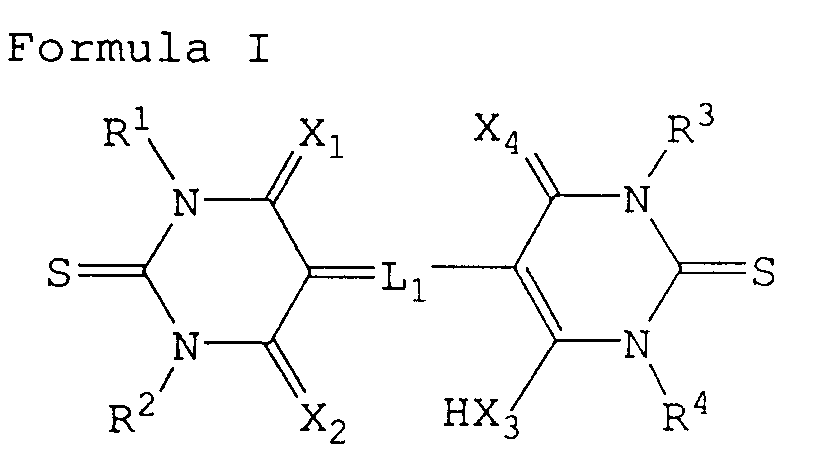
wherein R¹ represents an alkyl group, an alkenyl group, an aryl group or a heterocyclic group, R² through R⁴ independently represent a hydrogen atom, an alkyl group, an alkenyl group, an aryl group or a heterocyclic group, X₁ through X₄ independently represent an oxygen atom or a sulfur atom, L₁ represents a methine group,
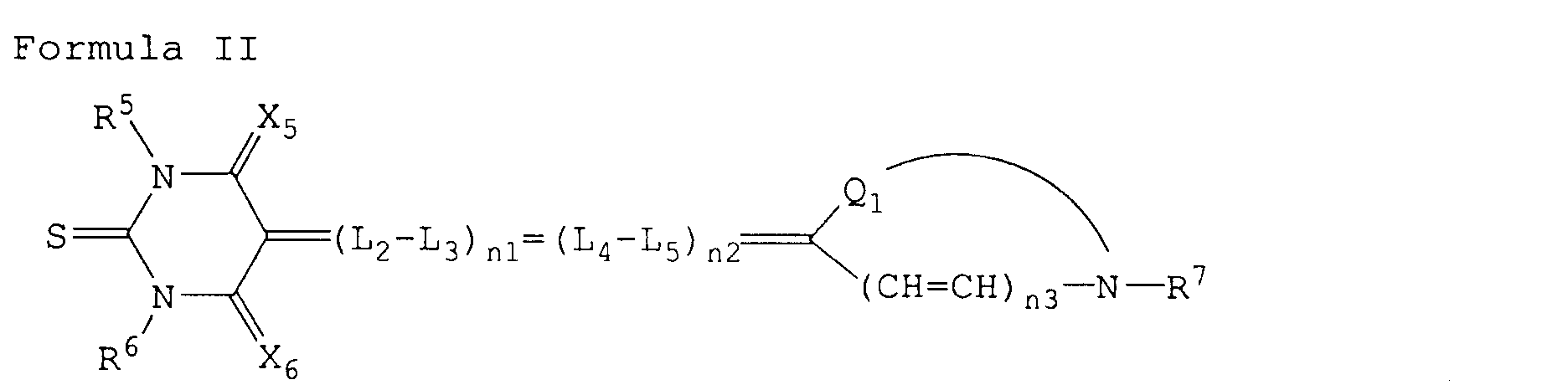
wherein R⁵ and R⁶ independently represent a hydrogen atom, an alkyl group, an alkenyl group, an aryl group or a heterocyclic group, X₅ through X₆ independently represent an oxygen atom or a sulfur atom, L₂ through L₅ each represent a methine group, n₁ through n₃ independently represent an integer of 0 to 2, R⁷ represents an alkyl group or an alkenyl group, Q₁ represents a group of non-metallic atoms necessary to form a 5 or 6-membered heterocycle,
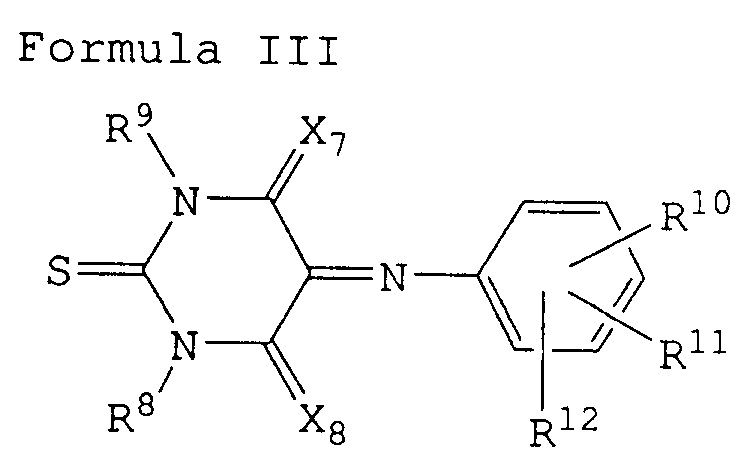
wherein R⁸ and R⁹ independently represent a hydrogen atom, an alkyl group, an alkenyl group, an aryl group or a heterocyclic group, X₇ through X₈ independently represent an oxygen atom or a sulfur atom, R¹⁰ through R¹² independently represent a hydrogen atom, an alkyl group, an alkenyl group, an aryl group, a heterocyclic group, a halogen atom, a cyano group, a sulfo group, -COR¹³, -CON(R¹³)(R¹⁴), -N(R¹³)(R¹⁴), -OR¹³, -SOR¹³, -SO₂R¹³, -SO₂N(R¹³)(R¹⁴), -N(R¹³)COR¹⁴, -N(R¹³)SO₂R¹⁴, -N(R¹³)CON(R¹⁴)(R¹⁵), -SR¹³ OR -COOR¹³, R¹³ through R¹⁵ independently represent a hydrogen atom, an alkyl group, an alkenyl group, an aryl group or a heterocyclic group,
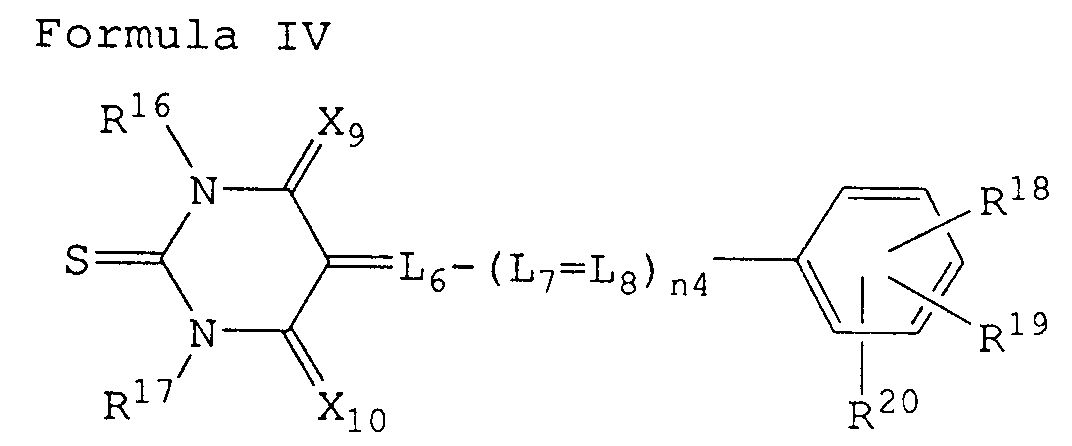
wherein R¹⁶ and R¹⁷ independently represent a hydrogen atom, an alkyl group, an alkenyl group, an aryl group or a heterocyclic group, X₉ and X₁₀ independently represent an oxygen atom or a sulfur atom, L₆ through L₈ each represent a methine group, n₄ represents an integer of 0 to 2, R¹⁸ through R²⁰ independently represent a hydrogen atom, an alkyl group, an alkenyl group, an aryl group, a heterocyclic group, a halogen atom, a cyano group, a sulfo group, -COR¹³, -CON(R¹³) (R¹⁴), -N(R¹³) (R¹⁴), -OR¹³, -SOR¹³, -SO₂R¹³, -SO₂N(R¹³) (R¹⁴), -N(R¹³)COR¹⁴, -N(R¹³)SO₂R¹⁴, -N(R¹³)CON(R¹⁴) (R¹⁵), -SR¹³ OR -COOR¹³, R¹³ through R¹⁵ independently represent a hydrogen atom, an alkyl group, an alkenyl group, an aryl group or a heterocyclic group,
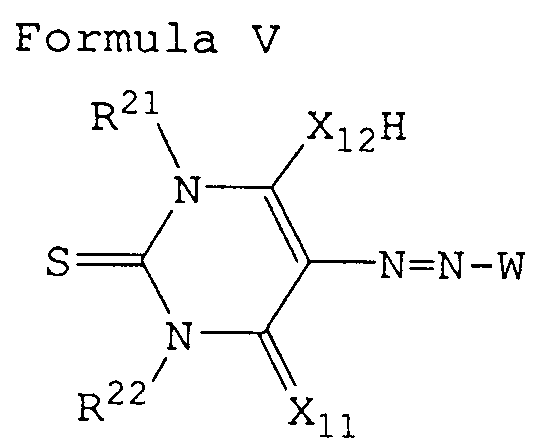
wherein R²¹ and R²² independently represent a hydrogen atom, an alkyl group, an alkenyl group, an aryl group or a heterocyclic group; X₁₁ and X₁₂ independently represent an oxygen atom or a sulfur atom, W represents an aryl group or a heterocyclic group,
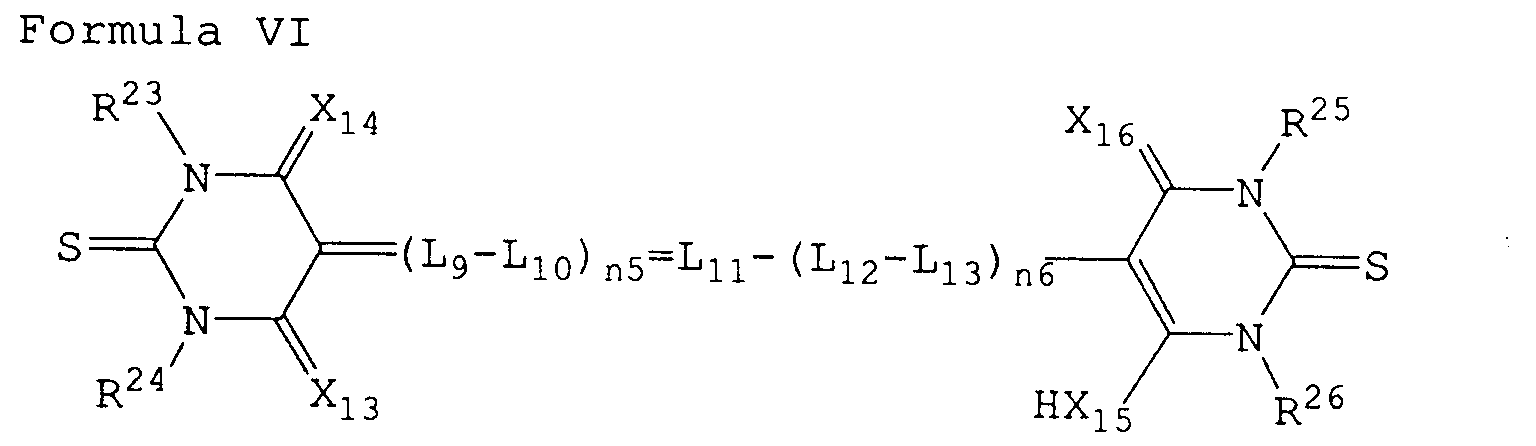
wherein R²³ through R²⁵ independently represent a hydrogen atom, an alkyl group, an alkenyl group, an aryl group or a heterocyclic group, R²⁶ represents an alkyl group, an alkenyl group, an aryl group or a heterocyclic group, provided that at least one of R²³ through R²⁵ is a hydrogen atom, L₉ through L₁₃ each represent a methine group, n₅ and n₆ represents an integer of 0 to 2, X₁₃ and X₁₆ independently represent an oxygen atom or a sulfur atom.
wherein R¹ represents an alkyl group, an alkenyl group, an aryl group or a heterocyclic group, R² through R⁴ independently represent a hydrogen atom, an alkyl group, an alkenyl group, an aryl group or a heterocyclic group, X₁ through X₄ independently represent an oxygen atom or a sulfur atom, L₁ represents a methine group,
wherein R⁵ and R⁶ independently represent a hydrogen atom, an alkyl group, an alkenyl group, an aryl group or a heterocyclic group, X₅ through X₆ independently represent an oxygen atom or a sulfur atom, L₂ through L₅ each represent a methine group, n₁ through n₃ independently represent an integer of 0 to 2, R⁷ represents an alkyl group or an alkenyl group, Q₁ represents a group of non-metallic atoms necessary to form a 5 or 6-membered heterocycle,
wherein R⁸ and R⁹ independently represent a hydrogen atom, an alkyl group, an alkenyl group, an aryl group or a heterocyclic group, X₇ through X₈ independently represent an oxygen atom or a sulfur atom, R¹⁰ through R¹² independently represent a hydrogen atom, an alkyl group, an alkenyl group, an aryl group, a heterocyclic group, a halogen atom, a cyano group, a sulfo group, -COR¹³, -CON(R¹³)(R¹⁴), -N(R¹³)(R¹⁴), -OR¹³, -SOR¹³, -SO₂R¹³, -SO₂N(R¹³)(R¹⁴), -N(R¹³)COR¹⁴, -N(R¹³)SO₂R¹⁴, -N(R¹³)CON(R¹⁴)(R¹⁵), -SR¹³ OR -COOR¹³, R¹³ through R¹⁵ independently represent a hydrogen atom, an alkyl group, an alkenyl group, an aryl group or a heterocyclic group,
wherein R¹⁶ and R¹⁷ independently represent a hydrogen atom, an alkyl group, an alkenyl group, an aryl group or a heterocyclic group, X₉ and X₁₀ independently represent an oxygen atom or a sulfur atom, L₆ through L₈ each represent a methine group, n₄ represents an integer of 0 to 2, R¹⁸ through R²⁰ independently represent a hydrogen atom, an alkyl group, an alkenyl group, an aryl group, a heterocyclic group, a halogen atom, a cyano group, a sulfo group, -COR¹³, -CON(R¹³) (R¹⁴), -N(R¹³) (R¹⁴), -OR¹³, -SOR¹³, -SO₂R¹³, -SO₂N(R¹³) (R¹⁴), -N(R¹³)COR¹⁴, -N(R¹³)SO₂R¹⁴, -N(R¹³)CON(R¹⁴) (R¹⁵), -SR¹³ OR -COOR¹³, R¹³ through R¹⁵ independently represent a hydrogen atom, an alkyl group, an alkenyl group, an aryl group or a heterocyclic group,
wherein R²¹ and R²² independently represent a hydrogen atom, an alkyl group, an alkenyl group, an aryl group or a heterocyclic group; X₁₁ and X₁₂ independently represent an oxygen atom or a sulfur atom, W represents an aryl group or a heterocyclic group,
wherein R²³ through R²⁵ independently represent a hydrogen atom, an alkyl group, an alkenyl group, an aryl group or a heterocyclic group, R²⁶ represents an alkyl group, an alkenyl group, an aryl group or a heterocyclic group, provided that at least one of R²³ through R²⁵ is a hydrogen atom, L₉ through L₁₃ each represent a methine group, n₅ and n₆ represents an integer of 0 to 2, X₁₃ and X₁₆ independently represent an oxygen atom or a sulfur atom.
2. The silver halide photographic light-sensitive material of claim 1, wherein the material
comprises a filter layer or an anti-halation layer, and the filter layer or the anti-halation
layer containing 0.05 to 2.0 g/m² of the silver salt of dye.
3. The silver halide photographic light-sensitive material of claim 1, wherein the material
comprises a filter layer or an anti-halation layer, and the filter layer or the anti-halation
layer containing 0.1 to 1.0 g/m² of the silver salt of dye.
4. The silver halide photographic light-sensitive material of claim 1, wherein a ratio
of an amount of the silver salt of the dye contained in a filter layer or an anti-halation
layer and an amount of gelatin added contained therein is not less than 0.1.
5. The silver halide photographic light-sensitive material of claim 1, wherein a ratio
of an amount of the silver salt of the dye contained in a filter layer or an anti-halation
layer and an amount of gelatin added contained therein is within the range of 0.1
to 2.0.
6. A silver halide photographic light-sensitive material comprising a silver salt of
dye selected from the group consisting of Formula I, Formula II, Formula III, Formula
IV, Formula V and Formula VI;
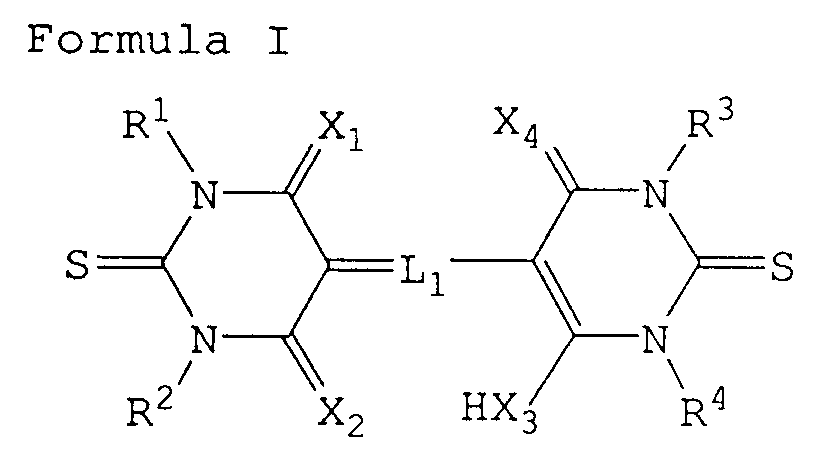
wherein R¹ represents an alkyl group, an alkenyl group, an aryl group or a heterocyclic group, R² through R⁴ independently represent a hydrogen atom, an alkyl group, an alkenyl group, an aryl group or a heterocyclic group, X₁ through X₄ independently represent an oxygen atom or a sulfur atom, L₁ represents a methine group,
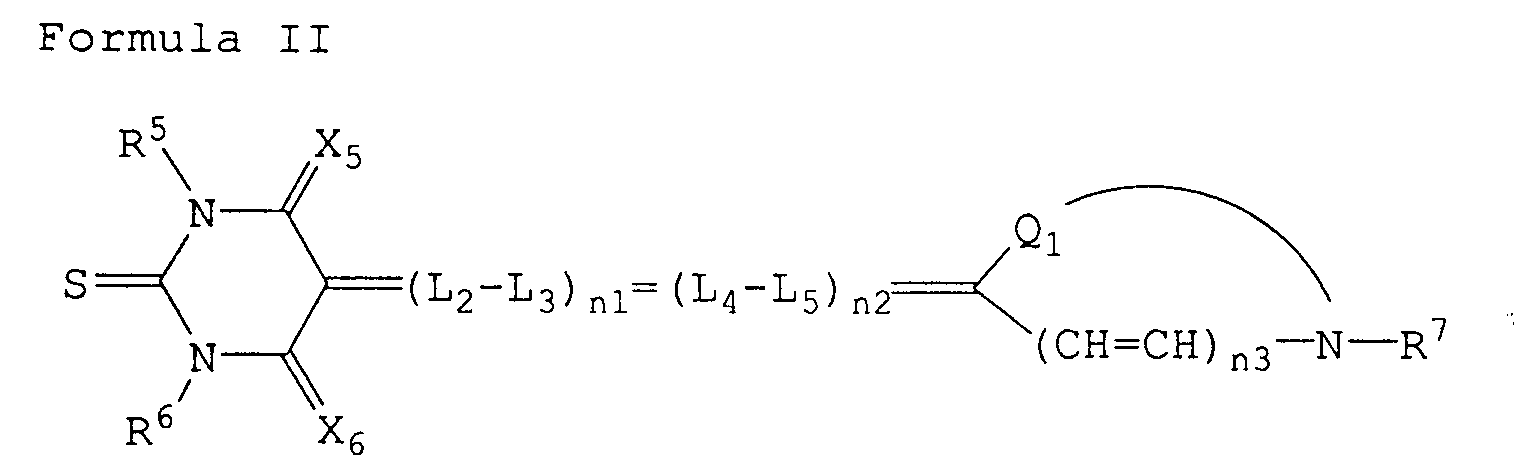
wherein R⁵ and R⁶ independently represent a hydrogen atom, an alkyl group, an alkenyl group, an aryl group or a heterocyclic group, X₅ through X₆ independently represent an oxygen atom or a sulfur atom, L₂ through L₅ each represent a methine group, n₁ through n₃ independently represent an integer of 0 to 2, R⁷ represents an alkyl group or an alkenyl group, Q₁ represents a group of non-metallic atoms necessary to form a 5 or 6-membered heterocycle,

wherein R⁸ and R⁹ independently represent a hydrogen atom, an alkyl group, an alkenyl group, an aryl group or a heterocyclic group, X₇ through X₈ independently represent an oxygen atom or a sulfur atom, R¹⁰ through R¹² independently represent a hydrogen atom, an alkyl group, an alkenyl group, an aryl group, a heterocyclic group, a halogen atom, a cyano group, a sulfo group, -COR¹³, -CON(R¹³)(R¹⁴), -N(R¹³) (R¹⁴), -OR¹³, -SOR¹³, -SO₂R¹³, -SO₂N(R¹³)(R¹⁴), -N(R¹³)COR¹⁴,-N(R¹³)SO₂R¹⁴, -N(R¹³)CON(R¹⁴) (R¹⁵), -SR¹³ OR -COOR¹³, R¹³ through R¹⁵ independently represent a hydrogen atom, an alkyl group, an alkenyl group, an aryl group or a heterocyclic group,
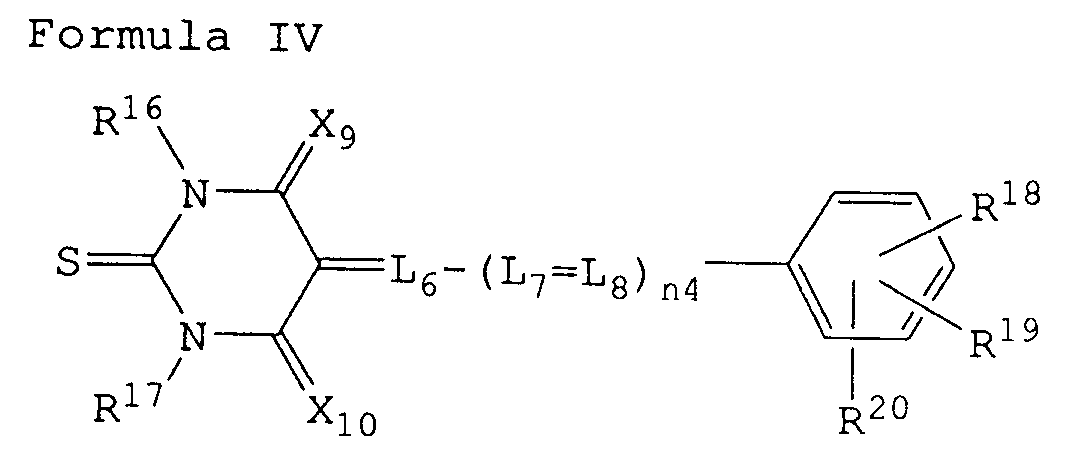
wherein R¹⁶ and R¹⁷ independently represent a hydrogen atom, an alkyl group, an alkenyl group, an aryl group or a heterocyclic group, X₉ and X₁₀ independently represent an oxygen atom or a sulfur atom, L₆ through L₈ each represent a methine group, n₄ represents an integer of 0 to 2, R¹⁸ through R²⁰ independently represent a hydrogen atom, an alkyl group, an alkenyl group, an aryl group, a heterocyclic group, a halogen atom, a cyano group, a sulfo group, -COR¹³, -CON (R¹³) (R¹⁴), -N(R¹³)(R¹⁴), -OR¹³, -SOR¹³, -SO₂R¹³, -SO₂N(R¹³) (R¹⁴), -N(R¹³)COR¹⁴, -N(R¹³)SO₂R¹⁴, -N(R¹³)CON(R¹⁴)(R¹⁵), -SR¹³ OR -COOR¹³, R¹³ through R¹⁵ independently represent a hydrogen atom, an alkyl group, an alkenyl group, an aryl group or a heterocyclic group,
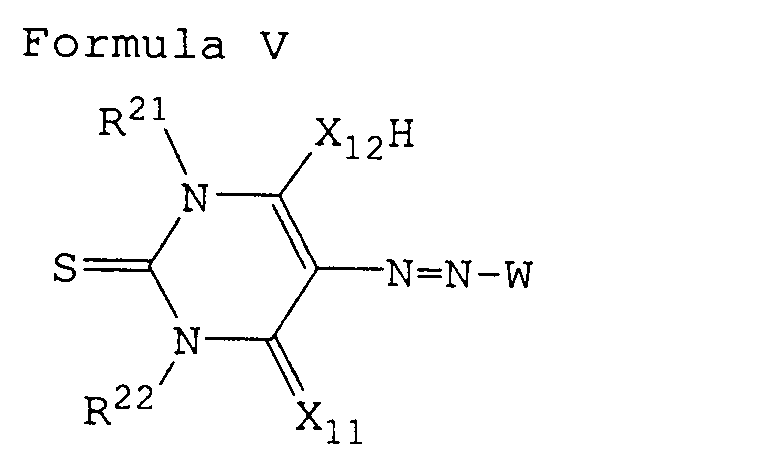
wherein R²¹ and R²² independently represent a hydrogen atom, an alkyl group, an alkenyl group, an aryl group or a heterocyclic group, X₁₁ and X₁₂ independently represent an oxygen atom or a sulfur atom, W represents an aryl group or a heterocyclic group,
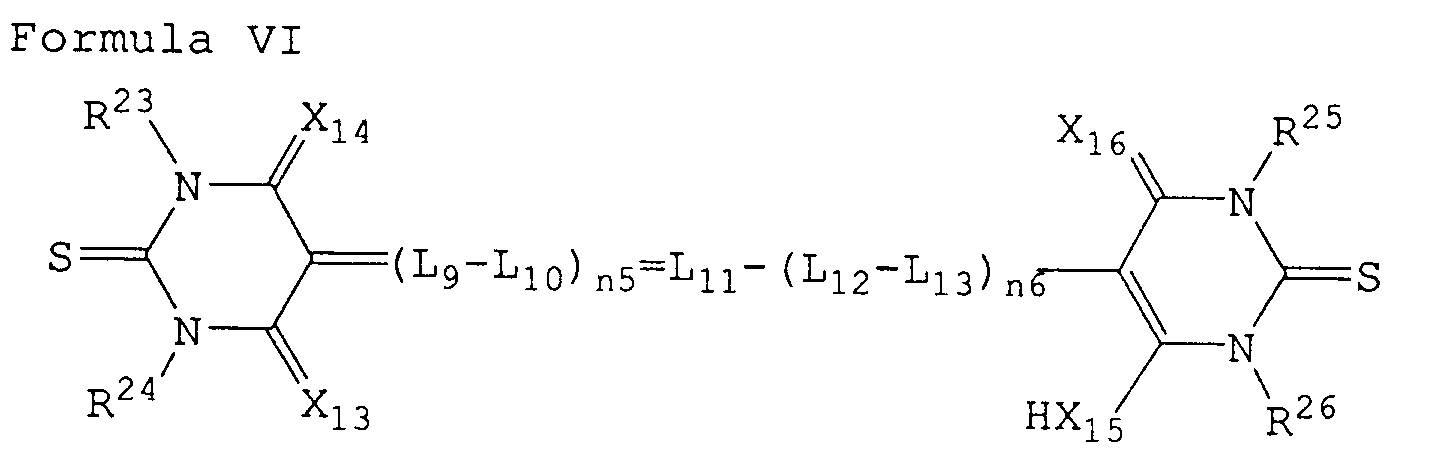
wherein R²³ through R²⁵ independently represent a hydrogen atom, an alkyl group, an alkenyl group, an aryl group or a heterocyclic group, R²⁶ represents an alkyl group, an alkenyl group, an aryl group or a heterocyclic group, provided that at least one of R²³ through R²⁵ is a hydrogen atom, L₉ through L₁₃ each represent a methine group, n₅ and n₆ represents an integer of 0 to 2, X₁₃ and X₁₆ independently represent an oxygen atom or a sulfur atom; and the silver halide photographic light-sensitive material comprises a filter layer or an antihalation layer, and the filter layer or the anti-halation layer containing 0.05 to 2.0 g/m² of the silver salt of dye.
wherein R¹ represents an alkyl group, an alkenyl group, an aryl group or a heterocyclic group, R² through R⁴ independently represent a hydrogen atom, an alkyl group, an alkenyl group, an aryl group or a heterocyclic group, X₁ through X₄ independently represent an oxygen atom or a sulfur atom, L₁ represents a methine group,
wherein R⁵ and R⁶ independently represent a hydrogen atom, an alkyl group, an alkenyl group, an aryl group or a heterocyclic group, X₅ through X₆ independently represent an oxygen atom or a sulfur atom, L₂ through L₅ each represent a methine group, n₁ through n₃ independently represent an integer of 0 to 2, R⁷ represents an alkyl group or an alkenyl group, Q₁ represents a group of non-metallic atoms necessary to form a 5 or 6-membered heterocycle,
wherein R⁸ and R⁹ independently represent a hydrogen atom, an alkyl group, an alkenyl group, an aryl group or a heterocyclic group, X₇ through X₈ independently represent an oxygen atom or a sulfur atom, R¹⁰ through R¹² independently represent a hydrogen atom, an alkyl group, an alkenyl group, an aryl group, a heterocyclic group, a halogen atom, a cyano group, a sulfo group, -COR¹³, -CON(R¹³)(R¹⁴), -N(R¹³) (R¹⁴), -OR¹³, -SOR¹³, -SO₂R¹³, -SO₂N(R¹³)(R¹⁴), -N(R¹³)COR¹⁴,-N(R¹³)SO₂R¹⁴, -N(R¹³)CON(R¹⁴) (R¹⁵), -SR¹³ OR -COOR¹³, R¹³ through R¹⁵ independently represent a hydrogen atom, an alkyl group, an alkenyl group, an aryl group or a heterocyclic group,
wherein R¹⁶ and R¹⁷ independently represent a hydrogen atom, an alkyl group, an alkenyl group, an aryl group or a heterocyclic group, X₉ and X₁₀ independently represent an oxygen atom or a sulfur atom, L₆ through L₈ each represent a methine group, n₄ represents an integer of 0 to 2, R¹⁸ through R²⁰ independently represent a hydrogen atom, an alkyl group, an alkenyl group, an aryl group, a heterocyclic group, a halogen atom, a cyano group, a sulfo group, -COR¹³, -CON (R¹³) (R¹⁴), -N(R¹³)(R¹⁴), -OR¹³, -SOR¹³, -SO₂R¹³, -SO₂N(R¹³) (R¹⁴), -N(R¹³)COR¹⁴, -N(R¹³)SO₂R¹⁴, -N(R¹³)CON(R¹⁴)(R¹⁵), -SR¹³ OR -COOR¹³, R¹³ through R¹⁵ independently represent a hydrogen atom, an alkyl group, an alkenyl group, an aryl group or a heterocyclic group,
wherein R²¹ and R²² independently represent a hydrogen atom, an alkyl group, an alkenyl group, an aryl group or a heterocyclic group, X₁₁ and X₁₂ independently represent an oxygen atom or a sulfur atom, W represents an aryl group or a heterocyclic group,
wherein R²³ through R²⁵ independently represent a hydrogen atom, an alkyl group, an alkenyl group, an aryl group or a heterocyclic group, R²⁶ represents an alkyl group, an alkenyl group, an aryl group or a heterocyclic group, provided that at least one of R²³ through R²⁵ is a hydrogen atom, L₉ through L₁₃ each represent a methine group, n₅ and n₆ represents an integer of 0 to 2, X₁₃ and X₁₆ independently represent an oxygen atom or a sulfur atom; and the silver halide photographic light-sensitive material comprises a filter layer or an antihalation layer, and the filter layer or the anti-halation layer containing 0.05 to 2.0 g/m² of the silver salt of dye.