|
(11) | EP 0 522 614 A1 |

| (12) | EUROPEAN PATENT APPLICATION |
|
|
|
|
|||||||||||||||||||||||
| (54) | Method of determining an electrical spectrum |
| (57) Method of determining a noise spectrum of an optical receiver comprising a detector
and a preamplifier, in which, starting from a standardised light source, the output
signal of said light source is presented to the input of the receiver and the equivalent
noise spectrum of the optical receiver is compared with and expressed in the electrical
response spectrum of the light source. If the light source has also to be standardised
beforehand, this is done by comparing the electrical response spectrum of the light
source with, and expressing it in, the noise spectrum of a known electrical noise
source, for example a resistor. The method can be used, in particular, if the electrical input of the preamplifier is not accessible from outside, if the optical input of the receiver is accessible only via a glass fibre, if the noise contribution of the receiver is relatively large, if the receiver is very broadband, and if its sensitivity is unknown but also frequency-dependent. |
[0001] The invention relates to a method of determining an electrical spectrum by using an optical detector.
[0002] The electrical spectrum to be determined may, for example, be an electrical response spectrum, to be generated by the optical detector, of an optical output signal of a light source. A known way of measuring said response spectrum is an absolute measurement with the aid of, for example, a frequency-selective voltmeter or a spectrum analyser. A disadvantage of this is that the sensitivity of such instruments is in general dependent upon the frequency of the signal presented, and is even dependent on the bandwidth of the signal presented, with the result that, for an accurate measurement, use has to be made of very accurate, and therefore expensive, instruments.
[0003] The electrical spectrum to be determined may also be, for example, the equivalent input noise spectrum of an optical receiver. Usually an electrical output of the optical detector is coupled to an input of a preamplifier associated therewith in order thereby to form an assembled optical receiver, which optical receiver provides an electrical output signal at an output of the preamplifier. A user of the optical receiver can use the electrical output signal thereof, that is to say the amplified detector signal, as required for a particular application purpose, for example the demodulation and reproduction of a particular frequency band thereof.
[0004] In the ideal case, the optical receiver does not provide an electrical output signal if an optical input signal is absent, with the result that, in the situation where an electrical output signal is in fact provided, this is a direct measure of the information to be detected which is present in the light received. In practice, the ideal case mentioned cannot, however, be achieved, but even in the absence of an optical input signal, the optical receiver provides an electrical output signal which is referred to by the term "noise signal". Said noise signal contains in general contributions from all the frequencies within a very broad noise frequency band.
[0005] When the optical receiver is used in a situation of any type whatsoever, an electrical signal which is a combination of signal and noise components is therefore always emitted at the output. In order to be able to make a judgement on the contribution of the noise components in the signal emitted in such a situation of any type whatsoever, for example in order to be able to accurately detect information present in the light signal presented, it is desirable to know the noise spectrum of the receiver accurately.
[0006] A known way of measuring an electrical noise spectrum is an absolute measurement with the aid of, for example, a frequency-selective voltmeter or a spectrum analyser. A disadvantage of this is that the sensitivity of such instruments is in general dependent on the frequency of the signal presented, and is even dependent on the bandwidth of the signal presented, with the result that, for an accurate measurement, use has to be made of very accurate, and therefore expensive, instruments, and/or a complicated standardisation or calibration operation is necessary.
[0007] Furthermore, in order to be able to compare various optical receivers quantitatively with one another, it is desirable to know the equivalent input noise spectrum of an optical receiver. Here the term "equivalent input noise spectrum" is understood to mean the noise spectrum of the output signal of the preamplifier extrapolated back to the input thereof, that is to say divided by the gain characteristic of the preamplifier. It will be clear that the actual noise spectrum appearing at the output of the preamplifier can be calculated from the equivalent input noise spectrum by multiplying the latter by the gain characteristic of the preamplifier, the preamplifier being regarded under these circumstances as ideal.
[0008] The usefulness of calculating the equivalent input noise spectrum can be illustrated with the following example. Suppose that two optical amplifiers whose outputs deliver identical noise spectra are compared with one another. However, the gain factor of one amplifier (A) is ten times as great as the gain factor of the other amplifier (B). On receiving an identical input signal, which is amplified ten times as much by amplifier (A) than by amplifier (B), the signal/noise ratio of the output signal delivered by the amplifier (A) is then ten times as great as the signal/noise ratio of the output signal delivered by amplifier (B), with the result that amplifier (A) can be regarded as being better than amplifier (B). According to the definition given above of the equivalent input noise spectrum, the equivalent input noise spectrum is a factor of ten lower for amplifier (A) than the equivalent input noise spectrum for amplifier (B), with the result that it is found in a simple way, by comparing the two equivalent input noise spectra, that amplifier (A) can be regarded as being better than amplifier (B).
[0009] A known way of determining the equivalent input noise spectrum of an optical receiver is first to measure the output noise spectrum accurately and to divide the latter by the gain characteristic of the preamplifier. More particularly, in this procedure, each frequency component of the output noise spectrum is divided by the gain factor of the preamplifier in operation at that frequency. A first problem in determining the equivalent input noise spectrum of an optical receiver in this known manner is the problem, described above, relating to the measurement of the output noise spectrum. A further problem is that the gain characteristic of the preamplifier has to be accurately known. Known techniques for measuring the gain characteristic of the preamplifier in which an electrical signal source is connected to the input of the preamplifier and a measuring device is connected to the output of the preamplifier, in which the electrical signal source provides an electrical signal having a small bandwidth at the input of the preamplifier, and in which the magnitude of the output signal of the preamplifier is divided by the magnitude of the electrical signal provided by the electrical signal source cannot be used in practice in this case. A first reason for this is that the input of the preamplifier for supplying input signals is not accessible for every receiver to be investigated. A second reason is that an accurate, and consequently expensive, measuring device having a flat, or at least a known frequency characteristic has to be used. A third reason is that the gain characteristic of the preamplifier is affected by the impedance applied to its input.
[0010] The object of the invention is therefore to provide a method, on the one hand, of determining the electrical response spectrum, to be generated by an optical detector, of an optical output signal of a light source and, on the other hand, of determining the equivalent input noise spectrum of an optical receiver, which method can be performed with relatively simple means which do not have to be exceptionally accurate.
[0011] For this purpose, the method according to the invention has the characteristic that an electrical response spectrum, which can be generated by the optical detector, of an optical output signal of a light source is compared with an electrical noise spectrum.
[0012] The invention is based on the insight that, if the electrical response spectrum is known, the electrical noise spectrum can be determined therewith by comparison and, if the electrical noise spectrum is known, the electrical response spectrum can be determined therewith by comparison, without accurate equipment being required in this connection.
[0013] In a first embodiment, the method according to the invention has the characteristic that the electrical response spectrum the electrical spectrum to be determined, the electrical noise spectrum being a known electrical noise spectrum of an electrical noise source. A light source can be very easily standardised by this method.
[0014] In a second embodiment, the method according to the invention has the characteristic that the electrical noise spectrum is the electrical spectrum to be determined, the optical output signal of the light source being presented to an optical input of an optical receiver whose equivalent noise signal is the electrical noise signal to be determined and whose optical input is formed by the optical detector. On the basis on an already known output signal of a light source, the equivalent noise signal of the optical receiver can be very easily determined by this method.
[0015] In a third embodiment, the method according to the invention has the characteristic that an optical response signal, which can be generated by a further optical detector, of the optical output signal of the light source is compared with a known electrical noise signal of an electrical noise source. The output signal of the light source is first standardised very easily by this method, and the equivalent noise signal of the receiver can then be determined by it.
[0016] According to the third embodiment of the method according to the invention, a two-stage method is therefore provided in which, in a first stage, the optical output signal of a light source is standardised by comparing the electrical response spectrum of said optical output signal with a known electrical noise spectrum of an electrical noise source, and in which, in a second stage, the standardised optical output signal of the light source is presented to the optical input of the optical receiver and the equivalent noise signal of the optical receiver is compared with the electrical response spectrum of the light source. Said comparison can be performed manually or by a computing device.
[0017] However, in determining the noise spectrum of the optical receiver, it is also possible for use to be made of a light source which has already been calibrated in accordance with the first embodiment of the method according to the invention. In that case, the second embodiment of the method according to the invention relates to a single-stage method.
[0018] Further embodiments, aspects and advantages of the method according to the invention will be discussed in the description of the figures.
[0019] The invention furthermore relates to an apparatus for determining a noise spectrum of an optical receiver by using the method according to the invention, which apparatus is provided with a light source.
[0020] The apparatus according to the invention has the characteristic that an electrical response spectrum, generated via an optical detector, of an optical output signal of the light source is compared with a known electrical noise spectrum. Such an apparatus comprises a standardised light source.
[0021] A first embodiment of the apparatus according to the invention has the characteristic that the apparatus is provided with a reference receiver which comprises an optical reference detector for receiving a light beam originating from the light source.
[0022] A second embodiment of the apparatus according to the invention has the characteristic that the reference receiver is provided with a noise source which is coupled to an output of the optical reference detector and generates a noise signal having the known noise spectrum. Further embodiments, aspects and advantages of the apparatus according to the invention will be discussed in the description given below, of the figures, wherein:
Figure 1 illustrates diagrammatically the inventive insight according to the invention;
Figure 2 shows diagrammatically a preferred circuit diagram for standardising a light source by means of the inventive insight according to the invention; and
Figure 3 shows diagrammatically a preferred circuit diagram for performing measurements on an optical receiver.
[0023] The invention is primarily based on the insight that it is possible to determine an unknown frequency spectrum of a first noise signal S1 by expressing it in the frequency spectrum of a second noise signal S2 if said signals are fed to an input of an amplifier A. In this case, no particularly accurate and/or expensive equipment is necessary, but it is possible to make do with measuring the output signal of the amplifier A with the aid of a relatively simple measuring instrument M, for example a spectrum analyser or a selective volt-meter.
[0024] To illustrate this insight, reference is made to Figure 1, in which S1(w) and S2(w) denote the strength of the signal components having frequency w. R denotes the output signal of the amplifier A as reproduced by the measuring instrument M, and R(w) is the strength of the output signal component having frequency w.
[0025] The electrical output signal R satisfies the formula
where A(w) denotes the (unknown) frequency-dependent gain factor of the preamplifier A at the frequency w (it also being possible for w to have the value 0), where B(w) denotes the (unknown) frequency-dependent gain factor of the measuring instrument M used, at the frequency w, when receiving a broadband input signal, and where the operation "S1(w) ⊕ S2(w)" denotes a frequency-wise combination of the two signals S1 and S2, which combination will not in general be a pure addition. It is pointed out that said frequency-wise combination is a statistically determined result of a time-averaged combination of two noise signals and is therefore present as an intrinsic property in the amplifier A and in general can be approximated to a good degree by the formula
Hereinafter it is assumed that the frequency spectrum of the signal S2 is known. A first measurement is made in a situation in which a predetermined fraction K1 of the signal S1 is fed to the input of the amplifier A along with a predetermined fraction K2 of the signal S2 in order to deliver a test signal which satisfies the formula
A second measurement is made in a situation in which a predetermined fraction K3 of the signal S1 is fed to the input of the amplifier A together with a predetermined fraction K4 of the signal S2 in order to deliver a test signal which satisfies the formula
Dividing the formulae (3) and (4) eliminates the characteristics of the amplifier A and of the measuring instrument M used, and the unknown signal S1 can be expressed in the signal S2 in accordance with the formula:
In an embodiment in which K1 = K2 = K4 = 1 and K3 = 0, by substituting formula (2) in formula (5), the unknown signal S1 can be expressed in the known signal S2 and the test signals R1(w) and R2(w) in accordance with the formula:
[0026] In another embodiment in which K1 = K2 = K3 = 1 and K4 = 0, by substituting formula (2) in formula (5), the unknown signal S1 can be expressed in the known signal S2 and the test signals R1(w) and R2(w) in accordance with the formula:
Although separate measurements have been described above, for the sake of clarity, for the signals R1(w) and R2(w) which are divided by one another, it is preferable to make a direct measurement of a signal which is representative of the ratio R1(w)/R2(w), for example by alternately interrupting the signal S1 or S2, which provides an alternating signal strength for every frequency component of the output signal of the test receiver, the ratio of the alternating signal values being representative of said ratio R1(w)/R2(w).
[0027] A method of standardising a light source 210 will now be explained in greater detail below by reference to Figure 2, use being made of the insight described above.
[0028] The light source 210 produces a light beam 211 which is directed at an optical test detector 2. The optical test detector 2, in the example shown a photosensitive diode, provides at an output 3 an electrical detector signal ID, in the example shown a current signal, whose spectrum is the (as yet unknown) electrical response spectrum of the light source 210.
[0029] Preferably, and as shown in Figure 2, the optical test detector 2 forms part of an optical test receiver 1 which comprises, moreover, a preamplifier 10, and the output 3 of the optical test detector 2 is coupled via a capacitor 4 to the input 11 of the preamplifier 10 in order to provide only the alternating-current components ID(w) of the electrical detector signal ID at the preamplifier 10. Moreover, the output 3 of the optical test detector 2 is coupled to an output terminal 5 in order to provide the direct-current component ID(0) of the detector output signal ID. It will be clear that, instead of the capacitor 4, another isolating device can be used to achieve the result that only desired alternating-current components can reach the input 11 of the preamplifier 10. The preamplifier 10 may also be designed to provide only (amplified) alternating-current components at the output 12, while, moreover, the preamplifier 10 may be designed to provide direct-current components at an output (not shown), optionally after amplification.
[0030] The input 11 of the preamplifier 10 of the test receiver 1 is coupled to a real source 20 which provides a known electrical noise spectrum IN,R having alternating-current components IN,R(w). In the example shown, the source 20 is a resistor for providing a known noise spectrum determined by thermal effects. An example of an alternative noise source is a photodiode illuminated by an incandescent lamp, which delivers so-called shot noise. In this case it is possible to illuminate the optical test diode 2 itself with an incandescent lamp in order to produce the noise spectrum.
[0031] The preamplifier 10 provides an electrical output signal IU having alternating-current components IU(w) at an output 12 thereof. Referring to the above discussion of Figure 1 and assuming that the electrical noise components produced by the combination of the test detector 2, the preamplifier 10 and the circuit configuration of the receiver 1 can be neglected when compared with the known noise components IN,R(w) produced by the real source 20 (which assumption is in fact very realistic, in particular, for example, for frequencies lower than 10 MHz), the electrical output signal IU satisfies the formula (1), where S1 corresponds to ID and S2 corresponds to IN,R.
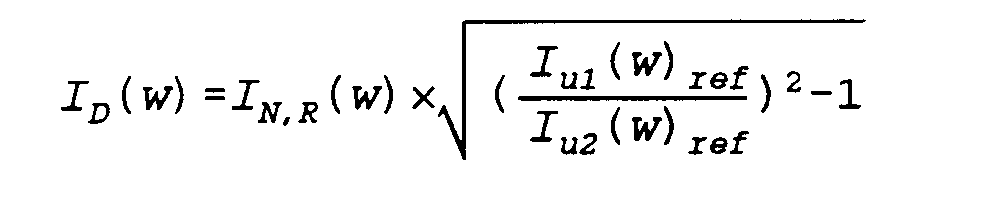
[0032] By performing at least two measurements in which the detector 2 is or is not illuminated with the light from the light source 210, which measurements are preferably performed by alternately interrupting and not interrupting the light beam 211, the electrical response spectrum ID of the light beam 211 can be expressed according to the invention, by analogy with formula (6), in the known noise signal IN,R of the noise source 20 in accordance with the formula
Within the scope of the present invention, the term "electrical response spectrum" is understood as meaning the frequency spectrum of the electrical signal which is generated in an optical detector, that is to say an optical/electrical converter, in response to the receipt of the light beam originating from the light source.
[0033] The optical detector may be a detector of any type whatsoever, such as, for example, a photocell or a photosensitive diode. In principle, such an optical detector provides a direct-current detector signal at its output, the magnitude of the direct current depending on the intensity of the light received and being virtually independent of the wavelength of the light received within certain limits. The detector signal of the optical detector may also contain alternating-current components, for example as a consequence of a modulation present in the light received or an interference between certain wavelength components of the light beam. A known fact is that various specimens of optical detectors of identical type, for example various specimens of photosensitive diodes, have an identical electrical response on receiving the same optical signal. Within the scope of the present invention, the electrical response spectrum is therefore regarded as a property of the light beam originating from the light source and, since the characteristics of the light beam are determined by the light source, the electrical response spectrum is more particularly regarded, within the scope of the present application, as a property of the light source.
[0034] Although various specimens of optical detectors of the same type provide in principle an identical response to the light received from the light source, it may, however, occur in practice that various specimens nevertheless have a different response to the light received. This may be due, for example, to variations in the detector bodies or in the protective materials surrounding the detector bodies or, for example, to varying effects in the light path between the light source and the detector(s) concerned. Such variations can essentially be attributed to variations in the intensity of the light received by the detector, all the wavelength components of the light being varied, at least to a good approximation, to an equal degree, with the consequence that the values of all the components ID(w) vary to an equal degree, that is to say that the form of the response spectrum remains identical, at least to a good approximation. The curve of the response spectrum F(w) of the spectrum of the signal ID delivered by the optical detector 2 is therefore now defined as
According to a preferred embodiment of the method according to the invention, the direct-current component ID(0) is therefore always measured when measuring the alternating-current components ID(w) as described above, and the alternating-current components ID(w) are normalised to produce curve components F(w) by dividing them by the direct-current component ID(0) in accordance with formula (9). In a system which is sufficiently stable with time, it is possible to make do with measuring the direct-current component ID(0) once and assuming it to be constant.
[0035] It is pointed out that, with a suitable design of the light source 210, the spectrum of the signal ID delivered by the optical detector 2 is flat, that is to say that F(w) = F.
[0036] An example of a light source which has such a flat spectrum and is therefore preferred is a so-called "homodyne sweeper", for example a "delayed self-homodyne sweeper" comprising a laser, or a "heterodyne sweeper" comprising an LED and a laser. For a detailed description of the operation of a "homodyne sweeper" and the response of a detector to the light emitted by such a light source, reference is made to the paper entitled "Measurement of Frequency Response of Photoreceivers using Self-homodyne Method" by J. Wang et al. in Electronics Letters, 25 May 1989, Vol. 25, No. 11, pages 722-723.
[0037] Using a "homodyne sweeper" as light source 210 also achieves the advantage that the electrical response spectrum can be standardised in a relatively large range, for example up to 20 GHz, by only performing measurement in a relatively small frequency range, for example up to 10 MHz. In theory it is even possible to make do with a measurement at only one frequency.
[0038] A method of determining the equivalent noise spectrum of an optical receiver will now be explained in greater detail by reference to Figure 3, use being made of the insight described above.
[0039] Figure 3 shows diagrammatically an optical receiver 101 to be investigated. The optical receiver 101 comprises an optical detector 102, in the example shown a photosensitive diode. The optical detector 102 provides at an output 103 an electrical detector signal, in the example shown a current signal ID, which corresponds to the light signal received by the optical detector 102. The output 103 of the optical detector 102 is coupled to an input 111 of a preamplifier 110 which has a gain factor A(w) at the frequency w (where w may also have the value 0).
[0040] In the example shown, the output 103 of the optical detector 102 is coupled via a capacitor 104 to the input 111 of the preamplifier 110 in order to provide only the alternating-current components ID(w) of the detector output signal ID at the preamplifier 110. Moreover, the output 103 of the optical detector 102 is coupled to an output terminal 105 in order to provide the direct-current component ID(0) of the detector output signal ID. It is emphatically pointed out, however, that the invention also relates to a method of determining the equivalent noise spectrum of an optical receiver in which such an isolation of signal components is not provided, and/or in which no output is present for providing the direct-current component ID(0) of the detector output signal ID.
[0041] If the detector output signal ID is disregarded, the preamplifier 110 provides, at an output 112 thereof, an electrical noise signal IN having alternating-current components IN(w) which is produced in a complex way by the combination of the detector 102, the optional isolating device 104, the preamplifier 110 and the connecting conductors between the detector 102, the optional isolating device 104 and the preamplifier 110. As has already been explained above, an equivalent input noise spectrum IN,eq having alternating-current components IN,eq(w) is defined in accordance with the formula
The optical receiver 101 can then be (notionally) regarded as being made up of ideal noise-free components 102, 104 and 110, the input 111 of the preamplifier 110 being connected to a notional noise source 120 which delivers the equivalent noise spectrum IN,eq, with the result that the output signal IU resulting in the operating state at the output 112 of the preamplifier 110 and having alternating-current components IU(w) is given, analagously to formula (1), by
Moreover, Figure 3 shows diagrammatically a light source 210 which produces a light beam 211. If the light source 210 has already been standardised, the light beam 211 can be fed directly to the detector 102 of the receiver to be investigated. The input signal at the input 111 of the amplifier 110 is then deemed to consist of two signals, namely the unknown equivalent input noise spectrum IN,eq (corresponding to S1) and the output signal ID of the detector 102 (corresponding to S2), whose spectrum is identical to the known electrical response spectrum of the light beam 211.
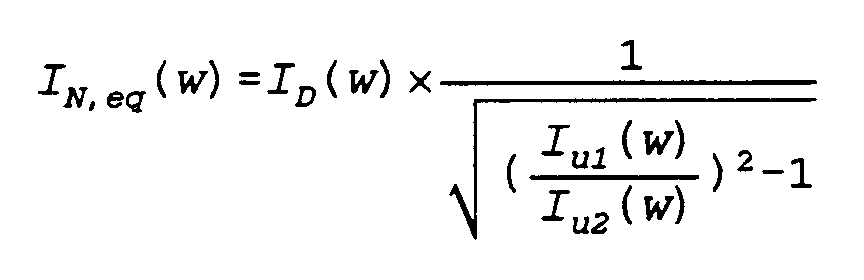
[0042] As a result of performing at least two measurements in which the detector 102 is and is not illuminated, respectively, with the light from the light source 210, which measurements are preferably alternately performed by interrupting and not interrupting the light beam 211, the equivalent input noise spectrum IN,eq of the optical receiver 101 can, according to the invention, be expressed, by analogy with formula (7) in the known electrical response spectrum ID of the light beam 211 in accordance with the formula
The description below relates to a measurement procedure according to the invention for determining the equivalent input noise spectrum IN,eq of the optical receiver 101 in the case where use is made of an unstandardised light source 210. For this purpose, as is also illustrated in Figure 3, the light beam 211 provided by the light source 210 is split by a splitting device 220 into two light beams 221 and 222 having essentially identical light spectra, one light beam 222 being directed at the optical detector 102 of the receiver 101 to be investigated and the other light beam 221 being directed at an optical detector 2 of a reference receiver 1 which is identical in terms of structure and operation to the optical receiver 1 described above by reference to Figure 2.
[0043] Preferably, the splitting device 220 is designed in such a way that the two light beams 221 and 222 have at least essentially equal intensities. For example, the splitting device 220 may comprise a beam splitting prism, or an optical fibre splitting device, or an optical switch, or other suitable means known to persons skilled in the art. Since the specific constructional details of the splitting device 220 are of no importance for a good understanding of the present invention, the splitting device 220 will not be discussed in greater detail here. It is only pointed out that the sole essential requirement which the splitting device 220 must satisfy is that the spectrum of the outgoing light beam 221 and the spectrum of the outgoing light beam 222 are both distorted in the same way with respect to the spectrum of the incoming light beam 211, while the spectra of the outgoing light beams 221 and 222 are preferably identical to the spectrum of the incoming light beam 211, that is to say are not distorted.
[0044] An advantage of this is that it is now possible to provide a device for determining a noise spectrum of an optical receiver, which device incorporates a light source 210, a splitting device 220, a reference receiver 1 and at least one measuring instrument which is not specified in greater detail, which device only needs to have one optical output, for example an end of an optical fibre, for delivering the light beam 222, and one electrical input for receiving the receiver output signal IU(w). At the same time, the splitting device 220 preferably contains an optical switch so as to provide the light beam 211 alternately as light beam 222 to the optical receiver 101 to be investigated and as light beam 221 for the reference receiver 1, an alternating interruption of the light beam for the purpose of the measurements also being provided.
[0045] In a particularly advantageous embodiment, the splitting device is provided by causing the light beam 211 to be reflected at a surface of the reference detector which, for this purpose, may have the same construction as a solar cell. In such a reflection, a part of the incident light beam 211 is reflected, with the result that this part is available as output light beam, and another part of the incident light beam 211 enters the reference detector in order to be converted into an electrical signal.
[0046] A description will be given below of how the equivalent noise signal IN,eq(w) of the optical receiver 101 to be investigated can be expressed, according to the invention, in the known noise signal IN,R(w) of the noise source 20. In this connection, it is assumed that the measurements on the receivers 1 and 101 have already been performed as described above, the light beams 221 and 222 having been alternately interrupted. Since the light beam 221 represents the "unknown" signal (S1, Figure 1) for the reference receiver 1, formula (6) applies thereto and, in this situation, can be written as
From this the following definition is derived:
Moreover, since the light beam 222 represents the "known" signal (S2, Figure 1) for the optical receiver 101 to be investigated, formula (7) is applicable thereto and, in this situation, can be written as
From this the following definition is derived:
The following definition is now made:
where the response spectrum ratio characteristic a(w) is the ratio between the detector signals of the optical detectors 2 and 102 and is therefore a measure of, inter alia, the intensity ratio of the beams 221 and 222 and the sensitivity ratio of the optical detectors 2 and 102. In practice, a(w) is constant to a good approximation, that is to say independent of w with the result that
Moreover, a curve parameter V(w) of the spectrum of the signal ID delivered by the optical detector 102 is defined as
where w₀ is any freely choosable frequency whatsoever, for example 10 MHz. In that case, the following applies:
As has already been pointed out above, with a suitable design of the light source 210, the spectrum of the signal ID(w) delivered by the optical detector 102 is flat, that is to say that V(w) = 1.
[0047] Moreover, it is pointed out that with a correct configuration of the reference receiver 1 and the splitter device 220, namely with a good degree of symmetry between the optical detector 102 and the optical reference detector 2 and with a completely symmetrical beam splitting, a is, to a good approximation, equal to 1. If desired, however, it is possible to measure the value of a. The values of the signal components ID(w) (including ID(0)) are, after all, dependent on the spectrum and the intensity of the light received in such a way that, if the intensity of the light received alters and the spectrum remains otherwise identical, the values of all the components ID(w) alter to an equal degree. For each light beam 221, 222 and for each frequency w, the ratio ID(w)/ID(0) is therefore independent of the intensity of the light received. If the spectrum of the light beam 221 corresponds to the spectrum of the light beam 222, which is assumed according to the above, said ratio for the light beam 222 is equal to that for the light beam 221, that is to say that the following applies:
which formula can be rewritten as:
If the optical receiver 101 and the optical reference receiver 1 are of the type in which the electrical direct-current components ID(0) and ID(0)ref of the signals ID and ID,ref emitted by the detectors 102 and 2 can be measured directly, the value of a can be determined in a simple way by direct measurement of said electrical direct-current components ID(0) and ID(0)ref and dividing them by one another.
[0048] As an alternative, for example in the case where the optical receiver 101 to be investigated is of a type in which the electrical direct-current component ID(0) cannot be measured directly, use can be made of an optical test receiver 201 in measuring the value of a. Such a test receiver can consist, in a simple design, of an optical test detector 202 which is identical to the detector 102 to be investigated and which is connected for direct current to an ammeter 203, as is also illustrated in Figure 3. In a separate test stage the light beam 222 is then fed to the optical test detector 202 and the direct-current signal I₂₀₂(0) which is thereby provided and which, to a good approximation, is equal to the electrical direct-current component ID(0) of the detector 102 to be investigated on receiving the light beam 222 is measured.
[0049] Instead of making use of a separate optical test receiver 201, it is also possible to feed the light beam 222 to the reference receiver 1.
[0050] It will be clear that the measurements on the reference receiver and the manipulation of the measurement results to obtain formula (18) only relate to the combination of light source 210, splitting device 220 and reference receiver 1, with the result that said measurements do not always have to be repeated in determining a noise spectrum of different optical receivers. However, preference is in fact given to the repetition of said measurements in order to eliminate any external effects such as temperature effects.
[0051] It is pointed out that the method according to the invention is not limited to optical receivers which are provided with a photocell or a photosensitive diode, although such a detector has been mentioned as an example of an optical detector above. The invention also relates to any other type whatsoever of optical detector, the sole requirement imposed on the latter being that the response characteristic (that is to say: the magnitude of the output signal as a function of the wavelength of the light received) is known, or is comparable at least for different specimens of the same type.
[0052] Moreover, it is pointed out that a person skilled in the art can modify the embodiment described of the invention without departing from the scope of the invention. Thus, for example, in determining the electrical response spectrum of the light source using the reference receiver, the noise signal of the known noise source can be operated at a first or a second level respectively, which, if the known noise source comprises a photodiode illuminated by an incandescent lamp to provide shot noise, can be achieved in a simple way by operating said incandescent lamp alternately at a first or a second light level, respectively, for example by switching said incandescent lamp alternately on and off, or, alternatively, alternately interrupting the light provided thereby.
1. Method of determining an electrical spectrum by using an optical detector (2; 102),
characterised in that a response spectrum, which can be generated by the optical detector
(2; 102), of an optical output signal of a light source (210) is compared with an
electrical noise spectrum.
2. Method according to Claim 1, characterised in that the electrical response signal
is the electrical spectrum to be determined, the electrical noise spectrum being a
known electrical noise spectrum of an electrical noise source (20).
3. Method according to Claim 1, characterised in that the electrical noise spectrum is
the electrical spectrum to be determined, the optical output signal of the light source
(210) being presented to an optical input of an optical receiver (101) whose equivalent
noise signal is the electrical noise spectrum to be determined and whose optical input
is formed by the optical detector (102).
4. Method according to Claim 3, characterised in that an optical response spectrum, which
can be generated by a further optical detector (2), of the optical output signal of
the light source (210) is compared with a known electrical noise spectrum of an electrical
noise source (20).
5. Method according to Claim 4, characterised in that a light signal (211, 222) from
the light source (210) is fed to the optical input (102) of the receiver (101) to
be investigated, in that the electrical output signal (IU(w)) of the receiver (101) to be investigated is measured at least once (Iu1(w)) at a first light level of said light signal (211, 222) and at least once (Iu2(w)) at a second light level of said light signal (211, 222) which is lower than the
first light level, and in that the equivalent noise spectrum (IN,eq(w)) of the receiver (101) to be investigated is expressed in the electrical response
spectrum (ID(w)) of the light source (210) in accordance with the formula
6. Method according to Claim 5, characterised in that the first light level is essentially
equal to 100% and in that the second light level is essentially equal to 0%.
7. Method according to Claim 4, 5 or 6, characterised in that use is made of a homodyne
sweeper as light source.
8. Method according to Claim 2, 4, 5, 6 or 7, characterised in that a light signal (211,
221) from the light source (210) is fed to the optical input (2) of a reference receiver
(1) which comprises an optical reference detector (2) of which an output (3) is coupled
to an input (11) of a reference preamplifier (10), which input (11) can also be coupled
to a noise source (20) which generates a noise signal having a known electrical noise
spectrum, in that the electrical output signal (Iu(w)ref) of the reference preamplifier (10) of the reference receiver (1) is measured at
least once (Iu1(w)ref) at a first light level of said light signal (211, 221) and at least once (Iu2(w)ref) at a second light level of said light signal (211, 221) which is less than the first
light level, and in that the electrical response spectrum (ID(w)) of the light source (210) is expressed in the known electrical noise spectrum
(IN,R(w)) of the noise source (20) in accordance with formula:
9. Method according Claims 5 and 8, characterised in that the light signal (211, 222;
211, 221) is alternately fed to the optical input (102) of the receiver (101) to be
investigated and to the optical input (2) of the reference receiver (1).
10. Method according to Claim 5 or 8, characterised in that the light signal (211, 222;
211, 221) is alternately interrupted.
11. Apparatus (210) for determining a noise spectrum of an optical receiver (101) by using
the method according to Claim 1, which apparatus is provided with a light source (210),
which is characterised in that an electrical response spectrum, generated via an optical detector (2), of an optical output signal of the light source (210) is
compared with a known electrical noise spectrum.
12. Apparatus (210; 1) according to Claim 11, characterised in that the apparatus is provided
with a reference receiver (1) which comprises an optical reference detector (2) for
receiving a light beam (211, 221) originating from the light source (210).
13. Apparatus (210; 1) according to Claim 12, characterised in that the reference receiver
(1) is provided with a noise source (20) which is coupled to an output of the optical
reference detector (2) and generates a noise signal with the known electrical noise
spectrum.
14. Apparatus (210; 1) according to Claim 13, characterised in that the noise source (20)
is a resistor for providing a noise spectrum determined by thermal effects.
15. Apparatus (210; 1) according to Claim 13, characterised in that the noise source (20)
is a photodiode illuminated by an incandescent lamp for providing a shot noise spectrum.