| (19) |
 |
|
(11) |
EP 0 524 421 B1 |
| (12) |
EUROPEAN PATENT SPECIFICATION |
| (45) |
Mention of the grant of the patent: |
|
26.03.2003 Bulletin 2003/13 |
| (22) |
Date of filing: 15.06.1992 |
|
|
| (54) |
Human herpesvirus type 6 protein p100, the corresponding DNA sequences, their preparation
and use
Protein p100von menschlichem Herpesvirus Typ 6, die korrespondierenden DNS Squenzen,
ihre Herstellung und Verwendung
Protéine p100 du virus humain de l'herpes de type 6, les séquences d'ADN correspondantes,
leur préparation et utilisation
|
| (84) |
Designated Contracting States: |
|
AT BE CH DE DK ES FR GB IT LI LU NL PT SE |
| (30) |
Priority: |
08.07.1991 EP 91111338
|
| (43) |
Date of publication of application: |
|
27.01.1993 Bulletin 1993/04 |
| (73) |
Proprietor: Dade Behring Marburg GmbH |
|
35001 Marburg (DE) |
|
| (72) |
Inventors: |
|
- Neipel, Frank
W-8520 Erlangen (DE)
- Fleckenstein, Bernhard
W-8551 Wiesenthau (DE)
|
| (56) |
References cited: :
WO-A-91/02794
|
DE-A- 4 013 536
|
|
| |
|
|
- JOURNAL OF CLINICAL MICROBIOLOGY vol. 28, no. 9, September 1990, AMERICAN SOCIETY
FOR MICROBIOLOGY pages 1957 - 1962 YAMAMOTO, M. ET AL. 'Identification of a nucleocapsid
protein as a specific serological marker of human herpesvirus 6 infection'
- SCIENCE. vol. 234, 31 October 1986, LANCASTER, PA US pages 601 - 603 JOSEPHS, S.F.
ET AL. 'Genomic analysis of the human B-lymphotropic virus (HBLV)'
- THE JOURNAL OF GENERAL VIROLOGY vol. 72, no. 9, September 1991, COLCHESTER, GB pages
2293 - 2297 NEIPEL, F. ET AL. 'The unique region of the human herpesvirus 6 genome
is essentially collinear with the UL segment of human cytomegalovirus'
- JOURNAL OF VIROLOGY vol. 66, no. 6, June 1992, BALTIMORE, US pages 3918 - 3924 NEIPEL,
ET AL. 'Gene for the major antigenic structural protein (p100) of human herpesvirus
6'
- PELLET, P.E. ET AL.: 'A strongly Immunoreactive Virion Protein of Human Herpesvirus
6 Variant B Strain Z29: Identification and Characterization of the Gene and Mapping
of a Variant-Specific Monoclonal Antibody Reactive Epitope' VIROLOGY vol. 195, 1993,
pages 521 - 531
|
|
| |
|
| Note: Within nine months from the publication of the mention of the grant of the European
patent, any person may give notice to the European Patent Office of opposition to
the European patent
granted. Notice of opposition shall be filed in a written reasoned statement. It shall
not be deemed to
have been filed until the opposition fee has been paid. (Art. 99(1) European Patent
Convention).
|
[0001] The present invention relates to the human herpesvirus type 6 protein p100 and parts
thereof having its specific immunological properties as provided hereinbelow.
[0002] It further relates to DNA sequences encoding said protein or parts thereof, to recombinant
vectors containing these DNA sequences and to host organisms transformed with these
vectors. Furthermore, it relates to the preparation of the proteins and DNA sequences
and their use in pharmaceutical or diagnostic compositions.
[0003] The human herpesvirus type 6 (HHV-6) has recently been shown to be closely related
to human cytomegalovirus (HCMV) on the basis of amino acid sequence homology (Littler
et al., 1990; Lawrence et al., 1990; Chang and Balachandran, 1991; Neipel et al.,
1991), genomic position and orientation of conserved herpesvirus genes (Neipel et
al., 1991), and antigenic properties (Larcher et al., 1988; Yamamoto et al., 1990;
Littler et al., 1990). Until today, only two proteins of HHV-6 and their genes have
been described in more detail: the major capsid protein (MCP) (Littler et al., 1990)
with a molecular weight of 135 kda, and a phosphoprotein of 41kda termed HHV-6 p41
(Chang and Balachandran, 1991). The latter one is homologous to UL44 of HCMV.
[0004] In order to be able to distinguish infections caused by HHV6 and HCMV it is desirable
to have a reagent which is specific for the human herpesvirus type 6.
[0005] Thus, the technical problem underlying the present invention essentially is to provide
a protein having immunogenic properties and the capability to induce the formation
of antibodies lacking crossreactivity with HCMV and other human herpesviruses. Furthermore,
it is a technical problem to provide the corresponding DNA sequences.
[0006] The solution to this technical problem is achieved by providing the embodiments characterized
in the claims.
[0007] The present invention therefore relates to an isolated DNA sequence encoding the
HHV-6 (human herpesvirus type 6) protein p100 having the amino acid sequence given
in Tab. 3 starting from the position corresponding to nucleotide 639 to the position
corresponding to nucleotide 3248.
[0008] The protein p100 is a structural protein from human herpesvirus type 6 with a molecular
weight of about 100kda that is in part homologous to pp150 of HCMV. It can be obtained
by expression of the gene which is located in the region of the EcoRI fragments 6/7
of HHV-6 strain U1102 (distance to the left end of the HHV-6 genome 21-25 kb). The
protein p100 has immunogenic properties and lacks crossreactivity with human cytomegalovirus
and other human herpesviruses (Yamamoto et al., 1990). It can, therefcre, be used
as a reagent for detecting HHV-6 antibodies and for the differential diagnosis of
HHV-6 infection versus CMV-infection.
[0009] The present invention further relates to the corresponding DNA sequence given in
Tab. 3 from position 639 to position 3248.
[0010] A DNA sequence encoding p100 can be isolated from an HHV-6 genome as disclosed herein.
If the obtained DNA sequence differs from the DNA sequence given in Tab. 3, the above
DNA can be derived therefrom by conventional in vitro mutagenesis techniques. Furthermore,
the person skilled in the art equipped with the technical teaching disclosed herein
will be able to obtain the DNA sequences of the present invention by conventional
DNA synthesis techniques.
[0011] In a further embodiment, the present invention relates to a DNA sequence hybridizing
to the above DNA sequence and encoding a protein having the specific immunological
properties of the HHV-6 protein p100. In this context, the term "hybridization" refers
to conventional hybridization conditions, preferably to hybridization conditions under
which the T
m value is between T
m = -20 to T
m = -27°C. Most preferably, the term "hybridization" refers to stringent hybridization
conditions. The term "having the specific immunological properties" characterizes
the entire protein defined by the amino acid sequence in Tab. 3 as well as parts of
this protein which react with antibodies specific for the protein and substantially
without crossreactivity to components of human cytomegalovirus and other herpesviruses.
Examples of such immunogenic parts or epitopes of the protein are the amino acid sequences
encoded by the nucleotide sequence given in Tab. 3 from position 2960 to position
3141 or the nucleotide sequence given in Tab. 3 from position 2408 to position 2959.
These epitopes may also be used in the diagnostic composition described below.
[0012] The present invention further relates to recombinant vectors containing the above
DNA sequences whereby the DNA sequences may be under the control of a homologous or
heterologous promoter allowing its expression in a desired host cell.
[0013] A further embodiment of the present invention is a host organism transformed with
one of the recombinant vectors of the present invention wherein the host organism
is a bacterium, preferably of the genus Escherichia, a yeast, preferably of the genus
Saccharomyces, a plant cell or an animal cell, preferably a mammalian cell.
[0014] The present invention also relates to the preparation of the HHV-6 protein p100 which
comprises the steps of cultivating a transformed host organism and recovering said
protein from the culture.
[0015] Another object of the invention is to provide pharmaceutical compositions containing
the HHV-6 protein p100 or parts thereof having its specific immunological properties
as described above , wherein the pharmaceutical compositions are suitable for the
prophylaxis or treatment of HHV-6 infections.
[0016] A further object of the invention is to provide a composition containing the HHV-6
protein p100 or parts thereof having its specific immunological properties as described
above the corresponding DNA Sequences of the invention. These compositions may additionally
contain parts of the major capsid protein gene of HHV-6, especially the DNA sequences
given in Tab. 1 and/or the polypeptide being encoded by these DNA sequences or parts
of the gene encoding the phosphorylated HHV-6 protein of 41 kda, especially the DNA
sequence given in Tab. 2 and/or the polypeptide being encoded by these DNA sequences.
Since the HHV-6, protein p100 has the capability to induce the formation of antibodies
lacking crossreactivity with human cytomegalovirus or human herpesviruses, it may
be used in the differential diagnosis for distinguishing whether an infection is caused
by HHV-6 or human cytomegalovirus or other herpesviruses.
[0017] The present invention is explained in more detail in the following description and
the figures:
- Tab. 1
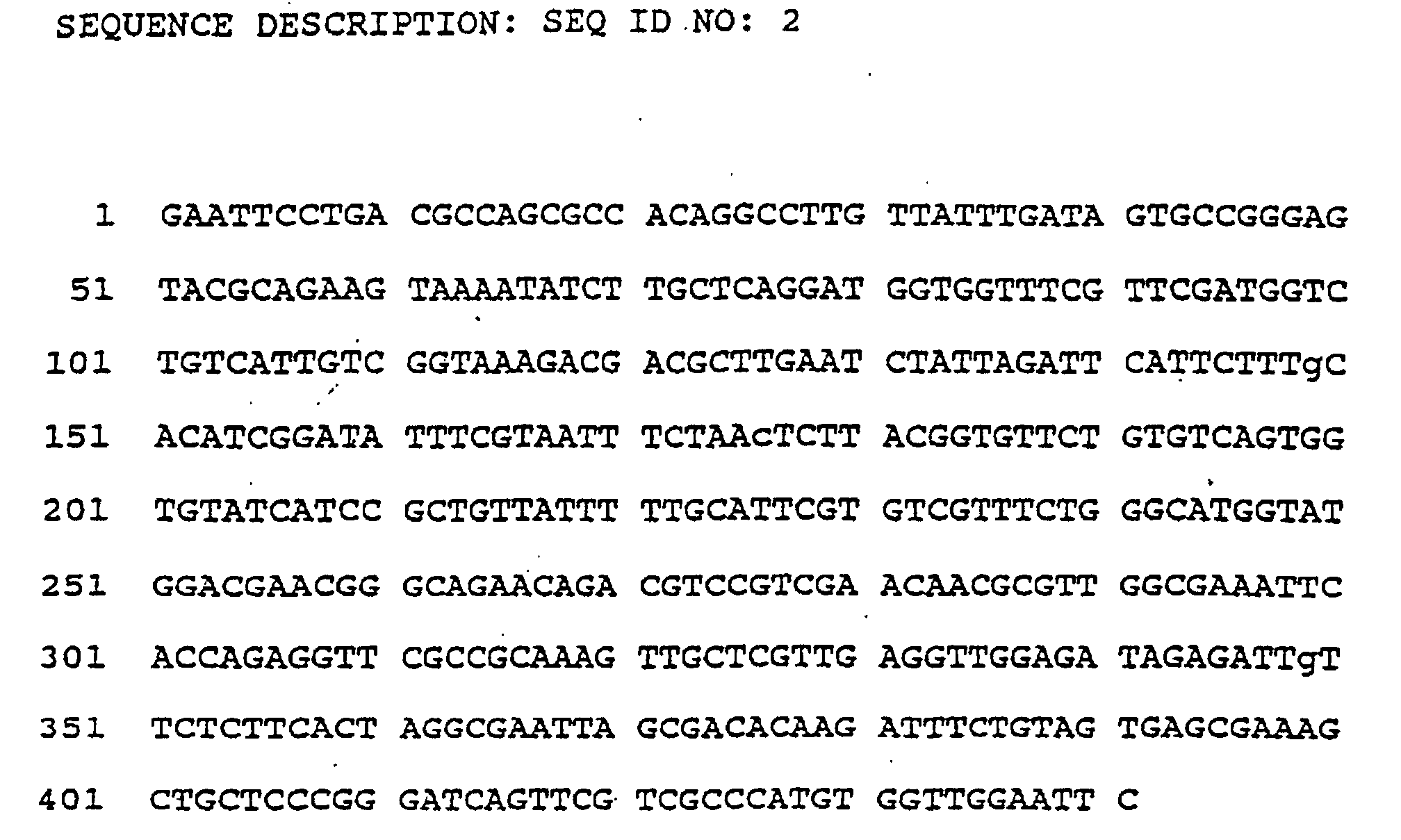
- shows the DNA sequences of the viral inserts of clones pMF94 and pMF295. Both sequences
are part of the major capsid protein gene of HHV-6 as published in Littler et al.,
1990.
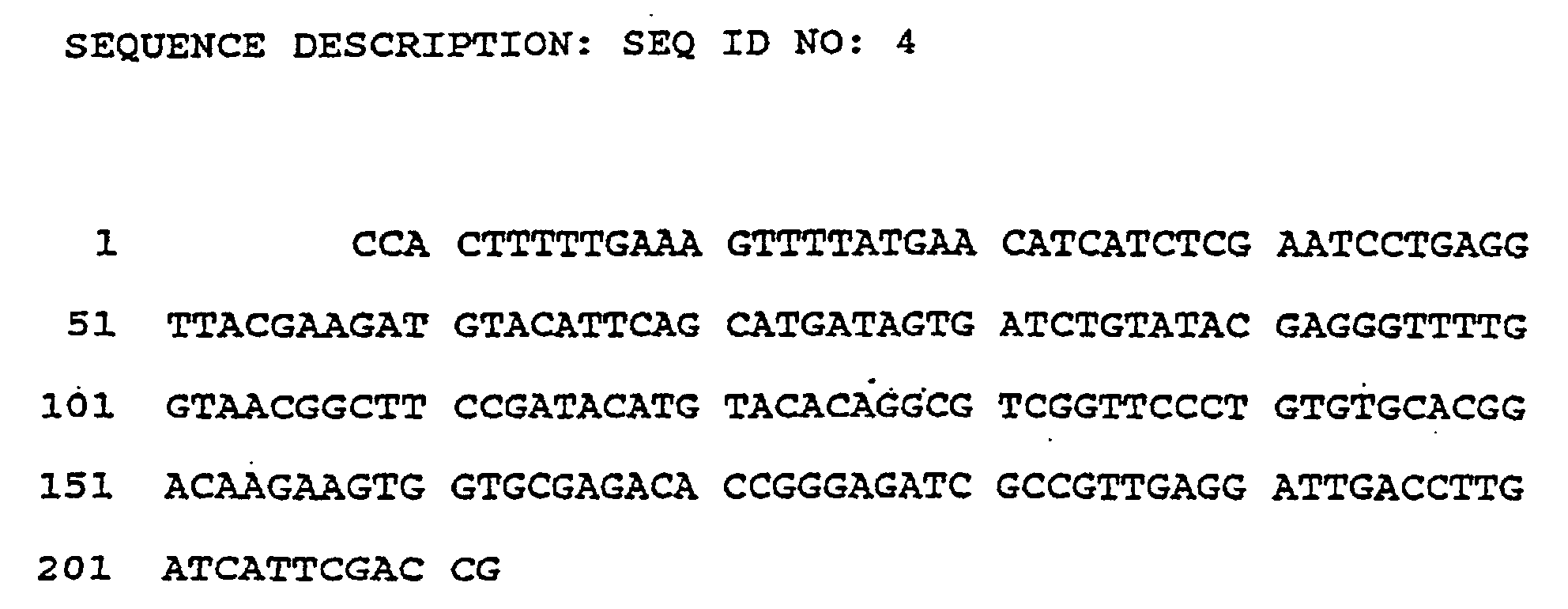
- Tab. 2
- shows the DNA sequence of the viral insert of clone pMF90. The sequence is identical
with nucleotides 117-194 of the sequence published in Chang and Balachandran, 1991.
- Tab. 3
- shows the complete DNA sequence of the HHV-6 EcoRI fragments numbered 6 and 7 (starting
from the left end). These fragments contain the entire p100 gene of HHV-6. Furthermore,
the amino acid sequence of p100 is shown.
- Fig. 1
- shows a Western blot analysis wherein antiserum of rabbits immunized with HHV-6 infected
HSB-2 cells and antibodies against the HHV-6 protein p100 purified from this antiserum
are reacted with viral proteins.
- Fig. 2
- shows the restriction map of the HHV-6 genome.
- Fig. 3
- shows the results of the expression of HHV-6 proteins in the expression vector pROS
in a Western blot with rabbit serum and a PAGE Coomassie staining.
- Fig. 4
- shows the reactivity of the serum of four patients with HHV-6 epitopes.
[0018] The DNA sequences encoding the immunogenic proteins and parts thereof were identified
in a genomic HHV-6 gene bank with mono- and polyspecific rabbit antisera against HHV-6
proteins.
[0019] Rabbits were immunized with whole HHV-6 infected HSB-2 cells. The obtained antiserum
reacted with at least 7 viral proteins (Fig. 4). Antibodies against a 100kda protein
of HHV-6 were purified from this serum. For this purpose, entire viral protein was
subjected to preparative SDS polyacrylamide electrophoresis. Viral protein with a
molecular weight of 100kda was transferred to nitrocellulose membranes and incubated
with the diluted rabbit serum. Antibodies that were specifically bound on the nitrocellulose
sheets were eluted with 100mM glycin at pH 2.7. The obtained antibodies reacted specifically
with an HHV-6 virion protein of about 100kda (Fig. 4). Both serum preparations were
used to screen the genomic library.
[0020] The construct of a genomic library DNA from cosmids containing the entire HHV-6 genome
in overlapping fragments was sheared by sonication. After addition of EcoRI linkers,
EcoRI digestions and size fractionation it was ligated into the commercially available
vector lambda zapII (Stratagene Inc., La Jolla, USA). After in vitro packaging a gene
bank of 3 x 10
5 independent recombinants was obtained. Positive clones were identified by immunological
screening using the sera mentioned and a commercially available detection system ('Pico
blue', Stratagene Inc., La Jolla, USA). The identified lambda clones were then subcloned
into the Bluescript SK- vector by 'in vivo excision' following the supplier's instructions
(Stratagene Inc.). , Four clones that were especially reactive in Western blots (pMF101,
pMF90, pMF94, pMF295) were chosen for further characterization. The inserts of these
clones were sequenced by Sanger's chain termination method. Data were analyzed by
the Genetics Computer Group (GCG, Madison, Wisconsin, USA) sequence analysis package.
The predicted amino acid sequences were used for homology searches with the computer
program FASTA (Pearson & Lipman, 1988) in a library containing all of the published
herpesvirus sequences. The clones pMF94 and pMF295 were found to contain parts of
the published Major Capsid Protein gene of HHV-6 (Tab. 1) (Littler et al., 1990),
while pMF90 contains part of an open reading frame homologous to UL44 of HCMV (Tab.
2). The corresponding HHV-6 gene has recently been identified using monoclonal antibodies
against a phosphorylated HHV-6 protein of 41kda (chang and Balachandran, 1991). However,
the epitope identified by Chang et al. is located after amino acid 227 of their sequence,
while pMF90 covers amino acids 119-187 only. No homologous gene could be found for
the predicted amino acid sequence of clone pMF101. The insert of pMF101 was used to
locate the gene within the virus genome. By hybridization with 7 cosmid clones that
encompass the entire HHV-6 genome (Neipel et al., 1991) it could be located within
an 1.4kb EcoRI fragment close to the left terminal repeat (Fig. 2). Further sequencing
in this area revealed an open reading frame coding. for a protein of 870 amino acids
with a predicted molecular weight of 97kda (termed p100 hereinafter).
[0021] Five fragments of p100, comprising almost the complete protein (pDF446-4, pDF446-3,
pD2Hae, pD2Hind, pMF101R), were prokaryotically expressed as β-galactosidase fusion
protein in the vector pROS (Ellinger et al). In Western blot assays only the carboxyterminal
clones reacted with both rabbit human HHV-6 positive sera (Fig. 3, Fig. 4). Fusion
protein expressed from pMF101R was used to purify antibodies from rabbit serum as
described above. The antibodies were used to carry out Western blot analyses with
HHV-6 infected and uninfected HSB-2 cells. A protein of 100kda was detected in infected
cells only. Of all expression clones investigated so far the carboxyterminal parts
of p100 were most reliably recognized by human HHV-6 positive sera in Western blot
analyses. Since it would be possible only with great technical elaboration to isolate
virion proteins in the amounts necessary for diagnostic aids, the manner of preparation
by gene manipulation according to the invention is especially advantageous. In Western
blot analyses using HHV-6 infected cells a protein of 100kda is recognized most reliably
by human sera. It could not have been expected that prokaryotically expressed p100
or parts thereof are invariably recognized by human sera, as the homologous gene of
HCMV codes for a much larger protein, and the immunogenic parts of the HHV-6 gene
did not show any homology to HCMV pp150. It is also surprising that the. prokaryotically
expressed part. of an phosphorylated HHV-6 protein homologous to HCMV UL44 (pMF90)
is recognized by most HHV-6 positive human sera.
[0022] It is possible according to the invention to use p100 and/or the fragment of the
UL44 homologue of HHV-6 (pMF90) and/or the phosphorylated HHV-6 protein of 41 kD,
or immunogenic parts thereof, which have been prepared, in prokaryotic or eukaryotic
cells, for example yeast cells, human or animal cells, as a reagent for detecting
HHV-6 antibodies, for example in an ELISA assay.
EXAMPLE
[0023] A fragment of 182 bp from the carboxyterminal part of HHV-6 p100 (nucleotides 2960-3141
in Tab. 3) was ligated in the expression vector pROS (Ellinger,S. et al., 1989). The
clone is termed pMF101R. The BamHI-HindIII fragments from plasmid pMF90, pMF94, and
pMF295 were also ligated into pROS. They are termed pD2MF90, pD2MF94, and pD2MF295,
respectively. Transformation of the resulting hybrid plasmid into E. coli JK50 was
followed by isolation of clones whose plasmid DNA had the expected restriction pattern.
After induction of the lac promoter with isopropyl-β-D-thiogalacto-pyranoside (IPTG)
the clones expressed large amounts of a fusion protein having a viral fraction. The
fusion proteins were isolated from the bacterial cells and used in Western blotting
experiments. All human sera that were HHV-6 positive in a standard immunofluorescence
assay using HHV-6 infected HSB-2 cells recognized at least one of the fusion proteins
(Fig. 3). Human sera that were found to be HHV-6 negative using the immunofluorescence
did react weakly or not at all.
[0024] Thus, prokaryotically expressed parts of p100 or the UL44 homologue of HHV-6 can
be used in a diagnostic assay that is more sensitive and specific than the immunofluorescence
used so far.
References:
[0025] Chang, C.K. and Balachandran, N. (1991) Identification, Characterization, and Sequence
Analysis of a cDNA Encoding a phosphoprotein of Human Herpesvirus 6. J. Virol., 65:2884-2894
[0026] Larcher, C., Huemer, H.P., Margreiter, R., and Dierich, M.P. (1988) Serological crossreaction
of human herpesvirus-6 with cytomegalovirus (letter). Lancet, 2:963-964
[0027] Lawrence, G.L., Chee, M., Craxton, M.A., Gompels, U.A, Honess, R.W., and Barrell,
B.G. (1990) Human herpesvirus 6 is closely related to human cytomegalovirus. J. Virol.,
64:287-299
[0028] Littler, E., Lawrence, G., Liu, M.Y., Barrell, B.G., and Arrand, J.R. (1990) Identification,
cloning, and expression of the major capsid protein gene of human herpesvirus 6. J.
Virol., 64:714-722
[0029] Neipel, F., Ellinger, K., and Fleckenstein, B. (1991) The unique region of the human
herpesvirus type 6 genome is essentially colinear to the UL segment of human cytomegalovirus.
J. Gen. Virol.
[0030] Yamamoto, M., Black, J.B., Stewart, J.A., Lopez, C., and Pellett, P.E. (1990) Identification
of a nucleocapsid protein as a specific serological marker of human herpesvirus 6
infection. J. Clin. Microbiol., 28:1957-1962
[0031] Ellinger, S., Glockshuber, R., Jahn, G., and Plückthun, A. (1989) Cleavage of procaryotically
expressed human immunodeficiency virus fusion proteins by factor Xa and application
in western blot (immunoblot) assays; J. Clin. Microbiol. 27 (5): 971-976
INFORMATION FOR SEQ ID NO: 2
[0033] SEQUENCE CHARACTERISTICS:
TYPE: nucleotide
LENGTH: 441 base pairs
STRANDEDNESS: single
TOPOLOGY: linear
MOLECULE TYPE: virus DNA
ORGANISM: HHV-6
PROPERTIES: coding for a part of HHV-6 major capsid protein
INFORMATION FOR SEQ ID NO: 3
[0034] SEQUENCE CHARACTERISTICS:
TYPE: nucleotide
LENGTH: 219 base pairs
STRANDEDNESS: single
TOPOLOGY: linear
MOLECULE TYPE: virus. DNA
ORGANISM: HHV-6
PROPERTIES: coding for a part of HHV-6 major capsid protein

INFORMATION FOR SEQ ID NO: 4
[0035] SEQUENCE CHARACTERISTICS:
TYPE: nucleotide
LENGTH: 212 base pairs
STRANDEDNESS: single
TOPOLOGY: linear
MOLECULE TYPE: virus DNA
ORGANISM: HHV-6
PROPERTIES: coding for a part of phosphorylated HHV-6 protein of 41 KD
Claims for the following Contracting State(s): AT, BE, CH, DE, DK, FR, GB, IT, LI,
LU, NL, PT, SE
1. An isolated DNA sequence encoding the HHV-6 (human herpesvirus type 6) protein p100
having the amino acid sequence given in Tab. 3 starting from the position corresponding
to nucleotide 639 to the position corresponding to nucleotide 3248.
2. The DNA sequence according to claim 1 having the nucleotide sequence from position
639 to the position corresponding to nucleotide 3248.
3. A DNA sequence hybridizing to a DNA sequence according to claim 1 or 2 and encoding
the entire protein defined by the amino acid sequence in Tab. 3 or parts of said protein
which react with antibodies specific for said protein and substantially without crossreactivity
to components of human cytomegalovirus and other herpesviruses.
4. The DNA sequence according to claim 3 having the nucleotide sequence given in Tab.
3 from position 2960 to position 3141.
5. The DNA sequence according to claim 3 having the nucleotide sequence given in Tab.
3 from position 2408 to position 2959.
6. An HHV-6 protein p100 or a part thereof , which reacts with antibodies specific for
the protein having the amino acid sequence given in Tab. 3 and substantially without
crossreactivity to components of human cytomegalovirus and other herpesviruses, being
encoded by a DNA sequence according to any one of claims 1 to 5.
7. A recombinant vector comprising the DNA according to any one of claims 1 to 5.
8. The recombinant vector according to claim 7 in which said DNA sequence is under the
control of a homologous or heterologous promoter allowing its expression in a desired
host cell.
9. A transformed host organism obtainable by transformation with the vector according
to claim 7 or 8.
10. The transformed host organism according to claim 9 which is a bacterium, preferably
of the genus Escherichia, a yeast, preferably of the genus Saccharomyces, a plant
cell or an animal cell, preferably a mammalian cell.
11. A process for the production of the HHV-6 protein p100 or a part thereof as claimed
in claim 6 comprising the steps of cultivating the transformed host organism as claimed
in claim 9 or 10 and recovering said protein or said part thereof from the culture.
12. A pharmaceutical composition containing a protein according to claim 6 optionally
in combination with a pharmaceutically acceptable carrier and/or diluent.
13. The pharmaceutical composition according to claim 12 for the prophylaxis or treatment
of HHV-6 infections.
14. A composition comprising a part of the HHV-6 protein p100 as claimed in claim 6 and/or
the DNA encoding said part as claimed in anyone of the claims 2 to 5.
15. The composition according to claim 14, additionally containing parts of the major
capsid protein gene of HHV-6, especially the DNA sequences given in Tab. 1 and/or
the polypeptide being encoded by these DNA sequences.
16. The composition according to claim 14, additionally containing parts of the gene encoding
the phosphorylated HHV-6 protein of 41 kD, especially the DNA sequences given in Tab.
2 and/or the polypeptide being encoded by these DNA sequences.
17. The composition according to any one of the claims 14 to 16 for carrying out an ELISA
assay.
18. The composition according to any one of the claims 14 to 17 for the differential diagnosis
of HHV-6.
Claims for the following Contracting State(s): ES
1. A process for the production of a HHV-6 protein p100 or a part thereof, which reacts
with antibodies specific for said protein and substantially without crossreactivity
to components of human cytomegalovirus and other herpesviruses, being encoded by a
DNA sequence encoding the HHV-6 (human herpesvirus type 6) protein p100, having the
amino acid sequence given in Tab. 3 starting from the position corresponding to nucleotide
639 to the position corresponding to nucleotide 3248, comprising the steps of cultivating
a transformed host organism containing a vector with said DNA sequence and recovering
said protein from the culture.
2. A process according to claim 1, wherein said DNA sequence has the nucleotide sequence
from position 639 to position 3248.
3. A process according to claim 1 or 2, wherein said DNA sequence hybridises to a DNA
sequence according to claim 1 or 2 and encoding a protein having the specific immunological
properties of the HHV-6 protein p100.
4. A process according to claim 3, wherein said DNA sequence has the nucleotide sequence
given in Tab. 3 from position 2960 to position 3141.
5. A process according to claim 3, wherein said DNA sequence has the nucleotide sequence
given in Tab. 3 from position 2408 to position 2959.
6. A process according to any of claims 1 - 5, wherein said DNA sequence is under the
control of a homologous or heterologous promoter allowing its expression in a desired
host cell.
7. A process according to any of claims 1 - 6, wherein the transformed host organism
is a bacterium, preferably of the genus Escherichia, a yeast, preferably of the genus
Saccharomyces, a plant cell or an animal cell, preferably a mammalian cell.
8. A process for producing a pharmaceutical composition by mixing a protein produced
according to any of claims 1 - 7 optionally with a pharmaceutically acceptable carrier
and/or diluent.
9. A process according to claim 8, wherein said pharmaceutical composition is for the
prophylaxis or treatment of HHV-6 infections.
10. A process for producing a composition containing a DNA sequence encoding the HHV-6
(human herpesvirus type 6) protein p100 having the amino acid sequence given in Tab.
3 starting from the position corresponding to nucleotide 639 to the position corresponding
to nucleotide 3248 and/or a protein produced according to any of claims 1 - 7.
11. A process according to claim 10, wherein said DNA sequence has the nucleotide sequence
from position 639 to position 3248.
12. A process according to claim 10 or 11, wherein said DNA sequence hybridises to a DNA
sequence according to claim 10 or 11 and encoding a protein which reacts with antibodies
specific for the HHV-6 (human herpesvirus type 6) protein p100 and substantially without
crossreactivity to components of human cytomegalovirus and other herpesviruses.
13. A process according to any of claims 10-12, wherein said composition additionally
contains parts of the major capsid protein gene of HHV-6, especially the DNA sequences
given in Tab. 1 and/or the polypeptide being encoded by these DNA sequences.
Patentansprüche für folgende(n) Vertragsstaat(en): AT, BE, CH, DE, DK, FR, GB, IT,
LI, LU, NL, PT, SE
1. Isolierte DNA-Sequenz, welche für das HHV-6(Human-Herpesvirus Typ 6)-Protein p100
mit der in Tabelle 3 angegebenen Aminosäuresequenz codiert, ausgehend von der Position,
welche dem Nucleotid 639 entspricht, bis zur Position, welche dem Nucleotid 3248 entspricht.
2. DNA-Sequenz nach Anspruch 1, mit der Nucleotidsequenz von der-Position 639 bis zur
Position, welche dem Nucleotid 3248 entspricht.
3. DNA-Sequenz, welche an eine DNA-Sequenz nach Anspruch 1 oder 2 hybridisiert und für
das gesamte Protein codiert, das durch die Aminosäuresequenz in Tabelle 3 definiert
ist, oder für Teile des genannten Proteins, welche mit Antikörpern reagieren, die
für das genannte Protein spezifisch sind, und im wesentlichen ohne Kreuzreaktivität
gegenüber Komponenten von Human-Cytomegalovirus und anderen Herpesviren.
4. DNA-Sequenz nach Anspruch 3 mit der in Tabelle 3 angegebenen Nucleotidsequenz von
der Position 2960 bis zur Position 3141.
5. DNA-Sequenz nach Anspruch 3 mit der in Tabelle 3 angegebenen Nucleotidsequenz von
der Position 2408 bis zur Position 2959.
6. HHV-6-Protein p 100 oder ein Teil. hievon, welcher mit Antikörpern reagiert, die für
das Protein mit der in Tabelle 3 angegebenen Aminosäuresequenz spezifisch sind, und
im wesentlichen ohne Kreuzreaktivität gegenüber Komponenten von Human-Cytomegalovirus
und anderen Herpesviren, welches durch eine DNA-Sequenz nach einem der Ansprüche 1
bis 5 codiert wird.
7. Rekombinanter Vektor, umfassend die DNA nach einem der Ansprüche 1 bis 5.
8. Rekombinanter Vektor nach Anspruch 7, worin die genannte DNA-Sequenz von einem homologen
oder heterologen Promotor reguliert wird, welcher deren Expression in einer gewünschten
Wirtszelle erlaubt.
9. Transformierter Wirtsorganismus, erhältlich durch Transformation mit dem Vektor nach
Anspruch 7 oder 8.
10. Transformierter Wirtsorganismus nach Anspruch 9, welcher ein Bakterium, vorzugsweise
vom Genus Escherichia, eine Hefe, vorzugsweise vom Genus Saccharomyces, eine Pflazenzelle
oder eine Tierzelle, vorzugsweise eine Säugetierzelle ist.
11. Verfahren zur Herstellung des HHV-6-Proteins p100 oder eines Teils hievon wie in Anspruch
6 beansprucht, umfassend die Schritte des Kultivierens des transformierten Wirtsorganismus
wie in Anspruch 9 oder 10 beansprucht und das Gewinnen des genannten Proteins oder
des genannten Teils hievon aus der Kultur.
12. Pharmazeutische Zusammensetzung, enthaltend ein Protein nach Anspruch 6, wahlweise
in Kombination mit einem pharmazeutisch annehmbaren Träger und/oder Verdünnungsmittel.
13. Pharmazeutische Zusammensetzung nach Anspruch 12 zur Prophylaxe oder Behandlung von
HHV-6-Infektionen.
14. Zusammensetzung, umfassend einen Teil des HHV-6-Proteins p100 wie in Anspruch 6 beansprucht
und/oder die für den genannten Teil codierende DNA, wie sie in einem der Ansprüche
2 bis 5 beansprucht wird.
15. Zusammensetzung nach Anspruch 14, welche zusätzlich Teile des Hauptcapsidproteingens
von HHV-6, insbesondere die in Tabelle 1 angegebenen DNA-Sequenzen und/oder das durch
diese DNA-Sequenzen codierte Polypeptid enthält.
16. Zusammensetzung nach Anspruch 14, welche zusätzlich Teile der Gene, die für das phosphorylierte
HHV-6-Protein von 41 kD codieren, insbesondere die DNA-Sequenzen, welche in Tabelle
2 angegeben sind, und/oder das Polypeptid enthält, für welches diese DNA-Sequenzen
codieren.
17. Zusammensetzung nach einem der Ansprüche 14 bis 16 zur Durchführung eines ELISA-Assays.
18. Zusammensetzung nach einem der Ansprüche 14 bis 17 für die unterscheidende Diagnose
von HHV-6.
Patentansprüche für folgende(n) Vertragsstaat(en): ES
1. Verfahren zur Herstellung eines HHV-6-Proteins p100 oder von einem Teil hievon, welcher
mit Antikörpern reagiert, die für das genannte Protein spezifisch sind, und im wesentlichen
ohne Kreuzreaktivität für Komponenten des Human-Cytomegalovirus und anderer Herpesviren,
welcher/welches von einer DNA Sequenz codiert wird, die für das HHV-6(Human-Herpesvirus
Typ 6)-Protein p100 mit der in Tabelle 3 angegebenen Aminosäuresequenz codiert, ausgehend
von der Position, welche dem Nucleotid 639 entspricht, bis zur Position, welche dem
Nucleotid 3248 entspricht, umfassend die Schritte der Kultivierung eines transformierten
Wirtsorganismus, welcher einen Vektor mit der genannten DNA-Sequenz enthält, und das
Gewinnen des genannten Proteins aus der Kultur.
2. Verfahren nach Anspruch 1, wobei die genannte DNA-Sequenz die Nucleotidsequenz von
Position 639 bis Position 3248 besitzt.
3. Verfahren nach Anspruch 1 oder 2, wobei die genannte DNA-Sequenz an eine DNA-Sequenz
nach Anspruch 1 oder 2 hybridisiert und welche für ein Protein codiert, das die spezifischen
immunologischen Eigenschaften des HHV-6-Proteins p100 besitzt.
4. Verfahren nach Anspruch 3, wobei die genannte DNA-Sequenz die in Tabelle 3 angeführte
Nucleotidsequenz von Position 2960 bis Position 3141 aufweist.
5. Verfahren nach Anspruch 3, wobei die DNA-Sequenz die in Tabelle 3 angeführte Nucleotidsequenz
von Position 2408 bis Position 2959 aufweist.
6. Verfahren nach einem der Ansprüche 1 bis 5, wobei die genannte DNA-Sequenz von einem
homologen oder heterologen Promotor reguliert wird, welcher deren Expression in einer
gewünschten Wirtszelle erlaubt.
7. Verfahren nach einem der Ansprüche 1 bis 6, wobei der transformierte Wirtsorganismus
ein Bakterium, vorzugsweise vom Genus Escherichia, eine Hefe, vorzugsweise vom Genus
Saccharomyces, eine Pflanzenzelle oder eine tierische Zelle, vorzugsweise eine Säugetierzelle
ist.
8. Verfahren zur Herstellung einer pharmazeutischen Zusammensetzung durch Vermischen
eines nach einem der Ansprüche 1 bis 7 hergestellten Proteins, wahlweise mit einem
pharmazeutisch annehmbaren Träger und/oder Verdünnungsmittel.
9. Verfahren nach Anspruch 8, wobei die genannte pharmazeutische Zusammensetzung für
die Prophylaxe oder Behandlung von HHV-6-Infektionen vorgesehen ist.
10. Verfahren zur Herstellung einer Zusammensetzung, welche eine DNA-Sequenz, die für
das HHV-6(Human-Herpesvirus Typ 6) -Protein mit der in Tabelle 3 angegebenen Aminosäuresequenz
p100 codiert, ausgehend von der Position, welche dem Nucleotid 639 entspricht, bis
zur Position, welche dem Nucleotid 3248 entspricht, und/oder ein nach einem der Ansprüche
1 bis 7 hergestelltes Protein enthält.
11. Verfahren nach Anspruch 10, wobei die genannte DNA-Sequenz die Nucleotidsequenz von
der Position 639 bis zur Position 3248 aufweist.
12. Verfahren nach Anspruch 10 oder 11, wobei die genannte DNA-Sequenz an eine DNA-Sequenz
nach Anspruch 10 oder 11 hybridisiert und welche für ein Protein codiert, das mit
den für das HHV-6(Human-Herpesvirus Typ 6) -Protein p100 spezifischen Antikörpern
reagiert, und im wesentlichen ohne Kreuzreaktivität zu Komponenten von Humancytomegalovirus
und anderen Herpesviren.
13. Verfahren nach einem der Ansprüche 10 bis 12, wobei die genannte Zusammensetzung zusätzlich
- Teile des Hauptcapsidproteingens von HHV-6, insbesondere die DNA-Sequenzen, welche
in Tabelle 1 angeführt sind, und/oder das Polypeptid enthält, für welches diese DNA-Sequenzen
codieren.
Revendications pour l'(les) Etat(s) contractant(s) suivant(s): AT, BE, CH, DE, DK,
FR, GB, IT, LI, LU, NL, PT, SE
1. Séquence d'ADN isolée codant pour la protéine p100 de HHV-6 (herpès virus humain de
type 6), ayant la séquence d'aminoacides donnée dans le tableau 3, allant de la position
correspondant au nucléotide 639 à la position correspondant au nucléotide 3248.
2. Séquence d'ADN selon la revendication 1, ayant la séquence nucléotidique allant de
la position 639 à la position 3248.
3. Séquence d'ADN s'hybridant avec une séquence d'ADN selon la revendication 1 ou 2 et
codant pour la protéine complète définie par la séquence d'aminoacides dans le tableau
3 ou des parties de ladite protéine qui réagissent avec des anticorps spécifiques
de ladite protéine et pratiquement sans réactivité croisée avec des composants de
cytomégalovirus humain et d'autres herpès virus.
4. Séquence d'ADN selon la revendication 3, comportant la séquence nucléotidique donnée
dans le tableau 3, de la position 2960 à la position 3141.
5. Séquence d'ADN selon la revendication 3, comportant la séquence nucléotidique donnée
dans le tableau 3, de la position 2408 à la position 2959.
6. Protéine p100 de HHV-6 ou une partie de celle-ci, réagissant avec des anticorps spécifiques
de la protéine ayant la séquence d'aminoacides donnée dans le tableau 3 et pratiquement
sans réactivité croisée avec des composants de cytomégalovirus humain et d'autres
herpès virus, qui est codée par une séquence d'ADN selon l'une quelconque des revendications
1 à 5.
7. Vecteur recombinant comprenant l'ADN selon l'une quelconque des revendications 1 à
5.
8. Vecteur recombinant selon la revendication 7, dans lequel ladite séquence d'ADN est
sous le contrôle d'un promoteur homologue ou hétérologue permettant son expression
dans une cellule hôte désirée.
9. Organisme hôte transformé pouvant être obtenu par transformation par le vecteur selon
la revendication 7 ou 8.
10. Organisme hôte transformé selon la revendication 9, qui est une bactérie, de préférence
appartenant au genre Escherichia, une levure, de préférence appartenant au genre Saccharomyces, une cellule végétale ou une cellule animale, de préférence une cellule mammalienne.
11. Procédé pour la production de la protéine p100 de HHV-6 ou d'une partie de celle-ci,
telle que revendiquée dans la revendication 6, comprenant les étapes de culture de
l'organisme hôte transformé tel que revendiqué dans la revendication 9 ou 10, et de
récupération de ladite protéine ou de ladite partie de celle-ci à partir de la culture.
12. Composition pharmaceutique contenant une protéine selon la revendication 6, éventuellement
en association avec un véhicule et/ou diluant pharmaceutiquement acceptable.
13. Composition pharmaceutique selon la revendication 12, destinée à la prophylaxie ou
au traitement d'infections à HHV-6.
14. Composition comprenant une partie de la protéine p100 de HHV-6 telle que revendiquée
dans la revendication 6 et/ou l'ADN codant pour ladite partie telle que revendiquée
dans l'une quelconque des revendications 2 à 5.
15. Composition selon la revendication 14, comprenant en outre des parties du gène de
protéine nucléocapsidique majeure de HW-6, en particulier la séquence d'ADN donnée
dans le tableau 1 et/ou le polypeptide qui est codé par ces séquences d'ADN.
16. Composition selon la revendication 14, contenant en outre des parties du gène codant
pour la protéine phosphorylée de 41 kDa de HHV-6, en particulier les séquences d'ADN
données dans le tableau 2 et/ou les polypeptides codés par ces séquences.
17. Composition selon l'une quelconque des revendications 14 à 16, pour effectuer un essai
ELISA.
18. Composition selon l'une quelconque des revendications 14 à 17, pour le diagnostic
différentiel de HHV-6.
Revendications pour l'(les) Etat(s) contractant(s) suivant(s): ES
1. Procédé pour la production d'une protéine p100 de HHV-6 ou d'une partie de celle-ci,
qui réagit avec des anticorps spécifiques de ladite protéine et pratiquement sans
réactivité croisée avec des composants de cytomégalovirus humain et d'autres herpès
virus, étant codée par une séquence d'ADN codant pour la protéine p100 de HHV-6 (herpès
virus humain de type 6), ayant la séquence d'aminoacides donnée dans le tableau 3,
de la position correspondant au nucléotide 639 à la position correspondant au nucléotide
3248, comprenant les étapes de culture d'un organisme hôte transformé contenant un
vecteur comportant ladite séquence d'ADN et de récupération de ladite protéine à partir
de la culture.
2. Procédé selon la revendication 1, dans lequel ladite séquence d'ADN comporte la séquence
nucléotidique allant de la position 639 à la position 3248.
3. Procédé selon la revendication 1 ou 2, dans lequel ladite séquence d'ADN s'hybride
avec une séquence d'ADN selon la revendication 1 ou 2 et codant pour une protéine
ayant les propriétés immunologiques particulières de la protéine p100 de HHV-6.
4. Procédé selon la revendication 3, dans lequel ladite séquence d'ADN comporte la séquence
nucléotidique donnée dans le tableau 3, de la position 2960 à la position 3141.
5. Procédé selon la revendication 3, dans lequel ladite séquence d'ADN comporte la séquence
nucléotidique donnée dans le tableau 3 de la position 2408 à la position 2959.
6. Procédé selon l'une quelconque des revendications 1 à 5, dans lequel ladite séquence
d'ADN est sous le contrôle d'un promoteur homologue ou hétérologue permettant son
expression dans une cellule hôte désirée.
7. Procédé selon l'une quelconque des revendications 1 à 6, dans lequel l'organisme hôte
transformé est une bactérie, de préférence appartenant au genre Escherichia, une levure, de préférence appartenant au genre Saccharomyces, une cellule végétale ou une cellule animale, de préférence une cellule mammalienne.
8. Procédé pour la préparation d'une composition pharmaceutique par mélange d'une protéine
produite selon-l'une quelconque des revendications 1 à 7, éventuellement avec un véhicule
et/ou diluant pharmaceutiquement acceptable.
9. Procédé selon la revendication 8, dans lequel ladite composition pharmaceutique est
destinée à la prophylaxie ou au traitement d'infections à HHV-6.
10. Procédé pour la préparation d'une composition contenant une séquence d'ADN codant
pour la protéine p100 de HHV-6 (herpès virus humain de type 6), ayant la séquence
d'aminoacides donnée dans le tableau 3, allant de la position correspondant au nucléotide
639 à la position correspondant au nucléotide 3248 et/ou une protéine produite selon
l'une quelconque des revendications 1 à 7.
11. Procédé selon la revendication 10, dans lequel ladite séquence d'ADN comporte la séquence
nucléotidique allant de la position 639 à la position 3248.
12. Procédé selon la revendication 10 ou 11, dans lequel ladite séquence d'ADN s'hybride
avec une séquence d'ADN selon la revendication 10 ou 11 et codant pour une protéine
qui réagit avec des anticorps spécifiques de la protéine p100 de HHV-6 (herpès virus
humain de type 6) et pratiquement sans réactivité croisée avec des composants de cytomégalovirus
humain et d'autres herpès virus.
13. Procédé selon l'une quelconque des revendications 10 à 12, dans lequel ladite composition
contient en outre des parties du gène de protéine nucléocapsidique majeure de HHV-6,
en particulier les séquences d'ADN données dans le tableau 1 et/ou le polypeptide
codé par ces séquences d'ADN.