|
(11) | EP 0 525 181 B1 |

| (12) | EUROPEAN PATENT SPECIFICATION |
|
|
| (54) |
NOVEL LANTHANIDE CHELATE-CONJUGATED OLIGONUCLEOTIDES NEUE OLIGONUKLEOTIDE KONJUGIERT ZU LANTHANIDE-CHELATEN NOUVEAUX OLIGONUCLEOTIDES CONJUGUES A DES CHELATES DE LANTHANIDE |
|
|
|||||||||||||||||||||||||||||||
| Note: Within nine months from the publication of the mention of the grant of the European patent, any person may give notice to the European Patent Office of opposition to the European patent granted. Notice of opposition shall be filed in a written reasoned statement. It shall not be deemed to have been filed until the opposition fee has been paid. (Art. 99(1) European Patent Convention). |
BACKGROUND OF THE INVENTION
[0001] The use of lanthanide chelates in nonisotopic labelling of biological macromolecules has attracted a great deal of interest in the field of diagnostics. This technique takes advantage of the long lived fluorescence of lanthanide elements, compared to ordinary fluorescent backgrounds which otherwise tend to overwhelm genuine signal. The trivalent lanthanide ions Eu+++, Tb+++, and Sm+++ all have fluorescent decay tmes on the order of milliseconds compared to nanosecond decay times for background fluorescence. By irradiating a sample at the appropriate wave-length and energy level, the fluorescence may be measured at a delayed point in time, after background fluorescence has already decayed, but while the lanthanide specimen is still emitting. this technique is known as time-resolved, or time-gated fluorescence spectroscopy. For a general review of the principles of the technique, see U.S. patents 4,150,295 and 4,058,132, and Immunoflurescence and Related Staining Techniques, Knapp, et al. eds. (1978: Elsefier/North Holland Biomedical Press).
[0002] The fluorescent properties of lanthanide ions are generally enhanced when they are captured by a chelating agent. This is because hydration of the ion in aqueous solution drastically quenches the emitted energy. Chelation is also necessary to entrain the ions in proximity to the target which they are to detect.
[0003] Covalent coupling of chelating agents to proteins, such as antibodies with binding specificity to a target, and to nucleic acids, which will hybridize to specific complementary nucleic acid sequences, is known in the art. For example, WO 89/04375 (Musso) discloses labelling of DNA probes with EDTA, DTPA, and certain analogs thereof such as p-phenyl-EDTA, through a linker moiety having a terminal group with the formulae NH(C=S)NH, NH(C=O)NH, S(C=S)NH, etc. The probes are complexed with lanthanide ions and utilize a beta-diketone in micelles to increase sensitivity. Similarly, WO 88/02784 (Ylikoski) discloses multiple chelate labelled polymeric probes having chelate moities of the modified EDTA and DTPA type. WO 90/00550 (Kankare) discloses novel terpyridine derivatives which act as chelating agents for lanthanide ions and may have utility in labelling nucleic acid probes and proteins.
[0004] EP 0 324 323 (Hemmila) discloses chelates having a structure containing a heteroatom having a free electron pair selected from nitrogen, oxygen, phosphorus or sulfur, and being bonded so that the free electron pair is delocalized to a conjugated system of pi-bonds, useful in a homogeneous assay format. WO 90/00623 (Kwiatkowski) discloses a multilabel nucleic acid probe system utilizing chelates having a bipyridine structure as a vehicle for multiple dicarboxylic acid groups.
[0005] The properties of various chelating agents differ with the type of biological macromolecule to which they are attached. Of particular interest are the poly(arylpyridine) chelates which have large capacity to bind ions. The monosubstituted amino triazine ligand molecule having two diacid groups binds rare earth ions efficiently when attached to proteins such as antibodies, but has serious limitations in probe assays. In the context of protein labelling, the ligand combines at a number of sites which confer a conformational configuration conducive to ion binding. Naturally occuring carboxyl groups, such as the free carboxyl group of glutamic acid, also promote chelation. However, no such conformational interactions are possible with nucleic acids, which behave such like linear molecules. Thus, it is not readily apparent, nor can it be predicted, which chelate structures have especial efficacy in nucleic acid probe assays.
SUMMARY OF THE INVENTION
[0006] The present invention relates to novel lanthanide chelate-conjugated oligonucleotides utilized in hybridization assays for detection of nucleic acids present in a sample in small amounts, frequently in the presence of large quantities of non-homologous nucleic acids. It is therefore an object of the present invention to obtain chelates capable of being conjugated covalently to oligonucleotides, which have extremely high level rare earth element capture efficiency, and corresponding high emission levels. This is especially important in labelling of nucleic acids since indiscriminate multiple chelate labelling of nucleotide bases interferes with binding specificity.
[0007] Another object of the present invention, is to provide chelates which may be universally coupled to any nucleic acid sequence. The present chelates have an oligonucleotide tail of at least 4 nucleotides adapted for hybridization to a separate partially complementary nucleic acid strand. Upon hybridizing, a new strand complementary to that hybridized to the oligonucleotide tail may be synthesized by invitro enzyme-catalyzed polymerization utilizing the tail as a primer. Alternatively, a non-complementary strand strand can be incorporated into the chelated oligonucleotide by first hybridizing both the strand and the oligonucleotide to a bridging sequence, and then ligating. Alternatively, the oligonucleotide and a probe sequence can be blunt-end ligated with RNA ligase.
[0008] In accordance with the present invention, rare earth chelate-conjugated oligonucleotides have a rare earth chelate portion comprising one or a plurality of 2-alkoxy-4,6-di(N,N,N',N'-tetraalkyl)amino triazines in which one triazine carbon is covalently linked to a functionalized arylalkyl group selected from the group consisting of p-aminophenethoxy, p-isothiocyanophenethoxy, and p-thionylchlorophenethoxy, and the second and third triazine carbons are covalently coupled to an (aryl-dicarboxylpyridine)alkyl group; a linking group, preferably selected from the group consisting of an amide and a thiourea; and an oligonucleotide containining at least 4 consecutive underivatized deoxy- or ribo- nucleotides joined to the rare earth chelate through the linking group.
[0009] In another aspect of the present invention, the present chelate-conjugated oligonucleotides may be utilized in an assay for detecting a complementary nucleic acid in which the oligonucleotides are hybridized to a target nucleic acid sequence, followed by separating the hybridized nucleic acids, and detecting the extent of hybridization by measuring the signal generated by a signal means. The improvement in the assay comprises the oligonucleotide probe having at least 12 consecutive underivatized nucleotides having a nucleotide sequence complementary to a sample tarjet sequence, which is linked covalently to a rare earth chelate comprising a tetra(arylpyridine) ligand having a tetramer of substituted arylpyridine diacid units attached covalently to a 2-alkoxy-4,6-diamino triazine radical.
[0010] Chelate-conjugated probes of any desired sequence can readily be constructed by hybridizing an oligonucleotide of at least 4 nucleotides which incorporates at the 3' or 5' terminus a rare earth chelate comprising a tetra(arylpyridine) having a tetramer of substituted arylpyridine diacid units covalently attached to a 2-alkoxy-4,6-diamino triazine radical, to a probe having a terminal sequence of at least 4 nucleotides complementary to the oligonucleotide, priming a polymerase-catalyzed extension reaction with the hybridized oligonucleotide, carrying out the extension reaction, separating the strands of the duplex, and isolating the chelate-tagged nucleic acid probe. The complementary strand may be removed by enzymatic digestion.
[0011] Alternatively, a chelate-tagged probe of any desired sequence can be constructed in a method comprising providing a bridging sequence complementary to an oligonucleotide of at least 4 consecutive underivatized nucleotides incorporating at the 3' or 5' terminus thereof, a rare earth chelate portion comprising a tetra(arylpyridine) ligands having a tetramer of substituted arylpyridine diacid units covalently attached to 2-alkoxy-4,6-diamino triazine radicals, which is also complementary to the terminus of a probe sequence of opposite 5'-3' polarity, hybridizing the bridging sequence to the oligonucleotide and the probe sequence, and ligating the probe sequence to the oligonucleotide.
[0012] In a further embodiment of the present invention, a kit is provided for preparing chelate-tagged nucleic acid probes of any sequence incorporating a rare earth chelate-conjugated oligonucleotide comprising a first vessel containing an oligonucleotide of at least 4 nucleotides incorporating at the 3' or 5' terminus, a rare earth chelate comprising a tetra(arylpyridine) ligand having a tetramer of substituted arylpyridine diacid units covalently attached to a 2-alkoxy-4,6-diamino triazine radical, and a second vessel containing an enzyme selected from the group consisting of a polymerase and a ligase.
DETAILED DESCRIPTION OF THE PREFERRED EMBODIMENT
[0013] The general class of rare earth chelate molecules to which the nucleic acid conjugated chelates of the present invention belong is disclosed in Patent Cooperation Treaty Application No. WO 89/04826 (Hale) and U.S. Patent No. 4,761,481 (Hale). More specifically, the chelates having unusual efficacy in end-labelled nucleic acid probe assays comprise 2-alkoxy-4,6-di(N,N,N',N'-tetraalkyl) amino triazines of the structure
wherein R is a functionalized arylalkyl group selected from the group consisting of p-aminophenethoxy, p-isothlocyanophenethoxy, and p-thionylchlorophenethoxy; R' is an (aryl-dicarboxylpyridyl)alkyl group, and n is the number of triazines. The chelates are alternatively defined as tetra(arylpyridine) ligands comprising a tetramer of substituted arylpyridine diacid units covalently attached to a 2-alkoxy-4,6-diamino triazine radical.
[0014] A preferred substituted arylpyridine diacid unit is a (2,4-dialkoxy-5-(2,6-diacid-pyridyl)-phenyl)-alkyl group, and an even more preferred substituted arylpyridine diacid unit is the (2,4-dimethoxy-5-(2,6-dicarboxyl-pyridyl)-phenyl)-propyl group. Covalent coupling of the substituted arylpyridine diacid unit to the aminotriazine radical is conveniently obtained through a sulfonamido or similar group.
[0015] In synthesizing the chelates of the present invention, an aryl dicarboxylpyridinedialkoxyphenyl compound is converted to a functionalized aryl dicarboxylpyridinedialkyoxyphenyl derivative by chlorosulfonation, which is reacted with a functionalized triazine to yield the nitrophenethoxytetra (dialkoxyphenyldicarboxypyridine)triazine. All of the reactions and procedures are well-known in the literature.
[0016] The preferred chelate so synthesized is 2-(p-aminophenethoxy)-4,6-di(N,N,N',N'-tetra(3-propyl(2,3-(dimet hoxy)-4-(2,6-di(carboxyl)-pyridyl sulfonamido)))-amino-triazine, hereafter referred to as Tetrakis. This compound, and others structurally related to it, have the advantages of being straightforward of synthesis, demonstrate high efficiency of rare earth element capture, low quenching, and relative ease of coupling to nucleic acid molecules.
[0017] A typical strategy for coupling of chelates to nucleic acids is shown in figure 1 in which amino-tetrakis is activated with thiophosgene, followed by incubation with DNA, and purification of the reaction products by reverse phase HPLC and gel filtration through G-200 Sephadex. It is important that the intermediate isothiocyanate is not purified but reduced to dryness prior to coupling to nucleic acids. The DNA is also functionalized at either the 3' or 5' end to contain one or more amino groups linked directly to a phosphate group. Alternatively, an amino group attached to a nucleic acid base (such as the so-called "Ruth" base) may also be used to attach the chelate isothiocyanate. (See Ruth, et al., Mol. Pharm., 20:45 (1981).) An alternative to isothiocyanate coupling is thionyl chloride derivatization. Thus the linking group between the chelate and the nucleic acid may either be an amide or a thiourea. Other coupling technologies which may be utilized in attaching the chelates to oligonucleotide probes are described in Brechbiel, et al., Inorg. Chem., 25: 2772 (1986), Evangelista, et al., Clin. Biochem., 21: 113 (1988), and U.S. Patent No. 4,808,541.
[0018] In order to enhance the sensitivity of assays utilizing chelate-conjugated probes, it is desirable to attach to the 3' or 5' end of nucleic acid probe sequences multiple chelate molecules either as a branching or concatenated structure. Figure 2 illustrates these strategies schematically. In Figure 2a a branched amino conjugate structure is repeated y times, with the terminal chelate positioned spacedly x bases from the first branching strucure. In Figure 2b multiple labelling is effected by coupling through an amino derivatized uracil on alternating bases at either the 3' or 5' terminus of the probe. While any plurality of triazine conjugate moieties may theoretically be attached, the value for x is generally 4 or less, and that for y is 8 or less. Above this number of conjugates, a certain amount of steric hindrance to probe hybridization or interference with hybridization kinetics may be expected, although these parameters will be influenced by the size and base composition of the probe and target sequences.
[0019] In coupling the chelate molecules to an oligonucleotide, it is important that a "tail" of at least 4 underivatized nucleotides be preserved 3' or 5' of the chelate conjugated portion of the probe. Recognition of a complementary sequence by hybridization generally requires at least 4 bases. If n is the number of triazines in the chelate portion of a chelate-conjugated oligonucleotide, then the oligonucleotide, either a deoxy- or ribo-nucleotide, must contain at least 4 plus n nucleotides. Preferably, the 4 nucleotides of the "tail" should be be consecutively underivatized to obtain maximum binding to a complementary sequence. The upper limit of nucleotides comprising the oligonucleotide probe may theoretically be on the order of kilobases. Functionally, however, a probe with minimally 12 bases substantially complementary to a target sequence is sufficient for adequate hybridizing discrimination in an assay, especially if the GC content is relatively high and the target sequence is highly conserved.
[0020] It is generally not intended that chelate-conjugated oligonucleotides with minimial length "tails" of about 4 nucleotides will be used as probes, but rather as tools in constructing probes of any given sequence, wherein the probe sequence is to be spliced onto the "tail" by blunt-end ligation utilizing RNA ligase. (See Sambrook, et al., Molecular Cloning: A Laboratory Manual, 2 ed., 1989.) Alternatively, splicing may be effected by T4 DNA ligase action on a single stranded nick in a duplex region spanning the end of the oligonucleotide and the probe. According to this method, a bridging Sequence is provided which is complementary to the tail sequence, and also complementary to the terminus of a probe sequence of opposite 5'-3' polarity. The bridging sequence is hybridized to the oligonucleotide tail and to the probe sequence under conventional hybridization conditions. Ligase is added to seal the blunt-end nick between the oligonucleotide tail and the probe, to create a continuously covalent molecule.
[0021] Alternatively, a chelate-conjugated tail oligonucleotide, of minimally 4 nucleotides, but preferably at least 12 nucleotides, is hybridized to a probe sequence complementary to the tail nucleotide wherein the terminal sequences are mutually complementary. The oligonucleotide tail is then used to prime a polymerase-catalyzed extension reaction along the probe sequence as template. The strands may then be separated, and the chelate-conjugated strand can readily be isolated, or the complementary strand may be digested enzymatically. The procedures for the polymerase extension reaction and strategies for strand separation and enzymatic digestion are conventional. See, for example, Sambrook, et al., Molecular Cloning: A Laboratory Notebook, 2 ed. New York : Cold Spring Harbor Laboratory, 1989, and Langer, et al., PNAS, 78: 6633 (1981).
[0022] The oligonucleotide tail may also be selected as the sequence of nucleotides between the pair of staggered opposite stranded cuts of "sticky-ends" created by the activity of restriction endonucleases. Thus, the chelate-conjugated oligonucleotides of the present invention may be directly attached to restriction endonuclease digestion fragments of DNA from any source. The following are examples of such restrictor enzymes and their corresponding recognition sequences: MboI(GATC), TaI(TCGA), Hind III(AAGCTT), EcoRI(GAATTC), and SacI(GAGCTC).
[0023] The chelate-conjugated oligonucleotide probes of the present invention can be iltilized in any liquid or solid phase-based assay system capable of detecting duplex nucleic acids. Particularly advantageous are the "sandwich" type assays, preferably the bead-based sandwich assays. Examples of basic sandwich assay formats are described in Ranki, et al., Gene, 21: 77 (1983), Virtanen, et al. J. Clin. Microbiol., 20: 1083 (1984), and Dahlen, et al., Molecular and Cellular Probes, 1: 159 (1987). Bead-based sandwich assays utilizing time-resolved fluorescence of rare earth chelates conjugated to nucleic acid probes are described in detail in WO89/04375 (Musso). Also advantageous in the practice of the present invention are solid phase-based assays such as Dot Blots which measure immobilized target, as described in Bresser, et al., DNA, 2: 243 (1983), and Oser, et al., NAR, 16: 1181(1988).
[0024] The preferred assay format for detecting a complementary nucleic acid sequence contained in a sample comprises hybridizing a probe conjugated to a rare earth chelate with the sample under conditions favoring hybridization to a complementary target sequence contained within the sample, separating the hybridized nucleic acids, and then detecting the extent of hybridization by measuring the signal generated by the chelated rare earth metal ion bound to the chelate-coningated probe. This is a more specific embodiment of the general assay format, equally applicable hereto, comprising hybridizing a probe containing a signal means to a target nucleic acid sequence contained in a sample, separating the hybridized nucleic acids, and detecting the extent of hybridization by measuring the signal generated by the signal means.
[0025] The assay of the present invention includes an improvement over the prior art in which an oligonucleotide probe is linked covalently to a rare earth chelate portion comprising tetra(arylpyridine) ligands comprising a tetramer of substituted arylpyridine diacid units covalently attached to 2-alkoxy-2,6-diaiino triazine radicals. This is highly significant, and completely unexpected, in that the corresponding closely related analogue, identical Probe sequence coupled to a molecule of the following structure:
(hereinafter referred to as TRIS) shows extremely poor signal in the presence of Tb+++, as does the nucleic acid-conjugated single corresponding dimethoxy-substituted arylpyridine dicarboxylic diacid compound (hereinafter referred to as PPTA). This is especially surprising since the optimum predicted signal is a TRIS configuration in view of the three faced coordination contact surfaces of the Eu+++ and Tb+++ atoms.
[0026] In another aspect of the present invention, a kit is provided which contains a first vessel containing an oligonucleotide of at least 4 nucleotides incorporating at the 3' or 5' terminus a rare earth chelate of the type described hereinabove; and a second vessel containing an enzyme such as a polymerase for chain extension, or a DNA ligase to seal abuttments of nucleic acid segments utilizing a bridging sequence or an RNA ligase to that blunt-end joinder. The solutions of such vessel ingredients are preferably sealed hermetically, and frozen until desired use. Additional advantages of the present invention are to be understood from the following Examples.
EXAMPLE 1
[0027] PPTA labelled DNA was prepared according to the procedures described in U.S. Patent No. 4,761,481 (Hale et al.). 50 ul of HSO3Cl was placed in a 1.5 ml Eppendorf snap cap vial and placed into 0.0 degrees C. water bath. To this solution was added 5.0 mg of PPTA in 5 approximately 1.0 mg quantities over a period of 5 minutes. The solution was stirred continuously during the PPTA addition, and the temperature maintained at 0.0 degrees C. The solution was allowed to stir for about 15 minutes before adding the solution very slowly to about 200 ul of ice. The resulting pale yellow solid was removed by centrifugation and washed twice with cold water. The PPTA thionyl chloride was dissolved in 100 ul, 0.2 M sodium borate, pH 9.5. To this solution of a 35 base oligomer, having the sequence TTTTT, AAC GGG TAC TTA TAC ACA ACT CAA AAA GTG, functionalized on the 5' end with 6-amino hexylphosphate. The 35 base oligomer was prepared using an Applied Biosystems Inc. synthesizer. The reaction mixture was allowed to stir at room temperature for 6 hours. The reaction mix was poured over a column of G-200 Sephadex (Trade Mark), and eluted with water. The first peak was collected and lyophilized. The resultant white powder was evaluated by UV scan showing maxima at 260 and 316 nm respectively. The unlabelled DNA absorbed at 260 nm only. The 14% denaturing PAGE gel showed a band migrating slightly slower than the starting DNA, and was positive to a terbium stain.
EXAMPLE 2
[0028] Functionalized amino-TRIS was prepared by dissolving 7.0 mg amino-TRIS in 100 ul water with LiOH (10mg). To this solution was added 100 ul of 0.5 M sodium carbonate and 200 ul water. 5 ul of thiophosgene was added in 200 ul chloroform to the chelate solution in about 75 ul increments, and vortexed for about 1 minute between additions. The solution was allowed to set for about 10 minutes with intermittant stirring. The solution was then dried under reduced pressure to yield a cream colored solid, which is used without further purification. TRIS-DNA was prepared from the above TRIS isothiocyanate upon redissolution in water. 57 nmoles of the 35 base oligonucleotide specified in Example 1 above, functionalized on the 5' end with 6-aminohexyl phosphate was dissolved in 0.1 M sodium borate pH 9.5. The chelate solution and oligomer solution were combined and allowed to react for 12 hours with stirring. The reaction mixture was purified by a two step process of 1) reverse phase HPLC using a gradient of 50 mM triethyl ammonium acetate and acetonitrile, and 2) G-200 gel filtration, with water as the eluant. The purified labelled oligomer was characterized upon a 14% denaturing PAGE gel.
EXAMPLE 3
[0029] TETRAKIS-DNA was prepared utilizing precisely the same procedures as for the preparation of TRIS-DNA set forth in Example 2 hereinabove. Spectrophotometric and PAGE analysis gave confirmation of the formation of the chelate-DNA conjugate.
EXAMPLE 4
[0030] Comparison of the PPTA-DNA 4(2,4-dimethoxyphenyl)-2,6-di(N,N,N',N' tetracarboxyethyl)-methylaminopyridine, TRIS-DNA, and TETRAKIS-DNA chelate-conjugated nucleic acids was carried out utilizing a bead based sandwich hybridization protocol, as follows: In a well of a Deltar (Trade Mark) plate (Pandex 22-010-2) 10 ul of a bead suspension of polystyrene beads (5 mg/ml) to which was bound a target complementary sequence to the probe sequence set forth in Example 1 hereinabove, was incubated with 25 ul 2x hyridization solution consisting of 10x SSC (1.5 M Sodium chloride, 0.15 M Sodium citrate), 50 mM MOPS ((3-(n-Morpholino)propane-sulfonic acid)). 100 fmoles of detection labelled oligonucleotide was added and incubated at 50 degrees C for 1 hour.
[0031] The beads were separated from the medium by vacuuming, and washed several times by addition of 0.1x SSC buffer (0.015 M Sodium chloride, 0.0015 M Sodium citrate). A resuspension solution of 1x SSC, 0.2 M Magnesium chloride was added followed by a Tb+++, EDTA (Ethylenediaminetetraacetic acid) solution. The solution was incubated for 10 minutes. Samples were read in a fluorescence time-resolved instrument at the exciting and emission wave lengths specified in McCarthy, et al., Anal. Chem., 38:848 (1966), and Richardson, Chem. Rev., 82:541 (1982).
[0032] The results are given in Table 1A below for the comparison of PPTA, TRIS, and the claimed TETRAKIS compounds. The first column shows the value of the chelate-conjugated probe in a bead-based sandwich hybridization reaction of the sequence of Example 1 with its complementary target. The control values in the second column are for the binding of probe to beads omitting a target sequence, and the values in the third column are the S:N ratio, or signal to noise ratio.
[0033] It is apparent from the data that the TETRAKIS compounds show an approximately 10 fold increase in signal (photons) compared to the closely related TRIS compound chelate. Comparatively, the difference in TETRAKIS and TRIS structure is negliable, even though it would be expected that the TRIS chelates would engage all of the molecular interaction surfaces presented by the rare earth ions. This data correlates well with the results of Table 1B for direct capture of rare earth ion.
Table 1A
| SANDWICH HYBRIDIZATION (includes target) | |||
| 50 femtomoles target used | |||
| POSITIVE | NEGATIVE | S:N | |
| Tetrakis | 40468 | 1654 | 24:1 |
| Tris | 4920 | 1690 | 3:1 |
| PPTA | 1114 | 975 | 1:1 |
Table 1B
| DIRECT CAPTURE | ||||
| 10 femtomoles chelate labeled probe | ||||
| POSITIVE | NEGATIVE | S:N | COUNTS/FM | |
| Tetrakis | 8240 | 55 | 150:1 | 820 |
| Tris | 952 | 55 | 17:1 | 90 |
| PPTA | 806 | 55 | 15:1 | 75 |
[0034] Table 2 shows that the level of sensitivity of this assay is on the order of 1 x 10-17 mol, and compares well to chemiluminescent technologies for acridinium esters and luminol enhancers.
Table 2
| Substrate | Detection mode | Detection limit for label mol | Detection limit in probe assay, mol |
| MUBP* | fluorometer | 8 x 10-20 | 1 x 10-19 |
| Isoluminol | luminometer | 1 x 10-18 | 1 x 10-13 |
| Acridinium Ester | luminometer | 2 x 10-16 | 2 x 10-17 |
| Luminol and Enhancer | luminometer | 6 x 10-17 | 6 x 10-17 |
| Tb+3/Tetrakis | Time-resolved fluorometer | 1 x 10-17 | 5 x 10-17 |
| D-luciferin-o-phosphate | luminometer | 6 x 10-20 | 1 x 10-19 |
| 1,2-dioxetane | luminometer film | 1 x 10-20 | 1 x 10-19 |
| * Methylumbilliferone |
[0035] Table 3 shows that a double chelate (concatenate wherein y=2) produces an additively enhanced signal compared to the single conjugate, in an assay of similar format to that given above. The data show that detection in the 0.1 fm (10-16 mol) range is possible with multiple labels.
Table 3
| Single vs. Multiple Labelled Chelate | ||
| Chelate conc | Single | Multiple |
| 2 fm | 2614 | 5676 |
| 1 fm | 1486 | 3076 |
| 0.5 fm | 596 | 1538 |
| 0.2 fm | 287 | 798 |
| 0.1 fm | --- | 407 |
Claims for the following Contracting State(s): AT, BE, CH, LI, DE, DK, FR, GB, GR,
IT, LU, NL, SE
1. Rare earth chelate-conjugated oligonucleotides comprising a fluorescent rare earth
chelate portion comprising one or a plurality of 2-alkoxy-4,6-di(N,N,N',N'-tetraalkyl)
amino triazines of the structure
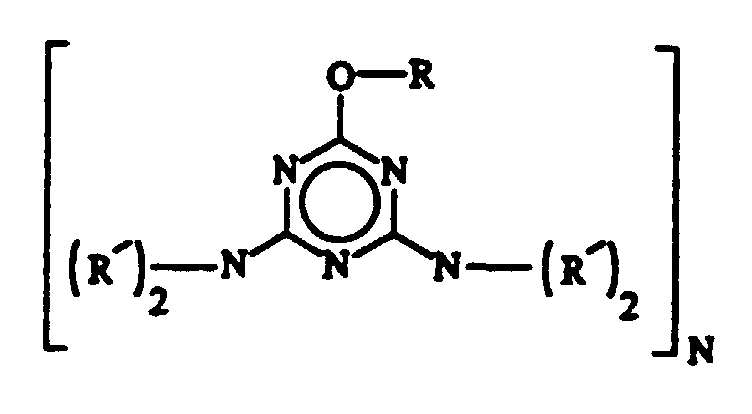
wherein R is a functionalized arylalkyl group selected from the group consisting of p-aminophenethoxy,
p-isothiocyanophenethoxy, and p-thionylchlorophenethoxy, R' is an (aryl-dicarboxylpyridyl)alkyl, group, and n is the number of said triazines, a linking group and an oligonucleotide containing at least 4 plus n deoxy- or ribo-nucleotides conjugated to the said rare earth chelate through the linking group.
wherein R is a functionalized arylalkyl group selected from the group consisting of p-aminophenethoxy,
p-isothiocyanophenethoxy, and p-thionylchlorophenethoxy, R' is an (aryl-dicarboxylpyridyl)alkyl, group, and n is the number of said triazines, a linking group and an oligonucleotide containing at least 4 plus n deoxy- or ribo-nucleotides conjugated to the said rare earth chelate through the linking group.
2. The rare earth chelate-conjugated oligonucleotide of claim 1 wherein said (aryl-dicarboxylpyridyl)alkyl
groups comprise a 2,6-di(carboxyl)-4-aryl pyridine.
3. The rare earth chelate-conjugated oligonucleotide of claim 1 or 2 wherein the oligonucleotide
has at least 4 consecutive underivatized nucleotides.
4. The rare earth chelate-conjugated oligonucleotide of any preceding claim, wherein
the linking group is selected from an amide and a thiourea and covalently joins the
oligonucleotide to the chelate.
5. An assay for detecting a complementary nucleic acid sequence comprising hybridizing
a probe containing a signal means to a target nucleic acid sequence contained in a
sample, separating the hybridized nucleic acids, and detecting the extent of hybridization
by measuring the signal generated by said signal means, characterized in that the
probe is an oligonucleotide of at least 12 consecutive underivitized nucleotides having
a nucleotide sequence complementary to the target nucleic acid, said oligonucleotide
being linked covalently to a rare earth chelate portion comprising tetra(arylpyridine)
ligands comprising a tetramer of substituted arylpyridine diacid units covalently
attached to said 2-alkoxy-4,6-diamino triazine radicals.
6. An improved assay for detecting a complementary nucleic acid sequence comprising hybridizing
a probe containing a signal means to a target nucleic acid sequence contained in a
sample, separating the hybridized nucleic acids, and detecting the extent of hybridization
by measuring the signal generated by said signal means, characterized in that the
probe is an oligonucleotide of at least 12 consecutive underivatized nucleotides having
a nucleotide sequence complementary to the target nucleic acid, said oligonucleotide
being linked covalently to a rare earth chelate portion comprising tetra(arylpyridine)
ligands comprising a tetramer of substituted arylpyridine diacid units covalently
attached to said 2-alkoxy-4,6-diamino triazine radicals, separating said oligonucleotide
probe and target nucleic acid so hybridized from the sample, incubating the hybridized
oligonucleotide probe and target nucleic acid in the presence of a rare earth element
to effect chelation; and measuring the extent of chelation by first exciting the rare
earth element with radiation of excitation wavelength, and then measuring the emission
fluorescence by time-resolved fluoresence spectroscopy.
7. A Chelate-tagged nucleic acid probe of any sequence incorporating a rare earth chelate-conjugated
oligonucleotide, the tagged probe comprising a rare earth chelate-conjugated oligonucleotide
as in any one of claims 1 to 4 coupled to a probe sequence, the oligonucleotide incorporating
said chelate portion at the 3' or 5' terminus thereof.
8. A kit for preparing chelate-tagged nucleic acid probes of any sequence incorporating
a rare earth chelate-conjugated oligonucleotide comprising a first vessel containing
an oligonucleotide of at least 4 nucleotides incorporating at the 3' or 5'terminus
thereof a rare earth chelate portion comprising one or a plurality of tetra(arylpyridine)
ligands, each said ligand having a tetramer of substituted arylpyridine diacid units
covalently attached to a 2-alkoxy-4,6-diamino triazine radical; and a second vessel
containing an enzyme selected from the group consisting of a polymerase and a ligase.
9. A method of producing a Chelate-tagged nucleic acid probe of any sequence incorporating
a rare earth chelate-conjugated oligonucleotide, the method comprising hybridizing
an oligonucleotide of at least 12 nucleotides incorporating at the 3' or 5' terminus
thereof a rare earth chelate portion comprising a tetra(arylpyridine) ligands having
a tetramer of substituted arylpyridine diacid units covalently attached to 2-alkoxy-4,6-diamino
triazine radicals, to a sequence complementary to a probe sequence and having a terminal
sequence complementary to the said oligonucleotide, priming a polymerase-catalyzed
extension reaction with the oligonucleotide sequence so hybridized, carrying out the
extension reaction, separating the strands of the duplex so formed; and isolating
the said chelate-tagged nucleic acid probe.
10. A method of producing a Chelate-tagged nucleic acid probes of any sequence incorporating
a rare earth chelate-conjugated oligonucleotide, the method comprising providing a
bridging sequence complementary to an oligonucleotide of at least 4 consecutive underivatized
nucleotides incorporating at the 3' or 5' terminus thereof a rare earth chelate portion
comprising one or a plurality of tetra(arylpyridine) ligands, each said ligand having
a tetramer of substituted arylpyridine diacid units covalently attached to 2-alkoxy-4,6-diamino
triazine radicals, which is also complementary to the terminus of a probe sequence
of opposite 5'-3' polarity, hybridizing the bridging sequence to the oligonucleotide
and the probe sequence; and ligating the probe sequence to the oligonucleotide.
11. A chelate-tagged probe obtainable by the method of Claim 9 or 10, wherein the rare
earth chelate-conjugated oligonucleotide is directly attached to the probe sequence,
and the probe can be cut by a restriction endonuclease into first and second parts,
the first part including the chelate portion and the second part including the probe
sequence.
12. A method of producing a Chelate-tagged nucleic acid probes of any sequence incorporating
a rare earth chelate-conjugated oligonucleotide, the method comprising ligating with
RNA ligase any desired probe sequence to an oligonucleotide tail of at least 4 consecutive
underivalized nucleotides conjugated to a rare earth chelate portion comprising one
or a plurality of tetra(arylpyridine) ligands, each said ligand having a tetramer
of substituted arylpyridine diacid units covalently attached to 2-alkoxy-4,6-diamino
triazine radicals.
Claims for the following Contracting State(s): ES
1. A process of producing a rare earth chelate-conjugated oligonucleotide comprising
a fluorescent rare earth chelate portion comprising one or a plurality of 2-alkoxy-4,6-di(N,N,N',N'-tetraalkyl)
amino triazines of the structure
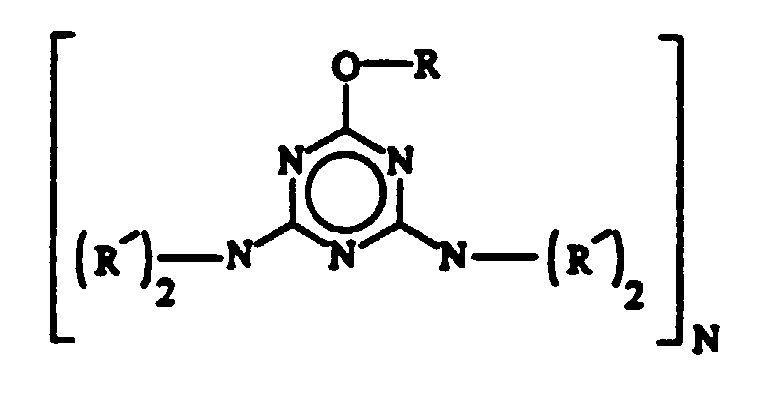
wherein R is a functionalized arylalkyl group selected from the group consisting of p-aminophenethoxy,
p-isothiocyanophenothoxy, and p-thionylchlorophonethoxy, R' is an (aryl-dicarboxylpyridyl)alkyl, group, and n is the number of said triazines, and an oligonucleotide containing at least 4 plus n deoxy- or ribo-nucleotides, the process comprising conjugating the oligonucleotide to the said rare earth chelate through a linking group.
wherein R is a functionalized arylalkyl group selected from the group consisting of p-aminophenethoxy,
p-isothiocyanophenothoxy, and p-thionylchlorophonethoxy, R' is an (aryl-dicarboxylpyridyl)alkyl, group, and n is the number of said triazines, and an oligonucleotide containing at least 4 plus n deoxy- or ribo-nucleotides, the process comprising conjugating the oligonucleotide to the said rare earth chelate through a linking group.
2. The process of claim 1 wherein said (aryl-dicarboxylpyridyl)alkyl groups comprise
a 2,6-di(carboxyl)-4-aryl pyridine.
3. The process of claim 1 or 2, wherein the oligonucleotide has at least 4 consecutive
underivatized nucleotides.
4. The process of any preceding claim, wherein the linking group is selected from an
amide and a thiourea and is used covalently to join the oligonucleotide to the chelate.
5. An assay for detecting a complementary nucleic acid sequence comprising hybridizing
a probe containing a signal means to a target nucleic acid sequence contained in a
sample, separating the hybridized nucleic acids, and detecting the extent of hybridization
by measuring the signal generated by said signal means, characterized in that the
probe is an oligonucleotide of at least 12 consecutive underivitized nucleotides having
a nucleotide sequence complementary to the target nucleic acid, said oligonucleotide
being linked covalently to a rare earth chelate portion comprising tetra(arylpyridine)
ligands comprising a tetramer of substituted arylpyridine diacid units covalently
attached to said 2-alkoxy-4,6-diamino triazine radicals.
6. An improved assay for detecting a complementary nucleic acid sequence comprising hybridizing
a probe containing a signal means to a target nucleic acid sequence contained in a
sample, separating the hybridized nucleic acids, and detecting the extent of hybridization
by measuring the signal generated by said signal means, characterized in that the
probe is an oligonucleotide of at least 12 consecutive underivatized nucleotides having
a nucleotide sequence complementary to the target nucleic acid, said oligonucleotide
being linked covalently to a rare earth chelate portion comprising tetra(arylpyridine)
ligands comprising a tetramer of substituted arylpyridine diacid units covalently
attached to said 2-alkoxy-4,6-diamino triazine radicals, separating said oligonucleotide
probe and target nucleic acid so hybridized from the sample, incubating the hybridized
oligonucleotide probe and target nucleic acid in the presence of a rare earth element
to effect chelation; and measuring the extent of chelation by first exciting the rare
earth element with radiation of excitation wavelength, and then measuring the emission
fluorescence by time-resolved fluoresence spectroscopy.
7. A process of producing a chelate-tagged nucleic acid probe of any sequence incorporating
a rare earth chelate-conjugated oligonucleotide made by the process of any one of
Claims 1 to 4, the oligonucleotide incorporating said chelate portion at the 3' or
5' terminus thereof, the process of producing the chelate tagged probe comprising
coupling the oligonucleotide to a probe sequence.
8. A kit for preparing chelate-tagged nucleic acid probes of any sequence incorporating
a rare earth chelate-conjugated oligonucleotide comprising a first vessel containing
an oligonucleotide of at least 4 nucleotides incorporating at the 3' or 5'terminus
thereof a rare earth chelate portion comprising one or a plurality of tetra(arylpyridine)
ligands, each said ligand having a tetramer of substituted arylpyridine diacid units
covalently attached to a 2-alkoxy-4,6-diamino triazine radical; and a second vessel
containing an enzyme selected from the group consisting of a polymerase and a ligase.
9. A method of producing a Chelate-tagged nucleic acid probe of any sequence incorporating
a rare earth chelate-conjugated oligonucleotide, the method comprising hybridizing
an oligonucleotide of at least 12 nucleotides incorporating at the 3' or 5' terminus
thereof a rare earth chelate portion comprising a tetra(arylpyridine) ligands having
a tetramer of substituted arylpyridine diacid units covalently attached to 2-alkoxy-4,6-diamino
triazine radicals, to a sequence complementary to a probe sequence and having a terminal
sequence complementary to the said oligonucleotide, priming a polymerase-catalyzed
extension reaction with the oligonucleotide sequence so hybridized, carrying out the
extension reaction, separating the strands of the duplex so formed; and isolating
the said chelate-tagged nucleic acid probe.
10. A method of producing a Chelate-tagged nucleic acid probes of any sequence incorporating
a rare earth chelate-conjugated oligonucleotide, the method comprising providing a
bridging sequence complementary to an oligonucleotide of at least 4 consecutive underivatized
nucleotides incorporating at the 3' or 5' terminus thereof a rare earth chelate portion
comprising one or a plurality of tetra(arylpyridine) ligands, each said ligand having
a tetramer of substituted arylpyridine diacid units covalently attached to 2-alkoxy-4,6-diamino
triazine radicals, which is also complementary to the terminus of a probe sequence
of opposite 5'-3' polarity, hybridizing the bridging sequence to the oligonucleotide
and the probe sequence; and ligating the probe sequence to the oligonucleotide.
11. The method of Claim 9 or 10, wherein the rare earth chelate-conjugated oligonucleotide
is directly attached to the probe sequence, and the probe can be cut by a restriction
endonuclease into first and second parts, the first part including the chelate portion
and the second part including the probe sequence.
12. A method of producing a Chelate-tagged nucleic acid probes of any sequence incorporating
a rare earth chelate-conjugated oligonucleotide, the method comprising ligating with
RNA ligase any desired probe sequence to an oligonucleotide tail of at least 4 consecutive
underivalized nucleotides conjugated to a rare earth chelate portion comprising one
or a plurality of tetra(arylpyridine) ligands, each said ligand having a tetramer
of substituted arylpyridine diacid units covalently attached to 2-alkoxy-4,6-diamino
triazine radicals.
Patentansprüche für folgende(n) Vertragsstaat(en): AT, BE, CH, LI, DE, DK, FR, GB,
GR, IT, LU, NL, SE
1. Seltenerdchelat-konjugiertes Oligonucleotid, das folgendes aufweist: einen fluoreszierenden
Seltenerdchelat-Anteil, der eines oder eine Vielzahl von 2-Alkoxy-4,6-di(N,N,N',N'-tetraalkyl)aminotriazinen
der Struktur aufweist:
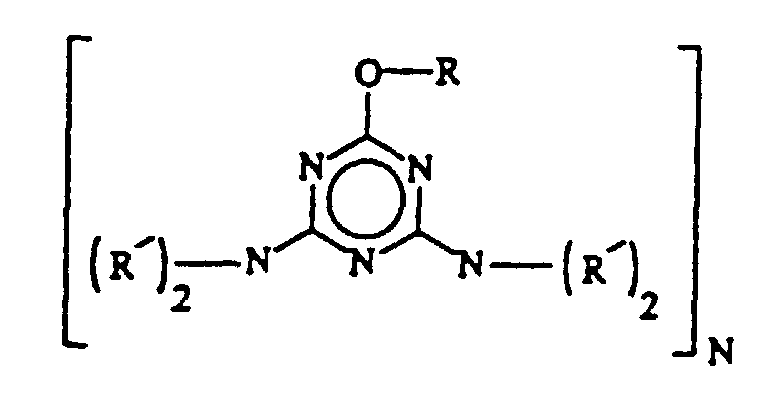
wobei R = eine funktionalisierte Arylalkylgruppe, die aus der Gruppe ausgewählt ist, die aus p-Aminophenethoxy, p-Isothiocyanophenethoxy und p-Thionylchlorphenethoxy besteht, R' = eine (Aryl-Dicarboxylpyridyl)alkylgruppe und n = die Anzahl der Triazine; eine Bindungsgruppe; und ein Oligonucleotid, das wenigstens 4 plus n Desoxy- oder Ribonucleotide enthält, die durch die Bindungsgruppe an das Seltenerdchelat konjugiert sind.
wobei R = eine funktionalisierte Arylalkylgruppe, die aus der Gruppe ausgewählt ist, die aus p-Aminophenethoxy, p-Isothiocyanophenethoxy und p-Thionylchlorphenethoxy besteht, R' = eine (Aryl-Dicarboxylpyridyl)alkylgruppe und n = die Anzahl der Triazine; eine Bindungsgruppe; und ein Oligonucleotid, das wenigstens 4 plus n Desoxy- oder Ribonucleotide enthält, die durch die Bindungsgruppe an das Seltenerdchelat konjugiert sind.
2. Seltenerdchelat-konjugiertes Oligonucleotid nach Anspruch 1, wobei die (Aryl-Dicarboxylpyridyl)alkylgruppen
ein 2,6-Di(carboxyl)-4-arylpyridin aufweisen.
3. Seltenerdchelat-konjugiertes Oligonucleotid nach Anspruch 1 oder 2, wobei das Oligonucleotid
wenigstens 4 aufeinanderfolgende nichtderivatisierte Nucleotide hat.
4. Seltenerdchelat-konjugiertes Oligonucleotid nach einem der vorhergehenden Ansprüche,
wobei die Bindungsgruppe aus einem Amid und einem Thioharnstoff ausgewählt ist und
das Oligonucleotid kovalent an das Chelat bindet.
5. Assay zum Nachweis einer komplementären Nucleinsäuresequenz, wobei der Assay folgendes
aufweist: Hybridisieren einer Sonde, die Signalmittel enthält, an einer in einer Probe
enthaltenen Ziel-Nucleinsäuresequenz, Trennen der hybridisierten Nucleinsäuren, und
Nachweisen des Grads der Hybridisierung durch Messen des von den Signalmitteln erzeugten
Signals, dadurch gekennzeichnet, daß die Sonde ein Oligonucleotid von wenigstens 12
aufeinanderfolgenden nichtderivatisierten Nucleotiden ist, die eine Nucleotidsequenz
haben, die zu der Ziel-Nucleinsäure komplementär ist, wobei das Oligonucleotid kovalent
an einen Seltenerdchelat-Anteil gebunden ist, der Tetra(arylpyridin)-Liganden aufweist,
die ein Tetrameres von substituierten zweisäurigen Arylpyridin-Einheiten aufweisen,
die kovalent an die 2-Alkoxy-4,6-diaminotriazin-Radikalen gekoppelt sind.
6. Verbesserter Assay zum Nachweis einer komplementären Nucleinsäuresequenz, wobei der
Assay folgendes aufweist: Hybridisieren einer Sonde, die Signalmittel enthält, an
eine Ziel-Nucleinsäuresequenz, die in einer Probe enthalten ist, Trennen der hybridisierten
Nucleinsäuren, und Nachweisen des Grads der Hybridisierung durch Messen des von den
Signalmitteln erzeugten Signals, dadurch gekennzeichnet, daß die Sonde ein Oligonucleotid
von wenigstens 12 aufeinanderfolgenden nichtderivatisierten Nucleotiden ist, die eine
Nucleotidsequenz haben, die zu der Ziel-Nucleinsäure komplementär ist, wobei das Oligonucleotid
kovalent an einen Seltenerdchelat-Anteil gebunden ist, der Tetra(arylpyridin)-Liganden
aufweist, die ein Tetrameres von substituierten zweisäurigen Arylpyridin-Einheiten
aufweisen, die kovalent an die 2-Alkoxy-4,6-diaminotriazin-Radikalen gekoppelt sind,
Trennen der so hybridisierten Oligonucleotidsonde und der Ziel-Nucleinsäure von der
Probe, Inkubieren der hybridisierten Oligonucleotidsonde und der Ziel-Nucleinsäure
in Anwesenheit eines Seltenerdelements, um die Chelatbildung zu bewirken; und Messen
des Grads der Chelatbildung, indem zuerst das Seltenerdelement mit Strahlung der Anregungswellenlänge
angeregt und dann die Emissionsfluoreszenz mittels zeitaufgelöster Fluoreszenzspektroskopie
gemessen wird.
7. Chelat-markierte Nucleinsäuresonde jeder Sequenz, in die ein Seltenerdchelat-konjugiertes
Oligonucleotid eingebaut ist, wobei die markierte Sonde ein Seltenerdchelat-konjugiertes
Oligonucleotid nach einem der Ansprüche 1 bis 4 aufweist, das an eine Sondensequenz
gekoppelt ist, und in das Oligonucleotid der Chelatanteil an dem 3'- oder 5'-Ende
davon eingebaut ist.
8. Set zum Herstellen von Chelat-markierten Nucleinsäuresonden jeder Sequenz, in die
ein Seltenerdchelat-konjugiertes Oligonucleotid eingebaut ist, wobei das Set folgendes
aufweist: einen ersten Behälter, der ein Oligonucleotid aus wenigstens 4 Nucleotiden
enthält, in die am 3'- oder 5'-Ende ein Seltenerdchelat-Anteil eingebaut ist, der
einen oder eine Vielzahl von Tetra(arylpyridin)-Liganden aufweist, wobei jeder Ligand
ein Tetrameres von substituierten zweisäurigen Arylpyridin-Einheiten hat, die kovalent
an ein 2-Alkoxy-4,6-diaminotriazin-Radikal gekoppelt sind; und einen zweiten Behälter,
der ein Enzym enthält, das aus der Gruppe ausgewählt ist, die aus einer Polymerase
und einer Ligase besteht.
9. Verfahren zum Erzeugen einer Chelat-markierten Nucleinsäuresonde jeder Sequenz, in
die ein Seltenerdchelat-konjugiertes Oligonucleotid eingebaut ist, wobei das Verfahren
folgende Schritte aufweist: Hybridisieren eines Oligonucleotids aus wenigstens 12
Nucleotiden, in die am 3'- oder 5'-Ende ein Seltenerdchelat-Anteil eingebaut ist,
der einen Tetra(arylpyridin)-Liganden aufweist, der ein Tetrameres von substituierten
zweisäurigen Arylpyridin-Einheiten hat, die kovalent an 2-Alkoxy-4,6-diaminotriazin-Radikale
gekoppelt sind, an einer Sequenz, die zu einer Sondensequenz komplementär ist und
eine Endsequenz hat, die zu dem genannten Oligonucleotid komplementär ist, Starten
einer Polymerasekatalysierten Streckreaktion mit der so hybridisierten Oligonucleotid-Sequenz,
Durchführen der Streckreaktion, Trennen der Stränge des so gebildeten Doppelstrangs,
und Isolieren der Chelat-markierten Nucleinsäure-Sonde.
10. Verfahren zum Erzeugen von Chelat-markierten Nucleinsäure-Sonden jeder Sequenz, in
die ein Seltenerdchelat-konjugiertes Oligonucleotid eingebaut ist, wobei das Verfahren
folgende Schritte aufweist: Bereitstellen einer Überbrückungssequenz, die zu einem
Oligonucleotid von wenigstens 4 aufeinanderfolgenden nichtderivatisierten Nucleotiden
komplementär ist, in die an ihrem 3'- oder 5'-Ende ein Seltenerdchelat-Anteil eingebaut
ist, der einen oder eine Vielzahl von Tetra(arylpyridin)-Liganden aufweist, wobei
jeder Ligand ein Tetrameres von substituierten zweisäurigen Arylpyridin-Einheiten
hat, die kovalent an 2-Alkoxy-4,6-diaminotriazin-Radikale gekoppelt sind, und die
auch zu dem Ende einer Sondensequenz von entgegengesetzter 5'-3'-Polarität komplementär
ist, Hybridisieren der Überbrückungssequenz an dem Oligonucleotid und der Sondensequenz;
und Ligasieren der Sondensequenz an das Oligonucleotid.
11. Chelat-markierte Sonde, die durch das Verfahren nach Anspruch 9 oder 10 erhältlich
ist, wobei das Seltenerdchelat-konjugierte Oligonucleotid direkt an die Sondensequenz
gekoppelt ist, und wobei die Sonde durch eine Restriktions-Endonuclease in einen ersten
und einen zweiten Teil zerschnitten werden kann, wobei der erste Teil den Chelat-Anteil
und der zweite Teil die Sondensequenz aufweist.
12. Verfahren zum Herstellen einer Chelat-markierten Nucleinsäuresonde jeder Sequenz,
in die ein Seltenerdchelat-konjugiertes Oligonucleotid eingebaut ist, wobei das Verfahren
folgendes aufweist: Ligasieren jeder gewünschten Sondensequenz mit RNA-Ligase an einen
Oligonucleotidschwanz vo wenigstens 4 aufeinanderfolgenden nichtderivatisierten Nucleotiden,
die an einen Seltenerdchelat-Anteil konjugiert sind, der einen oder eine Vielzahl
von Tetra(arylpyridin)-Liganden aufweist, wobei jeder Ligand ein Tetrameres von substituierten
zweisäurigen Arylpyridineinheiten hat, die kovalent an 2-Alkoxy-4,6-diaminotriazin-Radikale
gekoppelt sind.
Patentansprüche für folgende(n) Vertragsstaat(en): ES
1. Verfahren zum Erzeugen eines Seltenerdchelat-konjugierten Oligonucleotids, das folgendes
aufweist: einen fluoreszierenden Seltenerdchelat-Anteil, der eines oder eine Vielzahl
von 2-Alkoxy-4,6-di(N,N,N',N'-tetraalkyl)aminotriazinen der Struktur aufweist:
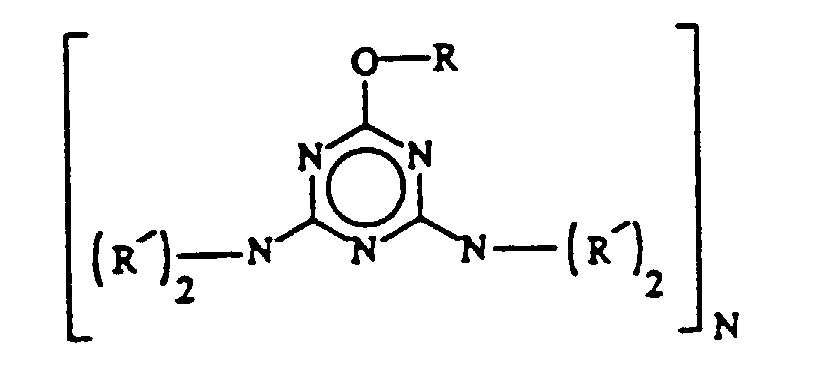
wobei R = eine funktionalisierte Arylalkylgruppe, die aus der Gruppe ausgewählt ist, die aus p-Aminophenethoxy, p-Isothiocyanophenethoxy und p-Thionylchlorphenethoxy besteht, R' = eine (Aryl-Dicarboxylpyridyl)alkylgruppe und n = die Anzahl der Triazine; und ein Oligonucleotid, das wenigstens 4 plus n Desoxy- oder Ribonucleotide enthält, wobei das Verfahren folgendes aufweist: Konjugieren des Oligonucleotids an das Seltenerdchelat durch eine Bindungsgruppe.
wobei R = eine funktionalisierte Arylalkylgruppe, die aus der Gruppe ausgewählt ist, die aus p-Aminophenethoxy, p-Isothiocyanophenethoxy und p-Thionylchlorphenethoxy besteht, R' = eine (Aryl-Dicarboxylpyridyl)alkylgruppe und n = die Anzahl der Triazine; und ein Oligonucleotid, das wenigstens 4 plus n Desoxy- oder Ribonucleotide enthält, wobei das Verfahren folgendes aufweist: Konjugieren des Oligonucleotids an das Seltenerdchelat durch eine Bindungsgruppe.
2. Verfahren nach Anspruch 1, wobei die (Aryl-Dicarboxylpyridyl)alkylgruppen ein 2,6-Di(carboxyl)-4-arylpyridin
aufweisen.
3. Verfahren nach Anspruch 1 oder 2, wobei das Oligonucleotid wenigstens 4 aufeinanderfolgende
nichtderivatisierte Nucleotide hat.
4. Verfahren nach einem der vorhergehenden Ansprüche, wobei die Bindungsgruppe aus einem
Amid und einem Thioharnstoff ausgewählt und eingesetzt wird, um das Oligonucleotid
kovalent an das Chelat zu binden.
5. Assay zum Nachweis einer komplementären Nucleinsäuresequenz, wobei der Assay folgendes
aufweist: Hybridisieren einer Sonde, die Signalmittel enthält, an einer in einer Probe
enthaltenen Ziel-Nucleinsäuresequenz, Trennen der hybridisierten Nucleinsäuren, und
Nachweisen des Grads der Hybridisierung durch Messen des von den Signalmitteln erzeugten
Signals, dadurch gekennzeichnet, daß die Sonde ein Oligonucleotid von wenigstens 12
aufeinanderfolgenden nichtderivatisierten Nucleotiden ist, die eine Nucleotidsequenz
haben, die zu der Ziel-Nucleinsäure komplementär ist, wobei das Oligonucleotid kovalent
an einen Seltenerdchelat-Anteil gebunden ist, der Tetra(arylpyridin)-Liganden aufweist,
die ein Tetrameres von substituierten zweisäurigen Arylpyridin-Einheiten aufweisen,
die kovalent an die 2-Alkoxy-4,6-diaminotriazin-Radikalen gekoppelt sind.
6. Verbesserter Assay zum Nachweis einer komplementären Nucleinsäuresequenz, wobei der
Assay folgendes aufweist: Hybridisieren einer Sonde, die Signalmittel enthält, an
einer Ziel-Nucleinsäuresequenz, die in einer Probe enthalten ist, Trennen der hybridisierten
Nucleinsäuren, und Nachweisen des Grads der Hybridisierung durch Messen des von den
Signalmitteln erzeugten Signals, dadurch gekennzeichnet, daß die Sonde ein Oligonucleotid
von wenigstens 12 aufeinanderfolgenden nichtderivatisierten Nucleotiden ist, die eine
Nucleotidsequenz haben, die zu der Ziel-Nucleinsäure komplementär ist, wobei das Oligonucleotid
kovalent an einen Seltenerdchelat-Anteil gebunden ist, der Tetra(arylpyridin)-Liganden
aufweist, die ein Tetrameres von substituierten zweisäurigen Arylpyridin-Einheiten
aufweisen, die kovalent an die 2-Alkoxy-4,6-diaminotriazin-Radikalen gekoppelt sind,
Trennen der so hybridisierten Oligonucleotidsonde und der Ziel-Nucleinsäure von der
Probe, Inkubieren der hybridisierten Oligonucleotidsonde und der Ziel-Nucleinsäure
in Anwesenheit eines Seltenerdelements, um die Chelatbildung zu bewirken; und Messen
des Grads der Chelatbildung, indem zuerst das Seltenerdelement mit Strahlung der Anregungswellenlänge
angeregt wird und dann die Emissionsfluoreszenz mittels zeitaufgelöster Fluoreszenzspektroskopie
gemessen wird.
7. Verfahren zum Erzeugen einer Chelat-markierten Nucleinsäuresonde jeder Sequenz, in
die ein Seltenerdchelat-konjugiertes Oligonucleotid, das durch das Verfahren nach
einem der Ansprüche 1 bis 4 hergestellt ist, eingebaut ist, wobei der Chelat-Anteil
in das Oligonucleotid an dessen 3'- oder 5'-Ende eingebaut ist, wobei das Verfahren
zum Erzeugen der Chelat-markierten Sonde das Koppeln des Oligonucleotids an eine Sondensequenz
aufweist.
8. Set zum Herstellen von Chelat-markierten Nucleinsäuresonden jeder Sequenz, in die
ein Seltenerdchelat-konjugiertes Oligonucleotid eingebaut ist, wobei das Set folgendes
aufweist: einen ersten Behälter, der ein Oligonucleotid aus wenigstens 4 Nucleotiden
enthält, in die am 3'- oder 5'-Ende ein Seltenerdchelat-Anteil eingebaut ist, der
einen oder eine Vielzahl von Tetra(arylpyridin)-Liganden aufweist, wobei jeder Ligand
ein Tetrameres von substituierten zweisäurigen Arylpyridin-Einheiten hat, die kovalent
an ein 2-Alkoxy-4,6-diaminotriazin-Radikal gekoppelt sind; und einen zweiten Behälter,
der ein Enzym enthält, das aus der Gruppe ausgewählt ist, die aus einer Polymerase
und einer Ligase besteht.
9. Verfahren zum Erzeugen einer Chelat-markierten Nucleinsäuresonde jeder Sequenz, in
die ein Seltenerdchelat-konjugiertes Oligonucleotid eingebaut ist, wobei das Verfahren
folgende Schritte aufweist: Hybridisieren eines Oligonucleotids aus wenigstens 12
Nucleotiden, in die am 3'- oder 5'-Ende ein Seltenerdchelat-Anteil eingebaut ist,
der einen Tetra(arylpyridin)-Liganden aufweist, der ein Tetrameres von substituierten
zweisäurigen Arylpyridin-Einheiten hat, die kovalent an 2-Alkoxy-4,6-diaminotriazin-Radikale
gekoppelt sind, an einer Sequenz, die zu einer Sondensequenz komplementär ist und
eine Endsequenz hat, die zu dem genannten Oligonucleotid komplementär ist, Starten
einer Polymerasekatalysierten Streckreaktion mit der so hybridisierten Oligonucleotid-Sequenz,
Durchführen der Streckreaktion, Trennen der Stränge des so gebildeten Doppelstrangs;
und Isolieren der Chelat-markierten Nucleinsäure-Sonde.
10. Verfahren zum Erzeugen von Chelat-markierten Nucleinsäure-Sonden jeder Sequenz, in
die ein Seltenerdchelat-konjugiertes Oligonucleotid eingebaut ist, wobei das Verfahren
folgende Schritte aufweist: Bereitstellen einer Überbrückungssequenz, die zu einem
Oligonucleotid von wenigstens 4 aufeinanderfolgenden nichtderivatisierten Nucleotiden
komplementär ist, in die an ihrem 3'- oder 5'-Ende ein Seltenerdchelat-Anteil eingebaut
ist, der einen oder eine Vielzahl von Tetra(arylpyridin)-Liganden aufweist, wobei
jeder Ligand ein Tetrameres von substituierten zweisäurigen Arylpyridin-Einheiten
hat, die kovalent an 2-Alkoxy-4,6-diaminotriazin-Radikale gekoppelt sind, und die
auch zu dem Ende einer Sondensequenz von entgegengesetzter 5'-3'-Polarität komplementär
ist, Hybridisieren der Überbrückungssequenz an dem Oligonucleotid und der Sondensequenz;
und Ligasieren der Sondensequenz an das Oligonucleotid.
11. Verfahren nach Anspruch 9 oder 10, wobei das Seltenerdchelat-konjugierte Oligonucleotid
direkt an die Sondensequenz gekoppelt ist und die Sonde von einer Restriktions-Endonuclease
in einen ersten und einen zweiten Teil zerschnitten werden kann, wobei der erste Teil
den Chelat-Anteil und der zweite Teil die Sondensequenz aufweist.
12. Verfahren zum Herstellen einer Chelat-markierten Nucleinsäuresonde jeder Sequenz,
in die ein Seltenerdchelat-konjugiertes Oligonucleotid eingebaut ist, wobei das Verfahren
folgendes aufweist: Ligasieren jeder gewünschten Sondensequenz mit RNA-Ligase an einen
Oligonucleotidschwanz von wenigstens 4 aufeinanderfolgenden nichtderivatisierten Nucleotiden,
die an einen Seltenerdchelat-Anteil konjugiert sind, der einen oder eine Vielzahl
von Tetra(arylpyridin)-Liganden aufweist, wobei jeder Ligand ein Tetrameres von substituierten
zweisäurigen Arylpyridineinheiten hat, die kovalent an 2-Alkoxy-4,6-diaminotriazin-Radikale
gekoppelt sind.
Revendications pour l'(les) Etat(s) contractant(s) suivant(s): AT, BE, CH, LI, DE,
DK, FR, GB, GR, IT, LU, NL, SE
1. Oligonucléotide conjugué à un chélate de terre rare comprenant une partie de chélate
de terre rare fluorescent qui comprend une seule ou bien une pluralité de 2-alcoxy-4,6-di-(N,N,N',N'-tétraalkyl)-aminotriazines
de la structure
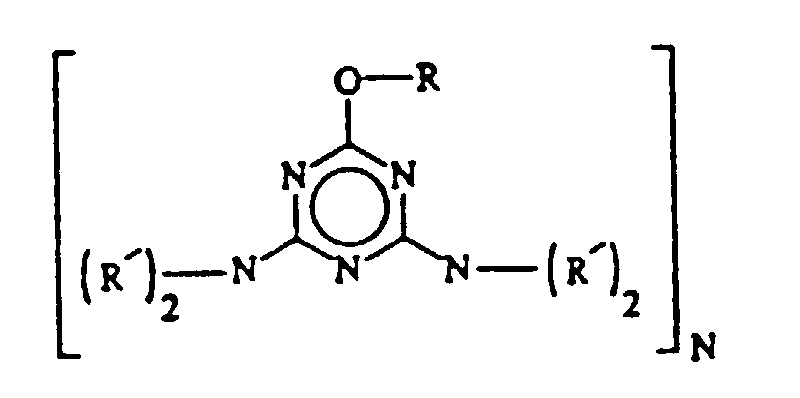
dans laquelle R est un groupe arylalkyle fonctionnalisé choisi dans le groupe composé de p-aminophénéthoxy, p-isothiocyanophénéthoxy et p-thionylchlorophénéthoxy, R' est un groupe (aryldicarboxylpyridyl)alkyle, et n est le nombre desdites triazines; un groupe de liaison; et un oligonucléotide contenant au moins 4 plus n désoxy- ou ribonucléotides conjugués audit chélate de terre rare par l'intermédiaire dudit groupe de liaison.
dans laquelle R est un groupe arylalkyle fonctionnalisé choisi dans le groupe composé de p-aminophénéthoxy, p-isothiocyanophénéthoxy et p-thionylchlorophénéthoxy, R' est un groupe (aryldicarboxylpyridyl)alkyle, et n est le nombre desdites triazines; un groupe de liaison; et un oligonucléotide contenant au moins 4 plus n désoxy- ou ribonucléotides conjugués audit chélate de terre rare par l'intermédiaire dudit groupe de liaison.
2. Oligonucléotide conjugué à un chélate de terre rare selon la revendication 1, dans
lequel lesdits groupes (aryldicarboxylpyridyl)alkyle comprennent une 2,6-di(carboxyl)-4-arylpyridine.
3. Oligonucléotide conjugué à un chélate de terre rare selon la revendication 1 ou la
revendication 2, dans lequel l'oligonucléotide possède au moins 4 nucléotides non
dérivatisés consécutifs.
4. Oligonucléotide conjugué à un chélate de terre rare selon l'une quelconque des revendications
précédentes, dans lequel le groupe de liaison est choisi dans le groupe comprenant
un amide et une thiourée et relie l'oligonucléotide de manière covalente au chélate.
5. Dosage permettant de détecter une séquence d'acides nucléiques complémentaires comprenant
les étapes consistant à hybrider une sonde contenant des moyens de signal avec une
séquence d'acides nucléiques recherchés contenus dans un échantillon, à séparer les
acides nucléiques hybridés et à détecter le degré d'hybridation en mesurant le signal
généré par lesdits moyens de signal, caractérisé en ce que la sonde est un oligonucléotide
composé d'au moins 12 nucléotides non dérivatisés consécutifs ayant une séquence de
nucléotides complémentaire de l'acide nucléique recherché, ledit oligonucléotide étant
lié de manière covalente à une partie de chélate de terre rare comprenant des ligands
tétra(arylpyridine) comprenant un tétramère d'unités de diacides arylpyridine substitués
fixées de manière covalente sur lesdits radicaux 2-alcoxy-4,6-diaminotriazine.
6. Dosage amélioré permettant de détecter une séquence d'acides nucléiques complémentaire
comprenant les étapes consistant à hybrider une sonde contenant des moyens de signal
avec une séquence d'acides nucléiques recherchés contenus dans un échantillon, à séparer
les acides nucléiques hybridés et à détecter le degré d'hybridation en mesurant le
signal généré par lesdits moyens de signal, caractérisé en ce que la sonde est un
oligonucléotide composé d'au moins 12 nucléotides non dérivatisés consécutifs possédant
une séquence nucléotidique complémentaire de l'acide nucléique recherché, ledit oligonucléotide
étant lié de manière covalente à une partie de chélate de terre rare comprenant des
ligands tétra(arylpyridine) comprenant un tétramère d'unités de diacides arylpyridine
substitués fixées de manière covalente sur lesdits radicaux 2-alcoxy-4,6-diaminotriazine;
à séparer de l'échantillon ladite sonde oligonucléotidique et l'acide nucléique recherché
ainsi hybridés; à incuber la sonde oligonucléotidique et l'acide nucléique recherché
hybridés en présence d'un élément de terre rare afin de réaliser la chélation; et
à mesurer le degré de chélation en excitant tout d'abord l'élément de terre rare avec
un rayonnement à une longueur d'onde d'excitation et en mesurant ensuite la fluorescence
d'émission par spectroscopie par fluorescence à résolution dans le temps.
7. Sonde d'acides nucléiques de séquence quelconque marquée par un chélate incorporant
un oligonucléotide conjugué à un chélate de terre rare, la sonde marquée comprenant
un oligonucléotide conjugué à un chélate de terre rare selon l'une quelconque des
revendications 1 à 4 couplé à une séquence de sonde, l'oligonucléotide incorporant
ladite partie de chélate dans sa position terminale 3' ou 5'.
8. Trousse permettant de préparer des sondes d'acides nucléiques de séquence quelconque
marquées par un chélate incorporant un oligonucléotide conjugué à un chélate de terre
rare, comprenant un premier récipient contenant un oligonucléotide d'au moins 4 nucléotides
incorporant dans leurs positions terminales 3' ou 5' une partie de chélate de terre
rare comprenant un seul ou bien une pluralité de ligands tétra-(arylpyridine), chacun
desdits ligands possédant un tétramère d'unités de diacides arylpyridine substitués
fixées de manière covalente sur un radical 2-alcoxy-4,6-diaminotriazine; et un second
récipient contenant une enzyme choisie dans le groupe composé d'une polymérase et
d'une ligase.
9. Procédé de production d'une sonde d'acides nucléiques de séquence quelconque marquée
par un chélate incorporant un oligonucléotide conjugué à un chélate de terre rare,
ledit procédé comprenant les étapes consistant à hybrider un oligonucléotide possédant
au moins 12 nucléotides incorporant dans leurs positions terminales 3' ou 5' une partie
de chélate de terre rare comprenant des ligands tétra(arylpyridine) possédant un tétramère
d'unités de diacides arylpyridine substitués fixées de manière covalente sur des radicaux
2-alcoxy-4,6-diaminotriazine, avec une séquence complémentaire d'une séquence de sonde
et possédant une séquence terminale complémentaire dudit oligonucléotide; à amorcer
une réaction d'allongement catalysée par une polymérase avec la séquence oligonucléotidique
ainsi hybridée; à réaliser la réaction d'allongement; à séparer les brins du doublet
ainsi formé; et à isoler ladite sonde d'acides nucléiques marquée par un chélate.
10. Procédé de production d'une sonde d'acides nucléiques de séquence quelconque marquée
par un chélate incorporant un oligonucléotide conjugué à un chélate de terre rare,
ledit procédé comprenant les étapes consistant à obtenir une séquence de pontage complémentaire
d'un oligonucléotide possédant au moins 4 nucléotides non dérivatisés consécutifs
incorporant dans leurs positions terminales 3' ou 5' une partie de chélate de terre
rare comprenant un seul ou bien une pluralité de ligands tétra(arylpyridine), chacun
desdits ligands possédant un tétramère d'unités de diacides arylpyridine substitués
fixées de manière covalente sur des radicaux 2-alcoxy-4,6-diaminotriazine, qui est
également complémentaire de la terminaison d'une séquence de sonde de polarité opposée
5'-3'; à hybrider la séquence de pontage avec l'oligonucléotide et la séquence de
sonde; et à lier la séquence de sonde à l'oligonucléotide.
11. Sonde marquée par un chélate pouvant être obtenue par le procédé selon la revendication
9 ou la revendication 10, dans laquelle l'oligonucléotide conjugué à un chélate de
terre rare est directement fixé sur la séquence de sonde, et la sonde peut être scindée
au moyen d'une endonucléase de restriction en une première et en une seconde partie,
la première partie comprenant la partie chélate et la seconde partie comprenant la
séquence de sonde.
12. Procédé de production d'une sonde d'acides nucléiques de séquence quelconque marquée
par un chélate et incorporant un oligonucléotide conjugué à un chélate de terre rare,
ledit procédé consistant à lier avec une ARN-ligase une séquence de sonde souhaitée
quelconque à une queue oligonucléotidique d'au moins 4 nucléotides non dérivatisés
consécutifs conjugués à une partie de chélate de terre rare comprenant un seul ou
bien une pluralité de ligands tétra(arylpyridine), chacun desdits ligands possédant
un tétramère d'unités de diacides arylpyridine substitués fixées de manière covalente
sur des radicaux 2-alcoxy-4,6-diaminotriazine.
Revendications pour l'(les) Etat(s) contractant(s) suivant(s): ES
1. Procédé de production d'un oligonucléotide conjugué à un chélate de terre rare comprenant
une partie de chélate de terre rare fluorescent qui comprend une seule ou bien une
pluralité de 2-alcoxy-4,6-di-(N,N,N',N'-tétraalkyl)-aminotriazines de la structure
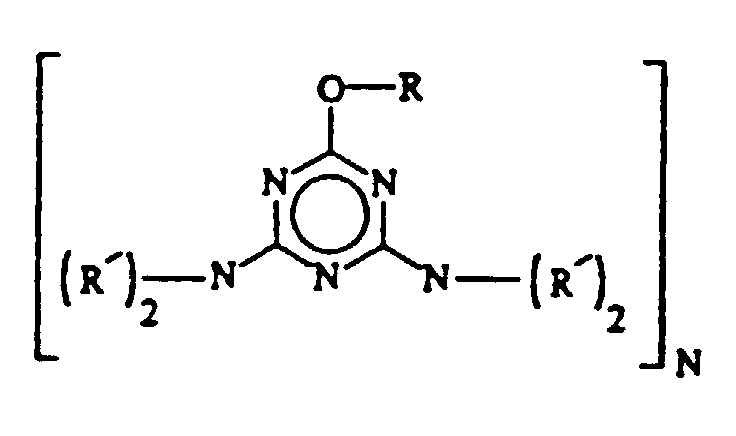
dans laquelle R est un groupe arylalkyle fonctionnalisé choisi dans le groupe composé de p-aminophénéthoxy, p-isothiocyanophénéthoxy et p-thionylchlorophénéthoxy, R' est un groupe (aryldicarboxylpyridyl)alkyle, et n est le nombre desdites triazines; et un oligonucléotide contenant au moins 4 plus n désoxy- ou ribonucléotides, ledit procédé consistant à conjuguer l'oligonucléotide audit chélate de terre rare par l'intermédiaire d'un groupe de liaison.
dans laquelle R est un groupe arylalkyle fonctionnalisé choisi dans le groupe composé de p-aminophénéthoxy, p-isothiocyanophénéthoxy et p-thionylchlorophénéthoxy, R' est un groupe (aryldicarboxylpyridyl)alkyle, et n est le nombre desdites triazines; et un oligonucléotide contenant au moins 4 plus n désoxy- ou ribonucléotides, ledit procédé consistant à conjuguer l'oligonucléotide audit chélate de terre rare par l'intermédiaire d'un groupe de liaison.
2. Procédé selon la revendication 1, dans lequel lesdits groupes (aryldicarboxylpyridyl)alkyle
comprennent une 2,6-di(carboxyl)-4-arylpyridine.
3. Procédé selon la revendication 1 ou la revendication 2, dans lequel l'oligonucléotide
possède au moins 4 nucléotides non dérivatisés consécutifs.
4. Procédé selon l'une quelconque des revendications précédentes, dans lequel le groupe
de liaison est choisi dans le groupe comprenant un amide et une thiourée et utilisé
pour relier l'oligonucléotide de manière covalente au chélate.
5. Dosage permettant de détecter une séquence d'acides nucléiques complémentaires comprenant
les étapes consistant à hybrider une sonde contenant des moyens de signal avec une
séquence d'acides nucléiques recherchés contenus dans un échantillon, à séparer les
acides nucléiques hybridés et à détecter le degré d'hybridation en mesurant le signal
généré par lesdits moyens de signal, caractérisé en ce que la sonde est un oligonucléotide
composé d'au moins 12 nucléotides non dérivatisés consécutifs ayant une séquence de
nucléotides complémentaire de l'acide nucléique recherché, ledit oligonucléotide étant
lié de manière covalente à une partie de chélate de terre rare comprenant des ligands
tétra(arylpyridine) comprenant un tétramère d'unités de diacides arylpyridine substitués
fixées de manière covalente sur lesdits radicaux 2-alcoxy-4,6-diaminotriazine.
6. Dosage amélioré permettant de détecter une séquence d'acides nucléiques complémentaire
comprenant les étapes consistant à hybrider une sonde contenant des moyens de signal
avec une séquence d'acides nucléiques recherchés contenus dans un échantillon, à séparer
les acides nucléiques hybridés et à détecter le degré d'hybridation en mesurant le
signal généré par lesdits moyens de signal, caractérisé en ce que la sonde est un
oligonucléotide composé d'au moins 12 nucléotides non dérivatisés consécutifs possédant
une séquence nucléotidique complémentaire de l'acide nucléique recherché, ledit oligonucléotide
étant lié de manière covalente à une partie de chélate de terre rare comprenant des
ligands tétra(arylpyridine) comprenant un tétramère d'unités de diacides arylpyridine
substitués fixées de manière covalente sur lesdits radicaux 2-alcoxy-4,6-diaminotriazine;
à séparer de l'échantillon ladite sonde oligonucléotidique et l'acide nucléique recherché
ainsi hybridés; à incuber la sonde oligonucléotidique et l'acide nucléique recherché
hybridés en présence d'un élément de terre rare afin de réaliser la chélation; et
à mesurer le degré de chélation en excitant tout d'abord l'élément de terre rare avec
un rayonnement à une longueur d'onde d'excitation et en mesurant ensuite la fluorescence
d'émission par spectroscopie par fluorescence à résolution dans le temps.
7. Procédé de production d'une sonde d'acides nucléiques de séquence quelconque marquée
par un chélate incorporant un oligonucléotide conjugué à un chélate de terre rare
préparé par le procédé selon l'une quelconque des revendications 1 à 4, l'oligonucléotide
incorporant ladite partie de chélate dans sa position terminale 3' ou 5', le procédé
de production de la sonde marquée par un chélate consistant à coupler l'oligonucléotide
à une séquence de sonde.
8. Trousse permettant de préparer des sondes d'acides nucléiques de séquence quelconque
marquées par un chélate incorporant un oligonucléotide conjugué à un chélate de terre
rare, comprenant un premier récipient contenant un oligonucléotide d'au moins 4 nucléotides
incorporant dans leurs positions terminales 3' ou 5' une partie de chélate de terre
rare comprenant un seul ou bien une pluralité de ligands tétra-(arylpyridine), chacun
desdits ligands possédant un tétramère d'unités de diacides arylpyridine substitués
fixées de manière covalente sur un radical 2-alcoxy-4,6-diaminotriazine; et un second
récipient contenant une enzyme choisie dans le groupe composé d'une polymérase et
d'une ligase.
9. Procédé de production d'une sonde d'acides nucléiques de séquence quelconque marquée
par un chélate incorporant un oligonucléotide conjugué à un chélate de terre rare,
ledit procédé comprenant les étapes consistant à hybrider un oligonucléotide possédant
au moins 12 nucléotides incorporant dans leurs positions terminales 3' ou 5' une partie
de chélate de terre rare comprenant des ligands tétra(arylpyridine) possédant un tétramère
d'unités de diacides arylpyridine substitués fixées de manière covalente sur des radicaux
2-alcoxy-4,6-diaminotriazine, avec une séquence complémentaire d'une séquence de sonde
et possédant une séquence terminale complémentaire dudit oligonucléotide; à amorcer
une réaction d'allongement catalysée par une polymérase avec la séquence oligonucléotidique
ainsi hybridée; à réaliser la réaction d'allongement; à séparer les brins du doublet
ainsi formé; et à isoler ladite sonde d'acides nucléiques marquée par un chélate.
10. Procédé de production d'une sonde d'acides nucléiques de séquence quelconque marquée
par un chélate incorporant un oligonucléotide conjugué à un chélate de terre rare,
ledit procédé comprenant les étapes consistant à obtenir une séquence de pontage complémentaire
d'un oligonucléotide possédant au moins 4 nucléotides non dérivatisés consécutifs
incorporant dans leurs positions terminales 3' ou 5' une partie de chélate de terre
rare comprenant un seul ou bien une pluralité de ligands tétra(arylpyridine), chacun
desdits ligands possédant un tétramère d'unités de diacides arylpyridine substitués
fixées de manière covalente sur des radicaux 2-alcoxy-4,6-diaminotriazine, qui est
également complémentaire de la terminaison d'une séquence de sonde de polarité opposée
5'-3'; à hybrider la séquence de pontage avec l'oligonucléotide et la séquence de
sonde; et à lier la séquence de sonde à l'oligonucléotide.
11. Procédé selon la revendication 9 ou la revendication 10, dans lequel l'oligonucléotide
conjugué à un chélate de terre rare est directement fixé sur la séquence de sonde,
et la sonde peut être scindée au moyen d'une endonucléase de restriction en une première
et en une seconde partie, la première partie comprenant la partie chélate et la seconde
partie comprenant la séquence de sonde.
12. Procédé de production d'une sonde d'acides nucléiques de séquence quelconque marquée
par un chélate et incorporant un oligonucléotide conjugué à un chélate de terre rare,
ledit procédé consistant à lier avec une ARN-ligase une séquence de sonde souhaitée
quelconque à une queue oligonucléotidique d'au moins 4 nucléotides non dérivatisés
consécutifs conjugués à une partie de chélate de terre rare comprenant un seul ou
bien une pluralité de ligands tétra(arylpyridine), chacun desdits ligands possédant
un tétramère d'unités de diacides arylpyridine substitués fixées de manière covalente
sur des radicaux 2-alcoxy-4,6-diaminotriazine.