|
(11) | EP 0 525 861 A1 |

| (12) | EUROPEAN PATENT APPLICATION |
|
|
|
|
|||||||||||||||||||||||||||
| (54) | Process for the enzymatic preparation of 7-amino-cephalosporanic acids |
| (57) 7-amino-cephalosporanic acids having the formula
are obtained by submitting compounds having the following formula to enzymatic conversion: wherein R represents H, OH, O-CO-R", R" being an alkyl radical with from 1 to 4 carbon atoms, R1 represents a carboxylic group. The reaction is carried out in the presence of a micro-organism selected from the Pseudomonas, Bacillus, Achromobacter genera, or in the presence of the enzyme, either free or immobilized, derived therefrom. |
[0001] The present invention relates to a process for the enzymatic preparation of 7-amino-cephalosporanic acids having the formula
wherein R represents H, OH, O-CO-R", R" being an alkyl radical with a number of carbon atoms ranging from 1 to 4, a process which consists of submitting compounds having the following formula to enzymatic conversion:
wherein R represents a radical containing the carboxylic group: said conversion is carried out in the presence of a micro-organism selected from those hereafter specified, or in the presence of the enzyme, either free or immobilized, obtained therefrom.
[0002] 3-acetoxymethyl-7-aminoceph-3-em-4-carboxylic acid or 7-amino-cephalosporanic acid (7-ACA), is a compound of great industrial interest, used in the synthesis of cephalosporanic derivatives having an antibacterial biological activity. This product is obtained by removing the side chain of Cephalosporin C [3-acetoxymethyl-7-(D-5-amino-5-carboxypentanamide)-ceph-3-em-4-carboxylic acid].
[0003] Industrial de-acylation processes of Cephalosporin C are carried out chemically, for example by means of nitrosyl chloride in formic acid in the presence of acetonitrile (U.S. Patent 3.367.933).
[0004] Another method involves the protection of the carboxyl group of the aminopentanoic chain, reaction with phosphorous pentachloride and subsequent hydrolysis at low temperature with a mixture of water and methanol (Belg. Patent 718.824).
[0005] These methods must generally be carried out at low temperatures and require the use of costly and toxic solvents and reagents, which can cause serious problems of pollution and environment. Moreover because of the instability of the B-lactam ring, special reaction conditions must be adopted (low temperatures, use of co-solvents etc) which make the process complicated from an industrial point of view.
[0006] Enzymatic methods are also known for the de-acylation of Cephalosporin C in position 7. For example it is possible to use specific acylases for the C-aminoadipic chain of cephalosporin C (FR 2.241.557, USP 4.774.179, EPA 283.218). These methods however often cannot be reproduced and are characterized by low yields and long reaction times.
[0007] On the other hand processes which transform Cephalosporin C into 7-ACA through two enzymatic steps are interesting from an industrial point of view. The first consists of using a D-aminoacid oxidase, for example that coming from a micro-organism belonging to the Trigonopsis species (UK Patent 1.272.769), which oxidizes the D-5-amino-5-carboxy pentanoyl side chain in compounds having formula II. These compounds are subsequently hydrolyzed to give 7-amino-cephalosporanic acid by using a specific enzyme, produced by a micro-organism belonging to the Comamonas species (U.S. Patent 3.960.662) which de- acylates the compounds of formula II into the corresponding derivatives of formula I.
[0008] The present invention consequently relates to a biotechnological process which consists in the selective deacylation of compounds having formula II by using a micro-organism or an enzyme contained therein having an acylasic activity.
[0009] These processes, and all enzymatic processes in general, are interesting from an industrial point of view, in that they eliminate the problems associated with chemical synthesis, of the disposal and use of compounds which are toxic and harmful for the environment.
[0010] Enzymatic reactions are in fact generally carried out in an aqueous environment, under moderate conditions of pH and temperature and do not involve the use of toxic substances or solvents.
[0011] A problem which sometimes occurs, in the case of enzymatic processes, is that relating to the low selectivity of the enzymatic species involved: however, the Applicant has singled out several micro-organisms having a high acylasic activity which are highly selective in the de-acylation of compounds corresponding to formula II.
[0012] The present invention consequently relates to a process for the enzymatic preparation of 7-amino- cephalosporanic acids having formula I which consists in the selective de-acylation of compounds having formula II using a micro-organism and enzyme with an acylasic activity contained therein.
[0013] To carry out this process, micro-organisms are particularly used, belonging to the Pseudomonas, Bacillus and Achromobacter species and classified as Achromobacter xylosoxidans 13/D7, Pseudomonas paucimobilis 4S/E7, Pseudomonas sp. 13/F7, Bacillus sp. 13/F8, Bacillus cereus 146/1, filed on 24.4.91 at the NCIMB, Aberdeen, Scotland, with numbers 40407, 40408, 40409, 40410, 40411, Pseudomonas sp. 13/D7b, Pseudomonas sp. 146/H9 deposited on 27.01.92 at NCIMB, with numbers 40473 and 40474, or mutants obtained therefrom or from the expression of their genetic material or the enzymes produced therefrom in a free or immobilized form, enzymes which are able to selectively remove the side chain from compounds having formula II.
[0014] The process of the present invention proves to be particularly effective in the preparation of 7-aminocephalosporanic acid starting from the glutaryl-derivative.
[0015] The isolated micro-organisms corresponding to strains 13/D7, 13/F7, 13/F8, 4S/E7, 146/1, 13/D7b and 146/H9 cultivated in a Nutrient Broth at pH=7 or in Nutrient Agar, have the following morphological characteristics:
Biochemical and physioloQical characteristics of strains 13/D7 4S/E7, 13/F7, 13/D7b e 146/H9.
Physiological and biochemical characteristics of strains 13/F8 and 146/1
[0018] The results obtained from the morpholigical and biochemical examination of the micro-organisms used in the invention, were compared with the taxonomical characteristics specified in Bergey's Manual of Systematic Bacteriology, 1st. Edition, 1986 and in "The Prokaryotes", Vol. I, 1981. Strains 13/D7, 13/F7, 4S/E7 therefore proved to be gram negative, they do not produce spores, are aerobes and belong to the Achromobacter and Pseudomonas genera. In particular strain 13/D7 has been classified as Achromobacter xylosoxidans and has been filed at NCIMB with number 40407.
[0019] Strain 4S/E7 gives a negative reaction to the cytochrome oxidase test, a peculiarity of Pseudomonas maltophilia and Pseudomonas paucimobilis, whereas the other species of the Pseudomonas kind are generally oxidase positive. The lysin utilization test gave a negative result, making it possible to identify the isolated micro-organism as Pseudomonas paucimobilis, deposited at NCIMB with number 40408. Strains 13/F7, 13/D7b and 146/H9 give a positive oxidase reaction and have all the characteristics of the Pseudomonas species. They have therefore been classified as Pseudomonas sp. and deposited at NCIMB respectively with number 40409, 40473 and 40474.
[0020] Micro-organisms 13/F8 and 146/1 have the characteristics of the Bacillus generis: they are Gram positive, produce endospores, are rod-shaped, aerobes and catalase positive. In particular strain 146/1 has the physiological and biochemical characteristics of Bacillus cereus and has been deposited as such at NCIMB with number 40411, whereas strain 13/F8 has been classified as Bacillus spp. and deposited at NCIMB with number 40410.
[0021] All the micro-organisms previously described produce an enzyme defined as 7-ACA acylase, whose activity is observed by using the whole cells of the isolated micro-organisms; the mechanical breakage of the cell wall, by ultrasounds for example, is consequently not necessary for the dosages of the acylasis activity.
[0022] This enzyme is inducible in that the enzymatic activity increases if the micro-organisms are grown in the presence of suitable inducers such as glutaric acid, in concentrations varying from 0.1% to 0.05%. The micro-organisms used in the present invention were cultivated under standard fermentation conditions, as they need a culture medium containing a source of carbon, nitrogen, inorganic salts and a source of vitamins.
[0023] With respect to the carbon source, organic acids or simple sugars can be used; the nitrogen source may be composed of corn steep liquor, peptone or casein; whereas yeast extract may be used as a vitamin source; the inorganic salts are generally composed of magnesium, iron sulphates and phosphates.
[0024] In addition the micro-organisms are cultivated in the presence of oxygen, glutaric acid, at a temperature ranging from 28 to 30 C, for a period of 3-5 days, during which the induction and production of the acylase enzyme take place.
[0025] The reaction can be carried out with entire cells, in that the acylase enzyme is probably located on the cell wall and the reaction product is released into the external environment. As an alternative cellular lysates or enzymatic preparations with varying degrees of purification, may be used, or cells whose wall has been made permeable. For this purpose 2.5% toluene and 2.5% ethanol solutions, in equal proportions, may be used.
[0026] The lysates can be prepared by suspending the cells of the above micro-organisms in suitable buffer solutions, for example 0.1 M pH 7 phosphate, and by submitting them to subsequent treatments with ultrasounds, of about 1 minute each. The samples thus obtained are centrifugated and the acylasic activity remains in the supranatant.
[0027] Partial purification of the acylase by cellular lysates may be obtained by fractionated precipitation with ammonium sulphate. A higher degree of purification can be obtained by column chromatography using ionexchange resins, such as a weak anion-exchange resin (DEAE), or by means of gel filtra-tion.
[0028] The presence of B-lactamase in the isolated micro-organisms can be determined using Nitrocephin (Oxoid), a B-lactamic compound capable of changing colour following enzymatic hydrolysis of the B-lactamic ring on the part of the beta-lactamasis (O'Callaghan et al. 1972, Antimicr. Ag. and Chem. 1, 283-288). This colour change can be measured by spectrophotometry at 482 nm. The acylasic activity can be measured by spectrophotometric dosage of the 7-ACA which is formed starting from glutaryl 7-ACA. In particular the colorimetric method can be used to determine the 6-APA described by Balasingham et al. [Biochim. Biophys. Acta, (1972), 276, 250] adapted for 7-ACA. 100 ul of a 65 mM solution of GI-7-ACA in an 0.1 M phosphate buffer are added to 900 ul of cellular suspension in an 0.1 M pH = phosphate buffer, to which 3 mg of potassium clavulanate have been added if the cells have a B-lactamasic activity, and the mixture is then incubated at 37 C, for a period varying from 30 minutes to 5 hours. At the established time, the reaction mixture is centrifuged and 0.5 ml of supranatant are extracted, to which 3 ml of a 2:1 20% acetic acid and NaOH 0.5 M solution are added. This solution is added to block the enzymatic reaction. 0.5 ml of p-dimethylaminobenzaldehyde (PDAB) are subsequently added to the sample and, when the colour has developed, the absorbance is determined at 415 nm.
[0029] The acylasic activity (U/ml, unit per millilitre, the unit is defined as the quantity of enzyme which transforms ul umole of substrate in one minute and is determined according to the following formula:
wherein D415 is the absorbance difference at 415 nm, d is the dilution factor, if this is necessary, 0.4 is the extinction co-efficient of 7-ACA (um/ml), t the reaction time in minutes.
[0030] The de-acylation reaction is carried out in a buffer solution at a pH ranging from 6 to 9, preferably from 7 to 8.5, and at a temperature ranging from 5 to 50 ° C, preferably from 20 to 40 ° C. The substrate can be used up to a concentra-tion of 2% w/v preferably from 0.1% to 1%. If the whole cells are used, the reaction mixture is not only thermostat-regulated but also kept under stirring to give a homogeneous distribution of the substrate.
[0031] At the end of the reaction the product of formula I can be recovered by absorption of the supranatant, after centrifugation of the reaction mixture, on a column filled with a weak anion-exchange resin, such as DEAE Sephadex. This column is then washed with distilled water and with a solution of NaCI. The fractions containing the product of formula I are concentrated, brought to a pH lower than 5 and left at a low temperature for several hours. When the precipitate has formed, it is separated and dried under vacuum.
EXAMPLE 1
[0032] A fermentation process having a volume of 1 litre was prepared in a culture medium having the following composition:
[0033] After sterilization at 121 ° C for 25 minutes, the medium was inoculated with cells of the micro-organism 13/D7, coming from an over night culture in Nutrient Broth. After 4 days of fermentation at 28°C and under stirring at 200 rpm., the cells were centrifugated, the acylasis activity, measured with the Balasingham spectrophotometric test, was 4.7 U/litre of fermentation broth.
[0034] The cells were then resuspended in 50 ml of 25 mM phosphate buffer at pH = 7. 210 mg of Glutaryl-7-ACA were added to this mixture. In addition, an aqueous solution of clavulanic acid up to a concentration of 3 mg/ml was added to the reaction mixture to inhibit the B-lactamasic activity. The reaction mixture was kept under stirring at 37 C. After 5 hours the almost total disappearance of the substrate was observed together with the formation of 7-aminocephalosporanic acid. The conversion was equal to 91 %, controlled by HPLC(RP-C18 column 15 x 0.46 cm, eluant 25mM phosphate buffer pH = 4.4 and acetonitrile 95:5.
[0035] The reaction mixture was centrifugated and the surnatant was absorbed on a 100 ml column containing the DEAE Sephadex A25 resin.
[0036] The column was washed with 100 ml of distilled water and with 200 ml of a 0.05 M solution of NaCl to eluate the 7-ACA.
[0037] The fractions containing 7-ACA were concentrated, the pH was brought to a value of 4 with HCI, and were left at 5 °C for one night. The precipitate was dried under vacuum. 74.3 mg of 7-aminocephalosporanic acid were obtained. (Elemental analysis: C10H12N2O5S. Calculated: C 44.11%, H 4.44%, N 10.29%, S 11.78%. Experimental: C 43.9%, H 4.72%, N 10.1%, S 11.2%).
EXAMPLE 2
[0038] A fermentation was carried out under the same conditions as Example 1. In this case the micro-organism 13/F7 was used. The activity registered with the Balasingham method is 3.8 U/litre of fermentation broth. The reaction was carried out under the same conditions as Example 1 and the conversion was 75%.
EXAMPLE 3
[0039] A fermentation was carried out under the same conditions as Example 1, using strain 146/1 as micro-organism. The spectrophotometric test after 5 days of fermentation showed an acylasic activity of 2 U/litre of broth. The reaction was carried out under the same conditions as Example 1 and the conversion obtained was 50%.
EXAMPLE 4
[0040] A fermentation was carried out under the same conditions as Example 1, using strain 146/H9 as the micro-organism. The spectrophotometric test after 5 days of fermentation showed an acylasic activity of 3.7 U/litre of broth. The reaction was carried out under the same conditions as Example 1 and a 70% conversion was obtained.
EXAMPLE 5
[0041] A new fermentation of 1 litre was carried out using the same culture medium as Example 1. The strain used was 4S/E7, which does not have a beta lactamasic activity. According to the spectrophotometric measurement, carried out without beta lactamase inhibitors, the acylasic activity is 2.2 units per litre of broth, after 5 days of fermentation.
[0042] The reaction was carried out as in Example 1, except that clavulanic acid was not added to the mixture of cells and substrate. The conversion, controlled by HPLC, using the same analytical conditions as Example 1, was 50%.
EXAMPLE 6
[0043] Strain 13/F8 was used to carry out a fermentation under the same conditions as Example 1. The acylasic activity was determined, as in Example 4, after 5 days of fermentation, and was 4.8 U/litre of broth. The reaction of the cells took place as in Example 4, as also in this case the micro-organism does not contain B-lactamase.
EXAMPLE 7
[0045] A fermentation was carried out under the same conditions as Example 1, using strain 13/D7b as the micro-organism. The spectrophotometric test after 5 days of fermentation showed an acylasic activity of 5.2 U/litre of broth. The reaction was carried out under the same conditions as Example 5, as also in this case the micro-organism does not have beta-lactamase. An 89% conversion was obtained in this case.
EXAMPLE 8
[0046] 20 g of humid cells coming from a culture of micro-organism 13/D7 grown as indicated in Example 1, were suspended in 40 ml of tris 50 mM buffer, 50mM NaCI, pH8.
[0047] The cells were broken by ultrasonic treatment (200 Watts) for 2 minutes, for 7 times, with intervals of cooling periods to keep the temperature of the suspension lower than 15°C. The suspension was then centrifugated to remove cellular waste, treated with ammonium sulphate up to a 30% saturation and centrifugated. Ammonium sulphate was added to the supranatant at a low temperature up to a 60% saturation. After having centrifuged at 18,000 rpm for 30 minutes, the solid residue was resuspended in tris 50 mM, 50 mM NaCl buffer, pH 8, dialyzed and charged onto a chromatographic column filled with the anion-exchange resin DEAE-Sephacel and balanced with the same buffer. The acylase enzyme was eluated using a NaCl gradient of 50 to 300 mM. The active fractions were then put together and concentrated. 7 ml of 0.1 M phosphate buffer, pH 7, and 40 mg of glutaryl 7-ACA were added to 3 ml of this concentrated solution (0.3 U/ml). In 4 hours at 37°C the complete disapperance of the substrate and formation of 7-ACA were observed. The conversion, controlled by HPLC, was 95%.
1. Process for the enzymatic preparation of 7-aminocephalosporanic acids having the
formula
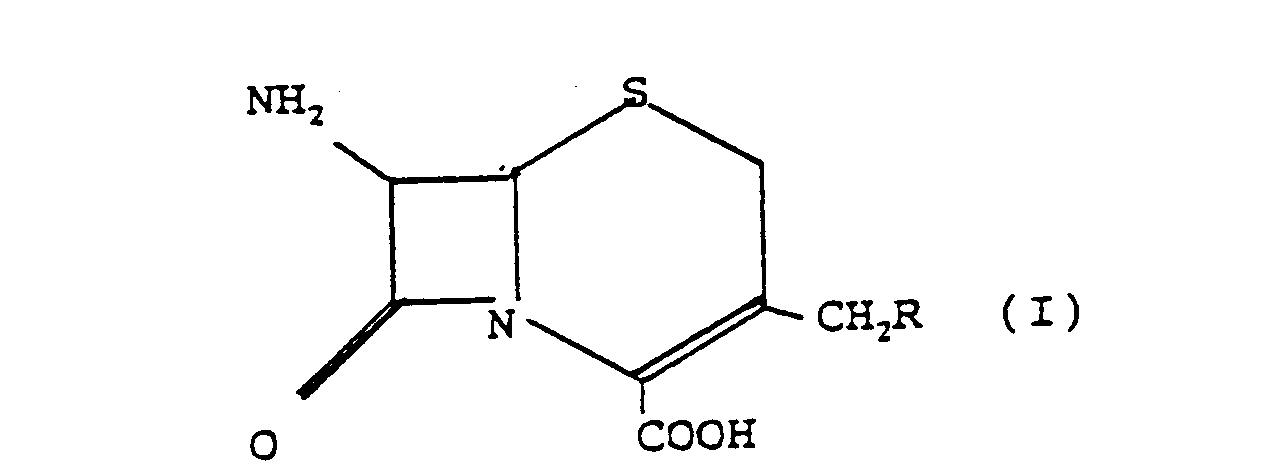
wherein R represents H, OH, O-CO-R", R" being an alkyl radical with a number of carbon atoms ranging from 1 to 4, which includes submitting compounds with the following formula to selective de- acylation
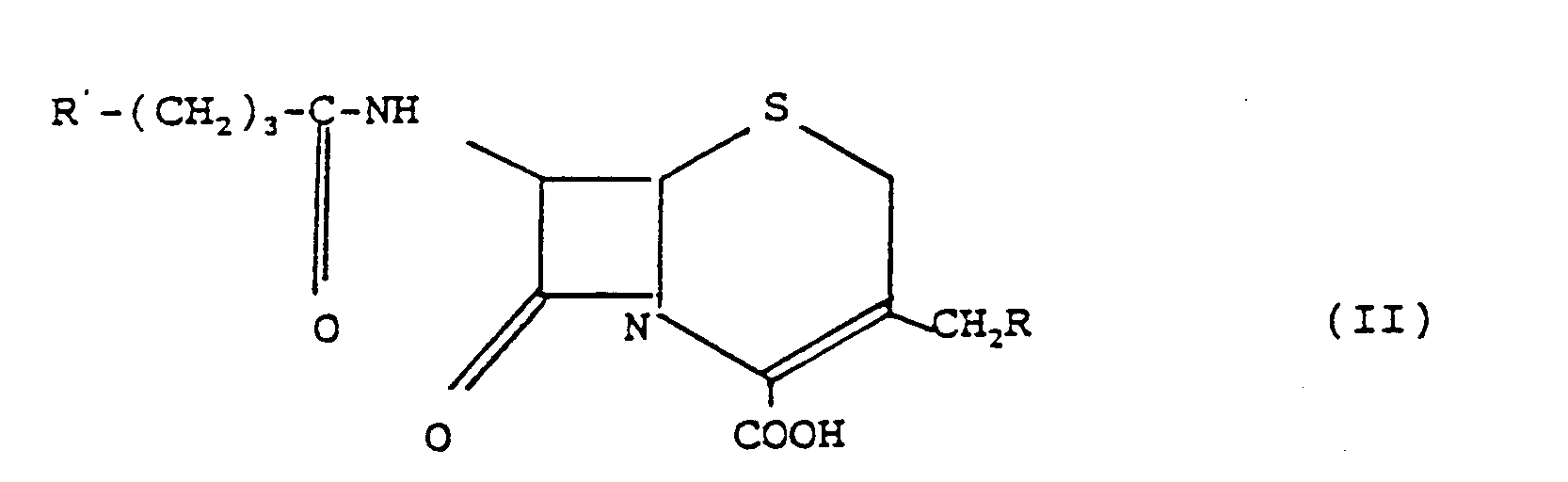
R' representing a radical containing the -COOH group in the presence of a micro-organism selected from the Pseudomonas, Bacillus, Achromobacter genera or the enzyme, in free form or immobilized, derived from these products.
wherein R represents H, OH, O-CO-R", R" being an alkyl radical with a number of carbon atoms ranging from 1 to 4, which includes submitting compounds with the following formula to selective de- acylation
R' representing a radical containing the -COOH group in the presence of a micro-organism selected from the Pseudomonas, Bacillus, Achromobacter genera or the enzyme, in free form or immobilized, derived from these products.
2. Process for the enzymatic preparation of 7-aminocephalosporanic acids according
to Claim 1, wherein the reaction is carried out in the presence of a micro-organism
preferably selected from the following:
Achromobacter xylosoxidans 13/D7, NCIMB 40407,
Pseudomonas paucimobilis 4S/E7, NCIMB 40408,
Pseudomonas sp. 13/F7, NCIMB 40409,
Bacillus sp. 13/F8, NCIMB 40410,
Bacillus cereus 146/1, NCIMB 40411
deposited at NCIMB, Aberdeen, on 24.04.1991,
Pseudomonas sp. 13/D7b, NCIMB 40473
Pseudomonas sp. 146/H9, NCIMB 40474
deposited at NCIMB, Aberdeen, on 27.01.1992, or in the presence of a mutant obtained from these or from the expression of their genetic material.
3. Process for the enzymatic preparation of 7-aminocephalosporanic acids according
to Claim 2, wherein the de-acylation reaction is carried out in a buffer solution
at a pH of 6 to 9, preferably from 7 to 8.5.
4. Process for the enzymatic preparation of 7-aminocephalosporanic acids according
to Claim 2, wherein the de-acylation reaction is carried out at a temperature ranging
from 5 to 50 ° C, preferably from 20 to 40 C.
5. Process for the enzymatic preparation of 7-aminocephalosporanic acids according
to Claim 2, wherein the de-acylation reaction is carried out at a concentration of
the substrate having formula (II) of up to 2%, preferably from 0.1 to 1 %.
6. Micro-organisms called Achromobacter (as per Claim) deposited on 24.04.91 at the
NCIMB of Aberdeen, or their biologically pure cultures.